About the Report
Base Year 2024Bahrain Recombinant Protein Manufacturing Services Market Overview
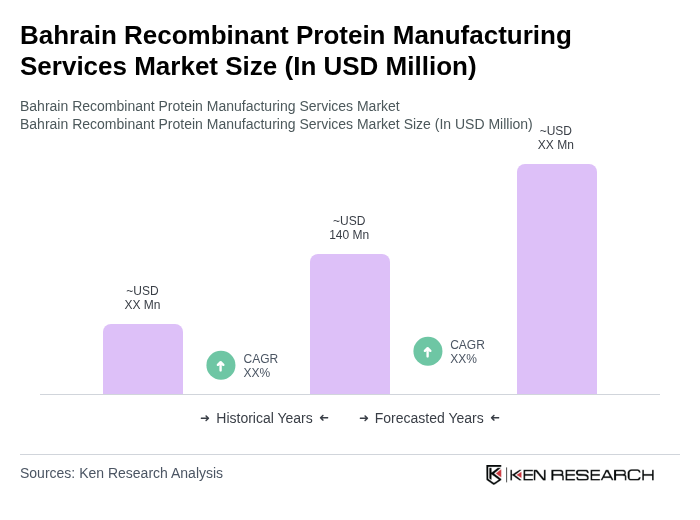
- The Bahrain Recombinant Protein Manufacturing Services Market is valued at USD 140 million, based on a five-year historical analysis and benchmarking against the regional recombinant protein and broader proteins market in Bahrain and the Middle East. This growth is primarily driven by the increasing demand for biopharmaceuticals, rising investments in biologics R&D, and the growing burden of chronic and lifestyle-related diseases that require innovative therapeutic and diagnostic solutions.
- Key players in this market include Manama, which serves as the capital and a central hub for biotechnology, healthcare services, and life sciences-related activities, and the Northern Governorate, known for its industrial parks, logistics zones, and proximity to research and healthcare institutions. These regions are pivotal due to their strategic investments in healthcare infrastructure, initiatives to attract pharmaceutical and biotech companies, and supportive government policies aimed at fostering life sciences and biomanufacturing.
- In 2023, Bahrain's government strengthened its pharmaceutical and biopharmaceutical regulatory framework to enhance the quality and safety of products, aligning with international standards. The National Health Regulatory Authority (NHRA) enforces Good Manufacturing Practices requirements under instruments such as the Bahrain Pharmacy Law and NHRA regulations for the licensing and regulation of pharmaceutical manufacturers, which mandate GMP-compliant facilities, routine inspections, and quality system documentation for biologics and sterile products.
Bahrain Recombinant Protein Manufacturing Services Market Segmentation
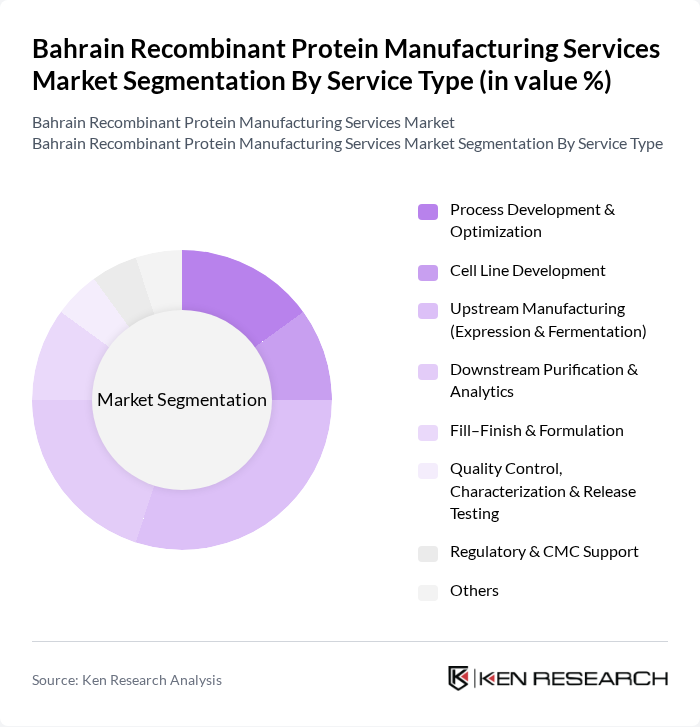
By Service Type:The service type segmentation includes various critical processes essential for recombinant protein manufacturing. The subsegments are Process Development & Optimization, Cell Line Development, Upstream Manufacturing (Expression & Fermentation), Downstream Purification & Analytics, Fill–Finish & Formulation, Quality Control, Characterization & Release Testing, Regulatory & CMC Support, and Others. Among these, Upstream Manufacturing is currently dominating the market due to the increasing focus on efficient protein expression systems and fermentation processes that are crucial for large-scale production.
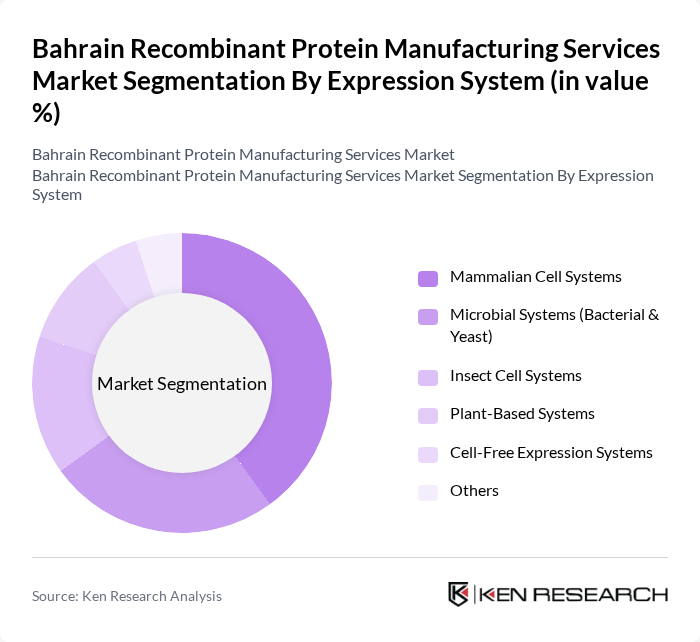
By Expression System:The expression system segmentation encompasses various platforms used for producing recombinant proteins. This includes Mammalian Cell Systems, Microbial Systems (Bacterial & Yeast), Insect Cell Systems, Plant-Based Systems, Cell-Free Expression Systems, and Others. The Mammalian Cell Systems segment is leading the market due to their ability to produce complex proteins with post-translational modifications that are essential for therapeutic efficacy.
Bahrain Recombinant Protein Manufacturing Services Market Competitive Landscape
The Bahrain Recombinant Protein Manufacturing Services Market is characterized by a dynamic mix of regional and international players. Leading participants such as Thermo Fisher Scientific, Merck KGaA (MilliporeSigma), Cytiva (Danaher Corporation), Lonza Group, Fujifilm Diosynth Biotechnologies, Samsung Biologics, Boehringer Ingelheim BioXcellence, WuXi Biologics, AGC Biologics, Catalent, Baxter International, Local & Regional Bahrain-Based Biomanufacturing Players, Niche Custom Recombinant Protein Service Providers, Academic & Government-Linked Production Facilities, Emerging GCC CDMOs with Presence in Bahrain contribute to innovation, geographic expansion, and service delivery in this space.
Bahrain Recombinant Protein Manufacturing Services Market Industry Analysis
Growth Drivers
- Increasing Demand for Biopharmaceuticals:The global biopharmaceutical market is projected to reach $600 billion in future, driven by the rising prevalence of chronic diseases. In Bahrain, the healthcare sector is expected to grow at a rate of 8% annually, reflecting a strong demand for innovative therapies. This surge in biopharmaceuticals is pushing local manufacturers to enhance their recombinant protein production capabilities, aligning with global trends and local healthcare needs.
- Government Support and Investment:The Bahraini government has allocated approximately $1.5 billion for healthcare infrastructure improvements in future. This investment aims to bolster the biopharmaceutical sector, including recombinant protein manufacturing. Initiatives such as tax incentives and grants for research and development are encouraging local firms to innovate and expand their production facilities, fostering a conducive environment for growth in this industry.
- Rising Healthcare Expenditure:Bahrain's healthcare expenditure is projected to reach $4 billion in future, reflecting a commitment to improving health services. This increase is driven by a growing population and higher demand for advanced medical treatments. As healthcare spending rises, the need for effective biopharmaceuticals, including recombinant proteins, will escalate, providing a significant growth opportunity for local manufacturers to meet this demand.
Market Challenges
- High Production Costs:The cost of producing recombinant proteins can exceed $1,200 per gram, primarily due to expensive raw materials and complex manufacturing processes. In Bahrain, where operational costs are rising, this poses a significant challenge for local manufacturers. The high production costs can limit competitiveness against larger global firms that benefit from economies of scale, impacting market growth.
- Regulatory Compliance Issues:The regulatory landscape for biopharmaceuticals in Bahrain is evolving, with stringent requirements for quality and safety. Compliance with these regulations can be costly and time-consuming, often requiring investments in specialized personnel and technology. As the market matures, companies face challenges in navigating these regulations, which can hinder their ability to bring products to market efficiently.
Bahrain Recombinant Protein Manufacturing Services Market Future Outlook
The future of the recombinant protein manufacturing sector in Bahrain appears promising, driven by increasing investments in healthcare and biopharmaceuticals. As the government continues to support innovation and infrastructure development, local manufacturers are likely to enhance their production capabilities. Additionally, the integration of advanced technologies, such as AI and automation, will streamline operations, improve efficiency, and ensure compliance with evolving regulatory standards, positioning Bahrain as a competitive player in the regional market.
Market Opportunities
- Expansion of Research and Development:With the government’s investment in R&D expected to reach $400 million in future, there is a significant opportunity for local firms to innovate in recombinant protein production. This funding can facilitate collaborations with academic institutions, enhancing the development of novel therapies and improving the overall quality of biopharmaceuticals produced in Bahrain.
- Collaborations with Global Firms:Bahrain's strategic location and favorable business environment present opportunities for partnerships with international biopharmaceutical companies. By leveraging these collaborations, local manufacturers can access advanced technologies and expertise, enhancing their production capabilities and expanding their market reach, ultimately driving growth in the recombinant protein sector.
Scope of the Report
| Segment | Sub-Segments |
|---|---|
| By Service Type | Process Development & Optimization Cell Line Development Upstream Manufacturing (Expression & Fermentation) Downstream Purification & Analytics Fill–Finish & Formulation Quality Control, Characterization & Release Testing Regulatory & CMC Support Others |
| By Expression System | Mammalian Cell Systems Microbial Systems (Bacterial & Yeast) Insect Cell Systems Plant-Based Systems Cell-Free Expression Systems Others |
| By Protein Type | Cytokines & Growth Factors Monoclonal & Recombinant Antibodies Recombinant Hormones Enzymes Vaccines & Viral Proteins Fusion Proteins & Chimeric Proteins Others |
| By Application | Therapeutics & Biopharmaceutical Production Drug Discovery & Development Diagnostics & In Vitro Diagnostics Basic & Applied Research Others |
| By Client Type | Pharmaceutical & Biotechnology Companies Academic & Research Institutions Contract Research Organizations (CROs) Government & Public Research Bodies Others |
| By Production Scale | Discovery & Preclinical Scale Clinical Scale (Phase I–III) Commercial Scale Pilot & Demonstration Scale |
| By Bahrain Region | Capital Governorate Northern Governorate Southern Governorate Muharraq Governorate |
Key Target Audience
Investors and Venture Capitalist Firms
Government and Regulatory Bodies (e.g., Bahrain National Health Regulatory Authority)
Biotechnology and Pharmaceutical Companies
Contract Manufacturing Organizations (CMOs)
Healthcare Providers and Hospitals
Biopharmaceutical Research Institutions
Supply Chain and Logistics Providers
Quality Control and Assurance Agencies
Players Mentioned in the Report:
Thermo Fisher Scientific
Merck KGaA (MilliporeSigma)
Cytiva (Danaher Corporation)
Lonza Group
Fujifilm Diosynth Biotechnologies
Samsung Biologics
Boehringer Ingelheim BioXcellence
WuXi Biologics
AGC Biologics
Catalent
Baxter International
Local & Regional Bahrain-Based Biomanufacturing Players
Niche Custom Recombinant Protein Service Providers
Academic & Government-Linked Production Facilities
Emerging GCC CDMOs with Presence in Bahrain
Table of Contents
Market Assessment Phase
1. Executive Summary and Approach
2. Bahrain Recombinant Protein Manufacturing Services Market Overview
2.1 Key Insights and Strategic Recommendations
2.2 Bahrain Recombinant Protein Manufacturing Services Market Overview
2.3 Definition and Scope
2.4 Evolution of Market Ecosystem
2.5 Timeline of Key Regulatory Milestones
2.6 Value Chain & Stakeholder Mapping
2.7 Business Cycle Analysis
2.8 Policy & Incentive Landscape
3. Bahrain Recombinant Protein Manufacturing Services Market Analysis
3.1 Growth Drivers
3.1.1 Increasing Demand for Biopharmaceuticals
3.1.3 Government Support and Investment
3.1.4 Rising Healthcare Expenditure
3.2 Market Challenges
3.2.1 High Production Costs
3.2.2 Regulatory Compliance Issues
3.2.3 Limited Skilled Workforce
3.2.4 Market Competition
3.3 Market Opportunities
3.3.1 Expansion of Research and Development
3.3.2 Collaborations with Global Firms
3.3.3 Growth in Personalized Medicine
3.3.4 Emerging Markets in the Region
3.4 Market Trends
3.4.1 Shift Towards Sustainable Manufacturing
3.4.2 Integration of AI in Production Processes
3.4.3 Increasing Focus on Quality Control
3.4.4 Rise of Contract Manufacturing Organizations (CMOs)
3.5 Government Regulation
3.5.1 Regulatory Framework for Biologics
3.5.2 Import and Export Regulations
3.5.3 Quality Assurance Standards
3.5.4 Intellectual Property Protection
4. SWOT Analysis
5. Stakeholder Analysis
6. Porter's Five Forces Analysis
7. Bahrain Recombinant Protein Manufacturing Services Market Market Size, 2019-2024
7.1 By Value
7.2 By Volume
7.3 By Average Selling Price
8. Bahrain Recombinant Protein Manufacturing Services Market Segmentation
8.1 By Service Type
8.1.1 Process Development & Optimization
8.1.2 Cell Line Development
8.1.3 Upstream Manufacturing (Expression & Fermentation)
8.1.4 Downstream Purification & Analytics
8.1.5 Fill–Finish & Formulation
8.1.6 Quality Control, Characterization & Release Testing
8.1.7 Regulatory & CMC Support
8.1.8 Others
8.2 By Expression System
8.2.1 Mammalian Cell Systems
8.2.2 Microbial Systems (Bacterial & Yeast)
8.2.3 Insect Cell Systems
8.2.4 Plant-Based Systems
8.2.5 Cell-Free Expression Systems
8.2.6 Others
8.3 By Protein Type
8.3.1 Cytokines & Growth Factors
8.3.2 Monoclonal & Recombinant Antibodies
8.3.3 Recombinant Hormones
8.3.4 Enzymes
8.3.5 Vaccines & Viral Proteins
8.3.6 Fusion Proteins & Chimeric Proteins
8.3.7 Others
8.4 By Application
8.4.1 Therapeutics & Biopharmaceutical Production
8.4.2 Drug Discovery & Development
8.4.3 Diagnostics & In Vitro Diagnostics
8.4.4 Basic & Applied Research
8.4.5 Others
8.5 By Client Type
8.5.1 Pharmaceutical & Biotechnology Companies
8.5.2 Academic & Research Institutions
8.5.3 Contract Research Organizations (CROs)
8.5.4 Government & Public Research Bodies
8.5.5 Others
8.6 By Production Scale
8.6.1 Discovery & Preclinical Scale
8.6.2 Clinical Scale (Phase I–III)
8.6.3 Commercial Scale
8.6.4 Pilot & Demonstration Scale
8.7 By Bahrain Region
8.7.1 Capital Governorate
8.7.2 Northern Governorate
8.7.3 Southern Governorate
8.7.4 Muharraq Governorate
9. Bahrain Recombinant Protein Manufacturing Services Market Competitive Analysis
9.1 Market Share of Key Players
9.2 Cross Comparison of Key Players
9.2.1 Company Name
9.2.2 Group Size (Global, Regional, or Local Player)
9.2.3 Bahrain Recombinant Protein Services Revenue (USD Mn)
9.2.4 3-Year CAGR in Services Revenue
9.2.5 EBITDA Margin from Bahrain Operations
9.2.6 Capacity Utilization Rate (%)
9.2.7 Average Project Ticket Size (USD)
9.2.8 Number of Active Bahrain Clients
9.2.9 Share of Repeat / Contract-Extended Clients (%)
9.2.10 On-Time Delivery Rate (%)
9.2.11 Number of Ongoing Clinical & Preclinical Projects
9.2.12 GMP Compliance Status & Audit Pass Rate
9.2.13 R&D Intensity (% of Revenue Spent on R&D)
9.2.14 CAPEX Investment in Bahrain (Last 3–5 Years)
9.2.15 Average Price per mg / batch (select benchmark proteins)
9.3 SWOT Analysis of Top Players
9.4 Pricing Analysis
9.5 Detailed Profile of Major Companies
9.5.1 Thermo Fisher Scientific
9.5.2 Merck KGaA (MilliporeSigma)
9.5.3 Cytiva (Danaher Corporation)
9.5.4 Lonza Group
9.5.5 Fujifilm Diosynth Biotechnologies
9.5.6 Samsung Biologics
9.5.7 Boehringer Ingelheim BioXcellence
9.5.8 WuXi Biologics
9.5.9 AGC Biologics
9.5.10 Catalent
9.5.11 Baxter International
9.5.12 Local & Regional Bahrain-Based Biomanufacturing Players
9.5.13 Niche Custom Recombinant Protein Service Providers
9.5.14 Academic & Government-Linked Production Facilities
9.5.15 Emerging GCC CDMOs with Presence in Bahrain
10. Bahrain Recombinant Protein Manufacturing Services Market End-User Analysis
10.1 Procurement Behavior of Key Ministries
10.1.1 Ministry of Health
10.1.2 Ministry of Industry and Commerce
10.1.3 Ministry of Education
10.1.4 Others
10.2 Corporate Spend on Infrastructure & Energy
10.2.1 Investment Trends
10.2.2 Budget Allocations
10.2.3 Funding Sources
10.2.4 Others
10.3 Pain Point Analysis by End-User Category
10.3.1 Pharmaceutical Companies
10.3.2 Research Institutions
10.3.3 Healthcare Providers
10.3.4 Others
10.4 User Readiness for Adoption
10.4.1 Awareness Levels
10.4.2 Training Needs
10.4.3 Infrastructure Readiness
10.4.4 Others
10.5 Post-Deployment ROI and Use Case Expansion
10.5.1 ROI Measurement Techniques
10.5.2 Use Case Scenarios
10.5.3 Feedback Mechanisms
10.5.4 Others
11. Bahrain Recombinant Protein Manufacturing Services Market Future Size, 2025-2030
11.1 By Value
11.2 By Volume
11.3 By Average Selling Price
Go-To-Market Strategy Phase
1. Whitespace Analysis + Business Model Canvas
1.1 Market Gaps Identification
1.2 Business Model Components
1.3 Value Proposition Development
1.4 Revenue Streams
1.5 Cost Structure Analysis
1.6 Key Partnerships
1.7 Customer Segments
2. Marketing and Positioning Recommendations
2.1 Branding Strategies
2.2 Product USPs
2.3 Target Market Identification
2.4 Communication Strategies
2.5 Digital Marketing Approaches
3. Distribution Plan
3.1 Urban Retail Strategies
3.2 Rural NGO Tie-ups
3.3 Online Distribution Channels
3.4 Direct Sales Approaches
4. Channel & Pricing Gaps
4.1 Underserved Routes
4.2 Pricing Bands Analysis
4.3 Competitor Pricing Strategies
4.4 Customer Price Sensitivity
5. Unmet Demand & Latent Needs
5.1 Category Gaps
5.2 Consumer Segments Analysis
5.3 Emerging Trends
5.4 Future Demand Projections
6. Customer Relationship
6.1 Loyalty Programs
6.2 After-sales Service
6.3 Customer Feedback Mechanisms
6.4 Relationship Management Strategies
7. Value Proposition
7.1 Sustainability Initiatives
7.2 Integrated Supply Chains
7.3 Competitive Advantages
7.4 Customer-Centric Approaches
8. Key Activities
8.1 Regulatory Compliance
8.2 Branding Initiatives
8.3 Distribution Setup
8.4 Training and Development
9. Entry Strategy Evaluation
9.1 Domestic Market Entry Strategy
9.1.1 Product Mix
9.1.2 Pricing Band
9.1.3 Packaging Strategies
9.2 Export Entry Strategy
9.2.1 Target Countries
9.2.2 Compliance Roadmap
10. Entry Mode Assessment
10.1 Joint Ventures
10.2 Greenfield Investments
10.3 Mergers & Acquisitions
10.4 Distributor Model
11. Capital and Timeline Estimation
11.1 Capital Requirements
11.2 Timelines for Implementation
12. Control vs Risk Trade-Off
12.1 Ownership vs Partnerships
12.2 Risk Management Strategies
13. Profitability Outlook
13.1 Breakeven Analysis
13.2 Long-term Sustainability
14. Potential Partner List
14.1 Distributors
14.2 Joint Ventures
14.3 Acquisition Targets
15. Execution Roadmap
15.1 Phased Plan for Market Entry
15.1.1 Market Setup
15.1.2 Market Entry
15.1.3 Growth Acceleration
15.1.4 Scale & Stabilize
15.2 Key Activities and Milestones
15.2.1 Milestone Planning
15.2.2 Activity Scheduling
Research Methodology
Phase 1: Approach1
Desk Research
- Analysis of industry reports from biotechnology associations and local health authorities
- Review of scientific publications and patents related to recombinant protein technologies
- Examination of market trends and forecasts from reputable market research firms
Primary Research
- Interviews with key opinion leaders in the biotechnology and pharmaceutical sectors
- Surveys targeting R&D managers and production heads in recombinant protein manufacturing
- Focus groups with industry experts to discuss market challenges and opportunities
Validation & Triangulation
- Cross-validation of findings through multiple data sources including trade publications and expert interviews
- Triangulation of quantitative data with qualitative insights from industry stakeholders
- Sanity checks through peer reviews and expert panel discussions
Phase 2: Market Size Estimation1
Top-down Assessment
- Estimation of market size based on national healthcare expenditure and biotechnology investments
- Segmentation of the market by application areas such as therapeutics, diagnostics, and research
- Incorporation of government initiatives promoting biotechnology and healthcare innovation
Bottom-up Modeling
- Collection of production data from leading recombinant protein manufacturers in Bahrain
- Operational cost analysis based on pricing models and service offerings
- Volume estimates derived from historical sales data and projected growth rates
Forecasting & Scenario Analysis
- Multi-variable forecasting using factors such as healthcare demand, technological advancements, and regulatory changes
- Scenario planning based on potential market disruptions and economic conditions
- Development of baseline, optimistic, and pessimistic growth scenarios through 2030
Phase 3: CATI Sample Composition1
| Scope Item/Segment | Sample Size | Target Respondent Profiles |
|---|---|---|
| Pharmaceutical Applications | 100 | R&D Directors, Product Managers |
| Diagnostic Tools Development | 80 | Laboratory Managers, Clinical Researchers |
| Research Institutions | 70 | Academic Researchers, Biotechnology Professors |
| Regulatory Affairs | 60 | Compliance Officers, Regulatory Managers |
| Biotechnology Startups | 90 | Founders, Business Development Managers |
Frequently Asked Questions
What is the current value of the Bahrain Recombinant Protein Manufacturing Services Market?
The Bahrain Recombinant Protein Manufacturing Services Market is valued at approximately USD 140 million, reflecting a robust growth trajectory driven by increasing demand for biopharmaceuticals and rising investments in biologics research and development.
What factors are driving growth in the Bahrain Recombinant Protein Manufacturing Services Market?
Who are the key players in the Bahrain Recombinant Protein Manufacturing Services Market?
What are the main service types offered in the Bahrain Recombinant Protein Manufacturing Services Market?
Other Regional/Country Reports
Other Adjacent Reports
South Korea Biopharmaceutical Manufacturing Market
Malaysia Biologics Development Market
South Africa Protein Expression Systems Market
Kuwait cell line development market size, share, growth drivers, trends, opportunities & forecast 2025–2030Oman Upstream Bioprocessing Market Size Share Growth Drivers Trends Opportunities & Forecast 2025–2030Indonesia Downstream Purification Market
Ksa Contract Manufacturing Services Market Report Size, Share, Growth Drivers, Trends, Opportunities & Forecast 2025–2030Oman Bioprocess Equipment Market
South Korea Therapeutic Protein Market
Singapore Biosimilar Production Market
Why Buy From Us?

What makes us stand out is that our consultants follow Robust, Refine and Result (RRR) methodology. Robust for clear definitions, approaches and sanity checking, Refine for differentiating respondents' facts and opinions, and Result for presenting data with story.

We have set a benchmark in the industry by offering our clients with syndicated and customized market research reports featuring coverage of entire market as well as meticulous research and analyst insights.

While we don't replace traditional research, we flip the method upside down. Our dual approach of Top Bottom & Bottom Top ensures quality deliverable by not just verifying company fundamentals but also looking at the sector and macroeconomic factors.

With one step in the future, our research team constantly tries to show you the bigger picture. We help with some of the tough questions you may encounter along the way: How is the industry positioned? Best marketing channel? KPI's of competitors? By aligning every element, we help maximize success.

Our report gives you instant access to the answers and sources that other companies might choose to hide. We elaborate each steps of research methodology we have used and showcase you the sample size to earn your trust.

If you need any support, we are here! We pride ourselves on universe strength, data quality, and quick, friendly, and professional service.