About the Report
Base Year 2024Listen to the audio summary
New Zealand Recombinant Protein Manufacturing Services Market Overview
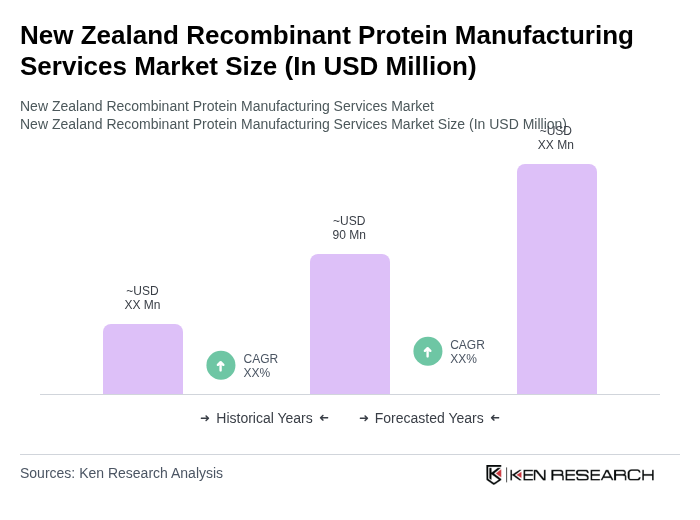
- The New Zealand Recombinant Protein Manufacturing Services Market is valued at USD 90 million, based on a five-year historical analysis of the country’s share in the global recombinant protein manufacturing and custom production services space. This growth is primarily driven by the increasing demand for biopharmaceuticals, advancements in biotechnology, and the rising prevalence of chronic and immune-mediated diseases that require biologics and other innovative protein-based therapeutic solutions.
- Auckland and Wellington are the dominant cities in this market, primarily due to their robust healthcare and life sciences infrastructure, presence of leading universities and research institutes such as the University of Auckland and Victoria University of Wellington, and a growing cluster of biotechnology and contract development and manufacturing organizations that foster innovation and collaboration in recombinant protein development.
- The regulatory framework for manufacturing and distribution of therapeutic products, including recombinant proteins, is primarily governed by the Medicines Act 1981 and the Medicines Regulations 1984 administered by Medsafe, which set requirements for product approval, Good Manufacturing Practice (GMP) licensing of manufacturers, quality, safety, and efficacy of medicines in New Zealand. In addition, the Therapeutic Products Act 2023, issued by the New Zealand Parliament, establishes a modernized framework for regulating medicines, biological products, and related manufacturing activities, including licensing, quality management systems, and post?market monitoring for therapeutic products.
New Zealand Recombinant Protein Manufacturing Services Market Segmentation
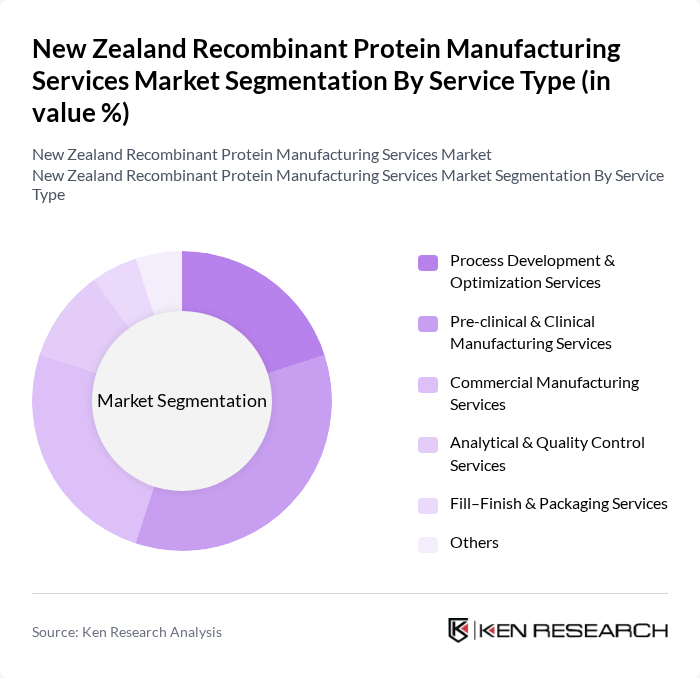
By Service Type:The service type segmentation includes various categories that cater to different stages of recombinant protein development and manufacturing. The key subsegments are Process Development & Optimization Services, Pre-clinical & Clinical Manufacturing Services, Commercial Manufacturing Services, Analytical & Quality Control Services, Fill–Finish & Packaging Services, and Others. This structure is aligned with global recombinant protein manufacturing and custom production services value chains, where end-to-end CDMOs typically offer upstream process development, clinical and commercial manufacturing, analytical characterization, and fill–finish as integrated or modular services. Among these, the Pre-clinical & Clinical Manufacturing Services subsegment is currently leading the market due to the increasing number of biologics and biosimilar candidates entering clinical trials, the growing focus on personalized and targeted therapies, and the reliance of small and mid-sized biotechs on outsourced development and GMP manufacturing capacity. The demand for these services is driven by the need for efficient, scalable, and regulatory-compliant production processes that can meet international GMP standards and ensure consistent product quality suitable for global clinical programs.
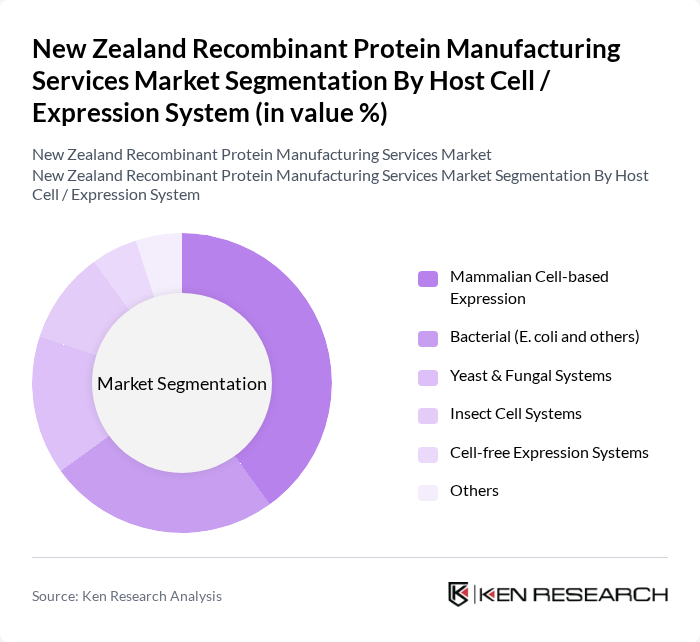
By Host Cell / Expression System:This segmentation focuses on the various host cells and expression systems used in recombinant protein production. The subsegments include Mammalian Cell-based Expression, Bacterial (E. coli and others), Yeast & Fungal Systems, Insect Cell Systems, Cell-free Expression Systems, and Others. This taxonomy is consistent with global recombinant protein and biologics manufacturing practice, where mammalian, bacterial, yeast, insect, and emerging cell-free systems represent the principal platforms. The Mammalian Cell-based Expression subsegment is currently the most prominent due to its ability to produce complex glycoproteins and monoclonal antibodies with human-like post-translational modifications that are essential for therapeutic efficacy, safety, and pharmacokinetics. The increasing preference for biologics and biosimilars over traditional small-molecule drugs, along with the expansion of antibody, fusion protein, and recombinant hormone pipelines, is further propelling the growth of this subsegment and sustaining investment in mammalian cell culture capacity.
New Zealand Recombinant Protein Manufacturing Services Market Competitive Landscape
The New Zealand Recombinant Protein Manufacturing Services Market is characterized by a dynamic mix of regional and international players. Leading participants such as Thermo Fisher Scientific Inc., Merck KGaA, Lonza Group Ltd., WuXi AppTec Co., Ltd., Sartorius AG, Takeda Pharmaceutical Company Limited, F. Hoffmann-La Roche Ltd, Novartis AG, Pfizer Inc., Amgen Inc., Biogen Inc., GenScript Biotech Corporation, Bio-Rad Laboratories, Inc., Abcam plc, and selected New Zealand-based CDMOs and Biotech Manufacturers contribute to innovation, geographic expansion, technology transfer, and service delivery in this space, often providing New Zealand clients access to global-scale recombinant protein expression, purification, and analytical capabilities through regional hubs in Asia-Pacific and beyond.
New Zealand Recombinant Protein Manufacturing Services Market Industry Analysis
Growth Drivers
- Increasing Demand for Biopharmaceuticals:The global biopharmaceutical market is projected to reach USD 0.7 trillion in future, driven by the rising prevalence of chronic diseases. In New Zealand, the biopharmaceutical sector is expected to grow significantly, with an estimated increase in demand for recombinant proteins, which are crucial for therapeutic applications. This growth is supported by the country's robust healthcare system, which allocated approximately NZD 26 billion for health services in the most recent national budget, enhancing access to innovative treatments.
- Advancements in Genetic Engineering Technologies:The New Zealand recombinant protein manufacturing sector is benefiting from rapid advancements in genetic engineering technologies, such as CRISPR and synthetic biology. These innovations are expected to enhance the efficiency of protein production, reducing time and costs. In future, the New Zealand government is investing about NZD 450 million in research, science and innovation funding streams that include biotechnology-related research, fostering an environment conducive to technological breakthroughs that can significantly improve production capabilities in the recombinant protein market.
- Rising Investments in Biotechnology Research:New Zealand's biotechnology sector is witnessing increased investments, with public research funding for health and biological sciences forming a significant share of the overall research, science and innovation budget. This funding is aimed at fostering innovation in recombinant protein manufacturing, enabling companies to develop new therapies and improve existing ones. The growing interest from venture capitalists and private equity firms in the biotech space is further propelling advancements, creating a favorable landscape for recombinant protein services in the region.
Market Challenges
- High Production Costs:The production of recombinant proteins involves significant costs, primarily due to the complex processes and technologies required. In New Zealand, the average cost of producing a recombinant protein can exceed NZD 1 million per batch, which poses a challenge for smaller companies. This high cost can limit market entry and competitiveness, particularly for startups and emerging firms looking to innovate in the recombinant protein space.
- Regulatory Hurdles and Compliance Issues:The recombinant protein manufacturing sector in New Zealand faces stringent regulatory requirements, including compliance with the Medicines Act and Good Manufacturing Practices (GMP). Navigating these regulations can be time-consuming and costly, with approval processes taking up to 18 months. This complexity can deter new entrants and slow down the introduction of innovative products, impacting the overall growth of the market.
New Zealand Recombinant Protein Manufacturing Services Market Future Outlook
The future of the New Zealand recombinant protein manufacturing market appears promising, driven by technological advancements and increasing demand for biopharmaceuticals. As the industry embraces sustainable practices and innovations in protein purification, companies are likely to enhance their production efficiency. Furthermore, the growing focus on personalized medicine is expected to create new avenues for growth, allowing firms to tailor therapies to individual patient needs, thereby expanding their market reach and improving health outcomes.
Market Opportunities
- Expansion into Emerging Markets:New Zealand's recombinant protein manufacturers have the opportunity to expand into emerging markets in Asia-Pacific, where the demand for biopharmaceuticals is rapidly increasing. With a projected market growth of about 10% annually in these regions, companies can leverage their expertise to capture new customer bases and enhance revenue streams.
- Development of Personalized Medicine:The shift towards personalized medicine presents a significant opportunity for the recombinant protein sector. By focusing on tailored therapies, companies can address specific patient needs, potentially increasing treatment efficacy. The global personalized medicine market is estimated at over USD 0.5 trillion in value, providing a lucrative avenue for growth in New Zealand's biotechnology landscape.
Scope of the Report
| Segment | Sub-Segments |
|---|---|
| By Service Type | Process Development & Optimization Services Pre-clinical & Clinical Manufacturing Services Commercial Manufacturing Services Analytical & Quality Control Services Fill–Finish & Packaging Services Others |
| By Host Cell / Expression System | Mammalian Cell-based Expression Bacterial (E. coli and others) Yeast & Fungal Systems Insect Cell Systems Cell-free Expression Systems Others |
| By Protein Type | Antibodies and Antibody Fragments Cytokines & Growth Factors Enzymes Hormones Fusion Proteins & Recombinant Vaccines Others |
| By Application | Therapeutics & Biopharmaceutical Production Drug Discovery & Development Diagnostics Academic & Translational Research Others |
| By End-User | Pharmaceutical & Biotechnology Companies Contract Research Organizations (CROs) Academic & Research Institutes Diagnostic Companies Others |
| By Scale of Operation | Pre-clinical / Pilot Scale Clinical Scale Commercial / Large Scale Others |
| By Ownership Model | Captive / In-house Manufacturing Outsourced / Contract Manufacturing Hybrid Models Others |
Key Target Audience
Investors and Venture Capitalist Firms
Government and Regulatory Bodies (e.g., Ministry of Health, Environmental Protection Authority)
Biotechnology Companies
Pharmaceutical Manufacturers
Contract Research Organizations (CROs)
Biomanufacturing Facilities
Healthcare Providers and Institutions
Industry Associations (e.g., BioTechNZ)
Players Mentioned in the Report:
Thermo Fisher Scientific Inc.
Merck KGaA
Lonza Group Ltd.
WuXi AppTec Co., Ltd.
Sartorius AG
Takeda Pharmaceutical Company Limited
F. Hoffmann-La Roche Ltd
Novartis AG
Pfizer Inc.
Amgen Inc.
Biogen Inc.
GenScript Biotech Corporation
Bio-Rad Laboratories, Inc.
Abcam plc
Selected New Zealand-based CDMOs and Biotech Manufacturers
Table of Contents
Market Assessment Phase
1. Executive Summary and Approach
2. New Zealand Recombinant Protein Manufacturing Services Market Overview
2.1 Key Insights and Strategic Recommendations
2.2 New Zealand Recombinant Protein Manufacturing Services Market Overview
2.3 Definition and Scope
2.4 Evolution of Market Ecosystem
2.5 Timeline of Key Regulatory Milestones
2.6 Value Chain & Stakeholder Mapping
2.7 Business Cycle Analysis
2.8 Policy & Incentive Landscape
3. New Zealand Recombinant Protein Manufacturing Services Market Analysis
3.1 Growth Drivers
3.1.1 Increasing demand for biopharmaceuticals
3.1.2 Advancements in genetic engineering technologies
3.1.3 Rising investments in biotechnology research
3.1.4 Supportive government policies and funding
3.2 Market Challenges
3.2.1 High production costs
3.2.2 Regulatory hurdles and compliance issues
3.2.3 Limited skilled workforce
3.2.4 Competition from alternative protein sources
3.3 Market Opportunities
3.3.1 Expansion into emerging markets
3.3.2 Development of personalized medicine
3.3.3 Collaborations with academic institutions
3.3.4 Innovations in protein purification technologies
3.4 Market Trends
3.4.1 Shift towards sustainable manufacturing practices
3.4.2 Increasing focus on biosimilars
3.4.3 Growth of contract manufacturing organizations (CMOs)
3.4.4 Integration of artificial intelligence in production
3.5 Government Regulation
3.5.1 Compliance with the Medicines Act
3.5.2 Adherence to the Hazardous Substances and New Organisms Act
3.5.3 Regulations on clinical trials and approvals
3.5.4 Guidelines for Good Manufacturing Practices (GMP)
4. SWOT Analysis
5. Stakeholder Analysis
6. Porter's Five Forces Analysis
7. New Zealand Recombinant Protein Manufacturing Services Market Size, 2019-2024
7.1 By Value
7.2 By Volume
7.3 By Average Selling Price
8. New Zealand Recombinant Protein Manufacturing Services Market Segmentation
8.1 By Service Type
8.1.1 Process Development & Optimization Services
8.1.2 Pre-clinical & Clinical Manufacturing Services
8.1.3 Commercial Manufacturing Services
8.1.4 Analytical & Quality Control Services
8.1.5 Fill–Finish & Packaging Services
8.1.6 Others
8.2 By Host Cell / Expression System
8.2.1 Mammalian Cell-based Expression
8.2.2 Bacterial (E. coli and others)
8.2.3 Yeast & Fungal Systems
8.2.4 Insect Cell Systems
8.2.5 Cell-free Expression Systems
8.2.6 Others
8.3 By Protein Type
8.3.1 Antibodies and Antibody Fragments
8.3.2 Cytokines & Growth Factors
8.3.3 Enzymes
8.3.4 Hormones
8.3.5 Fusion Proteins & Recombinant Vaccines
8.3.6 Others
8.4 By Application
8.4.1 Therapeutics & Biopharmaceutical Production
8.4.2 Drug Discovery & Development
8.4.3 Diagnostics
8.4.4 Academic & Translational Research
8.4.5 Others
8.5 By End-User
8.5.1 Pharmaceutical & Biotechnology Companies
8.5.2 Contract Research Organizations (CROs)
8.5.3 Academic & Research Institutes
8.5.4 Diagnostic Companies
8.5.5 Others
8.6 By Scale of Operation
8.6.1 Pre-clinical / Pilot Scale
8.6.2 Clinical Scale
8.6.3 Commercial / Large Scale
8.6.4 Others
8.7 By Ownership Model
8.7.1 Captive / In-house Manufacturing
8.7.2 Outsourced / Contract Manufacturing
8.7.3 Hybrid Models
8.7.4 Others
9. New Zealand Recombinant Protein Manufacturing Services Market Competitive Analysis
9.1 Market Share of Key Players
9.2 Cross Comparison of Key Players
9.2.1 Company Name
9.2.2 Company Size (Global Revenue Band)
9.2.3 New Zealand Recombinant Protein Manufacturing Revenue
9.2.4 3-year CAGR in Segment Revenue
9.2.5 EBITDA Margin (Segment-level)
9.2.6 Capacity Utilization Rate
9.2.7 Average Batch Success Rate
9.2.8 On-time Delivery Rate
9.2.9 R&D Spend as % of Revenue
9.2.10 Capex Intensity (Capex as % of Revenue)
9.2.11 Customer Concentration (Top 3 Customers’ % of Revenue)
9.2.12 Share of Revenue from New Zealand Clients
9.3 SWOT Analysis of Top Players
9.4 Pricing Analysis
9.5 Detailed Profile of Major Companies
9.5.1 Thermo Fisher Scientific Inc.
9.5.2 Merck KGaA
9.5.3 Lonza Group Ltd.
9.5.4 WuXi AppTec Co., Ltd.
9.5.5 Sartorius AG
9.5.6 Takeda Pharmaceutical Company Limited
9.5.7 F. Hoffmann-La Roche Ltd
9.5.8 Novartis AG
9.5.9 Pfizer Inc.
9.5.10 Amgen Inc.
9.5.11 Biogen Inc.
9.5.12 GenScript Biotech Corporation
9.5.13 Bio-Rad Laboratories, Inc.
9.5.14 Abcam plc
9.5.15 Selected New Zealand-based CDMOs and Biotech Manufacturers
10. New Zealand Recombinant Protein Manufacturing Services Market End-User Analysis
10.1 Procurement Behavior of Key Ministries
10.1.1 Ministry of Health
10.1.2 Ministry of Business, Innovation and Employment
10.1.3 Ministry of Research, Science and Innovation
10.1.4 Others
10.2 Corporate Spend on Infrastructure & Energy
10.2.1 Pharmaceutical Infrastructure Investments
10.2.2 Biotechnology Facility Upgrades
10.2.3 Energy Efficiency Initiatives
10.2.4 Others
10.3 Pain Point Analysis by End-User Category
10.3.1 Pharmaceutical Companies
10.3.2 Biotechnology Firms
10.3.3 Research Institutions
10.3.4 Others
10.4 User Readiness for Adoption
10.4.1 Awareness of Recombinant Proteins
10.4.2 Training and Skill Development
10.4.3 Infrastructure Readiness
10.4.4 Others
10.5 Post-Deployment ROI and Use Case Expansion
10.5.1 Measurement of ROI
10.5.2 Case Studies of Successful Implementations
10.5.3 Future Use Case Opportunities
10.5.4 Others
11. New Zealand Recombinant Protein Manufacturing Services Market Future Size, 2025-2030
11.1 By Value
11.2 By Volume
11.3 By Average Selling Price
Go-To-Market Strategy Phase
1. Whitespace Analysis + Business Model Canvas
1.1 Market Gaps Identification
1.2 Business Model Development
2. Marketing and Positioning Recommendations
2.1 Branding Strategies
2.2 Product USPs
3. Distribution Plan
3.1 Urban Retail Strategies
3.2 Rural NGO Tie-ups
4. Channel & Pricing Gaps
4.1 Underserved Routes
4.2 Pricing Bands
5. Unmet Demand & Latent Needs
5.1 Category Gaps
5.2 Consumer Segments
6. Customer Relationship
6.1 Loyalty Programs
6.2 After-sales Service
7. Value Proposition
7.1 Sustainability Initiatives
7.2 Integrated Supply Chains
8. Key Activities
8.1 Regulatory Compliance
8.2 Branding
8.3 Distribution Setup
9. Entry Strategy Evaluation
9.1 Domestic Market Entry Strategy
9.1.1 Product Mix
9.1.2 Pricing Band
9.1.3 Packaging
9.2 Export Entry Strategy
9.2.1 Target Countries
9.2.2 Compliance Roadmap
10. Entry Mode Assessment
10.1 Joint Ventures
10.2 Greenfield Investments
10.3 Mergers & Acquisitions
10.4 Distributor Model
11. Capital and Timeline Estimation
11.1 Capital Requirements
11.2 Timelines
12. Control vs Risk Trade-Off
12.1 Ownership vs Partnerships
13. Profitability Outlook
13.1 Breakeven Analysis
13.2 Long-term Sustainability
14. Potential Partner List
14.1 Distributors
14.2 Joint Ventures
14.3 Acquisition Targets
15. Execution Roadmap
15.1 Phased Plan for Market Entry
15.1.1 Market Setup
15.1.2 Market Entry
15.1.3 Growth Acceleration
15.1.4 Scale & Stabilize
15.2 Key Activities and Milestones
15.2.1 Milestone Planning
15.2.2 Activity Tracking
Research Methodology
Phase 1: Approach1
Desk Research
- Analysis of industry reports from New Zealand's Ministry of Business, Innovation and Employment
- Review of scientific publications and patents related to recombinant protein technologies
- Examination of market trends and forecasts from biotechnology associations and journals
Primary Research
- Interviews with executives from leading recombinant protein manufacturing firms in New Zealand
- Surveys targeting researchers and scientists in academic institutions focused on protein engineering
- Field interviews with regulatory experts to understand compliance and market entry barriers
Validation & Triangulation
- Cross-validation of findings through multiple data sources including trade publications and market surveys
- Triangulation of qualitative insights from interviews with quantitative data from market reports
- Sanity checks conducted through expert panel discussions with industry veterans
Phase 2: Market Size Estimation1
Top-down Assessment
- Estimation of market size based on national biotechnology sector growth rates
- Segmentation of the market by application areas such as therapeutics, diagnostics, and research
- Incorporation of government funding and support initiatives for biotechnology innovation
Bottom-up Modeling
- Collection of production volume data from key recombinant protein manufacturers
- Operational cost analysis based on pricing models and service offerings
- Estimation of market size through volume x average pricing for various protein products
Forecasting & Scenario Analysis
- Multi-factor regression analysis incorporating factors like healthcare expenditure and R&D investment
- Scenario modeling based on potential regulatory changes and technological advancements
- Development of baseline, optimistic, and pessimistic market projections through 2030
Phase 3: CATI Sample Composition1
| Scope Item/Segment | Sample Size | Target Respondent Profiles |
|---|---|---|
| Therapeutic Protein Development | 60 | Biotech Executives, R&D Managers |
| Diagnostic Reagent Manufacturing | 50 | Laboratory Directors, Quality Assurance Managers |
| Research and Development in Academia | 40 | University Professors, Research Scientists |
| Regulatory Compliance in Biomanufacturing | 40 | Regulatory Affairs Specialists, Compliance Officers |
| Market Trends and Innovations | 40 | Industry Analysts, Market Researchers |
Frequently Asked Questions
What is the current value of the New Zealand Recombinant Protein Manufacturing Services Market?
The New Zealand Recombinant Protein Manufacturing Services Market is valued at approximately USD 90 million, reflecting the country's significant role in the global recombinant protein manufacturing and custom production services sector.
What factors are driving the growth of the recombinant protein manufacturing market in New Zealand?
Which cities in New Zealand are leading in recombinant protein manufacturing?
What regulatory framework governs recombinant protein manufacturing in New Zealand?
Other Regional/Country Reports
Other Adjacent Reports
Qatar Biopharmaceutical Manufacturing Market
Qatar Contract Development and Manufacturing Market
Oman Protein Expression Systems Market
Brazil Cell Culture Technology Market
Vietnam Genetic Engineering Market
South Africa Biosimilars Development Market
Thailand Monoclonal Antibody Production Market
US personalized medicine market Size, Share, Growth Drivers, Trends, Opportunities & Forecast 2025–2030Singapore Analytical Testing Services Market
Egypt Biotechnology Research Market
Why Buy From Us?

What makes us stand out is that our consultants follow Robust, Refine and Result (RRR) methodology. Robust for clear definitions, approaches and sanity checking, Refine for differentiating respondents' facts and opinions, and Result for presenting data with story.

We have set a benchmark in the industry by offering our clients with syndicated and customized market research reports featuring coverage of entire market as well as meticulous research and analyst insights.

While we don't replace traditional research, we flip the method upside down. Our dual approach of Top Bottom & Bottom Top ensures quality deliverable by not just verifying company fundamentals but also looking at the sector and macroeconomic factors.

With one step in the future, our research team constantly tries to show you the bigger picture. We help with some of the tough questions you may encounter along the way: How is the industry positioned? Best marketing channel? KPI's of competitors? By aligning every element, we help maximize success.

Our report gives you instant access to the answers and sources that other companies might choose to hide. We elaborate each steps of research methodology we have used and showcase you the sample size to earn your trust.

If you need any support, we are here! We pride ourselves on universe strength, data quality, and quick, friendly, and professional service.