About the Report
Base Year 2024Philippines Recombinant Protein Manufacturing Services Market Overview
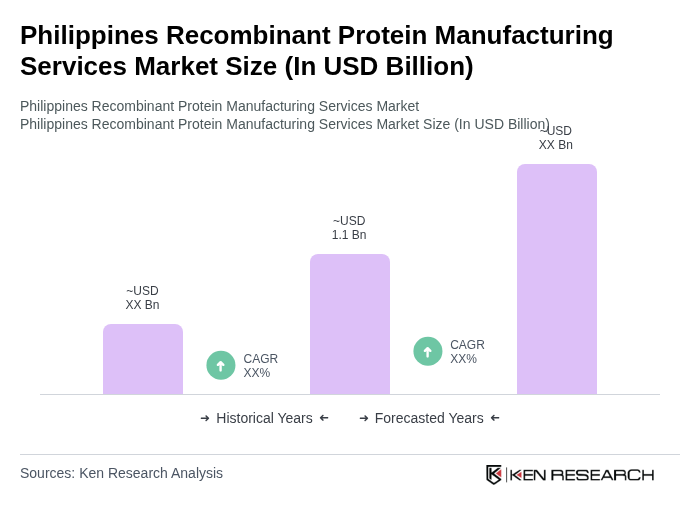
- The Philippines Recombinant Protein Manufacturing Services Market is valued at USD 1.1 billion, based on a five-year historical analysis that aligns with the broader healthcare contract development and manufacturing and recombinant technology activity in the country. This growth is primarily driven by the increasing demand for biopharmaceuticals, advancements in biotechnology, growing investments in life sciences research, and the rising prevalence of chronic and infectious diseases that require innovative therapeutic and vaccine solutions.
- Key cities such as Manila, Cebu, and Davao dominate the market due to their relatively robust healthcare infrastructure, concentration of tertiary hospitals, presence of leading universities and research institutions, and a growing number of life sciences and biotechnology-oriented firms and start-ups supported by government R&D programs. These urban centers are pivotal in fostering innovation, hosting clinical research, and attracting both public and private investments in the broader recombinant protein and biomanufacturing sector.
- The Philippine Innovation Act (Republic Act No. 11293), enacted by the Government of the Philippines and implemented by the National Innovation Council, establishes a national innovation policy framework that includes funding mechanisms such as the National Innovation Fund and National Innovation Credit Facility to support research, development, and commercialization activities, including biotechnology and life sciences. This regulation is designed to strengthen local innovation and manufacturing capabilities, encourage collaboration between government, academe, and industry, and indirectly promote the development and application of recombinant proteins in healthcare, agriculture, and industrial biotechnology.
Philippines Recombinant Protein Manufacturing Services Market Segmentation
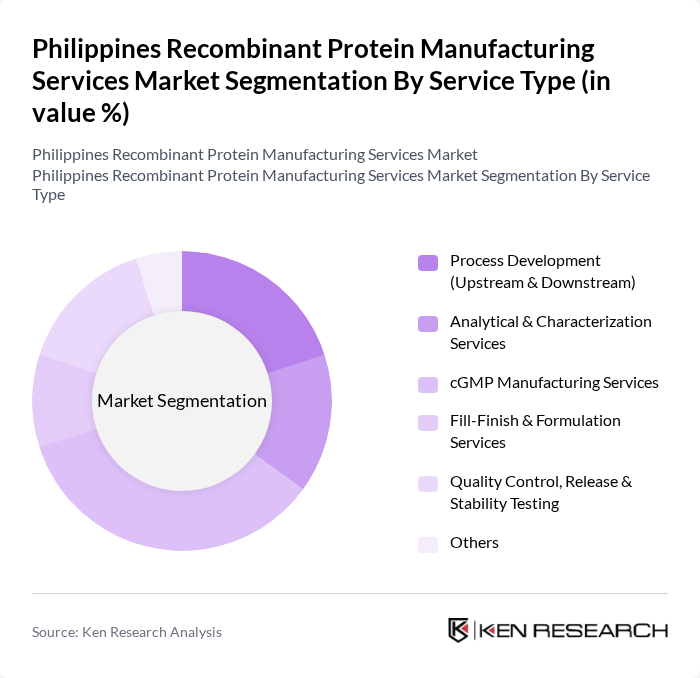
By Service Type:The service type segmentation includes various offerings that cater to the needs of the recombinant protein manufacturing sector. The subsegments include Process Development (Upstream & Downstream), Analytical & Characterization Services, cGMP Manufacturing Services, Fill-Finish & Formulation Services, Quality Control, Release & Stability Testing, and Others. cGMP Manufacturing Services is the leading subsegment, reflecting the growing tendency of biopharmaceutical and biotech companies to outsource large-scale compliant manufacturing to specialized CDMOs, stringent quality and validation requirements for biologics, and the increasing pipeline of recombinant therapeutics and vaccines requiring reliable commercial and clinical supply.
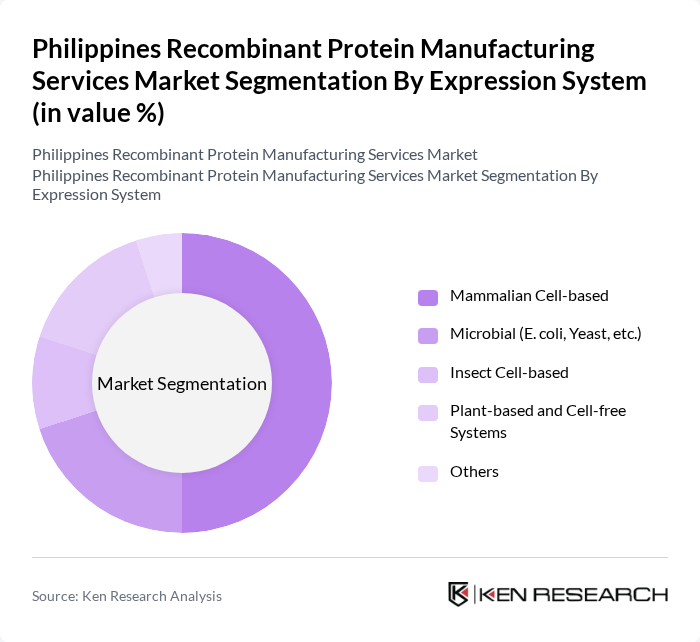
By Expression System:The expression system segmentation encompasses various platforms used for producing recombinant proteins. This includes Mammalian Cell-based, Microbial (E. coli, Yeast, etc.), Insect Cell-based, Plant-based and Cell-free Systems, and Others. The Mammalian Cell-based expression system is currently the dominant subsegment globally and in Asia Pacific CDMO activity, favored for its ability to produce complex glycoproteins and monoclonal antibodies with human-like post-translational modifications that are essential for therapeutic efficacy, safety, and regulatory acceptance.
Philippines Recombinant Protein Manufacturing Services Market Competitive Landscape
The Philippines Recombinant Protein Manufacturing Services Market is characterized by a dynamic mix of regional and international players. Leading participants such as Lonza Group AG, Boehringer Ingelheim, Samsung Biologics, WuXi Biologics, FUJIFILM Diosynth Biotechnologies, Catalent, Inc., Thermo Fisher Scientific (Patheon), Merck KGaA (MilliporeSigma), Eurofins Scientific, Syngene International Limited, Charles River Laboratories, AGC Biologics, AbbVie Contract Manufacturing, Roche CustomBiotech, and selected Philippines-based CDMOs/Biomanufacturers contribute to innovation, geographic expansion, and service delivery in this space, leveraging their global recombinant protein and biologics manufacturing platforms to support clinical and commercial programs in Asia Pacific, including the Philippines.
Philippines Recombinant Protein Manufacturing Services Market Industry Analysis
Growth Drivers
- Increasing Demand for Biopharmaceuticals:The Philippines is witnessing a significant rise in the demand for biopharmaceuticals, driven by a growing population and increasing healthcare awareness. In future, the biopharmaceutical market is projected to reach approximately $1.7 billion, reflecting a robust growth trajectory. This surge is attributed to the rising prevalence of diseases such as diabetes and cancer, which necessitate advanced therapeutic solutions. The increasing acceptance of biologics over traditional pharmaceuticals further fuels this demand, creating a favorable environment for recombinant protein manufacturing.
- Advancements in Biotechnology:The biotechnology sector in the Philippines is experiencing rapid advancements, with investments in research and development reaching around $250 million in future. These advancements are enhancing the capabilities of recombinant protein manufacturing, enabling the production of more complex and effective therapeutic proteins. The establishment of biotechnology hubs and partnerships with academic institutions is fostering innovation, leading to improved production techniques and higher yields. This technological progress is crucial for meeting the growing demand for high-quality biopharmaceuticals.
- Government Support and Funding:The Philippine government is actively supporting the biotechnology sector through various initiatives, including funding programs and tax incentives. In future, government funding for biotechnology research is expected to exceed $60 million, aimed at enhancing local capabilities in recombinant protein production. This support is crucial for attracting foreign investments and fostering collaborations with international firms, ultimately strengthening the local manufacturing landscape. Such initiatives are pivotal in positioning the Philippines as a competitive player in the global biopharmaceutical market.
Market Challenges
- High Production Costs:One of the significant challenges facing the recombinant protein manufacturing sector in the Philippines is the high production costs associated with advanced biotechnological processes. In future, the average cost of producing recombinant proteins is estimated to be around $550 per gram, which is substantially higher than traditional protein sources. These elevated costs can hinder competitiveness and limit market entry for new players, posing a barrier to growth in the industry.
- Regulatory Hurdles:The regulatory landscape for recombinant protein manufacturing in the Philippines presents considerable challenges. Compliance with stringent FDA regulations requires substantial investment in quality assurance and control processes. In future, the average time for obtaining necessary approvals is projected to be around 20 months, which can delay product launches and increase operational costs. Navigating these regulatory hurdles is essential for companies aiming to establish a foothold in the biopharmaceutical market.
Philippines Recombinant Protein Manufacturing Services Market Future Outlook
The future of the recombinant protein manufacturing services market in the Philippines appears promising, driven by ongoing advancements in biotechnology and increasing government support. As the demand for biopharmaceuticals continues to rise, companies are likely to invest in innovative production techniques and sustainable practices. Additionally, the growing focus on personalized medicine will create new opportunities for tailored therapeutic solutions. Collaborations with international firms will further enhance local capabilities, positioning the Philippines as a key player in the global biopharmaceutical landscape.
Market Opportunities
- Expansion of Research and Development Activities:The Philippine government’s commitment to boosting R&D in biotechnology presents a significant opportunity for recombinant protein manufacturers. With an expected increase in R&D funding to $250 million in future, companies can leverage this support to innovate and enhance production processes, ultimately leading to the development of novel therapeutics that meet market needs.
- Growth in Personalized Medicine:The rising trend of personalized medicine offers substantial opportunities for recombinant protein manufacturers. As healthcare shifts towards tailored treatments, the demand for specific therapeutic proteins is expected to grow. This shift is projected to create a market worth approximately $350 million in future, encouraging manufacturers to invest in specialized production capabilities to meet this emerging demand.
Scope of the Report
| Segment | Sub-Segments |
|---|---|
| By Service Type | Process Development (Upstream & Downstream) Analytical & Characterization Services cGMP Manufacturing Services Fill-Finish & Formulation Services Quality Control, Release & Stability Testing Others |
| By Expression System | Mammalian Cell-based Microbial (E. coli, Yeast, etc.) Insect Cell-based Plant-based and Cell-free Systems Others |
| By Application | Therapeutics and Biologics Production Diagnostics and Assay Development Research Reagents and Tool Proteins Preclinical & Clinical Trial Supply Others |
| By Customer Type | Pharmaceutical Companies Biotechnology Firms & Start-ups Academic & Research Institutions Contract Research Organizations (CROs) Others |
| By Scale of Operation | Discovery & Preclinical Scale Clinical Scale (Phase I–III) Commercial Scale Pilot / Medium Scale |
| By Mode of Service Delivery | Project-based / Custom Manufacturing (CDMO) Long-term Strategic Partnerships Dedicated / Captive Capacity Leasing Others |
| By Compliance Level | cGMP-certified Facilities Non-GMP / Research-grade Facilities Dual-grade (GMP and Non-GMP) Others |
Key Target Audience
Investors and Venture Capitalist Firms
Government and Regulatory Bodies (e.g., Department of Health, Food and Drug Administration)
Biotechnology and Pharmaceutical Companies
Contract Manufacturing Organizations (CMOs)
Healthcare Providers and Hospitals
Biomanufacturing Equipment Suppliers
Industry Associations (e.g., Philippine Biotechnology Organization)
Pharmaceutical Distributors
Players Mentioned in the Report:
Lonza Group AG
Boehringer Ingelheim
Samsung Biologics
WuXi Biologics
FUJIFILM Diosynth Biotechnologies
Catalent, Inc.
Thermo Fisher Scientific (Patheon)
Merck KGaA (MilliporeSigma)
Eurofins Scientific
Syngene International Limited
Charles River Laboratories
AGC Biologics
AbbVie Contract Manufacturing
Roche CustomBiotech
Selected Philippines-based CDMOs / Biomanufacturers
Table of Contents
Market Assessment Phase
1. Executive Summary and Approach
2. Philippines Recombinant Protein Manufacturing Services Market Overview
2.1 Key Insights and Strategic Recommendations
2.2 Philippines Recombinant Protein Manufacturing Services Market Overview
2.3 Definition and Scope
2.4 Evolution of Market Ecosystem
2.5 Timeline of Key Regulatory Milestones
2.6 Value Chain & Stakeholder Mapping
2.7 Business Cycle Analysis
2.8 Policy & Incentive Landscape
3. Philippines Recombinant Protein Manufacturing Services Market Analysis
3.1 Growth Drivers
3.1.1 Increasing demand for biopharmaceuticals
3.1.2 Advancements in biotechnology
3.1.3 Government support and funding
3.1.4 Rising prevalence of chronic diseases
3.2 Market Challenges
3.2.1 High production costs
3.2.2 Regulatory hurdles
3.2.3 Limited skilled workforce
3.2.4 Competition from traditional protein sources
3.3 Market Opportunities
3.3.1 Expansion of research and development activities
3.3.2 Collaborations with international firms
3.3.3 Growth in personalized medicine
3.3.4 Increasing investments in healthcare infrastructure
3.4 Market Trends
3.4.1 Shift towards sustainable manufacturing practices
3.4.2 Integration of AI in protein production
3.4.3 Rise of contract manufacturing organizations (CMOs)
3.4.4 Focus on biosimilars and biobetters
3.5 Government Regulation
3.5.1 Compliance with FDA regulations
3.5.2 Intellectual property protection laws
3.5.3 Import/export regulations for biological materials
3.5.4 Environmental regulations on waste management
4. SWOT Analysis
5. Stakeholder Analysis
6. Porter's Five Forces Analysis
7. Philippines Recombinant Protein Manufacturing Services Market Market Size, 2019-2024
7.1 By Value
7.2 By Volume
7.3 By Average Selling Price
8. Philippines Recombinant Protein Manufacturing Services Market Segmentation
8.1 By Service Type
8.1.1 Process Development (Upstream & Downstream)
8.1.2 Analytical & Characterization Services
8.1.3 cGMP Manufacturing Services
8.1.4 Fill-Finish & Formulation Services
8.1.5 Quality Control, Release & Stability Testing
8.1.6 Others
8.2 By Expression System
8.2.1 Mammalian Cell-based
8.2.2 Microbial (E. coli, Yeast, etc.)
8.2.3 Insect Cell-based
8.2.4 Plant-based and Cell-free Systems
8.2.5 Others
8.3 By Application
8.3.1 Therapeutics and Biologics Production
8.3.2 Diagnostics and Assay Development
8.3.3 Research Reagents and Tool Proteins
8.3.4 Preclinical & Clinical Trial Supply
8.3.5 Others
8.4 By Customer Type
8.4.1 Pharmaceutical Companies
8.4.2 Biotechnology Firms & Start-ups
8.4.3 Academic & Research Institutions
8.4.4 Contract Research Organizations (CROs)
8.4.5 Others
8.5 By Scale of Operation
8.5.1 Discovery & Preclinical Scale
8.5.2 Clinical Scale (Phase I–III)
8.5.3 Commercial Scale
8.5.4 Pilot / Medium Scale
8.6 By Mode of Service Delivery
8.6.1 Project-based / Custom Manufacturing (CDMO)
8.6.2 Long-term Strategic Partnerships
8.6.3 Dedicated / Captive Capacity Leasing
8.6.4 Others
8.7 By Compliance Level
8.7.1 cGMP-certified Facilities
8.7.2 Non-GMP / Research-grade Facilities
8.7.3 Dual-grade (GMP and Non-GMP)
8.7.4 Others
9. Philippines Recombinant Protein Manufacturing Services Market Competitive Analysis
9.1 Market Share of Key Players
9.2 Cross Comparison of Key Players
9.2.1 Company Name
9.2.2 Ownership / Group Type (Local, Regional, Global)
9.2.3 Revenue (Philippines) and 3-year CAGR
9.2.4 EBITDA Margin
9.2.5 Capacity Utilization Rate
9.2.6 Number of GMP-certified Production Lines
9.2.7 On-time Delivery Rate (OTD)
9.2.8 Average Project Lead Time (weeks)
9.2.9 R&D Spend as % of Revenue
9.2.10 Share of Revenue from International Clients
9.2.11 Regulatory Inspection Track Record (e.g., FDA/EMA/PMDA audits)
9.3 SWOT Analysis of Top Players
9.4 Pricing Analysis
9.5 Detailed Profile of Major Companies
9.5.1 Lonza Group AG
9.5.2 Boehringer Ingelheim
9.5.3 Samsung Biologics
9.5.4 WuXi Biologics
9.5.5 FUJIFILM Diosynth Biotechnologies
9.5.6 Catalent, Inc.
9.5.7 Thermo Fisher Scientific (Patheon)
9.5.8 Merck KGaA (MilliporeSigma)
9.5.9 Eurofins Scientific
9.5.10 Syngene International Limited
9.5.11 Charles River Laboratories
9.5.12 AGC Biologics
9.5.13 AbbVie Contract Manufacturing
9.5.14 Roche CustomBiotech
9.5.15 Selected Philippines-based CDMOs / Biomanufacturers
10. Philippines Recombinant Protein Manufacturing Services Market End-User Analysis
10.1 Procurement Behavior of Key Ministries
10.1.1 Budget Allocation Trends
10.1.2 Decision-Making Processes
10.1.3 Supplier Selection Criteria
10.1.4 Contract Management Practices
10.2 Corporate Spend on Infrastructure & Energy
10.2.1 Investment Trends in Biotech
10.2.2 Infrastructure Development Needs
10.2.3 Energy Consumption Patterns
10.2.4 Budgeting for Sustainability Initiatives
10.3 Pain Point Analysis by End-User Category
10.3.1 Cost Management Challenges
10.3.2 Quality Assurance Issues
10.3.3 Regulatory Compliance Difficulties
10.3.4 Supply Chain Disruptions
10.4 User Readiness for Adoption
10.4.1 Training and Development Needs
10.4.2 Technology Adoption Barriers
10.4.3 Awareness of Benefits
10.4.4 Support Infrastructure Availability
10.5 Post-Deployment ROI and Use Case Expansion
10.5.1 Measurement of Success Metrics
10.5.2 Case Studies of Successful Implementations
10.5.3 Feedback Mechanisms
10.5.4 Future Expansion Plans
11. Philippines Recombinant Protein Manufacturing Services Market Future Size, 2025-2030
11.1 By Value
11.2 By Volume
11.3 By Average Selling Price
Go-To-Market Strategy Phase
1. Whitespace Analysis + Business Model Canvas
1.1 Market Gaps Identification
1.2 Value Proposition Development
1.3 Revenue Streams Analysis
1.4 Cost Structure Evaluation
1.5 Key Partnerships Exploration
1.6 Customer Segmentation
1.7 Channels of Distribution
2. Marketing and Positioning Recommendations
2.1 Branding Strategies
2.2 Product USPs
2.3 Target Market Identification
2.4 Communication Strategies
2.5 Digital Marketing Approaches
2.6 Customer Engagement Tactics
2.7 Performance Metrics
3. Distribution Plan
3.1 Urban Retail Strategies
3.2 Rural NGO Tie-ups
3.3 E-commerce Opportunities
3.4 Direct Sales Approaches
3.5 Distribution Partnerships
3.6 Logistics and Supply Chain Management
3.7 Performance Evaluation
4. Channel & Pricing Gaps
4.1 Underserved Routes
4.2 Pricing Bands Analysis
4.3 Competitor Pricing Strategies
4.4 Customer Willingness to Pay
4.5 Value-Based Pricing Models
4.6 Discounting Strategies
4.7 Pricing Optimization Techniques
5. Unmet Demand & Latent Needs
5.1 Category Gaps Identification
5.2 Consumer Segments Analysis
5.3 Emerging Trends Exploration
5.4 Product Development Opportunities
5.5 Market Entry Strategies
5.6 Customer Feedback Integration
5.7 Future Demand Projections
6. Customer Relationship
6.1 Loyalty Programs
6.2 After-sales Service
6.3 Customer Support Systems
6.4 Feedback Mechanisms
6.5 Relationship Management Tools
6.6 Customer Retention Strategies
6.7 Performance Metrics
7. Value Proposition
7.1 Sustainability Initiatives
7.2 Integrated Supply Chains
7.3 Unique Selling Points
7.4 Customer-Centric Approaches
7.5 Competitive Advantages
7.6 Value Delivery Mechanisms
7.7 Performance Metrics
8. Key Activities
8.1 Regulatory Compliance
8.2 Branding Initiatives
8.3 Distribution Setup
8.4 Marketing Campaigns
8.5 Training and Development
8.6 Performance Monitoring
8.7 Continuous Improvement Processes
9. Entry Strategy Evaluation
9.1 Domestic Market Entry Strategy
9.1.1 Product Mix
9.1.2 Pricing Band
9.1.3 Packaging Considerations
9.2 Export Entry Strategy
9.2.1 Target Countries
9.2.2 Compliance Roadmap
10. Entry Mode Assessment
10.1 Joint Ventures
10.2 Greenfield Investments
10.3 Mergers & Acquisitions
10.4 Distributor Model
10.5 Risk Assessment
10.6 Strategic Fit Evaluation
10.7 Performance Metrics
11. Capital and Timeline Estimation
11.1 Capital Requirements
11.2 Timelines for Implementation
11.3 Financial Projections
11.4 Funding Sources
11.5 Risk Management Strategies
11.6 Performance Metrics
12. Control vs Risk Trade-Off
12.1 Ownership vs Partnerships
12.2 Risk Mitigation Strategies
12.3 Control Mechanisms
12.4 Performance Metrics
13. Profitability Outlook
13.1 Breakeven Analysis
13.2 Long-term Sustainability
13.3 Financial Health Indicators
13.4 Market Positioning
13.5 Performance Metrics
14. Potential Partner List
14.1 Distributors
14.2 Joint Ventures
14.3 Acquisition Targets
14.4 Strategic Alliances
14.5 Performance Metrics
15. Execution Roadmap
15.1 Phased Plan for Market Entry
15.1.1 Market Setup
15.1.2 Market Entry
15.1.3 Growth Acceleration
15.1.4 Scale & Stabilize
15.2 Key Activities and Milestones
15.2.1 Activity Planning
15.2.2 Milestone Tracking
15.2.3 Performance Evaluation
Research Methodology
Phase 1: Approach1
Desk Research
- Analysis of industry reports from biotechnology associations and government publications
- Review of academic journals and white papers on recombinant protein technologies
- Examination of market trends and forecasts from reputable market research firms
Primary Research
- Interviews with key opinion leaders in the biotechnology and pharmaceutical sectors
- Surveys targeting R&D managers and production heads in recombinant protein firms
- Field visits to manufacturing facilities to gather firsthand insights on operations
Validation & Triangulation
- Cross-validation of data through multiple sources including trade publications and expert interviews
- Triangulation of findings from primary and secondary research to ensure consistency
- Sanity checks through expert panel reviews to validate assumptions and projections
Phase 2: Market Size Estimation1
Top-down Assessment
- Estimation of market size based on national biotechnology spending and growth rates
- Segmentation by application areas such as therapeutics, diagnostics, and research
- Incorporation of government initiatives supporting biotechnology and recombinant protein development
Bottom-up Modeling
- Collection of production data from leading recombinant protein manufacturers in the Philippines
- Operational cost analysis based on service pricing and production capacity
- Volume x cost calculations to derive revenue estimates for different market segments
Forecasting & Scenario Analysis
- Multi-factor regression analysis incorporating factors like healthcare demand and technological advancements
- Scenario modeling based on regulatory changes and market entry of new players
- Development of baseline, optimistic, and pessimistic forecasts through 2030
Phase 3: CATI Sample Composition1
| Scope Item/Segment | Sample Size | Target Respondent Profiles |
|---|---|---|
| Pharmaceutical Applications | 120 | R&D Managers, Regulatory Affairs Specialists |
| Biotechnology Research Institutions | 90 | Research Scientists, Lab Managers |
| Healthcare Providers | 80 | Clinical Directors, Procurement Officers |
| Contract Manufacturing Organizations | 70 | Operations Managers, Quality Assurance Heads |
| Regulatory Bodies | 60 | Policy Makers, Compliance Officers |
Frequently Asked Questions
What is the current value of the Philippines Recombinant Protein Manufacturing Services Market?
The Philippines Recombinant Protein Manufacturing Services Market is valued at approximately USD 1.1 billion, reflecting significant growth driven by increasing demand for biopharmaceuticals and advancements in biotechnology.
What factors are driving the growth of the recombinant protein manufacturing market in the Philippines?
Which cities in the Philippines are leading in recombinant protein manufacturing?
What is the role of the Philippine Innovation Act in the biotechnology sector?
Other Regional/Country Reports
Other Adjacent Reports
South Africa Biopharmaceutical Market
Saudi Arabia biotechnology market Size, Share, Growth Drivers, Trends, Opportunities & Forecast 2025–2030UAE Contract Development and Manufacturing Market
KSA Vaccine Manufacturing Market
Egypt Monoclonal Antibody Market
Kuwait Gene Therapy Market Report Size Share Growth Drivers Trends Opportunities & Forecast 2025–2030Belgium Biosimilars Market
GCC Cell Culture Market Report Size Share Growth Drivers Trends Opportunities & Forecast 2025–2030UAE Pharmaceutical Research Market
Bahrain Life Sciences Equipment Market
Why Buy From Us?

What makes us stand out is that our consultants follow Robust, Refine and Result (RRR) methodology. Robust for clear definitions, approaches and sanity checking, Refine for differentiating respondents' facts and opinions, and Result for presenting data with story.

We have set a benchmark in the industry by offering our clients with syndicated and customized market research reports featuring coverage of entire market as well as meticulous research and analyst insights.

While we don't replace traditional research, we flip the method upside down. Our dual approach of Top Bottom & Bottom Top ensures quality deliverable by not just verifying company fundamentals but also looking at the sector and macroeconomic factors.

With one step in the future, our research team constantly tries to show you the bigger picture. We help with some of the tough questions you may encounter along the way: How is the industry positioned? Best marketing channel? KPI's of competitors? By aligning every element, we help maximize success.

Our report gives you instant access to the answers and sources that other companies might choose to hide. We elaborate each steps of research methodology we have used and showcase you the sample size to earn your trust.

If you need any support, we are here! We pride ourselves on universe strength, data quality, and quick, friendly, and professional service.