Bahrain Self Sanitizing Plastics Market Report Size Share Growth Drivers Trends Opportunities & Forecast 2025–2030

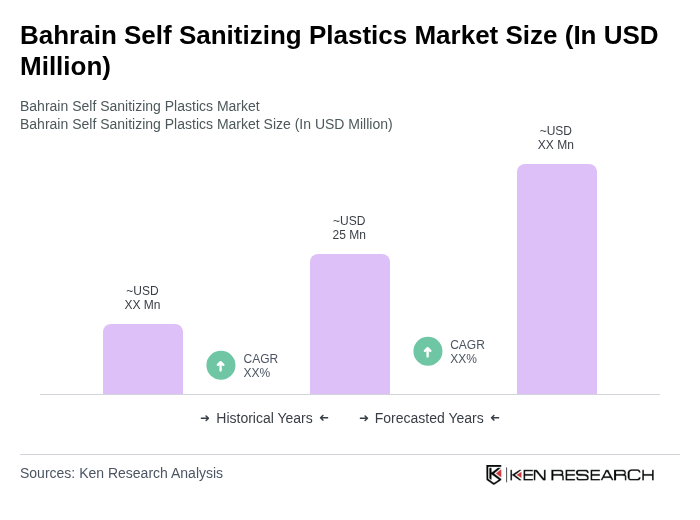
The Bahrain self sanitizing plastics market, valued at USD 25 million, is growing due to rising hygiene demands in healthcare and packaging, featuring antimicrobial products and silver-based additives.

Region:Middle East

Author(s):Dev

Product Code:KRAB1803

Pages:84

Published On:January 2026
About the Report

Base Year 2024

Bahrain Self Sanitizing Plastics Market Overview

  • The Bahrain Self Sanitizing Plastics Market is valued at USD 25 million, based on a five-year historical analysis and considering Bahrain’s share within the global self-sanitizing plastics market and the overall Bahrain plastics industry size. This growth is primarily driven by increasing health awareness, the rise in demand for hygiene-focused plastic applications, and the growing need for durable, high-performance materials in healthcare, packaging, and consumer goods. The market has seen a notable rise in the adoption of antimicrobial and self-sanitizing plastic solutions, particularly in medical devices, hospital infrastructure, and food and pharmaceutical packaging.
  • Key demand clusters for plastics and related converting activities in Bahrain are concentrated in the Capital Governorate, which is the most populous and economically vibrant region, and the Muharraq Governorate, known for its industrial and logistics activities. These areas play a central role in the uptake of advanced plastic materials due to their strategic locations, robust infrastructure, proximity to ports and airports, and concentration of manufacturing and processing facilities that increasingly incorporate value?added and functionalized plastics, including antimicrobial and hygienic grades.
  • In 2021, the Bahrain government strengthened infection?prevention and environmental health requirements in public and healthcare facilities through measures anchored in the Public Health Law (Law No. 34 of 2018) and implementing decisions of the Ministry of Health, which mandate strict hygiene, disinfection, and infection?control protocols for hospitals, clinics, and public premises. These binding rules require healthcare providers and operators of public facilities to use materials and surfaces that support effective cleaning, disinfection, and infection control, thereby encouraging the adoption of antimicrobial and self?sanitizing plastic components in high?touch areas, medical equipment, and hygienic packaging.
Bahrain Self Sanitizing Plastics Market Size

Bahrain Self Sanitizing Plastics Market Segmentation

By Product Type:The product type segmentation includes various categories of self-sanitizing plastics, each designed to combat specific pathogens. The subsegments are Antimicrobial Self-Sanitizing Plastics, Antiviral Self-Sanitizing Plastics, Antifungal Self-Sanitizing Plastics, and Multipurpose / Broad-Spectrum Self-Sanitizing Plastics. Antimicrobial Self-Sanitizing Plastics form the largest share of demand, supported by their broad-spectrum activity against bacteria and other microorganisms and their widespread application in healthcare surfaces, medical devices, food-contact packaging, and consumer goods. Growing use of hygienic and easy?to?clean plastic parts in hospitals, clinics, food processing, and retail environments underpins this dominance.
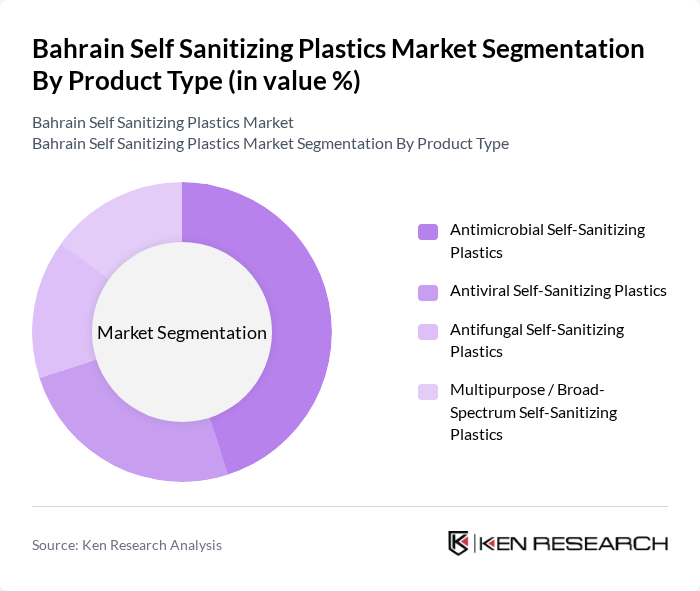
Bahrain Self Sanitizing Plastics Market segmentation by Product Type.

By Additive / Technology:This segmentation focuses on the various additives and technologies used in the production of self-sanitizing plastics. The subsegments include Silver-Based Additives, Copper-Based Additives, Zinc-Based Additives, Organic / Biocidal Additives, and Photocatalytic / Other Advanced Technologies. Silver-Based Additives are leading globally due to their well-documented efficacy, compatibility with multiple polymer systems, and long history of use in antimicrobial masterbatches and medical and food-contact applications, and similar preferences guide technology selection in GCC markets including Bahrain. Copper- and zinc-based systems, as well as organic biocides and photocatalytic coatings, are increasingly used in niche applications where specific performance, regulatory, or cost considerations apply.
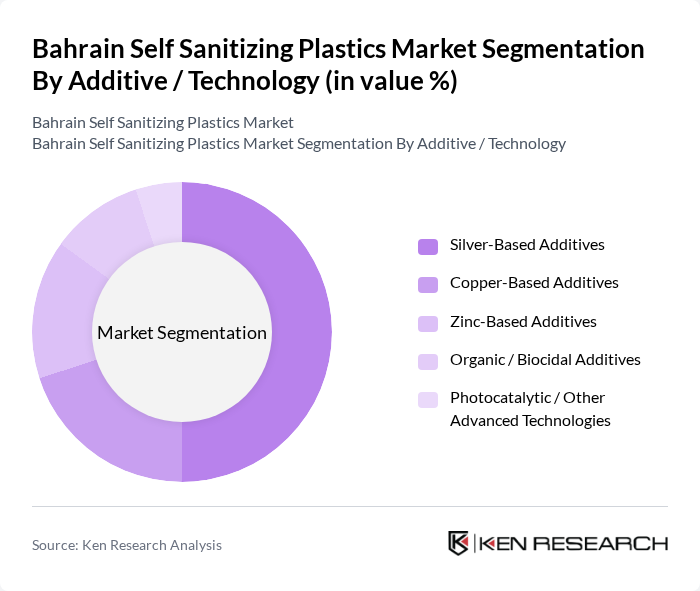
Bahrain Self Sanitizing Plastics Market segmentation by Additive / Technology.

Bahrain Self Sanitizing Plastics Market Competitive Landscape

The Bahrain Self Sanitizing Plastics Market is characterized by a dynamic mix of regional and international players, in line with the broader Bahrain plastics industry where local converters and GCC petrochemical majors coexist with global specialty additive and masterbatch suppliers. Leading participants such as BASF SE, DuPont de Nemours, Inc., Microban International, Ltd., Milliken & Company, Parx Materials N.V., BioCote Limited, Addmaster Ltd (An Polygiene Group Company), Polychem Alloy, Inc., King Plastic Corporation, Clariant AG, SABIC, Evonik Industries AG, Mitsubishi Chemical Corporation, RTP Company, Local & Regional GCC Converters / Compounders contribute to innovation in antimicrobial additives, hygienic polymer formulations, masterbatches, and compounded products, as well as geographic expansion and application development across healthcare, packaging, construction, and consumer goods.

BASF SE

1865

Ludwigshafen, Germany

DuPont de Nemours, Inc.

1802

Wilmington, Delaware, USA

Microban International, Ltd.

1984

Huntersville, North Carolina, USA

Milliken & Company

1865

Spartanburg, South Carolina, USA

Parx Materials N.V.

2012

Hasselt, Belgium

Company

Establishment Year

Headquarters

Bahrain Market Revenue (USD Million)

3-Year Revenue CAGR in Bahrain (%)

EBITDA Margin (%)

R&D Intensity (% of Revenue)

Share of Self-Sanitizing Plastics in Total Portfolio (%)

Installed Converting / Compounding Capacity in GCC (Tons/Year)

Bahrain Self Sanitizing Plastics Market Industry Analysis

Growth Drivers

  • Increasing Demand for Hygiene Products:The hygiene products market in Bahrain is projected to reach approximately $250 million, driven by heightened consumer awareness post-pandemic. This surge in demand is primarily attributed to the growing emphasis on cleanliness and sanitation in both residential and commercial sectors. The rise in disposable income, which is expected to increase by 4.5% annually, further supports the adoption of self-sanitizing plastics in various applications, enhancing market growth.
  • Technological Advancements in Self-Sanitizing Materials:Innovations in self-sanitizing technologies are expected to propel the market forward, with R&D investments in Bahrain projected to exceed $20 million. These advancements include the development of new antimicrobial agents and enhanced polymer formulations that improve efficacy and durability. As manufacturers adopt these technologies, the performance of self-sanitizing plastics will significantly improve, attracting more industries to integrate these materials into their products.
  • Rising Consumer Awareness about Health and Safety:A significant increase in health consciousness among consumers is evident, with 80% of Bahrainis prioritizing health and safety in their purchasing decisions. This trend is expected to drive the demand for self-sanitizing plastics, particularly in sectors like healthcare and food packaging. The growing public discourse around hygiene standards and safety protocols is likely to further influence consumer preferences, leading to increased market penetration of these innovative materials.

Market Challenges

  • High Production Costs of Self-Sanitizing Plastics:The production costs for self-sanitizing plastics are significantly higher than traditional plastics, with estimates indicating a 35% premium due to advanced materials and processing techniques. This cost barrier can deter manufacturers from adopting these materials, particularly small and medium enterprises (SMEs) that operate on tighter margins. As a result, the high initial investment required may limit market growth and adoption rates in Bahrain.
  • Limited Awareness Among End-Users:Despite the benefits of self-sanitizing plastics, awareness among end-users remains low, with only 50% of consumers familiar with these products. This lack of knowledge can hinder market penetration, as consumers may opt for traditional plastics due to perceived reliability and familiarity. Educational initiatives and marketing campaigns are essential to bridge this gap and promote the advantages of self-sanitizing materials to potential users in various sectors.

Bahrain Self Sanitizing Plastics Market Future Outlook

The future of the self-sanitizing plastics market in Bahrain appears promising, driven by increasing health awareness and technological innovations. As the demand for hygiene products continues to rise, manufacturers are likely to invest in advanced materials and processes. Additionally, the integration of smart technologies and sustainable practices will further enhance product offerings. Collaborations between manufacturers and technology firms will be crucial in developing innovative solutions that meet evolving consumer needs and regulatory standards, ensuring a competitive edge in the market.

Market Opportunities

  • Expansion into Healthcare and Food Packaging Sectors:The healthcare sector in Bahrain is projected to grow by 6% annually, creating significant opportunities for self-sanitizing plastics. These materials can enhance safety in medical devices and food packaging, addressing consumer concerns about contamination and hygiene. This expansion can lead to increased adoption and market growth, as industries seek reliable solutions to meet stringent health standards.
  • Collaborations with Technology Firms for Innovation:Partnerships with technology firms can drive innovation in self-sanitizing plastics, with potential investments reaching $15 million. These collaborations can lead to the development of smart packaging solutions that incorporate IoT technology, enhancing functionality and consumer engagement. By leveraging technological advancements, manufacturers can create products that not only meet hygiene standards but also offer added value to consumers.

Scope of the Report

SegmentSub-Segments
By Product Type

Antimicrobial Self-Sanitizing Plastics

Antiviral Self-Sanitizing Plastics

Antifungal Self-Sanitizing Plastics

Multipurpose / Broad-Spectrum Self-Sanitizing Plastics

By Additive / Technology

Silver-Based Additives

Copper-Based Additives

Zinc-Based Additives

Organic / Biocidal Additives

Photocatalytic / Other Advanced Technologies

By Base Polymer

Polypropylene (PP)

Polyethylene (PE)

Polyvinyl Chloride (PVC)

Polyethylene Terephthalate (PET)

Engineering Plastics & Others

By Application

Healthcare & Medical Devices

Food & Beverage Packaging

Consumer Goods & Electronics

Automotive & Transportation Interiors

Building, Construction & Public Infrastructure

Other Applications

By End-Use Sector

Hospitals, Clinics & Laboratories

Food Processors, Retail & HoReCa

OEMs & Industrial Users

Households

Government & Public Sector Entities

By Distribution Channel

Direct Sales / Contracts

Distributors & Dealers

Online B2B Platforms

Retail & Other Channels

By Bahrain Governorate

Capital Governorate

Muharraq Governorate

Northern Governorate

Southern Governorate

Key Target Audience

Investors and Venture Capitalist Firms

Government and Regulatory Bodies (e.g., Ministry of Health, Ministry of Industry, Commerce and Tourism)

Manufacturers and Producers of Sanitizing Plastics

Distributors and Retailers of Plastic Products

Healthcare Facilities and Institutions

Construction and Building Material Suppliers

Packaging Companies

Environmental Agencies (e.g., Supreme Council for the Environment)

Players Mentioned in the Report:

BASF SE

DuPont de Nemours, Inc.

Microban International, Ltd.

Milliken & Company

Parx Materials N.V.

BioCote Limited

Addmaster Ltd (An Polygiene Group Company)

Polychem Alloy, Inc.

King Plastic Corporation

Clariant AG

SABIC

Evonik Industries AG

Mitsubishi Chemical Corporation

RTP Company

Local & Regional GCC Converters / Compounders

Table of Contents

Market Assessment Phase

1. Executive Summary and Approach


2. Bahrain Self Sanitizing Plastics Market Overview

2.1 Key Insights and Strategic Recommendations

2.2 Bahrain Self Sanitizing Plastics Market Overview

2.3 Definition and Scope

2.4 Evolution of Market Ecosystem

2.5 Timeline of Key Regulatory Milestones

2.6 Value Chain & Stakeholder Mapping

2.7 Business Cycle Analysis

2.8 Policy & Incentive Landscape


3. Bahrain Self Sanitizing Plastics Market Analysis

3.1 Growth Drivers

3.1.1 Increasing demand for hygiene products
3.1.3 Technological advancements in self-sanitizing materials
3.1.4 Rising consumer awareness about health and safety

3.2 Market Challenges

3.2.1 High production costs of self-sanitizing plastics
3.2.2 Limited awareness among end-users
3.2.3 Regulatory hurdles in material approvals
3.2.4 Competition from traditional plastics

3.3 Market Opportunities

3.3.1 Expansion into healthcare and food packaging sectors
3.3.2 Collaborations with technology firms for innovation
3.3.3 Growing e-commerce demand for sanitizing products
3.3.4 Potential for export to neighboring markets

3.4 Market Trends

3.4.1 Increasing adoption of sustainable materials
3.4.2 Rise in consumer preference for antimicrobial products
3.4.3 Development of smart packaging solutions
3.4.4 Integration of IoT in sanitizing products

3.5 Government Regulation

3.5.1 Standards for antimicrobial efficacy
3.5.2 Import regulations for raw materials
3.5.3 Environmental compliance requirements
3.5.4 Health and safety regulations for end products

4. SWOT Analysis


5. Stakeholder Analysis


6. Porter's Five Forces Analysis


7. Bahrain Self Sanitizing Plastics Market Market Size, 2019-2024

7.1 By Value

7.2 By Volume

7.3 By Average Selling Price


8. Bahrain Self Sanitizing Plastics Market Segmentation

8.1 By Product Type

8.1.1 Antimicrobial Self-Sanitizing Plastics
8.1.2 Antiviral Self-Sanitizing Plastics
8.1.3 Antifungal Self-Sanitizing Plastics
8.1.4 Multipurpose / Broad-Spectrum Self-Sanitizing Plastics

8.2 By Additive / Technology

8.2.1 Silver-Based Additives
8.2.2 Copper-Based Additives
8.2.3 Zinc-Based Additives
8.2.4 Organic / Biocidal Additives
8.2.5 Photocatalytic / Other Advanced Technologies

8.3 By Base Polymer

8.3.1 Polypropylene (PP)
8.3.2 Polyethylene (PE)
8.3.3 Polyvinyl Chloride (PVC)
8.3.4 Polyethylene Terephthalate (PET)
8.3.5 Engineering Plastics & Others

8.4 By Application

8.4.1 Healthcare & Medical Devices
8.4.2 Food & Beverage Packaging
8.4.3 Consumer Goods & Electronics
8.4.4 Automotive & Transportation Interiors
8.4.5 Building, Construction & Public Infrastructure
8.4.6 Other Applications

8.5 By End-Use Sector

8.5.1 Hospitals, Clinics & Laboratories
8.5.2 Food Processors, Retail & HoReCa
8.5.3 OEMs & Industrial Users
8.5.4 Households
8.5.5 Government & Public Sector Entities

8.6 By Distribution Channel

8.6.1 Direct Sales / Contracts
8.6.2 Distributors & Dealers
8.6.3 Online B2B Platforms
8.6.4 Retail & Other Channels

8.7 By Bahrain Governorate

8.7.1 Capital Governorate
8.7.2 Muharraq Governorate
8.7.3 Northern Governorate
8.7.4 Southern Governorate

9. Bahrain Self Sanitizing Plastics Market Competitive Analysis

9.1 Market Share of Key Players

9.2 Cross Comparison of Key Players

9.2.1 Company Name
9.2.2 Bahrain Market Revenue (USD Million)
9.2.3 3-Year Revenue CAGR in Bahrain (%)
9.2.4 EBITDA Margin (%)
9.2.5 R&D Intensity (% of Revenue)
9.2.6 Share of Self-Sanitizing Plastics in Total Portfolio (%)
9.2.7 Installed Converting / Compounding Capacity in GCC (Tons/Year)
9.2.8 Bahrain Market Share (%)
9.2.9 Average Realized Price per Kg (USD/Kg)
9.2.10 Key End-Use Exposure (Top 2 Sectors by Revenue)
9.2.11 Number of Strategic Partnerships in GCC
9.2.12 Patent / IP Count Related to Self-Sanitizing Plastics

9.3 SWOT Analysis of Top Players

9.4 Pricing Analysis

9.5 Detailed Profile of Major Companies

9.5.1 BASF SE
9.5.2 DuPont de Nemours, Inc.
9.5.3 Microban International, Ltd.
9.5.4 Milliken & Company
9.5.5 Parx Materials N.V.
9.5.6 BioCote Limited
9.5.7 Addmaster Ltd (An Polygiene Group Company)
9.5.8 Polychem Alloy, Inc.
9.5.9 King Plastic Corporation
9.5.10 Clariant AG
9.5.11 SABIC
9.5.12 Evonik Industries AG
9.5.13 Mitsubishi Chemical Corporation
9.5.14 RTP Company
9.5.15 Local & Regional GCC Converters / Compounders

10. Bahrain Self Sanitizing Plastics Market End-User Analysis

10.1 Procurement Behavior of Key Ministries

10.1.1 Key procurement policies
10.1.2 Budget allocation trends
10.1.3 Supplier selection criteria
10.1.4 Contract management practices

10.2 Corporate Spend on Infrastructure & Energy

10.2.1 Investment trends in sanitizing solutions
10.2.2 Budget priorities for health and safety
10.2.3 Spending patterns in public health
10.2.4 Corporate social responsibility initiatives

10.3 Pain Point Analysis by End-User Category

10.3.1 Challenges faced by healthcare providers
10.3.2 Issues in food safety compliance
10.3.3 Concerns of consumers regarding product efficacy
10.3.4 Barriers to adoption in industrial applications

10.4 User Readiness for Adoption

10.4.1 Awareness levels among end-users
10.4.2 Training and support needs
10.4.3 Perceived value of self-sanitizing products
10.4.4 Adoption timelines and expectations

10.5 Post-Deployment ROI and Use Case Expansion

10.5.1 Metrics for measuring success
10.5.2 Case studies of successful implementations
10.5.3 Opportunities for scaling solutions
10.5.4 Feedback mechanisms for continuous improvement

11. Bahrain Self Sanitizing Plastics Market Future Size, 2025-2030

11.1 By Value

11.2 By Volume

11.3 By Average Selling Price


Go-To-Market Strategy Phase

1. Whitespace Analysis + Business Model Canvas

1.1 Market gaps identification

1.2 Value proposition development

1.3 Revenue model exploration

1.4 Customer segmentation analysis

1.5 Key partnerships identification

1.6 Cost structure analysis

1.7 Competitive advantage assessment


2. Marketing and Positioning Recommendations

2.1 Branding strategies

2.2 Product USPs

2.3 Target audience identification

2.4 Communication strategies

2.5 Digital marketing tactics

2.6 Offline marketing initiatives

2.7 Performance metrics


3. Distribution Plan

3.1 Urban retail strategies

3.2 Rural NGO tie-ups

3.3 E-commerce integration

3.4 Logistics and supply chain management

3.5 Distribution partnerships

3.6 Inventory management practices

3.7 Customer service considerations


4. Channel & Pricing Gaps

4.1 Underserved routes

4.2 Pricing bands analysis

4.3 Competitor pricing strategies

4.4 Value-based pricing considerations

4.5 Discounting strategies

4.6 Price elasticity assessment

4.7 Customer willingness to pay


5. Unmet Demand & Latent Needs

5.1 Category gaps identification

5.2 Consumer segments analysis

5.3 Product development opportunities

5.4 Market entry barriers

5.5 Customer feedback incorporation

5.6 Future trends anticipation

5.7 Strategic recommendations


6. Customer Relationship

6.1 Loyalty programs

6.2 After-sales service

6.3 Customer engagement strategies

6.4 Feedback collection methods

6.5 Relationship management tools

6.6 Community building initiatives

6.7 Customer education programs


7. Value Proposition

7.1 Sustainability initiatives

7.2 Integrated supply chains

7.3 Unique selling points

7.4 Customer-centric approach

7.5 Competitive differentiation

7.6 Long-term value creation

7.7 Brand loyalty enhancement


8. Key Activities

8.1 Regulatory compliance

8.2 Branding efforts

8.3 Distribution setup

8.4 Market research activities

8.5 Training and development

8.6 Performance monitoring

8.7 Stakeholder engagement


9. Entry Strategy Evaluation

9.1 Domestic Market Entry Strategy

9.1.1 Product mix considerations
9.1.2 Pricing band analysis
9.1.3 Packaging strategies

9.2 Export Entry Strategy

9.2.1 Target countries identification
9.2.2 Compliance roadmap development

10. Entry Mode Assessment

10.1 Joint Ventures

10.2 Greenfield Investments

10.3 Mergers & Acquisitions

10.4 Distributor Model

10.5 Risk assessment

10.6 Strategic fit evaluation

10.7 Long-term partnership considerations


11. Capital and Timeline Estimation

11.1 Capital requirements

11.2 Timelines for market entry

11.3 Financial projections

11.4 Funding sources identification

11.5 Budget allocation strategies

11.6 Cost management practices

11.7 Risk mitigation strategies


12. Control vs Risk Trade-Off

12.1 Ownership considerations

12.2 Partnership dynamics

12.3 Risk assessment frameworks

12.4 Control mechanisms

12.5 Strategic alignment

12.6 Long-term sustainability

12.7 Exit strategies


13. Profitability Outlook

13.1 Breakeven analysis

13.2 Long-term sustainability

13.3 Profit margin projections

13.4 Revenue growth forecasts

13.5 Cost structure analysis

13.6 Financial health indicators

13.7 Investment return expectations


14. Potential Partner List

14.1 Distributors

14.2 Joint Ventures

14.3 Acquisition targets

14.4 Strategic alliances

14.5 Industry collaborations

14.6 Research partnerships

14.7 Community engagement initiatives


15. Execution Roadmap

15.1 Phased Plan for Market Entry

15.1.1 Market Setup
15.1.2 Market Entry
15.1.3 Growth Acceleration
15.1.4 Scale & Stabilize

15.2 Key Activities and Milestones

15.2.1 Timeline for key activities
15.2.2 Milestone tracking
15.2.3 Performance evaluation
15.2.4 Adjustment strategies

Research Methodology

ApproachModellingSample

Phase 1: Approach1

Desk Research

  • Analysis of market reports from industry associations and government publications
  • Review of academic journals and white papers on self-sanitizing technologies
  • Examination of patent filings related to self-sanitizing plastics in Bahrain

Primary Research

  • Interviews with product development managers at leading plastic manufacturers
  • Surveys with end-users in healthcare and food packaging sectors
  • Focus groups with consumers to gauge awareness and acceptance of self-sanitizing plastics

Validation & Triangulation

  • Cross-validation of findings through multiple industry expert interviews
  • Triangulation of data from market reports, expert opinions, and consumer feedback
  • Sanity checks using historical market growth rates and trends

Phase 2: Market Size Estimation1

Top-down Assessment

  • Estimation of market size based on national plastic consumption statistics
  • Segmentation by application areas such as healthcare, food packaging, and consumer goods
  • Incorporation of growth rates from related sectors influenced by hygiene trends

Bottom-up Modeling

  • Volume estimates derived from production capacities of local manufacturers
  • Cost analysis based on pricing strategies of self-sanitizing plastic products
  • Assessment of market penetration rates across different end-user segments

Forecasting & Scenario Analysis

  • Scenario modeling based on potential regulatory changes affecting plastic usage
  • Impact analysis of consumer behavior shifts towards hygiene and safety
  • Development of baseline, optimistic, and pessimistic market forecasts through 2030

Phase 3: CATI Sample Composition1

Scope Item/SegmentSample SizeTarget Respondent Profiles
Healthcare Packaging100Quality Assurance Managers, Procurement Officers
Food Packaging Solutions80Product Managers, Supply Chain Coordinators
Consumer Goods Applications70Marketing Directors, Product Development Leads
Industrial Applications60Operations Managers, R&D Specialists
Retail Sector Insights90Store Managers, Category Buyers

Frequently Asked Questions

What is the current value of the Bahrain Self Sanitizing Plastics Market?

The Bahrain Self Sanitizing Plastics Market is valued at approximately USD 25 million, reflecting a five-year historical analysis and the country's share within the global self-sanitizing plastics market.

What factors are driving the growth of the self-sanitizing plastics market in Bahrain?

Which regions in Bahrain are the primary demand clusters for self-sanitizing plastics?

What regulatory measures have influenced the adoption of self-sanitizing plastics in Bahrain?

Other Regional/Country Reports

Indonesia Self Sanitizing Plastics Market

Malaysia Self Sanitizing Plastics Market

KSA Self Sanitizing Plastics Market

APAC Self Sanitizing Plastics Market

SEA Self Sanitizing Plastics Market

Vietnam Self Sanitizing Plastics Market

Why Buy From Us?

Refine Robust Result (RRR) Framework

What makes us stand out is that our consultants follow Robust, Refine and Result (RRR) methodology. Robust for clear definitions, approaches and sanity checking, Refine for differentiating respondents' facts and opinions, and Result for presenting data with story.

Our Reach Is Unmatched

We have set a benchmark in the industry by offering our clients with syndicated and customized market research reports featuring coverage of entire market as well as meticulous research and analyst insights.

Shifting the Research Paradigm

While we don't replace traditional research, we flip the method upside down. Our dual approach of Top Bottom & Bottom Top ensures quality deliverable by not just verifying company fundamentals but also looking at the sector and macroeconomic factors.

More Insights-Better Decisions

With one step in the future, our research team constantly tries to show you the bigger picture. We help with some of the tough questions you may encounter along the way: How is the industry positioned? Best marketing channel? KPI's of competitors? By aligning every element, we help maximize success.

Transparency and Trust

Our report gives you instant access to the answers and sources that other companies might choose to hide. We elaborate each steps of research methodology we have used and showcase you the sample size to earn your trust.

Round the Clock Support

If you need any support, we are here! We pride ourselves on universe strength, data quality, and quick, friendly, and professional service.

Why Clients Choose Us?

400000+
Reports in repository
150+
Consulting projects a year
100+
Analysts
8000+
Client Queries in 2022








