About the Report
Base Year 2024Bahrain Virtual Visits Market Overview
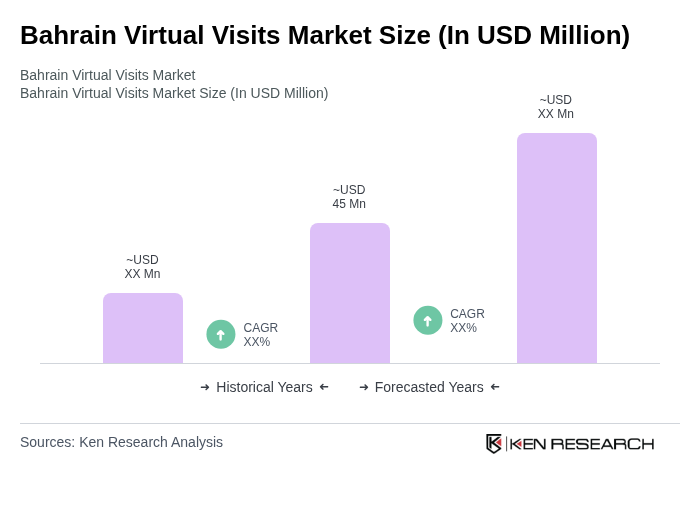
- The Bahrain Virtual Visits Market is valued at USD 45 million, based on a five-year historical analysis and proportionate allocation from the wider Bahrain digital health and telehealth kiosk markets. This growth is primarily driven by the increasing adoption of telehealth services, near-universal internet and smartphone penetration, strong national ICT infrastructure, and a growing demand for convenient, on-demand healthcare solutions among a young and digitally engaged population. The COVID-19 pandemic significantly accelerated the shift towards virtual consultations, normalizing remote care pathways and leading to sustained higher utilization of video, phone, and app-based consultations across public and private providers.
- Key players in this market include Manama, the capital city, which serves as the primary hub for healthcare innovation and digital health infrastructure, and other regions like Muharraq and Riffa, where hospitals and clinics are increasingly integrating teleconsultation platforms, remote follow-up tools, and digital triage solutions into routine service delivery. The concentration of tertiary hospitals, private specialty centers, and government-supported eHealth initiatives in these areas, together with high broadband coverage and strong ICT readiness, contributes to their dominance in the virtual visits market.
- In 2023, the Bahraini government strengthened its telehealth framework under the Kingdom of Bahrain Telemedicine Regulations issued by the National Health Regulatory Authority (NHRA) and the Supreme Council of Health, setting binding requirements for licensing, patient consent, data privacy, clinical documentation, cross-border consultations, and quality assurance for telemedicine services in public and private facilities. These rules support the provision of virtual visits through NHRA-licensed platforms, align reimbursement with approved teleconsultation codes within national and payer-based schemes, and encourage wider adoption among hospitals, clinics, and insurers by clarifying compliance obligations for remote care delivery.
Bahrain Virtual Visits Market Segmentation
By Consultation Type:This segmentation includes various methods of virtual consultations that cater to different patient needs and preferences. The subsegments are Video Visits, Audio/Phone Visits, Asynchronous / Chat & Message-Based Visits, Remote Patient Monitoring & Follow-Up Visits, and Kiosk-Based & Other Virtual Visit Formats. Video Visits are gaining traction due to their interactive nature and better alignment with synchronous virtual visit models that dominate global virtual health services, while Asynchronous visits are preferred for non-urgent consultations, prescription renewals, and follow-ups that can be managed via secure messaging within digital health platforms.
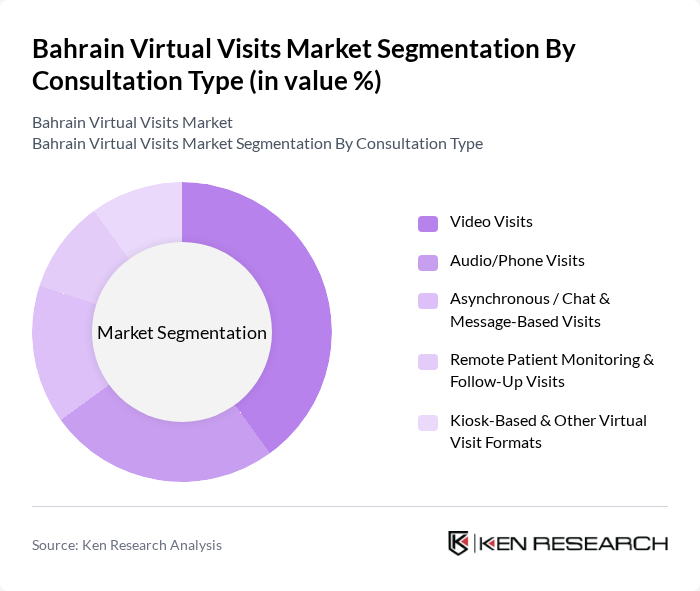
Among these subsegments, Video Visits dominate the market due to their ability to provide real-time interaction between healthcare providers and patients, mirroring the global pattern where synchronous virtual visits account for the largest share of virtual health services. This format allows for a more personal connection, which is crucial in healthcare, and supports better clinical assessment through visual cues. The convenience of accessing healthcare from home or work, combined with the visual element of video consultations and integration into hospital and insurer apps, has led to increased patient satisfaction and engagement. As a result, Video Visits are expected to continue leading the market as providers standardize video-based teleconsultation workflows for primary care, chronic disease management, and specialist follow-ups.
By Care Setting:This segmentation categorizes virtual visits based on the type of healthcare facility providing the service. The subsegments include Public Hospitals & Government Facilities, Private Hospitals & Specialty Clinics, Primary Care Centers & Polyclinics, Corporate & Occupational Health Programs, and Pharmacies, Home Care & Other Settings. Public hospitals and government-run facilities act as key access points for a broad segment of the population, while private facilities offer specialized services and often deploy branded telehealth platforms integrated with appointment booking, electronic medical records, and digital payments.
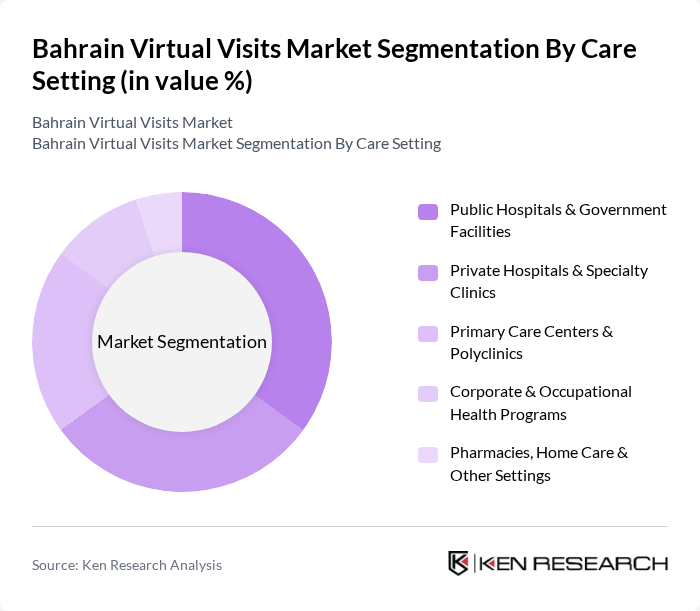
In this segmentation, Public Hospitals & Government Facilities lead the market due to their extensive reach, the essential services they provide to the population, and their central role in national eHealth and telemedicine programs coordinated by the Ministry of Health and the Supreme Council of Health. These institutions are often equipped with the necessary ICT infrastructure, including secure networks, integrated electronic medical records, and NHRA-compliant telemedicine platforms, to implement virtual visits effectively. Additionally, government initiatives to promote telehealth services in public healthcare settings, including digital-first access models and remote follow-up clinics, have further solidified their position as market leaders, while private and corporate programs increasingly complement this provision for insured and employed populations.
Bahrain Virtual Visits Market Competitive Landscape
The Bahrain Virtual Visits Market is characterized by a dynamic mix of regional and international players. Leading participants such as DabaDoc, Healthigo, Meddy, Doctori, Sehati, Aster DM Healthcare, Al Hilal Hospital, Bahrain Specialist Hospital, KIMSHEALTH, American Mission Hospital, Royal Bahrain Hospital, King Hamad University Hospital, Bahrain Defense Force (BDF) Hospital, Ministry of Health – Telemedicine & Virtual Clinics, Private Telehealth Platforms & Insurer-Led Virtual Care Programs contribute to innovation, geographic expansion, and service delivery in this space.
Bahrain Virtual Visits Market Industry Analysis
Growth Drivers
- Increased Demand for Remote Healthcare Services:The COVID-19 pandemic has significantly accelerated the demand for remote healthcare services in Bahrain, with a reported 70% increase in virtual consultations from 2020 to 2023. According to the Bahrain Ministry of Health, over 250,000 virtual visits were conducted in 2023 alone, reflecting a growing acceptance of telehealth solutions. This trend is expected to continue as patients seek convenient and safe healthcare options, particularly in urban areas where access to healthcare facilities is limited.
- Technological Advancements in Telecommunication:Bahrain's telecommunications sector has seen substantial investments, with the government reporting a 20% increase in broadband penetration from 2022 to 2023. Enhanced internet infrastructure, including 5G rollout, has facilitated smoother virtual consultations, enabling healthcare providers to deliver high-quality services. The Bahrain Telecommunications Regulatory Authority noted that over 95% of households now have access to high-speed internet, which is crucial for the growth of virtual healthcare services.
- Rising Awareness of Mental Health Services:There has been a notable increase in the awareness and acceptance of mental health services in Bahrain, with a 50% rise in inquiries for mental health virtual consultations reported in 2023. The Bahrain Mental Health Strategy aims to improve access to mental health care, emphasizing the importance of virtual visits. This growing recognition of mental health issues is driving demand for accessible and confidential online therapy options, particularly among younger populations.
Market Challenges
- Limited Internet Connectivity in Rural Areas:Despite advancements in telecommunications, rural areas in Bahrain still face challenges with internet connectivity. Approximately 30% of rural households lack reliable internet access, which hampers the ability to utilize virtual healthcare services. The Bahrain Economic Development Board has identified this digital divide as a significant barrier to equitable healthcare access, necessitating targeted investments in infrastructure to bridge this gap.
- Regulatory Compliance Issues:The regulatory landscape for telehealth in Bahrain is still evolving, with healthcare providers facing challenges in navigating compliance requirements. The Ministry of Health has implemented new telehealth regulations, but many providers report difficulties in understanding and adhering to these guidelines. This uncertainty can lead to hesitance in adopting virtual care solutions, potentially stalling market growth and innovation in the sector.
Bahrain Virtual Visits Market Future Outlook
The future of the Bahrain virtual visits market appears promising, driven by ongoing technological advancements and increasing consumer acceptance. As the government continues to support digital health initiatives, the integration of AI and machine learning into telehealth platforms is expected to enhance service delivery in future. Additionally, the rise of hybrid healthcare models, combining in-person and virtual visits, will likely reshape patient care, making it more accessible and efficient for all demographics in Bahrain.
Market Opportunities
- Expansion of Services to Underserved Populations:There is a significant opportunity to expand virtual healthcare services to underserved populations in Bahrain, particularly in rural areas. By leveraging mobile health technologies, providers can reach these communities, improving healthcare access and outcomes. The government’s commitment to enhancing healthcare equity can further support this initiative, potentially benefiting thousands of residents.
- Integration with Wearable Health Technologies:The integration of virtual visits with wearable health technologies presents a unique opportunity for healthcare providers in Bahrain. As the adoption of wearables increases, real-time health data can enhance virtual consultations, allowing for more personalized care. This synergy can lead to improved patient engagement and adherence to treatment plans, ultimately driving better health outcomes.
Scope of the Report
| Segment | Sub-Segments |
|---|---|
| By Consultation Type | Video Visits Audio/Phone Visits Asynchronous / Chat & Message-Based Visits Remote Patient Monitoring & Follow-Up Visits Kiosk-Based & Other Virtual Visit Formats |
| By Care Setting | Public Hospitals & Government Facilities Private Hospitals & Specialty Clinics Primary Care Centers & Polyclinics Corporate & Occupational Health Programs Pharmacies, Home Care & Other Settings |
| By Patient Type | Acute Care Visits Chronic Disease Management Visits Preventive & Wellness Visits Post-Operative & Follow-Up Visits Emergency / Urgent Virtual Triage |
| By Clinical Specialty | General & Family Medicine Mental & Behavioral Health Pediatrics Dermatology Other Specialties (Cardiology, Endocrinology, etc.) |
| By Reimbursement & Payment Model | Government-Funded & Public Insurance Private Insurance Reimbursement Employer-Paid & Corporate Contracts Out-of-Pocket / Self-Pay Subscription & Capitation Models |
| By Technology & Access Channel | Mobile Apps Web Portals & Browser-Based Platforms Integrated EHR / Hospital Information Systems Telehealth Kiosks & Devices Other Digital Channels (Call Centers, Messaging Platforms) |
| By User Demographics | Age Group Gender Nationality (Bahraini vs Expatriate) Income & Insurance Coverage Tier |
Key Target Audience
Investors and Venture Capitalist Firms
Government and Regulatory Bodies (e.g., Bahrain Economic Development Board, Ministry of Health)
Healthcare Providers and Institutions
Telecommunication Companies
Technology Solution Developers
Tourism and Hospitality Sector Stakeholders
Insurance Companies
Real Estate Developers
Players Mentioned in the Report:
DabaDoc
Healthigo
Meddy
Doctori
Sehati
Aster DM Healthcare
Al Hilal Hospital
Bahrain Specialist Hospital
KIMSHEALTH
American Mission Hospital
Royal Bahrain Hospital
King Hamad University Hospital
Bahrain Defense Force (BDF) Hospital
Ministry of Health Telemedicine & Virtual Clinics
Private Telehealth Platforms & Insurer-Led Virtual Care Programs
Table of Contents
Market Assessment Phase
1. Executive Summary and Approach
2. Bahrain Virtual Visits Market Overview
2.1 Key Insights and Strategic Recommendations
2.2 Bahrain Virtual Visits Market Overview
2.3 Definition and Scope
2.4 Evolution of Market Ecosystem
2.5 Timeline of Key Regulatory Milestones
2.6 Value Chain & Stakeholder Mapping
2.7 Business Cycle Analysis
2.8 Policy & Incentive Landscape
3. Bahrain Virtual Visits Market Analysis
3.1 Growth Drivers
3.1.1 Increased Demand for Remote Healthcare Services
3.1.2 Technological Advancements in Telecommunication
3.1.3 Rising Awareness of Mental Health Services
3.1.4 Government Initiatives Supporting Digital Health
3.2 Market Challenges
3.2.1 Limited Internet Connectivity in Rural Areas
3.2.2 Regulatory Compliance Issues
3.2.3 Resistance to Change from Traditional Practices
3.2.4 Data Privacy and Security Concerns
3.3 Market Opportunities
3.3.1 Expansion of Services to Underserved Populations
3.3.2 Integration with Wearable Health Technologies
3.3.3 Partnerships with Local Healthcare Providers
3.3.4 Development of Customized Virtual Care Solutions
3.4 Market Trends
3.4.1 Growth of AI and Machine Learning in Healthcare
3.4.2 Increasing Use of Mobile Health Applications
3.4.3 Shift Towards Patient-Centric Care Models
3.4.4 Rise of Hybrid Healthcare Delivery Models
3.5 Government Regulation
3.5.1 Telehealth Licensing Requirements
3.5.2 Data Protection Regulations
3.5.3 Reimbursement Policies for Virtual Visits
3.5.4 Standards for Telemedicine Practice
4. SWOT Analysis
5. Stakeholder Analysis
6. Porter's Five Forces Analysis
7. Bahrain Virtual Visits Market Market Size, 2019-2024
7.1 By Value
7.2 By Volume
7.3 By Average Selling Price
8. Bahrain Virtual Visits Market Segmentation
8.1 By Consultation Type
8.1.1 Video Visits
8.1.2 Audio/Phone Visits
8.1.3 Asynchronous / Chat & Message-Based Visits
8.1.4 Remote Patient Monitoring & Follow-Up Visits
8.1.5 Kiosk-Based & Other Virtual Visit Formats
8.2 By Care Setting
8.2.1 Public Hospitals & Government Facilities
8.2.2 Private Hospitals & Specialty Clinics
8.2.3 Primary Care Centers & Polyclinics
8.2.4 Corporate & Occupational Health Programs
8.2.5 Pharmacies, Home Care & Other Settings
8.3 By Patient Type
8.3.1 Acute Care Visits
8.3.2 Chronic Disease Management Visits
8.3.3 Preventive & Wellness Visits
8.3.4 Post-Operative & Follow-Up Visits
8.3.5 Emergency / Urgent Virtual Triage
8.4 By Clinical Specialty
8.4.1 General & Family Medicine
8.4.2 Mental & Behavioral Health
8.4.3 Pediatrics
8.4.4 Dermatology
8.4.5 Other Specialties (Cardiology, Endocrinology, etc.)
8.5 By Reimbursement & Payment Model
8.5.1 Government-Funded & Public Insurance
8.5.2 Private Insurance Reimbursement
8.5.3 Employer-Paid & Corporate Contracts
8.5.4 Out-of-Pocket / Self-Pay
8.5.5 Subscription & Capitation Models
8.6 By Technology & Access Channel
8.6.1 Mobile Apps
8.6.2 Web Portals & Browser-Based Platforms
8.6.3 Integrated EHR / Hospital Information Systems
8.6.4 Telehealth Kiosks & Devices
8.6.5 Other Digital Channels (Call Centers, Messaging Platforms)
8.7 By User Demographics
8.7.1 Age Group
8.7.2 Gender
8.7.3 Nationality (Bahraini vs Expatriate)
8.7.4 Income & Insurance Coverage Tier
9. Bahrain Virtual Visits Market Competitive Analysis
9.1 Market Share of Key Players
9.2 Cross Comparison of Key Players
9.2.1 Company Name
9.2.2 Company Size (Start-up, Emerging, or Established)
9.2.3 Number of Virtual Visits per Year
9.2.4 Active Users / Covered Lives
9.2.5 Average Revenue Per User (ARPU)
9.2.6 Customer Acquisition Cost (CAC)
9.2.7 Customer Retention / Churn Rate
9.2.8 Utilization Rate (Visits per Member per Month)
9.2.9 EBITDA Margin / Operating Margin
9.2.10 Market Share in Bahrain Virtual Visits
9.2.11 Average Resolution Time & First-Contact Resolution Rate
9.2.12 Net Promoter Score (NPS)
9.3 SWOT Analysis of Top Players
9.4 Pricing Analysis
9.5 Detailed Profile of Major Companies
9.5.1 DabaDoc
9.5.2 Healthigo
9.5.3 Meddy
9.5.4 Doctori
9.5.5 Sehati
9.5.6 Aster DM Healthcare
9.5.7 Al Hilal Hospital
9.5.8 Bahrain Specialist Hospital
9.5.9 KIMSHEALTH
9.5.10 American Mission Hospital
9.5.11 Royal Bahrain Hospital
9.5.12 King Hamad University Hospital
9.5.13 Bahrain Defense Force (BDF) Hospital
9.5.14 Ministry of Health – Telemedicine & Virtual Clinics
9.5.15 Private Telehealth Platforms & Insurer-Led Virtual Care Programs
10. Bahrain Virtual Visits Market End-User Analysis
10.1 Procurement Behavior of Key Ministries
10.1.1 Ministry of Health
10.1.2 Ministry of Education
10.1.3 Ministry of Labor
10.1.4 Ministry of Finance
10.2 Corporate Spend on Infrastructure & Energy
10.2.1 Healthcare Infrastructure Investments
10.2.2 Technology Upgrades
10.2.3 Employee Health Programs
10.2.4 Others
10.3 Pain Point Analysis by End-User Category
10.3.1 Patients
10.3.2 Healthcare Providers
10.3.3 Insurance Companies
10.3.4 Employers
10.4 User Readiness for Adoption
10.4.1 Awareness Levels
10.4.2 Technological Proficiency
10.4.3 Trust in Virtual Care
10.4.4 Others
10.5 Post-Deployment ROI and Use Case Expansion
10.5.1 Cost Savings
10.5.2 Improved Patient Outcomes
10.5.3 Service Expansion Opportunities
10.5.4 Others
11. Bahrain Virtual Visits Market Future Size, 2025-2030
11.1 By Value
11.2 By Volume
11.3 By Average Selling Price
Go-To-Market Strategy Phase
1. Whitespace Analysis + Business Model Canvas
1.1 Market Gaps Identification
1.2 Business Model Development
2. Marketing and Positioning Recommendations
2.1 Branding Strategies
2.2 Product USPs
3. Distribution Plan
3.1 Urban Retail vs Rural NGO Tie-Ups
4. Channel & Pricing Gaps
4.1 Underserved Routes
4.2 Pricing Bands
5. Unmet Demand & Latent Needs
5.1 Category Gaps
5.2 Consumer Segments
6. Customer Relationship
6.1 Loyalty Programs
6.2 After-Sales Service
7. Value Proposition
7.1 Sustainability
7.2 Integrated Supply Chains
8. Key Activities
8.1 Regulatory Compliance
8.2 Branding
8.3 Distribution Setup
9. Entry Strategy Evaluation
9.1 Domestic Market Entry Strategy
9.1.1 Product Mix
9.1.2 Pricing Band
9.1.3 Packaging
9.2 Export Entry Strategy
9.2.1 Target Countries
9.2.2 Compliance Roadmap
10. Entry Mode Assessment
10.1 JV
10.2 Greenfield
10.3 M&A
10.4 Distributor Model
11. Capital and Timeline Estimation
11.1 Capital Requirements
11.2 Timelines
12. Control vs Risk Trade-Off
12.1 Ownership vs Partnerships
13. Profitability Outlook
13.1 Breakeven Analysis
13.2 Long-Term Sustainability
14. Potential Partner List
14.1 Distributors
14.2 JVs
14.3 Acquisition Targets
15. Execution Roadmap
15.1 Phased Plan for Market Entry
15.1.1 Market Setup
15.1.2 Market Entry
15.1.3 Growth Acceleration
15.1.4 Scale & Stabilize
15.2 Key Activities and Milestones
15.2.1 Activity Planning
15.2.2 Milestone Tracking
Research Methodology
Phase 1: Approach1
Desk Research
- Analysis of government reports and publications on virtual tourism initiatives in Bahrain
- Review of industry white papers and market analysis reports specific to the virtual visits sector
- Examination of demographic and economic data from Bahrain's National Statistics Bureau
Primary Research
- Interviews with key stakeholders in the tourism and technology sectors, including virtual tour providers
- Surveys conducted with potential users of virtual visits, such as local residents and international tourists
- Focus groups with travel agencies and tourism boards to gather insights on market needs and preferences
Validation & Triangulation
- Cross-validation of findings through comparison with existing market reports and forecasts
- Triangulation of data from primary interviews and secondary research sources to ensure consistency
- Sanity checks through expert panel reviews involving industry veterans and academic professionals
Phase 2: Market Size Estimation1
Top-down Assessment
- Estimation of market size based on Bahrain's overall tourism revenue and projected growth in virtual experiences
- Segmentation of the market by type of virtual visit (e.g., cultural, educational, recreational)
- Incorporation of trends in digital engagement and technology adoption among tourists
Bottom-up Modeling
- Collection of data on pricing models from leading virtual tour providers in Bahrain
- Estimation of user adoption rates based on survey responses and demographic analysis
- Calculation of revenue potential based on projected user engagement and frequency of virtual visits
Forecasting & Scenario Analysis
- Multi-factor regression analysis incorporating variables such as internet penetration and smartphone usage
- Scenario modeling based on potential impacts of global travel trends and local tourism policies
- Development of baseline, optimistic, and pessimistic forecasts through 2030
Phase 3: CATI Sample Composition1
| Scope Item/Segment | Sample Size | Target Respondent Profiles |
|---|---|---|
| Local Residents Interested in Virtual Tours | 120 | Individuals aged 18-65, tech-savvy users |
| International Tourists Planning to Visit Bahrain | 90 | Travel enthusiasts, frequent travelers |
| Travel Agencies Offering Virtual Experiences | 60 | Agency owners, travel consultants |
| Educational Institutions Utilizing Virtual Tours | 50 | Teachers, administrators, and curriculum developers |
| Technology Providers in the Virtual Experience Space | 40 | Product managers, software developers |
Frequently Asked Questions
What is the current value of the Bahrain Virtual Visits Market?
The Bahrain Virtual Visits Market is valued at approximately USD 45 million, reflecting significant growth driven by the increasing adoption of telehealth services and a digitally engaged population, particularly following the COVID-19 pandemic.
What factors are driving the growth of virtual visits in Bahrain?
How has the COVID-19 pandemic impacted virtual consultations in Bahrain?
What types of virtual consultations are available in Bahrain?
Other Regional/Country Reports
Other Adjacent Reports
Germany Mobile Health Market
KSA healthcare it market size, share, growth drivers, trends, opportunities & forecast 2025–2030Global Wearable Technology Market Size, Share & Forecast, By Product Type, Application & Distribution Channel, 2026-2031Saudi Arabia Mental Health Services Market Size, Share, Growth Drivers, Trends, Opportunities & Forecast 2025–2030Global Electronic Health Records Market SWOT Analysis of Epic Systems Corporation & Forecast, 2026-2031Japan Telepharmacy Market
GCC Health Data Analytics Market Size, Share, Growth Drivers, Trends, Opportunities & Forecast 2025–2030Why Buy From Us?

What makes us stand out is that our consultants follow Robust, Refine and Result (RRR) methodology. Robust for clear definitions, approaches and sanity checking, Refine for differentiating respondents' facts and opinions, and Result for presenting data with story.

We have set a benchmark in the industry by offering our clients with syndicated and customized market research reports featuring coverage of entire market as well as meticulous research and analyst insights.

While we don't replace traditional research, we flip the method upside down. Our dual approach of Top Bottom & Bottom Top ensures quality deliverable by not just verifying company fundamentals but also looking at the sector and macroeconomic factors.

With one step in the future, our research team constantly tries to show you the bigger picture. We help with some of the tough questions you may encounter along the way: How is the industry positioned? Best marketing channel? KPI's of competitors? By aligning every element, we help maximize success.

Our report gives you instant access to the answers and sources that other companies might choose to hide. We elaborate each steps of research methodology we have used and showcase you the sample size to earn your trust.

If you need any support, we are here! We pride ourselves on universe strength, data quality, and quick, friendly, and professional service.