About the Report
Base Year 2024Japan Virtual Visits Market Overview
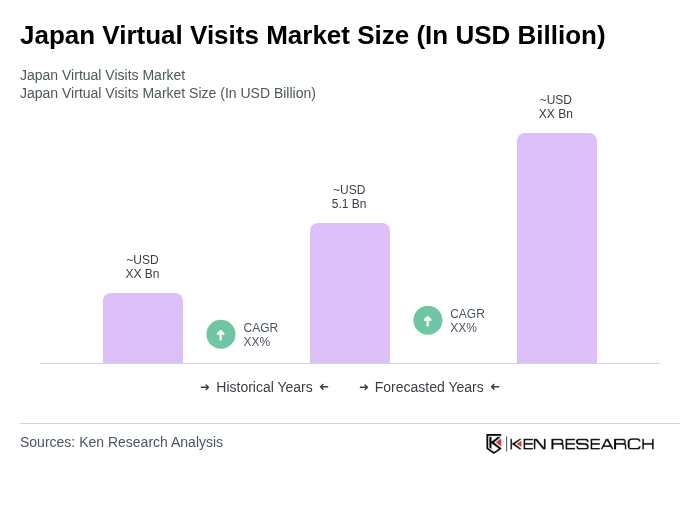
- The Japan Virtual Visits Market is valued at USD 5.1 billion, based on a five-year historical analysis of the broader telemedicine and telehealth segment in the country. This growth is primarily driven by the increasing adoption of telehealth services accelerated by the COVID-19 pandemic, rapid expansion of digital health platforms, and a growing demand for convenient healthcare solutions among an aging population. The market has seen a significant rise in virtual consultations, particularly in urban areas, as patients seek accessible and efficient healthcare options enabled by high smartphone penetration and robust broadband and 5G infrastructure.
- Tokyo, Osaka, and Yokohama are the dominant cities in the Japan Virtual Visits Market due to their high population density, advanced healthcare infrastructure, and strong technological adoption. These cities have a robust network of healthcare providers and a tech?savvy population, which facilitates the growth of virtual healthcare services through hospital-based telehealth, online doctor consultation apps, and remote monitoring programs. The presence of major healthcare institutions, digital health start?ups, and large technology and telecom companies further enhances their market dominance by driving innovation and integration of virtual visit solutions into routine care.
- In 2023, the Japanese government strengthened the regulatory framework to promote telemedicine, building on and expanding the “Guidelines for the Appropriate Implementation of Online Medical Treatment” issued by the Ministry of Health, Labour and Welfare (MHLW) in 2018 and subsequently revised to permanently allow online consultations beyond initial COVID?19 emergency measures. Under these MHLW guidelines, licensed healthcare providers can offer virtual consultations without requiring in?person visits in many cases, subject to requirements around patient identification, documentation, informed consent, and use of secure communication systems, thereby improving healthcare accessibility, especially in rural and underserved areas and supporting the broader national “medical DX” (digital transformation) strategy.
Japan Virtual Visits Market Segmentation
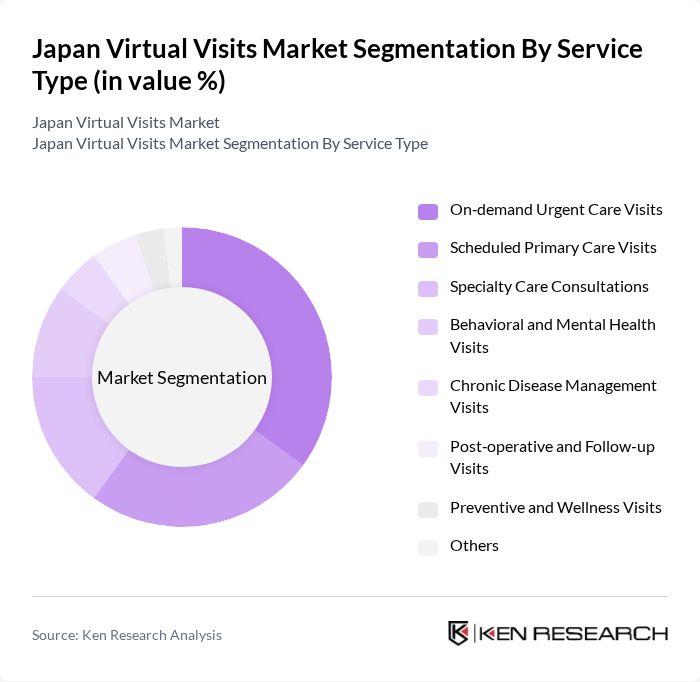
By Service Type:The service type segmentation includes various categories such as On-demand Urgent Care Visits, Scheduled Primary Care Visits, Specialty Care Consultations, Behavioral and Mental Health Visits, Chronic Disease Management Visits, Post-operative and Follow-up Visits, Preventive and Wellness Visits, and Others. During the pandemic period, On-demand Urgent Care Visits and Scheduled Primary Care Visits both saw strong traction as patients sought remote access for acute symptoms, triage, and routine follow?ups. In the current phase, Scheduled Primary Care Visits and Chronic Disease Management Visits have become key pillars of utilization as telehealth is increasingly embedded into ongoing care pathways for older adults and patients with lifestyle?related and chronic conditions, while demand for Behavioral and Mental Health Visits is also rising in response to greater awareness and easier access to remote counseling and psychiatric support.
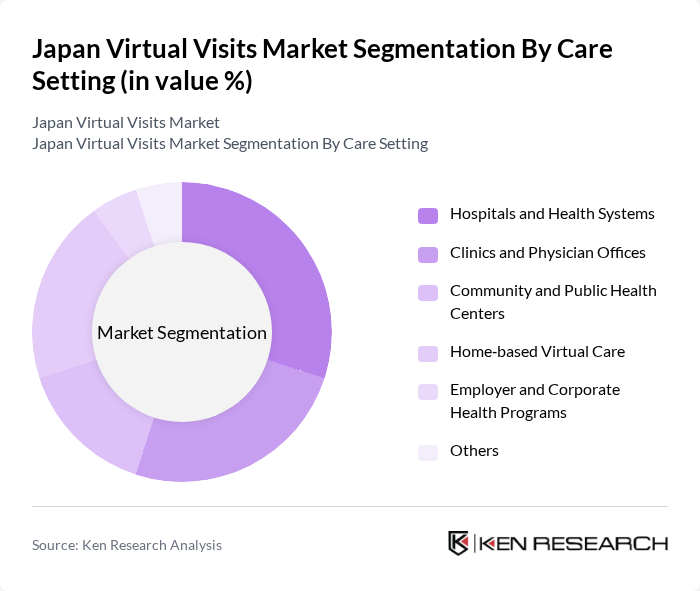
By Care Setting:The care setting segmentation includes Hospitals and Health Systems, Clinics and Physician Offices, Community and Public Health Centers, Home-based Virtual Care, Employer and Corporate Health Programs, and Others. Hospitals and Health Systems and Clinics and Physician Offices currently account for a substantial share of virtual visits in Japan, reflecting strong integration of telemedicine into hospital outpatient services and clinic workflows under the national health insurance reimbursement framework. Home-based Virtual Care is expanding rapidly, driven by the increasing preference for at?home healthcare solutions among older adults, growth of remote patient monitoring for chronic disease, and initiatives such as online consultations with prescription delivery pilots in community locations, while Employer and Corporate Health Programs are gradually adopting virtual visits as part of occupational health and wellness offerings.
Japan Virtual Visits Market Competitive Landscape
The Japan Virtual Visits Market is characterized by a dynamic mix of regional and international players. Leading participants such as Medley Inc. (CLINICS), MICIN Inc. (curon), LINE Healthcare Corporation, JMDC Inc., Nippon Telegraph and Telephone Corporation (NTT Group), SoftBank Corp., M3, Inc., DeSC Healthcare, Inc., Rakuten Medical & Healthcare subsidiaries, Teladoc Health, Amwell, MDLive, Doctor On Demand, HealthTap, eVisit contribute to innovation, geographic expansion, and service delivery in this space.
Japan Virtual Visits Market Industry Analysis
Growth Drivers
- Increasing Demand for Remote Healthcare Services:The demand for remote healthcare services in Japan has surged, with over 31 million virtual consultations recorded in future. This trend is driven by an aging population, where approximately 29% of the population is over 65 years old, necessitating accessible healthcare solutions. The Ministry of Health, Labour and Welfare reported that 72% of patients prefer virtual visits for non-emergency consultations, highlighting a significant shift towards digital healthcare.
- Technological Advancements in Telecommunication:Japan's robust telecommunication infrastructure supports the growth of virtual visits, with over 99% of households having access to high-speed internet. The introduction of 5G technology in future has further enhanced connectivity, enabling seamless video consultations. According to the Ministry of Internal Affairs and Communications, the number of mobile internet users reached 200 million in future, facilitating the adoption of telehealth services across various demographics.
- Rising Awareness of Mental Health Services:Mental health awareness in Japan has increased significantly, with a reported 42% rise in individuals seeking mental health support through virtual platforms in future. The government has initiated campaigns to destigmatize mental health issues, resulting in a 27% increase in teletherapy sessions. The Japan Psychological Association noted that 62% of mental health professionals now offer online services, reflecting a growing acceptance of virtual mental health care.
Market Challenges
- Regulatory Compliance Issues:The regulatory landscape for telemedicine in Japan presents challenges, with stringent licensing requirements for healthcare providers. As of future, only 16% of telehealth providers have met the necessary compliance standards set by the Ministry of Health. This has resulted in delays in service delivery and limited access to virtual care, particularly in rural areas where healthcare providers are scarce.
- Data Privacy and Security Concerns:Data privacy remains a significant challenge in the virtual visits market, with 72% of consumers expressing concerns about the security of their health information. The Personal Information Protection Commission reported over 1,200 data breaches in the healthcare sector in future, leading to increased scrutiny and calls for stricter regulations. This has hindered the growth of virtual healthcare services as providers struggle to ensure compliance with data protection laws.
Japan Virtual Visits Market Future Outlook
The future of the Japan virtual visits market appears promising, driven by ongoing technological advancements and a growing acceptance of digital healthcare solutions. As the government continues to support telehealth initiatives, the integration of AI and machine learning is expected to enhance patient care and streamline operations. Additionally, the increasing collaboration between healthcare providers and insurance companies will likely facilitate broader access to virtual services, ultimately improving healthcare delivery across the nation.
Market Opportunities
- Expansion of Virtual Care Platforms:The rise of virtual care platforms presents a significant opportunity, with over 210 new platforms launched in future. These platforms cater to diverse healthcare needs, from primary care to specialized services, enhancing accessibility for patients. The potential for partnerships with local healthcare providers can further drive adoption and improve service delivery.
- Growth in Elderly Population Seeking Remote Care:With Japan's elderly population projected to reach 37 million in future, there is a substantial opportunity for remote care services. This demographic is increasingly seeking convenient healthcare solutions, with 52% of seniors expressing interest in virtual consultations. Targeting this segment can lead to innovative service offerings tailored to their specific needs.
Scope of the Report
| Segment | Sub-Segments |
|---|---|
| By Service Type | On?demand Urgent Care Visits Scheduled Primary Care Visits Specialty Care Consultations Behavioral and Mental Health Visits Chronic Disease Management Visits Post?operative and Follow?up Visits Preventive and Wellness Visits Others |
| By Care Setting | Hospitals and Health Systems Clinics and Physician Offices Community and Public Health Centers Home?based Virtual Care Employer and Corporate Health Programs Others |
| By Clinical Area | General Medicine Pediatrics Geriatrics Psychiatry and Psychology Dermatology Rehabilitation and Physiotherapy Others |
| By Technology Modality | Video?based Visits Audio / Telephone?based Visits Asynchronous (Store?and?Forward) Visits Remote Patient Monitoring?enabled Visits Mobile App?based Visits Web Portal?based Visits Others |
| By Patient Group | Children and Adolescents (0–17 years) Adults (18–64 years) Older Adults (65+ years) Patients with Chronic Conditions Rural and Remote Population Others |
| By Payer Type | Public Health Insurance (SHI/NHI) Private Health Insurance Employer?Sponsored Plans Self?pay / Out?of?Pocket Others |
| By Platform Ownership | Provider?owned Platforms Third?party Telehealth Platforms Payer?owned Platforms Pharmacy / Retail?owned Platforms Others |
Key Target Audience
Investors and Venture Capitalist Firms
Government and Regulatory Bodies (e.g., Ministry of Internal Affairs and Communications, Ministry of Economy, Trade and Industry)
Healthcare Providers and Institutions
Travel and Tourism Agencies
Real Estate Developers and Property Management Firms
Event Organizers and Conference Planners
Telecommunication Companies
Technology Providers and Software Developers
Players Mentioned in the Report:
Medley Inc. (CLINICS)
MICIN Inc. (curon)
LINE Healthcare Corporation
JMDC Inc.
Nippon Telegraph and Telephone Corporation (NTT Group)
SoftBank Corp.
M3, Inc.
DeSC Healthcare, Inc.
Rakuten Medical & Healthcare subsidiaries
Teladoc Health
Amwell
MDLive
Doctor On Demand
HealthTap
eVisit
Table of Contents
Market Assessment Phase
1. Executive Summary and Approach
2. Japan Virtual Visits Market Overview
2.1 Key Insights and Strategic Recommendations
2.2 Japan Virtual Visits Market Overview
2.3 Definition and Scope
2.4 Evolution of Market Ecosystem
2.5 Timeline of Key Regulatory Milestones
2.6 Value Chain & Stakeholder Mapping
2.7 Business Cycle Analysis
2.8 Policy & Incentive Landscape
3. Japan Virtual Visits Market Analysis
3.1 Growth Drivers
3.1.1 Increasing Demand for Remote Healthcare Services
3.1.2 Technological Advancements in Telecommunication
3.1.3 Rising Awareness of Mental Health Services
3.1.4 Government Initiatives Supporting Digital Health
3.2 Market Challenges
3.2.1 Regulatory Compliance Issues
3.2.2 Limited Internet Accessibility in Rural Areas
3.2.3 Resistance from Traditional Healthcare Providers
3.2.4 Data Privacy and Security Concerns
3.3 Market Opportunities
3.3.1 Expansion of Virtual Care Platforms
3.3.2 Integration of AI and Machine Learning
3.3.3 Partnerships with Insurance Providers
3.3.4 Growth in Elderly Population Seeking Remote Care
3.4 Market Trends
3.4.1 Shift Towards Hybrid Healthcare Models
3.4.2 Increased Use of Mobile Health Applications
3.4.3 Focus on Patient-Centric Care Solutions
3.4.4 Rise of Virtual Health Communities
3.5 Government Regulation
3.5.1 Telemedicine Licensing Requirements
3.5.2 Reimbursement Policies for Virtual Visits
3.5.3 Data Protection Regulations
3.5.4 Standards for Remote Patient Monitoring
4. SWOT Analysis
5. Stakeholder Analysis
6. Porter's Five Forces Analysis
7. Japan Virtual Visits Market Market Size, 2019-2024
7.1 By Value
7.2 By Volume
7.3 By Average Selling Price
8. Japan Virtual Visits Market Segmentation
8.1 By Service Type
8.1.1 On?demand Urgent Care Visits
8.1.2 Scheduled Primary Care Visits
8.1.3 Specialty Care Consultations
8.1.4 Behavioral and Mental Health Visits
8.1.5 Chronic Disease Management Visits
8.1.6 Post?operative and Follow?up Visits
8.1.7 Preventive and Wellness Visits
8.1.8 Others
8.2 By Care Setting
8.2.1 Hospitals and Health Systems
8.2.2 Clinics and Physician Offices
8.2.3 Community and Public Health Centers
8.2.4 Home?based Virtual Care
8.2.5 Employer and Corporate Health Programs
8.2.6 Others
8.3 By Clinical Area
8.3.1 General Medicine
8.3.2 Pediatrics
8.3.3 Geriatrics
8.3.4 Psychiatry and Psychology
8.3.5 Dermatology
8.3.6 Rehabilitation and Physiotherapy
8.3.7 Others
8.4 By Technology Modality
8.4.1 Video?based Visits
8.4.2 Audio / Telephone?based Visits
8.4.3 Asynchronous (Store?and?Forward) Visits
8.4.4 Remote Patient Monitoring?enabled Visits
8.4.5 Mobile App?based Visits
8.4.6 Web Portal?based Visits
8.4.7 Others
8.5 By Patient Group
8.5.1 Children and Adolescents (0–17 years)
8.5.2 Adults (18–64 years)
8.5.3 Older Adults (65+ years)
8.5.4 Patients with Chronic Conditions
8.5.5 Rural and Remote Population
8.5.6 Others
8.6 By Payer Type
8.6.1 Public Health Insurance (SHI/NHI)
8.6.2 Private Health Insurance
8.6.3 Employer?Sponsored Plans
8.6.4 Self?pay / Out?of?Pocket
8.6.5 Others
8.7 By Platform Ownership
8.7.1 Provider?owned Platforms
8.7.2 Third?party Telehealth Platforms
8.7.3 Payer?owned Platforms
8.7.4 Pharmacy / Retail?owned Platforms
8.7.5 Others
9. Japan Virtual Visits Market Competitive Analysis
9.1 Market Share of Key Players
9.2 Cross Comparison of Key Players
9.2.1 Company name
9.2.2 Ownership / Type (Hospital, Insurer, Tech, Start?up, etc.)
9.2.3 Group Size (Large, Medium, Small as per industry convention)
9.2.4 Total Virtual Visit Volume (Annual)
9.2.5 Active User Base (Patients and Providers)
9.2.6 Revenue from Virtual Visits (Annual)
9.2.7 Average Revenue Per User (ARPU)
9.2.8 Customer Acquisition Cost (CAC)
9.2.9 Customer Lifetime Value (CLV)
9.2.10 Monthly Recurring Revenue (MRR)
9.2.11 Churn Rate (Patient / Provider)
9.2.12 Conversion Rate (Free to Paid / Trial to Paid)
9.2.13 Utilization Rate (Visits per User per Month)
9.2.14 Average Visit Duration and Wait Time
9.2.15 Net Promoter Score (NPS)
9.2.16 Market Penetration Rate in Target Segments
9.2.17 Share of Visits Reimbursed by Public Insurance
9.2.18 EBITDA Margin from Virtual Visit Business
9.2.19 R&D and Technology Spend as % of Revenue
9.2.20 Pricing Strategy and Packaging (Per?visit, Subscription, Bundled)
9.3 SWOT Analysis of Top Players
9.4 Pricing Analysis
9.5 Detailed Profile of Major Companies
9.5.1 Medley Inc. (CLINICS)
9.5.2 MICIN Inc. (curon)
9.5.3 LINE Healthcare Corporation
9.5.4 JMDC Inc.
9.5.5 Nippon Telegraph and Telephone Corporation (NTT Group)
9.5.6 SoftBank Corp.
9.5.7 M3, Inc.
9.5.8 DeSC Healthcare, Inc.
9.5.9 Rakuten Medical & Healthcare subsidiaries
9.5.10 Teladoc Health
9.5.11 Amwell
9.5.12 MDLive
9.5.13 Doctor On Demand
9.5.14 HealthTap
9.5.15 eVisit
10. Japan Virtual Visits Market End-User Analysis
10.1 Procurement Behavior of Key Ministries
10.1.1 Ministry of Health, Labour and Welfare
10.1.2 Ministry of Internal Affairs and Communications
10.1.3 Ministry of Economy, Trade and Industry
10.1.4 Ministry of Education, Culture, Sports, Science and Technology
10.2 Corporate Spend on Infrastructure & Energy
10.2.1 Healthcare Infrastructure Investments
10.2.2 Technology Upgrades for Virtual Services
10.2.3 Employee Health Programs
10.2.4 Digital Transformation Initiatives
10.3 Pain Point Analysis by End-User Category
10.3.1 Patients Seeking Convenience
10.3.2 Providers Needing Efficient Workflows
10.3.3 Insurers Looking for Cost-Effective Solutions
10.3.4 Corporates Aiming for Employee Wellness
10.4 User Readiness for Adoption
10.4.1 Awareness of Virtual Visit Benefits
10.4.2 Technological Literacy
10.4.3 Trust in Digital Health Solutions
10.4.4 Accessibility of Devices and Internet
10.5 Post-Deployment ROI and Use Case Expansion
10.5.1 Cost Savings from Reduced Travel
10.5.2 Increased Patient Engagement
10.5.3 Scalability of Services
10.5.4 Enhanced Data Analytics for Outcomes
11. Japan Virtual Visits Market Future Size, 2025-2030
11.1 By Value
11.2 By Volume
11.3 By Average Selling Price
Go-To-Market Strategy Phase
1. Whitespace Analysis + Business Model Canvas
1.1 Market Gaps Identification
1.2 Value Proposition Development
1.3 Revenue Streams Analysis
1.4 Key Partnerships Exploration
1.5 Customer Segmentation Insights
2. Marketing and Positioning Recommendations
2.1 Branding Strategies
2.2 Product USPs
2.3 Target Audience Engagement
2.4 Digital Marketing Tactics
2.5 Content Marketing Approaches
3. Distribution Plan
3.1 Urban Retail Strategies
3.2 Rural NGO Tie-Ups
3.3 Online vs Offline Distribution
3.4 Partnership with Healthcare Providers
3.5 Logistics and Supply Chain Management
4. Channel & Pricing Gaps
4.1 Underserved Routes
4.2 Pricing Bands Analysis
4.3 Competitor Pricing Strategies
4.4 Customer Willingness to Pay
4.5 Value-Based Pricing Models
5. Unmet Demand & Latent Needs
5.1 Category Gaps Identification
5.2 Consumer Segments Analysis
5.3 Emerging Trends and Needs
5.4 Feedback from Current Users
5.5 Future Demand Projections
6. Customer Relationship
6.1 Loyalty Programs
6.2 After-Sales Service
6.3 Customer Feedback Mechanisms
6.4 Community Engagement Initiatives
6.5 Personalization Strategies
7. Value Proposition
7.1 Sustainability Initiatives
7.2 Integrated Supply Chains
7.3 Customer-Centric Innovations
7.4 Competitive Differentiation
7.5 Long-Term Value Creation
8. Key Activities
8.1 Regulatory Compliance
8.2 Branding Initiatives
8.3 Distribution Setup
8.4 Training and Development
8.5 Performance Monitoring
9. Entry Strategy Evaluation
9.1 Domestic Market Entry Strategy
9.1.1 Product Mix Considerations
9.1.2 Pricing Band Analysis
9.1.3 Packaging Strategies
9.2 Export Entry Strategy
9.2.1 Target Countries Identification
9.2.2 Compliance Roadmap Development
10. Entry Mode Assessment
10.1 Joint Ventures
10.2 Greenfield Investments
10.3 Mergers & Acquisitions
10.4 Distributor Model Evaluation
10.5 Risk Assessment
11. Capital and Timeline Estimation
11.1 Capital Requirements
11.2 Timelines for Implementation
11.3 Financial Projections
11.4 Funding Sources
11.5 Milestone Tracking
12. Control vs Risk Trade-Off
12.1 Ownership vs Partnerships
12.2 Risk Mitigation Strategies
12.3 Control Mechanisms
12.4 Partnership Evaluation Criteria
12.5 Long-Term Strategic Planning
13. Profitability Outlook
13.1 Breakeven Analysis
13.2 Long-Term Sustainability
13.3 Profit Margin Projections
13.4 Cost Management Strategies
13.5 Revenue Growth Forecasts
14. Potential Partner List
14.1 Distributors
14.2 Joint Ventures
14.3 Acquisition Targets
14.4 Strategic Alliances
14.5 Collaborative Opportunities
15. Execution Roadmap
15.1 Phased Plan for Market Entry
15.1.1 Market Setup
15.1.2 Market Entry
15.1.3 Growth Acceleration
15.1.4 Scale & Stabilize
15.2 Key Activities and Milestones
15.2.1 Activity Planning
15.2.2 Milestone Tracking
15.2.3 Performance Evaluation
15.2.4 Adjustments and Iterations
Research Methodology
Phase 1: Approach1
Desk Research
- Analysis of market reports from Japanese tourism and virtual experience organizations
- Review of government publications on digital tourism initiatives and regulations
- Examination of academic journals and case studies on virtual tourism trends in Japan
Primary Research
- Interviews with key stakeholders in the virtual tourism sector, including technology providers
- Surveys targeting consumers who have participated in virtual visits to gauge satisfaction and preferences
- Focus groups with travel agencies and tour operators to understand market dynamics
Validation & Triangulation
- Cross-validation of findings through multiple data sources, including industry reports and expert opinions
- Triangulation of consumer insights with market trends and technological advancements
- Sanity checks conducted through expert panel reviews and feedback sessions
Phase 2: Market Size Estimation1
Top-down Assessment
- Estimation of market size based on national tourism revenue and digital engagement metrics
- Segmentation of the market by type of virtual experience (e.g., cultural, historical, natural)
- Incorporation of growth rates from related sectors such as e-learning and digital entertainment
Bottom-up Modeling
- Collection of data from leading virtual tour providers on pricing and user engagement
- Estimation of user adoption rates based on demographic and psychographic profiles
- Calculation of revenue potential based on average spend per user and frequency of use
Forecasting & Scenario Analysis
- Multi-factor regression analysis incorporating factors such as technological adoption and consumer behavior shifts
- Scenario modeling based on potential impacts of global events (e.g., pandemics, travel restrictions)
- Development of baseline, optimistic, and pessimistic forecasts through 2030
Phase 3: CATI Sample Composition1
| Scope Item/Segment | Sample Size | Target Respondent Profiles |
|---|---|---|
| Cultural Virtual Tours | 100 | Tourism Managers, Cultural Heritage Experts |
| Historical Site Virtual Experiences | 80 | Historians, Educational Content Developers |
| Nature and Adventure Virtual Tours | 70 | Outdoor Experience Coordinators, Environmental Educators |
| Corporate Virtual Team Building Events | 60 | HR Managers, Corporate Event Planners |
| Consumer Feedback on Virtual Experiences | 90 | Frequent Travelers, Virtual Experience Users |
Frequently Asked Questions
What is the current value of the Japan Virtual Visits Market?
The Japan Virtual Visits Market is valued at approximately USD 5.1 billion, reflecting significant growth driven by the increased adoption of telehealth services, particularly during the COVID-19 pandemic, and the demand for convenient healthcare solutions among an aging population.
What factors are driving the growth of virtual visits in Japan?
Which cities are leading in the Japan Virtual Visits Market?
How has the Japanese government supported telemedicine?
Other Regional/Country Reports
Other Adjacent Reports
Japan Mobile Health Market
KSA Artificial Intelligence in Healthcare Market Size, Share & Forecast, By Solution Type, Deployment Model & Application, 2026-2031Vietnam Home Healthcare Market Size, Share & Forecast, By Service Type, Care Setting & End User, 2025-2031Why Buy From Us?

What makes us stand out is that our consultants follow Robust, Refine and Result (RRR) methodology. Robust for clear definitions, approaches and sanity checking, Refine for differentiating respondents' facts and opinions, and Result for presenting data with story.

We have set a benchmark in the industry by offering our clients with syndicated and customized market research reports featuring coverage of entire market as well as meticulous research and analyst insights.

While we don't replace traditional research, we flip the method upside down. Our dual approach of Top Bottom & Bottom Top ensures quality deliverable by not just verifying company fundamentals but also looking at the sector and macroeconomic factors.

With one step in the future, our research team constantly tries to show you the bigger picture. We help with some of the tough questions you may encounter along the way: How is the industry positioned? Best marketing channel? KPI's of competitors? By aligning every element, we help maximize success.

Our report gives you instant access to the answers and sources that other companies might choose to hide. We elaborate each steps of research methodology we have used and showcase you the sample size to earn your trust.

If you need any support, we are here! We pride ourselves on universe strength, data quality, and quick, friendly, and professional service.