About the Report
Base Year 2024New Zealand Virtual Visits Market Overview
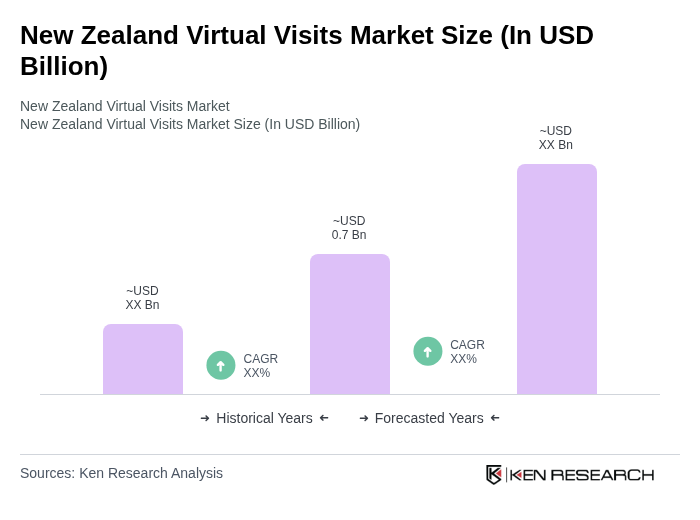
- The New Zealand Virtual Visits Market is valued at USD 0.7 billion, based on a five-year historical analysis of the national telehealth and virtual care expansion. This growth is primarily driven by the increasing adoption of telehealth services across primary and specialist care, rapid advancements in digital health technologies, and a growing demand for convenient, on-demand healthcare solutions among consumers. The COVID-19 pandemic significantly accelerated the shift towards virtual consultations, normalizing remote care pathways in general practice and hospital services and supporting a sustained increase in virtual visit volumes.
- Auckland, Wellington, and Christchurch are the dominant cities in the New Zealand Virtual Visits Market. Auckland leads due to its large population base and concentration of public and private healthcare providers, while Wellington benefits from being the political and administrative center, which supports early adoption of government-backed telehealth and digital health initiatives. Christchurch, with its robust healthcare infrastructure and strong focus on innovative service delivery models following major system rebuilds, also plays a crucial role in the market's growth.
- The policy framework for virtual visits in New Zealand has been strengthened through national digital health strategies and operational guidance that embed virtual consultations into routine care. The New Zealand Health Information Standards Organisation (HISO) Telehealth Standard 10029:2015, issued under the Ministry of Health’s digital health standards programme, sets requirements for video and telephone consultations covering security, consent, clinical safety, and documentation. In parallel, the Health and Disability Services (Safety) Act 2001 and the Code of Health and Disability Services Consumers’ Rights, administered by the Health and Disability Commissioner, require providers offering telehealth to meet the same quality, privacy, informed consent, and continuity-of-care obligations as in-person services, which has driven systematic integration of virtual consultations across public and private providers.
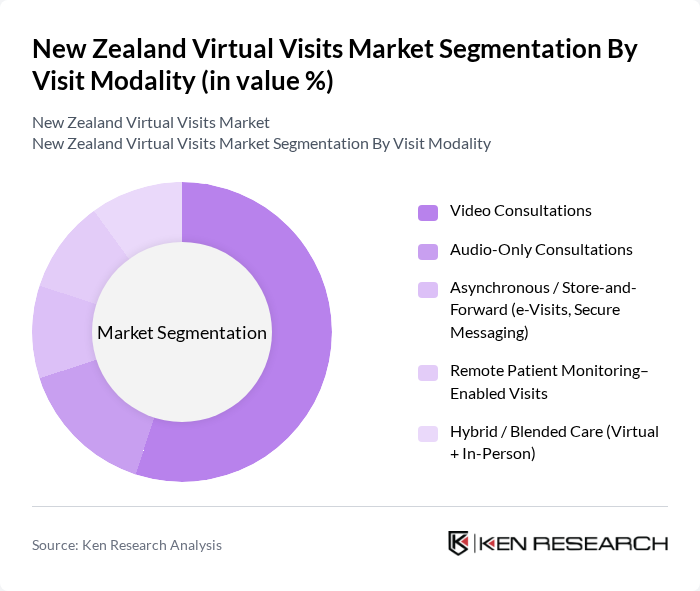
New Zealand Virtual Visits Market Segmentation
By Visit Modality:The segmentation by visit modality includes various methods through which virtual consultations are conducted. The subsegments include Video Consultations, Audio-Only Consultations, Asynchronous / Store-and-Forward (e-Visits, Secure Messaging), Remote Patient Monitoring–Enabled Visits, and Hybrid / Blended Care (Virtual + In-Person). Video Consultations dominate the market due to their ability to provide real-time interaction, which enhances patient engagement and satisfaction, and are the primary mode referenced in New Zealand telehealth guidance and clinical standards. The convenience and effectiveness of video consultations, supported by widespread broadband availability and secure clinical platforms, have led to their widespread adoption among healthcare providers and patients alike.
By Clinical Application:The clinical application segmentation encompasses various healthcare services delivered through virtual visits. This includes Primary and Urgent Care, Specialist Care (e.g., Cardiology, Dermatology), Mental Health and Behavioral Health, Chronic Disease Management, and Post-Operative and Follow-Up Care. Mental Health and Behavioral Health services are currently leading this segment, supported by strong telepsychiatry and online counselling uptake and policy emphasis on improving access to mental health support. Increasing awareness of mental health issues, combined with the convenience and privacy of accessing therapy and counseling services online, has reinforced growth in this subsegment and aligns with global virtual behavioural health trends.

New Zealand Virtual Visits Market Competitive Landscape
The New Zealand Virtual Visits Market is characterized by a dynamic mix of regional and international players. Leading participants such as HealthTap, Zoom Video Communications, Doxy.me, Teladoc Health, Medgate, MyTelemedicine, Doctor On Demand, Healthdirect Australia, Coviu, Practo, Push Health, Maven Clinic, Amwell, SimplePractice, Livi (Kry International) contribute to innovation, geographic expansion, and service delivery in this space. New Zealand providers and health systems also increasingly integrate global telehealth platforms and video solutions into local primary care networks and after-hours services to expand access and support 24/7 virtual care options.
New Zealand Virtual Visits Market Industry Analysis
Growth Drivers
- Increased Demand for Remote Healthcare Services:The New Zealand healthcare system has seen a significant rise in demand for remote healthcare services, with over 1.5 million virtual consultations conducted in the future. This surge is driven by the need for accessible healthcare, especially in light of the COVID-19 pandemic, which highlighted the importance of remote services. The Ministry of Health reported a 30% increase in telehealth usage, indicating a strong consumer preference for virtual visits as a viable alternative to in-person consultations.
- Technological Advancements in Communication Tools:The proliferation of advanced communication technologies has facilitated the growth of virtual visits in New Zealand. In the future, it is estimated that 85% of the population will have access to high-speed internet, enabling seamless video consultations. Additionally, the adoption of secure platforms for telehealth has increased, with 70% of healthcare providers utilizing encrypted communication tools, ensuring patient confidentiality and enhancing trust in virtual healthcare services.
- Government Support for Digital Health Initiatives:The New Zealand government has actively promoted digital health initiatives, allocating NZD 50 million in the future to enhance telehealth infrastructure. This funding supports the development of user-friendly platforms and training for healthcare professionals. Furthermore, the government’s commitment to improving healthcare access in rural areas, where around 14% of the population resides, has led to increased investment in telehealth services, fostering a more inclusive healthcare environment.
Market Challenges
- Data Privacy and Security Concerns:Data privacy remains a significant challenge in the New Zealand virtual visits market, with 60% of consumers expressing concerns about the security of their personal health information. The Health Information Privacy Code mandates strict compliance, yet breaches can lead to severe penalties. In the future, there were 15 reported data breaches in healthcare, highlighting the need for robust security measures to protect sensitive patient data and maintain trust in virtual services.
- Limited Internet Connectivity in Rural Areas:Despite advancements, approximately 20% of rural households in New Zealand still lack reliable internet access, hindering the effectiveness of virtual visits. The Digital Strategy for Aotearoa aims to address this issue, but as of the future, only 60% of rural areas have access to high-speed broadband. This connectivity gap poses a barrier to equitable healthcare access, particularly for vulnerable populations who rely on telehealth services for essential medical care.
New Zealand Virtual Visits Market Future Outlook
The future of the New Zealand virtual visits market appears promising, driven by ongoing technological advancements and increasing consumer acceptance. As healthcare providers continue to integrate telehealth into their services, the focus will shift towards enhancing user experience and accessibility. The rise of hybrid healthcare models, combining in-person and virtual visits, is expected to gain traction, catering to diverse patient needs. Additionally, the emphasis on mental health services will likely expand, reflecting a growing societal awareness of mental well-being and the importance of accessible care.
Market Opportunities
- Expansion of Telehealth Services:The ongoing expansion of telehealth services presents a significant opportunity for growth. With an estimated 1.2 million New Zealanders utilizing telehealth in the future, healthcare providers can capitalize on this trend by offering specialized virtual services, particularly in mental health and chronic disease management, to meet the evolving needs of patients.
- Integration of AI and Machine Learning:The integration of AI and machine learning into virtual visits can enhance diagnostic accuracy and patient engagement. By the future, it is projected that 40% of healthcare providers will adopt AI-driven tools, improving clinical decision-making and personalizing patient care. This technological advancement can significantly streamline operations and enhance the overall patient experience in virtual healthcare.
Scope of the Report
| Segment | Sub-Segments |
|---|---|
| By Visit Modality | Video Consultations Audio-Only Consultations Asynchronous / Store-and-Forward (e-Visits, Secure Messaging) Remote Patient Monitoring–Enabled Visits Hybrid / Blended Care (Virtual + In-Person) |
| By Clinical Application | Primary and Urgent Care Specialist Care (e.g., Cardiology, Dermatology) Mental Health and Behavioral Health Chronic Disease Management Post-Operative and Follow-Up Care |
| By End-User Type | District Health Boards / Te Whatu Ora – Health New Zealand Primary Health Organisations (PHOs) and General Practices Private Hospitals and Specialist Clinics Employers and Corporate Wellness Programs Individual Self-Pay Consumers |
| By Technology Platform | Web-Based Portals Mobile Health Applications Integrated EMR / Practice Management Systems Cloud-Based Virtual Care Platforms Telehealth Kiosks and Peripheral Devices |
| By Care Setting | Home-Based Virtual Visits Community and Primary Care Settings Hospital and Outpatient Settings Aged Care and Long-Term Care Facilities School and Workplace Clinics |
| By Payment and Reimbursement Model | Publicly Funded (ACC, Te Whatu Ora, Other Government Schemes) Private Health Insurance Reimbursement Employer-Funded / Occupational Health Direct-to-Consumer Out-of-Pocket Capitated and Value-Based Contracts |
| By Region in New Zealand | North Island – Major Urban Centres (e.g., Auckland, Wellington) North Island – Regional and Rural Areas South Island – Major Urban Centres (e.g., Christchurch, Dunedin) South Island – Regional and Rural Areas Remote and Underserved Communities |
Key Target Audience
Investors and Venture Capitalist Firms
Government and Regulatory Bodies (e.g., New Zealand Ministry of Business, Innovation and Employment)
Tourism Operators and Agencies
Healthcare Providers and Telehealth Services
Real Estate Developers and Agencies
Event Organizers and Conference Planners
Technology Providers and Software Developers
Telecommunications Companies
Players Mentioned in the Report:
HealthTap
Zoom Video Communications
Doxy.me
Teladoc Health
Medgate
MyTelemedicine
Doctor On Demand
Healthdirect Australia
Coviu
Practo
Push Health
Maven Clinic
Amwell
SimplePractice
Livi (Kry International)
Table of Contents
Market Assessment Phase
1. Executive Summary and Approach
2. New Zealand Virtual Visits Market Overview
2.1 Key Insights and Strategic Recommendations
2.2 New Zealand Virtual Visits Market Overview
2.3 Definition and Scope
2.4 Evolution of Market Ecosystem
2.5 Timeline of Key Regulatory Milestones
2.6 Value Chain & Stakeholder Mapping
2.7 Business Cycle Analysis
2.8 Policy & Incentive Landscape
3. New Zealand Virtual Visits Market Analysis
3.1 Growth Drivers
3.1.1 Increased Demand for Remote Healthcare Services
3.1.2 Technological Advancements in Communication Tools
3.1.3 Rising Consumer Preference for Convenience
3.1.4 Government Support for Digital Health Initiatives
3.2 Market Challenges
3.2.1 Data Privacy and Security Concerns
3.2.2 Limited Internet Connectivity in Rural Areas
3.2.3 Resistance to Change from Traditional Practices
3.2.4 Regulatory Compliance Issues
3.3 Market Opportunities
3.3.1 Expansion of Telehealth Services
3.3.2 Integration of AI and Machine Learning
3.3.3 Partnerships with Healthcare Providers
3.3.4 Development of User-Friendly Platforms
3.4 Market Trends
3.4.1 Growth of Hybrid Healthcare Models
3.4.2 Increasing Use of Wearable Health Technology
3.4.3 Focus on Patient-Centric Care
3.4.4 Rise of Virtual Mental Health Services
3.5 Government Regulation
3.5.1 Telehealth Licensing Requirements
3.5.2 Data Protection Regulations
3.5.3 Reimbursement Policies for Virtual Visits
3.5.4 Standards for Telehealth Services
4. SWOT Analysis
5. Stakeholder Analysis
6. Porter's Five Forces Analysis
7. New Zealand Virtual Visits Market Market Size, 2019-2024
7.1 By Value
7.2 By Volume
7.3 By Average Selling Price
8. New Zealand Virtual Visits Market Segmentation
8.1 By Visit Modality
8.1.1 Video Consultations
8.1.2 Audio-Only Consultations
8.1.3 Asynchronous / Store-and-Forward (e-Visits, Secure Messaging)
8.1.4 Remote Patient Monitoring–Enabled Visits
8.1.5 Hybrid / Blended Care (Virtual + In-Person)
8.2 By Clinical Application
8.2.1 Primary and Urgent Care
8.2.2 Specialist Care (e.g., Cardiology, Dermatology)
8.2.3 Mental Health and Behavioral Health
8.2.4 Chronic Disease Management
8.2.5 Post-Operative and Follow-Up Care
8.3 By End-User Type
8.3.1 District Health Boards / Te Whatu Ora – Health New Zealand
8.3.2 Primary Health Organisations (PHOs) and General Practices
8.3.3 Private Hospitals and Specialist Clinics
8.3.4 Employers and Corporate Wellness Programs
8.3.5 Individual Self-Pay Consumers
8.4 By Technology Platform
8.4.1 Web-Based Portals
8.4.2 Mobile Health Applications
8.4.3 Integrated EMR / Practice Management Systems
8.4.4 Cloud-Based Virtual Care Platforms
8.4.5 Telehealth Kiosks and Peripheral Devices
8.5 By Care Setting
8.5.1 Home-Based Virtual Visits
8.5.2 Community and Primary Care Settings
8.5.3 Hospital and Outpatient Settings
8.5.4 Aged Care and Long-Term Care Facilities
8.5.5 School and Workplace Clinics
8.6 By Payment and Reimbursement Model
8.6.1 Publicly Funded (ACC, Te Whatu Ora, Other Government Schemes)
8.6.2 Private Health Insurance Reimbursement
8.6.3 Employer-Funded / Occupational Health
8.6.4 Direct-to-Consumer Out-of-Pocket
8.6.5 Capitated and Value-Based Contracts
8.7 By Region in New Zealand
8.7.1 North Island – Major Urban Centres (e.g., Auckland, Wellington)
8.7.2 North Island – Regional and Rural Areas
8.7.3 South Island – Major Urban Centres (e.g., Christchurch, Dunedin)
8.7.4 South Island – Regional and Rural Areas
8.7.5 Remote and Underserved Communities
9. New Zealand Virtual Visits Market Competitive Analysis
9.1 Market Share of Key Players
9.2 Cross Comparison of Key Players
9.2.1 Company Name
9.2.2 Scale of Operations in New Zealand (National, Regional, Local)
9.2.3 Number of Active Users / Registered Patients
9.2.4 Number of Partner Providers / Clinics
9.2.5 Annual Virtual Visit Volume
9.2.6 Customer Acquisition Cost (CAC)
9.2.7 Average Revenue Per User (ARPU)
9.2.8 Customer Retention / Churn Rate
9.2.9 EBITDA Margin / Operating Margin
9.2.10 Net Promoter Score (NPS)
9.2.11 Average Visit Completion Time and First-Contact Resolution Rate
9.2.12 Technology Uptime / Service-Level Performance
9.3 SWOT Analysis of Top Players
9.4 Pricing Analysis
9.5 Detailed Profile of Major Companies
9.5.1 HealthTap
9.5.2 Zoom Video Communications
9.5.3 Doxy.me
9.5.4 Teladoc Health
9.5.5 Medgate
9.5.6 MyTelemedicine
9.5.7 Doctor On Demand
9.5.8 Healthdirect Australia
9.5.9 Coviu
9.5.10 Practo
9.5.11 Push Health
9.5.12 Maven Clinic
9.5.13 Amwell
9.5.14 SimplePractice
9.5.15 Livi (Kry International)
10. New Zealand Virtual Visits Market End-User Analysis
10.1 Procurement Behavior of Key Ministries
10.1.1 Ministry of Health
10.1.2 Ministry of Education
10.1.3 Ministry of Social Development
10.1.4 Ministry of Business, Innovation and Employment
10.2 Corporate Spend on Infrastructure & Energy
10.2.1 Investment in Telehealth Infrastructure
10.2.2 Budget Allocation for Digital Health Initiatives
10.2.3 Expenditure on Training and Development
10.2.4 Funding for Research and Development
10.3 Pain Point Analysis by End-User Category
10.3.1 Patients
10.3.2 Healthcare Providers
10.3.3 Insurance Companies
10.3.4 Employers
10.4 User Readiness for Adoption
10.4.1 Awareness of Virtual Visit Options
10.4.2 Technical Proficiency of Users
10.4.3 Accessibility of Technology
10.4.4 Willingness to Pay for Services
10.5 Post-Deployment ROI and Use Case Expansion
10.5.1 Measurement of Cost Savings
10.5.2 User Satisfaction Metrics
10.5.3 Expansion of Service Offerings
10.5.4 Long-Term Engagement Strategies
11. New Zealand Virtual Visits Market Future Size, 2025-2030
11.1 By Value
11.2 By Volume
11.3 By Average Selling Price
Go-To-Market Strategy Phase
1. Whitespace Analysis + Business Model Canvas
1.1 Market Gaps Identification
1.2 Value Proposition Development
1.3 Revenue Streams Analysis
1.4 Cost Structure Evaluation
1.5 Key Partnerships Exploration
1.6 Customer Segmentation
1.7 Channels of Distribution
2. Marketing and Positioning Recommendations
2.1 Branding Strategies
2.2 Product USPs
2.3 Target Audience Identification
2.4 Communication Strategy
2.5 Digital Marketing Tactics
2.6 Offline Marketing Approaches
2.7 Performance Metrics
3. Distribution Plan
3.1 Urban Retail vs Rural NGO Tie-Ups
3.2 Online Distribution Channels
3.3 Partnerships with Local Providers
3.4 Logistics and Supply Chain Management
3.5 Customer Service Framework
3.6 Feedback Mechanisms
3.7 Distribution Cost Analysis
4. Channel & Pricing Gaps
4.1 Underserved Routes
4.2 Pricing Bands
4.3 Competitor Pricing Analysis
4.4 Customer Willingness to Pay
4.5 Value-Based Pricing Strategies
4.6 Discount and Promotion Strategies
4.7 Pricing Model Evaluation
5. Unmet Demand & Latent Needs
5.1 Category Gaps
5.2 Consumer Segments
5.3 Emerging Trends Analysis
5.4 Customer Feedback Insights
5.5 Future Demand Projections
5.6 Product Development Opportunities
5.7 Market Entry Barriers
6. Customer Relationship
6.1 Loyalty Programs
6.2 After-Sales Service
6.3 Customer Engagement Strategies
6.4 Feedback and Improvement Processes
6.5 Community Building Initiatives
6.6 Customer Education and Training
6.7 Relationship Management Tools
7. Value Proposition
7.1 Sustainability
7.2 Integrated Supply Chains
7.3 Unique Selling Points
7.4 Customer-Centric Innovations
7.5 Competitive Advantages
7.6 Market Differentiation Strategies
7.7 Value Communication Techniques
8. Key Activities
8.1 Regulatory Compliance
8.2 Branding
8.3 Distribution Setup
8.4 Training and Development
8.5 Technology Integration
8.6 Performance Monitoring
8.7 Stakeholder Engagement
9. Entry Strategy Evaluation
9.1 Domestic Market Entry Strategy
9.1.1 Product Mix
9.1.2 Pricing Band
9.1.3 Packaging
9.2 Export Entry Strategy
9.2.1 Target Countries
9.2.2 Compliance Roadmap
10. Entry Mode Assessment
10.1 JV
10.2 Greenfield
10.3 M&A
10.4 Distributor Model
11. Capital and Timeline Estimation
11.1 Capital Requirements
11.2 Timelines
12. Control vs Risk Trade-Off
12.1 Ownership vs Partnerships
13. Profitability Outlook
13.1 Breakeven Analysis
13.2 Long-Term Sustainability
14. Potential Partner List
14.1 Distributors
14.2 JVs
14.3 Acquisition Targets
15. Execution Roadmap
15.1 Phased Plan for Market Entry
15.1.1 Market Setup
15.1.2 Market Entry
15.1.3 Growth Acceleration
15.1.4 Scale & Stabilize
15.2 Key Activities and Milestones
15.2.1 Milestone Planning
15.2.2 Activity Tracking
Research Methodology
Phase 1: Approach1
Desk Research
- Analysis of government reports on tourism and virtual experiences in New Zealand
- Review of industry publications and market analysis reports specific to virtual visits
- Examination of demographic and psychographic data from Statistics New Zealand
Primary Research
- Interviews with key stakeholders in the tourism and virtual experience sectors
- Surveys targeting consumers who have participated in virtual visits
- Focus groups with travel agencies and virtual tour providers to gather insights
Validation & Triangulation
- Cross-validation of findings with existing market data and trends
- Triangulation of insights from primary interviews and secondary research sources
- Sanity checks through expert reviews from industry professionals
Phase 2: Market Size Estimation1
Top-down Assessment
- Estimation of market size based on overall tourism revenue and virtual visit penetration rates
- Segmentation of the market by type of virtual experience (e.g., cultural, adventure, educational)
- Incorporation of growth trends in digital engagement and technology adoption
Bottom-up Modeling
- Collection of data on the number of virtual visits conducted by leading providers
- Estimation of average revenue per virtual visit based on pricing models
- Calculation of total market size by aggregating firm-level data
Forecasting & Scenario Analysis
- Multi-factor analysis considering technological advancements and consumer behavior shifts
- Scenario modeling based on potential impacts of global events on tourism
- Development of baseline, optimistic, and pessimistic forecasts through 2030
Phase 3: CATI Sample Composition1
| Scope Item/Segment | Sample Size | Target Respondent Profiles |
|---|---|---|
| Virtual Cultural Tours | 100 | Tourism Managers, Cultural Heritage Experts |
| Adventure Virtual Experiences | 80 | Outdoor Activity Coordinators, Adventure Tour Operators |
| Educational Virtual Visits | 70 | Educators, School Administrators |
| Corporate Virtual Team Building | 60 | HR Managers, Corporate Event Planners |
| Consumer Feedback on Virtual Visits | 90 | General Consumers, Frequent Travelers |
Frequently Asked Questions
What is the current value of the New Zealand Virtual Visits Market?
The New Zealand Virtual Visits Market is valued at approximately USD 0.7 billion, reflecting significant growth driven by the adoption of telehealth services and advancements in digital health technologies, particularly accelerated by the COVID-19 pandemic.
Which cities are the key players in the New Zealand Virtual Visits Market?
What are the main modalities of virtual visits in New Zealand?
How has the COVID-19 pandemic impacted virtual visits in New Zealand?
Other Regional/Country Reports
Other Adjacent Reports
Japan Hybrid Care Solutions Market
Why Buy From Us?

What makes us stand out is that our consultants follow Robust, Refine and Result (RRR) methodology. Robust for clear definitions, approaches and sanity checking, Refine for differentiating respondents' facts and opinions, and Result for presenting data with story.

We have set a benchmark in the industry by offering our clients with syndicated and customized market research reports featuring coverage of entire market as well as meticulous research and analyst insights.

While we don't replace traditional research, we flip the method upside down. Our dual approach of Top Bottom & Bottom Top ensures quality deliverable by not just verifying company fundamentals but also looking at the sector and macroeconomic factors.

With one step in the future, our research team constantly tries to show you the bigger picture. We help with some of the tough questions you may encounter along the way: How is the industry positioned? Best marketing channel? KPI's of competitors? By aligning every element, we help maximize success.

Our report gives you instant access to the answers and sources that other companies might choose to hide. We elaborate each steps of research methodology we have used and showcase you the sample size to earn your trust.

If you need any support, we are here! We pride ourselves on universe strength, data quality, and quick, friendly, and professional service.