About the Report
Base Year 2024Bahrain Wearable Computing Market Overview
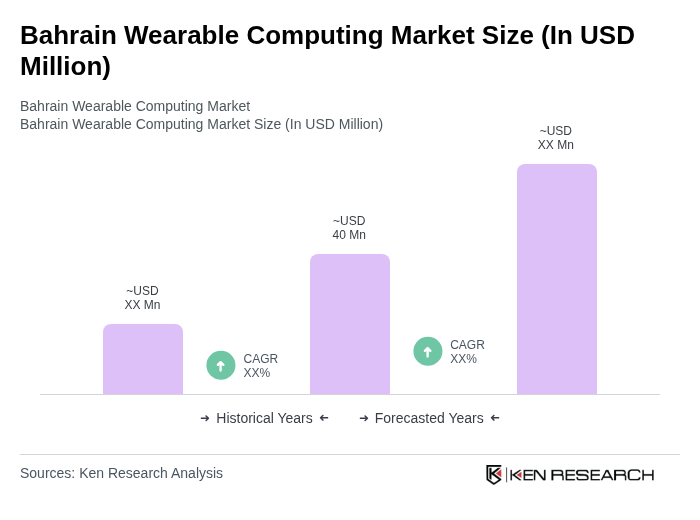
- The Bahrain Wearable Computing Market is valued at USD 40 million, based on a five-year historical analysis and alignment with recent Bahrain IoT wearable and wearable medical device market assessments. This growth is primarily driven by increasing health awareness, technological advancements, and the rising adoption of smart devices among consumers. The demand for wearables, particularly smartwatches and fitness trackers, has surged as individuals seek to monitor their health and fitness levels more effectively, supported by a broader shift toward preventive healthcare and personalized health data in Bahrain and the wider Middle East wearable technology market.
- Key demand clusters in this market include Manama, the capital city, which serves as a hub for technology, healthcare, and innovation, and other urban areas like Muharraq and Riffa. The concentration of affluent consumers, higher penetration of connected devices, and a growing interest in health and fitness technology contribute to the dominance of these cities in the wearable computing and wearable medical devices market.
- Regulation of wearable health technology in Bahrain is framed within the health data and medical devices regime, including instruments such as the Personal Data Protection Law (Law No. 30 of 2018) overseen by the Personal Data Protection Authority and the National Health Regulatory Authority (NHRA) guidelines for classification, registration, and licensing of medical devices used for patient monitoring. These frameworks set requirements on data processing consent, security safeguards, and approval/registration of wearable medical and diagnostic devices used by healthcare providers, supporting integration of remote monitoring and telehealth solutions into patient care in Bahrain.
Bahrain Wearable Computing Market Segmentation
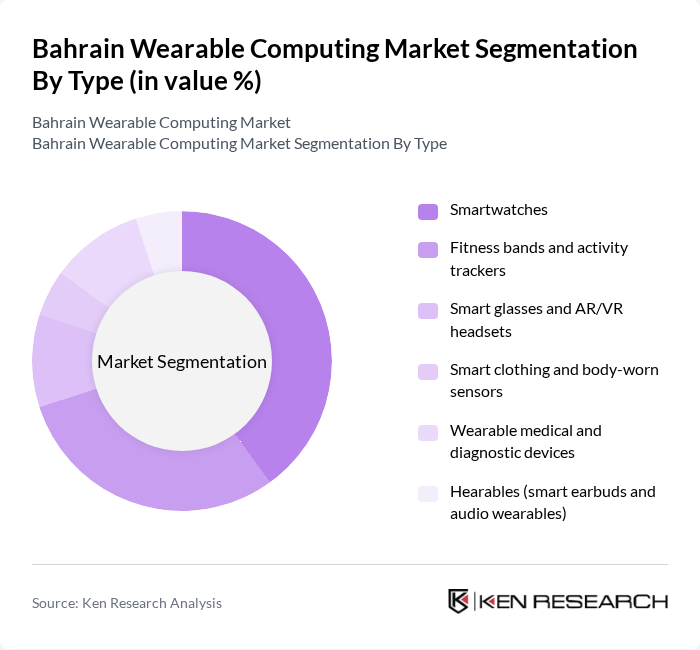
By Type:The wearable computing market can be segmented into various types, including smartwatches, fitness bands and activity trackers, smart glasses and AR/VR headsets, smart clothing and body-worn sensors, wearable medical and diagnostic devices, and hearables (smart earbuds and audio wearables). Among these, smartwatches and fitness bands are the most popular due to their multifunctionality, integration with smartphones, and health-tracking features such as heart-rate, SpO?, sleep, and activity monitoring, which appeal to a broad consumer base focused on fitness and preventive healthcare.
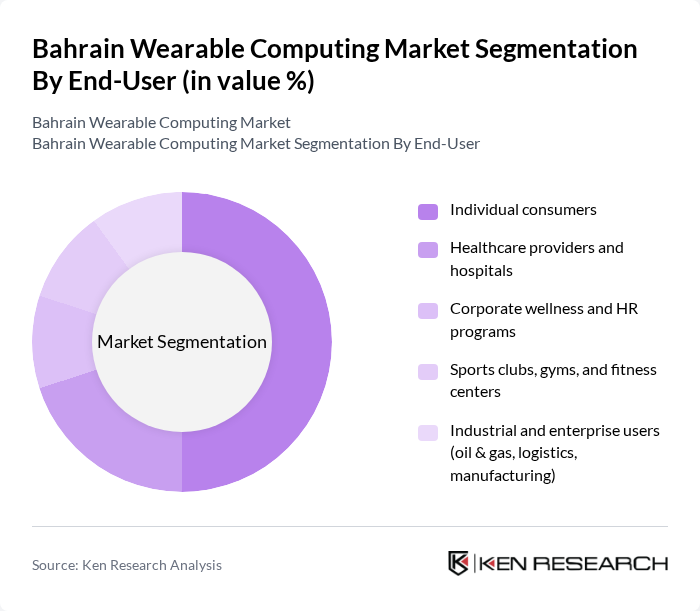
By End-User:The end-user segmentation includes individual consumers, healthcare providers and hospitals, corporate wellness and HR programs, sports clubs, gyms, and fitness centers, and industrial and enterprise users (oil and gas, logistics, manufacturing). Individual consumers dominate the market, driven by increasing health consciousness, broader smartphone and internet penetration, and the desire for personal fitness and wellness tracking, while healthcare providers increasingly adopt wearable medical and diagnostic devices for remote patient monitoring and chronic disease management.
Bahrain Wearable Computing Market Competitive Landscape
The Bahrain Wearable Computing Market is characterized by a dynamic mix of regional and international players. Leading participants such as Apple Inc., Samsung Electronics Co., Ltd., Huawei Technologies Co., Ltd., Xiaomi Corporation, Garmin Ltd., Fitbit LLC (Google LLC), Google LLC (including Pixel Watch), Fossil Group, Inc., Sony Group Corporation, Amazfit (Zepp Health Corporation), Polar Electro Oy, Suunto Oy, Jabra (GN Audio A/S), Huawei Consumer Business Group – Middle East & Africa, Batelco (Bahrain Telecommunications Company) – local wearable distribution partner contribute to innovation, geographic expansion, and service delivery in this space, with distribution through telecom operators, electronics retail, and e?commerce channels across Bahrain.
Bahrain Wearable Computing Market Industry Analysis
Growth Drivers
- Increasing Health Consciousness Among Consumers:The health and wellness market in Bahrain is projected to reach approximately $1.2 billion in future, driven by a growing awareness of fitness and preventive healthcare. This trend is reflected in the rising sales of wearable devices, with a reported increase of 15% in unit sales in future. Consumers are increasingly seeking devices that monitor health metrics, such as heart rate and sleep patterns, contributing to the demand for innovative wearable technology.
- Technological Advancements in Wearable Devices:The Bahrain wearable technology sector is benefiting from rapid advancements in technology, with the number of connected wearable devices expected to exceed 1.5 million in future. Innovations such as improved sensors, enhanced connectivity, and miniaturization of components are making wearables more appealing. The integration of features like GPS and health monitoring capabilities is driving consumer interest, leading to a projected increase in market penetration of 20% annually.
- Rising Demand for Fitness Tracking Solutions:The fitness tracking segment in Bahrain is experiencing significant growth, with an estimated market value of $300 million in future. This surge is attributed to the increasing number of fitness enthusiasts and the popularity of health-focused lifestyles. Wearable fitness trackers are becoming essential tools for individuals aiming to monitor their physical activity, leading to a 25% increase in sales of fitness wearables in the past year alone.
Market Challenges
- High Cost of Advanced Wearable Devices:The average price of high-end wearable devices in Bahrain is around $250, which can be a barrier for many consumers. Despite the growing interest in wearables, the high initial investment required for advanced features limits accessibility. This challenge is compounded by the economic conditions, where disposable income growth is projected at only 3% in future, affecting consumer purchasing power.
- Data Privacy and Security Concerns:With the increasing use of wearable devices, data privacy has become a significant concern among consumers. A survey indicated that 60% of potential users in Bahrain are hesitant to adopt wearables due to fears of data breaches. The lack of robust data protection regulations in the region exacerbates this issue, leading to a potential slowdown in market growth as consumers prioritize their privacy over technology adoption.
Bahrain Wearable Computing Market Future Outlook
The Bahrain wearable computing market is poised for dynamic growth, driven by technological innovations and increasing health awareness. As consumers become more health-conscious, the demand for advanced wearable devices is expected to rise significantly. Additionally, the integration of artificial intelligence and IoT technologies will enhance user experiences, making wearables more functional and appealing. However, addressing data privacy concerns and reducing device costs will be crucial for sustaining this growth trajectory in the coming years.
Market Opportunities
- Expansion of E-commerce Platforms for Wearables:The growth of e-commerce in Bahrain, projected to reach $1 billion in future, presents a significant opportunity for wearable device manufacturers. Online platforms can facilitate wider distribution and accessibility, allowing consumers to explore various products and price points, thus driving sales and market penetration.
- Collaborations with Healthcare Providers:Partnerships between wearable technology companies and healthcare providers can enhance product credibility and adoption. With Bahrain's healthcare expenditure expected to rise to $3.5 billion in future, integrating wearables into health management programs can improve patient outcomes and create new revenue streams for manufacturers, fostering innovation in the sector.
Scope of the Report
| Segment | Sub-Segments |
|---|---|
| By Type | Smartwatches Fitness bands and activity trackers Smart glasses and AR/VR headsets Smart clothing and body-worn sensors Wearable medical and diagnostic devices Hearables (smart earbuds and audio wearables) |
| By End-User | Individual consumers Healthcare providers and hospitals Corporate wellness and HR programs Sports clubs, gyms, and fitness centers Industrial and enterprise users (oil & gas, logistics, manufacturing) |
| By Application | Health monitoring and chronic disease management Fitness and wellness tracking Navigation and location-based services Communication and notifications Enterprise productivity and safety (e.g., industrial wearables, AR support) |
| By Distribution Channel | Online retail and marketplaces Offline consumer electronics and telecom retailers Direct sales through telecom operators Enterprise and B2B channel partners OEM brand stores and regional distributors |
| By Price Range | Entry-level and budget wearables (< USD 100) Mid-range wearables (USD 100–300) Premium wearables (USD 300–600) Luxury and designer wearables (> USD 600) |
| By Technology | Bluetooth-enabled devices Wi?Fi-enabled devices Cellular-enabled devices (4G/5G eSIM) NFC and contactless payment-enabled devices GPS and GNSS-enabled devices |
| By User Demographics | Age group (Children, Youth, Adults, Seniors) Gender (Male, Female, Others) Income level (Mass, Affluent, High Net Worth) Lifestyle segment (Health-conscious, Tech?savvy, Professional, Sports/Outdoor) Nationality (Bahraini nationals, Expatriates) |
Key Target Audience
Investors and Venture Capitalist Firms
Government and Regulatory Bodies (e.g., Bahrain Economic Development Board, Ministry of Industry and Commerce)
Manufacturers and Producers
Distributors and Retailers
Healthcare Providers and Institutions
Telecommunications Companies
Insurance Companies
Technology Providers
Players Mentioned in the Report:
Apple Inc.
Samsung Electronics Co., Ltd.
Huawei Technologies Co., Ltd.
Xiaomi Corporation
Garmin Ltd.
Fitbit LLC (Google LLC)
Google LLC (including Pixel Watch)
Fossil Group, Inc.
Sony Group Corporation
Amazfit (Zepp Health Corporation)
Polar Electro Oy
Suunto Oy
Jabra (GN Audio A/S)
Huawei Consumer Business Group Middle East & Africa
Batelco (Bahrain Telecommunications Company) local wearable distribution partner
Table of Contents
Market Assessment Phase
1. Executive Summary and Approach
2. Bahrain Wearable Computing Market Overview
2.1 Key Insights and Strategic Recommendations
2.2 Bahrain Wearable Computing Market Overview
2.3 Definition and Scope
2.4 Evolution of Market Ecosystem
2.5 Timeline of Key Regulatory Milestones
2.6 Value Chain & Stakeholder Mapping
2.7 Business Cycle Analysis
2.8 Policy & Incentive Landscape
3. Bahrain Wearable Computing Market Analysis
3.1 Growth Drivers
3.1.1 Increasing health consciousness among consumers
3.1.2 Technological advancements in wearable devices
3.1.3 Rising demand for fitness tracking solutions
3.1.4 Growth in mobile health applications
3.2 Market Challenges
3.2.1 High cost of advanced wearable devices
3.2.2 Data privacy and security concerns
3.2.3 Limited battery life of devices
3.2.4 Lack of interoperability among devices
3.3 Market Opportunities
3.3.1 Expansion of e-commerce platforms for wearables
3.3.2 Collaborations with healthcare providers
3.3.3 Development of niche wearable products
3.3.4 Increasing adoption of IoT in wearables
3.4 Market Trends
3.4.1 Growth of smart clothing and textiles
3.4.2 Integration of AI in wearable technology
3.4.3 Rise of augmented reality wearables
3.4.4 Focus on sustainability in product design
3.5 Government Regulation
3.5.1 Compliance with health and safety standards
3.5.2 Data protection regulations
3.5.3 Import/export regulations for electronic devices
3.5.4 Incentives for local manufacturing of wearables
4. SWOT Analysis
5. Stakeholder Analysis
6. Porter's Five Forces Analysis
7. Bahrain Wearable Computing Market Market Size, 2019-2024
7.1 By Value
7.2 By Volume
7.3 By Average Selling Price
8. Bahrain Wearable Computing Market Segmentation
8.1 By Type
8.1.1 Smartwatches
8.1.2 Fitness bands and activity trackers
8.1.3 Smart glasses and AR/VR headsets
8.1.4 Smart clothing and body-worn sensors
8.1.5 Wearable medical and diagnostic devices
8.1.6 Hearables (smart earbuds and audio wearables)
8.2 By End-User
8.2.1 Individual consumers
8.2.2 Healthcare providers and hospitals
8.2.3 Corporate wellness and HR programs
8.2.4 Sports clubs, gyms, and fitness centers
8.2.5 Industrial and enterprise users (oil & gas, logistics, manufacturing)
8.3 By Application
8.3.1 Health monitoring and chronic disease management
8.3.2 Fitness and wellness tracking
8.3.3 Navigation and location-based services
8.3.4 Communication and notifications
8.3.5 Enterprise productivity and safety (e.g., industrial wearables, AR support)
8.4 By Distribution Channel
8.4.1 Online retail and marketplaces
8.4.2 Offline consumer electronics and telecom retailers
8.4.3 Direct sales through telecom operators
8.4.4 Enterprise and B2B channel partners
8.4.5 OEM brand stores and regional distributors
8.5 By Price Range
8.5.1 Entry-level and budget wearables (< USD 100)
8.5.2 Mid-range wearables (USD 100–300)
8.5.3 Premium wearables (USD 300–600)
8.5.4 Luxury and designer wearables (> USD 600)
8.6 By Technology
8.6.1 Bluetooth-enabled devices
8.6.2 Wi?Fi-enabled devices
8.6.3 Cellular-enabled devices (4G/5G eSIM)
8.6.4 NFC and contactless payment-enabled devices
8.6.5 GPS and GNSS-enabled devices
8.7 By User Demographics
8.7.1 Age group (Children, Youth, Adults, Seniors)
8.7.2 Gender (Male, Female, Others)
8.7.3 Income level (Mass, Affluent, High Net Worth)
8.7.4 Lifestyle segment (Health-conscious, Tech?savvy, Professional, Sports/Outdoor)
8.7.5 Nationality (Bahraini nationals, Expatriates)
9. Bahrain Wearable Computing Market Competitive Analysis
9.1 Market Share of Key Players
9.2 Cross Comparison of Key Players
9.2.1 Company name and headquarters region
9.2.2 Scale of operations in Bahrain (local presence, via distributor, via e?commerce)
9.2.3 Bahrain wearable revenue and 3?year CAGR
9.2.4 Product portfolio breadth (type and application coverage)
9.2.5 Market share in Bahrain by shipments/value
9.2.6 Average selling price positioning in Bahrain
9.2.7 Channel mix (online, telecom operator, retail, B2B)
9.2.8 Installed base / active users in Bahrain
9.2.9 Partnership footprint (telcos, retailers, healthcare, enterprise)
9.2.10 R&D and innovation intensity (features, health metrics, localization)
9.3 SWOT Analysis of Top Players
9.4 Pricing Analysis
9.5 Detailed Profile of Major Companies
9.5.1 Apple Inc.
9.5.2 Samsung Electronics Co., Ltd.
9.5.3 Huawei Technologies Co., Ltd.
9.5.4 Xiaomi Corporation
9.5.5 Garmin Ltd.
9.5.6 Fitbit LLC (Google LLC)
9.5.7 Google LLC (including Pixel Watch)
9.5.8 Fossil Group, Inc.
9.5.9 Sony Group Corporation
9.5.10 Amazfit (Zepp Health Corporation)
9.5.11 Polar Electro Oy
9.5.12 Suunto Oy
9.5.13 Jabra (GN Audio A/S)
9.5.14 Huawei Consumer Business Group – Middle East & Africa
9.5.15 Batelco (Bahrain Telecommunications Company) – local wearable distribution partner
10. Bahrain Wearable Computing Market End-User Analysis
10.1 Procurement Behavior of Key Ministries
10.1.1 Budget allocation for wearable technology
10.1.2 Decision-making processes
10.1.3 Evaluation criteria for procurement
10.1.4 Supplier selection preferences
10.2 Corporate Spend on Infrastructure & Energy
10.2.1 Investment in wearable technology
10.2.2 Budget trends in corporate wellness
10.2.3 Spending on health monitoring solutions
10.2.4 Future spending projections
10.3 Pain Point Analysis by End-User Category
10.3.1 Challenges faced by individual consumers
10.3.2 Issues for healthcare providers
10.3.3 Corporate challenges in adoption
10.3.4 Sports organizations' pain points
10.4 User Readiness for Adoption
10.4.1 Awareness of wearable technology
10.4.2 Willingness to invest in wearables
10.4.3 Perceived benefits of wearables
10.4.4 Barriers to adoption
10.5 Post-Deployment ROI and Use Case Expansion
10.5.1 Measurement of ROI from wearables
10.5.2 Expansion of use cases in organizations
10.5.3 Long-term benefits realization
10.5.4 User feedback and improvement cycles
11. Bahrain Wearable Computing Market Future Size, 2025-2030
11.1 By Value
11.2 By Volume
11.3 By Average Selling Price
Go-To-Market Strategy Phase
1. Whitespace Analysis + Business Model Canvas
1.1 Market gaps identification
1.2 Business model development
1.3 Value proposition analysis
1.4 Competitive landscape overview
1.5 Customer segmentation
1.6 Revenue stream identification
1.7 Cost structure analysis
2. Marketing and Positioning Recommendations
2.1 Branding strategies
2.2 Product USPs
2.3 Target audience identification
2.4 Marketing channels selection
2.5 Messaging and communication strategy
3. Distribution Plan
3.1 Urban retail strategies
3.2 Rural NGO tie-ups
3.3 Online distribution channels
3.4 Partnerships with local retailers
3.5 Logistics and supply chain considerations
4. Channel & Pricing Gaps
4.1 Underserved routes
4.2 Pricing bands analysis
4.3 Competitor pricing strategies
4.4 Consumer price sensitivity
4.5 Recommendations for pricing adjustments
5. Unmet Demand & Latent Needs
5.1 Category gaps identification
5.2 Consumer segments analysis
5.3 Emerging trends and needs
5.4 Recommendations for product development
6. Customer Relationship
6.1 Loyalty programs design
6.2 After-sales service strategies
6.3 Customer feedback mechanisms
6.4 Community engagement initiatives
6.5 Building brand advocates
7. Value Proposition
7.1 Sustainability initiatives
7.2 Integrated supply chains
7.3 Unique selling points of products
7.4 Customer-centric approach
7.5 Long-term value creation
8. Key Activities
8.1 Regulatory compliance
8.2 Branding efforts
8.3 Distribution setup
8.4 Marketing campaigns
8.5 Partnership development
9. Entry Strategy Evaluation
9.1 Domestic Market Entry Strategy
9.1.1 Product mix considerations
9.1.2 Pricing band analysis
9.1.3 Packaging strategies
9.2 Export Entry Strategy
9.2.1 Target countries identification
9.2.2 Compliance roadmap development
10. Entry Mode Assessment
10.1 Joint Ventures
10.2 Greenfield investments
10.3 Mergers & Acquisitions
10.4 Distributor Model evaluation
11. Capital and Timeline Estimation
11.1 Capital requirements analysis
11.2 Timelines for market entry
11.3 Resource allocation planning
12. Control vs Risk Trade-Off
12.1 Ownership considerations
12.2 Partnerships evaluation
12.3 Risk management strategies
13. Profitability Outlook
13.1 Breakeven analysis
13.2 Long-term sustainability strategies
13.3 Financial projections
14. Potential Partner List
14.1 Distributors identification
14.2 Joint Ventures opportunities
14.3 Acquisition targets analysis
15. Execution Roadmap
15.1 Phased Plan for Market Entry
15.1.1 Market Setup
15.1.2 Market Entry
15.1.3 Growth Acceleration
15.1.4 Scale & Stabilize
15.2 Key Activities and Milestones
15.2.1 Milestone planning
15.2.2 Activity tracking
15.2.3 Performance evaluation
Research Methodology
Phase 1: Approach1
Desk Research
- Market reports from industry associations and government publications on wearable technology trends in Bahrain
- Analysis of consumer behavior studies and technology adoption rates from local research firms
- Review of academic journals and white papers focusing on wearable computing applications in healthcare and fitness
Primary Research
- Interviews with key stakeholders in the wearable technology sector, including manufacturers and retailers
- Surveys conducted with end-users to gauge preferences, usage patterns, and satisfaction levels
- Focus group discussions with tech enthusiasts and health professionals to explore emerging trends and innovations
Validation & Triangulation
- Cross-validation of findings through comparison with international market trends and forecasts
- Triangulation of data from consumer surveys, expert interviews, and secondary research sources
- Sanity checks through feedback from industry experts and academic professionals in wearable technology
Phase 2: Market Size Estimation1
Top-down Assessment
- Estimation of market size based on Bahrain's overall technology spending and growth in the wearable segment
- Segmentation of the market by product type (fitness trackers, smartwatches, health monitors) and end-user demographics
- Incorporation of government initiatives promoting digital health and technology adoption in the region
Bottom-up Modeling
- Collection of sales data from leading wearable technology retailers and e-commerce platforms in Bahrain
- Estimation of average selling prices and unit sales volumes for various wearable devices
- Analysis of distribution channels and their impact on market penetration and growth rates
Forecasting & Scenario Analysis
- Development of predictive models using historical sales data and market growth indicators
- Scenario analysis based on potential regulatory changes and shifts in consumer preferences towards health and fitness
- Creation of multiple growth scenarios (baseline, optimistic, and pessimistic) through 2030
Phase 3: CATI Sample Composition1
| Scope Item/Segment | Sample Size | Target Respondent Profiles |
|---|---|---|
| Consumer Wearable Technology Adoption | 120 | Health-conscious Individuals, Tech-savvy Consumers |
| Healthcare Professionals' Insights | 90 | Doctors, Physiotherapists, Fitness Trainers |
| Retailer Perspectives on Wearable Sales | 70 | Store Managers, Sales Representatives |
| Corporate Wellness Program Implementers | 60 | HR Managers, Corporate Wellness Coordinators |
| Technology Enthusiasts and Influencers | 50 | Bloggers, Social Media Influencers, Tech Reviewers |
Frequently Asked Questions
What is the current value of the Bahrain Wearable Computing Market?
The Bahrain Wearable Computing Market is valued at approximately USD 40 million, reflecting a five-year historical analysis and recent assessments of the IoT wearable and wearable medical device sectors in Bahrain.
What factors are driving the growth of the wearable computing market in Bahrain?
Which cities in Bahrain are the primary demand clusters for wearable devices?
What types of wearable devices are most popular in Bahrain?
Other Regional/Country Reports
Indonesia Wearable Computing Market
Malaysia Wearable Computing Market
KSA Wearable Computing Market
APAC Wearable Computing Market
SEA Wearable Computing Market
Vietnam Wearable Computing Market
Other Adjacent Reports
Brazil Wearable Medical Device Market
Oman IoT Device Market
Global Africa Telehealth Market Report Size Share Growth Drivers Trends Opportunities & Forecast 2025–2030UAE Remote Patient Monitoring Market Size, Share, Growth Drivers, Trends, Opportunities & Forecast 2025–2030GCC Health Data Analytics Market Size, Share, Growth Drivers, Trends, Opportunities & Forecast 2025–2030Malaysia Augmented Reality Device Market
Qatar sports technology market Size, Share, Growth Drivers, Trends, Opportunities & Forecast 2025–2030New Zealand Consumer Electronics Market Size Share Growth Drivers Trends Opportunities & Forecast 2025–2030Why Buy From Us?

What makes us stand out is that our consultants follow Robust, Refine and Result (RRR) methodology. Robust for clear definitions, approaches and sanity checking, Refine for differentiating respondents' facts and opinions, and Result for presenting data with story.

We have set a benchmark in the industry by offering our clients with syndicated and customized market research reports featuring coverage of entire market as well as meticulous research and analyst insights.

While we don't replace traditional research, we flip the method upside down. Our dual approach of Top Bottom & Bottom Top ensures quality deliverable by not just verifying company fundamentals but also looking at the sector and macroeconomic factors.

With one step in the future, our research team constantly tries to show you the bigger picture. We help with some of the tough questions you may encounter along the way: How is the industry positioned? Best marketing channel? KPI's of competitors? By aligning every element, we help maximize success.

Our report gives you instant access to the answers and sources that other companies might choose to hide. We elaborate each steps of research methodology we have used and showcase you the sample size to earn your trust.

If you need any support, we are here! We pride ourselves on universe strength, data quality, and quick, friendly, and professional service.