Bahrain web 3 0 market report size, share, growth drivers, trends, opportunities & forecast 2025–2030

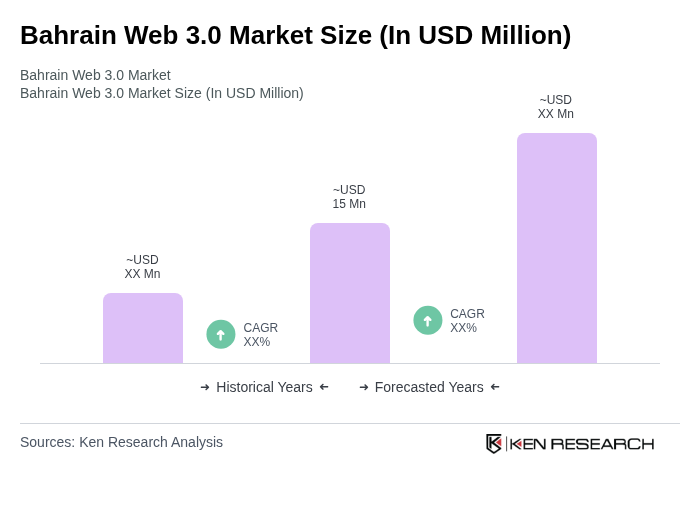
The Bahrain Web 3.0 Market, valued at USD 15 million, is growing due to blockchain innovation, regulatory support, and rising demand for DeFi and NFTs, positioning Bahrain as a regional hub.

Region:Middle East

Author(s):Shubham

Product Code:KRAA8895

Pages:86

Published On:November 2025
About the Report

Base Year 2024

Bahrain Web 3.0 Market Overview

  • The Bahrain Web 3.0 Market is valued at USD 15 million, based on a five-year historical analysis and regional blockchain adoption rates. This growth is primarily driven by the increasing adoption of blockchain technology, the rise of decentralized finance (DeFi), and the growing interest in non-fungible tokens (NFTs). The market is further supported by robust investments in digital infrastructure, a surge in digital asset trading, and the expansion of regulatory-compliant crypto exchanges in Bahrain .
  • Key players in this market include Bahrain, which has established itself as a regional hub for blockchain and fintech innovation. The country's strategic location, progressive government policies, and a growing number of tech startups contribute to its prominence in the Web 3.0 space. Manama, in particular, is recognized as a center for blockchain development, hosting several licensed crypto exchanges and digital asset service providers .
  • The Central Bank of Bahrain issued the “Crypto-Asset Module” under the Financial Institutions Rulebook, Volume 6, in 2019, establishing a comprehensive regulatory framework for digital asset activities. This framework includes licensing requirements for crypto-asset exchanges, guidelines for digital asset custody, anti-money laundering (AML) and counter-terrorist financing (CTF) obligations, and the operation of a regulatory sandbox to support fintech and Web 3.0 innovation .
Bahrain Web 3.0 Market Size

Bahrain Web 3.0 Market Segmentation

By Type:The market can be segmented into Decentralized Finance (DeFi), Non-Fungible Tokens (NFTs), Decentralized Autonomous Organizations (DAOs), Blockchain Infrastructure, and Public vs Private Platforms. Each segment is shaped by Bahrain’s regulatory clarity and the increasing participation of financial institutions and technology startups in decentralized applications and tokenized assets .
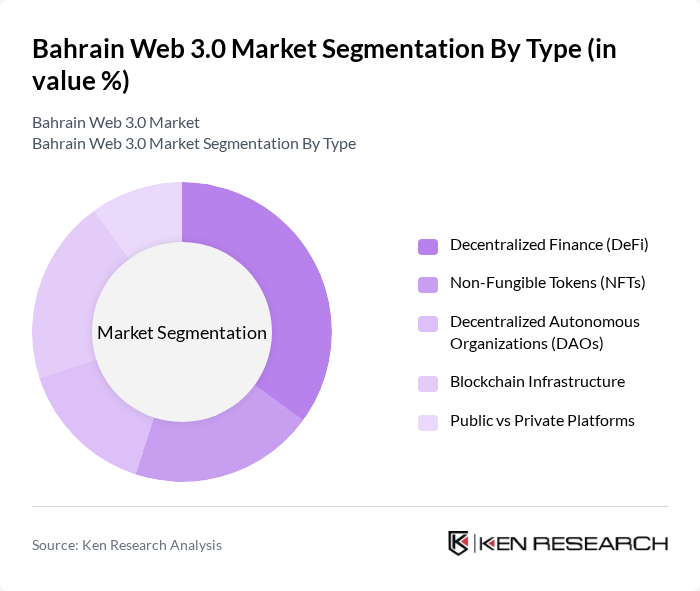
Bahrain Web 3.0 Market segmentation by Type.

By End-User:The end-user segmentation includes Financial Institutions, Technology Companies, Government Agencies, Educational Institutions, Retail & E-commerce, and Others. Financial institutions and technology companies are the primary adopters, leveraging Web 3.0 for digital asset management, payments, and compliance, while government agencies and educational institutions are increasingly exploring blockchain for secure record-keeping and credentialing .
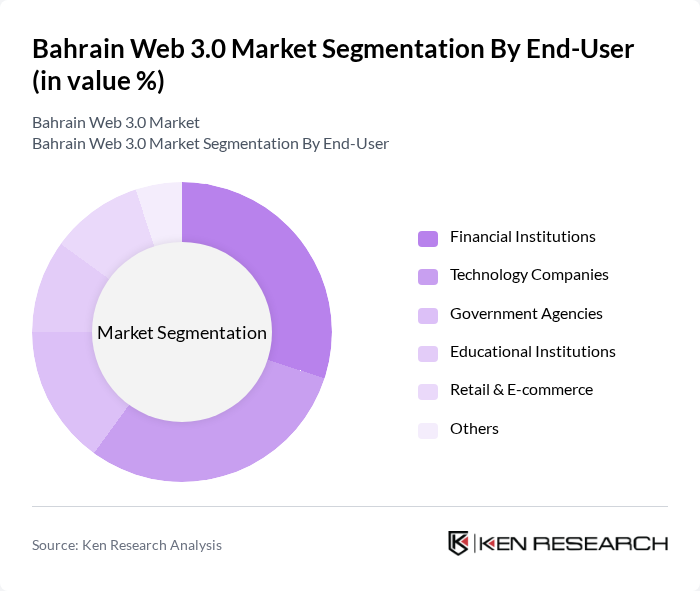
Bahrain Web 3.0 Market segmentation by End-User.

Bahrain Web 3.0 Market Competitive Landscape

The Bahrain Web 3.0 Market is characterized by a dynamic mix of regional and international players. Leading participants such as Rain Financial, CoinMENA, Binance Bahrain, BitOasis, Bittrex Global, Crypto.com, Kraken, eToro, Huobi, OKX, Bitfinex, Gemini, KuCoin, Poloniex, Bybit contribute to innovation, geographic expansion, and service delivery in this space.

Rain Financial

2017

Manama, Bahrain

CoinMENA

2019

Manama, Bahrain

Binance Bahrain

2020

Manama, Bahrain

BitOasis

2015

Dubai, UAE

Bittrex Global

2014

Seattle, USA

Company

Establishment Year

Headquarters

Group Size (Large, Medium, or Small as per industry convention)

Revenue Growth Rate (YoY %)

Customer Acquisition Cost (USD per user)

Market Penetration Rate (% of target market)

Customer Retention Rate (%)

Average Transaction Value (USD)

Bahrain Web 3.0 Market Industry Analysis

Growth Drivers

  • Increasing Adoption of Decentralized Applications:The Bahrain Web 3.0 market is witnessing a surge in decentralized applications (dApps), with over 200 active projects reported in future. This growth is driven by a 30% increase in user engagement on blockchain platforms, as per the Bahrain Economic Development Board. The demand for dApps is further supported by a projected 15% rise in internet penetration, reaching 99% in future, facilitating broader access to these technologies.
  • Government Support for Blockchain Initiatives:The Bahraini government has allocated approximately $50 million towards blockchain initiatives in future, aiming to enhance digital infrastructure. This investment is part of a broader strategy to position Bahrain as a regional blockchain hub, with 60% of local businesses expressing interest in adopting blockchain solutions. The establishment of the Bahrain FinTech Bay has also attracted over 100 startups, fostering innovation in the Web 3.0 space.
  • Rising Demand for Data Privacy and Security:With data breaches affecting 40% of businesses in the region, there is a growing demand for enhanced data privacy solutions. The global data protection market is expected to reach $150 billion in future, with Bahrain's share projected to grow significantly. This trend is driving the adoption of Web 3.0 technologies, as decentralized systems offer improved security and user control over personal data, appealing to both consumers and enterprises.

Market Challenges

  • Regulatory Uncertainty:The lack of clear regulations surrounding blockchain and cryptocurrencies poses a significant challenge for the Bahrain Web 3.0 market. As of in future, only 25% of blockchain projects have received regulatory approval, leading to hesitance among investors. This uncertainty is compounded by the evolving nature of global regulations, which can impact local initiatives and deter potential foreign investments in the sector.
  • Limited Awareness and Understanding of Web 3.0:Despite the growth potential, only 35% of the Bahraini population is familiar with Web 3.0 technologies. This lack of awareness hinders adoption rates, as many businesses remain skeptical about transitioning to decentralized systems. Educational initiatives are crucial, yet only 10% of local universities offer courses related to blockchain and Web 3.0, limiting the talent pool necessary for industry growth.

Bahrain Web 3.0 Market Future Outlook

The Bahrain Web 3.0 market is poised for significant transformation, driven by technological advancements and increasing consumer demand for decentralized solutions. As the government continues to implement blockchain-friendly policies, the ecosystem will likely attract more startups and investments. Additionally, the integration of artificial intelligence and the Internet of Things with Web 3.0 technologies will create new avenues for innovation, enhancing operational efficiencies and user experiences across various sectors.

Market Opportunities

  • Development of Smart Contracts:The potential for smart contracts in Bahrain is substantial, with an estimated 40% of businesses expressing interest in automating processes. This could lead to a reduction in operational costs by up to $20 million annually, as smart contracts streamline transactions and reduce the need for intermediaries, enhancing efficiency across sectors.
  • Expansion of NFT Marketplaces:The NFT market in Bahrain is expected to grow, with over 50 new marketplaces anticipated in future. This expansion could generate approximately $10 million in revenue, driven by local artists and creators seeking to monetize digital assets. The increasing interest in NFTs presents a unique opportunity for businesses to engage with consumers in innovative ways.

Scope of the Report

SegmentSub-Segments
By Type

Decentralized Finance (DeFi)

Non-Fungible Tokens (NFTs)

Decentralized Autonomous Organizations (DAOs)

Blockchain Infrastructure

Public vs Private Platforms

By End-User

Financial Institutions

Technology Companies

Government Agencies

Educational Institutions

Retail & E-commerce

Others

By Industry

Finance and Banking

Healthcare

Supply Chain Management

Entertainment and Media

IT & Telecom

Others

By Application

Digital Identity Verification

Smart Contracts

Data Storage Solutions

Tokenization of Assets

Payments & Remittances

Others

By Technology

Blockchain Platforms

Cryptographic Protocols

Distributed Ledger Technologies

Smart Contract Platforms

Others

By Investment Source

Venture Capital

Private Equity

Government Grants

Crowdfunding

Corporate Investment

Others

By Policy Support

Tax Incentives

Regulatory Frameworks

Public-Private Partnerships

Sandbox Initiatives

Others

Key Target Audience

Investors and Venture Capitalist Firms

Government and Regulatory Bodies (e.g., Central Bank of Bahrain, Bahrain Economic Development Board)

Blockchain Technology Developers

Cryptocurrency Exchanges

Decentralized Finance (DeFi) Platforms

Digital Asset Custodians

Fintech Startups

Telecommunications Companies

Players Mentioned in the Report:

Rain Financial

CoinMENA

Binance Bahrain

BitOasis

Bittrex Global

Crypto.com

Kraken

eToro

Huobi

OKX

Bitfinex

Gemini

KuCoin

Poloniex

Bybit

Table of Contents

Market Assessment Phase

1. Executive Summary and Approach


2. Bahrain Web 3.0 Market Overview

2.1 Key Insights and Strategic Recommendations

2.2 Bahrain Web 3.0 Market Overview

2.3 Definition and Scope

2.4 Evolution of Market Ecosystem

2.5 Timeline of Key Regulatory Milestones

2.6 Value Chain & Stakeholder Mapping

2.7 Business Cycle Analysis

2.8 Policy & Incentive Landscape


3. Bahrain Web 3.0 Market Analysis

3.1 Growth Drivers

3.1.1 Increasing Adoption of Decentralized Applications
3.1.2 Government Support for Blockchain Initiatives
3.1.3 Rising Demand for Data Privacy and Security
3.1.4 Growth of Digital Assets and Cryptocurrencies

3.2 Market Challenges

3.2.1 Regulatory Uncertainty
3.2.2 Limited Awareness and Understanding of Web 3.0
3.2.3 High Initial Investment Costs
3.2.4 Competition from Established Technologies

3.3 Market Opportunities

3.3.1 Development of Smart Contracts
3.3.2 Expansion of NFT Marketplaces
3.3.3 Integration with IoT and AI Technologies
3.3.4 Potential for Cross-Border Transactions

3.4 Market Trends

3.4.1 Rise of Decentralized Finance (DeFi)
3.4.2 Increasing Focus on Sustainability in Blockchain
3.4.3 Growth of Community-Driven Projects
3.4.4 Emergence of Web 3.0 Education and Training Programs

3.5 Government Regulation

3.5.1 Implementation of Blockchain-Friendly Policies
3.5.2 Establishment of Regulatory Sandboxes
3.5.3 Guidelines for Cryptocurrency Exchanges
3.5.4 Data Protection Regulations for Decentralized Platforms

4. SWOT Analysis


5. Stakeholder Analysis


6. Porter's Five Forces Analysis


7. Bahrain Web 3.0 Market Market Size, 2019-2024

7.1 By Value

7.2 By Volume

7.3 By Average Selling Price


8. Bahrain Web 3.0 Market Segmentation

8.1 By Type

8.1.1 Decentralized Finance (DeFi)
8.1.2 Non-Fungible Tokens (NFTs)
8.1.3 Decentralized Autonomous Organizations (DAOs)
8.1.4 Blockchain Infrastructure
8.1.5 Public vs Private Platforms

8.2 By End-User

8.2.1 Financial Institutions
8.2.2 Technology Companies
8.2.3 Government Agencies
8.2.4 Educational Institutions
8.2.5 Retail & E-commerce
8.2.6 Others

8.3 By Industry

8.3.1 Finance and Banking
8.3.2 Healthcare
8.3.3 Supply Chain Management
8.3.4 Entertainment and Media
8.3.5 IT & Telecom
8.3.6 Others

8.4 By Application

8.4.1 Digital Identity Verification
8.4.2 Smart Contracts
8.4.3 Data Storage Solutions
8.4.4 Tokenization of Assets
8.4.5 Payments & Remittances
8.4.6 Others

8.5 By Technology

8.5.1 Blockchain Platforms
8.5.2 Cryptographic Protocols
8.5.3 Distributed Ledger Technologies
8.5.4 Smart Contract Platforms
8.5.5 Others

8.6 By Investment Source

8.6.1 Venture Capital
8.6.2 Private Equity
8.6.3 Government Grants
8.6.4 Crowdfunding
8.6.5 Corporate Investment
8.6.6 Others

8.7 By Policy Support

8.7.1 Tax Incentives
8.7.2 Regulatory Frameworks
8.7.3 Public-Private Partnerships
8.7.4 Sandbox Initiatives
8.7.5 Others

9. Bahrain Web 3.0 Market Competitive Analysis

9.1 Market Share of Key Players

9.2 Cross Comparison of Key Players

9.2.1 Company Name
9.2.2 Group Size (Large, Medium, or Small as per industry convention)
9.2.3 Revenue Growth Rate (YoY %)
9.2.4 Customer Acquisition Cost (USD per user)
9.2.5 Market Penetration Rate (% of target market)
9.2.6 Customer Retention Rate (%)
9.2.7 Average Transaction Value (USD)
9.2.8 Pricing Strategy (Fee structure, commission, subscription)
9.2.9 Brand Recognition Score (survey-based or social metrics)
9.2.10 Innovation Index (patents, new product launches, R&D spend)
9.2.11 Regulatory Compliance Score (licenses, approvals from Central Bank of Bahrain)
9.2.12 Number of Active Users (monthly/annual)
9.2.13 Product Portfolio Breadth (number of supported assets/services)
9.2.14 Partnership Network (number and quality of strategic alliances)

9.3 SWOT Analysis of Top Players

9.4 Pricing Analysis

9.5 Detailed Profile of Major Companies

9.5.1 Rain Financial
9.5.2 CoinMENA
9.5.3 Binance Bahrain
9.5.4 BitOasis
9.5.5 Bittrex Global
9.5.6 Crypto.com
9.5.7 Kraken
9.5.8 eToro
9.5.9 Huobi
9.5.10 OKX
9.5.11 Bitfinex
9.5.12 Gemini
9.5.13 KuCoin
9.5.14 Poloniex
9.5.15 Bybit

10. Bahrain Web 3.0 Market End-User Analysis

10.1 Procurement Behavior of Key Ministries

10.1.1 Budget Allocation for Digital Initiatives
10.1.2 Decision-Making Processes
10.1.3 Vendor Selection Criteria
10.1.4 Contract Management Practices

10.2 Corporate Spend on Infrastructure & Energy

10.2.1 Investment in Blockchain Solutions
10.2.2 Spending on Cybersecurity Measures
10.2.3 Budget for Training and Development
10.2.4 Expenditure on Research and Development

10.3 Pain Point Analysis by End-User Category

10.3.1 Security Concerns
10.3.2 Integration Challenges
10.3.3 Scalability Issues
10.3.4 Lack of Skilled Workforce

10.4 User Readiness for Adoption

10.4.1 Awareness Levels
10.4.2 Training Needs
10.4.3 Infrastructure Readiness
10.4.4 Support from Leadership

10.5 Post-Deployment ROI and Use Case Expansion

10.5.1 Measurement of Success Metrics
10.5.2 Identification of New Use Cases
10.5.3 Feedback Mechanisms
10.5.4 Long-term Sustainability Plans

11. Bahrain Web 3.0 Market Future Size, 2025-2030

11.1 By Value

11.2 By Volume

11.3 By Average Selling Price


Go-To-Market Strategy Phase

1. Whitespace Analysis + Business Model Canvas

1.1 Market Gaps Identification

1.2 Value Proposition Development

1.3 Revenue Streams Analysis

1.4 Cost Structure Evaluation

1.5 Key Partnerships Exploration

1.6 Customer Segments Definition

1.7 Channels Strategy


2. Marketing and Positioning Recommendations

2.1 Branding Strategies

2.2 Product USPs

2.3 Target Audience Identification

2.4 Communication Strategy

2.5 Digital Marketing Tactics

2.6 Offline Marketing Approaches

2.7 Performance Metrics


3. Distribution Plan

3.1 Urban Retail Strategies

3.2 Rural NGO Tie-ups

3.3 Online Distribution Channels

3.4 Partnerships with Local Businesses

3.5 Logistics and Supply Chain Management

3.6 Customer Service Framework

3.7 Distribution Performance Metrics


4. Channel & Pricing Gaps

4.1 Underserved Routes

4.2 Pricing Bands Analysis

4.3 Competitor Pricing Comparison

4.4 Customer Willingness to Pay

4.5 Pricing Strategy Recommendations

4.6 Price Sensitivity Analysis

4.7 Pricing Performance Metrics


5. Unmet Demand & Latent Needs

5.1 Category Gaps Identification

5.2 Consumer Segments Analysis

5.3 Emerging Trends Exploration

5.4 Customer Feedback Collection

5.5 Market Research Insights

5.6 Demand Forecasting

5.7 Unmet Needs Performance Metrics


6. Customer Relationship

6.1 Loyalty Programs Development

6.2 After-sales Service Strategies

6.3 Customer Engagement Tactics

6.4 Feedback Mechanisms

6.5 Relationship Management Tools

6.6 Customer Retention Strategies

6.7 Customer Relationship Performance Metrics


7. Value Proposition

7.1 Sustainability Initiatives

7.2 Integrated Supply Chains

7.3 Unique Selling Points

7.4 Customer-Centric Approach

7.5 Value Creation Strategies

7.6 Value Proposition Performance Metrics


8. Key Activities

8.1 Regulatory Compliance

8.2 Branding Initiatives

8.3 Distribution Setup

8.4 Training and Development Programs

8.5 Technology Integration

8.6 Performance Monitoring

8.7 Key Activities Performance Metrics


9. Entry Strategy Evaluation

9.1 Domestic Market Entry Strategy

9.1.1 Product Mix Considerations
9.1.2 Pricing Band Analysis
9.1.3 Packaging Strategies

9.2 Export Entry Strategy

9.2.1 Target Countries Identification
9.2.2 Compliance Roadmap Development

10. Entry Mode Assessment

10.1 Joint Ventures

10.2 Greenfield Investments

10.3 Mergers & Acquisitions

10.4 Distributor Model Evaluation

10.5 Risk Assessment

10.6 Mode Selection Criteria

10.7 Entry Mode Performance Metrics


11. Capital and Timeline Estimation

11.1 Capital Requirements Analysis

11.2 Timelines for Implementation

11.3 Financial Projections

11.4 Funding Sources Exploration

11.5 Budget Allocation Strategies

11.6 Capital and Timeline Performance Metrics


12. Control vs Risk Trade-Off

12.1 Ownership Considerations

12.2 Partnership Opportunities

12.3 Risk Management Strategies

12.4 Control Mechanisms

12.5 Trade-Off Analysis

12.6 Control vs Risk Performance Metrics


13. Profitability Outlook

13.1 Breakeven Analysis

13.2 Long-term Sustainability Strategies

13.3 Profitability Metrics

13.4 Financial Health Assessment

13.5 Profitability Outlook Performance Metrics


14. Potential Partner List

14.1 Distributors Identification

14.2 Joint Ventures Opportunities

14.3 Acquisition Targets

14.4 Partnership Evaluation Criteria

14.5 Potential Partner Performance Metrics


15. Execution Roadmap

15.1 Phased Plan for Market Entry

15.1.1 Market Setup
15.1.2 Market Entry
15.1.3 Growth Acceleration</h

Research Methodology

ApproachModellingSample

Phase 1: Approach1

Desk Research

  • Analysis of government reports on digital transformation initiatives in Bahrain
  • Review of industry publications and white papers on Web 3.0 technologies
  • Examination of market trends and forecasts from local tech associations

Primary Research

  • Interviews with blockchain developers and Web 3.0 startups in Bahrain
  • Surveys targeting financial institutions exploring decentralized finance (DeFi)
  • Focus groups with consumers to understand adoption barriers and preferences

Validation & Triangulation

  • Cross-validation of findings with insights from industry conferences and seminars
  • Triangulation of data from government, private sector, and academic sources
  • Sanity checks through expert panel reviews comprising local tech leaders

Phase 2: Market Size Estimation1

Top-down Assessment

  • Estimation of market size based on Bahrain's digital economy growth rate
  • Segmentation by application areas such as finance, supply chain, and gaming
  • Incorporation of government initiatives promoting blockchain technology

Bottom-up Modeling

  • Data collection from local Web 3.0 startups regarding user engagement and revenue
  • Operational cost analysis of blockchain implementation in various sectors
  • Volume and transaction value estimates based on user adoption rates

Forecasting & Scenario Analysis

  • Multi-factor regression analysis considering factors like internet penetration and tech literacy
  • Scenario modeling based on regulatory developments and market entry of new players
  • Baseline, optimistic, and pessimistic projections through 2030

Phase 3: CATI Sample Composition1

Scope Item/SegmentSample SizeTarget Respondent Profiles
Blockchain Adoption in Financial Services100Banking Executives, Fintech Innovators
Consumer Attitudes Towards NFTs70Digital Art Collectors, Young Professionals
Decentralized Finance (DeFi) Usage60Crypto Investors, Financial Advisors
Web 3.0 Gaming Engagement80Gamers, Game Developers
Supply Chain Innovations with Blockchain50Logistics Managers, Supply Chain Analysts

Frequently Asked Questions

What is the current value of the Bahrain Web 3.0 market?

The Bahrain Web 3.0 market is valued at approximately USD 15 million, driven by the increasing adoption of blockchain technology, decentralized finance (DeFi), and non-fungible tokens (NFTs), along with robust investments in digital infrastructure.

What are the key drivers of growth in the Bahrain Web 3.0 market?

Who are the major players in the Bahrain Web 3.0 market?

What regulatory framework supports the Bahrain Web 3.0 market?

Other Regional/Country Reports

Indonesia Web 3 0 Market

Malaysia Web 3 0 Market

KSA Web 3 0 Market

APAC Web 3 0 Market

SEA Web 3 0 Market

Vietnam Web 3 0 Market

Why Buy From Us?

Refine Robust Result (RRR) Framework

What makes us stand out is that our consultants follow Robust, Refine and Result (RRR) methodology. Robust for clear definitions, approaches and sanity checking, Refine for differentiating respondents' facts and opinions, and Result for presenting data with story.

Our Reach Is Unmatched

We have set a benchmark in the industry by offering our clients with syndicated and customized market research reports featuring coverage of entire market as well as meticulous research and analyst insights.

Shifting the Research Paradigm

While we don't replace traditional research, we flip the method upside down. Our dual approach of Top Bottom & Bottom Top ensures quality deliverable by not just verifying company fundamentals but also looking at the sector and macroeconomic factors.

More Insights-Better Decisions

With one step in the future, our research team constantly tries to show you the bigger picture. We help with some of the tough questions you may encounter along the way: How is the industry positioned? Best marketing channel? KPI's of competitors? By aligning every element, we help maximize success.

Transparency and Trust

Our report gives you instant access to the answers and sources that other companies might choose to hide. We elaborate each steps of research methodology we have used and showcase you the sample size to earn your trust.

Round the Clock Support

If you need any support, we are here! We pride ourselves on universe strength, data quality, and quick, friendly, and professional service.

Why Clients Choose Us?

400000+
Reports in repository
150+
Consulting projects a year
100+
Analysts
8000+
Client Queries in 2022








