About the Report
Base Year 2024Listen to the audio summary
Brazil Cashew Market Overview
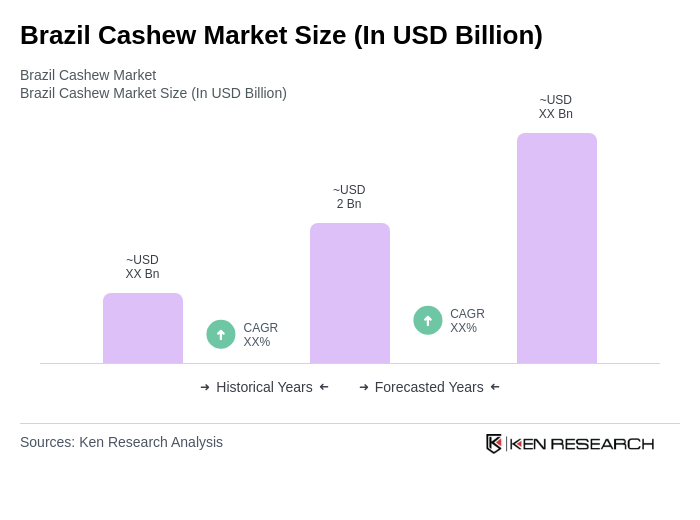
- The Brazil Cashew Market is valued at USD 2 billion, based on a five-year historical analysis. This growth is primarily driven by increasing global and domestic demand for healthy snacks, the rise in popularity of plant-based diets, and the expansion of the food processing industry. Recent trends highlight the adoption of hybrid seeds for higher yields, mechanization, and data-driven farming practices that boost efficiency and crop resilience. The cashew nut's nutritional benefits, including high protein and healthy fat content, continue to fuel market growth, while innovations in processing and packaging enhance product quality and shelf life .
- Key players in this market include **Ceará, Piauí, and Rio Grande do Norte**, which dominate due to their favorable climatic conditions for cashew cultivation. These regions benefit from established supply chains, advanced irrigation systems, and processing facilities, making them pivotal in the production and export of cashew nuts. Strategic upgrades in farming techniques and local expertise in cashew farming and processing further contribute to their market leadership .
- In 2023, the Brazilian government implemented the Normative Instruction No. 37/2023 issued by the Ministry of Agriculture, Livestock and Food Supply (MAPA). This regulation mandates that all cashew producers adhere to environmentally friendly agricultural methods, including reduced pesticide use, improved soil management, and traceability standards. The initiative aims to enhance the quality of cashew nuts, ensure product safety, and promote the sustainability of the cashew farming sector through compliance with best practices and regular audits .
Brazil Cashew Market Segmentation
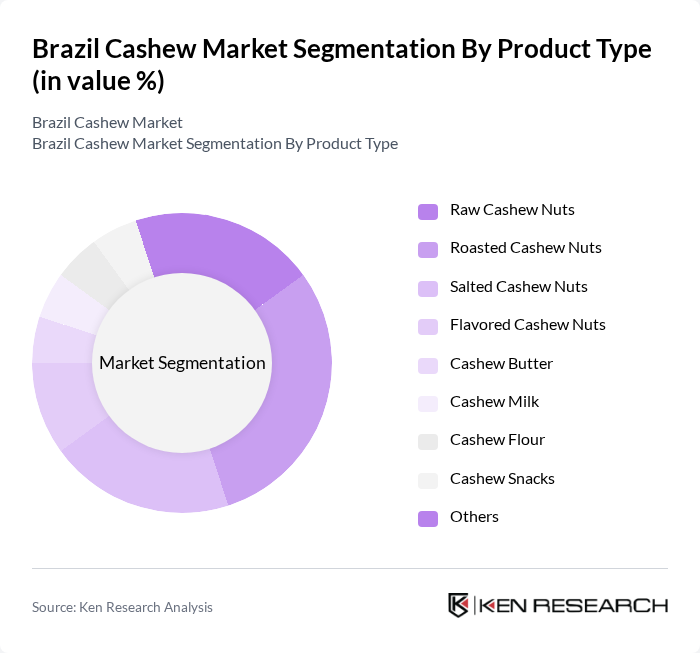
By Product Type:The product type segmentation of the Brazil Cashew Market includes various forms of cashew nuts and related products. The subsegments are Raw Cashew Nuts, Roasted Cashew Nuts, Salted Cashew Nuts, Flavored Cashew Nuts, Cashew Butter, Cashew Milk, Cashew Flour, Cashew Snacks, and Others. Among these, Roasted Cashew Nuts are particularly popular due to their enhanced flavor and convenience as a snack option. The growing trend of healthy snacking and the introduction of new flavors have led to increased consumption of roasted and flavored varieties, making them the leading subsegment in the market .
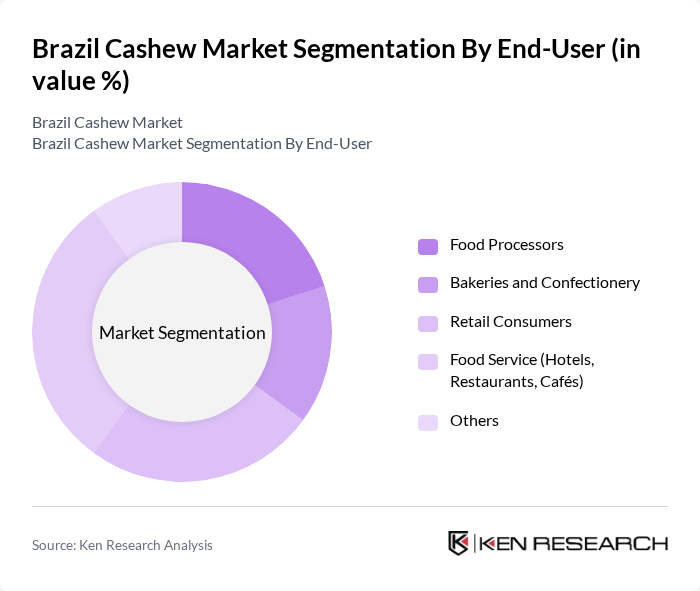
By End-User:The end-user segmentation of the Brazil Cashew Market includes Food Processors, Bakeries and Confectionery, Retail Consumers, Food Service (Hotels, Restaurants, Cafés), and Others. The Food Service sector is currently the dominant end-user, driven by the increasing incorporation of cashew nuts in various culinary applications, including desserts and gourmet dishes. The trend towards healthier menu options in restaurants and cafes, as well as the adoption of cashew-based dairy alternatives, has further propelled the demand for cashew products .
Brazil Cashew Market Competitive Landscape
The Brazil Cashew Market is characterized by a dynamic mix of regional and international players. Leading participants such as Caju Brasil Indústria e Comércio Ltda., Vitória Cashew Exportadora Ltda., Agrobras Agroindústria de Castanha Ltda., Brazil Nuts S/A, Noble Cashew do Brasil Ltda., Usibras – Usina de Beneficiamento de Castanha de Caju S/A, Cajuesp – Cooperativa dos Cajucultores do Estado de São Paulo, Cione – Companhia Industrial de Óleos do Nordeste, Grupo Amêndoas do Brasil, Cacique de Café Solúvel S.A. (Cashew Division), Olam International (Brazil Operations), Bunge Alimentos S.A., Intersnack Group (Brazil), Golden Star Caju Ltda., Agropecuária Santa Rita Ltda. contribute to innovation, geographic expansion, and service delivery in this space.
Brazil Cashew Market Industry Analysis
Growth Drivers
- Increasing Health Consciousness:The Brazilian population is increasingly prioritizing health, with 60% of consumers actively seeking healthier snack options. This trend is supported by the World Health Organization's report indicating a 20% rise in health-related food purchases in Brazil from 2020 to 2023. Cashews, rich in nutrients and healthy fats, are becoming a preferred choice, driving demand. The health food market in Brazil is projected to reach $10 billion in future, further fueling cashew consumption.
- Rising Demand for Plant-Based Snacks:The plant-based snack market in Brazil is expected to grow significantly, with a projected value of $1.5 billion in future. This growth is driven by a 30% increase in consumers opting for plant-based diets, as reported by the Brazilian Institute of Food Technology. Cashews, being versatile and nutritious, are well-positioned to meet this demand, contributing to a surge in production and sales within the sector.
- Export Opportunities in International Markets:Brazil's cashew exports reached $300 million in future, with a 15% increase from the previous year. The global demand for cashews is projected to rise, particularly in North America and Europe, where health trends favor nut consumption. The Brazilian government is actively promoting cashew exports, aiming to increase market share in these regions, which could lead to a further 10% growth in export revenues in future.
Market Challenges
- Climate Change Impact on Production:Brazil's cashew production is increasingly threatened by climate change, with a reported 25% decrease in yield due to erratic weather patterns over the past five years. The National Institute of Meteorology indicates that rising temperatures and altered rainfall patterns could further reduce production capacity, potentially impacting the overall supply chain and increasing prices for consumers and exporters alike.
- Competition from Other Nut Markets:The Brazilian cashew market faces stiff competition from other nut varieties, particularly almonds and walnuts, which have seen a 20% increase in market share over the last three years. The global nut market is projected to grow by $5 billion in future, intensifying competition. This could lead to price pressures on cashews, challenging producers to maintain profitability while competing for consumer attention.
Brazil Cashew Market Future Outlook
The Brazil cashew market is poised for significant transformation, driven by evolving consumer preferences and increasing health awareness. Innovations in product offerings, such as cashew milk and value-added snacks, are expected to capture a larger market share. Additionally, the integration of sustainable farming practices will likely enhance production efficiency. As e-commerce continues to expand, direct-to-consumer sales channels will provide new opportunities for growth, allowing producers to reach health-conscious consumers more effectively.
Market Opportunities
- Expansion of Organic Cashew Products:The organic food market in Brazil is projected to reach $2 billion in future, with organic cashews expected to capture a significant share. This trend is driven by a 40% increase in consumer demand for organic products, presenting a lucrative opportunity for producers to diversify their offerings and cater to health-conscious consumers.
- Development of Value-Added Cashew Products:The market for value-added cashew products, such as cashew butter and snacks, is anticipated to grow by $500 million in future. This growth is fueled by a 35% increase in consumer interest in convenient, healthy snacks. Producers can leverage this trend by innovating and expanding their product lines to meet evolving consumer preferences.
Scope of the Report
| Segment | Sub-Segments |
|---|---|
| By Product Type | Raw Cashew Nuts Roasted Cashew Nuts Salted Cashew Nuts Flavored Cashew Nuts Cashew Butter Cashew Milk Cashew Flour Cashew Snacks Others |
| By End-User | Food Processors Bakeries and Confectionery Retail Consumers Food Service (Hotels, Restaurants, Cafés) Others |
| By Distribution Channel | Supermarkets/Hypermarkets Convenience Stores Online Retail Specialty Stores Direct Sales |
| By Packaging Type | Bulk Packaging Retail Packaging Eco-Friendly Packaging |
| By Price Range | Premium Mid-Range Economy |
| By Region | Ceará Piauí Rio Grande do Norte São Paulo Paraná Others |
| By Product Form | Whole Nuts Chopped Nuts Powdered Nuts Others |
Key Target Audience
Investors and Venture Capitalist Firms
Government and Regulatory Bodies (e.g., Brazilian Ministry of Agriculture, Livestock and Food Supply)
Manufacturers and Producers
Distributors and Retailers
Exporters and Importers
Food Processing Companies
Industry Associations (e.g., Brazilian Cashew Association)
Financial Institutions
Players Mentioned in the Report:
Caju Brasil Industria e Comercio Ltda.
Vitoria Cashew Exportadora Ltda.
Agrobras Agroindustria de Castanha Ltda.
Brazil Nuts S/A
Noble Cashew do Brasil Ltda.
Usibras Usina de Beneficiamento de Castanha de Caju S/A
Cajuesp Cooperativa dos Cajucultores do Estado de Sao Paulo
Cione Companhia Industrial de Oleos do Nordeste
Grupo Amendoas do Brasil
Cacique de Cafe Soluvel S.A. (Cashew Division)
Olam International (Brazil Operations)
Bunge Alimentos S.A.
Intersnack Group (Brazil)
Golden Star Caju Ltda.
Agropecuaria Santa Rita Ltda.
Table of Contents
Market Assessment Phase
1. Executive Summary and Approach
2. Brazil Cashew Market Overview
2.1 Key Insights and Strategic Recommendations
2.2 Brazil Cashew Market Overview
2.3 Definition and Scope
2.4 Evolution of Market Ecosystem
2.5 Timeline of Key Regulatory Milestones
2.6 Value Chain & Stakeholder Mapping
2.7 Business Cycle Analysis
2.8 Policy & Incentive Landscape
3. Brazil Cashew Market Analysis
3.1 Growth Drivers
3.1.1 Increasing Health Consciousness
3.1.2 Rising Demand for Plant-Based Snacks
3.1.3 Export Opportunities in International Markets
3.1.4 Government Support for Agricultural Development
3.2 Market Challenges
3.2.1 Climate Change Impact on Production
3.2.2 Competition from Other Nut Markets
3.2.3 Supply Chain Disruptions
3.2.4 Price Volatility of Raw Cashew Nuts
3.3 Market Opportunities
3.3.1 Expansion of Organic Cashew Products
3.3.2 Development of Value-Added Cashew Products
3.3.3 Growing E-commerce Platforms for Direct Sales
3.3.4 Partnerships with Health Food Brands
3.4 Market Trends
3.4.1 Increasing Popularity of Cashew Milk
3.4.2 Sustainable Farming Practices
3.4.3 Innovations in Packaging
3.4.4 Rise of Cashew-Based Culinary Products
3.5 Government Regulation
3.5.1 Import Tariffs on Cashew Products
3.5.2 Quality Standards for Export
3.5.3 Agricultural Subsidies for Cashew Farmers
3.5.4 Environmental Regulations on Farming Practices
4. SWOT Analysis
5. Stakeholder Analysis
6. Porter's Five Forces Analysis
7. Brazil Cashew Market Market Size, 2019-2024
7.1 By Value
7.2 By Volume
7.3 By Average Selling Price
8. Brazil Cashew Market Segmentation
8.1 By Product Type
8.1.1 Raw Cashew Nuts
8.1.2 Roasted Cashew Nuts
8.1.3 Salted Cashew Nuts
8.1.4 Flavored Cashew Nuts
8.1.5 Cashew Butter
8.1.6 Cashew Milk
8.1.7 Cashew Flour
8.1.8 Cashew Snacks
8.1.9 Others
8.2 By End-User
8.2.1 Food Processors
8.2.2 Bakeries and Confectionery
8.2.3 Retail Consumers
8.2.4 Food Service (Hotels, Restaurants, Cafés)
8.2.5 Others
8.3 By Distribution Channel
8.3.1 Supermarkets/Hypermarkets
8.3.2 Convenience Stores
8.3.3 Online Retail
8.3.4 Specialty Stores
8.3.5 Direct Sales
8.4 By Packaging Type
8.4.1 Bulk Packaging
8.4.2 Retail Packaging
8.4.3 Eco-Friendly Packaging
8.5 By Price Range
8.5.1 Premium
8.5.2 Mid-Range
8.5.3 Economy
8.6 By Region
8.6.1 Ceará
8.6.2 Piauí
8.6.3 Rio Grande do Norte
8.6.4 São Paulo
8.6.5 Paraná
8.6.6 Others
8.7 By Product Form
8.7.1 Whole Nuts
8.7.2 Chopped Nuts
8.7.3 Powdered Nuts
8.7.4 Others
9. Brazil Cashew Market Competitive Analysis
9.1 Market Share of Key Players
9.2 Cross Comparison of Key Players
9.2.1 Company Name
9.2.2 Company Size (Large, Medium, Small)
9.2.3 Annual Revenue (USD Million)
9.2.4 Revenue Growth Rate (%)
9.2.5 Market Share (%)
9.2.6 Export Volume (Metric Tons)
9.2.7 Product Portfolio Breadth
9.2.8 Supply Chain Integration Level
9.2.9 Certifications (e.g., Organic, Fair Trade)
9.2.10 Distribution Network Coverage (Domestic/Export)
9.3 SWOT Analysis of Top Players
9.4 Pricing Analysis
9.5 Detailed Profile of Major Companies
9.5.1 Caju Brasil Indústria e Comércio Ltda.
9.5.2 Vitória Cashew Exportadora Ltda.
9.5.3 Agrobras Agroindústria de Castanha Ltda.
9.5.4 Brazil Nuts S/A
9.5.5 Noble Cashew do Brasil Ltda.
9.5.6 Usibras – Usina de Beneficiamento de Castanha de Caju S/A
9.5.7 Cajuesp – Cooperativa dos Cajucultores do Estado de São Paulo
9.5.8 Cione – Companhia Industrial de Óleos do Nordeste
9.5.9 Grupo Amêndoas do Brasil
9.5.10 Cacique de Café Solúvel S.A. (Cashew Division)
9.5.11 Olam International (Brazil Operations)
9.5.12 Bunge Alimentos S.A.
9.5.13 Intersnack Group (Brazil)
9.5.14 Golden Star Caju Ltda.
9.5.15 Agropecuária Santa Rita Ltda.
10. Brazil Cashew Market End-User Analysis
10.1 Procurement Behavior of Key Ministries
10.1.1 Government Procurement Policies
10.1.2 Budget Allocations for Cashew Products
10.1.3 Supplier Selection Criteria
10.2 Corporate Spend on Infrastructure & Energy
10.2.1 Investment in Sustainable Practices
10.2.2 Budget for Cashew Product Development
10.2.3 Infrastructure Development for Processing
10.3 Pain Point Analysis by End-User Category
10.3.1 Quality Assurance Issues
10.3.2 Supply Chain Delays
10.3.3 Price Sensitivity
10.4 User Readiness for Adoption
10.4.1 Awareness of Health Benefits
10.4.2 Availability of Products
10.4.3 Consumer Education Initiatives
10.5 Post-Deployment ROI and Use Case Expansion
10.5.1 Measurement of ROI in Cashew Investments
10.5.2 Expansion into New Markets
10.5.3 Long-term Sustainability Practices
11. Brazil Cashew Market Future Size, 2025-2030
11.1 By Value
11.2 By Volume
11.3 By Average Selling Price
Go-To-Market Strategy Phase
1. Whitespace Analysis + Business Model Canvas
1.1 Market Gaps Identification
1.2 Business Model Development
1.3 Value Proposition Canvas
1.4 Competitive Landscape Analysis
1.5 Customer Segmentation
1.6 Revenue Streams
1.7 Cost Structure
2. Marketing and Positioning Recommendations
2.1 Branding Strategies
2.2 Product USPs
2.3 Target Market Positioning
2.4 Communication Strategy
2.5 Digital Marketing Approaches
3. Distribution Plan
3.1 Urban Retail Strategies
3.2 Rural NGO Tie-Ups
3.3 E-commerce Distribution
3.4 Wholesale Partnerships
4. Channel & Pricing Gaps
4.1 Underserved Routes
4.2 Pricing Bands Analysis
4.3 Competitor Pricing Strategies
5. Unmet Demand & Latent Needs
5.1 Category Gaps
5.2 Consumer Segments Analysis
5.3 Product Development Opportunities
6. Customer Relationship
6.1 Loyalty Programs
6.2 After-sales Service
6.3 Customer Feedback Mechanisms
7. Value Proposition
7.1 Sustainability Initiatives
7.2 Integrated Supply Chains
7.3 Community Engagement
8. Key Activities
8.1 Regulatory Compliance
8.2 Branding Efforts
8.3 Distribution Setup
9. Entry Strategy Evaluation
9.1 Domestic Market Entry Strategy
9.1.1 Product Mix Considerations
9.1.2 Pricing Band Strategy
9.1.3 Packaging Innovations
9.2 Export Entry Strategy
9.2.1 Target Countries Identification
9.2.2 Compliance Roadmap Development
10. Entry Mode Assessment
10.1 Joint Ventures
10.2 Greenfield Investments
10.3 Mergers & Acquisitions
10.4 Distributor Model Evaluation
11. Capital and Timeline Estimation
11.1 Capital Requirements
11.2 Timelines for Market Entry
12. Control vs Risk Trade-Off
12.1 Ownership vs Partnerships
13. Profitability Outlook
13.1 Breakeven Analysis
13.2 Long-term Sustainability Strategies
14. Potential Partner List
14.1 Distributors
14.2 Joint Ventures
14.3 Acquisition Targets
15. Execution Roadmap
15.1 Phased Plan for Market Entry
15.1.1 Market Setup
15.1.2 Market Entry
15.1.3 Growth Acceleration
15.1.4 Scale & Stabilize
15.2 Key Activities and Milestones
15.2.1 Activity Planning
15.2.2 Milestone Tracking
Research Methodology
Phase 1: Approach1
Desk Research
- Analysis of trade statistics from Brazil's Ministry of Agriculture and Livestock
- Review of market reports from agricultural organizations and industry associations
- Examination of academic journals and publications focusing on cashew production and export trends
Primary Research
- Interviews with cashew farmers and producers across key growing regions
- Surveys with exporters and importers to understand market dynamics
- Field visits to processing facilities to gather insights on production practices
Validation & Triangulation
- Cross-validation of data from government sources and industry reports
- Triangulation of findings from interviews with market trends and statistical data
- Sanity checks through expert panels comprising agronomists and market analysts
Phase 2: Market Size Estimation1
Top-down Assessment
- Estimation of total cashew production based on national agricultural output data
- Analysis of export volumes and values to determine market potential
- Incorporation of consumer demand trends in domestic and international markets
Bottom-up Modeling
- Collection of production data from local farms and cooperatives
- Cost analysis of production, processing, and distribution channels
- Volume estimates based on historical sales data and growth projections
Forecasting & Scenario Analysis
- Multi-factor regression analysis incorporating climate impact, market access, and pricing trends
- Scenario modeling based on potential changes in trade policies and global demand
- Development of baseline, optimistic, and pessimistic forecasts through 2030
Phase 3: CATI Sample Composition1
| Scope Item/Segment | Sample Size | Target Respondent Profiles |
|---|---|---|
| Cashew Farmers | 100 | Smallholder Farmers, Cooperative Leaders |
| Exporters and Importers | 60 | Trade Managers, Logistics Coordinators |
| Processing Facilities | 50 | Operations Managers, Quality Control Supervisors |
| Retail Market Insights | 40 | Retail Buyers, Category Managers |
| Industry Experts | 40 | Agricultural Economists, Market Analysts |
Frequently Asked Questions
What is the current value of the Brazil Cashew Market?
The Brazil Cashew Market is valued at approximately USD 2 billion, reflecting a five-year historical analysis. This growth is driven by increasing demand for healthy snacks and innovations in farming and processing practices.
Which regions in Brazil are the leading producers of cashew nuts?
What are the main product types in the Brazil Cashew Market?
How has the Brazilian government influenced the cashew industry?
Why Buy From Us?

What makes us stand out is that our consultants follow Robust, Refine and Result (RRR) methodology. Robust for clear definitions, approaches and sanity checking, Refine for differentiating respondents' facts and opinions, and Result for presenting data with story.

We have set a benchmark in the industry by offering our clients with syndicated and customized market research reports featuring coverage of entire market as well as meticulous research and analyst insights.

While we don't replace traditional research, we flip the method upside down. Our dual approach of Top Bottom & Bottom Top ensures quality deliverable by not just verifying company fundamentals but also looking at the sector and macroeconomic factors.

With one step in the future, our research team constantly tries to show you the bigger picture. We help with some of the tough questions you may encounter along the way: How is the industry positioned? Best marketing channel? KPI's of competitors? By aligning every element, we help maximize success.

Our report gives you instant access to the answers and sources that other companies might choose to hide. We elaborate each steps of research methodology we have used and showcase you the sample size to earn your trust.

If you need any support, we are here! We pride ourselves on universe strength, data quality, and quick, friendly, and professional service.