About the Report
Base Year 2024Listen to the audio summary
Canada Crop Protection and Sustainable Inputs Market Overview
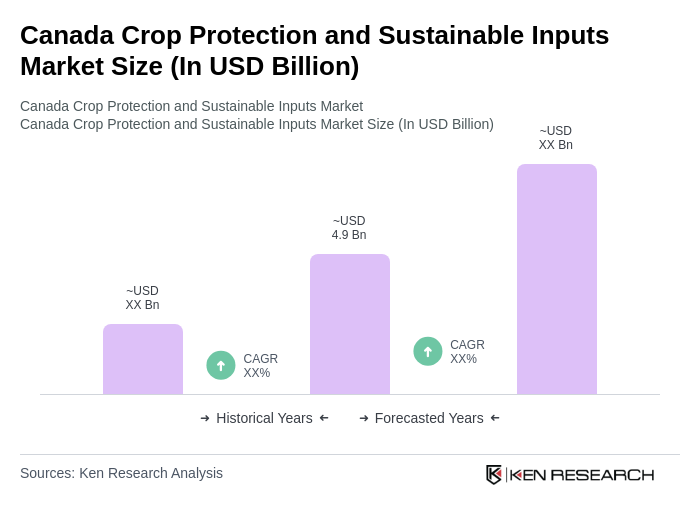
- The Canada Crop Protection and Sustainable Inputs Market is valued at USD 4.9 billion, based on a five-year historical analysis. This growth is primarily driven by the increasing demand for sustainable agricultural practices, advancements in crop protection technologies, and the rising need for food security. The market has seen a significant shift towards eco-friendly inputs, reflecting a broader trend in the agricultural sector towards sustainability and environmental responsibility .
- Key players in this market include Ontario, Quebec, and Alberta, which dominate due to their extensive agricultural activities and diverse crop production. These provinces benefit from a combination of favorable climatic conditions, advanced farming techniques, and strong government support for agricultural innovation, making them pivotal in the crop protection and sustainable inputs landscape .
- In 2023, the Canadian government implemented the Sustainable Agriculture Strategy, which aims to promote the use of environmentally friendly crop protection products. This initiative includes funding for research and development of biopesticides and biofertilizers, as well as incentives for farmers to adopt sustainable practices, thereby enhancing the overall sustainability of the agricultural sector. The Sustainable Agriculture Strategy, 2023, issued by Agriculture and Agri-Food Canada, mandates support for research, adoption of bioproducts, and compliance with environmental performance benchmarks .
Canada Crop Protection and Sustainable Inputs Market Segmentation
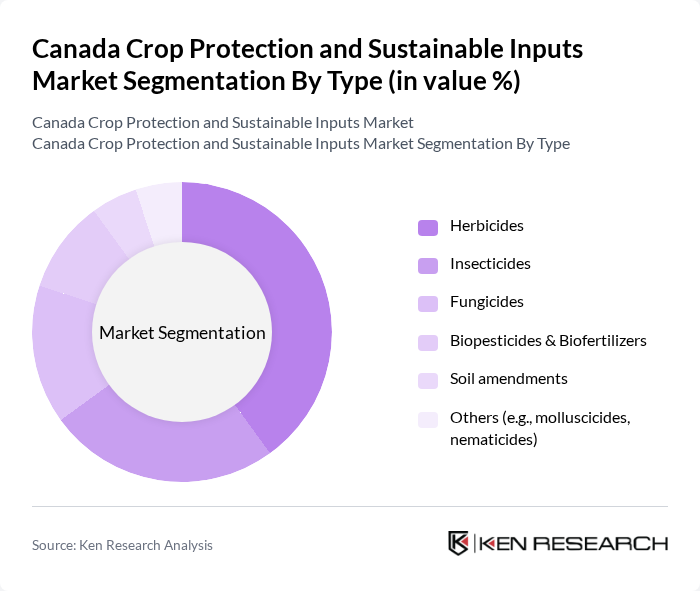
By Type:The market is segmented into various types of crop protection and sustainable inputs, including herbicides, insecticides, fungicides, biopesticides & biofertilizers, soil amendments, and others. Among these, herbicides are the most widely used due to their effectiveness in controlling weeds, which is crucial for maximizing crop yields. The increasing adoption of precision agriculture and integrated pest management practices has further propelled the demand for these products .
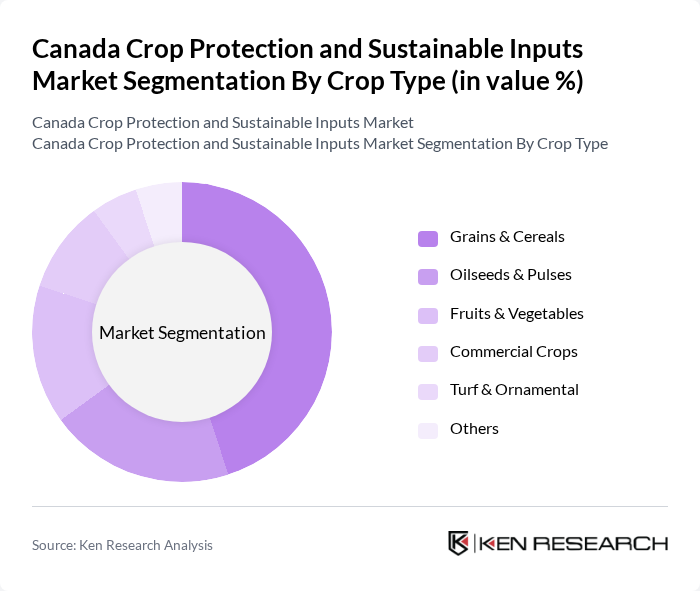
By Crop Type:The segmentation by crop type includes grains & cereals, oilseeds & pulses, fruits & vegetables, commercial crops, turf & ornamental, and others. Grains and cereals dominate this segment due to their high demand in both domestic and international markets. The increasing focus on food security and the need for efficient crop production methods have led to a surge in the use of crop protection products in this category .
Canada Crop Protection and Sustainable Inputs Market Competitive Landscape
The Canada Crop Protection and Sustainable Inputs Market is characterized by a dynamic mix of regional and international players. Leading participants such as Bayer CropScience, Syngenta AG, Corteva Agriscience, BASF SE, FMC Corporation, ADAMA Agricultural Solutions Ltd., Nufarm Limited, Nutrien Ltd., Gowan Company, Marrone Bio Innovations (now part of Bioceres Crop Solutions), Stoller Group (now part of Corteva Agriscience), UPL Limited, Biobest Group NV, Belchim Crop Protection Canada, Engage Agro (now part of Belchim Crop Protection Canada) contribute to innovation, geographic expansion, and service delivery in this space.
Canada Crop Protection and Sustainable Inputs Market Industry Analysis
Growth Drivers
- Increasing Demand for Organic Farming:The organic farming sector in Canada has seen significant growth, with organic farmland increasing by 8% to 1.5 million acres in future. This rise is driven by consumer demand for organic products, which reached CAD 5.9 billion in sales, reflecting a 9% increase from the previous year. As more farmers transition to organic practices, the demand for sustainable crop protection inputs is expected to rise, creating a robust market for eco-friendly solutions.
- Government Support for Sustainable Agriculture:The Canadian government allocated CAD 1.7 billion in future to support sustainable agricultural practices, including crop protection initiatives. This funding aims to enhance the adoption of environmentally friendly inputs and technologies. Additionally, programs like the Agricultural Clean Technology Program are designed to promote innovation in sustainable farming, further driving the market for sustainable crop protection solutions as farmers seek to comply with government incentives and regulations.
- Technological Advancements in Crop Protection:The Canadian crop protection market is witnessing rapid technological advancements, with investments in R&D reaching CAD 350 million in future. Innovations such as precision agriculture and biopesticides are gaining traction, enhancing the efficiency and effectiveness of crop protection methods. These technologies not only improve yield but also reduce environmental impact, aligning with the growing trend towards sustainability in agriculture, thus propelling market growth.
Market Challenges
- Stringent Regulatory Requirements:The crop protection industry in Canada faces stringent regulatory frameworks, with the Pest Management Regulatory Agency (PMRA) overseeing pesticide approvals. In future, the average time for pesticide registration was approximately 20 months, which can delay market entry for new sustainable products. These regulatory hurdles can deter investment in innovative solutions, posing a significant challenge for companies aiming to introduce eco-friendly crop protection inputs.
- High Cost of Sustainable Inputs:The cost of sustainable crop protection inputs remains a significant barrier for many farmers. In future, the average price of biopesticides was CAD 160 per acre, compared to CAD 110 for traditional synthetic alternatives. This price disparity can discourage farmers from adopting sustainable practices, particularly in a competitive market where cost efficiency is crucial. As a result, the high cost of sustainable inputs poses a challenge to market growth.
Canada Crop Protection and Sustainable Inputs Market Future Outlook
The future of the Canada crop protection and sustainable inputs market appears promising, driven by increasing consumer demand for organic products and government initiatives supporting sustainable agriculture. As technological advancements continue to emerge, the market is likely to see a shift towards more efficient and eco-friendly solutions. Additionally, the growing emphasis on environmental sustainability will encourage farmers to adopt innovative practices, fostering a more resilient agricultural sector that prioritizes both productivity and ecological health.
Market Opportunities
- Expansion of E-commerce in Agricultural Inputs:The rise of e-commerce platforms for agricultural inputs presents a significant opportunity for the sustainable crop protection market. In future, online sales of agricultural products increased by 30%, allowing farmers to access sustainable inputs more conveniently. This trend can enhance market penetration and consumer awareness of eco-friendly products, driving growth in the sector.
- Development of Biopesticides and Biofertilizers:The increasing focus on sustainable agriculture has led to a surge in the development of biopesticides and biofertilizers. In future, the biopesticide market in Canada was valued at CAD 250 million, with a projected growth rate of 18% annually. This growth presents a lucrative opportunity for companies to innovate and expand their product offerings in the sustainable inputs market, catering to the rising demand for environmentally friendly solutions.
Scope of the Report
| Segment | Sub-Segments |
|---|---|
| By Type | Herbicides Insecticides Fungicides Biopesticides & Biofertilizers Soil amendments Others (e.g., molluscicides, nematicides) |
| By Crop Type | Grains & Cereals Oilseeds & Pulses Fruits & Vegetables Commercial Crops Turf & Ornamental Others |
| By Application Mode | Foliar Spray Soil Treatment Seed Treatment Chemigation Fumigation Others |
| By End-User | Farmers Agricultural Cooperatives Distributors Others |
| By Distribution Channel | Direct Sales Retail Outlets Online Platforms Others |
| By Region | Western Canada Central Canada Eastern Canada Others |
| By Price Range | Low Medium High |
| By Product Formulation | Liquid Granular Powder Others |
Key Target Audience
Investors and Venture Capitalist Firms
Government and Regulatory Bodies (e.g., Agriculture and Agri-Food Canada, Canadian Food Inspection Agency)
Manufacturers and Producers
Distributors and Retailers
Crop Protection Product Suppliers
Agrochemical Companies
Industry Associations (e.g., CropLife Canada)
Financial Institutions
Players Mentioned in the Report:
Bayer CropScience
Syngenta AG
Corteva Agriscience
BASF SE
FMC Corporation
ADAMA Agricultural Solutions Ltd.
Nufarm Limited
Nutrien Ltd.
Gowan Company
Marrone Bio Innovations (now part of Bioceres Crop Solutions)
Stoller Group (now part of Corteva Agriscience)
UPL Limited
Biobest Group NV
Belchim Crop Protection Canada
Engage Agro (now part of Belchim Crop Protection Canada)
Table of Contents
Market Assessment Phase
1. Executive Summary and Approach
2. Canada Crop Protection and Sustainable Inputs Market Overview
2.1 Key Insights and Strategic Recommendations
2.2 Canada Crop Protection and Sustainable Inputs Market Overview
2.3 Definition and Scope
2.4 Evolution of Market Ecosystem
2.5 Timeline of Key Regulatory Milestones
2.6 Value Chain & Stakeholder Mapping
2.7 Business Cycle Analysis
2.8 Policy & Incentive Landscape
3. Canada Crop Protection and Sustainable Inputs Market Analysis
3.1 Growth Drivers
3.1.1 Increasing demand for organic farming
3.1.2 Government support for sustainable agriculture
3.1.3 Technological advancements in crop protection
3.1.4 Rising awareness of environmental sustainability
3.2 Market Challenges
3.2.1 Stringent regulatory requirements
3.2.2 High cost of sustainable inputs
3.2.3 Limited consumer awareness
3.2.4 Competition from synthetic alternatives
3.3 Market Opportunities
3.3.1 Expansion of e-commerce in agricultural inputs
3.3.2 Development of biopesticides and biofertilizers
3.3.3 Collaborations with research institutions
3.3.4 Growing export potential for sustainable products
3.4 Market Trends
3.4.1 Shift towards integrated pest management
3.4.2 Increasing investment in R&D for sustainable solutions
3.4.3 Adoption of precision agriculture technologies
3.4.4 Rise in consumer preference for eco-friendly products
3.5 Government Regulation
3.5.1 Pesticide registration and approval processes
3.5.2 Environmental protection regulations
3.5.3 Subsidies for sustainable farming practices
3.5.4 Compliance with international standards
4. SWOT Analysis
5. Stakeholder Analysis
6. Porter's Five Forces Analysis
7. Canada Crop Protection and Sustainable Inputs Market Market Size, 2019-2024
7.1 By Value
7.2 By Volume
7.3 By Average Selling Price
8. Canada Crop Protection and Sustainable Inputs Market Segmentation
8.1 By Type
8.1.1 Herbicides
8.1.2 Insecticides
8.1.3 Fungicides
8.1.4 Biopesticides & Biofertilizers
8.1.5 Soil amendments
8.1.6 Others (e.g., molluscicides, nematicides)
8.2 By Crop Type
8.2.1 Grains & Cereals
8.2.2 Oilseeds & Pulses
8.2.3 Fruits & Vegetables
8.2.4 Commercial Crops
8.2.5 Turf & Ornamental
8.2.6 Others
8.3 By Application Mode
8.3.1 Foliar Spray
8.3.2 Soil Treatment
8.3.3 Seed Treatment
8.3.4 Chemigation
8.3.5 Fumigation
8.3.6 Others
8.4 By End-User
8.4.1 Farmers
8.4.2 Agricultural Cooperatives
8.4.3 Distributors
8.4.4 Others
8.5 By Distribution Channel
8.5.1 Direct Sales
8.5.2 Retail Outlets
8.5.3 Online Platforms
8.5.4 Others
8.6 By Region
8.6.1 Western Canada
8.6.2 Central Canada
8.6.3 Eastern Canada
8.6.4 Others
8.7 By Price Range
8.7.1 Low
8.7.2 Medium
8.7.3 High
8.8 By Product Formulation
8.8.1 Liquid
8.8.2 Granular
8.8.3 Powder
8.8.4 Others
9. Canada Crop Protection and Sustainable Inputs Market Competitive Analysis
9.1 Market Share of Key Players
9.2 KPIs for Cross Comparison of Key Players
9.2.1 Company Name
9.2.2 Group Size (Large, Medium, or Small as per industry convention)
9.2.3 Revenue (Canada Crop Protection Segment)
9.2.4 Revenue Growth Rate (3-5 year CAGR)
9.2.5 Market Share (Canada Crop Protection & Sustainable Inputs)
9.2.6 Product Portfolio Breadth (Number of SKUs/Active Ingredients)
9.2.7 R&D Intensity (% of Revenue Invested in R&D)
9.2.8 Sustainability Score (e.g., share of sustainable/biological products)
9.2.9 Distribution Network Coverage (Number of Provinces/Dealers)
9.2.10 Customer Segments Served (e.g., crop types, end-users)
9.2.11 Regulatory Compliance Track Record
9.2.12 Innovation Index (Patents, New Product Launches)
9.2.13 Pricing Strategy
9.2.14 Brand Recognition Score
9.3 SWOT Analysis of Top Players
9.4 Pricing Analysis
9.5 Detailed Profile of Major Companies
9.5.1 Bayer CropScience
9.5.2 Syngenta AG
9.5.3 Corteva Agriscience
9.5.4 BASF SE
9.5.5 FMC Corporation
9.5.6 ADAMA Agricultural Solutions Ltd.
9.5.7 Nufarm Limited
9.5.8 Nutrien Ltd.
9.5.9 Gowan Company
9.5.10 Marrone Bio Innovations (now part of Bioceres Crop Solutions)
9.5.11 Stoller Group (now part of Corteva Agriscience)
9.5.12 UPL Limited
9.5.13 Biobest Group NV
9.5.14 Belchim Crop Protection Canada
9.5.15 Engage Agro (now part of Belchim Crop Protection Canada)
10. Canada Crop Protection and Sustainable Inputs Market End-User Analysis
10.1 Procurement Behavior of Key Ministries
10.1.1 Budget allocation trends
10.1.2 Decision-making processes
10.1.3 Preferred suppliers
10.2 Corporate Spend on Infrastructure & Energy
10.2.1 Investment in sustainable practices
10.2.2 Budget for crop protection inputs
10.2.3 Trends in spending
10.3 Pain Point Analysis by End-User Category
10.3.1 Cost management challenges
10.3.2 Access to sustainable products
10.3.3 Regulatory compliance issues
10.4 User Readiness for Adoption
10.4.1 Awareness of sustainable practices
10.4.2 Training and support needs
10.4.3 Technology adoption rates
10.5 Post-Deployment ROI and Use Case Expansion
10.5.1 Measurement of ROI
10.5.2 Case studies of successful implementations
10.5.3 Future expansion plans
11. Canada Crop Protection and Sustainable Inputs Market Future Size, 2025-2030
11.1 By Value
11.2 By Volume
11.3 By Average Selling Price
Go-To-Market Strategy Phase
1. Whitespace Analysis + Business Model Canvas
1.1 Market gaps identification
1.2 Value proposition development
1.3 Revenue model exploration
1.4 Customer segmentation analysis
1.5 Competitive landscape overview
1.6 Key partnerships identification
1.7 Risk assessment
2. Marketing and Positioning Recommendations
2.1 Branding strategies
2.2 Product USPs
2.3 Target audience definition
2.4 Communication channels
2.5 Marketing budget allocation
3. Distribution Plan
3.1 Urban retail strategies
3.2 Rural NGO tie-ups
3.3 Direct-to-consumer models
3.4 E-commerce integration
4. Channel & Pricing Gaps
4.1 Underserved routes
4.2 Pricing bands analysis
4.3 Competitor pricing strategies
4.4 Customer willingness to pay
5. Unmet Demand & Latent Needs
5.1 Category gaps identification
5.2 Consumer segments analysis
5.3 Emerging trends
5.4 Future product needs
6. Customer Relationship
6.1 Loyalty programs
6.2 After-sales service
6.3 Customer feedback mechanisms
6.4 Community engagement
7. Value Proposition
7.1 Sustainability initiatives
7.2 Integrated supply chains
7.3 Cost-effectiveness
7.4 Quality assurance
8. Key Activities
8.1 Regulatory compliance
8.2 Branding efforts
8.3 Distribution setup
8.4 Training and support
9. Entry Strategy Evaluation
9.1 Domestic Market Entry Strategy
9.1.1 Product mix considerations
9.1.2 Pricing band strategies
9.1.3 Packaging innovations
9.2 Export Entry Strategy
9.2.1 Target countries analysis
9.2.2 Compliance roadmap
10. Entry Mode Assessment
10.1 Joint Ventures
10.2 Greenfield investments
10.3 Mergers & Acquisitions
10.4 Distributor Model
11. Capital and Timeline Estimation
11.1 Capital requirements
11.2 Timelines for market entry
12. Control vs Risk Trade-Off
12.1 Ownership considerations
12.2 Partnerships evaluation
13. Profitability Outlook
13.1 Breakeven analysis
13.2 Long-term sustainability strategies
14. Potential Partner List
14.1 Distributors
14.2 Joint Ventures
14.3 Acquisition targets
15. Execution Roadmap
15.1 Phased Plan for Market Entry
15.1.1 Market Setup
15.1.2 Market Entry
15.1.3 Growth Acceleration
15.1.4 Scale & Stabilize
15.2 Key Activities and Milestones
15.2.1 Milestone tracking
15.2.2 Activity scheduling
Research Methodology
Phase 1: Approach1
Desk Research
- Analysis of agricultural production statistics from Statistics Canada and provincial agricultural departments
- Review of market reports and white papers from industry associations such as CropLife Canada
- Examination of regulatory frameworks and guidelines from the Pest Management Regulatory Agency (PMRA)
Primary Research
- Interviews with agronomists and crop protection specialists in leading agricultural firms
- Surveys with farmers to understand their preferences for sustainable inputs
- Focus groups with agricultural extension officers to gather insights on market trends
Validation & Triangulation
- Cross-validation of findings through multiple data sources including government reports and industry publications
- Triangulation of qualitative insights from interviews with quantitative data from surveys
- Sanity checks through expert panel discussions with agribusiness stakeholders
Phase 2: Market Size Estimation1
Top-down Assessment
- Estimation of total market size based on national agricultural expenditure and crop protection spending
- Segmentation of the market by crop type, input type, and geographical region
- Incorporation of trends in organic farming and sustainable practices into market projections
Bottom-up Modeling
- Collection of sales data from major crop protection product manufacturers
- Estimation of market share based on product usage rates among different crop types
- Volume and pricing analysis to derive revenue estimates for sustainable inputs
Forecasting & Scenario Analysis
- Development of forecasting models based on historical growth rates and emerging market trends
- Scenario analysis considering factors such as climate change impacts and regulatory changes
- Creation of baseline, optimistic, and pessimistic forecasts through 2030
Phase 3: CATI Sample Composition1
| Scope Item/Segment | Sample Size | Target Respondent Profiles |
|---|---|---|
| Cereal Crop Protection | 60 | Farm Owners, Agronomists |
| Fruit and Vegetable Inputs | 50 | Horticulturists, Crop Advisors |
| Organic Farming Practices | 40 | Organic Farmers, Sustainability Consultants |
| Herbicide Usage Trends | 55 | Agricultural Researchers, Product Managers |
| Integrated Pest Management Strategies | 45 | Extension Officers, Pest Control Specialists |
Frequently Asked Questions
What is the current value of the Canada Crop Protection and Sustainable Inputs Market?
The Canada Crop Protection and Sustainable Inputs Market is valued at approximately USD 4.9 billion, reflecting a significant growth trend driven by the demand for sustainable agricultural practices and advancements in crop protection technologies.
Which provinces are key players in the Canada Crop Protection Market?
What initiatives has the Canadian government implemented to promote sustainable agriculture?
What types of products are included in the Canada Crop Protection Market?
Other Regional/Country Reports
Indonesia Crop Protection and Sustainable Inputs Market
Malaysia Crop Protection and Sustainable Inputs Market
KSA Crop Protection and Sustainable Inputs Market
APAC Crop Protection and Sustainable Inputs Market
SEA Crop Protection and Sustainable Inputs Market
Vietnam Crop Protection and Sustainable Inputs Market
Other Adjacent Reports
Kuwait Biopesticide Market
Italy Agricultural Machinery Market (2022-2027)Asia Pacific Seed Treatment Market Outlook to 2030: Size, Share, Growth and TrendsIndia Fertilizer Market (2023-2029)Thailand Irrigation Systems MarketKuwait Farm Management Software Market Size, Share, Growth Drivers, Trends, Opportunities & Forecast 2025–2030Kuwait Agricultural Biotechnology Market Size, Share, Growth Drivers, Trends, Opportunities & Forecast 2025–2030Kuwait Soil Amendment Market
Why Buy From Us?

What makes us stand out is that our consultants follow Robust, Refine and Result (RRR) methodology. Robust for clear definitions, approaches and sanity checking, Refine for differentiating respondents' facts and opinions, and Result for presenting data with story.

We have set a benchmark in the industry by offering our clients with syndicated and customized market research reports featuring coverage of entire market as well as meticulous research and analyst insights.

While we don't replace traditional research, we flip the method upside down. Our dual approach of Top Bottom & Bottom Top ensures quality deliverable by not just verifying company fundamentals but also looking at the sector and macroeconomic factors.

With one step in the future, our research team constantly tries to show you the bigger picture. We help with some of the tough questions you may encounter along the way: How is the industry positioned? Best marketing channel? KPI's of competitors? By aligning every element, we help maximize success.

Our report gives you instant access to the answers and sources that other companies might choose to hide. We elaborate each steps of research methodology we have used and showcase you the sample size to earn your trust.

If you need any support, we are here! We pride ourselves on universe strength, data quality, and quick, friendly, and professional service.