About the Report
Base Year 2024Listen to the audio summary
Canada Fruits and Vegetables Market Overview
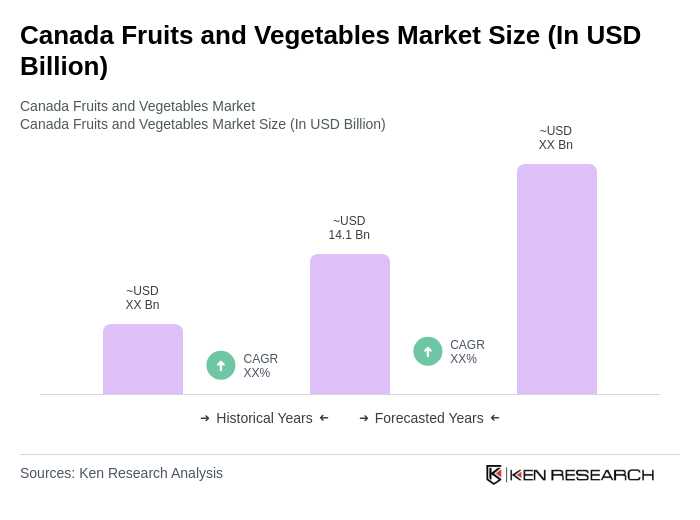
- The Canada Fruits and Vegetables Market is valued at USD 14.1 billion, based on a five-year historical analysis. This growth is primarily driven by increasing health consciousness among consumers, a rising trend towards plant-based diets, and the expansion of organic and sustainable farming practices. The demand for fresh produce has surged as consumers prioritize nutrition, food safety, and environmental sustainability in their food choices. The adoption of hybrid seeds, advanced farming technologies, and government initiatives supporting sustainable agriculture further fuel market expansion .
- Key players in this market includeOntario, British Columbia, and Quebec, which dominate due to their favorable climates for agriculture, advanced farming technologies, and robust distribution networks. These regions benefit from a combination of fertile land, innovation in crop management, and a strong consumer base that supports local produce, making them pivotal in the Canadian fruits and vegetables landscape .
- In 2023, the Canadian government implemented theCanada Organic Regimeunder the Safe Food for Canadians Regulations (SFCR), administered by the Canadian Food Inspection Agency (CFIA). This regulation establishes binding requirements for organic certification, including production, processing, labeling, and import standards. All organic produce sold in Canada must be certified to these standards, enhancing consumer trust and supporting sustainable agricultural practices (Safe Food for Canadians Regulations, Canadian Food Inspection Agency, 2023) .
Canada Fruits and Vegetables Market Segmentation
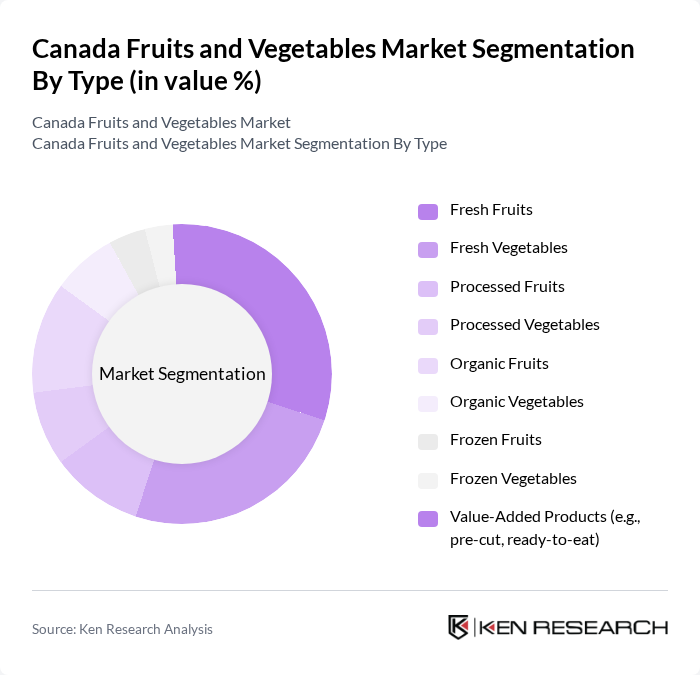
By Type:The market is segmented into various types, including Fresh Fruits, Fresh Vegetables, Processed Fruits, Processed Vegetables, Organic Fruits, Organic Vegetables, Frozen Fruits, Frozen Vegetables, and Value-Added Products (e.g., pre-cut, ready-to-eat). Each sub-segment caters to different consumer preferences and dietary needs, withfresh fruits and vegetablesleading the market due to their health benefits, convenience, and increasing demand for minimally processed foods. Organic and value-added products are also experiencing notable growth, reflecting consumer interest in food safety, traceability, and convenience .
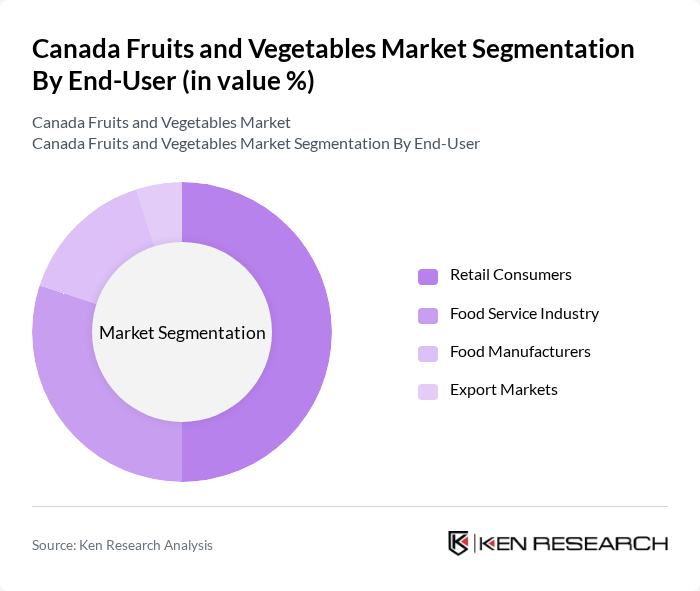
By End-User:The market is segmented by end-users, including Retail Consumers, Food Service Industry, Food Manufacturers, and Export Markets.Retail consumersdominate the market, driven by increasing demand for fresh produce in households, while the food service industry is also significant due to the growing trend of healthy eating in restaurants and cafes. Food manufacturers and export markets are expanding, supported by innovation in processing and packaging .
Canada Fruits and Vegetables Market Competitive Landscape
The Canada Fruits and Vegetables Market is characterized by a dynamic mix of regional and international players. Leading participants such as Fresh Del Monte Produce Inc., Dole plc, The Green Organic Dutchman Holdings Ltd., Sunfresh Farms Ltd., Highline Mushrooms, Nature Fresh Farms, Ocean Spray Cranberries, Inc., Canada Bread Company, Limited, Bonduelle Americas, Mastronardi Produce Ltd. (SUNSET), The Produce Terminal, Ontario Greenhouse Vegetable Growers, FreshPoint Canada, BC Blueberry Council, Canadian Organic Growers contribute to innovation, geographic expansion, and service delivery in this space.
Canada Fruits and Vegetables Market Industry Analysis
Growth Drivers
- Increasing Health Consciousness:The Canadian population is increasingly prioritizing health, with 63% of adults actively seeking to improve their diets. This trend is reflected in the rising consumption of fruits and vegetables, which reached7.6 million metric tonsin future. The World Health Organization recommends a daily intake of 400 grams of fruits and vegetables, further driving demand. As health awareness grows, consumers are more inclined to purchase fresh produce, boosting market growth significantly.
- Rising Demand for Organic Produce:The organic fruits and vegetables segment in Canada has seen a remarkable increase, with sales reachingCAD 2.8 billionin future, a notable rise from previous years. This growth is fueled by consumer preferences for chemical-free products, with 45% of Canadians indicating a willingness to pay more for organic options. The Canadian Organic Standards ensure quality, further enhancing consumer trust and driving the organic market's expansion.
- Expansion of E-commerce Platforms:E-commerce sales of fruits and vegetables in Canada surged toCAD 1.1 billionin future, reflecting a significant increase from previous years. The convenience of online shopping has attracted a broader customer base, particularly among younger consumers. Major retailers are investing in digital platforms, enhancing logistics and delivery systems, which is expected to further increase online sales. This trend is reshaping the distribution landscape, making fresh produce more accessible.
Market Challenges
- Climate Change Impact:Climate change poses significant risks to the Canadian fruits and vegetables market, with extreme weather events leading to crop losses estimated atCAD 1.5 billion annually. Droughts and floods disrupt production cycles, affecting supply and quality. The Canadian government has reported that 30% of farmers have experienced adverse weather conditions, which directly impacts yield and market stability, creating challenges for producers and consumers alike.
- Supply Chain Disruptions:The Canadian fruits and vegetables market faces ongoing supply chain challenges, exacerbated by global events such as the COVID-19 pandemic. In future, 25% of producers reported delays in logistics and transportation, leading to increased costs and reduced availability of fresh produce. These disruptions have resulted in a10% increase in pricesfor consumers, complicating access to essential food items and straining market dynamics.
Canada Fruits and Vegetables Market Future Outlook
The future of the Canadian fruits and vegetables market appears promising, driven by evolving consumer preferences and technological advancements. As health consciousness continues to rise, the demand for fresh and organic produce is expected to grow. Additionally, innovations in agricultural technology, such as precision farming and vertical farming, will enhance productivity and sustainability. These trends, coupled with government support for local farmers, will likely create a more resilient and dynamic market landscape in the coming years.
Market Opportunities
- Growth in Plant-Based Diets:The shift towards plant-based diets presents a significant opportunity for the fruits and vegetables market, with28% of Canadiansactively reducing meat consumption. This trend is expected to drive demand for diverse produce options, encouraging innovation in product offerings and marketing strategies to cater to health-conscious consumers seeking plant-based alternatives.
- Technological Advancements in Agriculture:The adoption of smart agriculture technologies, such as IoT and AI, is revolutionizing farming practices in Canada. These innovations can increase crop yields by up to18%while reducing resource consumption. As farmers embrace these technologies, the efficiency and sustainability of fruit and vegetable production will improve, creating new market opportunities and enhancing competitiveness.
Scope of the Report
| Segment | Sub-Segments |
|---|---|
| By Type | Fresh Fruits Fresh Vegetables Processed Fruits Processed Vegetables Organic Fruits Organic Vegetables Frozen Fruits Frozen Vegetables Value-Added Products (e.g., pre-cut, ready-to-eat) |
| By End-User | Retail Consumers Food Service Industry Food Manufacturers Export Markets |
| By Distribution Channel | Supermarkets/Hypermarkets Online Retail Farmers' Markets Wholesale Distributors Direct-to-Consumer (Subscription/Box Schemes) |
| By Packaging Type | Bulk Packaging Retail Packaging Eco-Friendly Packaging |
| By Region | Western Canada (British Columbia, Alberta, Saskatchewan, Manitoba) Central Canada (Ontario, Quebec) Eastern Canada (New Brunswick, Newfoundland and Labrador, Nova Scotia, Prince Edward Island) Northern Canada (Yukon, Northwest Territories, Nunavut) |
| By Price Range | Premium Mid-Range Budget |
| By Product Lifecycle Stage | Introduction Growth Maturity Decline |
Key Target Audience
Investors and Venture Capitalist Firms
Government and Regulatory Bodies (e.g., Agriculture and Agri-Food Canada, Canadian Food Inspection Agency)
Manufacturers and Producers
Distributors and Retailers
Food Processing Companies
Exporters and Importers
Industry Associations (e.g., Canadian Horticultural Council)
Financial Institutions
Players Mentioned in the Report:
Fresh Del Monte Produce Inc.
Dole plc
The Green Organic Dutchman Holdings Ltd.
Sunfresh Farms Ltd.
Highline Mushrooms
Nature Fresh Farms
Ocean Spray Cranberries, Inc.
Canada Bread Company, Limited
Bonduelle Americas
Mastronardi Produce Ltd. (SUNSET)
The Produce Terminal
Ontario Greenhouse Vegetable Growers
FreshPoint Canada
BC Blueberry Council
Canadian Organic Growers
Table of Contents
Market Assessment Phase
1. Executive Summary and Approach
2. Canada Fruits and Vegetables Market Overview
2.1 Key Insights and Strategic Recommendations
2.2 Canada Fruits and Vegetables Market Overview
2.3 Definition and Scope
2.4 Evolution of Market Ecosystem
2.5 Timeline of Key Regulatory Milestones
2.6 Value Chain & Stakeholder Mapping
2.7 Business Cycle Analysis
2.8 Policy & Incentive Landscape
3. Canada Fruits and Vegetables Market Analysis
3.1 Growth Drivers
3.1.1 Increasing Health Consciousness
3.1.2 Rising Demand for Organic Produce
3.1.3 Expansion of E-commerce Platforms
3.1.4 Government Support for Local Farmers
3.2 Market Challenges
3.2.1 Climate Change Impact
3.2.2 Supply Chain Disruptions
3.2.3 Competition from Imported Products
3.2.4 Price Volatility of Raw Materials
3.3 Market Opportunities
3.3.1 Growth in Plant-Based Diets
3.3.2 Technological Advancements in Agriculture
3.3.3 Export Potential to Emerging Markets
3.3.4 Development of Value-Added Products
3.4 Market Trends
3.4.1 Increased Focus on Sustainability
3.4.2 Rise of Local and Urban Farming
3.4.3 Adoption of Smart Agriculture Technologies
3.4.4 Growing Popularity of Meal Kits
3.5 Government Regulation
3.5.1 Food Safety Standards
3.5.2 Organic Certification Regulations
3.5.3 Import Tariffs on Foreign Produce
3.5.4 Environmental Protection Policies
4. SWOT Analysis
5. Stakeholder Analysis
6. Porter's Five Forces Analysis
7. Canada Fruits and Vegetables Market Market Size, 2019-2024
7.1 By Value
7.2 By Volume
7.3 By Average Selling Price
8. Canada Fruits and Vegetables Market Segmentation
8.1 By Type
8.1.1 Fresh Fruits
8.1.2 Fresh Vegetables
8.1.3 Processed Fruits
8.1.4 Processed Vegetables
8.1.5 Organic Fruits
8.1.6 Organic Vegetables
8.1.7 Frozen Fruits
8.1.8 Frozen Vegetables
8.1.9 Value-Added Products (e.g., pre-cut, ready-to-eat)
8.2 By End-User
8.2.1 Retail Consumers
8.2.2 Food Service Industry
8.2.3 Food Manufacturers
8.2.4 Export Markets
8.3 By Distribution Channel
8.3.1 Supermarkets/Hypermarkets
8.3.2 Online Retail
8.3.3 Farmers' Markets
8.3.4 Wholesale Distributors
8.3.5 Direct-to-Consumer (Subscription/Box Schemes)
8.4 By Packaging Type
8.4.1 Bulk Packaging
8.4.2 Retail Packaging
8.4.3 Eco-Friendly Packaging
8.5 By Region
8.5.1 Western Canada (British Columbia, Alberta, Saskatchewan, Manitoba)
8.5.2 Central Canada (Ontario, Quebec)
8.5.3 Eastern Canada (New Brunswick, Newfoundland and Labrador, Nova Scotia, Prince Edward Island)
8.5.4 Northern Canada (Yukon, Northwest Territories, Nunavut)
8.6 By Price Range
8.6.1 Premium
8.6.2 Mid-Range
8.6.3 Budget
8.7 By Product Lifecycle Stage
8.7.1 Introduction
8.7.2 Growth
8.7.3 Maturity
8.7.4 Decline
9. Canada Fruits and Vegetables Market Competitive Analysis
9.1 Market Share of Key Players
9.2 Cross Comparison of Key Players
9.2.1 Company Name
9.2.2 Group Size (Large, Medium, or Small as per industry convention)
9.2.3 Revenue (CAD, latest fiscal year)
9.2.4 Revenue Growth Rate (YoY %)
9.2.5 Market Share (%)
9.2.6 Product Portfolio Breadth (Number of SKUs/Varieties)
9.2.7 Geographic Coverage (Number of Provinces/Regions Served)
9.2.8 Distribution Channel Diversity (Retail, Foodservice, Export, D2C)
9.2.9 Supply Chain Efficiency (Lead Time, Fill Rate, On-Time Delivery %)
9.2.10 Certification & Compliance (e.g., Organic, Food Safety, Sustainability)
9.2.11 Brand Recognition Score (Survey/Market Index)
9.2.12 Customer Retention Rate (%)
9.2.13 Innovation Index (New Product Launches, Patents, R&D Spend)
9.3 SWOT Analysis of Top Players
9.4 Pricing Analysis
9.5 Detailed Profile of Major Companies
9.5.1 Fresh Del Monte Produce Inc.
9.5.2 Dole plc
9.5.3 The Green Organic Dutchman Holdings Ltd.
9.5.4 Sunfresh Farms Ltd.
9.5.5 Highline Mushrooms
9.5.6 Nature Fresh Farms
9.5.7 Ocean Spray Cranberries, Inc.
9.5.8 Canada Bread Company, Limited
9.5.9 Bonduelle Americas
9.5.10 Mastronardi Produce Ltd. (SUNSET)
9.5.11 The Produce Terminal
9.5.12 Ontario Greenhouse Vegetable Growers
9.5.13 FreshPoint Canada
9.5.14 BC Blueberry Council
9.5.15 Canadian Organic Growers
10. Canada Fruits and Vegetables Market End-User Analysis
10.1 Procurement Behavior of Key Ministries
10.1.1 Government Procurement Policies
10.1.2 Budget Allocations for Fresh Produce
10.1.3 Supplier Selection Criteria
10.2 Corporate Spend on Infrastructure & Energy
10.2.1 Investment in Cold Storage Facilities
10.2.2 Energy Efficiency Initiatives
10.2.3 Infrastructure Development for Distribution
10.3 Pain Point Analysis by End-User Category
10.3.1 Quality Assurance Issues
10.3.2 Supply Chain Delays
10.3.3 Price Fluctuations
10.4 User Readiness for Adoption
10.4.1 Awareness of Organic Products
10.4.2 Willingness to Pay for Quality
10.4.3 Adoption of E-commerce Solutions
10.5 Post-Deployment ROI and Use Case Expansion
10.5.1 Measurement of Cost Savings
10.5.2 Customer Satisfaction Metrics
10.5.3 Opportunities for Upselling
11. Canada Fruits and Vegetables Market Future Size, 2025-2030
11.1 By Value
11.2 By Volume
11.3 By Average Selling Price
Go-To-Market Strategy Phase
1. Whitespace Analysis + Business Model Canvas
1.1 Market Gaps Identification
1.2 Business Model Framework
2. Marketing and Positioning Recommendations
2.1 Branding Strategies
2.2 Product USPs
3. Distribution Plan
3.1 Urban Retail Strategies
3.2 Rural NGO Tie-Ups
4. Channel & Pricing Gaps
4.1 Underserved Routes
4.2 Pricing Bands
5. Unmet Demand & Latent Needs
5.1 Category Gaps
5.2 Consumer Segments
6. Customer Relationship
6.1 Loyalty Programs
6.2 After-Sales Service
7. Value Proposition
7.1 Sustainability Initiatives
7.2 Integrated Supply Chains
8. Key Activities
8.1 Regulatory Compliance
8.2 Branding Efforts
8.3 Distribution Setup
9. Entry Strategy Evaluation
9.1 Domestic Market Entry Strategy
9.1.1 Product Mix Considerations
9.1.2 Pricing Band Strategy
9.1.3 Packaging Innovations
9.2 Export Entry Strategy
9.2.1 Target Countries Analysis
9.2.2 Compliance Roadmap
10. Entry Mode Assessment
10.1 Joint Ventures
10.2 Greenfield Investments
10.3 Mergers & Acquisitions
10.4 Distributor Model
11. Capital and Timeline Estimation
11.1 Capital Requirements
11.2 Timelines for Implementation
12. Control vs Risk Trade-Off
12.1 Ownership Considerations
12.2 Partnerships Evaluation
13. Profitability Outlook
13.1 Breakeven Analysis
13.2 Long-Term Sustainability
14. Potential Partner List
14.1 Distributors
14.2 Joint Ventures
14.3 Acquisition Targets
15. Execution Roadmap
15.1 Phased Plan for Market Entry
15.1.1 Market Setup
15.1.2 Market Entry
15.1.3 Growth Acceleration
15.1.4 Scale & Stabilize
15.2 Key Activities and Milestones
15.2.1 Milestone Planning
15.2.2 Activity Tracking
Research Methodology
Phase 1: Approach1
Desk Research
- Analysis of government agricultural reports and statistics from Agriculture and Agri-Food Canada
- Review of market reports from industry associations such as the Canadian Produce Marketing Association
- Examination of trade publications and journals focusing on the fruits and vegetables sector
Primary Research
- Interviews with key stakeholders including farmers, distributors, and retailers in the fruits and vegetables market
- Surveys targeting consumers to understand purchasing behavior and preferences
- Focus groups with industry experts to gather insights on market trends and challenges
Validation & Triangulation
- Cross-validation of data from multiple sources including trade data and consumer surveys
- Triangulation of findings through expert panel discussions and feedback
- Sanity checks using historical market growth rates and current economic indicators
Phase 2: Market Size Estimation1
Top-down Assessment
- Estimation of total market size based on national consumption data and import/export statistics
- Segmentation of the market by product type (fruits vs. vegetables) and distribution channel (retail vs. wholesale)
- Incorporation of demographic trends and population growth projections in Canada
Bottom-up Modeling
- Collection of sales data from major retailers and wholesalers in the fruits and vegetables sector
- Estimation of average prices and volume sold per product category
- Calculation of market size based on firm-level data and extrapolation to the national level
Forecasting & Scenario Analysis
- Development of forecasting models using historical sales data and economic indicators
- Scenario analysis based on potential impacts of climate change and trade policies on supply
- Projections of market growth under different consumer behavior scenarios through 2030
Phase 3: CATI Sample Composition1
| Scope Item/Segment | Sample Size | Target Respondent Profiles |
|---|---|---|
| Retail Fruit Sales | 100 | Store Managers, Category Buyers |
| Wholesale Vegetable Distribution | 80 | Wholesale Distributors, Supply Chain Managers |
| Consumer Purchasing Behavior | 150 | General Consumers, Health-Conscious Shoppers |
| Organic Produce Market | 60 | Organic Farmers, Retailers of Organic Products |
| Export Market Insights | 50 | Export Managers, Trade Analysts |
Frequently Asked Questions
What is the current value of the Canada Fruits and Vegetables Market?
The Canada Fruits and Vegetables Market is valued at approximately USD 14.1 billion, reflecting a significant growth trend driven by health consciousness, plant-based diets, and sustainable farming practices among consumers.
Which regions dominate the Canada Fruits and Vegetables Market?
What are the main types of products in the Canada Fruits and Vegetables Market?
How has the demand for organic produce changed in Canada?
Other Regional/Country Reports
Why Buy From Us?

What makes us stand out is that our consultants follow Robust, Refine and Result (RRR) methodology. Robust for clear definitions, approaches and sanity checking, Refine for differentiating respondents' facts and opinions, and Result for presenting data with story.

We have set a benchmark in the industry by offering our clients with syndicated and customized market research reports featuring coverage of entire market as well as meticulous research and analyst insights.

While we don't replace traditional research, we flip the method upside down. Our dual approach of Top Bottom & Bottom Top ensures quality deliverable by not just verifying company fundamentals but also looking at the sector and macroeconomic factors.

With one step in the future, our research team constantly tries to show you the bigger picture. We help with some of the tough questions you may encounter along the way: How is the industry positioned? Best marketing channel? KPI's of competitors? By aligning every element, we help maximize success.

Our report gives you instant access to the answers and sources that other companies might choose to hide. We elaborate each steps of research methodology we have used and showcase you the sample size to earn your trust.

If you need any support, we are here! We pride ourselves on universe strength, data quality, and quick, friendly, and professional service.