About the Report
Base Year 2024Canada Oil and Gas Market Overview
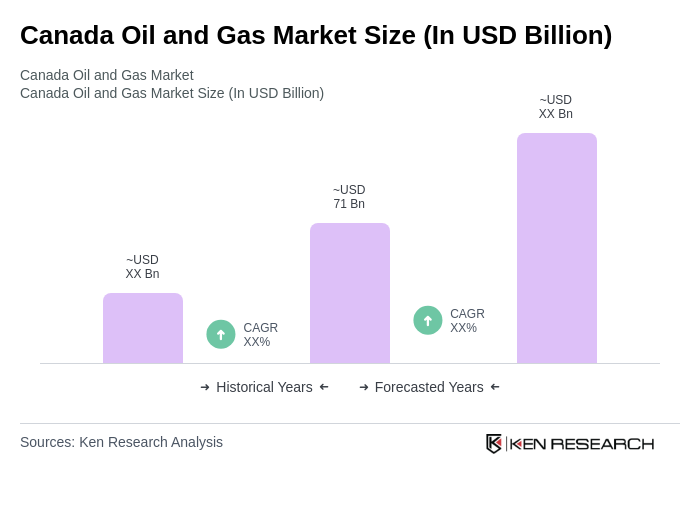
- The Canada Oil and Gas Market is valued at USD 71 billion, based on a five-year historical analysis of industry contribution to gross domestic product. This growth is primarily driven by the country's vast natural resources, ongoing investments in upstream and LNG projects, technological advancements in extraction methods, and sustained global demand for energy. The market has experienced fluctuations due to geopolitical factors and evolving environmental regulations, but the overall trend indicates a robust sector supported by both domestic and international investments .
- Key players in this market include Alberta, British Columbia, and Saskatchewan, which dominate due to their rich reserves of oil sands and natural gas. Alberta, in particular, is recognized for its extensive oil sands operations, while British Columbia has emerged as a major hub for natural gas and LNG export projects. The strategic location of these provinces, along with expanded pipeline infrastructure such as the Trans Mountain Pipeline, facilitates efficient transportation and export, further enhancing their market position .
- In 2023, the Canadian government implemented the Clean Fuel Regulations, 2022 issued by Environment and Climate Change Canada. This regulation mandates a phased reduction in the carbon intensity of liquid fossil fuels supplied in Canada, requiring fuel suppliers to adopt cleaner technologies and practices. The Clean Fuel Regulations are a core component of Canada’s strategy to achieve net-zero greenhouse gas emissions by 2050, significantly impacting operational strategies and investment decisions within the oil and gas industry .
Canada Oil and Gas Market Segmentation
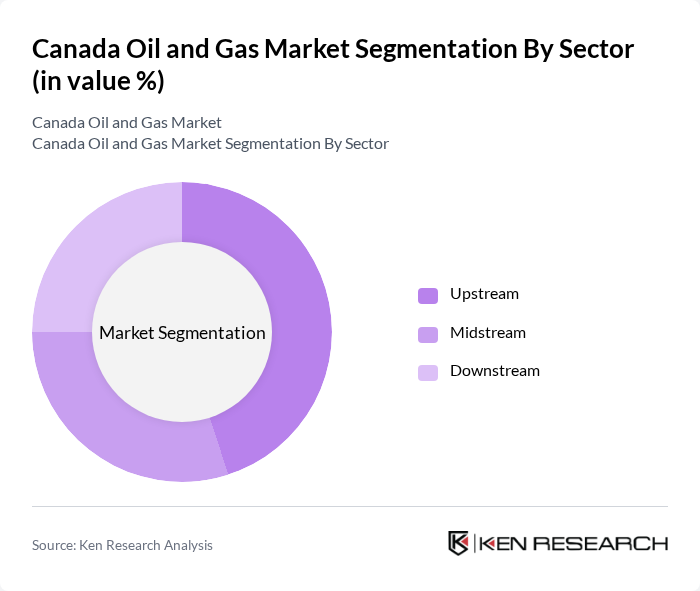
By Sector:The market is segmented by sector into upstream, midstream, and downstream activities. The upstream sector encompasses exploration and production of crude oil and natural gas, supported by major investments in oil sands and LNG projects. The midstream sector involves transportation, storage, and export infrastructure, including pipelines and LNG terminals. The downstream sector covers refining, processing, and distribution of petroleum products to end users. Each sector plays a crucial role in the value chain, with upstream and midstream segments seeing significant capital investment and technological innovation .
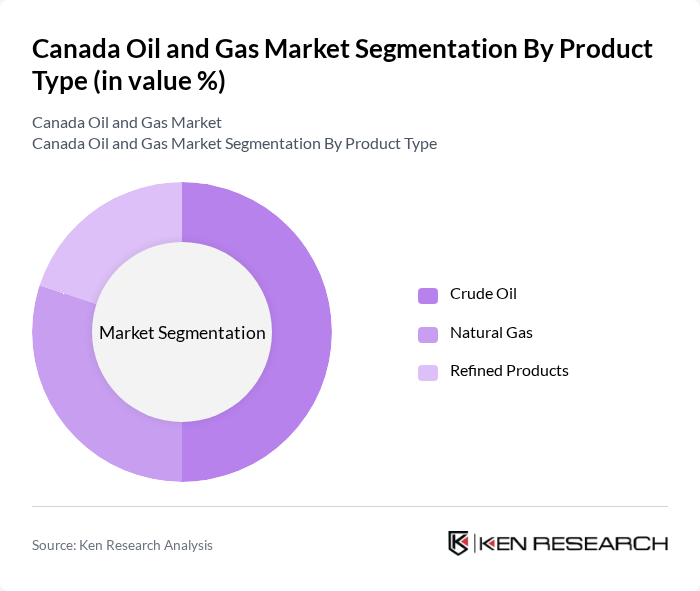
By Product Type:The market is segmented by product type into crude oil, natural gas, and refined products. Crude oil remains the dominant product, driven by robust production from oil sands and strong export demand. Natural gas is gaining market share, supported by increased LNG export capacity and its role as a lower-carbon transition fuel. Refined products, including gasoline, diesel, and petrochemicals, serve diverse industrial and consumer markets. These segments reflect evolving energy preferences and ongoing advancements in extraction, processing, and emissions reduction technologies .
Canada Oil and Gas Market Competitive Landscape
The Canada Oil and Gas Market is characterized by a dynamic mix of regional and international players. Leading participants such as Suncor Energy Inc., Canadian Natural Resources Limited, Cenovus Energy Inc., Imperial Oil Limited, Husky Energy Inc., Enbridge Inc., TC Energy Corporation, Pembina Pipeline Corporation, Ovintiv Inc., Vermilion Energy Inc., Crescent Point Energy Corp., Tourmaline Oil Corp., Whitecap Resources Inc., Keyera Corp., and AltaGas Ltd. contribute to innovation, geographic expansion, and service delivery in this space.
Canada Oil and Gas Market Industry Analysis
Growth Drivers
- Increasing Energy Demand:The demand for energy in Canada is projected to reach 1,800 terawatt-hours (TWh) in future, driven by population growth and industrial expansion. The oil and gas sector is expected to contribute significantly, with crude oil production estimated at 4.8 million barrels per day (bpd) in future. This rising demand is supported by the country's commitment to energy security and economic growth, making the oil and gas industry a critical component of Canada's energy landscape.
- Technological Advancements:The Canadian oil and gas sector is increasingly adopting advanced technologies, such as enhanced oil recovery (EOR) techniques, which can improve extraction rates by up to 30%. Investments in digital technologies, including artificial intelligence and machine learning, are projected to exceed CAD 1 billion in future. These innovations not only enhance operational efficiency but also reduce costs, positioning Canada as a leader in energy technology within the global market.
- Government Support and Incentives:The Canadian government has allocated CAD 1.5 billion in incentives for oil and gas exploration and production in future. This includes tax breaks and grants aimed at fostering innovation and sustainability in the sector. Additionally, policies promoting energy independence and job creation are expected to bolster investment, with the government targeting a 10% increase in domestic oil production in future, further driving growth in the industry.
Market Challenges
- Environmental Regulations:Stricter environmental regulations are a significant challenge for the Canadian oil and gas industry. In future, compliance costs are expected to rise by 15%, driven by new emission reduction targets set by the federal government. These regulations aim to reduce greenhouse gas emissions by 40% in future, which may hinder operational flexibility and increase the financial burden on companies, impacting overall profitability.
- Market Volatility:The Canadian oil and gas market faces significant volatility, with crude oil prices fluctuating between CAD 60 and CAD 80 per barrel in future. This unpredictability affects investment decisions and operational planning, as companies struggle to maintain profitability amid changing market conditions. The reliance on global oil prices, influenced by geopolitical tensions and supply chain disruptions, adds to the uncertainty faced by industry stakeholders.
Canada Oil and Gas Market Future Outlook
The future of the Canadian oil and gas market appears promising, driven by a combination of technological advancements and government support. As the industry adapts to environmental regulations, companies are likely to invest in cleaner technologies and sustainable practices. Furthermore, the ongoing digital transformation will enhance operational efficiencies, allowing firms to remain competitive. With a focus on strategic partnerships and innovation, the sector is poised for growth, despite facing challenges from market volatility and environmental concerns.
Market Opportunities
- Expansion into Emerging Markets:Canadian oil and gas companies are increasingly looking to expand into emerging markets, particularly in Asia and Africa. With a projected increase in energy demand in these regions, estimated at 3.5% annually, Canadian firms can leverage their expertise to capture new market share and enhance revenue streams, potentially increasing exports by CAD 2 billion in future.
- Investment in Clean Technologies:The shift towards sustainability presents a significant opportunity for investment in clean technologies. In future, the Canadian government is expected to invest CAD 500 million in research and development for renewable energy solutions. This investment can lead to innovative practices in the oil and gas sector, reducing environmental impact while maintaining production levels, ultimately enhancing the industry's long-term viability.
Scope of the Report
| Segment | Sub-Segments |
|---|---|
| By Sector | Upstream Midstream Downstream |
| By Product Type | Crude Oil Natural Gas Refined Products |
| By End-User | Industrial Commercial Residential Government & Utilities |
| By Application | Power Generation Transportation Heating Feedstock for Chemicals |
| By Distribution Channel | Direct Sales Retail Outlets Online Platforms |
| By Investment Source | Domestic Investment Foreign Direct Investment (FDI) Public-Private Partnerships (PPP) |
| By Regulatory Compliance | Environmental Compliance Safety Standards Compliance Quality Assurance Compliance |
| By Region | Western Canada (Alberta, British Columbia, Saskatchewan, Manitoba) Eastern Canada (Newfoundland & Labrador, Nova Scotia, Quebec) Central Canada (Ontario, Quebec) Northern Canada (Yukon, Northwest Territories, Nunavut) |
Key Target Audience
Investors and Venture Capitalist Firms
Government and Regulatory Bodies (e.g., Natural Resources Canada, Canada Energy Regulator)
Oil and Gas Exploration and Production Companies
Pipeline and Infrastructure Operators
Environmental Agencies (e.g., Environment and Climate Change Canada)
Energy Policy Makers
Trade Associations (e.g., Canadian Association of Petroleum Producers)
Financial Institutions and Banks
Players Mentioned in the Report:
Suncor Energy Inc.
Canadian Natural Resources Limited
Cenovus Energy Inc.
Imperial Oil Limited
Husky Energy Inc.
Enbridge Inc.
TC Energy Corporation
Pembina Pipeline Corporation
Ovintiv Inc.
Vermilion Energy Inc.
Crescent Point Energy Corp.
Tourmaline Oil Corp.
Whitecap Resources Inc.
Keyera Corp.
AltaGas Ltd.
Table of Contents
Go-To-Market Strategy Phase
1. Whitespace Analysis + Business Model Canvas
1.1 Market Gaps Identification
1.2 Business Model Development
2. Marketing and Positioning Recommendations
2.1 Branding Strategies
2.2 Product USPs
3. Distribution Plan
3.1 Urban Retail Strategies
3.2 Rural NGO Tie-Ups
4. Channel & Pricing Gaps
4.1 Underserved Routes
4.2 Pricing Bands
5. Unmet Demand & Latent Needs
5.1 Category Gaps
5.2 Consumer Segments
6. Customer Relationship
6.1 Loyalty Programs
6.2 After-Sales Service
7. Value Proposition
7.1 Sustainability Initiatives
7.2 Integrated Supply Chains
8. Key Activities
8.1 Regulatory Compliance
8.2 Branding Efforts
8.3 Distribution Setup
9. Entry Strategy Evaluation
9.1 Domestic Market Entry Strategy
9.1.1 Product Mix
9.1.2 Pricing Band
9.1.3 Packaging
9.2 Export Entry Strategy
9.2.1 Target Countries
9.2.2 Compliance Roadmap
10. Entry Mode Assessment
10.1 Joint Ventures
10.2 Greenfield Investments
10.3 Mergers & Acquisitions
10.4 Distributor Model
11. Capital and Timeline Estimation
11.1 Capital Requirements
11.2 Timelines
12. Control vs Risk Trade-Off
12.1 Ownership vs Partnerships
13. Profitability Outlook
13.1 Breakeven Analysis
13.2 Long-Term Sustainability
14. Potential Partner List
14.1 Distributors
14.2 Joint Ventures
14.3 Acquisition Targets
15. Execution Roadmap
15.1 Phased Plan for Market Entry
15.1.1 Market Setup
15.1.2 Market Entry
15.1.3 Growth Acceleration
15.1.4 Scale & Stabilize
15.2 Key Activities and Milestones
15.2.1 Activity Planning
15.2.2 Milestone Tracking
Research Methodology
Phase 1: Approach1
Desk Research
- Analysis of government reports and publications from Natural Resources Canada
- Review of industry reports from the Canadian Association of Petroleum Producers (CAPP)
- Examination of market trends and forecasts from energy market analysts
Primary Research
- Interviews with executives from major oil and gas companies operating in Canada
- Surveys targeting field engineers and project managers in the exploration sector
- Focus groups with stakeholders from indigenous communities affected by oil and gas projects
Validation & Triangulation
- Cross-validation of findings with data from the Canadian Energy Regulator (CER)
- Triangulation of insights from primary interviews with secondary data sources
- Sanity checks through expert panels comprising industry veterans and analysts
Phase 2: Market Size Estimation1
Top-down Assessment
- Estimation of total market size based on national oil production and consumption statistics
- Segmentation of market by province and type of oil and gas resources
- Incorporation of export data and international market trends affecting Canada
Bottom-up Modeling
- Collection of production data from leading oil sands and shale gas operators
- Cost analysis based on operational expenditures and capital investments in the sector
- Volume estimates derived from drilling activity and production rates
Forecasting & Scenario Analysis
- Multi-variable forecasting models incorporating oil price volatility and regulatory changes
- Scenario analysis based on environmental policies and technological advancements
- Development of baseline, optimistic, and pessimistic market projections through 2030
Phase 3: CATI Sample Composition1
| Scope Item/Segment | Sample Size | Target Respondent Profiles |
|---|---|---|
| Oil Sands Production Insights | 100 | Operations Managers, Environmental Compliance Officers |
| Shale Gas Exploration Trends | 80 | Geologists, Project Managers |
| Regulatory Impact Assessments | 60 | Policy Analysts, Legal Advisors |
| Indigenous Community Engagement | 40 | Community Leaders, Stakeholder Relations Managers |
| Renewable Energy Integration | 70 | Energy Transition Specialists, Sustainability Managers |
Frequently Asked Questions
1. What is the current value of the Canada Oil and Gas Market?
The Canada Oil and Gas Market is valued at approximately USD 71 billion, reflecting its significant contribution to the country's gross domestic product and driven by natural resources, investments, and global energy demand.
2. Which provinces are the key players in the Canada Oil and Gas Market?
3. What are the main sectors of the Canada Oil and Gas Market?
4. How has the Canadian government influenced the oil and gas industry?
Why Buy From Us?

What makes us stand out is that our consultants follow Robust, Refine and Result (RRR) methodology. Robust for clear definitions, approaches and sanity checking, Refine for differentiating respondents' facts and opinions, and Result for presenting data with story.

We have set a benchmark in the industry by offering our clients with syndicated and customized market research reports featuring coverage of entire market as well as meticulous research and analyst insights.

While we don't replace traditional research, we flip the method upside down. Our dual approach of Top Bottom & Bottom Top ensures quality deliverable by not just verifying company fundamentals but also looking at the sector and macroeconomic factors.

With one step in the future, our research team constantly tries to show you the bigger picture. We help with some of the tough questions you may encounter along the way: How is the industry positioned? Best marketing channel? KPI's of competitors? By aligning every element, we help maximize success.

Our report gives you instant access to the answers and sources that other companies might choose to hide. We elaborate each steps of research methodology we have used and showcase you the sample size to earn your trust.

If you need any support, we are here! We pride ourselves on universe strength, data quality, and quick, friendly, and professional service.