About the Report
Base Year 2024France Renewable Energy Market Overview
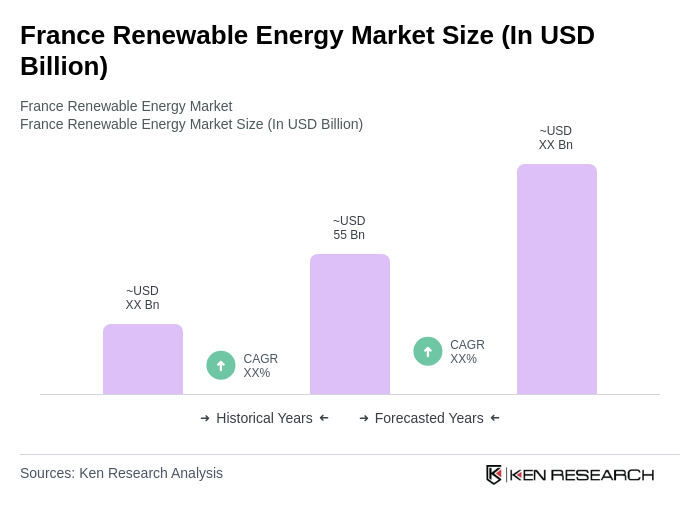
- The France Renewable Energy Market is valued at approximately USD 55 billion, based on a five-year historical analysis. This reflects sustained additions in solar and wind capacity, rising renewable generation, and supportive investment signals from national policy frameworks and tenders .
- Key players in this market include regions such as Île-de-France, Occitanie, and Nouvelle-Aquitaine, which dominate due to their favorable geographic conditions, robust infrastructure, and supportive local government initiatives. Occitanie and Nouvelle-Aquitaine have among the highest onshore wind and solar resources and project pipelines, while Île-de-France leads demand-side initiatives, grid upgrades, and rooftop solar deployment supported by regional policies .
- In 2023, the French government advanced the Multiannual Energy Program (Programmation pluriannuelle de l’énergie, PPE) objectives toward a 40% share of renewable energy in the national energy mix by 2030, emphasizing accelerated solar and wind deployment via auctions and permitting reforms; this target and pathway are reiterated in official investment promotion materials based on the Ministry’s data .
France Renewable Energy Market Segmentation
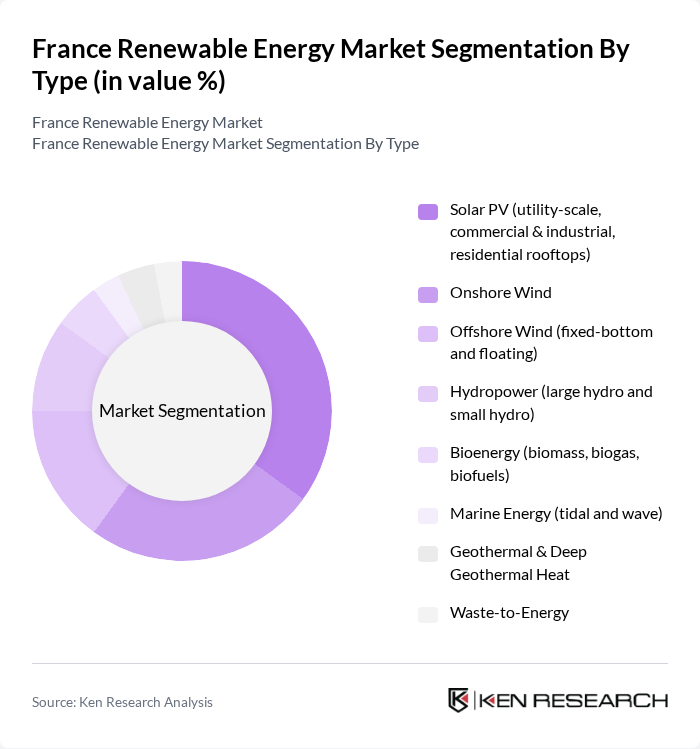
By Type:The market is segmented into various types of renewable energy sources, including solar PV, onshore wind, offshore wind, hydropower, bioenergy, marine energy, geothermal energy, and waste-to-energy. Each of these segments plays a crucial role in the overall energy landscape, with specific applications and technologies driving their growth. Recent trends include rapid utility-scale and distributed solar additions, momentum in onshore wind repowering, commissioning of initial fixed-bottom offshore wind and buildout of floating wind tenders, modernization of legacy hydropower assets, scaling of biogas-to-grid, and municipal waste-to-energy upgrades aligned with decarbonization plans .
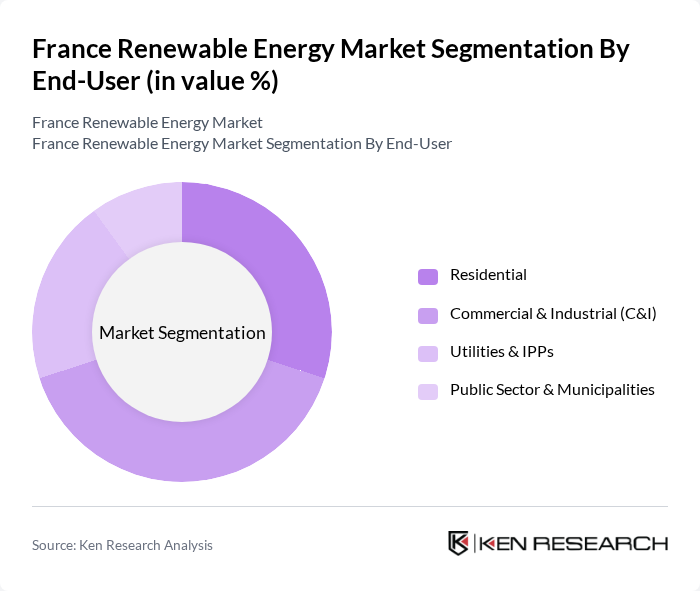
By End-User:The end-user segmentation includes residential, commercial & industrial (C&I), utilities & independent power producers (IPPs), and public sector & municipalities. Each segment has distinct energy needs and consumption patterns, influencing the demand for renewable energy solutions. Growth is driven by self-consumption schemes and rooftop solar in residential, corporate PPAs and site-level generation in C&I, utility-scale auction-backed projects for utilities & IPPs, and municipal decarbonization programs including waste-to-energy and district heating for public sector .
France Renewable Energy Market Competitive Landscape
The France Renewable Energy Market is characterized by a dynamic mix of regional and international players. Leading participants such as EDF Renewables, Engie SA, TotalEnergies SE, Neoen SA, EDP Renewables (EDPR), Akuo Energy, Voltalia, GreenYellow, Qair, Enedis, Vattenfall, BayWa r.e., Siemens Gamesa Renewable Energy, Nordex, Vestas contribute to innovation, geographic expansion, and service delivery in this space .
France Renewable Energy Market Industry Analysis
Growth Drivers
- Increasing Government Support for Renewable Initiatives:The French government allocated €9 billion in future to support renewable energy projects, reflecting a commitment to achieving 33% of energy consumption from renewable sources in future. This funding is directed towards solar, wind, and biomass projects, which are expected to create approximately 100,000 jobs in future. Additionally, the government aims to reduce greenhouse gas emissions by 55% in future, further driving investment in renewable technologies.
- Rising Consumer Demand for Sustainable Energy:In future, over 70% of French consumers expressed a preference for renewable energy sources, leading to a significant increase in demand for green energy solutions. This shift is supported by a 15% rise in the number of households opting for green energy tariffs, which now account for 25% of the residential energy market. The growing awareness of climate change impacts is propelling consumers towards sustainable energy options, influencing market dynamics.
- Technological Advancements in Energy Storage:The energy storage market in France is projected to reach €1.5 billion in future, driven by innovations in battery technology and energy management systems. The deployment of lithium-ion batteries has increased by 30% in the last year, enhancing the efficiency of renewable energy systems. These advancements enable better integration of intermittent renewable sources, ensuring a stable energy supply and supporting the transition to a low-carbon economy.
Market Challenges
- Regulatory Uncertainties:The French renewable energy sector faces significant regulatory challenges, with over 50% of developers citing regulatory unpredictability as a major barrier. Frequent changes in policies, such as feed-in tariffs and grid access rules, create an unstable investment environment. This uncertainty can delay project approvals and increase costs, hindering the growth of renewable energy initiatives and discouraging potential investors from entering the market.
- High Initial Capital Investment:The upfront costs for renewable energy projects in France can exceed €1 million per megawatt for solar and wind installations. This high initial capital requirement poses a significant barrier for small and medium-sized enterprises (SMEs) looking to enter the market. Additionally, financing options remain limited, with only 40% of projects receiving adequate funding, which can slow down the deployment of renewable technologies across the country.
France Renewable Energy Market Future Outlook
The future of the renewable energy market in France appears promising, driven by increasing investments in innovative technologies and a strong commitment to sustainability. The government’s ambitious targets for carbon neutrality in future will likely stimulate further growth in the sector. Additionally, the integration of smart grid technologies and energy efficiency solutions will enhance the overall energy landscape, making it more resilient and adaptable to changing consumer demands and environmental challenges.
Market Opportunities
- Expansion of Offshore Wind Projects:France aims to install 6,000 MW of offshore wind capacity in future, creating significant opportunities for investment and job creation. This expansion is expected to attract over €20 billion in investments, positioning France as a leader in offshore wind energy in Europe and contributing to its renewable energy goals.
- Development of Smart Grid Technologies:The smart grid market in France is projected to grow to €3 billion in future, driven by the need for improved energy management and efficiency. Investments in smart meters and grid automation will enhance the integration of renewable sources, reduce energy losses, and empower consumers to manage their energy consumption more effectively.
Scope of the Report
| Segment | Sub-Segments |
|---|---|
| By Type | Solar PV (utility-scale, commercial & industrial, residential rooftops) Onshore Wind Offshore Wind (fixed-bottom and floating) Hydropower (large hydro and small hydro) Bioenergy (biomass, biogas, biofuels) Marine Energy (tidal and wave) Geothermal & Deep Geothermal Heat Waste-to-Energy |
| By End-User | Residential Commercial & Industrial (C&I) Utilities & IPPs Public Sector & Municipalities |
| By Application | Grid-Connected Electricity Off-Grid & Microgrids Behind-the-Meter/Rooftop Utility-Scale Projects Heating & Cooling (district heating, heat pumps, geothermal heat) Green Hydrogen (renewables-to-hydrogen) |
| By Investment Source | Domestic Private Foreign Direct Investment (FDI) Public-Private Partnerships (PPP) Government Programs & Tenders (CRE auctions, support schemes) |
| By Policy Support | Feed-in Tariffs / Feed-in Premiums Contracts for Difference (CfDs) & PPAs Tax Credits & Accelerated Depreciation Guarantees of Origin (GOs) & Renewable Energy Certificates |
| By Distribution Mode | Direct (developers/EPCs to offtakers) Online & Aggregator Platforms Channel Partners/Installers & Distributors |
| By Price Range | Low (residential/SME installations) Medium (C&I projects) High (utility-scale & offshore) |
Key Target Audience
Investors and Venture Capitalist Firms
Government and Regulatory Bodies (e.g., Ministry of Ecological Transition, French Energy Regulatory Commission)
Energy Producers and Utilities
Renewable Energy Project Developers
Grid Operators and Transmission Companies
Environmental NGOs and Advocacy Groups
Energy Storage Solution Providers
Local and Regional Authorities
Players Mentioned in the Report:
EDF Renewables
Engie SA
TotalEnergies SE
Neoen SA
EDP Renewables (EDPR)
Akuo Energy
Voltalia
GreenYellow
Qair
Enedis
Vattenfall
BayWa r.e.
Siemens Gamesa Renewable Energy
Nordex
Vestas
Table of Contents
Market Assessment Phase
1. Executive Summary and Approach
2. France Renewable Energy Market Overview
2.1 Key Insights and Strategic Recommendations
2.2 France Renewable Energy Market Overview
2.3 Definition and Scope
2.4 Evolution of Market Ecosystem
2.5 Timeline of Key Regulatory Milestones
2.6 Value Chain & Stakeholder Mapping
2.7 Business Cycle Analysis
2.8 Policy & Incentive Landscape
3. France Renewable Energy Market Analysis
3.1 Growth Drivers
3.1.1 Increasing Government Support for Renewable Initiatives
3.1.2 Rising Consumer Demand for Sustainable Energy
3.1.3 Technological Advancements in Energy Storage
3.1.4 Investment in Infrastructure Development
3.2 Market Challenges
3.2.1 Regulatory Uncertainties
3.2.2 High Initial Capital Investment
3.2.3 Competition from Traditional Energy Sources
3.2.4 Grid Integration Issues
3.3 Market Opportunities
3.3.1 Expansion of Offshore Wind Projects
3.3.2 Growth in Energy Efficiency Solutions
3.3.3 Development of Smart Grid Technologies
3.3.4 Increasing Public Awareness and Engagement
3.4 Market Trends
3.4.1 Shift Towards Decentralized Energy Production
3.4.2 Rise of Corporate Power Purchase Agreements (PPAs)
3.4.3 Integration of AI and IoT in Energy Management
3.4.4 Focus on Circular Economy Practices
3.5 Government Regulation
3.5.1 Renewable Energy Directive Compliance
3.5.2 Feed-in Tariff Adjustments
3.5.3 Emission Reduction Targets
3.5.4 Incentives for Energy Storage Solutions
4. SWOT Analysis
5. Stakeholder Analysis
6. Porter's Five Forces Analysis
7. France Renewable Energy Market Market Size, 2019-2024
7.1 By Value
7.2 By Volume
7.3 By Average Selling Price
8. France Renewable Energy Market Segmentation
8.1 By Type
8.1.1 Solar PV (utility-scale, commercial & industrial, residential rooftops)
8.1.2 Onshore Wind
8.1.3 Offshore Wind (fixed-bottom and floating)
8.1.4 Hydropower (large hydro and small hydro)
8.1.5 Bioenergy (biomass, biogas, biofuels)
8.1.6 Marine Energy (tidal and wave)
8.1.7 Geothermal & Deep Geothermal Heat
8.1.8 Waste-to-Energy
8.2 By End-User
8.2.1 Residential
8.2.2 Commercial & Industrial (C&I)
8.2.3 Utilities & IPPs
8.2.4 Public Sector & Municipalities
8.3 By Application
8.3.1 Grid-Connected Electricity
8.3.2 Off-Grid & Microgrids
8.3.3 Behind-the-Meter/Rooftop
8.3.4 Utility-Scale Projects
8.3.5 Heating & Cooling (district heating, heat pumps, geothermal heat)
8.3.6 Green Hydrogen (renewables-to-hydrogen)
8.4 By Investment Source
8.4.1 Domestic Private
8.4.2 Foreign Direct Investment (FDI)
8.4.3 Public-Private Partnerships (PPP)
8.4.4 Government Programs & Tenders (CRE auctions, support schemes)
8.5 By Policy Support
8.5.1 Feed-in Tariffs / Feed-in Premiums
8.5.2 Contracts for Difference (CfDs) & PPAs
8.5.3 Tax Credits & Accelerated Depreciation
8.5.4 Guarantees of Origin (GOs) & Renewable Energy Certificates
8.6 By Distribution Mode
8.6.1 Direct (developers/EPCs to offtakers)
8.6.2 Online & Aggregator Platforms
8.6.3 Channel Partners/Installers & Distributors
8.7 By Price Range
8.7.1 Low (residential/SME installations)
8.7.2 Medium (C&I projects)
8.7.3 High (utility-scale & offshore)
9. France Renewable Energy Market Competitive Analysis
9.1 Market Share of Key Players
9.2 Cross Comparison of Key Players
9.2.1 Company
9.2.2 Scale (utility, C&I, residential; France portfolio MW)
9.2.3 Installed/Operational Capacity in France (MW/GW, by technology)
9.2.4 Development Pipeline (awarded/tendered MW)
9.2.5 Revenue Growth Rate (France or EMEA renewables)
9.2.6 Market Share by Segment (solar, onshore wind, offshore wind, hydro, bioenergy)
9.2.7 Average PPA/Strike Price Band (€/MWh by technology)
9.2.8 LCOE Range by Technology (€/MWh)
9.2.9 Capex per MW and Opex per MW (benchmark)
9.2.10 Capacity Factor/Availability (by asset class)
9.2.11 Auction/Tender Win Rate (CRE rounds)
9.2.12 Leverage & Cost of Capital (WACC)
9.2.13 ESG/Sustainability Metrics (scope 1–3, avoided CO2e, biodiversity)
9.2.14 HSE Record (TRIR/LTIF)
9.2.15 O&M Performance (downtime %, fleetwide)
9.3 SWOT Analysis of Top Players
9.4 Pricing Analysis
9.5 Detailed Profile of Major Companies
9.5.1 EDF Renewables
9.5.2 Engie SA
9.5.3 TotalEnergies SE
9.5.4 Neoen SA
9.5.5 EDP Renewables (EDPR)
9.5.6 Akuo Energy
9.5.7 Voltalia
9.5.8 GreenYellow
9.5.9 Qair
9.5.10 Enedis
9.5.11 Vattenfall
9.5.12 BayWa r.e.
9.5.13 Siemens Gamesa Renewable Energy
9.5.14 Nordex
9.5.15 Vestas
10. France Renewable Energy Market End-User Analysis
10.1 Procurement Behavior of Key Ministries
10.1.1 Energy Procurement Strategies
10.1.2 Budget Allocation for Renewable Projects
10.1.3 Collaboration with Private Sector
10.2 Corporate Spend on Infrastructure & Energy
10.2.1 Investment Trends in Renewable Energy
10.2.2 Budgeting for Sustainability Initiatives
10.2.3 Long-term Energy Contracts
10.3 Pain Point Analysis by End-User Category
10.3.1 Cost of Transition to Renewables
10.3.2 Reliability of Energy Supply
10.3.3 Regulatory Compliance Challenges
10.4 User Readiness for Adoption
10.4.1 Awareness of Renewable Options
10.4.2 Financial Incentives Understanding
10.4.3 Technical Support Availability
10.5 Post-Deployment ROI and Use Case Expansion
10.5.1 Performance Monitoring Practices
10.5.2 Scalability of Solutions
10.5.3 Long-term Cost Savings Analysis
11. France Renewable Energy Market Future Size, 2025-2030
11.1 By Value
11.2 By Volume
11.3 By Average Selling Price
Go-To-Market Strategy Phase
1. Whitespace Analysis + Business Model Canvas
1.1 Market Gaps Identification
1.2 Value Proposition Development
1.3 Revenue Streams Analysis
1.4 Key Partnerships Exploration
1.5 Customer Segmentation
1.6 Cost Structure Assessment
1.7 Competitive Advantage Analysis
2. Marketing and Positioning Recommendations
2.1 Branding Strategies
2.2 Product USPs
2.3 Target Audience Identification
2.4 Communication Channels
2.5 Marketing Budget Allocation
2.6 Performance Metrics
3. Distribution Plan
3.1 Urban Retail Strategies
3.2 Rural NGO Tie-ups
3.3 Online Distribution Channels
3.4 Partnerships with Local Distributors
3.5 Logistics and Supply Chain Management
4. Channel & Pricing Gaps
4.1 Underserved Routes
4.2 Pricing Bands Analysis
4.3 Competitor Pricing Strategies
4.4 Customer Willingness to Pay
4.5 Price Sensitivity Assessment
5. Unmet Demand & Latent Needs
5.1 Category Gaps Identification
5.2 Consumer Segments Analysis
5.3 Emerging Trends Exploration
5.4 Feedback Mechanisms
6. Customer Relationship
6.1 Loyalty Programs
6.2 After-sales Service
6.3 Customer Engagement Strategies
6.4 Feedback and Improvement Processes
7. Value Proposition
7.1 Sustainability Initiatives
7.2 Integrated Supply Chains
7.3 Customer-Centric Solutions
7.4 Competitive Differentiation
8. Key Activities
8.1 Regulatory Compliance
8.2 Branding Initiatives
8.3 Distribution Setup
8.4 Training and Development
9. Entry Strategy Evaluation
9.1 Domestic Market Entry Strategy
9.1.1 Product Mix
9.1.2 Pricing Band
9.1.3 Packaging Strategies
9.2 Export Entry Strategy
9.2.1 Target Countries
9.2.2 Compliance Roadmap
10. Entry Mode Assessment
10.1 Joint Ventures
10.2 Greenfield Investments
10.3 Mergers & Acquisitions
10.4 Distributor Model
11. Capital and Timeline Estimation
11.1 Capital Requirements
11.2 Timelines for Implementation
12. Control vs Risk Trade-Off
12.1 Ownership vs Partnerships
13. Profitability Outlook
13.1 Breakeven Analysis
13.2 Long-term Sustainability
14. Potential Partner List
14.1 Distributors
14.2 Joint Ventures
14.3 Acquisition Targets
15. Execution Roadmap
15.1 Phased Plan for Market Entry
15.1.1 Market Setup
15.1.2 Market Entry
15.1.3 Growth Acceleration
15.1.4 Scale & Stabilize
15.2 Key Activities and Milestones
15.2.1 Milestone Planning
15.2.2 Activity Tracking
Research Methodology
Phase 1: Approach1
Desk Research
- Analysis of government reports on renewable energy policies and initiatives in France
- Review of industry publications and market analysis reports from energy associations
- Examination of statistical data from the French Ministry of Ecological Transition and energy regulatory bodies
Primary Research
- Interviews with key stakeholders in the renewable energy sector, including project developers and investors
- Surveys targeting energy consultants and analysts to gather insights on market trends
- Field interviews with operational managers at renewable energy facilities across France
Validation & Triangulation
- Cross-validation of findings through multiple data sources, including government and industry reports
- Triangulation of qualitative insights from interviews with quantitative data from market reports
- Sanity checks conducted through expert panel reviews and feedback sessions
Phase 2: Market Size Estimation1
Top-down Assessment
- Estimation of total renewable energy capacity based on national energy consumption statistics
- Segmentation of the market by energy type (solar, wind, hydro, etc.) and geographical distribution
- Incorporation of government targets for renewable energy adoption and investment forecasts
Bottom-up Modeling
- Collection of data on installed capacity and generation from leading renewable energy companies
- Operational cost analysis based on project-level financials and investment returns
- Volume and pricing analysis for energy produced, factoring in subsidies and incentives
Forecasting & Scenario Analysis
- Multi-variable regression analysis incorporating economic growth, energy demand, and policy changes
- Scenario modeling based on potential regulatory shifts and technological advancements
- Development of baseline, optimistic, and pessimistic forecasts through 2030
Phase 3: CATI Sample Composition1
| Scope Item/Segment | Sample Size | Target Respondent Profiles |
|---|---|---|
| Solar Energy Project Developers | 100 | Project Managers, Business Development Executives |
| Wind Energy Operators | 80 | Operations Managers, Technical Directors |
| Hydropower Facility Managers | 60 | Plant Managers, Environmental Compliance Officers |
| Energy Policy Analysts | 50 | Regulatory Affairs Specialists, Policy Advisors |
| Investors in Renewable Energy | 70 | Investment Analysts, Portfolio Managers |
Frequently Asked Questions
What is the current value of the France Renewable Energy Market?
The France Renewable Energy Market is valued at approximately USD 55 billion, reflecting significant growth driven by increased solar and wind capacity, rising renewable generation, and supportive national policies aimed at enhancing investment in the sector.
Which regions in France are leading in renewable energy production?
What are the key renewable energy sources in France?
What are the French government's renewable energy targets for 2030?
Other Regional/Country Reports
Why Buy From Us?

What makes us stand out is that our consultants follow Robust, Refine and Result (RRR) methodology. Robust for clear definitions, approaches and sanity checking, Refine for differentiating respondents' facts and opinions, and Result for presenting data with story.

We have set a benchmark in the industry by offering our clients with syndicated and customized market research reports featuring coverage of entire market as well as meticulous research and analyst insights.

While we don't replace traditional research, we flip the method upside down. Our dual approach of Top Bottom & Bottom Top ensures quality deliverable by not just verifying company fundamentals but also looking at the sector and macroeconomic factors.

With one step in the future, our research team constantly tries to show you the bigger picture. We help with some of the tough questions you may encounter along the way: How is the industry positioned? Best marketing channel? KPI's of competitors? By aligning every element, we help maximize success.

Our report gives you instant access to the answers and sources that other companies might choose to hide. We elaborate each steps of research methodology we have used and showcase you the sample size to earn your trust.

If you need any support, we are here! We pride ourselves on universe strength, data quality, and quick, friendly, and professional service.