About the Report
Base Year 2024Spain Renewable Energy Market Overview
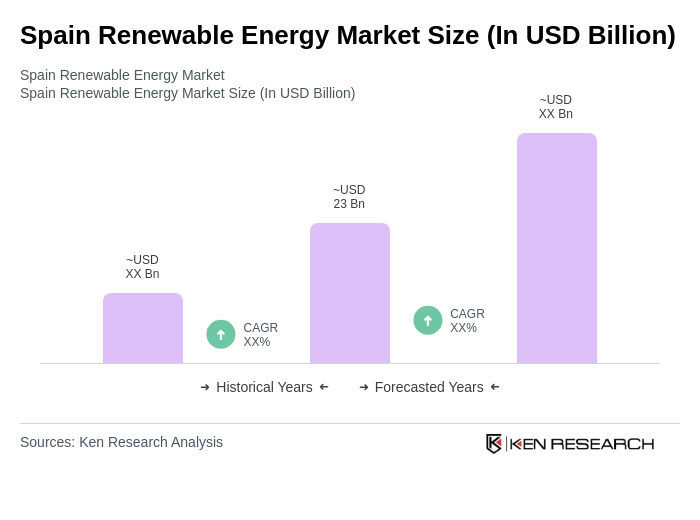
- The Spain Renewable Energy Market is valued at approximately USD 23 billion, based on a five-year historical analysis. This growth is primarily driven by the increasing demand for sustainable energy solutions, government initiatives promoting renewable energy adoption, and advancements in technology that enhance energy efficiency. The market has seen significant investments in solar and wind energy, contributing to its robust expansion .
- Key players in this market include cities like Madrid, Barcelona, and Valencia, which dominate due to their strategic investments in renewable infrastructure and supportive local policies. These urban centers are also hubs for innovation and technology, attracting both domestic and international investments, thereby fostering a conducive environment for renewable energy growth .
- The Law 7/2021 on Climate Change and Energy Transition, issued by the Government of Spain in 2021, establishes binding targets and operational frameworks to increase the share of renewables in the energy mix to 74% by 2030. This regulation includes incentives for solar and wind projects, streamlined permitting processes, and financial support for research and development in renewable technologies .
Spain Renewable Energy Market Segmentation
By Technology:The technology segment of the renewable energy market includes various sources such as solar energy, wind energy, hydropower, bioenergy, waste-to-energy, green hydrogen, energy storage, and others. Each of these technologies plays a crucial role in the overall energy landscape, with solar and wind energy being the most prominent due to their scalability and decreasing costs .
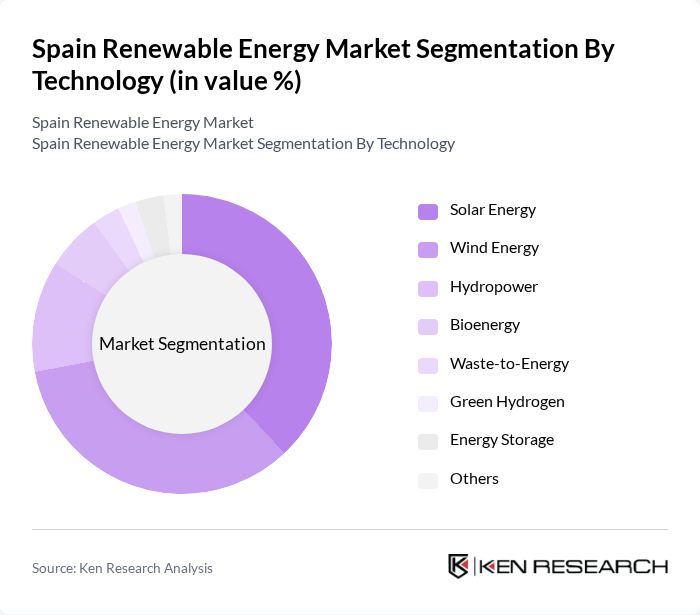
The solar energy segment is currently dominating the market, driven by decreasing costs of photovoltaic technology and favorable government policies. The increasing adoption of solar panels in residential and commercial sectors reflects a growing consumer preference for sustainable energy solutions. Additionally, advancements in energy storage technologies are enhancing the viability of solar energy, making it a preferred choice for many consumers and businesses .
By End-User:The end-user segmentation includes industrial, residential, commercial, and government & utilities sectors. Each sector has unique energy needs and consumption patterns, influencing the adoption of renewable technologies. The industrial sector is a significant consumer due to its high energy demands, while residential and commercial sectors are increasingly adopting renewable solutions for sustainability and cost savings .
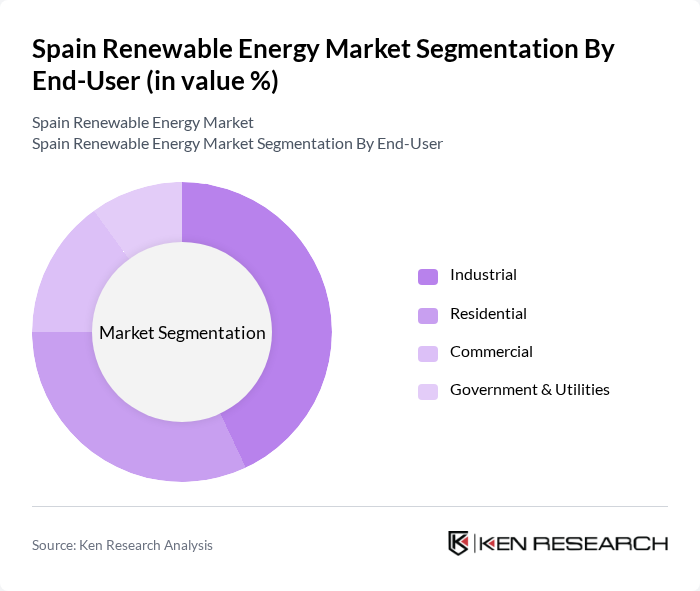
The industrial sector is leading the market, primarily due to its substantial energy requirements and the push for sustainability. Industries are increasingly investing in renewable energy to reduce operational costs and meet regulatory requirements. The residential sector is also growing rapidly, driven by consumer awareness and government incentives for solar installations, making it a significant contributor to the overall market .
Spain Renewable Energy Market Competitive Landscape
The Spain Renewable Energy Market is characterized by a dynamic mix of regional and international players. Leading participants such as Iberdrola S.A., Acciona Energía, Endesa S.A., Siemens Gamesa Renewable Energy S.A., EDP Renováveis S.A., Solaria Energía y Medio Ambiente S.A., Fotowatio Renewable Ventures (FRV), Naturgy Energy Group S.A., Green Eagle Solutions, Grenergy Renovables S.A., Capital Energy, Plenium Partners, Ecooo Energía Ciudadana, Enel Green Power España S.L., Vestas Mediterranean S.A.U. contribute to innovation, geographic expansion, and service delivery in this space.
Spain Renewable Energy Market Industry Analysis
Growth Drivers
- Increasing Government Support for Renewable Energy:The Spanish government allocated approximately €6.9 billion in support of renewable energy initiatives through its Recovery, Transformation and Resilience Plan, reflecting a commitment to achieving a high share of electricity generation from renewables in future. This funding is aimed at enhancing infrastructure and incentivizing investments in solar and wind energy projects. Additionally, the government has set a target of installing 76 GW of renewable capacity in future, including a significant share from solar, which is expected to significantly boost the renewable energy sector's growth.
- Technological Advancements in Energy Storage:The energy storage market in Spain is projected to reach €1.5 billion in future, driven by innovations in battery technology and grid management systems. These advancements enable better integration of renewable sources, particularly solar and wind, into the national grid. The deployment of lithium-ion batteries, which have seen a cost reduction of approximately 30 percent globally in recent years, is enhancing energy reliability and efficiency, thus supporting the overall growth of the renewable energy market.
- Rising Consumer Demand for Sustainable Energy:In future, approximately 45 percent of Spanish consumers express a preference for renewable energy sources, up from 35 percent in previous years. This shift is driven by increasing awareness of climate change and sustainability. The demand for green energy is further supported by the growth of residential solar installations, which reached over 200,000 new installations in future, indicating a robust consumer shift towards sustainable energy solutions and contributing to market expansion.
Market Challenges
- Regulatory Uncertainty:The Spanish renewable energy sector faces significant regulatory challenges, with frequent changes in energy policies in recent years. This instability creates an unpredictable environment for investors, leading to hesitance in funding new projects. The lack of a consistent regulatory framework has resulted in a decline in new renewable project approvals in recent periods compared to previous years, hindering market growth and innovation.
- High Initial Investment Costs:The average capital expenditure for renewable energy projects in Spain is approximately €1.2 million per MW, which poses a barrier to entry for many potential investors. Despite decreasing technology costs, the upfront investment remains a significant hurdle, particularly for smaller companies. Only a minority of new projects are financed through private investments, indicating a reliance on government funding and highlighting the challenge of attracting private capital.
Spain Renewable Energy Market Future Outlook
The future of the renewable energy market in Spain appears promising, driven by increasing investments in innovative technologies and a strong commitment to sustainability. The government’s ambitious targets for renewable energy generation, coupled with rising consumer demand for green energy, are expected to foster significant growth. Additionally, the integration of smart grid technologies and energy management systems will enhance efficiency and reliability, paving the way for a more resilient energy landscape in the coming years.
Market Opportunities
- Expansion of Solar Energy Projects:Spain's solar energy capacity is expected to increase substantially in future, driven by favorable weather conditions and government incentives. This expansion presents significant opportunities for investors and developers, particularly in regions with high solar irradiance, which can enhance energy production and profitability.
- Development of Offshore Wind Farms:The Spanish government aims to install up to 3 GW of offshore wind capacity in future, creating a burgeoning market for offshore wind energy. This initiative not only diversifies the energy mix but also attracts investment in coastal regions, fostering job creation and technological advancements in marine energy solutions.
Scope of the Report
| Segment | Sub-Segments |
|---|---|
| By Technology | Solar Energy Wind Energy Hydropower Bioenergy Waste-to-Energy Green Hydrogen Energy Storage Others |
| By End-User | Industrial Residential Commercial Government & Utilities |
| By Application | Grid-Connected Off-Grid Rooftop Installations Utility-Scale Projects |
| By Investment Source | Domestic Foreign Direct Investment (FDI) Public-Private Partnerships (PPP) Government Schemes |
| By Policy Support | Subsidies Tax Exemptions Renewable Energy Certificates (RECs) |
| By Distribution Mode | Direct Sales Online Sales Distributors |
| By Price Range | Low Medium High |
Key Target Audience
Investors and Venture Capitalist Firms
Government and Regulatory Bodies (e.g., Ministry for the Ecological Transition, Spanish Energy Agency)
Renewable Energy Project Developers
Utility Companies
Energy Service Companies (ESCOs)
Environmental NGOs and Advocacy Groups
Grid Operators and Transmission Companies
Insurance Companies and Risk Management Firms
Players Mentioned in the Report:
Iberdrola S.A.
Acciona Energia
Endesa S.A.
Siemens Gamesa Renewable Energy S.A.
EDP Renovaveis S.A.
Solaria Energia y Medio Ambiente S.A.
Fotowatio Renewable Ventures (FRV)
Naturgy Energy Group S.A.
Green Eagle Solutions
Grenergy Renovables S.A.
Capital Energy
Plenium Partners
Ecooo Energia Ciudadana
Enel Green Power Espana S.L.
Vestas Mediterranean S.A.U.
Table of Contents
Market Assessment Phase
1. Executive Summary and Approach
2. Spain Renewable Energy Market Overview
2.1 Key Insights and Strategic Recommendations
2.2 Spain Renewable Energy Market Overview
2.3 Definition and Scope
2.4 Evolution of Market Ecosystem
2.5 Timeline of Key Regulatory Milestones
2.6 Value Chain & Stakeholder Mapping
2.7 Business Cycle Analysis
2.8 Policy & Incentive Landscape
3. Spain Renewable Energy Market Analysis
3.1 Growth Drivers
3.1.1 Increasing Government Support for Renewable Energy
3.1.2 Technological Advancements in Energy Storage
3.1.3 Rising Consumer Demand for Sustainable Energy
3.1.4 EU Climate Goals and Commitments
3.2 Market Challenges
3.2.1 Regulatory Uncertainty
3.2.2 High Initial Investment Costs
3.2.3 Infrastructure Limitations
3.2.4 Competition from Traditional Energy Sources
3.3 Market Opportunities
3.3.1 Expansion of Solar Energy Projects
3.3.2 Development of Offshore Wind Farms
3.3.3 Investment in Smart Grid Technologies
3.3.4 Growth in Energy Efficiency Solutions
3.4 Market Trends
3.4.1 Increasing Decentralization of Energy Production
3.4.2 Rise of Energy-as-a-Service Models
3.4.3 Integration of AI in Energy Management
3.4.4 Focus on Circular Economy Practices
3.5 Government Regulation
3.5.1 Renewable Energy Directive Compliance
3.5.2 Feed-in Tariff Adjustments
3.5.3 Emission Reduction Targets
3.5.4 Grid Access Regulations
4. SWOT Analysis
5. Stakeholder Analysis
6. Porter's Five Forces Analysis
7. Spain Renewable Energy Market Market Size, 2019-2024
7.1 By Value
7.2 By Volume
7.3 By Average Selling Price
8. Spain Renewable Energy Market Segmentation
8.1 By Technology
8.1.1 Solar Energy
8.1.2 Wind Energy
8.1.3 Hydropower
8.1.4 Bioenergy
8.1.5 Waste-to-Energy
8.1.6 Green Hydrogen
8.1.7 Energy Storage
8.1.8 Others
8.2 By End-User
8.2.1 Industrial
8.2.2 Residential
8.2.3 Commercial
8.2.4 Government & Utilities
8.3 By Application
8.3.1 Grid-Connected
8.3.2 Off-Grid
8.3.3 Rooftop Installations
8.3.4 Utility-Scale Projects
8.4 By Investment Source
8.4.1 Domestic
8.4.2 Foreign Direct Investment (FDI)
8.4.3 Public-Private Partnerships (PPP)
8.4.4 Government Schemes
8.5 By Policy Support
8.5.1 Subsidies
8.5.2 Tax Exemptions
8.5.3 Renewable Energy Certificates (RECs)
8.6 By Distribution Mode
8.6.1 Direct Sales
8.6.2 Online Sales
8.6.3 Distributors
8.7 By Price Range
8.7.1 Low
8.7.2 Medium
8.7.3 High
9. Spain Renewable Energy Market Competitive Analysis
9.1 Market Share of Key Players
9.2 KPIs for Cross Comparison of Key Players
9.2.1 Installed Renewable Capacity (MW)
9.2.2 Annual Revenue from Renewables (€)
9.2.3 Market Share (%)
9.2.4 Project Pipeline (MW)
9.2.5 Capacity Factor (%)
9.2.6 Investment in R&D (€)
9.2.7 Carbon Emissions Reduction (tons CO?/year)
9.2.8 Return on Investment (ROI) (%)
9.2.9 Number of PPAs Signed
9.2.10 Sustainability Ratings / ESG Scores
9.3 SWOT Analysis of Top Players
9.4 Pricing Analysis
9.5 Detailed Profile of Major Companies
9.5.1 Iberdrola S.A.
9.5.2 Acciona Energía
9.5.3 Endesa S.A.
9.5.4 Siemens Gamesa Renewable Energy S.A.
9.5.5 EDP Renováveis S.A.
9.5.6 Solaria Energía y Medio Ambiente S.A.
9.5.7 Fotowatio Renewable Ventures (FRV)
9.5.8 Naturgy Energy Group S.A.
9.5.9 Green Eagle Solutions
9.5.10 Grenergy Renovables S.A.
9.5.11 Capital Energy
9.5.12 Plenium Partners
9.5.13 Ecooo Energía Ciudadana
9.5.14 Enel Green Power España S.L.
9.5.15 Vestas Mediterranean S.A.U.
10. Spain Renewable Energy Market End-User Analysis
10.1 Procurement Behavior of Key Ministries
10.1.1 Energy Procurement Strategies
10.1.2 Budget Allocation for Renewable Projects
10.1.3 Collaboration with Private Sector
10.2 Corporate Spend on Infrastructure & Energy
10.2.1 Investment Trends in Renewable Energy
10.2.2 Budgeting for Sustainability Initiatives
10.2.3 Long-term Energy Contracts
10.3 Pain Point Analysis by End-User Category
10.3.1 Cost of Transition to Renewables
10.3.2 Reliability of Energy Supply
10.3.3 Regulatory Compliance Challenges
10.4 User Readiness for Adoption
10.4.1 Awareness of Renewable Options
10.4.2 Financial Incentives Understanding
10.4.3 Technical Support Availability
10.5 Post-Deployment ROI and Use Case Expansion
10.5.1 Performance Metrics Tracking
10.5.2 Scalability of Solutions
10.5.3 Long-term Cost Savings Analysis
11. Spain Renewable Energy Market Future Size, 2025-2030
11.1 By Value
11.2 By Volume
11.3 By Average Selling Price
Go-To-Market Strategy Phase
1. Whitespace Analysis + Business Model Canvas
1.1 Market Gaps Identification
1.2 Value Proposition Development
1.3 Revenue Streams Analysis
1.4 Customer Segmentation
1.5 Key Partnerships
1.6 Cost Structure Evaluation
1.7 Competitive Advantage Assessment
2. Marketing and Positioning Recommendations
2.1 Branding Strategies
2.2 Product USPs
2.3 Target Audience Identification
2.4 Communication Channels
2.5 Marketing Budget Allocation
2.6 Performance Metrics
3. Distribution Plan
3.1 Urban Retail Strategies
3.2 Rural NGO Tie-ups
3.3 Online Distribution Channels
3.4 Direct Sales Approaches
3.5 Partnership with Local Distributors
4. Channel & Pricing Gaps
4.1 Underserved Routes
4.2 Pricing Bands Analysis
4.3 Competitor Pricing Strategies
4.4 Customer Willingness to Pay
5. Unmet Demand & Latent Needs
5.1 Category Gaps
5.2 Consumer Segments Analysis
5.3 Emerging Trends Identification
5.4 Feedback Mechanisms
6. Customer Relationship
6.1 Loyalty Programs
6.2 After-sales Service
6.3 Customer Engagement Strategies
6.4 Feedback and Improvement Processes
7. Value Proposition
7.1 Sustainability Initiatives
7.2 Integrated Supply Chains
7.3 Customer-Centric Solutions
7.4 Competitive Differentiation
8. Key Activities
8.1 Regulatory Compliance
8.2 Branding Efforts
8.3 Distribution Setup
8.4 Training and Development
9. Entry Strategy Evaluation
9.1 Domestic Market Entry Strategy
9.1.1 Product Mix
9.1.2 Pricing Band
9.1.3 Packaging Strategies
9.2 Export Entry Strategy
9.2.1 Target Countries
9.2.2 Compliance Roadmap
10. Entry Mode Assessment
10.1 Joint Ventures
10.2 Greenfield Investments
10.3 Mergers & Acquisitions
10.4 Distributor Model
11. Capital and Timeline Estimation
11.1 Capital Requirements
11.2 Timelines for Implementation
12. Control vs Risk Trade-Off
12.1 Ownership vs Partnerships
13. Profitability Outlook
13.1 Breakeven Analysis
13.2 Long-term Sustainability
14. Potential Partner List
14.1 Distributors
14.2 Joint Ventures
14.3 Acquisition Targets
15. Execution Roadmap
15.1 Phased Plan for Market Entry
15.1.1 Market Setup
15.1.2 Market Entry
15.1.3 Growth Acceleration
15.1.4 Scale & Stabilize
15.2 Key Activities and Milestones
15.2.1 Milestone Planning
15.2.2 Activity Tracking
Research Methodology
Phase 1: Approach1
Desk Research
- Analysis of government reports on renewable energy policies and initiatives in Spain
- Review of industry publications and market analysis reports from energy associations
- Examination of statistical data from the Spanish National Institute of Statistics (INE) and Eurostat
Primary Research
- Interviews with key stakeholders in the renewable energy sector, including project developers and investors
- Surveys targeting energy policy experts and regulatory bodies to understand market dynamics
- Field interviews with operational managers at renewable energy facilities across Spain
Validation & Triangulation
- Cross-validation of findings through multiple data sources, including trade publications and government statistics
- Triangulation of insights from expert interviews with quantitative data from market reports
- Sanity checks through feedback from an advisory panel of industry experts
Phase 2: Market Size Estimation1
Top-down Assessment
- Estimation of total renewable energy capacity based on national energy consumption data
- Segmentation of the market by energy source (solar, wind, hydro, etc.) and application
- Incorporation of government targets for renewable energy adoption and investment forecasts
Bottom-up Modeling
- Collection of data on installed capacity and generation from leading renewable energy companies
- Operational cost analysis based on project-level financials and investment returns
- Volume x cost calculations for energy production and sales across different segments
Forecasting & Scenario Analysis
- Multi-variable regression analysis incorporating economic growth, energy prices, and policy changes
- Scenario modeling based on potential regulatory shifts and technological advancements
- Development of baseline, optimistic, and pessimistic forecasts through 2030
Phase 3: CATI Sample Composition1
| Scope Item/Segment | Sample Size | Target Respondent Profiles |
|---|---|---|
| Solar Energy Developers | 100 | Project Managers, Business Development Executives |
| Wind Energy Operators | 80 | Operations Managers, Technical Directors |
| Hydropower Facility Managers | 60 | Plant Managers, Environmental Compliance Officers |
| Energy Policy Experts | 40 | Regulatory Affairs Specialists, Policy Analysts |
| Investors in Renewable Projects | 50 | Investment Analysts, Portfolio Managers |
Frequently Asked Questions
What is the current value of the Spain Renewable Energy Market?
The Spain Renewable Energy Market is valued at approximately USD 23 billion, driven by increasing demand for sustainable energy solutions, government initiatives, and technological advancements that enhance energy efficiency.
Which cities are key players in the Spain Renewable Energy Market?
What are the main technologies driving the Spain Renewable Energy Market?
What is the target for renewable energy share in Spain by 2030?
Other Regional/Country Reports
Why Buy From Us?

What makes us stand out is that our consultants follow Robust, Refine and Result (RRR) methodology. Robust for clear definitions, approaches and sanity checking, Refine for differentiating respondents' facts and opinions, and Result for presenting data with story.

We have set a benchmark in the industry by offering our clients with syndicated and customized market research reports featuring coverage of entire market as well as meticulous research and analyst insights.

While we don't replace traditional research, we flip the method upside down. Our dual approach of Top Bottom & Bottom Top ensures quality deliverable by not just verifying company fundamentals but also looking at the sector and macroeconomic factors.

With one step in the future, our research team constantly tries to show you the bigger picture. We help with some of the tough questions you may encounter along the way: How is the industry positioned? Best marketing channel? KPI's of competitors? By aligning every element, we help maximize success.

Our report gives you instant access to the answers and sources that other companies might choose to hide. We elaborate each steps of research methodology we have used and showcase you the sample size to earn your trust.

If you need any support, we are here! We pride ourselves on universe strength, data quality, and quick, friendly, and professional service.