About the Report
Base Year 2024France Telemedicine and Remote Healthcare Market Overview
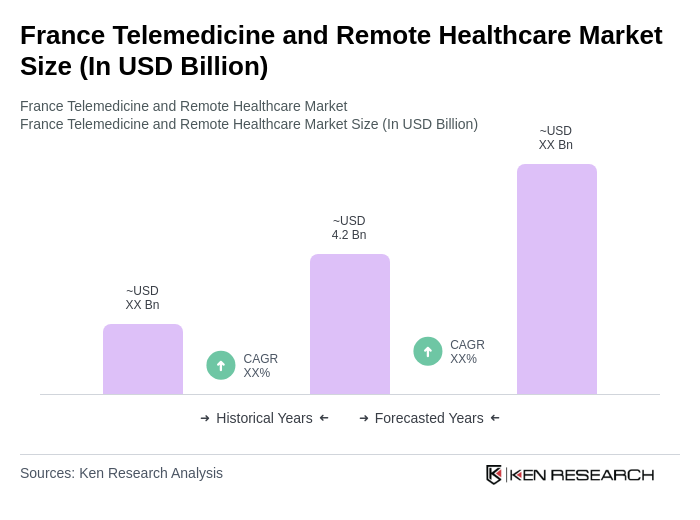
- The France Telemedicine and Remote Healthcare Market is valued at approximately USD 4.2 billion, based on a five-year historical analysis. This growth is primarily driven by the increasing adoption of digital health solutions, the rising prevalence of chronic diseases, and the need for efficient healthcare delivery systems. The COVID-19 pandemic has further accelerated the demand for telemedicine services, as patients and healthcare providers sought safer alternatives to in-person consultations.
- Key cities such as Paris, Lyon, and Marseille dominate the market due to their advanced healthcare infrastructure, high population density, and a strong presence of healthcare technology companies. France's commitment to digital health initiatives and government support for telemedicine adoption have also contributed to the growth of these urban centers as leaders in the telemedicine landscape.
- The French healthcare system operates under the Code de la santé publique, 2021 issued by the Ministry of Health and Solidarity, which establishes the regulatory framework for telemedicine services including teleconsultations, teleexpertise, telesurveillance, and teleassistance. This regulation mandates that telemedicine acts must be performed by healthcare professionals with appropriate qualifications, ensures patient consent and data protection compliance, and establishes reimbursement mechanisms through the national health insurance system for qualifying telemedicine services, thereby promoting accessibility and encouraging the integration of telemedicine into standard healthcare practices.
France Telemedicine and Remote Healthcare Market Segmentation
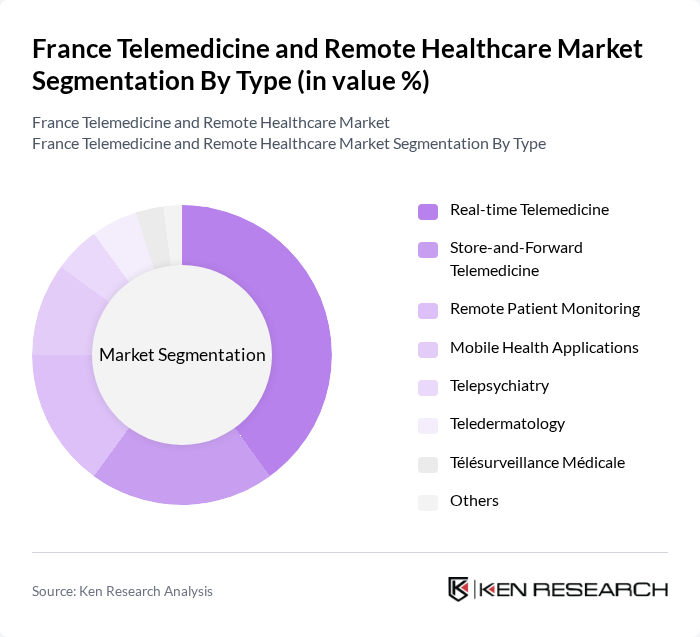
By Type:The market is segmented into various types of telemedicine services, including Real-time Telemedicine, Store-and-Forward Telemedicine, Remote Patient Monitoring, Mobile Health Applications, Telepsychiatry, Teledermatology, Télésurveillance Médicale, and Others. Among these, Real-time Telemedicine is the leading sub-segment, driven by the increasing demand for immediate healthcare access and the convenience of virtual consultations. The rise in smartphone usage and internet penetration has further facilitated the growth of this segment, making it a preferred choice for both patients and healthcare providers.
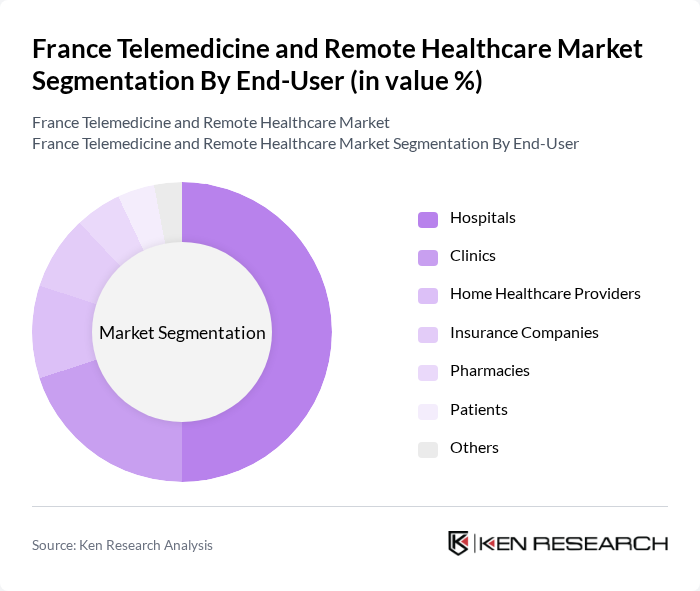
By End-User:The end-user segmentation includes Hospitals, Clinics, Home Healthcare Providers, Insurance Companies, Pharmacies, Patients, and Others. Hospitals are the dominant end-user segment, as they increasingly adopt telemedicine solutions to enhance patient care and streamline operations. The integration of telemedicine in hospitals allows for better management of patient flow, reduced wait times, and improved access to specialists, making it a critical component of modern healthcare delivery.
France Telemedicine and Remote Healthcare Market Competitive Landscape
The France Telemedicine and Remote Healthcare Market is characterized by a dynamic mix of regional and international players. Leading participants such as Doctolib, Qare, Livi (Kry), Hellocare, MesDocteurs, Télémedecine.fr, ChronoMed, Medadom, Keldoc, Doctena, MédecinDirect, MonDocteur, Withings, Teladoc Health, CompuGroup Medical contribute to innovation, geographic expansion, and service delivery in this space.
France Telemedicine and Remote Healthcare Market Industry Analysis
Growth Drivers
- Increasing Demand for Remote Patient Monitoring:The French healthcare system is witnessing a surge in demand for remote patient monitoring, driven by an aging population. In the near future, approximately 22% of the population will be over 65 years old, leading to a projected increase in chronic disease management needs. The French government has allocated €1.7 billion to enhance telehealth services, indicating a strong commitment to integrating remote monitoring solutions into standard care practices, thereby improving patient outcomes and reducing hospital visits.
- Rising Healthcare Costs:France's healthcare expenditure is expected to reach €315 billion in the near future, reflecting a 4.5% annual increase. This rise in costs is prompting healthcare providers to seek cost-effective solutions, such as telemedicine. Remote healthcare services can significantly reduce operational costs by minimizing in-person consultations and hospital admissions. The French Ministry of Health estimates that telemedicine could save the healthcare system up to €1.1 billion annually by streamlining care delivery and enhancing efficiency.
- Technological Advancements in Telecommunication:The rollout of 5G technology in France is set to revolutionize telemedicine in the near future, providing faster and more reliable internet connections. This advancement is crucial for real-time data transmission and high-quality video consultations. With over 85% of the population expected to have access to 5G networks, healthcare providers can leverage these technologies to enhance telehealth services, improve patient engagement, and facilitate remote diagnostics, ultimately leading to better healthcare delivery.
Market Challenges
- Data Privacy and Security Concerns:As telemedicine expands, data privacy and security remain significant challenges. In the near future, France will enforce stricter data protection regulations under GDPR, requiring healthcare providers to enhance their cybersecurity measures. The French National Commission on Informatics and Liberty (CNIL) reported that 32% of healthcare organizations experienced data breaches in the past year, highlighting the urgent need for robust security protocols to protect sensitive patient information and maintain trust in telehealth services.
- Limited Reimbursement Policies:Despite the growth of telemedicine, reimbursement policies in France are still evolving. Currently, only 62% of telehealth services are reimbursed by the national health insurance system. This limitation poses a barrier to widespread adoption, as healthcare providers may be reluctant to invest in telemedicine technologies without guaranteed compensation. The French government is reviewing these policies, but until changes are implemented, financial uncertainty will continue to hinder market growth.
France Telemedicine and Remote Healthcare Market Future Outlook
The future of telemedicine in France appears promising, driven by technological advancements and increasing acceptance among patients and providers. In the near future, the integration of artificial intelligence and machine learning into telehealth platforms is expected to enhance diagnostic accuracy and patient engagement. Additionally, the expansion of telehealth services into rural areas will address healthcare disparities, ensuring that underserved populations receive timely medical attention. Overall, the market is poised for significant growth as stakeholders adapt to evolving healthcare needs and regulatory frameworks.
Market Opportunities
- Expansion of Telehealth Services:The French government is actively promoting the expansion of telehealth services, particularly in rural areas. With a budget of €220 million allocated for telemedicine initiatives in the near future, this presents a significant opportunity for healthcare providers to develop innovative solutions that cater to underserved populations, ultimately improving access to care and enhancing patient outcomes.
- Integration of AI and Machine Learning:The integration of AI and machine learning technologies into telemedicine platforms is set to transform patient care. In the near future, investments in AI-driven telehealth solutions are projected to exceed €550 million, enabling healthcare providers to offer personalized treatment plans and predictive analytics, thereby improving patient management and operational efficiency in the telemedicine sector.
Scope of the Report
| Segment | Sub-Segments |
|---|---|
| By Type | Real-time Telemedicine Store-and-Forward Telemedicine Remote Patient Monitoring Mobile Health Applications Telepsychiatry Teledermatology Télésurveillance Médicale Others |
| By End-User | Hospitals Clinics Home Healthcare Providers Insurance Companies Pharmacies Patients Others |
| By Application | Chronic Disease Management Emergency Care Follow-up Care Mental Health Services Preventive Healthcare Rehabilitation Services Others |
| By Distribution Channel | Direct Sales Online Platforms Partnerships with Healthcare Providers Telehealth Networks Pharmacies Others |
| By Pricing Model | Subscription-based Pay-per-visit Freemium Models Bundled Services Reimbursement-based Others |
| By Technology | Video Conferencing Mobile Applications Cloud-based Solutions Wearable Devices Artificial Intelligence & Analytics Others |
| By Patient Demographics | Age Groups Gender Socioeconomic Status Geographic Location Chronic Disease Prevalence Others |
Key Target Audience
Investors and Venture Capitalist Firms
Government and Regulatory Bodies (e.g., Agence Nationale de la Santé Numérique, Haute Autorité de Santé)
Healthcare Providers and Hospitals
Telemedicine Technology Developers
Health Insurance Companies
Pharmaceutical Companies
Medical Device Manufacturers
Healthcare IT Solutions Providers
Players Mentioned in the Report:
Doctolib
Qare
Livi (Kry)
Hellocare
MesDocteurs
Telemedecine.fr
ChronoMed
Medadom
Keldoc
Doctena
MedecinDirect
MonDocteur
Withings
Teladoc Health
CompuGroup Medical
Table of Contents
Market Assessment Phase
1. Executive Summary and Approach
2. France Telemedicine and Remote Healthcare Market Overview
2.1 Key Insights and Strategic Recommendations
2.2 France Telemedicine and Remote Healthcare Market Overview
2.3 Definition and Scope
2.4 Evolution of Market Ecosystem
2.5 Timeline of Key Regulatory Milestones
2.6 Value Chain & Stakeholder Mapping
2.7 Business Cycle Analysis
2.8 Policy & Incentive Landscape
3. France Telemedicine and Remote Healthcare Market Analysis
3.1 Growth Drivers
3.1.1 Increasing Demand for Remote Patient Monitoring
3.1.2 Rising Healthcare Costs
3.1.3 Technological Advancements in Telecommunication
3.1.4 Government Initiatives Supporting Telemedicine
3.2 Market Challenges
3.2.1 Data Privacy and Security Concerns
3.2.2 Limited Reimbursement Policies
3.2.3 Resistance from Traditional Healthcare Providers
3.2.4 Infrastructure Limitations in Rural Areas
3.3 Market Opportunities
3.3.1 Expansion of Telehealth Services
3.3.2 Integration of AI and Machine Learning
3.3.3 Partnerships with Technology Providers
3.3.4 Growing Acceptance of Digital Health Solutions
3.4 Market Trends
3.4.1 Shift Towards Patient-Centric Care
3.4.2 Increased Use of Wearable Health Devices
3.4.3 Rise of Mobile Health Applications
3.4.4 Focus on Preventive Healthcare
3.5 Government Regulation
3.5.1 Telemedicine Licensing Requirements
3.5.2 Data Protection Regulations (GDPR)
3.5.3 Reimbursement Policies for Telehealth Services
3.5.4 Standards for Telemedicine Practice
4. SWOT Analysis
5. Stakeholder Analysis
6. Porter's Five Forces Analysis
7. France Telemedicine and Remote Healthcare Market Market Size, 2019-2024
7.1 By Value
7.2 By Volume
7.3 By Average Selling Price
8. France Telemedicine and Remote Healthcare Market Segmentation
8.1 By Type
8.1.1 Real-time Telemedicine
8.1.2 Store-and-Forward Telemedicine
8.1.3 Remote Patient Monitoring
8.1.4 Mobile Health Applications
8.1.5 Telepsychiatry
8.1.6 Teledermatology
8.1.7 Télésurveillance Médicale
8.1.8 Others
8.2 By End-User
8.2.1 Hospitals
8.2.2 Clinics
8.2.3 Home Healthcare Providers
8.2.4 Insurance Companies
8.2.5 Pharmacies
8.2.6 Patients
8.2.7 Others
8.3 By Application
8.3.1 Chronic Disease Management
8.3.2 Emergency Care
8.3.3 Follow-up Care
8.3.4 Mental Health Services
8.3.5 Preventive Healthcare
8.3.6 Rehabilitation Services
8.3.7 Others
8.4 By Distribution Channel
8.4.1 Direct Sales
8.4.2 Online Platforms
8.4.3 Partnerships with Healthcare Providers
8.4.4 Telehealth Networks
8.4.5 Pharmacies
8.4.6 Others
8.5 By Pricing Model
8.5.1 Subscription-based
8.5.2 Pay-per-visit
8.5.3 Freemium Models
8.5.4 Bundled Services
8.5.5 Reimbursement-based
8.5.6 Others
8.6 By Technology
8.6.1 Video Conferencing
8.6.2 Mobile Applications
8.6.3 Cloud-based Solutions
8.6.4 Wearable Devices
8.6.5 Artificial Intelligence & Analytics
8.6.6 Others
8.7 By Patient Demographics
8.7.1 Age Groups
8.7.2 Gender
8.7.3 Socioeconomic Status
8.7.4 Geographic Location
8.7.5 Chronic Disease Prevalence
8.7.6 Others
9. France Telemedicine and Remote Healthcare Market Competitive Analysis
9.1 Market Share of Key Players
9.2 Cross Comparison of Key Players
9.2.1 Company Name
9.2.2 Group Size (Large, Medium, or Small as per industry convention)
9.2.3 Revenue (France, latest available year)
9.2.4 Revenue Growth Rate (YoY %)
9.2.5 Number of Active Users (France)
9.2.6 Average Revenue Per User (ARPU)
9.2.7 Customer Acquisition Cost (CAC)
9.2.8 Customer Retention Rate (%)
9.2.9 Market Penetration Rate (%)
9.2.10 Number of Consultations Delivered
9.2.11 Service Delivery Efficiency (e.g., average wait time)
9.2.12 Regulatory Compliance (e.g., HAS, CNIL certifications)
9.2.13 Pricing Strategy
9.2.14 Brand Recognition (survey-based or digital presence)
9.2.15 Partnerships with Healthcare Providers
9.2.16 Technology Integration (AI, EHR, etc.)
9.2.17 Others
9.3 SWOT Analysis of Top Players
9.4 Pricing Analysis
9.5 Detailed Profile of Major Companies
9.5.1 Doctolib
9.5.2 Qare
9.5.3 Livi (Kry)
9.5.4 Hellocare
9.5.5 MesDocteurs
9.5.6 Télémedecine.fr
9.5.7 ChronoMed
9.5.8 Medadom
9.5.9 Keldoc
9.5.10 Doctena
9.5.11 MédecinDirect
9.5.12 MonDocteur
9.5.13 Withings
9.5.14 Teladoc Health
9.5.15 CompuGroup Medical
10. France Telemedicine and Remote Healthcare Market End-User Analysis
10.1 Procurement Behavior of Key Ministries
10.1.1 Ministry of Health
10.1.2 Ministry of Digital Affairs
10.1.3 Ministry of Finance
10.1.4 Ministry of Education
10.2 Corporate Spend on Infrastructure & Energy
10.2.1 Healthcare Infrastructure Investments
10.2.2 Technology Upgrades
10.2.3 Training and Development
10.3 Pain Point Analysis by End-User Category
10.3.1 Patients
10.3.2 Healthcare Providers
10.3.3 Insurance Companies
10.4 User Readiness for Adoption
10.4.1 Awareness Levels
10.4.2 Technological Proficiency
10.4.3 Trust in Telemedicine
10.5 Post-Deployment ROI and Use Case Expansion
10.5.1 Cost Savings
10.5.2 Improved Patient Outcomes
10.5.3 Scalability of Services
11. France Telemedicine and Remote Healthcare Market Future Size, 2025-2030
11.1 By Value
11.2 By Volume
11.3 By Average Selling Price
Go-To-Market Strategy Phase
1. Whitespace Analysis + Business Model Canvas
1.1 Market Gaps Identification
1.2 Value Proposition Development
1.3 Revenue Streams Analysis
1.4 Cost Structure Evaluation
1.5 Key Partnerships
1.6 Customer Segments
1.7 Channels
2. Marketing and Positioning Recommendations
2.1 Branding Strategies
2.2 Product USPs
3. Distribution Plan
3.1 Urban Retail vs Rural NGO Tie-ups
4. Channel & Pricing Gaps
4.1 Underserved Routes
4.2 Pricing Bands
5. Unmet Demand & Latent Needs
5.1 Category Gaps
5.2 Consumer Segments
6. Customer Relationship
6.1 Loyalty Programs
6.2 After-sales Service
7. Value Proposition
7.1 Sustainability
7.2 Integrated Supply Chains
8. Key Activities
8.1 Regulatory Compliance
8.2 Branding
8.3 Distribution Setup
9. Entry Strategy Evaluation
9.1 Domestic Market Entry Strategy
9.1.1 Product Mix
9.1.2 Pricing Band
9.1.3 Packaging
9.2 Export Entry Strategy
9.2.1 Target Countries
9.2.2 Compliance Roadmap
10. Entry Mode Assessment
10.1 JV
10.2 Greenfield
10.3 M&A
10.4 Distributor Model
11. Capital and Timeline Estimation
11.1 Capital Requirements
11.2 Timelines
12. Control vs Risk Trade-Off
12.1 Ownership vs Partnerships
13. Profitability Outlook
13.1 Breakeven Analysis
13.2 Long-term Sustainability
14. Potential Partner List
14.1 Distributors
14.2 JVs
14.3 Acquisition Targets
15. Execution Roadmap
15.1 Phased Plan for Market Entry
15.1.1 Market Setup
15.1.2 Market Entry
15.1.3 Growth Acceleration
15.1.4 Scale & Stabilize
15.2 Key Activities and Milestones
15.2.1 Milestone Planning
15.2.2 Activity Scheduling
Research Methodology
Phase 1: Approach1
Desk Research
- Analysis of government reports on telemedicine regulations and policies in France
- Review of industry publications and market reports on remote healthcare trends
- Examination of academic journals focusing on telehealth efficacy and adoption rates
Primary Research
- Interviews with healthcare providers utilizing telemedicine solutions
- Surveys targeting patients who have engaged with remote healthcare services
- Discussions with technology vendors offering telehealth platforms
Validation & Triangulation
- Cross-validation of findings through multiple data sources including government and industry reports
- Triangulation of qualitative insights from interviews with quantitative data from surveys
- Sanity checks conducted through expert panel reviews comprising healthcare professionals and market analysts
Phase 2: Market Size Estimation1
Top-down Assessment
- Estimation of market size based on national healthcare expenditure and telemedicine adoption rates
- Segmentation of the market by service type, including video consultations and remote monitoring
- Incorporation of demographic data to assess potential market growth among different age groups
Bottom-up Modeling
- Collection of data from telemedicine service providers on user engagement and service pricing
- Estimation of market penetration rates based on historical growth patterns
- Volume x pricing model to calculate revenue potential for various telehealth services
Forecasting & Scenario Analysis
- Multi-factor regression analysis incorporating variables such as healthcare policy changes and technology adoption
- Scenario modeling based on potential impacts of economic conditions and public health crises
- Development of baseline, optimistic, and pessimistic forecasts through 2030
Phase 3: CATI Sample Composition1
| Scope Item/Segment | Sample Size | Target Respondent Profiles |
|---|---|---|
| Healthcare Provider Telemedicine Adoption | 120 | Doctors, Clinic Administrators |
| Patient Experience with Remote Healthcare | 100 | Patients, Caregivers |
| Technology Vendor Insights | 60 | Product Managers, Sales Executives |
| Regulatory Impact on Telehealth Services | 50 | Policy Makers, Healthcare Regulators |
| Market Trends in Remote Monitoring Solutions | 80 | Healthcare Analysts, IT Specialists |
Frequently Asked Questions
What is the current value of the France Telemedicine and Remote Healthcare Market?
The France Telemedicine and Remote Healthcare Market is valued at approximately USD 4.2 billion, driven by the increasing adoption of digital health solutions and the rising prevalence of chronic diseases, further accelerated by the COVID-19 pandemic.
What are the main types of telemedicine services in France?
Which cities are leading in the France Telemedicine Market?
What regulatory framework governs telemedicine in France?
Other Regional/Country Reports
Indonesia Telemedicine and Remote Healthcare Market
Malaysia Telemedicine and Remote Healthcare Market
KSA Telemedicine and Remote Healthcare Market
APAC Telemedicine and Remote Healthcare Market
SEA Telemedicine and Remote Healthcare Market
Vietnam Telemedicine and Remote Healthcare Market
Other Adjacent Reports
KSA Health Information Technology Market
KSA Mobile Health Applications Market
Belgium Telepsychiatry Market
Gcc Teledermatology Market Report Size, Share, Growth Drivers, Trends, Opportunities & Forecast 2025–2030Global electronic health records market report size, share, growth drivers, trends, opportunities & forecast 2025–2030Saudi Arabia Wearable Medical Devices Market Outlook to 2030: Size, Share, Growth and TrendsQatar AI in Healthcare MarketSaudi Arabia Home Healthcare Services Market Outlook to 2030: Size, Share, Growth and TrendsWhy Buy From Us?

What makes us stand out is that our consultants follow Robust, Refine and Result (RRR) methodology. Robust for clear definitions, approaches and sanity checking, Refine for differentiating respondents' facts and opinions, and Result for presenting data with story.

We have set a benchmark in the industry by offering our clients with syndicated and customized market research reports featuring coverage of entire market as well as meticulous research and analyst insights.

While we don't replace traditional research, we flip the method upside down. Our dual approach of Top Bottom & Bottom Top ensures quality deliverable by not just verifying company fundamentals but also looking at the sector and macroeconomic factors.

With one step in the future, our research team constantly tries to show you the bigger picture. We help with some of the tough questions you may encounter along the way: How is the industry positioned? Best marketing channel? KPI's of competitors? By aligning every element, we help maximize success.

Our report gives you instant access to the answers and sources that other companies might choose to hide. We elaborate each steps of research methodology we have used and showcase you the sample size to earn your trust.

If you need any support, we are here! We pride ourselves on universe strength, data quality, and quick, friendly, and professional service.