GCC Atopic Dermatitis Drugs Market

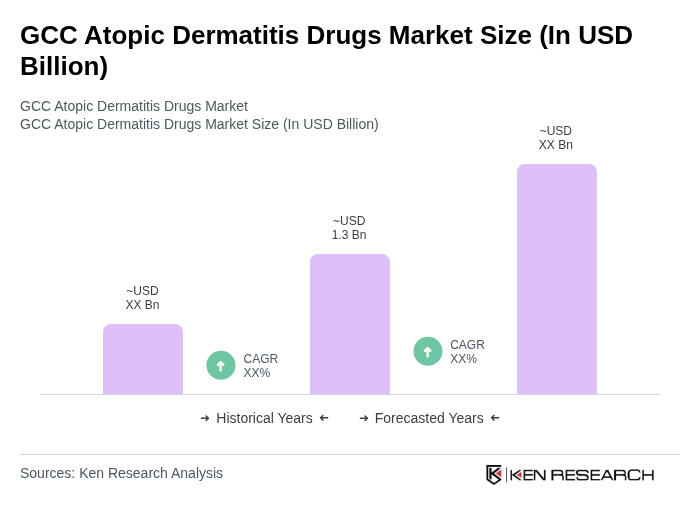
The GCC Atopic Dermatitis Drugs Market, valued at USD 1.3 billion, is growing due to increasing skin condition awareness and innovative therapies like biologics in Saudi Arabia and UAE.

Region:Middle East

Author(s):Geetanshi

Product Code:KRAD4765

Pages:100

Published On:December 2025
About the Report

Base Year 2024

GCC Atopic Dermatitis Drugs Market Overview

  • The GCC Atopic Dermatitis Drugs Market is valued at USD 1.3 billion, based on a five-year historical analysis, aligned with the strong growth seen in the global atopic dermatitis/atopic dermatitis drugs market, which has reached the mid-teen billion range in recent years. This growth is primarily driven by the increasing prevalence of atopic dermatitis in the region, heightened awareness of skin conditions, and advancements in drug formulations, including targeted biologics and JAK inhibitors that address moderate-to-severe disease. The market is also supported by rising healthcare expenditures in GCC economies, improving access to specialty dermatology care, and the introduction of innovative therapies and combination regimens that cater to diverse pediatric and adult patient needs.
  • Key players in this market are concentrated in countries like Saudi Arabia and the UAE, which dominate due to their advanced healthcare infrastructure, high disposable incomes, strong insurance coverage for specialty biologics, and a growing population with a rising incidence and diagnosis of chronic skin disorders. These nations have also established regulatory and reimbursement frameworks that facilitate the approval, pricing, and distribution of dermatological products, including biologics and novel small molecules, further enhancing market growth through faster patient access and broader formulary inclusion.
  • In 2023, the Saudi Food and Drug Authority (SFDA) implemented updated requirements for human drugs and biologics under instruments such as the SFDA “Drug Registration Guideline for Human Drugs” issued by the Saudi Food and Drug Authority and the “Guideline on Biologics Registration” issued by the Saudi Food and Drug Authority, which aim to streamline the evaluation and marketing authorization process for pharmaceutical products, including dermatological and biologic therapies. This initiative is designed to expedite the availability of innovative treatments for atopic dermatitis by enabling more efficient dossier review, reliance pathways, and post-marketing safety monitoring, ensuring that patients have timely access to effective therapies while maintaining stringent safety, quality, and efficacy standards.
GCC Atopic Dermatitis Drugs Market Size

GCC Atopic Dermatitis Drugs Market Segmentation

By Drug Class:The drug class segmentation includes various therapeutic options for managing atopic dermatitis. The primary subsegments are Topical Corticosteroids, Topical Calcineurin Inhibitors, Antihistamines, Biologics (e.g., IL-4/IL-13 inhibitors, JAK inhibitors), PDE-4 Inhibitors, and Others. Among these, Topical Corticosteroids continue to account for the largest share of treated patients due to their widespread availability in multiple potencies, well-established efficacy in reducing inflammation and itching, and use as first-line therapy across mild-to-moderate disease. The increasing preference for topical treatments over systemic options for initial and maintenance management, combined with the chronic relapsing nature of atopic dermatitis and the availability of low-cost generics, also contributes to the growth and persistence of this subsegment.
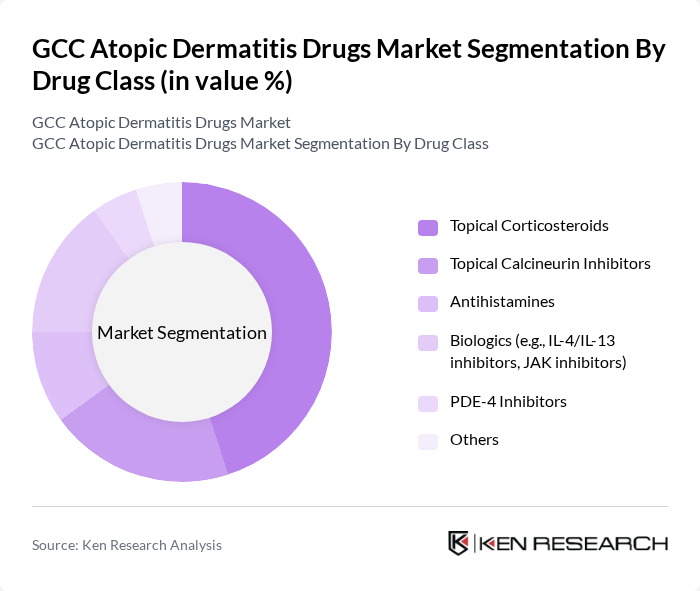
GCC Atopic Dermatitis Drugs Market segmentation by Drug Class.

By Route of Administration:The route of administration for atopic dermatitis drugs includes Topical, Oral, Injectable, and Others. The Topical route is the most prevalent in terms of treatment volume due to its direct application to affected areas, leading to localized drug delivery, faster relief of pruritus and erythema, and fewer systemic side effects compared with systemic immunosuppressants. The convenience, lower cost, and wide range of topical formulations (creams, ointments, lotions, foams) have made them the preferred choice among both healthcare providers and patients for mild-to-moderate disease and as adjuncts in severe cases, driving their dominance in the market.
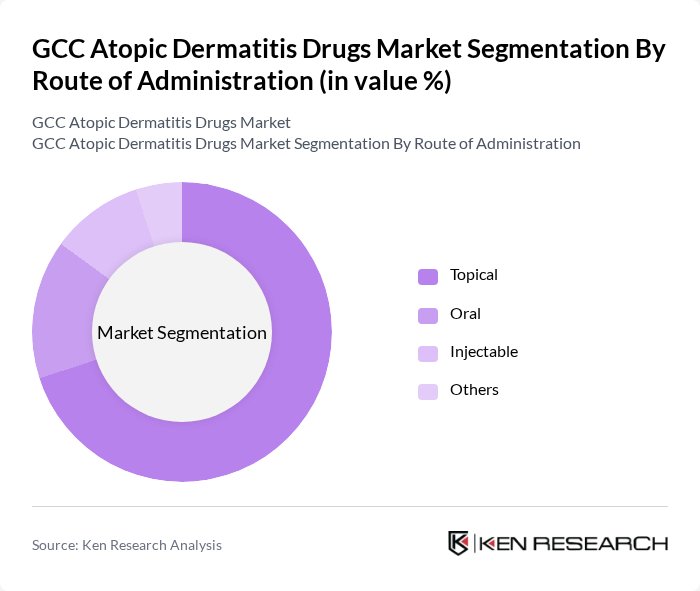
GCC Atopic Dermatitis Drugs Market segmentation by Route of Administration.

GCC Atopic Dermatitis Drugs Market Competitive Landscape

The GCC Atopic Dermatitis Drugs Market is characterized by a dynamic mix of regional and international players. Leading participants such as Sanofi, AbbVie Inc., Novartis AG, Pfizer Inc., Eli Lilly and Company, Regeneron Pharmaceuticals, Inc., GlaxoSmithKline plc, Johnson & Johnson (Janssen Pharmaceuticals), Leo Pharma A/S, Galderma S.A., Amgen Inc., Astellas Pharma Inc., Takeda Pharmaceutical Company Limited, Merck & Co., Inc., Novo Nordisk A/S contribute to innovation, geographic expansion, and service delivery in this space, with several of these companies marketing biologics and advanced small molecules for moderate-to-severe atopic dermatitis globally.

Sanofi

2004

Paris, France

AbbVie Inc.

2013

North Chicago, Illinois, USA

Novartis AG

1996

Basel, Switzerland

Pfizer Inc.

1849

New York City, New York, USA

Eli Lilly and Company

1876

Indianapolis, Indiana, USA

Company

Establishment Year

Headquarters

Group Size (Large, Medium, or Small as per industry convention)

Revenue from Atopic Dermatitis Drugs in GCC (USD million)

Market Penetration Rate in GCC (by value, %)

Number of Approved Atopic Dermatitis Products in GCC

Pricing Strategy (Premium, Value, Competitive, etc.)

Product Portfolio Breadth (Number of AD products in GCC portfolio)

GCC Atopic Dermatitis Drugs Market Industry Analysis

Growth Drivers

  • Increasing Prevalence of Atopic Dermatitis:The GCC region has witnessed a significant rise in atopic dermatitis cases, with estimates indicating that approximately 20% of children and 10% of adults are affected. This translates to around 1.6 million children and 800,000 adults in the region. The increasing incidence is attributed to environmental factors, lifestyle changes, and genetic predispositions, driving demand for effective treatment options and contributing to market growth in the pharmaceutical sector.
  • Rising Awareness About Skin Health:Public awareness campaigns and educational initiatives have led to a heightened understanding of skin health issues, including atopic dermatitis. In future, it is projected that healthcare spending on dermatological conditions in the GCC will reach $1.3 billion, reflecting a growing commitment to skin health. This increased awareness encourages patients to seek treatment, thereby expanding the market for atopic dermatitis drugs and fostering innovation in therapeutic solutions.
  • Advancements in Drug Formulations:The GCC market is benefiting from significant advancements in drug formulations, particularly in biologics and targeted therapies. In future, the introduction of new biologic treatments is expected to increase the number of available therapies by 35%, enhancing treatment efficacy and patient outcomes. These innovations are crucial in addressing the unmet needs of patients with moderate to severe atopic dermatitis, further propelling market growth and investment in research and development.

Market Challenges

  • High Cost of Innovative Treatments:The introduction of advanced therapies for atopic dermatitis often comes with high price tags, limiting accessibility for many patients. For instance, the average annual cost of biologic treatments can exceed $32,000, creating financial barriers for patients and healthcare systems. This challenge is particularly pronounced in lower-income segments of the GCC, where affordability remains a critical issue, potentially stifling market growth.
  • Limited Access to Healthcare in Rural Areas:Access to specialized dermatological care is often limited in rural areas of the GCC, where healthcare infrastructure may be underdeveloped. Approximately 42% of the population in these regions lacks access to dermatology services, which hampers timely diagnosis and treatment of atopic dermatitis. This disparity poses a significant challenge to market penetration and the effective distribution of atopic dermatitis drugs across the region.

GCC Atopic Dermatitis Drugs Market Future Outlook

The future of the GCC atopic dermatitis drugs market appears promising, driven by ongoing innovations in treatment options and increasing healthcare investments. As the prevalence of atopic dermatitis continues to rise, the demand for effective therapies will likely grow. Additionally, the expansion of telemedicine services and personalized medicine approaches will enhance patient access to care, fostering a more inclusive healthcare environment and potentially improving treatment adherence and outcomes in the region.

Market Opportunities

  • Expansion of Telemedicine Services:The rise of telemedicine in the GCC presents a unique opportunity to improve access to dermatological care. In future, it is estimated that telemedicine consultations will increase by 55%, allowing patients in remote areas to receive timely advice and prescriptions for atopic dermatitis treatments, thereby enhancing overall market reach and patient engagement.
  • Development of Personalized Medicine:The shift towards personalized medicine in dermatology is gaining momentum, with a projected increase in tailored therapies by 30% in the next few years. This approach allows for more effective treatment plans based on individual patient profiles, improving outcomes for those with atopic dermatitis and creating new avenues for pharmaceutical companies to innovate and capture market share.

Scope of the Report

SegmentSub-Segments
By Drug Class

Topical Corticosteroids

Topical Calcineurin Inhibitors

Antihistamines

Biologics (e.g., IL-4/IL-13 inhibitors, JAK inhibitors)

PDE-4 Inhibitors

Others

By Route of Administration

Topical

Oral

Injectable

Others

By Patient Demographics

Pediatric

Adult

Geriatric

Others

By Distribution Channel

Hospital Pharmacies

Retail Pharmacies

Online Pharmacies

Others

By Geography

Saudi Arabia

UAE

Qatar

Kuwait

Oman

Bahrain

Others

By Treatment Type

Acute Treatment

Maintenance Treatment

Others

By Market Type

Prescription Drugs

Over-the-Counter Drugs

Others

Key Target Audience

Investors and Venture Capitalist Firms

Government and Regulatory Bodies (e.g., Gulf Cooperation Council, Saudi Food and Drug Authority, Ministry of Health - UAE)

Pharmaceutical Manufacturers

Biotechnology Companies

Healthcare Providers and Clinics

Pharmacy Chains and Drug Distributors

Health Insurance Companies

Market Access and Pricing Strategy Firms

Players Mentioned in the Report:

Sanofi

AbbVie Inc.

Novartis AG

Pfizer Inc.

Eli Lilly and Company

Regeneron Pharmaceuticals, Inc.

GlaxoSmithKline plc

Johnson & Johnson (Janssen Pharmaceuticals)

Leo Pharma A/S

Galderma S.A.

Amgen Inc.

Astellas Pharma Inc.

Takeda Pharmaceutical Company Limited

Merck & Co., Inc.

Novo Nordisk A/S

Table of Contents

Market Assessment Phase

1. Executive Summary and Approach


2. GCC Atopic Dermatitis Drugs Market Overview

2.1 Key Insights and Strategic Recommendations

2.2 GCC Atopic Dermatitis Drugs Market Overview

2.3 Definition and Scope

2.4 Evolution of Market Ecosystem

2.5 Timeline of Key Regulatory Milestones

2.6 Value Chain & Stakeholder Mapping

2.7 Business Cycle Analysis

2.8 Policy & Incentive Landscape


3. GCC Atopic Dermatitis Drugs Market Analysis

3.1 Growth Drivers

3.1.1 Increasing prevalence of atopic dermatitis
3.1.2 Rising awareness about skin health
3.1.3 Advancements in drug formulations
3.1.4 Growing healthcare expenditure

3.2 Market Challenges

3.2.1 High cost of innovative treatments
3.2.2 Limited access to healthcare in rural areas
3.2.3 Stringent regulatory approvals
3.2.4 Competition from alternative therapies

3.3 Market Opportunities

3.3.1 Expansion of telemedicine services
3.3.2 Development of personalized medicine
3.3.3 Increasing investment in dermatology research
3.3.4 Collaborations with healthcare providers

3.4 Market Trends

3.4.1 Shift towards biologics and targeted therapies
3.4.2 Growing demand for over-the-counter products
3.4.3 Emphasis on holistic treatment approaches
3.4.4 Rise in digital health solutions

3.5 Government Regulation

3.5.1 Regulatory frameworks for drug approval
3.5.2 Guidelines for clinical trials
3.5.3 Policies promoting access to medications
3.5.4 Incentives for research and development

4. SWOT Analysis


5. Stakeholder Analysis


6. Porter's Five Forces Analysis


7. GCC Atopic Dermatitis Drugs Market Size, 2019-2024

7.1 By Value

7.2 By Volume

7.3 By Average Selling Price


8. GCC Atopic Dermatitis Drugs Market Segmentation

8.1 By Drug Class

8.1.1 Topical Corticosteroids
8.1.2 Topical Calcineurin Inhibitors
8.1.3 Antihistamines
8.1.4 Biologics (e.g., IL-4/IL-13 inhibitors, JAK inhibitors)
8.1.5 PDE-4 Inhibitors
8.1.6 Others

8.2 By Route of Administration

8.2.1 Topical
8.2.2 Oral
8.2.3 Injectable
8.2.4 Others

8.3 By Patient Demographics

8.3.1 Pediatric
8.3.2 Adult
8.3.3 Geriatric
8.3.4 Others

8.4 By Distribution Channel

8.4.1 Hospital Pharmacies
8.4.2 Retail Pharmacies
8.4.3 Online Pharmacies
8.4.4 Others

8.5 By Geography

8.5.1 Saudi Arabia
8.5.2 UAE
8.5.3 Qatar
8.5.4 Kuwait
8.5.5 Oman
8.5.6 Bahrain
8.5.7 Others

8.6 By Treatment Type

8.6.1 Acute Treatment
8.6.2 Maintenance Treatment
8.6.3 Others

8.7 By Market Type

8.7.1 Prescription Drugs
8.7.2 Over-the-Counter Drugs
8.7.3 Others

9. GCC Atopic Dermatitis Drugs Market Competitive Analysis

9.1 Market Share of Key Players

9.2 Cross Comparison of Key Players

9.2.1 Company Name
9.2.2 Group Size (Large, Medium, or Small as per industry convention)
9.2.3 Revenue from Atopic Dermatitis Drugs in GCC (USD million)
9.2.4 Market Penetration Rate in GCC (by value, %)
9.2.5 Number of Approved Atopic Dermatitis Products in GCC
9.2.6 Pricing Strategy (Premium, Value, Competitive, etc.)
9.2.7 Product Portfolio Breadth (Number of AD products in GCC portfolio)
9.2.8 R&D Investment in Dermatology (as % of GCC-region revenue)
9.2.9 Sales Force Size in GCC (FTEs)
9.2.10 Brand Equity Score (Physician & Patient Perception Index, 0–100)

9.3 SWOT Analysis of Top Players

9.4 Pricing Analysis

9.5 Detailed Profile of Major Companies

9.5.1 Sanofi
9.5.2 AbbVie Inc.
9.5.3 Novartis AG
9.5.4 Pfizer Inc.
9.5.5 Eli Lilly and Company
9.5.6 Regeneron Pharmaceuticals, Inc.
9.5.7 GlaxoSmithKline plc
9.5.8 Johnson & Johnson (Janssen Pharmaceuticals)
9.5.9 Leo Pharma A/S
9.5.10 Galderma S.A.
9.5.11 Amgen Inc.
9.5.12 Astellas Pharma Inc.
9.5.13 Takeda Pharmaceutical Company Limited
9.5.14 Merck & Co., Inc.
9.5.15 Novo Nordisk A/S

Research Methodology

ApproachModellingSample

Phase 1: Approach1

Desk Research

  • Analysis of published market reports and white papers on atopic dermatitis treatments in the GCC region
  • Review of clinical trial registries and pharmaceutical databases for drug approvals and pipeline products
  • Examination of healthcare expenditure reports and demographic studies related to atopic dermatitis prevalence

Primary Research

  • Interviews with dermatologists and allergists specializing in atopic dermatitis treatment
  • Surveys with pharmacy managers regarding prescription trends and over-the-counter product sales
  • Focus groups with patients suffering from atopic dermatitis to understand treatment experiences and preferences

Validation & Triangulation

  • Cross-validation of findings through multiple data sources, including healthcare providers and pharmaceutical sales data
  • Triangulation of market insights from expert interviews and secondary research findings
  • Sanity checks through peer reviews and expert panel discussions to ensure data reliability

Phase 2: Market Size Estimation1

Top-down Assessment

  • Estimation of the total addressable market based on national healthcare spending on dermatological conditions
  • Segmentation of the market by drug type, including topical treatments, systemic therapies, and biologics
  • Incorporation of regional healthcare policies and insurance coverage affecting drug accessibility

Bottom-up Modeling

  • Collection of sales data from leading pharmaceutical companies operating in the GCC region
  • Estimation of patient population size and treatment adherence rates based on epidemiological studies
  • Calculation of average treatment costs and frequency of prescriptions to derive market value

Forecasting & Scenario Analysis

  • Utilization of time-series analysis to project market growth based on historical data trends
  • Scenario modeling based on potential regulatory changes and emerging treatment options
  • Development of baseline, optimistic, and pessimistic forecasts through 2030

Phase 3: CATI Sample Composition1

Scope Item/SegmentSample SizeTarget Respondent Profiles
Dermatology Clinics75Dermatologists, Clinic Managers
Pharmacies65Pharmacy Managers, Pharmacists
Patient Advocacy Groups50Patient Representatives, Healthcare Advocates
Healthcare Payers45Insurance Analysts, Policy Makers
Research Institutions40Clinical Researchers, Epidemiologists

Frequently Asked Questions

What is the current value of the GCC Atopic Dermatitis Drugs Market?

The GCC Atopic Dermatitis Drugs Market is valued at approximately USD 1.3 billion, reflecting significant growth driven by the increasing prevalence of atopic dermatitis and advancements in drug formulations, including biologics and JAK inhibitors.

What factors are driving the growth of the GCC Atopic Dermatitis Drugs Market?

Which countries dominate the GCC Atopic Dermatitis Drugs Market?

What are the main drug classes used in treating atopic dermatitis?

Other Regional/Country Reports

Bahrain Atopic Dermatitis Drugs Market

Indonesia Atopic Dermatitis Drugs Market

Malaysia Atopic Dermatitis Drugs Market

KSA Atopic Dermatitis Drugs Market

APAC Atopic Dermatitis Drugs Market

SEA Atopic Dermatitis Drugs Market

Why Buy From Us?

Refine Robust Result (RRR) Framework

What makes us stand out is that our consultants follow Robust, Refine and Result (RRR) methodology. Robust for clear definitions, approaches and sanity checking, Refine for differentiating respondents' facts and opinions, and Result for presenting data with story.

Our Reach Is Unmatched

We have set a benchmark in the industry by offering our clients with syndicated and customized market research reports featuring coverage of entire market as well as meticulous research and analyst insights.

Shifting the Research Paradigm

While we don't replace traditional research, we flip the method upside down. Our dual approach of Top Bottom & Bottom Top ensures quality deliverable by not just verifying company fundamentals but also looking at the sector and macroeconomic factors.

More Insights-Better Decisions

With one step in the future, our research team constantly tries to show you the bigger picture. We help with some of the tough questions you may encounter along the way: How is the industry positioned? Best marketing channel? KPI's of competitors? By aligning every element, we help maximize success.

Transparency and Trust

Our report gives you instant access to the answers and sources that other companies might choose to hide. We elaborate each steps of research methodology we have used and showcase you the sample size to earn your trust.

Round the Clock Support

If you need any support, we are here! We pride ourselves on universe strength, data quality, and quick, friendly, and professional service.

Why Clients Choose Us?

400000+
Reports in repository
150+
Consulting projects a year
100+
Analysts
8000+
Client Queries in 2022








