About the Report
Base Year 2024GCC Bakeware Market Overview
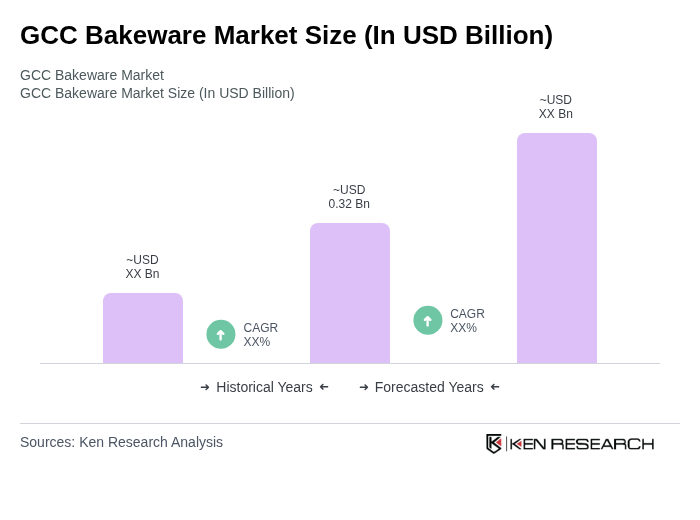
- The GCC Bakeware Market is valued at USD 0.32 billion, based on a five-year historical analysis of its share within the global bakeware market and the relative weight of GCC household and hospitality spending in the wider Middle East and Africa segment. This growth is primarily driven by the increasing popularity of home baking, influenced by social media trends, digital cooking content, and premium in-store demonstrations, alongside a rise in disposable income among consumers in key GCC economies. The market has seen a surge in demand for innovative and high-quality bakeware products, including non-stick, silicone, glass, and ceramic bakeware, catering to both amateur and professional bakers through modern retail, specialty kitchen stores, and fast-growing e-commerce channels.
- Key players in this market include the United Arab Emirates and Saudi Arabia, which dominate due to their robust modern retail infrastructure, extensive hypermarket and supermarket networks, and a growing culture of home baking and café-style desserts. The UAE, with its diverse expatriate population, high consumer spending, and strong presence of international kitchenware chains, has become a hub for premium and designer bakeware brands, while Saudi Arabia's expanding middle class and rapid development of bakery, café, and restaurant formats is increasingly driving investment in both household bakeware and professional-grade equipment.
- In 2023, the GCC countries continued to strengthen food-contact material requirements relevant to bakeware through national and harmonized standards. For example, the Gulf Cooperation Council Standardization Organization (GSO) and national authorities apply binding rules such as GSO 1863/2013 on “Materials and Articles in Contact with Food” and its adopted national implementations, which require bakeware and other food-contact materials to comply with specific migration limits and safety criteria, be free from hazardous levels of heavy metals and certain organic contaminants, and be manufactured using approved materials suitable for repeated food contact. These regulations mandate conformity assessment, labelling, and documentation for importers and local manufacturers, thereby enhancing consumer protection, supporting safer product formulations such as low?migration non-stick coatings, and encouraging more sustainable materials and production practices within the regional bakeware industry.
GCC Bakeware Market Segmentation
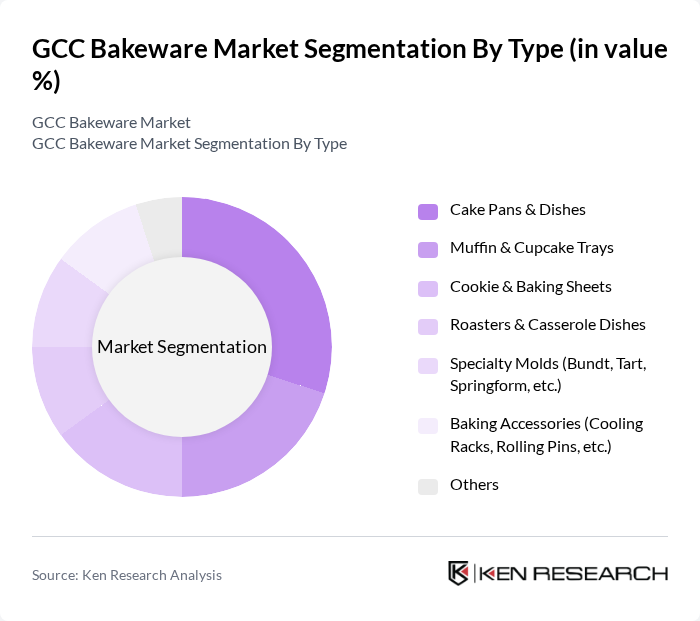
By Type:The bakeware market is segmented into various types, including Cake Pans & Dishes, Muffin & Cupcake Trays, Cookie & Baking Sheets, Roasters & Casserole Dishes, Specialty Molds, Baking Accessories, and Others. This structure is consistent with global categorization, where pans and dishes, tins and trays, cups, molds, and rolling pins represent the core product families. Among these, Cake Pans & Dishes are the most popular due to their versatility and essential role in preparing cakes, quick breads, and oven dishes for both everyday and occasion-based baking, aligning with global trends where pans and dishes account for the largest share of bakeware demand. The trend of baking at home has led to increased sales in this category as consumers seek durable, non-stick, and aesthetically pleasing products that enhance their baking experience and allow direct oven-to-table serving.
By End-User:The market is segmented by end-user into Household, Professional Bakeries & Patisseries, Hotels, Restaurants & Cafés (HoReCa), Industrial / Central Kitchens, and Others. This segmentation aligns with the broader bakeware industry, where demand is commonly split between household and commercial users. The Household segment leads the market in the GCC, supported by the growing trend of home baking, rising penetration of modern ovens in residential kitchens, and increased interest in healthier, home-prepared desserts and snacks, even as commercial and HoReCa channels collectively dominate global bakeware revenues. This segment has seen a significant increase in demand as more people engage in baking as a hobby, influenced by social media recipes, international bakery chains raising product awareness, and a preference for premium, long-lasting bakeware products.

GCC Bakeware Market Competitive Landscape
The GCC Bakeware Market is characterized by a dynamic mix of regional and international players. Leading participants such as Tefal (Groupe SEB), Pyrex, Nordic Ware, Wilton Brands, OXO (Helen of Troy Limited), Cuisinart (Conair Corporation), KitchenAid (Whirlpool Corporation), USA Pan, Anolon (Meyer Corporation), Rachael Ray (Meyer Corporation Licensed Brand), Silpat, Emile Henry, Le Creuset, Lodge Cast Iron, Tavola (UAE), Nabeel Perfumes Group – Home & Kitchen Division (GCC), Lulu Group – Private Label Bakeware, Carrefour (Majid Al Futtaim) Private Label Bakeware contribute to innovation, geographic expansion, and service delivery in this space, reflecting the global bakeware competitive set where these brands are recognized among key suppliers and marketers of pans, dishes, molds, and accessories.
GCC Bakeware Market Industry Analysis
Growth Drivers
- Increasing Home Baking Trends:The GCC region has witnessed a significant rise in home baking, with a reported 30% increase in home baking activities since 2020. This trend is driven by a growing interest in culinary skills and the desire for homemade goods. According to the World Bank, household consumption in the GCC is projected to reach $1.7 trillion in future, further fueling demand for bakeware products as consumers invest in quality kitchen tools to enhance their baking experiences.
- Rise in E-commerce Sales:E-commerce sales in the GCC are expected to exceed $35 billion in future, reflecting a 25% annual growth rate. This surge is attributed to increased internet penetration and a shift in consumer behavior towards online shopping. As more consumers turn to digital platforms for purchasing bakeware, companies are investing in robust online marketing strategies to capture this expanding market, thus driving overall sales in the bakeware sector.
- Growing Demand for Non-Stick Bakeware:The demand for non-stick bakeware is on the rise, with sales projected to reach 18 million units in future. This growth is driven by consumer preferences for convenience and ease of use in baking. Industry reports indicate that non-stick bakeware accounts for approximately 45% of total bakeware sales in the GCC, as consumers increasingly seek products that simplify the baking process and enhance cooking results.
Market Challenges
- Intense Competition:The GCC bakeware market is characterized by intense competition, with over 100 brands vying for market share. This saturation leads to price wars and reduced profit margins for manufacturers. According to industry analysis, the top five companies hold only 35% of the market share, indicating a fragmented landscape where smaller players can disrupt established brands, making it challenging for companies to maintain profitability.
- Fluctuating Raw Material Prices:The volatility in raw material prices, particularly for metals and silicone, poses a significant challenge for bakeware manufacturers. In future, the price of aluminum is projected to rise by 12%, impacting production costs. This fluctuation can lead to increased prices for consumers, potentially reducing demand. Manufacturers must navigate these challenges while maintaining competitive pricing to sustain market presence.
GCC Bakeware Market Future Outlook
The GCC bakeware market is poised for continued growth, driven by evolving consumer preferences towards healthier baking options and innovative product designs. The increasing popularity of smart bakeware technology, which integrates digital features for enhanced cooking experiences, is expected to reshape the market landscape. Additionally, the rise of social media platforms for recipe sharing will further inspire home bakers, creating a vibrant community that supports ongoing demand for diverse bakeware products.
Market Opportunities
- Introduction of Eco-Friendly Bakeware:The demand for eco-friendly bakeware is on the rise, with consumers increasingly prioritizing sustainability. In future, the market for eco-friendly products is expected to grow by 30%, presenting a lucrative opportunity for manufacturers to innovate and capture environmentally conscious consumers seeking sustainable alternatives in their baking practices.
- Collaborations with Influencers and Chefs:Collaborating with culinary influencers and professional chefs can significantly enhance brand visibility and credibility. As social media continues to influence consumer choices, partnerships with popular figures in the culinary space can drive sales and foster brand loyalty, tapping into the growing trend of personalized baking experiences among consumers in the GCC.
Scope of the Report
| Segment | Sub-Segments |
|---|---|
| By Type | Cake Pans & Dishes Muffin & Cupcake Trays Cookie & Baking Sheets Roasters & Casserole Dishes Specialty Molds (Bundt, Tart, Springform, etc.) Baking Accessories (Cooling Racks, Rolling Pins, etc.) Others |
| By End-User | Household Professional Bakeries & Patisseries Hotels, Restaurants & Cafés (HoReCa) Industrial / Central Kitchens Others |
| By Material | Aluminum (Including Hard-Anodized) Carbon & Stainless Steel Glass Ceramic & Stoneware Silicone & Hybrid Non-Stick Others |
| By Distribution Channel | Supermarkets / Hypermarkets Home & Kitchenware Specialty Stores Brand Stores & Showrooms Online Retail (E-commerce Marketplaces & Brand Websites) B2B / HoReCa Distributors Others |
| By Price Range | Economy Mid-Range Premium Luxury / Designer Others |
| By Brand | Local GCC Brands International Brands Private Labels (Modern Trade & E-commerce) Foodservice / Professional Lines Others |
| By Application | Bread & Loaf Baking Cakes & Pastries Cookies, Biscuits & Confectionery Savory Baking (Pies, Quiche, Lasagna, etc.) Multi-Purpose / Roasting Others |
Key Target Audience
Investors and Venture Capitalist Firms
Government and Regulatory Bodies (e.g., Ministry of Economy, Ministry of Health)
Manufacturers and Producers
Distributors and Retailers
Food Service Providers
Hospitality Industry Stakeholders
Importers and Exporters
Packaging Suppliers
Players Mentioned in the Report:
Tefal (Groupe SEB)
Pyrex
Nordic Ware
Wilton Brands
OXO (Helen of Troy Limited)
Cuisinart (Conair Corporation)
KitchenAid (Whirlpool Corporation)
USA Pan
Anolon (Meyer Corporation)
Rachael Ray (Meyer Corporation Licensed Brand)
Silpat
Emile Henry
Le Creuset
Lodge Cast Iron
Tavola (UAE)
Nabeel Perfumes Group Home & Kitchen Division (GCC)
Lulu Group Private Label Bakeware
Carrefour (Majid Al Futtaim) Private Label Bakeware
Table of Contents
Market Assessment Phase
1. Executive Summary and Approach
2. GCC Bakeware Market Overview
2.1 Key Insights and Strategic Recommendations
2.2 GCC Bakeware Market Overview
2.3 Definition and Scope
2.4 Evolution of Market Ecosystem
2.5 Timeline of Key Regulatory Milestones
2.6 Value Chain & Stakeholder Mapping
2.7 Business Cycle Analysis
2.8 Policy & Incentive Landscape
3. GCC Bakeware Market Analysis
3.1 Growth Drivers
3.1.1 Increasing Home Baking Trends
3.1.2 Rise in E-commerce Sales
3.1.3 Growing Demand for Non-Stick Bakeware
3.1.4 Expansion of Culinary Shows and Classes
3.2 Market Challenges
3.2.1 Intense Competition
3.2.2 Fluctuating Raw Material Prices
3.2.3 Regulatory Compliance Costs
3.2.4 Limited Awareness of Product Innovations
3.3 Market Opportunities
3.3.1 Introduction of Eco-Friendly Bakeware
3.3.2 Expansion into Emerging Markets
3.3.3 Collaborations with Influencers and Chefs
3.3.4 Customization and Personalization Trends
3.4 Market Trends
3.4.1 Shift Towards Health-Conscious Baking
3.4.2 Increasing Popularity of Silicone Bakeware
3.4.3 Growth of Smart Bakeware Technology
3.4.4 Rise in Online Recipe Sharing Platforms
3.5 Government Regulation
3.5.1 Food Safety Standards Compliance
3.5.2 Import Tariffs on Bakeware Products
3.5.3 Environmental Regulations on Materials
3.5.4 Labeling and Packaging Regulations
4. SWOT Analysis
5. Stakeholder Analysis
6. Porter's Five Forces Analysis
7. GCC Bakeware Market Market Size, 2019-2024
7.1 By Value
7.2 By Volume
7.3 By Average Selling Price
8. GCC Bakeware Market Segmentation
8.1 By Type
8.1.1 Cake Pans & Dishes
8.1.2 Muffin & Cupcake Trays
8.1.3 Cookie & Baking Sheets
8.1.4 Roasters & Casserole Dishes
8.1.5 Specialty Molds (Bundt, Tart, Springform, etc.)
8.1.6 Baking Accessories (Cooling Racks, Rolling Pins, etc.)
8.1.7 Others
8.2 By End-User
8.2.1 Household
8.2.2 Professional Bakeries & Patisseries
8.2.3 Hotels, Restaurants & Cafés (HoReCa)
8.2.4 Industrial / Central Kitchens
8.2.5 Others
8.3 By Material
8.3.1 Aluminum (Including Hard-Anodized)
8.3.2 Carbon & Stainless Steel
8.3.3 Glass
8.3.4 Ceramic & Stoneware
8.3.5 Silicone & Hybrid Non-Stick
8.3.6 Others
8.4 By Distribution Channel
8.4.1 Supermarkets / Hypermarkets
8.4.2 Home & Kitchenware Specialty Stores
8.4.3 Brand Stores & Showrooms
8.4.4 Online Retail (E-commerce Marketplaces & Brand Websites)
8.4.5 B2B / HoReCa Distributors
8.4.6 Others
8.5 By Price Range
8.5.1 Economy
8.5.2 Mid-Range
8.5.3 Premium
8.5.4 Luxury / Designer
8.5.5 Others
8.6 By Brand
8.6.1 Local GCC Brands
8.6.2 International Brands
8.6.3 Private Labels (Modern Trade & E-commerce)
8.6.4 Foodservice / Professional Lines
8.6.5 Others
8.7 By Application
8.7.1 Bread & Loaf Baking
8.7.2 Cakes & Pastries
8.7.3 Cookies, Biscuits & Confectionery
8.7.4 Savory Baking (Pies, Quiche, Lasagna, etc.)
8.7.5 Multi-Purpose / Roasting
8.7.6 Others
9. GCC Bakeware Market Competitive Analysis
9.1 Market Share of Key Players
9.2 Cross Comparison of Key Players
9.2.1 Company Name
9.2.2 Geographic Footprint in GCC (Countries Covered, Store / Distributor Reach)
9.2.3 Revenue from GCC Bakeware Segment
9.2.4 GCC Bakeware Revenue Growth Rate
9.2.5 Product Portfolio Breadth (Types, Materials, Price Tiers)
9.2.6 Share of HoReCa / Professional Sales vs Retail
9.2.7 Average Realized Price per Unit (Key SKUs)
9.2.8 Distribution Channel Mix (Offline vs Online Share)
9.2.9 New Product Launches per Year in GCC
9.2.10 Marketing & Promotion Intensity (Ad Spend / Visibility in Modern Trade)
9.2.11 Brand Awareness & Preference Scores in GCC
9.2.12 Warranty / After-Sales & B2B Service Capability
9.3 SWOT Analysis of Top Players
9.4 Pricing Analysis
9.5 Detailed Profile of Major Companies
9.5.1 Tefal (Groupe SEB)
9.5.2 Pyrex
9.5.3 Nordic Ware
9.5.4 Wilton Brands
9.5.5 OXO (Helen of Troy Limited)
9.5.6 Cuisinart (Conair Corporation)
9.5.7 KitchenAid (Whirlpool Corporation)
9.5.8 USA Pan
9.5.9 Anolon (Meyer Corporation)
9.5.10 Rachael Ray (Meyer Corporation Licensed Brand)
9.5.11 Silpat
9.5.12 Emile Henry
9.5.13 Le Creuset
9.5.14 Lodge Cast Iron
9.5.15 Tavola (UAE)
9.5.16 Nabeel Perfumes Group – Home & Kitchen Division (GCC)
9.5.17 Lulu Group – Private Label Bakeware
9.5.18 Carrefour (Majid Al Futtaim) Private Label Bakeware
10. GCC Bakeware Market End-User Analysis
10.1 Procurement Behavior of Key Ministries
10.1.1 Budget Allocation Trends
10.1.2 Supplier Selection Criteria
10.1.3 Purchase Frequency
10.1.4 Compliance Requirements
10.2 Corporate Spend on Infrastructure & Energy
10.2.1 Investment Trends
10.2.2 Budget Prioritization
10.2.3 Long-term Contracts
10.2.4 Sustainability Initiatives
10.3 Pain Point Analysis by End-User Category
10.3.1 Quality Concerns
10.3.2 Availability of Products
10.3.3 Pricing Issues
10.3.4 Customer Service Challenges
10.4 User Readiness for Adoption
10.4.1 Awareness Levels
10.4.2 Training Needs
10.4.3 Technology Adoption Rates
10.4.4 Feedback Mechanisms
10.5 Post-Deployment ROI and Use Case Expansion
10.5.1 Performance Metrics
10.5.2 User Satisfaction Levels
10.5.3 Expansion Opportunities
10.5.4 Long-term Value Assessment
11. GCC Bakeware Market Future Size, 2025-2030
11.1 By Value
11.2 By Volume
11.3 By Average Selling Price
Go-To-Market Strategy Phase
1. Whitespace Analysis + Business Model Canvas
1.1 Market Gaps Identification
1.2 Value Proposition Development
1.3 Revenue Streams Analysis
1.4 Cost Structure Evaluation
1.5 Key Partnerships Exploration
1.6 Customer Segmentation
1.7 Channels of Distribution
2. Marketing and Positioning Recommendations
2.1 Branding Strategies
2.2 Product USPs
3. Distribution Plan
3.1 Urban Retail vs Rural NGO Tie-ups
4. Channel & Pricing Gaps
4.1 Underserved Routes
4.2 Pricing Bands
5. Unmet Demand & Latent Needs
5.1 Category Gaps
5.2 Consumer Segments
6. Customer Relationship
6.1 Loyalty Programs
6.2 After-sales Service
7. Value Proposition
7.1 Sustainability
7.2 Integrated Supply Chains
8. Key Activities
8.1 Regulatory Compliance
8.2 Branding
8.3 Distribution Setup
9. Entry Strategy Evaluation
9.1 Domestic Market Entry Strategy
9.1.1 Product Mix
9.1.2 Pricing Band
9.1.3 Packaging
9.2 Export Entry Strategy
9.2.1 Target Countries
9.2.2 Compliance Roadmap
10. Entry Mode Assessment
10.1 JV
10.2 Greenfield
10.3 M&A
10.4 Distributor Model
11. Capital and Timeline Estimation
11.1 Capital Requirements
11.2 Timelines
12. Control vs Risk Trade-Off
12.1 Ownership vs Partnerships
13. Profitability Outlook
13.1 Breakeven Analysis
13.2 Long-term Sustainability
14. Potential Partner List
14.1 Distributors
14.2 JVs
14.3 Acquisition Targets
15. Execution Roadmap
15.1 Phased Plan for Market Entry
15.1.1 Market Setup
15.1.2 Market Entry
15.1.3 Growth Acceleration
15.1.4 Scale & Stabilize
15.2 Key Activities and Milestones
15.2.1 Activity Planning
15.2.2 Milestone Tracking
Research Methodology
Phase 1: Approach1
Desk Research
- Market reports from industry associations such as the Gulf Cooperation Council (GCC) and local trade bodies
- Analysis of import/export data from customs authorities and trade statistics
- Review of consumer behavior studies and market trends published in relevant journals
Primary Research
- Interviews with key stakeholders in the bakeware supply chain, including manufacturers and distributors
- Surveys targeting retail managers and buyers in major GCC supermarkets and specialty stores
- Focus group discussions with consumers to understand preferences and purchasing behavior
Validation & Triangulation
- Cross-validation of findings through multiple data sources, including sales data and market surveys
- Triangulation of insights from primary interviews with secondary research findings
- Sanity checks conducted through expert reviews and feedback from industry analysts
Phase 2: Market Size Estimation1
Top-down Assessment
- Estimation of total market size based on overall kitchenware market growth in the GCC region
- Segmentation of bakeware products by material type (e.g., silicone, metal, glass) and end-user applications
- Incorporation of demographic trends and consumer spending patterns in the GCC
Bottom-up Modeling
- Collection of sales data from leading bakeware manufacturers and retailers in the GCC
- Estimation of average selling prices and volume sold across different product categories
- Analysis of distribution channels and their impact on market penetration and growth
Forecasting & Scenario Analysis
- Utilization of historical sales data to project future growth rates for the bakeware market
- Scenario analysis based on economic conditions, consumer trends, and potential regulatory changes
- Development of multiple forecasts (baseline, optimistic, and pessimistic) through 2030
Phase 3: CATI Sample Composition1
| Scope Item/Segment | Sample Size | Target Respondent Profiles |
|---|---|---|
| Retail Bakeware Sales | 120 | Store Managers, Category Buyers |
| Consumer Preferences in Bakeware | 140 | Home Bakers, Cooking Enthusiasts |
| Manufacturing Insights | 100 | Production Managers, Quality Control Officers |
| Distribution Channel Analysis | 80 | Logistics Coordinators, Supply Chain Analysts |
| Market Trends and Innovations | 90 | Product Development Managers, Marketing Executives |
Frequently Asked Questions
What is the current value of the GCC Bakeware Market?
The GCC Bakeware Market is valued at approximately USD 0.32 billion, reflecting its share within the global bakeware market and the increasing household and hospitality spending in the region.
What factors are driving the growth of the GCC Bakeware Market?
Which countries are the largest players in the GCC Bakeware Market?
What types of bakeware are most popular in the GCC region?
Other Regional/Country Reports
Indonesia Bakeware Market
Malaysia Bakeware Market
KSA Bakeware Market
APAC Bakeware Market
SEA Bakeware Market
Other Adjacent Reports
Oman Hospitality Supplies Market
Egypt E-Commerce Retail Market
UAE Non-Stick Coatings MarketOman Sustainable Materials Market
South Korea Culinary Tools Market
Why Buy From Us?

What makes us stand out is that our consultants follow Robust, Refine and Result (RRR) methodology. Robust for clear definitions, approaches and sanity checking, Refine for differentiating respondents' facts and opinions, and Result for presenting data with story.

We have set a benchmark in the industry by offering our clients with syndicated and customized market research reports featuring coverage of entire market as well as meticulous research and analyst insights.

While we don't replace traditional research, we flip the method upside down. Our dual approach of Top Bottom & Bottom Top ensures quality deliverable by not just verifying company fundamentals but also looking at the sector and macroeconomic factors.

With one step in the future, our research team constantly tries to show you the bigger picture. We help with some of the tough questions you may encounter along the way: How is the industry positioned? Best marketing channel? KPI's of competitors? By aligning every element, we help maximize success.

Our report gives you instant access to the answers and sources that other companies might choose to hide. We elaborate each steps of research methodology we have used and showcase you the sample size to earn your trust.

If you need any support, we are here! We pride ourselves on universe strength, data quality, and quick, friendly, and professional service.