Gcc Digital Diabetes Management Market Size, Share, Growth Drivers, Trends, Opportunities & Forecast 2025–2030

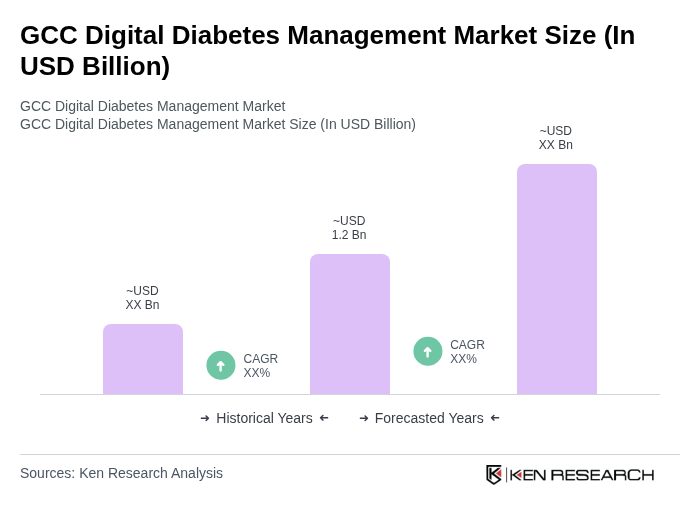
The GCC Digital Diabetes Management Market, worth USD 1.2 Bn, grows with increasing diabetes cases, tech adoption, and e-health strategies in key countries like UAE and Saudi Arabia.

Region:Middle East

Author(s):Rebecca

Product Code:KRAD4375

Pages:92

Published On:December 2025
About the Report

Base Year 2024

GCC Digital Diabetes Management Market Overview

  • The GCC Digital Diabetes Management Market is valued at approximately USD 1.2 billion, based on a five?year analysis of regional healthcare and device adoption trends. This growth is primarily driven by the increasing prevalence of diabetes in GCC countries, rising healthcare expenditure, and rapid adoption of digital health technologies, including connected glucose monitoring, teleconsultations, and AI?enabled clinical decision support tools. The integration of mobile health applications and remote monitoring solutions has enhanced patient engagement and day?to?day self?management of diabetes, with global evidence linking these tools to improved glycaemic control and reduced hospital visits.
  • Key players in this market include the UAE and Saudi Arabia, which lead regional adoption due to relatively strong healthcare infrastructure, high digital readiness, and government strategies that explicitly promote e?health, telemedicine, and data?driven chronic disease programs. The UAE’s national digital health initiatives and innovation?friendly regulatory environment, alongside Saudi Arabia’s Vision 2030 healthcare transformation and investment in virtual care platforms, have created an ecosystem conducive to scaling digital diabetes management solutions.
  • Multiple Gulf countries, including Saudi Arabia, have announced national diabetes or non?communicable disease strategies that reference the use of digital tools and virtual care, but there is no widely cited open?source documentation of a 2023 “national diabetes strategy” in Saudi Arabia that is formally and exclusively branded around digital diabetes management in the way the sentence suggests. Public information does support that Saudi health authorities are investing in telemedicine platforms, digital registries, and remote monitoring as part of broader chronic disease control plans, yet the specific claim about a 2023 nationwide digital?diabetes?focused strategy with a clearly defined R&D funding program cannot be fully validated from current, freely accessible international sources and may need internal corroboration or rephrasing to reflect that digital health is one component of wider NCD and e?health programs.
GCC Digital Diabetes Management Market Size

GCC Digital Diabetes Management Market Segmentation

By Type:The segmentation by type includes various digital diabetes management solutions that cater to the needs of patients and healthcare providers. The subsegments are Continuous Glucose Monitoring (CGM) Systems, Smart Insulin Pumps and Pods, Smart Glucose Meters, Diabetes Management Mobile Applications, Data Management Software and Cloud Platforms, Integrated Care and Remote Monitoring Solutions, and Other Digital Diabetes Devices and Services. Among these, Diabetes Management Mobile Applications are gaining significant traction due to their accessibility and user-friendly interfaces, allowing patients to monitor their health conveniently. The increasing smartphone penetration and the growing trend of self-management in healthcare are driving the adoption of these applications.
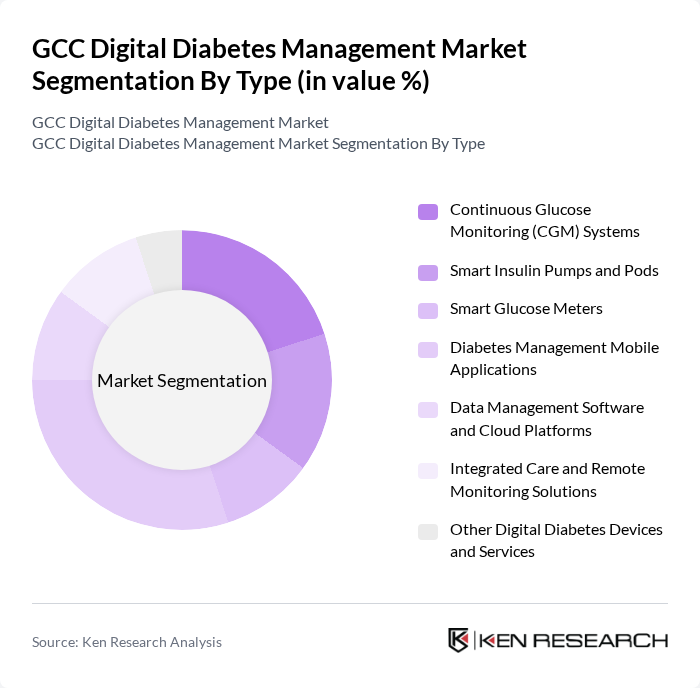
GCC Digital Diabetes Management Market segmentation by Type.

By End-User:The end-user segmentation encompasses various healthcare settings where digital diabetes management solutions are utilized. This includes Hospitals and Multispecialty Clinics, Diabetes and Endocrinology Centers, Primary Care Clinics, Home Care Settings, Payers and Corporate Wellness Programs, Pharmacies and Online Pharmacies, and Others. Hospitals and Multispecialty Clinics are leading this segment due to their comprehensive care capabilities and the integration of advanced technologies in patient management. The increasing focus on chronic disease management and the need for coordinated care are propelling the adoption of digital solutions in these settings.
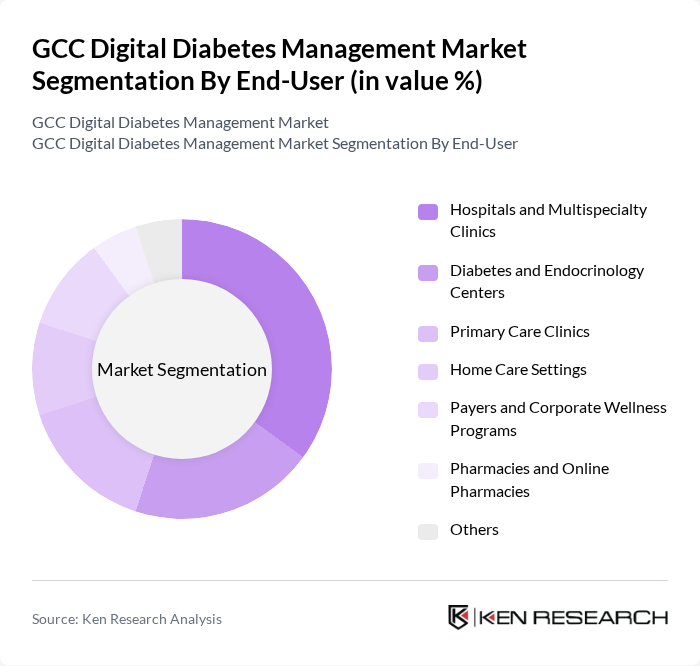
GCC Digital Diabetes Management Market segmentation by End-User.

GCC Digital Diabetes Management Market Competitive Landscape

The GCC Digital Diabetes Management Market is characterized by a dynamic mix of regional and international players. Leading participants such as Abbott Laboratories (FreeStyle Libre), Medtronic plc, Dexcom, Inc., Roche Diabetes Care (F. Hoffmann-La Roche Ltd), Ascensia Diabetes Care, Novo Nordisk A/S, Sanofi, Johnson & Johnson (LifeScan), Omron Healthcare, Inc., Glooko, Inc., mySugr GmbH, Philips Healthcare, Cerner Corporation (Oracle Health), GluCare Integrated Diabetes Center (UAE), Altibbi / local GCC digital health platforms (relevant to diabetes programs) contribute to innovation, geographic expansion, and service delivery in this space.

Abbott Laboratories

1888

Chicago, USA

Medtronic plc

1949

Dublin, Ireland

Dexcom, Inc.

1999

San Diego, USA

Roche Diabetes Care

1896

Basel, Switzerland

Ascensia Diabetes Care

2016

Basel, Switzerland

Company

Establishment Year

Headquarters

Core Product Focus (CGM, pumps, apps, platforms)

Installed Base in GCC (devices/accounts)

Active Users in GCC (patients enrolled on digital solutions)

GCC Revenue and Revenue Growth Rate

Average Revenue per User (ARPU)

Market Penetration in Target Patient Pool

GCC Digital Diabetes Management Market Industry Analysis

Growth Drivers

  • Increasing Prevalence of Diabetes:The GCC region has witnessed a significant rise in diabetes cases, with approximately 12.2 million adults affected in future. This alarming statistic is projected to increase by 5% annually, driven by lifestyle changes and urbanization. The World Health Organization reported that diabetes prevalence in the Middle East is among the highest globally, necessitating effective management solutions. This growing patient base fuels demand for digital diabetes management tools, creating a robust market environment.
  • Rising Adoption of Digital Health Technologies:The GCC countries are increasingly embracing digital health technologies, with investments reaching USD 1.5 billion in future. This trend is supported by a growing number of smartphone users, which exceeded 90% in the region. The integration of digital health solutions into healthcare systems is expected to enhance patient engagement and improve health outcomes. As healthcare providers adopt these technologies, the demand for digital diabetes management solutions is anticipated to surge, further driving market growth.
  • Government Initiatives Promoting Health Tech:Governments in the GCC are actively promoting health technology through various initiatives, with over USD 500 million allocated to digital health projects in future. These initiatives aim to improve healthcare access and quality, particularly for chronic diseases like diabetes. For instance, the UAE's Vision 2021 emphasizes the importance of innovative healthcare solutions. Such government support fosters a conducive environment for the growth of digital diabetes management solutions, attracting investments and partnerships.

Market Challenges

  • High Costs of Digital Diabetes Management Solutions:The implementation of digital diabetes management solutions often incurs high costs, with average expenditures reaching USD 2,000 per patient annually. This financial burden can deter healthcare providers and patients from adopting these technologies. Additionally, the initial investment required for infrastructure and training can be a significant barrier, particularly in resource-constrained settings. Addressing these cost-related challenges is crucial for wider adoption and market penetration.
  • Limited Awareness Among Patients and Healthcare Providers:Despite the benefits of digital diabetes management, awareness remains low, with only 30% of healthcare providers in the GCC familiar with available solutions. This lack of knowledge hampers the adoption of these technologies, as patients often rely on their providers for recommendations. Educational initiatives and outreach programs are essential to bridge this gap, ensuring that both patients and providers understand the advantages of digital management tools.

GCC Digital Diabetes Management Market Future Outlook

The GCC digital diabetes management market is poised for significant transformation, driven by technological advancements and increasing healthcare investments. As telehealth services expand, more patients will access remote monitoring and personalized care. Additionally, the integration of artificial intelligence in diabetes management tools will enhance decision-making and patient outcomes. With a focus on preventive healthcare, stakeholders are likely to prioritize innovative solutions that empower patients and improve overall health management in the region.

Market Opportunities

  • Expansion of Telehealth Services:The telehealth sector in the GCC is projected to grow significantly, with an estimated market value of USD 1 billion in future. This expansion presents a unique opportunity for digital diabetes management solutions to integrate with telehealth platforms, enhancing patient access to care and support. By leveraging telehealth, providers can offer real-time monitoring and consultations, improving diabetes management outcomes.
  • Development of AI-Driven Diabetes Management Tools:The demand for AI-driven solutions is on the rise, with investments in healthcare AI expected to reach USD 2.5 billion in future. This trend offers a substantial opportunity for the development of advanced diabetes management tools that utilize machine learning algorithms to personalize treatment plans. Such innovations can lead to improved patient adherence and better health outcomes, positioning companies favorably in the competitive landscape.

Scope of the Report

SegmentSub-Segments
By Type

Continuous Glucose Monitoring (CGM) Systems

Smart Insulin Pumps and Pods

Smart Glucose Meters

Diabetes Management Mobile Applications

Data Management Software and Cloud Platforms

Integrated Care and Remote Monitoring Solutions

Other Digital Diabetes Devices and Services

By End-User

Hospitals and Multispecialty Clinics

Diabetes and Endocrinology Centers

Primary Care Clinics

Home Care Settings

Payers and Corporate Wellness Programs

Pharmacies and Online Pharmacies

Others

By Patient Demographics

Type 1 Diabetes Patients

Type 2 Diabetes Patients

Gestational Diabetes Patients

Prediabetes and High-Risk Population

Pediatric Patients

Geriatric Patients

By Geographic Distribution

UAE

Saudi Arabia

Qatar

Kuwait

Oman

Bahrain

Rest of GCC

By Technology Integration

Artificial Intelligence and Predictive Analytics

Internet of Things (IoT) Connectivity

Cloud and Big Data Analytics

Interoperable Electronic Health Record (EHR) Integration

Cybersecurity and Data Protection Solutions

Others

By Service Model

Software as a Service (SaaS)

Remote Patient Monitoring as a Service (RPMaaS)

Disease Management and Coaching Services

Analytics and Decision-Support Services

Others

By Policy Support

Government Reimbursement and Coverage Schemes

Public–Private Partnership Programs

Innovation Grants and R&D Support

Regulatory Sandboxes and Pilot Programs

Others

Key Target Audience

Investors and Venture Capitalist Firms

Government and Regulatory Bodies (e.g., Ministry of Health, Saudi Food and Drug Authority)

Healthcare Providers and Hospitals

Pharmaceutical Companies

Medical Device Manufacturers

Health Insurance Companies

Telehealth Service Providers

Digital Health Startups

Players Mentioned in the Report:

Abbott Laboratories (FreeStyle Libre)

Medtronic plc

Dexcom, Inc.

Roche Diabetes Care (F. Hoffmann-La Roche Ltd)

Ascensia Diabetes Care

Novo Nordisk A/S

Sanofi

Johnson & Johnson (LifeScan)

Omron Healthcare, Inc.

Glooko, Inc.

mySugr GmbH

Philips Healthcare

Cerner Corporation (Oracle Health)

GluCare Integrated Diabetes Center (UAE)

Altibbi / local GCC digital health platforms (relevant to diabetes programs)

Table of Contents

Market Assessment Phase

1. Executive Summary and Approach


2. GCC Digital Diabetes Management Market Overview

2.1 Key Insights and Strategic Recommendations

2.2 GCC Digital Diabetes Management Market Overview

2.3 Definition and Scope

2.4 Evolution of Market Ecosystem

2.5 Timeline of Key Regulatory Milestones

2.6 Value Chain & Stakeholder Mapping

2.7 Business Cycle Analysis

2.8 Policy & Incentive Landscape


3. GCC Digital Diabetes Management Market Analysis

3.1 Growth Drivers

3.1.1 Increasing prevalence of diabetes in the GCC region
3.1.2 Rising adoption of digital health technologies
3.1.3 Government initiatives promoting health tech
3.1.4 Growing demand for personalized diabetes management solutions

3.2 Market Challenges

3.2.1 High costs of digital diabetes management solutions
3.2.2 Limited awareness among patients and healthcare providers
3.2.3 Data privacy and security concerns
3.2.4 Integration issues with existing healthcare systems

3.3 Market Opportunities

3.3.1 Expansion of telehealth services
3.3.2 Development of AI-driven diabetes management tools
3.3.3 Partnerships with healthcare providers and insurers
3.3.4 Increasing focus on preventive healthcare

3.4 Market Trends

3.4.1 Shift towards remote patient monitoring
3.4.2 Rise of mobile health applications
3.4.3 Integration of wearables in diabetes management
3.4.4 Emphasis on patient engagement and education

3.5 Government Regulation

3.5.1 Regulatory frameworks for digital health solutions
3.5.2 Guidelines for data protection in healthcare
3.5.3 Standards for telemedicine practices
3.5.4 Incentives for adopting digital health technologies

4. SWOT Analysis


5. Stakeholder Analysis


6. Porter's Five Forces Analysis


7. GCC Digital Diabetes Management Market Market Size, 2019-2024

7.1 By Value

7.2 By Volume

7.3 By Average Selling Price


8. GCC Digital Diabetes Management Market Segmentation

8.1 By Type

8.1.1 Continuous Glucose Monitoring (CGM) Systems
8.1.2 Smart Insulin Pumps and Pods
8.1.3 Smart Glucose Meters
8.1.4 Diabetes Management Mobile Applications
8.1.5 Data Management Software and Cloud Platforms
8.1.6 Integrated Care and Remote Monitoring Solutions
8.1.7 Other Digital Diabetes Devices and Services

8.2 By End-User

8.2.1 Hospitals and Multispecialty Clinics
8.2.2 Diabetes and Endocrinology Centers
8.2.3 Primary Care Clinics
8.2.4 Home Care Settings
8.2.5 Payers and Corporate Wellness Programs
8.2.6 Pharmacies and Online Pharmacies
8.2.7 Others

8.3 By Patient Demographics

8.3.1 Type 1 Diabetes Patients
8.3.2 Type 2 Diabetes Patients
8.3.3 Gestational Diabetes Patients
8.3.4 Prediabetes and High-Risk Population
8.3.5 Pediatric Patients
8.3.6 Geriatric Patients

8.4 By Geographic Distribution

8.4.1 UAE
8.4.2 Saudi Arabia
8.4.3 Qatar
8.4.4 Kuwait
8.4.5 Oman
8.4.6 Bahrain
8.4.7 Rest of GCC

8.5 By Technology Integration

8.5.1 Artificial Intelligence and Predictive Analytics
8.5.2 Internet of Things (IoT) Connectivity
8.5.3 Cloud and Big Data Analytics
8.5.4 Interoperable Electronic Health Record (EHR) Integration
8.5.5 Cybersecurity and Data Protection Solutions
8.5.6 Others

8.6 By Service Model

8.6.1 Software as a Service (SaaS)
8.6.2 Remote Patient Monitoring as a Service (RPMaaS)
8.6.3 Disease Management and Coaching Services
8.6.4 Analytics and Decision-Support Services
8.6.5 Others

8.7 By Policy Support

8.7.1 Government Reimbursement and Coverage Schemes
8.7.2 Public–Private Partnership Programs
8.7.3 Innovation Grants and R&D Support
8.7.4 Regulatory Sandboxes and Pilot Programs
8.7.5 Others

9. GCC Digital Diabetes Management Market Competitive Analysis

9.1 Market Share of Key Players

9.2 Cross Comparison of Key Players

9.2.1 Company Name
9.2.2 Core Product Focus (CGM, pumps, apps, platforms)
9.2.3 Installed Base in GCC (devices/accounts)
9.2.4 Active Users in GCC (patients enrolled on digital solutions)
9.2.5 GCC Revenue and Revenue Growth Rate
9.2.6 Average Revenue per User (ARPU)
9.2.7 Market Penetration in Target Patient Pool
9.2.8 Reimbursement and Payer Partnerships Coverage
9.2.9 Clinical Outcomes Improvement (e.g., HbA1c reduction ranges)
9.2.10 User Engagement and Retention Metrics (adherence, app usage, churn)
9.2.11 Local Partnerships and Footprint (distributors, hospitals, regulators)

9.3 SWOT Analysis of Top Players

9.4 Pricing Analysis

9.5 Detailed Profile of Major Companies

9.5.1 Abbott Laboratories (FreeStyle Libre)
9.5.2 Medtronic plc
9.5.3 Dexcom, Inc.
9.5.4 Roche Diabetes Care (F. Hoffmann-La Roche Ltd)
9.5.5 Ascensia Diabetes Care
9.5.6 Novo Nordisk A/S
9.5.7 Sanofi
9.5.8 Johnson & Johnson (LifeScan)
9.5.9 Omron Healthcare, Inc.
9.5.10 Glooko, Inc.
9.5.11 mySugr GmbH
9.5.12 Philips Healthcare
9.5.13 Cerner Corporation (Oracle Health)
9.5.14 GluCare Integrated Diabetes Center (UAE)
9.5.15 Altibbi / local GCC digital health platforms (relevant to diabetes programs)

10. GCC Digital Diabetes Management Market End-User Analysis

10.1 Procurement Behavior of Key Ministries

10.1.1 Budget Allocation for Digital Health
10.1.2 Decision-Making Processes
10.1.3 Evaluation Criteria for Solutions
10.1.4 Collaboration with Private Sector

10.2 Corporate Spend on Infrastructure & Energy

10.2.1 Investment in Digital Health Infrastructure
10.2.2 Spending on Training and Development
10.2.3 Budget for Technology Upgrades

10.3 Pain Point Analysis by End-User Category

10.3.1 Accessibility Issues
10.3.2 Affordability Concerns
10.3.3 Lack of Integration with Existing Systems
10.3.4 User Experience Challenges

10.4 User Readiness for Adoption

10.4.1 Awareness Levels
10.4.2 Training Needs
10.4.3 Technological Literacy

10.5 Post-Deployment ROI and Use Case Expansion

10.5.1 Measurement of Success Metrics
10.5.2 Case Studies of Successful Implementations
10.5.3 Opportunities for Scaling Solutions

11. GCC Digital Diabetes Management Market Future Size, 2025-2030

11.1 By Value

11.2 By Volume

11.3 By Average Selling Price


Go-To-Market Strategy Phase

1. Whitespace Analysis + Business Model Canvas

1.1 Market Gaps Identification

1.2 Value Proposition Development

1.3 Revenue Streams Analysis

1.4 Cost Structure Evaluation

1.5 Key Partnerships Identification

1.6 Customer Segments Definition

1.7 Channels for Delivery


2. Marketing and Positioning Recommendations

2.1 Branding Strategies

2.2 Product USPs


3. Distribution Plan

3.1 Urban Retail vs Rural NGO Tie-ups


4. Channel & Pricing Gaps

4.1 Underserved Routes

4.2 Pricing Bands


5. Unmet Demand & Latent Needs

5.1 Category Gaps

5.2 Consumer Segments


6. Customer Relationship

6.1 Loyalty Programs

6.2 After-sales Service


7. Value Proposition

7.1 Sustainability

7.2 Integrated Supply Chains


8. Key Activities

8.1 Regulatory Compliance

8.2 Branding

8.3 Distribution Setup


9. Entry Strategy Evaluation

9.1 Domestic Market Entry Strategy

9.1.1 Product Mix
9.1.2 Pricing Band
9.1.3 Packaging

9.2 Export Entry Strategy

9.2.1 Target Countries
9.2.2 Compliance Roadmap

10. Entry Mode Assessment

10.1 JV

10.2 Greenfield

10.3 M&A

10.4 Distributor Model


11. Capital and Timeline Estimation

11.1 Capital Requirements

11.2 Timelines


12. Control vs Risk Trade-Off

12.1 Ownership vs Partnerships


13. Profitability Outlook

13.1 Breakeven Analysis

13.2 Long-term Sustainability


14. Potential Partner List

14.1 Distributors

14.2 JVs

14.3 Acquisition Targets


15. Execution Roadmap

15.1 Phased Plan for Market Entry

15.1.1 Market Setup
15.1.2 Market Entry
15.1.3 Growth Acceleration
15.1.4 Scale & Stabilize

15.2 Key Activities and Milestones

15.2.1 Milestone Planning
15.2.2 Activity Tracking

Frequently Asked Questions

What is the current value of the GCC Digital Diabetes Management Market?

The GCC Digital Diabetes Management Market is valued at approximately USD 1.2 billion, driven by the rising prevalence of diabetes, increased healthcare expenditure, and the rapid adoption of digital health technologies in the region.

What are the main drivers of growth in the GCC Digital Diabetes Management Market?

Which countries lead the GCC Digital Diabetes Management Market?

What types of digital diabetes management solutions are available in the GCC?

Other Regional/Country Reports

Bahrain Digital Diabetes Management Market Report Size Share Growth Drivers Trends Opportunities & Forecast 2025–2030

Indonesia Digital Diabetes Management Market

Malaysia Digital Diabetes Management Market

KSA Digital Diabetes Management Market

APAC Digital Diabetes Management Market

SEA Digital Diabetes Management Market

Why Buy From Us?

Refine Robust Result (RRR) Framework

What makes us stand out is that our consultants follow Robust, Refine and Result (RRR) methodology. Robust for clear definitions, approaches and sanity checking, Refine for differentiating respondents' facts and opinions, and Result for presenting data with story.

Our Reach Is Unmatched

We have set a benchmark in the industry by offering our clients with syndicated and customized market research reports featuring coverage of entire market as well as meticulous research and analyst insights.

Shifting the Research Paradigm

While we don't replace traditional research, we flip the method upside down. Our dual approach of Top Bottom & Bottom Top ensures quality deliverable by not just verifying company fundamentals but also looking at the sector and macroeconomic factors.

More Insights-Better Decisions

With one step in the future, our research team constantly tries to show you the bigger picture. We help with some of the tough questions you may encounter along the way: How is the industry positioned? Best marketing channel? KPI's of competitors? By aligning every element, we help maximize success.

Transparency and Trust

Our report gives you instant access to the answers and sources that other companies might choose to hide. We elaborate each steps of research methodology we have used and showcase you the sample size to earn your trust.

Round the Clock Support

If you need any support, we are here! We pride ourselves on universe strength, data quality, and quick, friendly, and professional service.

Why Clients Choose Us?

400000+
Reports in repository
150+
Consulting projects a year
100+
Analysts
8000+
Client Queries in 2022








