GCC fuel cell powertrain market report size, share, growth drivers, trends, opportunities & forecast 2025–2030

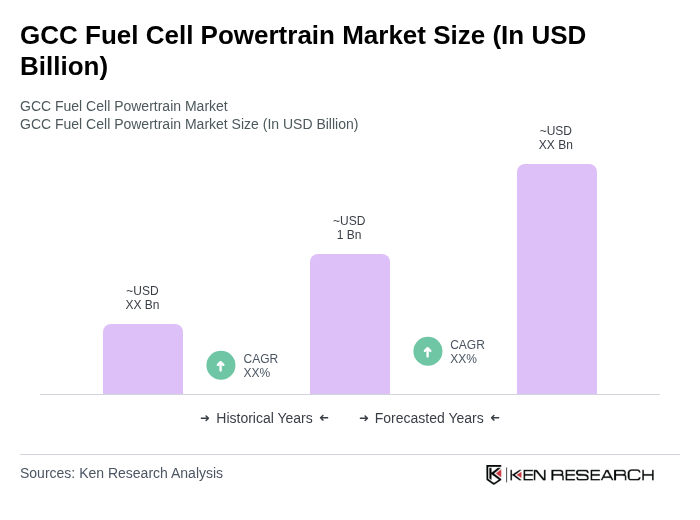
The GCC Fuel Cell Powertrain Market, valued at USD 1 billion, is growing due to government initiatives like UAE's Hydrogen Strategy and advancements in fuel cell technology.

Region:Middle East

Author(s):Rebecca

Product Code:KRAC8422

Pages:83

Published On:November 2025
About the Report

Base Year 2024

GCC Fuel Cell Powertrain Market Overview

  • The GCC Fuel Cell Powertrain Market is valued at USD 1 billion, based on a five-year historical analysis. This growth is primarily driven by increasing investments in clean energy technologies, government initiatives promoting hydrogen fuel adoption, and rising environmental concerns among consumers and industries. The market is witnessing a shift towards sustainable transportation solutions, further bolstered by advancements in fuel cell technology and the rapid deployment of hydrogen-powered commercial vehicles, especially in heavy-duty fleets.
  • Key players in this market include Saudi Arabia, the United Arab Emirates, and Qatar. These countries dominate the market due to their substantial investments in renewable energy projects, strategic government policies aimed at reducing carbon emissions, and the availability of natural resources for hydrogen production. The GCC region's commitment to diversifying its energy sources and enhancing energy security also contributes to its market leadership. Recent trends include large-scale hydrogen production projects, expansion of hydrogen refueling infrastructure, and cross-border collaborations to accelerate fuel cell deployment in transportation and industrial sectors.
  • In 2023, the UAE government implemented the National Hydrogen Strategy 2050, issued by the Ministry of Energy and Infrastructure. This binding instrument aims to establish the country as a global hub for hydrogen production and export. The strategy includes investments of approximately USD 1 billion in hydrogen infrastructure and technology development, focusing on creating a sustainable ecosystem for fuel cell applications across transportation, industry, and energy sectors. Operational requirements include mandatory reporting of hydrogen production volumes, compliance with international safety standards, and licensing for hydrogen refueling stations.
GCC Fuel Cell Powertrain Market Size

GCC Fuel Cell Powertrain Market Segmentation

By Type:The market is segmented into various types of fuel cells, including Proton Exchange Membrane Fuel Cells (PEMFC), Solid Oxide Fuel Cells (SOFC), Alkaline Fuel Cells (AFC), Phosphoric Acid Fuel Cells (PAFC), and others. Among these, PEMFCs are the most widely used due to their high efficiency, rapid start-up, and suitability for transportation applications. The growing demand for zero-emission vehicles and commercial fleets is driving the adoption of PEMFCs, making them the dominant force in the market. SOFCs are gaining traction for stationary and industrial applications due to their fuel flexibility and high-temperature operation. AFCs and PAFCs remain niche segments, primarily used in specialized industrial and backup power scenarios.
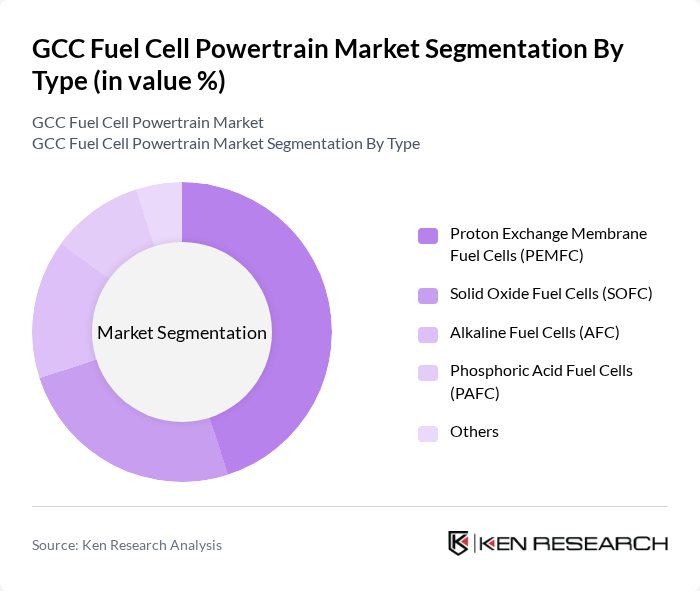
GCC Fuel Cell Powertrain Market segmentation by Type.

By Component:The market is further segmented by components, including Fuel Cell Module (Stack + Balance of Plant), Hydrogen Storage System, Electric Drive Unit (EDU), Power Electronics & Control, Battery System, Air Compressor & Humidifier, and others. The Fuel Cell Module is the leading component due to its critical role in the overall efficiency and performance of fuel cell systems, particularly in automotive and commercial vehicle applications. Hydrogen Storage Systems are increasingly important as refueling infrastructure expands, while Electric Drive Units and Power Electronics & Control are essential for optimizing power delivery and system integration. Battery Systems and Air Compressor & Humidifier components support auxiliary functions and system reliability.
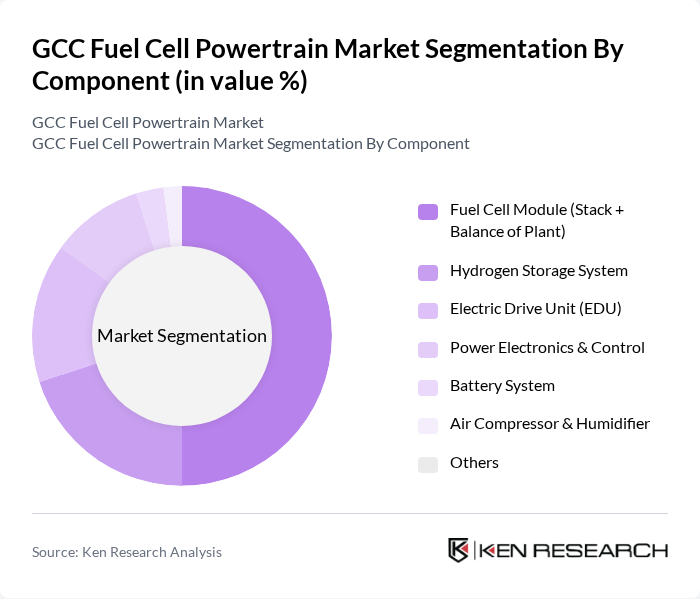
GCC Fuel Cell Powertrain Market segmentation by Component.

GCC Fuel Cell Powertrain Market Competitive Landscape

The GCC Fuel Cell Powertrain Market is characterized by a dynamic mix of regional and international players. Leading participants such as Ballard Power Systems, Plug Power Inc., Hydrogenics Corporation, FuelCell Energy, Inc., Toyota Motor Corporation, Hyundai Motor Company, Honda Motor Co., Ltd., Siemens AG, General Motors Company, Nikola Corporation, Cummins Inc., Air Products and Chemicals, Inc., Linde plc, ABB Ltd., Robert Bosch GmbH contribute to innovation, geographic expansion, and service delivery in this space.

Ballard Power Systems

1979

Burnaby, Canada

Plug Power Inc.

1997

Latham, New York, USA

Hydrogenics Corporation

1995

Mississauga, Canada

FuelCell Energy, Inc.

1969

Danbury, Connecticut, USA

Toyota Motor Corporation

1937

Toyota City, Japan

Company

Establishment Year

Headquarters

Group Size (Large, Medium, or Small as per industry convention)

Revenue Growth Rate (Fuel Cell Powertrain Segment)

Market Penetration Rate (GCC Region)

Installed Fuel Cell Powertrain Capacity (MW or Units)

Number of Commercial Deployments (Vehicles/Projects)

Strategic Partnerships & Alliances (GCC Focus)

GCC Fuel Cell Powertrain Market Industry Analysis

Growth Drivers

  • Increasing Demand for Clean Energy Solutions:The GCC region is witnessing a significant shift towards clean energy, with the International Renewable Energy Agency (IRENA) reporting a 20% increase in renewable energy investments in future, totaling approximately USD 20 billion. This growing demand for sustainable energy sources is driving the adoption of fuel cell technologies, as countries like Saudi Arabia and the UAE aim to diversify their energy portfolios and reduce carbon emissions, aligning with global climate goals.
  • Government Initiatives Promoting Hydrogen Fuel:Governments in the GCC are actively promoting hydrogen as a key component of their energy strategies. For instance, the UAE's Hydrogen Strategy aims to capture 25% of the global hydrogen market in future, with investments exceeding USD 10 billion. Such initiatives are fostering a conducive environment for fuel cell powertrains, encouraging research and development, and facilitating partnerships between public and private sectors to enhance hydrogen production and utilization.
  • Technological Advancements in Fuel Cell Efficiency:Recent advancements in fuel cell technology have significantly improved efficiency and reduced costs. The U.S. Department of Energy reported that fuel cell systems have achieved efficiencies of up to 65% in converting hydrogen to electricity. In the GCC, local research institutions are collaborating with international firms to enhance fuel cell performance, which is expected to drive market growth as these technologies become more commercially viable and accessible to consumers.

Market Challenges

  • High Initial Investment Costs:The high upfront costs associated with fuel cell technology remain a significant barrier to market entry. According to the World Bank, the average cost of fuel cell systems is approximately USD 1,200 per kilowatt, which can deter potential investors. This financial hurdle is particularly pronounced in the GCC, where traditional fossil fuel sources are still economically favorable, making it challenging for fuel cell technologies to compete without substantial subsidies or incentives.
  • Limited Hydrogen Refueling Infrastructure:The lack of a comprehensive hydrogen refueling infrastructure poses a critical challenge for the fuel cell market in the GCC. As of in future, there are only 20 operational hydrogen refueling stations across the region, primarily located in urban centers. This limited availability restricts the adoption of fuel cell vehicles, as consumers are hesitant to invest in technologies that lack adequate support infrastructure, hindering overall market growth.

GCC Fuel Cell Powertrain Market Future Outlook

The future of the GCC fuel cell powertrain market appears promising, driven by increasing government support and technological advancements. As countries in the region strive to meet their emission reduction targets, the integration of fuel cells into various sectors, including transportation and energy generation, is expected to accelerate. Furthermore, the collaboration between governments and private entities will likely enhance hydrogen production capabilities, fostering a more robust market environment and encouraging wider adoption of fuel cell technologies.

Market Opportunities

  • Expansion of Hydrogen Production Technologies:The GCC has significant potential for expanding hydrogen production technologies, particularly green hydrogen. With abundant solar and wind resources, the region can leverage these assets to produce hydrogen sustainably, attracting investments and fostering innovation in fuel cell applications across various industries, including transportation and power generation.
  • Collaborations with Automotive Manufacturers:Strategic partnerships between fuel cell technology providers and automotive manufacturers present a lucrative opportunity. As major automotive companies increasingly invest in hydrogen fuel cell vehicles, collaborations can facilitate knowledge transfer, enhance product development, and accelerate the commercialization of fuel cell technologies, positioning the GCC as a leader in sustainable transportation solutions.

Scope of the Report

SegmentSub-Segments
By Type

Proton Exchange Membrane Fuel Cells (PEMFC)

Solid Oxide Fuel Cells (SOFC)

Alkaline Fuel Cells (AFC)

Phosphoric Acid Fuel Cells (PAFC)

Others

By Component

Fuel Cell Module (Stack + Balance of Plant)

Hydrogen Storage System

Electric Drive Unit (EDU)

Power Electronics & Control

Battery System

Air Compressor & Humidifier

Others

By Power Output

Less than 150 kW

–250 kW

More than 250 kW

By Vehicle Type

Passenger Cars

Light Commercial Vehicles (LCV)

Buses

Trucks

Others

By Application

Transportation (Commercial Trucks & Buses)

Material Handling

Passenger Vehicles

Stationary Power Generation

Portable Power

Backup Power Systems

Others

By Fuel Source

Hydrogen

Natural Gas

Biogas

Others

By Region

Saudi Arabia

United Arab Emirates

Qatar

Kuwait

Oman

By Investment Source

Private Investments

Government Funding

International Grants

Others

By Policy Support

Subsidies

Tax Exemptions

Research Grants

Others

Key Target Audience

Investors and Venture Capitalist Firms

Government and Regulatory Bodies (e.g., Gulf Cooperation Council, Ministry of Energy and Industry)

Automotive Manufacturers

Fuel Cell Technology Developers

Energy Providers and Utilities

Infrastructure Developers

Environmental Agencies (e.g., Ministry of Environment and Climate Change)

Logistics and Transportation Companies

Players Mentioned in the Report:

Ballard Power Systems

Plug Power Inc.

Hydrogenics Corporation

FuelCell Energy, Inc.

Toyota Motor Corporation

Hyundai Motor Company

Honda Motor Co., Ltd.

Siemens AG

General Motors Company

Nikola Corporation

Cummins Inc.

Air Products and Chemicals, Inc.

Linde plc

ABB Ltd.

Robert Bosch GmbH

Table of Contents

Market Assessment Phase

1. Executive Summary and Approach


2. GCC Fuel Cell Powertrain Market Overview

2.1 Key Insights and Strategic Recommendations

2.2 GCC Fuel Cell Powertrain Market Overview

2.3 Definition and Scope

2.4 Evolution of Market Ecosystem

2.5 Timeline of Key Regulatory Milestones

2.6 Value Chain & Stakeholder Mapping

2.7 Business Cycle Analysis

2.8 Policy & Incentive Landscape


3. GCC Fuel Cell Powertrain Market Analysis

3.1 Growth Drivers

3.1.1 Increasing demand for clean energy solutions
3.1.2 Government initiatives promoting hydrogen fuel
3.1.3 Technological advancements in fuel cell efficiency
3.1.4 Rising investments in renewable energy infrastructure

3.2 Market Challenges

3.2.1 High initial investment costs
3.2.2 Limited hydrogen refueling infrastructure
3.2.3 Competition from battery electric vehicles
3.2.4 Regulatory uncertainties

3.3 Market Opportunities

3.3.1 Expansion of hydrogen production technologies
3.3.2 Collaborations with automotive manufacturers
3.3.3 Development of fuel cell applications in various sectors
3.3.4 Growing interest in sustainable transportation solutions

3.4 Market Trends

3.4.1 Increasing adoption of fuel cell vehicles
3.4.2 Integration of fuel cells in public transportation
3.4.3 Focus on hydrogen as a key energy carrier
3.4.4 Rise of decentralized energy systems

3.5 Government Regulation

3.5.1 Emission reduction targets
3.5.2 Incentives for hydrogen production
3.5.3 Standards for fuel cell safety and performance
3.5.4 Support for R&D in fuel cell technologies

4. SWOT Analysis


5. Stakeholder Analysis


6. Porter's Five Forces Analysis


7. GCC Fuel Cell Powertrain Market Size, 2019-2024

7.1 By Value

7.2 By Volume

7.3 By Average Selling Price


8. GCC Fuel Cell Powertrain Market Segmentation

8.1 By Type

8.1.1 Proton Exchange Membrane Fuel Cells (PEMFC)
8.1.2 Solid Oxide Fuel Cells (SOFC)
8.1.3 Alkaline Fuel Cells (AFC)
8.1.4 Phosphoric Acid Fuel Cells (PAFC)
8.1.5 Others

8.2 By Component

8.2.1 Fuel Cell Module (Stack + Balance of Plant)
8.2.2 Hydrogen Storage System
8.2.3 Electric Drive Unit (EDU)
8.2.4 Power Electronics & Control
8.2.5 Battery System
8.2.6 Air Compressor & Humidifier
8.2.7 Others

8.3 By Power Output

8.3.1 Less than 150 kW
8.3.2 150–250 kW
8.3.3 More than 250 kW

8.4 By Vehicle Type

8.4.1 Passenger Cars
8.4.2 Light Commercial Vehicles (LCV)
8.4.3 Buses
8.4.4 Trucks
8.4.5 Others

8.5 By Application

8.5.1 Transportation (Commercial Trucks & Buses)
8.5.2 Material Handling
8.5.3 Passenger Vehicles
8.5.4 Stationary Power Generation
8.5.5 Portable Power
8.5.6 Backup Power Systems
8.5.7 Others

8.6 By Fuel Source

8.6.1 Hydrogen
8.6.2 Natural Gas
8.6.3 Biogas
8.6.4 Others

8.7 By Region

8.7.1 Saudi Arabia
8.7.2 United Arab Emirates
8.7.3 Qatar
8.7.4 Kuwait
8.7.5 Oman

8.8 By Investment Source

8.8.1 Private Investments
8.8.2 Government Funding
8.8.3 International Grants
8.8.4 Others

8.9 By Policy Support

8.9.1 Subsidies
8.9.2 Tax Exemptions
8.9.3 Research Grants
8.9.4 Others

9. GCC Fuel Cell Powertrain Market Competitive Analysis

9.1 Market Share of Key Players

9.2 KPIs for Cross Comparison of Key Players

9.2.1 Company Name
9.2.2 Group Size (Large, Medium, or Small as per industry convention)
9.2.3 Revenue Growth Rate (Fuel Cell Powertrain Segment)
9.2.4 Market Penetration Rate (GCC Region)
9.2.5 Installed Fuel Cell Powertrain Capacity (MW or Units)
9.2.6 Number of Commercial Deployments (Vehicles/Projects)
9.2.7 Strategic Partnerships & Alliances (GCC Focus)
9.2.8 R&D Investment in Fuel Cell Technology
9.2.9 Product Innovation Index (Patents, New Launches)
9.2.10 Operational Efficiency (Cost per kW, Reliability Metrics)
9.2.11 Brand Recognition (Regional & Global)
9.2.12 Customer Satisfaction Score (Fleet/End-User Feedback)

9.3 SWOT Analysis of Top Players

9.4 Pricing Analysis

9.5 Detailed Profile of Major Companies

9.5.1 Ballard Power Systems
9.5.2 Plug Power Inc.
9.5.3 Hydrogenics Corporation
9.5.4 FuelCell Energy, Inc.
9.5.5 Toyota Motor Corporation
9.5.6 Hyundai Motor Company
9.5.7 Honda Motor Co., Ltd.
9.5.8 Siemens AG
9.5.9 General Motors Company
9.5.10 Nikola Corporation
9.5.11 Cummins Inc.
9.5.12 Air Products and Chemicals, Inc.
9.5.13 Linde plc
9.5.14 ABB Ltd.
9.5.15 Robert Bosch GmbH

10. GCC Fuel Cell Powertrain Market End-User Analysis

10.1 Procurement Behavior of Key Ministries

10.1.1 Government procurement policies
10.1.2 Budget allocation for fuel cell projects
10.1.3 Collaboration with private sector
10.1.4 Evaluation criteria for suppliers

10.2 Corporate Spend on Infrastructure & Energy

10.2.1 Investment in renewable energy projects
10.2.2 Budget for fuel cell technology adoption
10.2.3 Partnerships with energy providers
10.2.4 Infrastructure development plans

10.3 Pain Point Analysis by End-User Category

10.3.1 Cost of implementation
10.3.2 Reliability of technology
10.3.3 Availability of skilled workforce
10.3.4 Integration with existing systems

10.4 User Readiness for Adoption

10.4.1 Awareness of fuel cell benefits
10.4.2 Training and support needs
10.4.3 Infrastructure readiness
10.4.4 Financial incentives for adoption

10.5 Post-Deployment ROI and Use Case Expansion

10.5.1 Measurement of operational efficiency
10.5.2 Long-term cost savings
10.5.3 Scalability of fuel cell solutions
10.5.4 Expansion into new markets

11. GCC Fuel Cell Powertrain Market Future Size, 2025-2030

11.1 By Value

11.2 By Volume

11.3 By Average Selling Price


Go-To-Market Strategy Phase

1. Whitespace Analysis + Business Model Canvas

1.1 Identification of market gaps

1.2 Value proposition development

1.3 Revenue model exploration

1.4 Customer segmentation analysis

1.5 Competitive landscape overview

1.6 Key partnerships and alliances

1.7 Risk assessment and mitigation strategies


2. Marketing and Positioning Recommendations

2.1 Branding strategies

2.2 Product USPs

2.3 Target audience identification

2.4 Communication strategies

2.5 Digital marketing initiatives

2.6 Event marketing and trade shows

2.7 Customer engagement tactics


3. Distribution Plan

3.1 Urban retail strategies

3.2 Rural NGO tie-ups

3.3 Online distribution channels

3.4 Partnerships with logistics providers

3.5 Inventory management solutions

3.6 Distribution network optimization

3.7 Customer service and support


4. Channel & Pricing Gaps

4.1 Underserved routes

4.2 Pricing bands analysis

4.3 Competitor pricing strategies

4.4 Customer willingness to pay

4.5 Value-based pricing models

4.6 Discount and promotion strategies

4.7 Pricing adjustments based on market feedback


5. Unmet Demand & Latent Needs

5.1 Category gaps analysis

5.2 Consumer segments identification

5.3 Product development opportunities

5.4 Service enhancement needs

5.5 Market entry barriers

5.6 Customer feedback mechanisms

5.7 Future trends and predictions


6. Customer Relationship

6.1 Loyalty programs

6.2 After-sales service

6.3 Customer feedback loops

6.4 Community engagement initiatives

6.5 Customer education and training

6.6 Relationship management tools

6.7 Personalization strategies


7. Value Proposition

7.1 Sustainability initiatives

7.2 Integrated supply chains

7.3 Cost-effectiveness analysis

7.4 Innovation in product offerings

7.5 Customer-centric solutions

7.6 Competitive advantages

7.7 Long-term value creation


8. Key Activities

8.1 Regulatory compliance

8.2 Branding efforts

8.3 Distribution setup

8.4 Market research and analysis

8.5 Training and development

8.6 Stakeholder engagement

8.7 Performance monitoring


9. Entry Strategy Evaluation

9.1 Domestic Market Entry Strategy

9.1.1 Product mix considerations
9.1.2 Pricing band analysis
9.1.3 Packaging strategies

9.2 Export Entry Strategy

9.2.1 Target countries identification
9.2.2 Compliance roadmap development

10. Entry Mode Assessment

10.1 Joint Ventures

10.2 Greenfield investments

10.3 Mergers & Acquisitions

10.4 Distributor Model

10.5 Risk assessment of entry modes

10.6 Strategic fit evaluation

10.7 Long-term sustainability considerations


11. Capital and Timeline Estimation

11.1 Capital requirements

11.2 Timelines for market entry

11.3 Financial projections

11.4 Funding sources identification

11.5 Budget allocation strategies

11.6 Risk management in capital allocation

11.7 Milestones for funding stages


12. Control vs Risk Trade-Off

12.1 Ownership vs Partnerships

12.2 Risk assessment frameworks

12.3 Control mechanisms

12.4 Strategic alliances

12.5 Long-term partnership strategies

12.6 Exit strategies

12.7 Balancing control and risk


13. Profitability Outlook

13.1 Breakeven analysis

13.2 Long-term sustainability

13.3 Profit margin projections

13.4 Cost management strategies

13.5 Revenue diversification

13.6 Financial health indicators

13.7 Market conditions impact


14. Potential Partner List

14.1 Distributors

14.2 Join


Research Methodology

ApproachModellingSample

Phase 1: Approach1

Desk Research

  • Industry reports from the Gulf Cooperation Council (GCC) on fuel cell technologies
  • Government publications and energy policies related to renewable energy in GCC countries
  • Academic journals and white papers focusing on fuel cell advancements and market trends

Primary Research

  • Interviews with key stakeholders in the automotive and energy sectors, including OEMs and fuel cell manufacturers
  • Surveys targeting fleet operators and logistics companies utilizing fuel cell powertrains
  • Field interviews with regulatory bodies and energy consultants in the GCC region

Validation & Triangulation

  • Cross-validation of data through multiple industry sources and expert opinions
  • Triangulation of market size estimates using sales data, production statistics, and policy impacts
  • Sanity checks conducted through expert panel discussions and feedback loops

Phase 2: Market Size Estimation1

Top-down Assessment

  • Analysis of national energy consumption data to estimate fuel cell adoption rates
  • Segmentation of the market by application areas such as transportation, stationary power, and portable power
  • Incorporation of government incentives and subsidies for fuel cell technology deployment

Bottom-up Modeling

  • Estimation of market size based on production capacities of existing fuel cell manufacturers in the GCC
  • Cost analysis of fuel cell systems and their components to derive pricing models
  • Volume projections based on anticipated demand from various sectors, including automotive and industrial

Forecasting & Scenario Analysis

  • Multi-variable forecasting models incorporating technological advancements and market penetration rates
  • Scenario analysis based on regulatory changes, environmental policies, and economic conditions
  • Development of baseline, optimistic, and pessimistic forecasts through 2030

Phase 3: CATI Sample Composition1

Scope Item/SegmentSample SizeTarget Respondent Profiles
Automotive Fuel Cell Applications100Automotive Engineers, Product Managers
Stationary Power Generation80Energy Managers, Facility Directors
Portable Fuel Cell Devices60Product Development Managers, R&D Specialists
Government Policy Impact50Policy Makers, Regulatory Affairs Managers
Market Trends and Consumer Insights70Market Analysts, Business Development Executives

Frequently Asked Questions

What is the current value of the GCC Fuel Cell Powertrain Market?

The GCC Fuel Cell Powertrain Market is valued at approximately USD 1 billion, driven by investments in clean energy technologies, government initiatives for hydrogen fuel adoption, and increasing environmental concerns among consumers and industries.

Which countries are leading in the GCC Fuel Cell Powertrain Market?

What are the main types of fuel cells used in the GCC market?

What are the key components of fuel cell powertrains?

Other Regional/Country Reports

Indonesia Fuel Cell Powertrain Market

Malaysia Fuel Cell Powertrain Market

KSA Fuel Cell Powertrain Market

APAC Fuel Cell Powertrain Market

SEA Fuel Cell Powertrain Market

Vietnam Fuel Cell Powertrain Market

Why Buy From Us?

Refine Robust Result (RRR) Framework

What makes us stand out is that our consultants follow Robust, Refine and Result (RRR) methodology. Robust for clear definitions, approaches and sanity checking, Refine for differentiating respondents' facts and opinions, and Result for presenting data with story.

Our Reach Is Unmatched

We have set a benchmark in the industry by offering our clients with syndicated and customized market research reports featuring coverage of entire market as well as meticulous research and analyst insights.

Shifting the Research Paradigm

While we don't replace traditional research, we flip the method upside down. Our dual approach of Top Bottom & Bottom Top ensures quality deliverable by not just verifying company fundamentals but also looking at the sector and macroeconomic factors.

More Insights-Better Decisions

With one step in the future, our research team constantly tries to show you the bigger picture. We help with some of the tough questions you may encounter along the way: How is the industry positioned? Best marketing channel? KPI's of competitors? By aligning every element, we help maximize success.

Transparency and Trust

Our report gives you instant access to the answers and sources that other companies might choose to hide. We elaborate each steps of research methodology we have used and showcase you the sample size to earn your trust.

Round the Clock Support

If you need any support, we are here! We pride ourselves on universe strength, data quality, and quick, friendly, and professional service.

Why Clients Choose Us?

400000+
Reports in repository
150+
Consulting projects a year
100+
Analysts
8000+
Client Queries in 2022








