About the Report
Base Year 2024GCC Microfluidics Market Overview
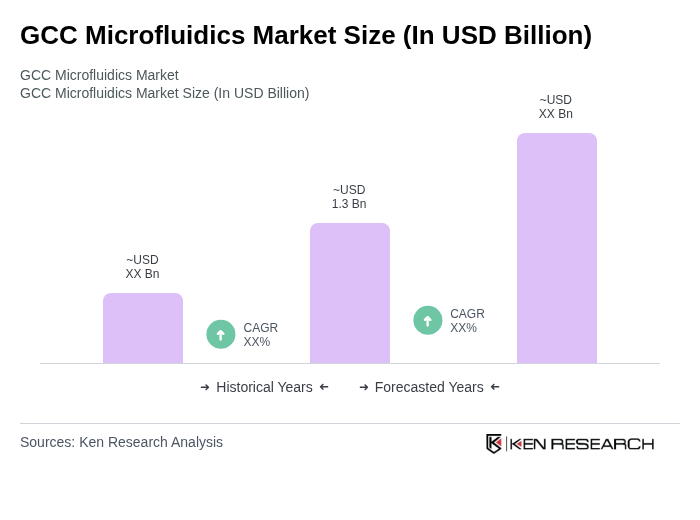
- The GCC Microfluidics Market is valued at USD 1.3 billion, based on a five-year historical analysis and regional share of the global microfluidics industry. This growth is primarily driven by advancements in healthcare technology, increasing demand for point-of-care testing, and the rising prevalence of chronic diseases in Gulf countries, where non-communicable diseases account for a substantial share of morbidity and mortality. The integration of microfluidics in diagnostics (including lab-on-a-chip platforms, molecular diagnostics, and POC analyzers) and drug delivery systems has significantly contributed to the market's expansion, as it offers enhanced precision, lower sample and reagent consumption, and higher throughput in medical applications.
- Key players in this market include Saudi Arabia and the United Arab Emirates, which dominate due to their robust healthcare infrastructure, significant investments in research and development, and a growing focus on personalized medicine and precision diagnostics. The presence of leading pharmaceutical, biotechnology, and diagnostics companies, combined with national initiatives to build genomics and precision medicine programs, further strengthens their position in the microfluidics market, fostering innovation and collaboration across hospitals, reference laboratories, and academic research centers.
- In the GCC region, regulations relevant to microfluidic medical devices are primarily governed through medical device and IVD frameworks, such as the Medical Devices Interim Regulation issued by the Saudi Food and Drug Authority (SFDA) in 2010 and its implementing rules and guidance for in vitro diagnostic medical devices, which set requirements for classification, marketing authorization, quality management systems, and post-market surveillance. At a regional level, the Gulf Health Council’s Unified Guide for Medical Devices provides harmonized technical documentation, safety, and performance requirements for medical devices marketed in GCC member states, covering technologies including microfluidic-based diagnostic systems. In addition to these regulatory instruments, several GCC governments have launched targeted health and life-science R&D and innovation funding programs (for example, Saudi Arabia’s Vision 2030 healthcare transformation initiatives and the UAE’s national innovation and advanced technology strategies) that collectively allocate several hundred million USD-equivalent to support medical technology R&D, localization of manufacturing, and digital diagnostics, indirectly promoting the development and adoption of microfluidic technologies in healthcare.
GCC Microfluidics Market Segmentation
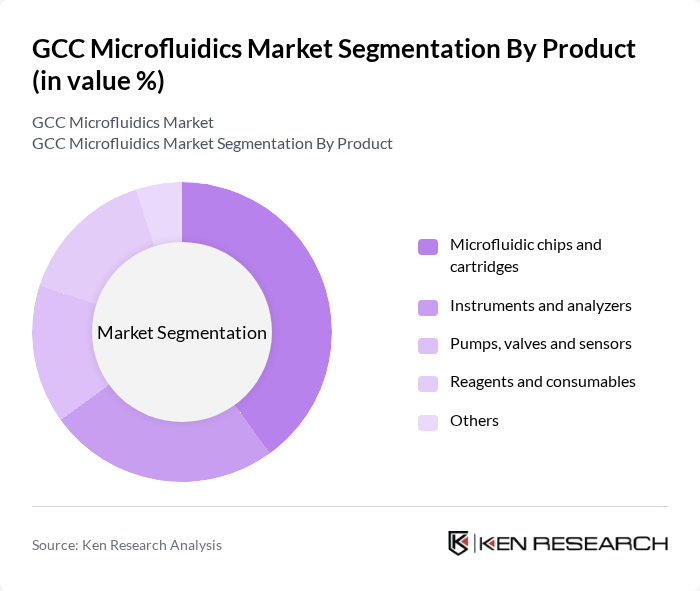
By Product:The product segmentation of the market includes microfluidic chips and cartridges, instruments and analyzers, pumps, valves and sensors, reagents and consumables, and others. Among these, microfluidic chips and cartridges are leading the market due to their essential role in diagnostics and point-of-care testing. The increasing demand for rapid and accurate testing solutions in healthcare drives the growth of this subsegment, as healthcare providers seek to enhance patient outcomes through efficient diagnostic tools.
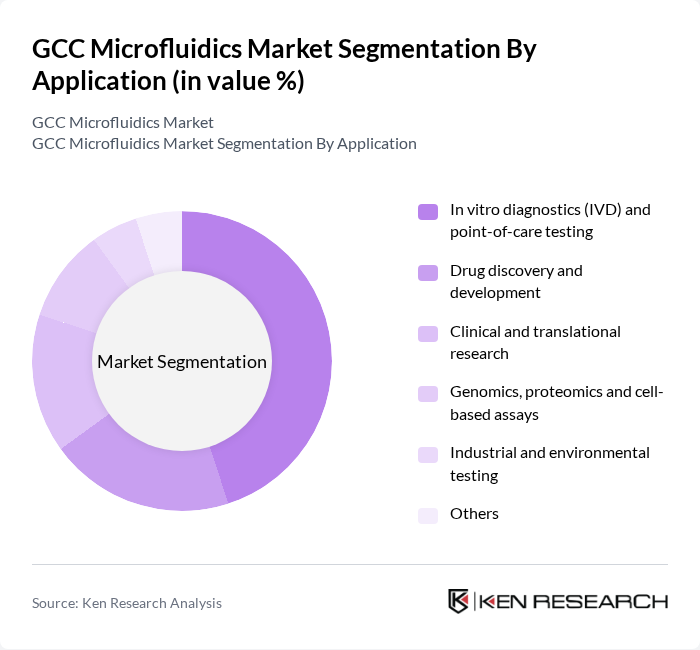
By Application:The application segmentation includes in vitro diagnostics (IVD) and point-of-care testing, drug discovery and development, clinical and translational research, genomics, proteomics and cell-based assays, industrial and environmental testing, and others. The in vitro diagnostics and point-of-care testing segment is the most significant, driven by the increasing need for rapid diagnostic solutions in clinical settings. The growing prevalence of infectious diseases and the demand for personalized medicine further bolster this segment's growth, as healthcare providers prioritize timely and accurate testing.
GCC Microfluidics Market Competitive Landscape
The GCC Microfluidics Market is characterized by a dynamic mix of regional and international players. Leading participants such as Thermo Fisher Scientific Inc., Agilent Technologies Inc., Bio-Rad Laboratories Inc., Revvity Inc. (PerkinElmer), Illumina Inc., Merck KGaA (MilliporeSigma), F. Hoffmann-La Roche Ltd, Becton, Dickinson and Company, QIAGEN N.V., 10x Genomics Inc., Micronit Microtechnologies B.V. (Micronit Microfluidics), Cellix Ltd, Elveflow (Elvesys Group), Blacktrace Holdings Ltd, Dolomite Microfluidics contribute to innovation, geographic expansion, and service delivery in this space.
GCC Microfluidics Market Industry Analysis
Growth Drivers
- Increasing Demand for Point-of-Care Testing:The GCC region has witnessed a significant rise in the demand for point-of-care testing (POCT), driven by the need for rapid diagnostic solutions. In future, the market for POCT is projected to reach approximately $1.8 billion, reflecting a growing preference for decentralized healthcare. This shift is largely attributed to the increasing incidence of infectious diseases, which necessitate immediate testing and treatment, thereby propelling the microfluidics market forward.
- Advancements in Microfluidic Technologies:Continuous innovations in microfluidic technologies are enhancing the capabilities of diagnostic devices. In future, investments in R&D for microfluidics are expected to exceed $600 million in the GCC, focusing on improving device sensitivity and integration with digital health platforms. These advancements are crucial for developing more efficient, cost-effective solutions that cater to the evolving needs of healthcare providers and patients alike.
- Rising Prevalence of Chronic Diseases:The GCC region is experiencing a surge in chronic diseases, with diabetes and cardiovascular conditions affecting over 35% of the adult population. This alarming trend is expected to drive the microfluidics market, as healthcare systems seek innovative diagnostic tools to manage these diseases effectively. By future, the demand for microfluidic devices in chronic disease management is anticipated to grow, reflecting the urgent need for early detection and monitoring solutions.
Market Challenges
- High Initial Investment Costs:One of the significant barriers to the growth of the microfluidics market in the GCC is the high initial investment required for technology development and manufacturing. Companies often face costs exceeding $1.5 million for setting up production facilities and acquiring advanced equipment. This financial burden can deter new entrants and limit the expansion of existing players, hindering overall market growth in the region.
- Regulatory Hurdles and Compliance Issues:Navigating the regulatory landscape poses a considerable challenge for microfluidics manufacturers in the GCC. Compliance with stringent regulations can lead to delays in product approvals, with timelines extending up to 30 months. This uncertainty can stifle innovation and deter investment, as companies may hesitate to commit resources without clear pathways to market entry and acceptance.
GCC Microfluidics Market Future Outlook
The future of the microfluidics market in the GCC appears promising, driven by technological advancements and increasing healthcare demands. As the region invests in healthcare infrastructure, the integration of AI and machine learning into microfluidic devices is expected to enhance diagnostic accuracy and efficiency. Furthermore, the shift towards personalized medicine will likely create new avenues for growth, as tailored healthcare solutions become more prevalent in the region's medical landscape.
Market Opportunities
- Expansion of Research and Development Activities:The GCC is prioritizing R&D in healthcare technologies, with government funding projected to reach $250 million in future. This investment will foster innovation in microfluidics, enabling the development of cutting-edge diagnostic tools that meet local healthcare needs and enhance patient outcomes.
- Collaborations with Academic Institutions:Partnerships between microfluidics companies and academic institutions are on the rise, with over 20 collaborative projects initiated in future. These collaborations aim to leverage academic research to accelerate product development, ensuring that new technologies are aligned with clinical requirements and market demands.
Scope of the Report
| Segment | Sub-Segments |
|---|---|
| By Product | Microfluidic chips and cartridges Instruments and analyzers Pumps, valves and sensors Reagents and consumables Others |
| By Application | In vitro diagnostics (IVD) and point-of-care testing Drug discovery and development Clinical and translational research Genomics, proteomics and cell-based assays Industrial and environmental testing Others |
| By End-User | Hospitals and diagnostic centers Pharmaceutical and biotechnology companies Academic and research institutions Contract research organizations (CROs) Others |
| By Material | Polymers (including PDMS) Glass Silicon Others |
| By Technology | Lab-on-a-chip Organ-on-chip Continuous flow microfluidics Droplet-based microfluidics Others |
| By Country | Saudi Arabia United Arab Emirates Qatar Kuwait Oman Bahrain |
Key Target Audience
Investors and Venture Capitalist Firms
Government and Regulatory Bodies (e.g., Gulf Cooperation Council, Saudi Food and Drug Authority, Ministry of Health and Prevention - UAE)
Manufacturers and Producers
Distributors and Retailers
Healthcare Providers and Hospitals
Biotechnology and Pharmaceutical Companies
Medical Device Companies
Industry Associations and Trade Organizations
Players Mentioned in the Report:
Thermo Fisher Scientific Inc.
Agilent Technologies Inc.
Bio-Rad Laboratories Inc.
Revvity Inc. (PerkinElmer)
Illumina Inc.
Merck KGaA (MilliporeSigma)
F. Hoffmann-La Roche Ltd
Becton, Dickinson and Company
QIAGEN N.V.
10x Genomics Inc.
Micronit Microtechnologies B.V. (Micronit Microfluidics)
Cellix Ltd
Elveflow (Elvesys Group)
Blacktrace Holdings Ltd
Dolomite Microfluidics
Table of Contents
Market Assessment Phase
1. Executive Summary and Approach
2. GCC Microfluidics Market Overview
2.1 Key Insights and Strategic Recommendations
2.2 GCC Microfluidics Market Overview
2.3 Definition and Scope
2.4 Evolution of Market Ecosystem
2.5 Timeline of Key Regulatory Milestones
2.6 Value Chain & Stakeholder Mapping
2.7 Business Cycle Analysis
2.8 Policy & Incentive Landscape
3. GCC Microfluidics Market Analysis
3.1 Growth Drivers
3.1.1 Increasing demand for point-of-care testing
3.1.2 Advancements in microfluidic technologies
3.1.3 Rising prevalence of chronic diseases
3.1.4 Government initiatives to promote healthcare innovation
3.2 Market Challenges
3.2.1 High initial investment costs
3.2.2 Regulatory hurdles and compliance issues
3.2.3 Limited awareness among end-users
3.2.4 Technical complexities in product development
3.3 Market Opportunities
3.3.1 Expansion of research and development activities
3.3.2 Collaborations with academic institutions
3.3.3 Growth in the biotechnology sector
3.3.4 Increasing investments in healthcare infrastructure
3.4 Market Trends
3.4.1 Integration of AI and machine learning in microfluidics
3.4.2 Shift towards personalized medicine
3.4.3 Development of portable microfluidic devices
3.4.4 Focus on sustainable and eco-friendly materials
3.5 Government Regulation
3.5.1 Stricter quality control standards
3.5.2 Incentives for R&D in healthcare technologies
3.5.3 Guidelines for clinical trials and product approvals
3.5.4 Policies promoting local manufacturing of medical devices
4. SWOT Analysis
5. Stakeholder Analysis
6. Porter's Five Forces Analysis
7. GCC Microfluidics Market Market Size, 2019-2024
7.1 By Value
7.2 By Volume
7.3 By Average Selling Price
8. GCC Microfluidics Market Segmentation
8.1 By Product
8.1.1 Microfluidic chips and cartridges
8.1.2 Instruments and analyzers
8.1.3 Pumps, valves and sensors
8.1.4 Reagents and consumables
8.1.5 Others
8.2 By Application
8.2.1 In vitro diagnostics (IVD) and point-of-care testing
8.2.2 Drug discovery and development
8.2.3 Clinical and translational research
8.2.4 Genomics, proteomics and cell-based assays
8.2.5 Industrial and environmental testing
8.2.6 Others
8.3 By End-User
8.3.1 Hospitals and diagnostic centers
8.3.2 Pharmaceutical and biotechnology companies
8.3.3 Academic and research institutions
8.3.4 Contract research organizations (CROs)
8.3.5 Others
8.4 By Material
8.4.1 Polymers (including PDMS)
8.4.2 Glass
8.4.3 Silicon
8.4.4 Others
8.5 By Technology
8.5.1 Lab-on-a-chip
8.5.2 Organ-on-chip
8.5.3 Continuous flow microfluidics
8.5.4 Droplet-based microfluidics
8.5.5 Others
8.6 By Country
8.6.1 Saudi Arabia
8.6.2 United Arab Emirates
8.6.3 Qatar
8.6.4 Kuwait
8.6.5 Oman
8.6.6 Bahrain
9. GCC Microfluidics Market Competitive Analysis
9.1 Market Share of Key Players
9.2 Cross Comparison of Key Players
9.2.1 Company Name
9.2.2 Group Size (Large, Medium, or Small as per industry convention)
9.2.3 GCC microfluidics revenue (USD million)
9.2.4 3-year revenue CAGR in GCC microfluidics
9.2.5 GCC market share (%)
9.2.6 R&D intensity (% of revenue)
9.2.7 Number of GCC-focused microfluidic SKUs / product lines
9.2.8 Average selling price per device / cartridge (USD)
9.2.9 Installed base in GCC (number of systems)
9.2.10 Key GCC reference accounts (hospitals, labs, pharma)
9.2.11 Gross margin (%) on GCC microfluidics portfolio
9.2.12 Pipeline strength (number of products in development / regulatory)
9.3 SWOT Analysis of Top Players
9.4 Pricing Analysis
9.5 Detailed Profile of Major Companies
9.5.1 Thermo Fisher Scientific Inc.
9.5.2 Agilent Technologies Inc.
9.5.3 Bio-Rad Laboratories Inc.
9.5.4 Revvity Inc. (PerkinElmer)
9.5.5 Illumina Inc.
9.5.6 Merck KGaA (MilliporeSigma)
9.5.7 F. Hoffmann-La Roche Ltd
9.5.8 Becton, Dickinson and Company
9.5.9 QIAGEN N.V.
9.5.10 10x Genomics Inc.
9.5.11 Micronit Microtechnologies B.V. (Micronit Microfluidics)
9.5.12 Cellix Ltd
9.5.13 Elveflow (Elvesys Group)
9.5.14 Blacktrace Holdings Ltd
9.5.15 Dolomite Microfluidics
10. GCC Microfluidics Market End-User Analysis
10.1 Procurement Behavior of Key Ministries
10.1.1 Budget allocation trends
10.1.2 Decision-making processes
10.1.3 Preferred procurement methods
10.1.4 Key evaluation criteria
10.2 Corporate Spend on Infrastructure & Energy
10.2.1 Investment priorities
10.2.2 Spending patterns
10.2.3 Impact of economic conditions
10.2.4 Future spending forecasts
10.3 Pain Point Analysis by End-User Category
10.3.1 Challenges faced by healthcare providers
10.3.2 Issues in research and development
10.3.3 Barriers for pharmaceutical companies
10.3.4 Others
10.4 User Readiness for Adoption
10.4.1 Awareness levels
10.4.2 Training and support needs
10.4.3 Infrastructure readiness
10.4.4 Others
10.5 Post-Deployment ROI and Use Case Expansion
10.5.1 Measurement of success
10.5.2 Case studies of successful implementations
10.5.3 Future use case opportunities
10.5.4 Others
11. GCC Microfluidics Market Future Size, 2025-2030
11.1 By Value
11.2 By Volume
11.3 By Average Selling Price
Go-To-Market Strategy Phase
1. Whitespace Analysis + Business Model Canvas
1.1 Market gaps identification
1.2 Value proposition development
1.3 Revenue model exploration
1.4 Customer segmentation analysis
1.5 Competitive landscape overview
1.6 Key partnerships identification
1.7 Risk assessment
2. Marketing and Positioning Recommendations
2.1 Branding strategies
2.2 Product USPs
2.3 Target audience definition
2.4 Communication channels
2.5 Marketing budget allocation
2.6 Performance metrics
2.7 Feedback mechanisms
3. Distribution Plan
3.1 Urban retail strategies
3.2 Rural NGO tie-ups
3.3 Online distribution channels
3.4 Logistics and supply chain management
3.5 Partnership with distributors
3.6 Inventory management
3.7 Customer service strategies
4. Channel & Pricing Gaps
4.1 Underserved routes
4.2 Pricing bands analysis
4.3 Competitor pricing strategies
4.4 Customer willingness to pay
4.5 Price elasticity of demand
4.6 Discount strategies
4.7 Bundling opportunities
5. Unmet Demand & Latent Needs
5.1 Category gaps
5.2 Consumer segments analysis
5.3 Emerging trends identification
5.4 Product development opportunities
5.5 Market entry barriers
5.6 Customer feedback analysis
5.7 Future demand forecasting
6. Customer Relationship
6.1 Loyalty programs
6.2 After-sales service
6.3 Customer engagement strategies
6.4 Feedback collection methods
6.5 Relationship management tools
6.6 Customer education initiatives
6.7 Community building efforts
7. Value Proposition
7.1 Sustainability initiatives
7.2 Integrated supply chains
7.3 Unique selling points
7.4 Customer-centric approach
7.5 Competitive advantages
7.6 Value delivery mechanisms
7.7 Long-term vision alignment
8. Key Activities
8.1 Regulatory compliance
8.2 Branding efforts
8.3 Distribution setup
8.4 Market research activities
8.5 Training and development
8.6 Performance monitoring
8.7 Stakeholder engagement
9. Entry Strategy Evaluation
9.1 Domestic Market Entry Strategy
9.1.1 Product mix considerations
9.1.2 Pricing band analysis
9.1.3 Packaging strategies
9.2 Export Entry Strategy
9.2.1 Target countries identification
9.2.2 Compliance roadmap development
10. Entry Mode Assessment
10.1 Joint Ventures
10.2 Greenfield investments
10.3 Mergers & Acquisitions
10.4 Distributor Model
10.5 Risk assessment
10.6 Market entry timelines
10.7 Success factors
11. Capital and Timeline Estimation
11.1 Capital requirements
11.2 Timelines for market entry
11.3 Financial projections
11.4 Funding sources
11.5 Cost management strategies
11.6 Investment return expectations
11.7 Milestone tracking
12. Control vs Risk Trade-Off
12.1 Ownership considerations
12.2 Partnership dynamics
12.3 Risk management strategies
12.4 Control mechanisms
12.5 Long-term implications
12.6 Flexibility in operations
12.7 Exit strategies
13. Profitability Outlook
13.1 Breakeven analysis
13.2 Long-term sustainability
13.3 Profit margin expectations
13.4 Revenue growth projections
13.5 Cost structure analysis
13.6 Financial health indicators
13.7 Market share growth
14. Potential Partner List
14.1 Distributors
14.2 Joint Ventures
14.3 Acquisition targets
14.4 Strategic alliances
14.5 Collaboration opportunities
14.6 Partnership evaluation criteria
14.7 Risk assessment of partnerships
15. Execution Roadmap
15.1 Phased Plan for Market Entry
15.1.1 Market Setup
15.1.2 Market Entry
15.1.3 Growth Acceleration
15.1.4 Scale & Stabilize
15.2 Key Activities and Milestones
15.2.1 Timeline for key activities
15.2.2 Milestone tracking
15.2.3 Performance evaluation
15.2.4 Resource allocation
Research Methodology
Phase 1: Approach1
Desk Research
- Industry reports from regional microfluidics associations and trade organizations
- Market analysis publications focusing on the GCC healthcare and biotechnology sectors
- Government publications and white papers on microfluidics technology adoption in the GCC
Primary Research
- Interviews with R&D heads at leading microfluidics companies in the GCC
- Surveys with laboratory managers in hospitals and research institutions
- Field interviews with regulatory experts on microfluidics compliance and standards
Validation & Triangulation
- Cross-validation of findings through multiple data sources including trade publications and expert opinions
- Triangulation of market data with insights from industry conferences and seminars
- Sanity checks through feedback from a panel of microfluidics experts and stakeholders
Phase 2: Market Size Estimation1
Top-down Assessment
- Analysis of the overall healthcare expenditure in the GCC and its allocation to microfluidics
- Segmentation of the market by application areas such as diagnostics, drug delivery, and research
- Incorporation of growth trends in biotechnology and personalized medicine impacting microfluidics
Bottom-up Modeling
- Estimation of market size based on unit sales data from key microfluidics manufacturers
- Cost analysis of microfluidics devices and consumables across different applications
- Volume projections based on laboratory usage rates and healthcare demand forecasts
Forecasting & Scenario Analysis
- Multi-variable forecasting using trends in healthcare innovation and regulatory changes
- Scenario analysis based on potential market disruptions and technological advancements
- Development of baseline, optimistic, and pessimistic market growth projections through 2030
Phase 3: CATI Sample Composition1
| Scope Item/Segment | Sample Size | Target Respondent Profiles |
|---|---|---|
| Healthcare Diagnostics | 120 | Laboratory Managers, Clinical Researchers |
| Drug Delivery Systems | 90 | Pharmaceutical R&D Directors, Product Managers |
| Biotechnology Research Applications | 80 | Biotech Researchers, Lab Technicians |
| Microfluidics Device Manufacturing | 70 | Manufacturing Engineers, Quality Assurance Managers |
| Regulatory Compliance in Microfluidics | 60 | Regulatory Affairs Specialists, Compliance Officers |
Frequently Asked Questions
What is the current value of the GCC Microfluidics Market?
The GCC Microfluidics Market is valued at approximately USD 1.3 billion, driven by advancements in healthcare technology, increasing demand for point-of-care testing, and the rising prevalence of chronic diseases in the region.
What factors are driving the growth of the GCC Microfluidics Market?
Which countries are leading in the GCC Microfluidics Market?
What are the main applications of microfluidics in the GCC region?
Other Regional/Country Reports
Other Adjacent Reports
Indonesia Point-of-Care Testing Market
Global In Vitro Diagnostics Market Size, Share & Forecast, By Product Type, Technology & End User, 2026-2031Philippines Molecular Diagnostics Market Size Share Growth Drivers Trends Opportunities & Forecast 2025–2030KSA Lab-on-a-Chip Market
Kuwait Drug Delivery Systems Market
Bahrain Genomics Market Report Size Share Growth Drivers Trends Opportunities & Forecast 2025–2030Qatar proteomics market size, share, growth drivers, trends, opportunities & forecast 2025–2030Saudi Arabia biotechnology market Size, Share, Growth Drivers, Trends, Opportunities & Forecast 2025–2030Oman Medical Devices Market Size, Share & Forecast, By Product Type, Care Setting & End User, 2025-2032UAE Precision Medicine MarketWhy Buy From Us?

What makes us stand out is that our consultants follow Robust, Refine and Result (RRR) methodology. Robust for clear definitions, approaches and sanity checking, Refine for differentiating respondents' facts and opinions, and Result for presenting data with story.

We have set a benchmark in the industry by offering our clients with syndicated and customized market research reports featuring coverage of entire market as well as meticulous research and analyst insights.

While we don't replace traditional research, we flip the method upside down. Our dual approach of Top Bottom & Bottom Top ensures quality deliverable by not just verifying company fundamentals but also looking at the sector and macroeconomic factors.

With one step in the future, our research team constantly tries to show you the bigger picture. We help with some of the tough questions you may encounter along the way: How is the industry positioned? Best marketing channel? KPI's of competitors? By aligning every element, we help maximize success.

Our report gives you instant access to the answers and sources that other companies might choose to hide. We elaborate each steps of research methodology we have used and showcase you the sample size to earn your trust.

If you need any support, we are here! We pride ourselves on universe strength, data quality, and quick, friendly, and professional service.