About the Report
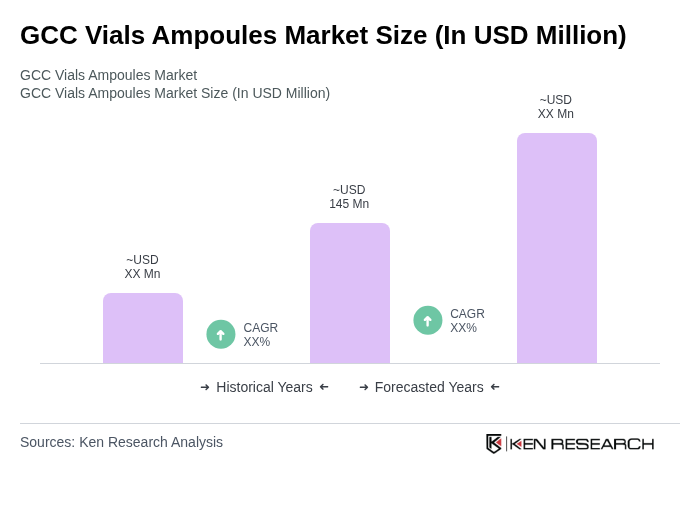
Base Year 2024GCC Vials Ampoules Market Overview
- The GCC Vials Ampoules Market is valued at USD 145 million, based on a five-year analysis. This growth is driven by surging demand for pharmaceuticals and biologics, as well as the increasing prevalence of chronic diseases requiring injectable therapies. The market is further supported by technological advancements in packaging that enhance the safety, integrity, and traceability of drug delivery systems, including tamper-evident features and improved barrier properties .
- Key players in this market include the UAE and Saudi Arabia, which lead due to their advanced pharmaceutical manufacturing capabilities and sustained investments in healthcare infrastructure. The presence of multinational pharmaceutical firms, expanding local production, and a strong focus on research and development further strengthen the market position of these countries within the GCC .
- The GCC governments have enacted binding quality and safety requirements for pharmaceutical packaging. For example, the “GCC Standardization Organization Technical Regulation for Pharmaceutical Packaging Materials (GSO 2468:2021)” mandates that all vials and ampoules used for pharmaceuticals comply with international standards such as ISO 8362 for glass containers and ISO 9187 for ampoules. This regulation, issued by the GCC Standardization Organization, requires manufacturers to ensure material compatibility, sterility, and traceability, thereby reinforcing consumer trust and product reliability in the market.
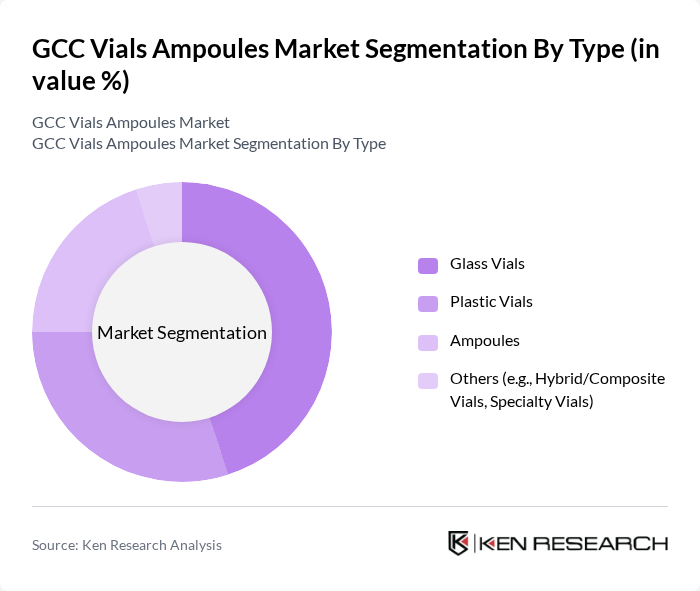
GCC Vials Ampoules Market Segmentation
By Type:The market is segmented into Glass Vials, Plastic Vials, Ampoules, and Others (e.g., Hybrid/Composite Vials, Specialty Vials). Glass Vials remain the preferred choice due to their superior chemical resistance, inertness, and compatibility with a broad spectrum of pharmaceuticals, especially injectables and biologics. Plastic Vials are increasingly adopted for their lightweight, break-resistant properties and suitability for oral and diagnostic applications. Ampoules are widely used for single-dose, sterile medications, minimizing contamination risks. The Others category includes hybrid and specialty vials designed for advanced drug formulations and customized delivery requirements .
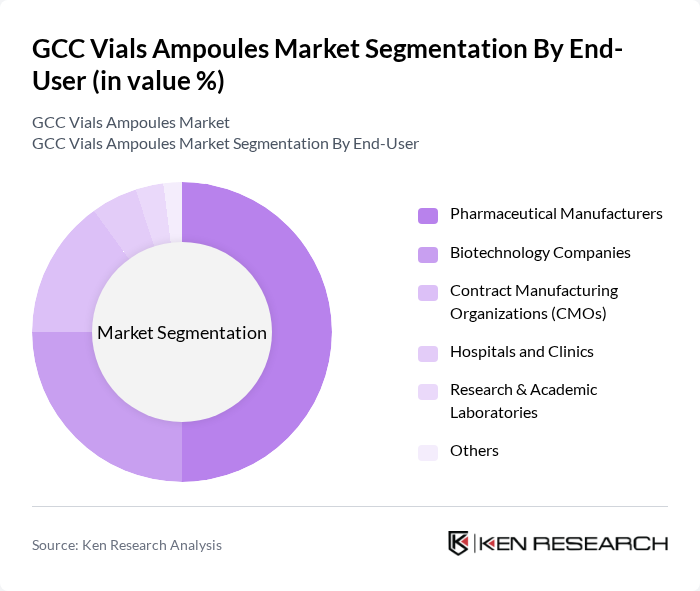
By End-User:The market is segmented by end-users, including Pharmaceutical Manufacturers, Biotechnology Companies, Contract Manufacturing Organizations (CMOs), Hospitals and Clinics, Research & Academic Laboratories, and Others. Pharmaceutical Manufacturers constitute the largest segment, reflecting the region’s focus on expanding injectable and vaccine production. Biotechnology Companies are rapidly growing due to the increasing adoption of biologics and biosimilars. CMOs are expanding their footprint to serve both multinational and regional pharmaceutical firms. Hospitals and Clinics, as well as Research & Academic Laboratories, represent essential demand centers for small-batch and specialty packaging .
GCC Vials Ampoules Market Competitive Landscape
The GCC Vials Ampoules Market is characterized by a dynamic mix of regional and international players. Leading participants such as Schott AG, Gerresheimer AG, Nipro Corporation, Becton, Dickinson and Company, West Pharmaceutical Services, Inc., ACG Worldwide, Ompi (Stevanato Group), SGD Pharma, Arabian Medical Products Manufacturing Company (Enayah), Alpla Group, Piramal Glass, Stölzle-Oberglas GmbH, Origin Pharma Packaging, Gulf Pharmaceutical Industries (Julphar), Majan Glass Company SAOG contribute to innovation, geographic expansion, and service delivery in this space.
GCC Vials Ampoules Market Industry Analysis
Growth Drivers
- Increasing Demand for Biologics and Pharmaceuticals:The GCC region has witnessed a significant rise in the demand for biologics and pharmaceuticals, driven by an aging population and increasing prevalence of chronic diseases. In future, the pharmaceutical market in the GCC is projected to reach approximately $30 billion, with biologics accounting for over 25% of this figure. This surge necessitates reliable packaging solutions like vials and ampoules, which ensure the integrity and efficacy of these sensitive products.
- Rising Healthcare Expenditure in GCC Countries:Healthcare expenditure in the GCC countries is expected to exceed $100 billion in future, reflecting a compound annual growth rate (CAGR) of 7% from previous years. This increase is primarily driven by government initiatives to enhance healthcare infrastructure and services. As healthcare spending rises, the demand for high-quality packaging solutions, such as vials and ampoules, is anticipated to grow, supporting the pharmaceutical supply chain's efficiency and safety.
- Technological Advancements in Packaging Solutions:The GCC market is experiencing rapid technological advancements in packaging solutions, with investments in smart packaging technologies projected to reach $1.5 billion by future. Innovations such as tamper-evident seals and integrated tracking systems enhance product safety and traceability. These advancements not only improve the user experience but also align with regulatory requirements, driving the demand for advanced vials and ampoules in the pharmaceutical sector.
Market Challenges
- Stringent Regulatory Requirements:The GCC region faces stringent regulatory requirements for pharmaceutical packaging, which can pose significant challenges for manufacturers. Compliance with the Gulf Cooperation Council (GCC) health authority standards requires extensive documentation and quality assurance processes. In future, the cost of compliance is expected to rise, with companies spending an estimated $500 million collectively to meet these regulations, impacting overall profitability and operational efficiency.
- High Production Costs:The production costs for vials and ampoules in the GCC are notably high, primarily due to the need for advanced materials and technologies. In future, the average production cost per unit is projected to be around $0.50, influenced by rising raw material prices and labor costs. This financial burden can limit the competitiveness of local manufacturers against cheaper alternatives from global suppliers, posing a challenge to market growth.
GCC Vials Ampoules Market Future Outlook
The future of the GCC vials and ampoules market appears promising, driven by ongoing advancements in healthcare and packaging technologies. As the pharmaceutical industry continues to expand, the demand for innovative and sustainable packaging solutions is expected to rise. Additionally, the integration of smart technologies in packaging will enhance product safety and consumer engagement. Companies that adapt to these trends will likely capture significant market share, positioning themselves favorably in a competitive landscape.
Market Opportunities
- Expansion of the Pharmaceutical Industry in GCC:The pharmaceutical industry in the GCC is set to expand significantly, with an expected growth rate of 8% annually. This growth presents opportunities for packaging manufacturers to develop tailored solutions that meet the specific needs of new drug formulations, particularly in biologics and specialty pharmaceuticals, enhancing their market presence.
- Increasing Adoption of Sustainable Packaging:There is a growing trend towards sustainable packaging solutions in the GCC, with an estimated market value of $2 billion by future. Companies that invest in eco-friendly materials and practices will not only meet regulatory demands but also appeal to environmentally conscious consumers, creating a competitive advantage in the vials and ampoules market.
Scope of the Report
| Segment | Sub-Segments |
|---|---|
| By Type | Glass Vials Plastic Vials Ampoules Others (e.g., Hybrid/Composite Vials, Specialty Vials) |
| By End-User | Pharmaceutical Manufacturers Biotechnology Companies Contract Manufacturing Organizations (CMOs) Hospitals and Clinics Research & Academic Laboratories Others |
| By Material | Borosilicate Glass Type I Glass Polypropylene (PP) Polyethylene (PE) Others |
| By Capacity | Less than 5ml ml to 10ml More than 10ml Others |
| By Application | Vaccines Injectable Drugs Diagnostic Agents Biologics Others |
| By Distribution Channel | Direct Sales Distributors/Wholesalers Online Sales Others |
| By Region | UAE Saudi Arabia Qatar Kuwait Oman Bahrain Others |
Key Target Audience
Investors and Venture Capitalist Firms
Government and Regulatory Bodies (e.g., Gulf Cooperation Council, Saudi Food and Drug Authority, UAE Ministry of Health and Prevention)
Manufacturers and Producers
Distributors and Retailers
Pharmaceutical Companies
Biotechnology Firms
Healthcare Providers and Hospitals
Logistics and Supply Chain Companies
Players Mentioned in the Report:
Schott AG
Gerresheimer AG
Nipro Corporation
Becton, Dickinson and Company
West Pharmaceutical Services, Inc.
ACG Worldwide
Ompi (Stevanato Group)
SGD Pharma
Arabian Medical Products Manufacturing Company (Enayah)
Alpla Group
Piramal Glass
Stolzle-Oberglas GmbH
Origin Pharma Packaging
Gulf Pharmaceutical Industries (Julphar)
Majan Glass Company SAOG
Table of Contents
Market Assessment Phase
1. Executive Summary and Approach
2. GCC Vials Ampoules Market Overview
2.1 Key Insights and Strategic Recommendations
2.2 GCC Vials Ampoules Market Overview
2.3 Definition and Scope
2.4 Evolution of Market Ecosystem
2.5 Timeline of Key Regulatory Milestones
2.6 Value Chain & Stakeholder Mapping
2.7 Business Cycle Analysis
2.8 Policy & Incentive Landscape
3. GCC Vials Ampoules Market Analysis
3.1 Growth Drivers
3.1.1 Increasing demand for biologics and pharmaceuticals
3.1.2 Rising healthcare expenditure in GCC countries
3.1.3 Technological advancements in packaging solutions
3.1.4 Growing focus on safety and sterility in drug delivery
3.2 Market Challenges
3.2.1 Stringent regulatory requirements
3.2.2 High production costs
3.2.3 Competition from alternative packaging solutions
3.2.4 Supply chain disruptions
3.3 Market Opportunities
3.3.1 Expansion of the pharmaceutical industry in GCC
3.3.2 Increasing adoption of sustainable packaging
3.3.3 Growth in the biopharmaceutical sector
3.3.4 Emerging markets within the GCC region
3.4 Market Trends
3.4.1 Shift towards eco-friendly packaging materials
3.4.2 Rise in demand for pre-filled syringes and vials
3.4.3 Integration of smart packaging technologies
3.4.4 Increasing focus on personalized medicine
3.5 Government Regulation
3.5.1 Compliance with GCC health authority standards
3.5.2 Regulations on packaging materials
3.5.3 Guidelines for sterile manufacturing processes
3.5.4 Import/export regulations for pharmaceutical products
4. SWOT Analysis
5. Stakeholder Analysis
6. Porter's Five Forces Analysis
7. GCC Vials Ampoules Market Market Size, 2019-2024
7.1 By Value
7.2 By Volume
7.3 By Average Selling Price
8. GCC Vials Ampoules Market Segmentation
8.1 By Type
8.1.1 Glass Vials
8.1.2 Plastic Vials
8.1.3 Ampoules
8.1.4 Others (e.g., Hybrid/Composite Vials, Specialty Vials)
8.2 By End-User
8.2.1 Pharmaceutical Manufacturers
8.2.2 Biotechnology Companies
8.2.3 Contract Manufacturing Organizations (CMOs)
8.2.4 Hospitals and Clinics
8.2.5 Research & Academic Laboratories
8.2.6 Others
8.3 By Material
8.3.1 Borosilicate Glass
8.3.2 Type I Glass
8.3.3 Polypropylene (PP)
8.3.4 Polyethylene (PE)
8.3.5 Others
8.4 By Capacity
8.4.1 Less than 5ml
8.4.2 5ml to 10ml
8.4.3 More than 10ml
8.4.4 Others
8.5 By Application
8.5.1 Vaccines
8.5.2 Injectable Drugs
8.5.3 Diagnostic Agents
8.5.4 Biologics
8.5.5 Others
8.6 By Distribution Channel
8.6.1 Direct Sales
8.6.2 Distributors/Wholesalers
8.6.3 Online Sales
8.6.4 Others
8.7 By Region
8.7.1 UAE
8.7.2 Saudi Arabia
8.7.3 Qatar
8.7.4 Kuwait
8.7.5 Oman
8.7.6 Bahrain
8.7.7 Others
9. GCC Vials Ampoules Market Competitive Analysis
9.1 Market Share of Key Players
9.2 Cross Comparison of Key Players
9.2.1 Company Name
9.2.2 Group Size (Large, Medium, or Small as per industry convention)
9.2.3 Regional Production Capacity (million units/year)
9.2.4 Revenue Growth Rate (CAGR %)
9.2.5 Market Penetration (Number of GCC Countries Served)
9.2.6 Key End-User Segments Served
9.2.7 Product Portfolio Breadth (Vials, Ampoules, Materials)
9.2.8 Quality Certifications (e.g., ISO 15378, cGMP)
9.2.9 Distribution Network Strength
9.2.10 Innovation Index (Patents, New Product Launches)
9.3 SWOT Analysis of Top Players
9.4 Pricing Analysis
9.5 Detailed Profile of Major Companies
9.5.1 Schott AG
9.5.2 Gerresheimer AG
9.5.3 Nipro Corporation
9.5.4 Becton, Dickinson and Company
9.5.5 West Pharmaceutical Services, Inc.
9.5.6 ACG Worldwide
9.5.7 Ompi (Stevanato Group)
9.5.8 SGD Pharma
9.5.9 Arabian Medical Products Manufacturing Company (Enayah)
9.5.10 Alpla Group
9.5.11 Piramal Glass
9.5.12 Stölzle-Oberglas GmbH
9.5.13 Origin Pharma Packaging
9.5.14 Gulf Pharmaceutical Industries (Julphar)
9.5.15 Majan Glass Company SAOG
10. GCC Vials Ampoules Market End-User Analysis
10.1 Procurement Behavior of Key Ministries
10.1.1 Budget Allocation Trends
10.1.2 Procurement Processes
10.1.3 Supplier Selection Criteria
10.1.4 Contract Management Practices
10.2 Corporate Spend on Infrastructure & Energy
10.2.1 Investment Trends in Healthcare Infrastructure
10.2.2 Spending on Pharmaceutical Supplies
10.2.3 Budgeting for R&D in Biopharmaceuticals
10.2.4 Others
10.3 Pain Point Analysis by End-User Category
10.3.1 Supply Chain Inefficiencies
10.3.2 Quality Assurance Challenges
10.3.3 Regulatory Compliance Issues
10.3.4 Others
10.4 User Readiness for Adoption
10.4.1 Awareness of New Technologies
10.4.2 Training and Support Needs
10.4.3 Financial Readiness
10.4.4 Others
10.5 Post-Deployment ROI and Use Case Expansion
10.5.1 Measurement of ROI
10.5.2 Case Studies of Successful Implementations
10.5.3 Future Use Case Opportunities
10.5.4 Others
11. GCC Vials Ampoules Market Future Size, 2025-2030
11.1 By Value
11.2 By Volume
11.3 By Average Selling Price
Go-To-Market Strategy Phase
1. Whitespace Analysis + Business Model Canvas
1.1 Market Gaps Identification
1.2 Value Proposition Development
1.3 Revenue Model Structuring
1.4 Key Partnerships Identification
1.5 Customer Segmentation Analysis
1.6 Competitive Landscape Overview
1.7 Risk Assessment
2. Marketing and Positioning Recommendations
2.1 Branding Strategies
2.2 Product USPs
2.3 Target Market Positioning
2.4 Communication Strategy
2.5 Digital Marketing Approach
2.6 Customer Engagement Tactics
2.7 Performance Metrics
3. Distribution Plan
3.1 Urban Retail Strategy
3.2 Rural NGO Tie-ups
3.3 E-commerce Integration
3.4 Logistics and Supply Chain Management
3.5 Distribution Partnerships
3.6 Inventory Management
3.7 Performance Tracking
4. Channel & Pricing Gaps
4.1 Underserved Routes
4.2 Pricing Bands Analysis
4.3 Competitor Pricing Comparison
4.4 Value-Based Pricing Strategies
4.5 Discount and Promotion Strategies
4.6 Price Sensitivity Analysis
4.7 Pricing Strategy Recommendations
5. Unmet Demand & Latent Needs
5.1 Category Gaps Identification
5.2 Consumer Segments Analysis
5.3 Product Development Opportunities
5.4 Market Entry Strategies
5.5 Customer Feedback Mechanisms
5.6 Future Trends Forecasting
5.7 Strategic Recommendations
6. Customer Relationship
6.1 Loyalty Programs
6.2 After-sales Service
6.3 Customer Feedback Loops
6.4 Relationship Management Strategies
6.5 Customer Retention Tactics
6.6 Engagement Metrics
6.7 Performance Evaluation
7. Value Proposition
7.1 Sustainability Initiatives
7.2 Integrated Supply Chains
7.3 Customer-Centric Innovations
7.4 Competitive Differentiation
7.5 Value Delivery Mechanisms
7.6 Market Positioning
7.7 Performance Metrics
8. Key Activities
8.1 Regulatory Compliance
8.2 Branding Initiatives
8.3 Distribution Setup
8.4 Marketing Campaigns
8.5 Training and Development
8.6 Performance Monitoring
8.7 Continuous Improvement Strategies
9. Entry Strategy Evaluation
9.1 Domestic Market Entry Strategy
9.1.1 Product Mix
9.1.2 Pricing Band
9.1.3 Packaging Considerations
9.1.4 Distribution Channels
9.1.5 Marketing Strategies
9.1.6 Regulatory Compliance
9.1.7 Risk Management
9.2 Export Entry Strategy
9.2.1 Target Countries
9.2.2 Compliance Roadmap
9.2.3 Market Research
9.2.4 Distribution Partnerships
9.2.5 Pricing Strategies
9.2.6 Marketing Approaches
9.2.7 Risk Assessment
10. Entry Mode Assessment
10.1 Joint Ventures
10.2 Greenfield Investments
10.3 Mergers & Acquisitions
10.4 Distributor Model
10.5 Risk Analysis
10.6 Strategic Fit Evaluation
10.7 Performance Metrics
11. Capital and Timeline Estimation
11.1 Capital Requirements
11.2 Timelines for Implementation
11.3 Financial Projections
11.4 Funding Sources
11.5 Risk Management Strategies
11.6 Performance Monitoring
12. Control vs Risk Trade-Off
12.1 Ownership vs Partnerships
12.2 Risk Assessment
12.3 Strategic Alignment
12.4 Performance Metrics
12.5 Decision-Making Framework
13. Profitability Outlook
13.1 Breakeven Analysis
13.2 Long-term Sustainability
13.3 Financial Health Metrics
13.4 Market Positioning
13.5 Strategic Recommendations
14. Potential Partner List
14.1 Distributors
14.2 Joint Ventures
14.3 Acquisition Targets
14.4 Strategic Alliances
14.5 Performance Metrics
15. Execution Roadmap
15.1 Phased Plan for Market Entry
15.1.1 Market Setup
15.1.2 Market Entry
15.1.3 Growth Acceleration
15.1.4 Scale & Stabilize
15.2 Key Activities and Milestones
15.2.1 Activity Planning</
Research Methodology
Phase 1: Approach1
Desk Research
- Analysis of industry reports from regional health authorities and pharmaceutical associations
- Review of market publications and white papers focusing on vials and ampoules
- Examination of trade statistics and import-export data from GCC customs authorities
Primary Research
- Interviews with key opinion leaders in the pharmaceutical and biotechnology sectors
- Surveys conducted with manufacturers and suppliers of vials and ampoules
- Field visits to production facilities to gather insights on operational practices
Validation & Triangulation
- Cross-validation of findings through multiple data sources including trade associations and government reports
- Triangulation of qualitative insights from interviews with quantitative data from surveys
- Sanity checks performed by consulting industry experts and stakeholders
Phase 2: Market Size Estimation1
Top-down Assessment
- Estimation of market size based on overall pharmaceutical market growth in the GCC region
- Segmentation analysis by product type (vials vs. ampoules) and end-user applications
- Incorporation of trends in healthcare spending and regulatory impacts on packaging
Bottom-up Modeling
- Collection of production volume data from leading manufacturers in the GCC
- Cost analysis based on material inputs and manufacturing processes for vials and ampoules
- Estimation of market share based on sales data from key players in the industry
Forecasting & Scenario Analysis
- Utilization of time-series analysis to project future demand based on historical data
- Scenario modeling based on potential changes in healthcare regulations and market dynamics
- Development of best-case, worst-case, and most-likely forecasts through 2030
Phase 3: CATI Sample Composition1
| Scope Item/Segment | Sample Size | Target Respondent Profiles |
|---|---|---|
| Pharmaceutical Manufacturers | 60 | Production Managers, Quality Assurance Heads |
| Healthcare Providers | 50 | Pharmacists, Hospital Procurement Officers |
| Regulatory Bodies | 40 | Regulatory Affairs Specialists, Compliance Officers |
| Packaging Suppliers | 40 | Sales Managers, Product Development Engineers |
| Research Institutions | 40 | Research Scientists, Lab Managers |
Frequently Asked Questions
What is the current value of the GCC Vials Ampoules Market?
The GCC Vials Ampoules Market is valued at approximately USD 145 million, reflecting significant growth driven by the rising demand for pharmaceuticals and biologics, as well as the increasing prevalence of chronic diseases requiring injectable therapies.
What factors are driving the growth of the GCC Vials Ampoules Market?
Which countries are leading in the GCC Vials Ampoules Market?
What are the regulatory requirements for pharmaceutical packaging in the GCC?
Other Regional/Country Reports
Indonesia Vials Ampoules Market
Malaysia Vials Ampoules Market
KSA Vials Ampoules Market
APAC Vials Ampoules Market
SEA Vials Ampoules Market
Vietnam Vials Ampoules Market
Other Adjacent Reports
Indonesia Biologics Packaging Market
KSA Injectable Drug Delivery Market
Qatar glass packaging market analysis size, share, growth drivers, trends, opportunities & forecast 2025–2030Bahrain Plastic Packaging Market Report Size Share Growth Drivers Trends Opportunities & Forecast 2025–2030Philippines Sterile Packaging Market
Kuwait vaccine packaging market report Size, Share, Growth Drivers, Trends, Opportunities & Forecast 2025–2030GCC prefilled syringes market report size, share, growth drivers, trends, opportunities & forecast 2025–2030Kuwait contract manufacturing market Size, Share, Growth Drivers, Trends, Opportunities & Forecast 2025–2030KSA sustainable packaging market report Size, Share, Growth Drivers, Trends, Opportunities & Forecast 2025–2030Why Buy From Us?

What makes us stand out is that our consultants follow Robust, Refine and Result (RRR) methodology. Robust for clear definitions, approaches and sanity checking, Refine for differentiating respondents' facts and opinions, and Result for presenting data with story.

We have set a benchmark in the industry by offering our clients with syndicated and customized market research reports featuring coverage of entire market as well as meticulous research and analyst insights.

While we don't replace traditional research, we flip the method upside down. Our dual approach of Top Bottom & Bottom Top ensures quality deliverable by not just verifying company fundamentals but also looking at the sector and macroeconomic factors.

With one step in the future, our research team constantly tries to show you the bigger picture. We help with some of the tough questions you may encounter along the way: How is the industry positioned? Best marketing channel? KPI's of competitors? By aligning every element, we help maximize success.

Our report gives you instant access to the answers and sources that other companies might choose to hide. We elaborate each steps of research methodology we have used and showcase you the sample size to earn your trust.

If you need any support, we are here! We pride ourselves on universe strength, data quality, and quick, friendly, and professional service.