About the Report
Base Year 2024Global Application Integration Market Overview
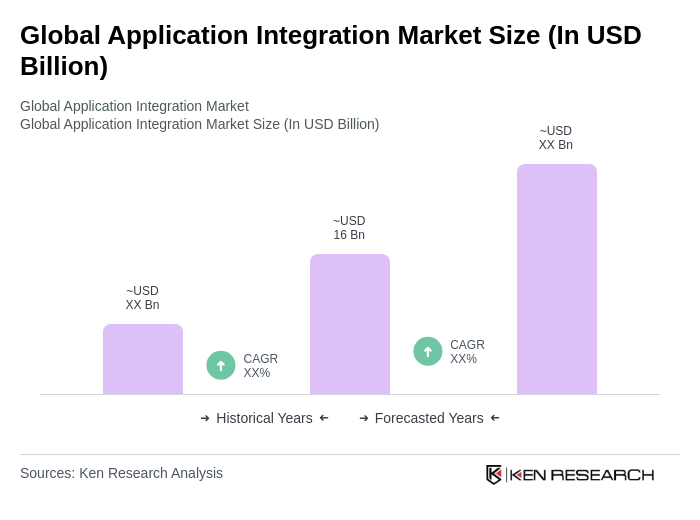
- The Global Application Integration Market is valued at USD 16 billion, based on a five-year historical analysis. This growth is primarily driven by the increasing need for businesses to streamline operations, enhance data sharing, and improve customer experiences through integrated applications. The rise of cloud computing and the demand for real-time data access have further propelled the market, as organizations seek to connect disparate systems and applications seamlessly. Recent trends include heightened investments in digital transformation, the proliferation of SaaS solutions, and the complexity of legacy IT landscapes, all of which are accelerating the adoption of advanced integration platforms that offer end-to-end visibility, process automation, and secure data exchange. The market is also seeing a shift toward API management, microservices architectures, and AI-driven integration, reflecting the evolving requirements of enterprises for agility and operational efficiency.
- Key players in this market include the United States, Germany, and the United Kingdom, which dominate due to their advanced technological infrastructure, high adoption rates of digital solutions, and significant investments in IT. North America alone accounted for nearly 40 percent of the global market revenue, underscoring its leadership position. The presence of major technology companies and a robust startup ecosystem in these regions also contribute to their prominence in the application integration space.
- In 2022, the European Union enacted Regulation (EU) 2022/2065, known as the Digital Services Act (DSA), which entered into application in 2024 for very large online platforms and search engines, and will apply to all in-scope entities from February 2024. The DSA imposes obligations on digital service providers to ensure transparency, accountability, and safety online, including requirements for interoperability and data portability. These provisions are designed to enhance consumer protection, promote fair competition, and encourage the adoption of integrated solutions that facilitate compliance with the new regulatory standards. The DSA is issued by the European Parliament and the Council of the European Union and applies to providers of intermediary services offering their services in the EU, regardless of their place of establishment.
Global Application Integration Market Segmentation
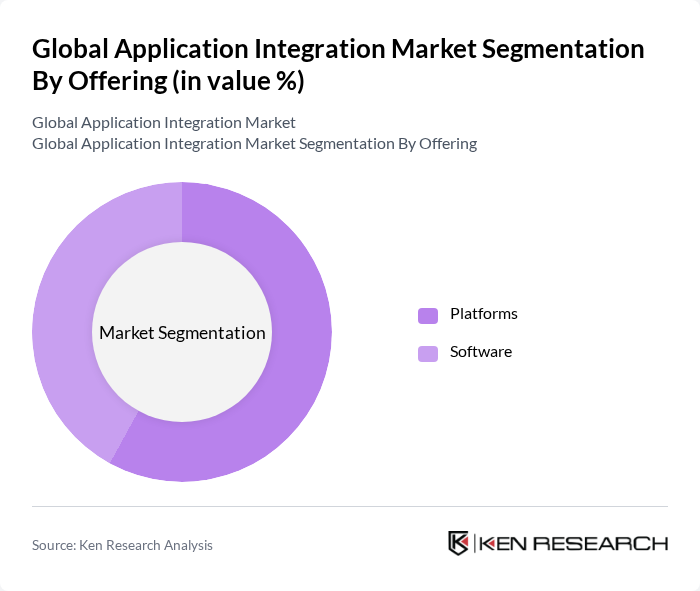
By Offering:The market is segmented into Platforms and Software. Platforms are increasingly favored due to their ability to provide comprehensive integration solutions that facilitate seamless connectivity between various applications. In 2023, platforms accounted for over 58 percent of global revenue, reflecting their role as the primary growth engine in the market. Software solutions, while essential, often serve as complementary tools to these platforms, enhancing their functionality and user experience.
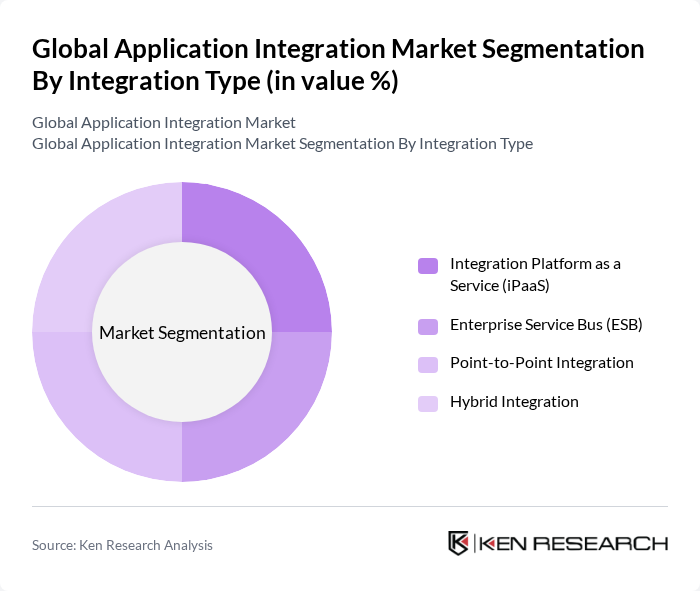
By Integration Type:The market is categorized into Integration Platform as a Service (iPaaS), Enterprise Service Bus (ESB), Point-to-Point Integration, and Hybrid Integration. iPaaS is leading the market due to its scalability and flexibility, allowing businesses to integrate applications across various environments efficiently. In 2023, the iPaaS segment accounted for the largest market revenue share, driven by the demand for cloud-native, scalable integration solutions. ESB and Point-to-Point Integration remain significant but are gradually being overshadowed by the growing preference for hybrid solutions that combine the strengths of multiple integration approaches.
Global Application Integration Market Competitive Landscape
The Global Application Integration Market is characterized by a dynamic mix of regional and international players. Leading participants such as MuleSoft, LLC (a Salesforce company), Dell Boomi, Inc. (a Dell Technologies company), IBM Corporation, Microsoft Corporation, Oracle Corporation, SAP SE, TIBCO Software Inc., Informatica LLC, SnapLogic, Inc., Jitterbit, Inc., Workato, Inc., Celigo, Inc., Talend S.A. (now part of Qlik), WSO2, Inc., Adeptia, Inc. contribute to innovation, geographic expansion, and service delivery in this space.
Global Application Integration Market Industry Analysis
Growth Drivers
- Increasing Demand for Cloud Integration:The global cloud computing market is projected to reach $1.6 trillion in future, driven by businesses seeking scalable solutions. This surge in cloud adoption necessitates robust application integration to ensure seamless data flow across platforms. According to the International Data Corporation (IDC), 70% of organizations are prioritizing cloud integration, highlighting the critical need for effective application integration strategies to support their digital infrastructure.
- Rise of Digital Transformation Initiatives:As organizations invest heavily in digital transformation, the global digital transformation market is expected to exceed $2 trillion in future. This shift is prompting businesses to integrate applications to enhance operational efficiency and customer experience. A report by McKinsey indicates that 80% of executives view integration as essential for successful digital initiatives, underscoring the growing demand for application integration solutions in various sectors.
- Need for Real-Time Data Processing:The increasing reliance on real-time data analytics is driving the demand for application integration solutions. The global big data analytics market is anticipated to reach $684 billion in future, with organizations requiring integrated systems to process data efficiently. According to Gartner, 90% of organizations will prioritize real-time data processing, emphasizing the necessity for effective application integration to support timely decision-making and operational agility.
Market Challenges
- Data Security Concerns:As organizations integrate applications, data security becomes a paramount concern. The global cybersecurity market is projected to reach $345 billion in future, reflecting the increasing investments in security measures. A report by Cybersecurity Ventures indicates that cybercrime damages are expected to reach $10.5 trillion annually in future, highlighting the urgent need for secure integration solutions to protect sensitive data during application interactions.
- Complexity of Integration Processes:The integration of diverse applications often leads to complex processes that can hinder operational efficiency. According to a study by Forrester, 60% of organizations report challenges in managing integration complexity. This complexity can result in increased project timelines and costs, with integration projects averaging 20% over budget, emphasizing the need for streamlined integration solutions to mitigate these challenges.
Global Application Integration Market Future Outlook
The future of the application integration market is poised for significant evolution, driven by technological advancements and changing business needs. Organizations are increasingly adopting hybrid integration platforms to manage diverse environments effectively. Additionally, the integration of artificial intelligence and machine learning is expected to enhance automation and data processing capabilities. As businesses continue to prioritize digital transformation, the demand for seamless application integration will remain critical for achieving operational excellence and competitive advantage.
Market Opportunities
- Expansion of IoT Applications:The global IoT market is projected to reach $1.1 trillion in future, creating opportunities for application integration solutions that connect various devices. This growth necessitates robust integration frameworks to manage data flow and interoperability, presenting a significant opportunity for providers to develop tailored solutions for IoT ecosystems.
- Increased Focus on Automation:The automation market is expected to exceed $200 billion in future, driven by the need for efficiency and cost reduction. This trend presents opportunities for application integration solutions that facilitate automated workflows and processes, enabling organizations to streamline operations and enhance productivity through integrated systems.
Scope of the Report
| Segment | Sub-Segments |
|---|---|
| By Offering | Platforms Software |
| By Integration Type | Integration Platform as a Service (iPaaS) Enterprise Service Bus (ESB) Point-to-Point Integration Hybrid Integration |
| By Deployment | Cloud On-Premises Hybrid |
| By Enterprise Size | Large Enterprises Small & Medium Enterprises (SMEs) |
| By Application | Customer Relationship Management (CRM) Enterprise Resource Planning (ERP) Supply Chain Management (SCM) Human Capital Management (HCM) Business Intelligence & Analytics |
| By Industry Vertical | Banking, Financial Services, and Insurance (BFSI) Manufacturing Healthcare Retail IT & Telecom Energy & Utilities Government Others |
| By Region | North America Europe Asia-Pacific Latin America Middle East & Africa |
Key Target Audience
Investors and Venture Capitalist Firms
Government and Regulatory Bodies (e.g., Federal Communications Commission, European Commission)
Software Development Companies
Cloud Service Providers
System Integrators
Telecommunications Companies
Data Management and Analytics Firms
Enterprise Resource Planning (ERP) Vendors
Players Mentioned in the Report:
MuleSoft, LLC (a Salesforce company)
Dell Boomi, Inc. (a Dell Technologies company)
IBM Corporation
Microsoft Corporation
Oracle Corporation
SAP SE
TIBCO Software Inc.
Informatica LLC
SnapLogic, Inc.
Jitterbit, Inc.
Workato, Inc.
Celigo, Inc.
Talend S.A. (now part of Qlik)
WSO2, Inc.
Adeptia, Inc.
Table of Contents
Market Assessment Phase
1. Executive Summary and Approach
2. Global Application Integration Market Overview
2.1 Key Insights and Strategic Recommendations
2.2 Global Application Integration Market Overview
2.3 Definition and Scope
2.4 Evolution of Market Ecosystem
2.5 Timeline of Key Regulatory Milestones
2.6 Value Chain & Stakeholder Mapping
2.7 Business Cycle Analysis
2.8 Policy & Incentive Landscape
3. Global Application Integration Market Analysis
3.1 Growth Drivers
3.1.1 Increasing Demand for Cloud Integration
3.1.2 Rise of Digital Transformation Initiatives
3.1.3 Need for Real-Time Data Processing
3.1.4 Growing Adoption of API Management Solutions
3.2 Market Challenges
3.2.1 Data Security Concerns
3.2.2 Complexity of Integration Processes
3.2.3 High Implementation Costs
3.2.4 Lack of Skilled Workforce
3.3 Market Opportunities
3.3.1 Expansion of IoT Applications
3.3.2 Increased Focus on Automation
3.3.3 Growth in E-commerce Platforms
3.3.4 Emergence of Low-Code Development Platforms
3.4 Market Trends
3.4.1 Shift Towards Microservices Architecture
3.4.2 Adoption of Hybrid Integration Platforms
3.4.3 Emphasis on Data Privacy Regulations
3.4.4 Integration of AI and Machine Learning
3.5 Government Regulation
3.5.1 GDPR Compliance Requirements
3.5.2 Data Protection Laws
3.5.3 Industry-Specific Compliance Standards
3.5.4 Support for Digital Infrastructure Initiatives
4. SWOT Analysis
5. Stakeholder Analysis
6. Porter's Five Forces Analysis
7. Global Application Integration Market Market Size, 2019-2024
7.1 By Value
7.2 By Volume
7.3 By Average Selling Price
8. Global Application Integration Market Segmentation
8.1 By Offering
8.1.1 Platforms
8.1.2 Software
8.2 By Integration Type
8.2.1 Integration Platform as a Service (iPaaS)
8.2.2 Enterprise Service Bus (ESB)
8.2.3 Point-to-Point Integration
8.2.4 Hybrid Integration
8.3 By Deployment
8.3.1 Cloud
8.3.2 On-Premises
8.3.3 Hybrid
8.4 By Enterprise Size
8.4.1 Large Enterprises
8.4.2 Small & Medium Enterprises (SMEs)
8.5 By Application
8.5.1 Customer Relationship Management (CRM)
8.5.2 Enterprise Resource Planning (ERP)
8.5.3 Supply Chain Management (SCM)
8.5.4 Human Capital Management (HCM)
8.5.5 Business Intelligence & Analytics
8.6 By Industry Vertical
8.6.1 Banking, Financial Services, and Insurance (BFSI)
8.6.2 Manufacturing
8.6.3 Healthcare
8.6.4 Retail
8.6.5 IT & Telecom
8.6.6 Energy & Utilities
8.6.7 Government
8.6.8 Others
8.7 By Region
8.7.1 North America
8.7.2 Europe
8.7.3 Asia-Pacific
8.7.4 Latin America
8.7.5 Middle East & Africa
9. Global Application Integration Market Competitive Analysis
9.1 Market Share of Key Players
9.2 Cross Comparison of Key Players
9.2.1 Company Name
9.2.2 Group Size (Large, Medium, or Small as per industry convention)
9.2.3 Revenue Growth Rate (YoY)
9.2.4 Market Share (%)
9.2.5 Geographic Coverage (Regions/Countries Served)
9.2.6 Product/Platform Portfolio Breadth
9.2.7 Customer Base (Enterprise vs. SMB)
9.2.8 Innovation Index (R&D Spend, Patents, New Product Launches)
9.2.9 Partner Ecosystem Strength
9.2.10 Customer Satisfaction (NPS/CSAT)
9.3 SWOT Analysis of Top Players
9.4 Pricing Analysis
9.5 Detailed Profile of Major Companies
9.5.1 MuleSoft, LLC (a Salesforce company)
9.5.2 Dell Boomi, Inc. (a Dell Technologies company)
9.5.3 IBM Corporation
9.5.4 Microsoft Corporation
9.5.5 Oracle Corporation
9.5.6 SAP SE
9.5.7 TIBCO Software Inc.
9.5.8 Informatica LLC
9.5.9 SnapLogic, Inc.
9.5.10 Jitterbit, Inc.
9.5.11 Workato, Inc.
9.5.12 Celigo, Inc.
9.5.13 Talend S.A. (now part of Qlik)
9.5.14 WSO2, Inc.
9.5.15 Adeptia, Inc.
10. Global Application Integration Market End-User Analysis
10.1 Procurement Behavior of Key Ministries
10.1.1 Budget Allocation Trends
10.1.2 Decision-Making Processes
10.1.3 Vendor Selection Criteria
10.2 Corporate Spend on Infrastructure & Energy
10.2.1 Investment Priorities
10.2.2 Spending Patterns
10.2.3 Cost-Benefit Analysis
10.3 Pain Point Analysis by End-User Category
10.3.1 Integration Complexity
10.3.2 Data Silos
10.3.3 Compliance Challenges
10.4 User Readiness for Adoption
10.4.1 Training and Support Needs
10.4.2 Technology Familiarity
10.4.3 Change Management Strategies
10.5 Post-Deployment ROI and Use Case Expansion
10.5.1 Performance Metrics
10.5.2 Scalability Considerations
10.5.3 Future Integration Needs
11. Global Application Integration Market Future Size, 2025-2030
11.1 By Value
11.2 By Volume
11.3 By Average Selling Price
Go-To-Market Strategy Phase
1. Whitespace Analysis + Business Model Canvas
1.1 Market Gaps Identification
1.2 Value Proposition Development
1.3 Revenue Streams Analysis
1.4 Key Partnerships
1.5 Customer Segmentation
1.6 Cost Structure Analysis
1.7 Channels of Distribution
2. Marketing and Positioning Recommendations
2.1 Branding Strategies
2.2 Product USPs
2.3 Target Audience Identification
2.4 Communication Strategies
2.5 Digital Marketing Approaches
3. Distribution Plan
3.1 Urban Retail Strategies
3.2 Rural NGO Tie-Ups
3.3 Online Distribution Channels
3.4 Direct Sales Approaches
4. Channel & Pricing Gaps
4.1 Underserved Routes
4.2 Pricing Bands Analysis
4.3 Competitive Pricing Strategies
5. Unmet Demand & Latent Needs
5.1 Category Gaps
5.2 Consumer Segments Analysis
5.3 Emerging Trends Identification6. Customer Relationship6.1 Loyalty Programs6.2 After-Sales Service6.3 Customer Feedback Mechanisms7. Value Proposition7.1 Sustainability Initiatives7.2 Integrated Supply Chains7.3 Customer-Centric Solutions8. Key Activities8.1 Regulatory Compliance8.2 Branding Efforts8.3 Distribution Setup9. Entry Strategy Evaluation9.1 Domestic Market Entry Strategy9.1.1 Product Mix Considerations9.1.2 Pricing Band Strategies9.1.3 Packaging Approaches9.2 Export Entry Strategy9.2.1 Target Countries Analysis9.2.2 Compliance Roadmap Development10. Entry Mode Assessment10.1 Joint Ventures10.2 Greenfield Investments10.3 Mergers & Acquisitions10.4 Distributor Model Evaluation11. Capital and Timeline Estimation11.1 Capital Requirements11.2 Timelines for Implementation12. Control vs Risk Trade-Off12.1 Ownership Considerations12.2 Partnerships Evaluation13. Profitability Outlook13.1 Breakeven Analysis13.2 Long-Term Sustainability Strategies14. Potential Partner List14.1 Distributors14.2 Joint Ventures14.3 Acquisition Targets15. Execution Roadmap15.1 Phased Plan for Market Entry15.1.1 Market Setup15.1.2 Market Entry15.1.3 Growth Acceleration15.1.4 Scale & Stabilize15.2 Key Activities and Milestones15.2.1 Milestone Planning15.2.2 Activity TrackingDisclaimerContact Us``` ## Validation & Updates ### Section 8: Market Segmentation - **Restructured to reflect industry-standard segmentation** for the global application integration market, based on offering (platforms, software), integration type (iPaaS, ESB, point-to-point, hybrid), deployment (cloud, on-premises, hybrid), enterprise size (large, SME), application (CRM, ERP, SCM, HCM, BI & analytics), industry vertical (BFSI, manufacturing, healthcare, retail, IT & telecom, energy & utilities, government), and region (North America, Europe, Asia-Pacific, Latin America, Middle East & Africa)[1][3]. - **Removed redundant or less relevant sub-segments** (e.g., “By Type” with cloud/on-prem/hybrid, which is better covered under deployment; “By Service Type” and “By Pricing Model” are more operational than market-structure). - **Added “By Application” and “By Industry Vertical”** to align with analyst coverage and real-world vendor positioning[3]. - **Ensured all major segments are mutually exclusive and collectively exhaustive** for global market analysis. ### Section 9.2: KPIs for Cross Comparison of Key Players - **Replaced generic KPIs with investor-relevant, measurable metrics** used in competitive analysis for enterprise software and integration platforms. - **Added Market Share (%)**—critical for understanding competitive positioning. - **Added Geographic Coverage**—important for global players. - **Added Product/Platform Portfolio Breadth**—indicator of solution completeness. - **Added Customer Base (Enterprise vs. SMB)**—shows target market focus. - **Added Innovation Index (R&D spend, patents, new product launches)**—key for growth and differentiation. - **Added Partner Ecosystem Strength**—vital for scalability and implementation. - **Retained Customer Satisfaction (NPS/CSAT)**—standard for service quality. - **Removed less relevant KPIs** like Customer Acquisition Cost and Average Deal Size, which are more relevant for sales operations than market intelligence. ### Section 9.5: List of Major Companies - **Confirmed and updated the list of leading global application integration providers**, reflecting current market leadership and M&A activity (e.g., Talend now part of Qlik)[1]. - **Added parent company clarifications** where relevant (e.g., MuleSoft is a Salesforce company, Dell Boomi is a Dell Technologies company). - **Ensured all company names are correctly spelled and encoded in UTF-8**; no garbled characters detected in the original list. - **The list covers the full spectrum**: from hyperscalers (Microsoft, IBM, Oracle, SAP) to pure-play integration specialists (MuleSoft, Boomi, TIBCO, Informatica, SnapLogic, Jitterbit, Workato, Celigo, WSO2, Adeptia)[1]. - **No regional or niche players were added**, as the focus is on global leaders with broad portfolios and significant market presence. --- **All other sections, tags, and structure remain unchanged** as per your instructions. The above updates ensure the TOC accurately reflects the structure, competitive dynamics, and segmentation of the global application integration market as of 2025.
Research Methodology
Phase 1: Approach1
Desk Research
- Market reports from industry associations such as the Application Integration Association
- Analysis of white papers and case studies published by leading technology firms
- Review of academic journals focusing on integration technologies and trends
Primary Research
- Interviews with IT managers and integration specialists in various sectors
- Surveys targeting decision-makers in enterprise software procurement
- Field interviews with system integrators and consultants in the application integration space
Validation & Triangulation
- Cross-validation of findings through multiple industry reports and expert opinions
- Triangulation of data from primary interviews and secondary sources
- Sanity checks conducted through expert panel discussions and feedback sessions
Phase 2: Market Size Estimation1
Top-down Assessment
- Estimation of market size based on global IT spending trends and forecasts
- Segmentation by industry verticals such as healthcare, finance, and retail
- Incorporation of growth rates from emerging markets and digital transformation initiatives
Bottom-up Modeling
- Data collection from leading application integration vendors regarding their revenue streams
- Estimation of market share based on the number of deployments and user licenses
- Cost analysis of integration solutions based on service offerings and pricing models
Forecasting & Scenario Analysis
- Multi-variable forecasting using trends in cloud adoption and API usage
- Scenario analysis based on regulatory changes and technological advancements
- Development of baseline, optimistic, and pessimistic growth projections through 2030
Phase 3: CATI Sample Composition1
| Scope Item/Segment | Sample Size | Target Respondent Profiles |
|---|---|---|
| Healthcare Application Integration | 50 | IT Directors, Healthcare System Administrators |
| Financial Services Integration Solutions | 45 | Chief Technology Officers, Compliance Officers |
| Retail Systems Integration | 50 | Operations Managers, E-commerce Directors |
| Manufacturing Process Integration | 40 | Production Managers, Supply Chain Analysts |
| Telecommunications Integration Services | 45 | Network Engineers, IT Project Managers |
Frequently Asked Questions
What is the current value of the Global Application Integration Market?
The Global Application Integration Market is valued at approximately USD 16 billion, driven by the need for businesses to streamline operations, enhance data sharing, and improve customer experiences through integrated applications.
What are the key drivers of growth in the Global Application Integration Market?
Which regions dominate the Global Application Integration Market?
What are the main segments of the Global Application Integration Market?
Other Regional/Country Reports
Indonesia Application Integration Market
Malaysia Application Integration Market
KSA Application Integration Market
APAC Application Integration Market
SEA Application Integration Market
Vietnam Application Integration Market
Other Adjacent Reports
Kuwait API Management Market
Indonesia Digital Transformation Market Size, Share & Forecast, By Solution Type, Deployment Model & End-Use Industry, 2026-2031Kuwait Big Data Analytics Market
Vietnam IoT Integration Market Report: Size, Share, Growth Drivers, Trends, Opportunities & Forecast 2025–2030UAE Cybersecurity Solutions Market
Middle East enterprise software market size, share, growth drivers, trends, opportunities & forecast 2025–2030Vietnam SaaS Platform Market
Mexico Automation Tools Market
South Korea AI-Driven Integration Market
Why Buy From Us?

What makes us stand out is that our consultants follow Robust, Refine and Result (RRR) methodology. Robust for clear definitions, approaches and sanity checking, Refine for differentiating respondents' facts and opinions, and Result for presenting data with story.

We have set a benchmark in the industry by offering our clients with syndicated and customized market research reports featuring coverage of entire market as well as meticulous research and analyst insights.

While we don't replace traditional research, we flip the method upside down. Our dual approach of Top Bottom & Bottom Top ensures quality deliverable by not just verifying company fundamentals but also looking at the sector and macroeconomic factors.

With one step in the future, our research team constantly tries to show you the bigger picture. We help with some of the tough questions you may encounter along the way: How is the industry positioned? Best marketing channel? KPI's of competitors? By aligning every element, we help maximize success.

Our report gives you instant access to the answers and sources that other companies might choose to hide. We elaborate each steps of research methodology we have used and showcase you the sample size to earn your trust.

If you need any support, we are here! We pride ourselves on universe strength, data quality, and quick, friendly, and professional service.