About the Report
Base Year 2024Listen to the audio summary
Global Cold Chain Packaging Market Overview
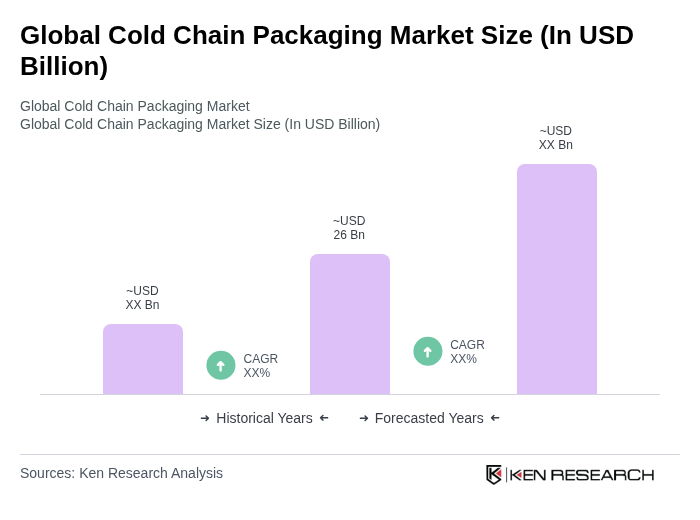
- The Global Cold Chain Packaging Market is valued at USD 26 billion, based on a five-year historical analysis and recent syndicated estimates indicating a market size of about USD 26.17 billion in 2023 and around USD 29–30 billion in 2024. This growth is primarily driven by the increasing demand for temperature-sensitive products, particularly in the food and pharmaceutical sectors, alongside the rising need for efficient logistics and supply chain solutions. The market is also bolstered by advancements in packaging technologies such as high?performance insulated containers, reusable systems, and smart monitoring solutions that enhance product safety, traceability, and shelf life.
- Key players in this market include the United States, Germany, and China, which dominate due to their robust logistics infrastructure, significant investments in cold chain technologies, and a high concentration of pharmaceutical and food processing industries. North America holds the largest share of global cold chain packaging revenues, while Asia Pacific, led by China, is the fastest-growing region, supported by national programs such as China’s Cold Chain Logistics Development Plan (2021–2025) that accelerate refrigerated transport and cold chain packaging investments. The presence of major companies and a growing consumer base in these regions further contribute to their market leadership.
- In 2023, the U.S. government implemented regulations mandating stricter temperature control measures for the transportation of pharmaceuticals and perishable goods through strengthened enforcement of existing federal requirements such as the Food Safety Modernization Act (FSMA) Final Rule on Sanitary Transportation of Human and Animal Food issued by the U.S. Food and Drug Administration and Title 21 of the U.S. Code of Federal Regulations Part 205 on Wholesale Distribution of Prescription Drugs. These instruments require covered shippers, loaders, carriers, and receivers to use appropriately designed equipment, maintain specified temperature conditions, document controls, and ensure protection of temperature-sensitive pharmaceuticals and foods throughout transportation, thereby enhancing the overall reliability of cold chain logistics.
Global Cold Chain Packaging Market Segmentation
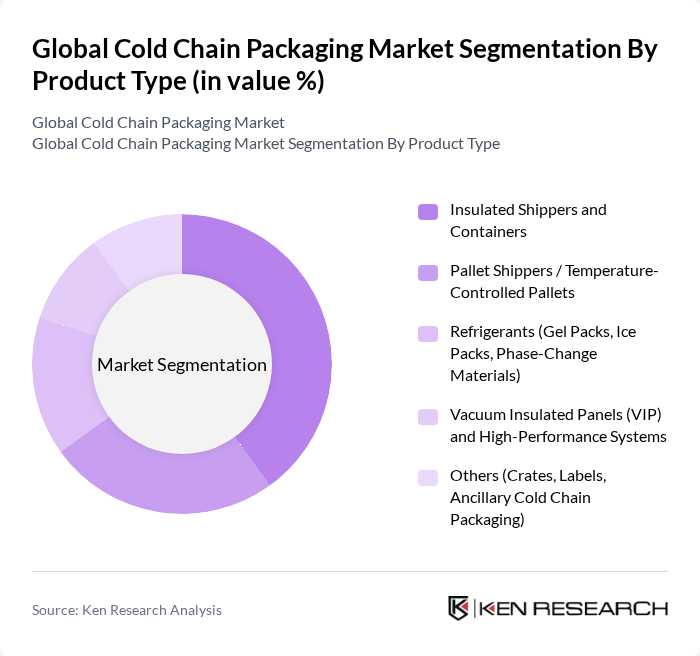
By Product Type:The product type segmentation includes various categories that cater to different needs within the cold chain packaging market. The subsegments are Insulated Shippers and Containers, Pallet Shippers / Temperature-Controlled Pallets, Refrigerants (Gel Packs, Ice Packs, Phase-Change Materials), Vacuum Insulated Panels (VIP) and High-Performance Systems, and Others (Crates, Labels, Ancillary Cold Chain Packaging). Among these, Insulated Shippers and Containers are leading due to their versatility and effectiveness in maintaining temperature during transit, and they represent the largest product category in global cold chain packaging revenues.
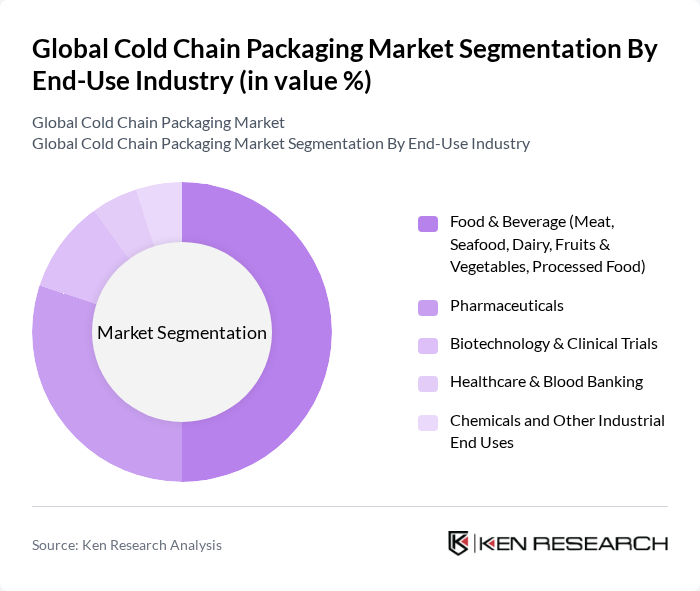
By End-Use Industry:The end-use industry segmentation encompasses various sectors that utilize cold chain packaging solutions. This includes Food & Beverage (Meat, Seafood, Dairy, Fruits & Vegetables, Processed Food), Pharmaceuticals, Biotechnology & Clinical Trials, Healthcare & Blood Banking, and Chemicals and Other Industrial End Uses. The Food & Beverage sector is the dominant segment in overall cold chain logistics by volume, driven by the increasing demand for fresh and frozen products and expansion of modern retail and e?commerce grocery channels. At the same time, pharmaceutical, biotechnology, and clinical trial applications account for a rapidly growing share of value due to stringent temperature compliance needs for vaccines, biologics, and high-value specialty drugs.
Global Cold Chain Packaging Market Competitive Landscape
The Global Cold Chain Packaging Market is characterized by a dynamic mix of regional and international players. Leading participants such as Sonoco Products Company, Cold Chain Technologies LLC, Pelican BioThermal LLC, ThermoSafe Brands (Sonoco ThermoSafe), Cryopak Industries Inc., Packaging Corporation of America, Sealed Air Corporation, Insulated Products Corporation, Antunes (A. J. Antunes & Co.), Softbox Systems (Softbox, a CSafe Company), DDL, Inc., Tempack Packaging Solutions, S.L. (Tempack), Biotherm Corp., EcoCool GmbH, Klinge Corporation contribute to innovation, geographic expansion, and service delivery in this space.
Global Cold Chain Packaging Market Industry Analysis
Growth Drivers
- Increasing Demand for Temperature-Sensitive Products:The global demand for temperature-sensitive products is projected to reach 1.5 billion units in future, driven by the rise in perishable goods consumption. The Food and Agriculture Organization of the United Nations reports that global food loss and waste is estimated at about 1.3 billion tons annually, highlighting the need for effective cold chain solutions. Additionally, the global pharmaceutical market is projected to grow at an annual rate of around 5% in future, further increasing the demand for cold chain packaging to ensure product integrity during transport.
- Expansion of the Pharmaceutical and Biotechnology Sectors:The global pharmaceutical market is anticipated to reach a value in the order of over USD 1 trillion in future, with biotechnology contributing significantly to this growth. According to the International Federation of Pharmaceutical Manufacturers & Associations, the number of new medicines launched globally has increased notably over the past decade, reflecting an expansion in innovative therapies that often require temperature-controlled logistics. This surge necessitates robust cold chain packaging solutions to maintain the efficacy of temperature-sensitive medications, thereby driving market growth in this sector.
- Technological Advancements in Packaging Solutions:The cold chain packaging industry is witnessing rapid technological advancements, with investments in smart packaging and related technologies expected to amount to several billions of USD in future. Innovations such as temperature-monitoring sensors and RFID technology enhance supply chain visibility and product safety. The integration of these technologies is crucial for maintaining compliance with stringent regulations, thus propelling the demand for advanced cold chain packaging solutions across various industries.
Market Challenges
- High Costs Associated with Cold Chain Logistics:The logistics of cold chain management can account for a substantial share of total supply chain costs, significantly impacting profitability. According to the Food and Agriculture Organization and World Bank analyses, investment and operating costs for cold chains are a major barrier, especially in low- and middle-income countries, limiting broader participation in temperature-controlled logistics. These high costs can deter smaller companies from investing in necessary cold chain infrastructure, limiting market growth and accessibility.
- Regulatory Compliance Complexities:The cold chain packaging industry faces stringent regulatory requirements, particularly in the pharmaceutical sector. Compliance with regulations such as national and international guidelines for Good Distribution Practices can lead to significant compliance and infrastructure costs for large companies, though exact amounts vary and cannot be robustly generalized. The complexity of these regulations can lead to delays and increased operational costs, posing significant challenges for companies striving to maintain compliance while ensuring product safety and quality.
Global Cold Chain Packaging Market Future Outlook
The future of the cold chain packaging market is poised for significant transformation, driven by technological innovations and evolving consumer preferences. The integration of IoT and automation is expected to enhance operational efficiency, while the shift towards sustainable packaging materials will address environmental concerns. As e-commerce continues to expand, the demand for reliable cold chain solutions will grow, necessitating investments in infrastructure and technology to meet the needs of temperature-sensitive products across various sectors.
Market Opportunities
- Growth in E-commerce and Online Food Delivery Services:The global e-commerce sector is projected to reach a multi-trillion USD value in future, significantly boosting the demand for cold chain packaging solutions. As online food delivery services expand, the need for efficient temperature-controlled packaging will become critical to ensure product quality and safety during transit, presenting a lucrative opportunity for market players.
- Innovations in Sustainable Packaging Materials:The global market for sustainable packaging is expected to account for a substantial share of the overall packaging market in future, with strong growth driven by environmental regulations and consumer demand. Innovations in biodegradable and recyclable materials are gaining traction, driven by consumer demand for eco-friendly solutions. Companies that invest in sustainable cold chain packaging will not only meet regulatory requirements but also enhance their brand reputation, tapping into a growing market segment focused on environmental responsibility.
Scope of the Report
| Segment | Sub-Segments |
|---|---|
| By Product Type | Insulated Shippers and Containers Pallet Shippers / Temperature-Controlled Pallets Refrigerants (Gel Packs, Ice Packs, Phase-Change Materials) Vacuum Insulated Panels (VIP) and High-Performance Systems Others (Crates, Labels, Ancillary Cold Chain Packaging) |
| By End-Use Industry | Food & Beverage (Meat, Seafood, Dairy, Fruits & Vegetables, Processed Food) Pharmaceuticals Biotechnology & Clinical Trials Healthcare & Blood Banking Chemicals and Other Industrial End Uses |
| By Packaging Format | Disposable / Single-Use Packaging Reusable / Returnable Packaging |
| By Material Type | Expanded Polystyrene (EPS) Polyurethane (PU) Vacuum Insulated Panels (VIP) Other Polymers and Composite Materials |
| By Temperature Range | Ambient Controlled (15°C to 25°C) Chilled / Refrigerated (2°C to 8°C) Frozen (0°C to -25°C) Deep Frozen & Cryogenic (Below -25°C) |
| By Region | North America Europe Asia-Pacific Latin America Middle East & Africa |
| By Application | Transportation / Shipping Storage Distribution & Last-Mile Delivery Retail & Point-of-Use Others |
Key Target Audience
Investors and Venture Capitalist Firms
Government and Regulatory Bodies (e.g., Food and Drug Administration, Environmental Protection Agency)
Manufacturers and Producers
Distributors and Retailers
Logistics and Supply Chain Companies
Pharmaceutical Companies
Food and Beverage Companies
Cold Chain Technology Providers
Players Mentioned in the Report:
Sonoco Products Company
Cold Chain Technologies LLC
Pelican BioThermal LLC
ThermoSafe Brands (Sonoco ThermoSafe)
Cryopak Industries Inc.
Packaging Corporation of America
Sealed Air Corporation
Insulated Products Corporation
Antunes (A. J. Antunes & Co.)
Softbox Systems (Softbox, a CSafe Company)
DDL, Inc.
Tempack Packaging Solutions, S.L. (Tempack)
Biotherm Corp.
EcoCool GmbH
Klinge Corporation
Table of Contents
Market Assessment Phase
1. Executive Summary and Approach
2. Global Cold Chain Packaging Market Overview
2.1 Key Insights and Strategic Recommendations
2.2 Global Cold Chain Packaging Market Overview
2.3 Definition and Scope
2.4 Evolution of Market Ecosystem
2.5 Timeline of Key Regulatory Milestones
2.6 Value Chain & Stakeholder Mapping
2.7 Business Cycle Analysis
2.8 Policy & Incentive Landscape
3. Global Cold Chain Packaging Market Analysis
3.1 Growth Drivers
3.1.1 Increasing demand for temperature-sensitive products
3.1.2 Expansion of the pharmaceutical and biotechnology sectors
3.1.3 Rising consumer awareness regarding food safety
3.1.4 Technological advancements in packaging solutions
3.2 Market Challenges
3.2.1 High costs associated with cold chain logistics
3.2.2 Regulatory compliance complexities
3.2.3 Limited infrastructure in developing regions
3.2.4 Environmental concerns regarding packaging materials
3.3 Market Opportunities
3.3.1 Growth in e-commerce and online food delivery services
3.3.2 Innovations in sustainable packaging materials
3.3.3 Expansion into emerging markets
3.3.4 Increasing investments in cold chain infrastructure
3.4 Market Trends
3.4.1 Adoption of IoT and smart technologies in cold chain
3.4.2 Shift towards eco-friendly packaging solutions
3.4.3 Customization of packaging solutions for specific industries
3.4.4 Integration of automation in cold chain processes
3.5 Government Regulation
3.5.1 Food safety regulations impacting packaging standards
3.5.2 Environmental regulations on packaging waste
3.5.3 Compliance requirements for pharmaceutical products
3.5.4 Incentives for sustainable packaging initiatives
4. SWOT Analysis
5. Stakeholder Analysis
6. Porter's Five Forces Analysis
7. Global Cold Chain Packaging Market Size, 2019-2024
7.1 By Value
7.2 By Volume
7.3 By Average Selling Price
8. Global Cold Chain Packaging Market Segmentation
8.1 By Product Type
8.1.1 Insulated Shippers and Containers
8.1.2 Pallet Shippers / Temperature-Controlled Pallets
8.1.3 Refrigerants (Gel Packs, Ice Packs, Phase-Change Materials)
8.1.4 Vacuum Insulated Panels (VIP) and High-Performance Systems
8.1.5 Others (Crates, Labels, Ancillary Cold Chain Packaging)
8.2 By End-Use Industry
8.2.1 Food & Beverage (Meat, Seafood, Dairy, Fruits & Vegetables, Processed Food)
8.2.2 Pharmaceuticals
8.2.3 Biotechnology & Clinical Trials
8.2.4 Healthcare & Blood Banking
8.2.5 Chemicals and Other Industrial End Uses
8.3 By Packaging Format
8.3.1 Disposable / Single-Use Packaging
8.3.2 Reusable / Returnable Packaging
8.4 By Material Type
8.4.1 Expanded Polystyrene (EPS)
8.4.2 Polyurethane (PU)
8.4.3 Vacuum Insulated Panels (VIP)
8.4.4 Other Polymers and Composite Materials
8.5 By Temperature Range
8.5.1 Ambient Controlled (15°C to 25°C)
8.5.2 Chilled / Refrigerated (2°C to 8°C)
8.5.3 Frozen (0°C to -25°C)
8.5.4 Deep Frozen & Cryogenic (Below -25°C)
8.6 By Region
8.6.1 North America
8.6.2 Europe
8.6.3 Asia-Pacific
8.6.4 Latin America
8.6.5 Middle East & Africa
8.7 By Application
8.7.1 Transportation / Shipping
8.7.2 Storage
8.7.3 Distribution & Last-Mile Delivery
8.7.4 Retail & Point-of-Use
8.7.5 Others
9. Global Cold Chain Packaging Market Competitive Analysis
9.1 Market Share of Key Players
9.2 Cross Comparison of Key Players
9.2.1 Company Name
9.2.2 Revenue (Most Recent Fiscal Year, USD Million)
9.2.3 3-Year Revenue CAGR (%)
9.2.4 EBITDA Margin (%)
9.2.5 R&D Intensity (% of Revenue)
9.2.6 Capital Expenditure Intensity (% of Revenue)
9.2.7 Geographic Revenue Diversification Index
9.2.8 Product / End-Use Diversification Index
9.2.9 Market Share in Global Cold Chain Packaging (%)
9.2.10 Average Price Realization per Shipment / Unit
9.2.11 Customer Concentration (Top 5 Customers’ % of Revenue)
9.2.12 Contracted / Recurring Revenue Share (%)
9.2.13 On-Time Delivery Performance (%)
9.2.14 Innovation Rate (New Products Launched per Year)
9.2.15 Customer Satisfaction / Net Promoter Score (NPS)
9.3 SWOT Analysis of Top Players
9.4 Pricing Analysis
9.5 Detailed Profile of Major Companies
9.5.1 Sonoco Products Company
9.5.2 Cold Chain Technologies LLC
9.5.3 Pelican BioThermal LLC
9.5.4 ThermoSafe Brands (Sonoco ThermoSafe)
9.5.5 Cryopak Industries Inc.
9.5.6 Packaging Corporation of America
9.5.7 Sealed Air Corporation
9.5.8 Insulated Products Corporation
9.5.9 Antunes (A. J. Antunes & Co.)
9.5.10 Softbox Systems (Softbox, a CSafe Company)
9.5.11 DDL, Inc.
9.5.12 Tempack Packaging Solutions, S.L. (Tempack)
9.5.13 Biotherm Corp.
9.5.14 EcoCool GmbH
9.5.15 Klinge Corporation
10. Global Cold Chain Packaging Market End-User Analysis
10.1 Procurement Behavior of Key Ministries
10.1.1 Government procurement policies
10.1.2 Budget allocation for cold chain initiatives
10.1.3 Collaboration with private sector
10.1.4 Evaluation criteria for suppliers
10.2 Corporate Spend on Infrastructure & Energy
10.2.1 Investment in cold storage facilities
10.2.2 Expenditure on energy-efficient technologies
10.2.3 Budget for maintenance and upgrades
10.2.4 Funding for research and development
10.3 Pain Point Analysis by End-User Category
10.3.1 Challenges in maintaining temperature control
10.3.2 Issues with packaging material sustainability
10.3.3 Difficulties in regulatory compliance
10.3.4 Limitations in logistics and distribution
10.4 User Readiness for Adoption
10.4.1 Awareness of cold chain solutions
10.4.2 Willingness to invest in new technologies
10.4.3 Training and skill development needs
10.4.4 Assessment of current infrastructure
10.5 Post-Deployment ROI and Use Case Expansion
10.5.1 Measurement of cost savings
10.5.2 Evaluation of service quality improvements
10.5.3 Analysis of market expansion opportunities
10.5.4 Feedback mechanisms for continuous improvement
11. Global Cold Chain Packaging Market Future Size, 2025-2030
11.1 By Value
11.2 By Volume
11.3 By Average Selling Price
Go-To-Market Strategy Phase
1. Whitespace Analysis + Business Model Canvas
1.1 Market Gaps Identification
1.2 Value Proposition Development
1.3 Revenue Streams Analysis
1.4 Cost Structure Evaluation
1.5 Key Partnerships Exploration
1.6 Customer Segmentation
1.7 Channels of Distribution
2. Marketing and Positioning Recommendations
2.1 Branding Strategies
2.2 Product USPs
2.3 Target Market Identification
2.4 Communication Strategy
2.5 Digital Marketing Approaches
3. Distribution Plan
3.1 Urban Retail vs Rural NGO Tie-ups
3.2 Logistics Optimization
3.3 Partnership with Distributors
3.4 Inventory Management Strategies
4. Channel & Pricing Gaps
4.1 Underserved Routes
4.2 Pricing Bands Analysis
4.3 Competitor Pricing Strategies
5. Unmet Demand & Latent Needs
5.1 Category Gaps
5.2 Consumer Segments Analysis
5.3 Emerging Trends Identification
6. Customer Relationship
6.1 Loyalty Programs
6.2 After-sales Service
6.3 Customer Feedback Mechanisms
7. Value Proposition
7.1 Sustainability Initiatives
7.2 Integrated Supply Chains
7.3 Competitive Advantages
8. Key Activities
8.1 Regulatory Compliance
8.2 Branding Initiatives
8.3 Distribution Setup
9. Entry Strategy Evaluation
9.1 Domestic Market Entry Strategy
9.1.1 Product Mix
9.1.2 Pricing Band
9.1.3 Packaging Considerations
9.2 Export Entry Strategy
9.2.1 Target Countries
9.2.2 Compliance Roadmap
10. Entry Mode Assessment
10.1 JV
10.2 Greenfield
10.3 M&A
10.4 Distributor Model
11. Capital and Timeline Estimation
11.1 Capital Requirements
11.2 Timelines
12. Control vs Risk Trade-Off
12.1 Ownership vs Partnerships
13. Profitability Outlook
13.1 Breakeven Analysis
13.2 Long-term Sustainability
14. Potential Partner List
14.1 Distributors
14.2 JVs
14.3 Acquisition Targets
15. Execution Roadmap
15.1 Phased Plan for Market Entry
15.1.1 Market Setup
15.1.2 Market Entry
15.1.3 Growth Acceleration
15.1.4 Scale & Stabilize
15.2 Key Activities and Milestones
15.2.1 Milestone Planning
15.2.2 Activity Tracking
Research Methodology
Phase 1: Approach1
Desk Research
- Industry reports from global cold chain associations and logistics organizations
- Market analysis publications from trade journals focusing on packaging technologies
- Government publications on food safety regulations and cold chain standards
Primary Research
- Interviews with supply chain managers in the food and pharmaceutical sectors
- Surveys with packaging engineers specializing in temperature-controlled solutions
- Field interviews with logistics providers operating cold chain facilities
Validation & Triangulation
- Cross-validation of data from multiple industry sources and expert opinions
- Triangulation of market size estimates using historical growth rates and current trends
- Sanity checks through feedback from industry panels and focus groups
Phase 2: Market Size Estimation1
Top-down Assessment
- Analysis of global cold chain logistics spending and its correlation with packaging needs
- Segmentation of the market by end-user industries such as food, pharmaceuticals, and chemicals
- Incorporation of trends in e-commerce and online grocery delivery impacting cold chain demand
Bottom-up Modeling
- Volume estimates based on the number of temperature-sensitive shipments across sectors
- Cost analysis of various cold chain packaging solutions, including insulation and refrigerants
- Calculation of market size based on unit sales and average selling prices of packaging products
Forecasting & Scenario Analysis
- Multi-variable forecasting using growth rates in the food and pharmaceutical industries
- Scenario analysis based on potential regulatory changes and sustainability initiatives
- Development of baseline, optimistic, and pessimistic market projections through 2030
Phase 3: CATI Sample Composition1
| Scope Item/Segment | Sample Size | Target Respondent Profiles |
|---|---|---|
| Food & Beverage Cold Chain | 120 | Supply Chain Managers, Quality Assurance Directors |
| Pharmaceutical Cold Chain Solutions | 90 | Logistics Coordinators, Regulatory Affairs Managers |
| Biotechnology Product Distribution | 60 | Operations Managers, Product Development Leads |
| Retail Cold Chain Packaging | 50 | Packaging Engineers, Procurement Specialists |
| Temperature-Controlled Logistics Providers | 70 | Business Development Managers, Fleet Operations Directors |
Frequently Asked Questions
What is the current value of the Global Cold Chain Packaging Market?
The Global Cold Chain Packaging Market is valued at approximately USD 26.17 billion in 2023, with projections indicating it could reach around USD 2930 billion in 2024, driven by the demand for temperature-sensitive products in food and pharmaceutical sectors.
What are the main drivers of growth in the cold chain packaging market?
Which regions dominate the Global Cold Chain Packaging Market?
What are the main product types in cold chain packaging?
Other Regional/Country Reports
Indonesia Cold Chain Packaging Market
Malaysia Cold Chain Packaging Market
APAC Cold Chain Packaging Market
SEA Cold Chain Packaging Market
Other Adjacent Reports
Malaysia Refrigerated Transportation Market
Vietnam Biotechnology Packaging Market
Europe Sustainable Packaging Market Size, Share & Forecast 2025-2031UAE Temperature Monitoring Solutions Market
Bahrain Insulated Shipping Containers Market
Mexico Clinical Trial Logistics Market
Brazil Perishable Goods Supply Chain Market
Why Buy From Us?

What makes us stand out is that our consultants follow Robust, Refine and Result (RRR) methodology. Robust for clear definitions, approaches and sanity checking, Refine for differentiating respondents' facts and opinions, and Result for presenting data with story.

We have set a benchmark in the industry by offering our clients with syndicated and customized market research reports featuring coverage of entire market as well as meticulous research and analyst insights.

While we don't replace traditional research, we flip the method upside down. Our dual approach of Top Bottom & Bottom Top ensures quality deliverable by not just verifying company fundamentals but also looking at the sector and macroeconomic factors.

With one step in the future, our research team constantly tries to show you the bigger picture. We help with some of the tough questions you may encounter along the way: How is the industry positioned? Best marketing channel? KPI's of competitors? By aligning every element, we help maximize success.

Our report gives you instant access to the answers and sources that other companies might choose to hide. We elaborate each steps of research methodology we have used and showcase you the sample size to earn your trust.

If you need any support, we are here! We pride ourselves on universe strength, data quality, and quick, friendly, and professional service.