About the Report
Base Year 2024Listen to the audio summary
Global Collagen Supplement Market Overview
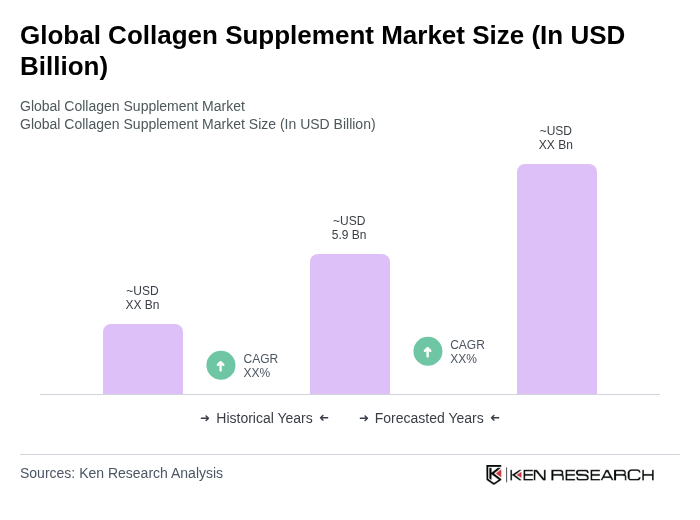
- The Global Collagen Supplement Market is valued at USD 5.9 billion, based on a five-year historical analysis. This growth is primarily driven by increasing consumer awareness regarding health and wellness, alongside a rising demand for beauty and anti-aging products. The market has seen a surge in popularity due to the growing trend of preventive healthcare, the incorporation of collagen supplements into daily diets, and the expansion of product formats such as powders, gummies, and ready-to-drink beverages. The appeal of collagen supplements spans multiple demographics, from younger consumers focused on wellness to older adults seeking joint and skin health benefits .
- Key players in this market include the United States, Germany, and Japan, which dominate due to their advanced healthcare systems, high disposable incomes, and strong consumer demand for dietary supplements. The presence of established brands and a robust distribution network further solidify their market leadership, making these countries pivotal in the global collagen supplement landscape .
- In 2023, the U.S. Food and Drug Administration (FDA) implemented new regulations requiring collagen supplement manufacturers to provide clear labeling on the source and type of collagen used in their products. This regulation, under the Dietary Supplement Labeling Act (U.S. Food and Drug Administration, 2023), mandates manufacturers to disclose the animal or marine origin, processing method (e.g., hydrolyzed, gelatin), and any allergens present. The regulation aims to enhance consumer safety and transparency, ensuring that consumers are well-informed about the ingredients in their supplements .
Global Collagen Supplement Market Segmentation
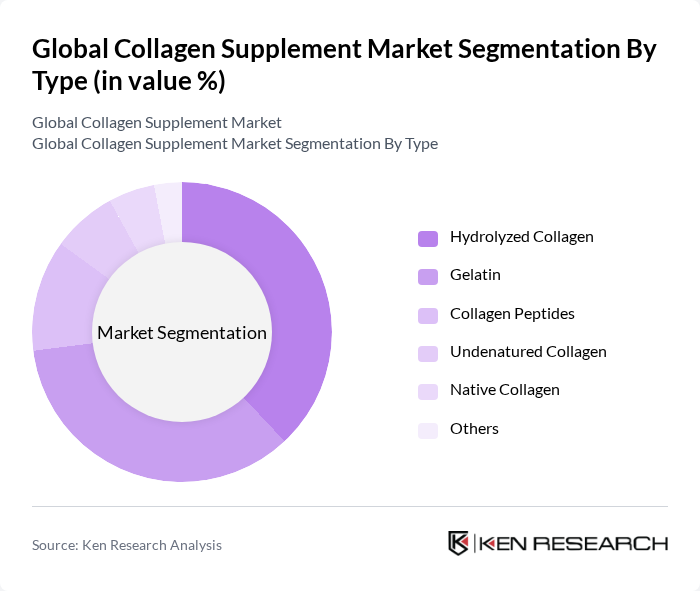
By Type:The collagen supplement market is segmented into various types, including Hydrolyzed Collagen, Gelatin, Collagen Peptides, Undenatured Collagen, Native Collagen, and Others. Among these, Hydrolyzed Collagen is the most dominant segment due to its high bioavailability and ease of incorporation into various products. Consumers prefer hydrolyzed collagen for its quick absorption and effectiveness in promoting skin elasticity and joint health. The increasing trend of using collagen in functional foods and beverages further boosts the demand for this segment. Gelatin-based supplements also hold a significant share, particularly in traditional and culinary applications .
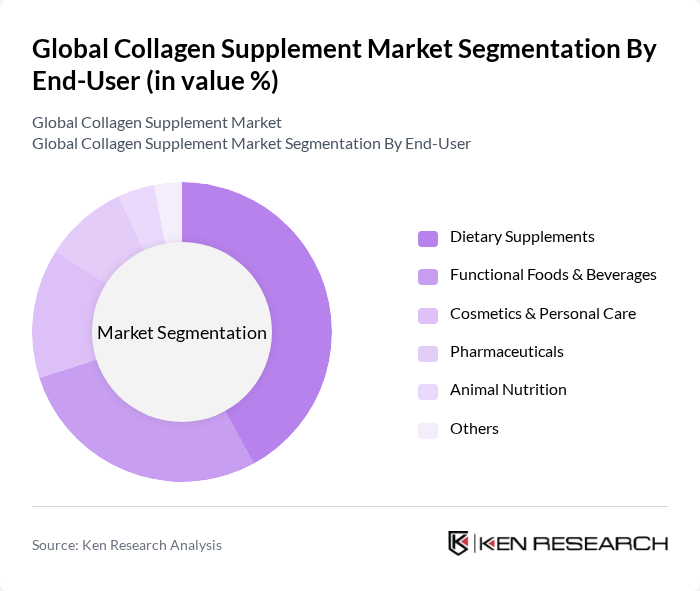
By End-User:The end-user segmentation includes Dietary Supplements, Functional Foods & Beverages, Cosmetics & Personal Care, Pharmaceuticals, Animal Nutrition, and Others. The Dietary Supplements segment leads the market, driven by the growing trend of health-conscious consumers seeking preventive health solutions. The rise in fitness and wellness culture has significantly increased the consumption of collagen supplements among athletes and health enthusiasts, making this segment a key driver of market growth. Functional foods and beverages are also gaining traction as manufacturers innovate with new delivery formats and flavors .
Global Collagen Supplement Market Competitive Landscape
The Global Collagen Supplement Market is characterized by a dynamic mix of regional and international players. Leading participants such as Vital Proteins, NeoCell, Great Lakes Wellness, Collagen Solutions Plc, Youtheory (Nutrawise Health & Beauty LLC), Sports Research, Garden of Life (Nestlé Health Science), Further Food, Ancient Nutrition, BioCell Technology LLC, Perfect Supplements, Zint Nutrition, Rousselot (Darling Ingredients Inc.), Primal Kitchen (Kraft Heinz), NutraBlast contribute to innovation, geographic expansion, and service delivery in this space.
Global Collagen Supplement Market Industry Analysis
Growth Drivers
- Increasing Consumer Awareness of Health Benefits:The global health and wellness market is projected to reach $4.8 trillion in future, with collagen supplements gaining traction due to their perceived health benefits. A survey by the International Food Information Council found that 78% of consumers are actively seeking products that support joint health, skin elasticity, and overall wellness. This growing awareness is driving demand for collagen supplements, particularly among health-conscious consumers in regions like North America and Europe.
- Rising Demand for Anti-Aging Products:The anti-aging market is expected to reach $426 billion in future, with collagen supplements playing a crucial role. According to a report by Grand View Research, 62% of consumers aged 30-50 are investing in anti-aging products, including collagen. This demographic is increasingly aware of the benefits of collagen for skin health, leading to a surge in product offerings targeting this age group, particularly in developed markets.
- Growth in the Sports Nutrition Sector:The sports nutrition market is anticipated to reach $46 billion in future, with collagen supplements becoming a staple for athletes and fitness enthusiasts. Research from the Journal of Sports Science indicates that collagen supplementation can enhance muscle recovery and joint health. As more athletes incorporate collagen into their diets, the demand for these supplements is expected to rise significantly, particularly in regions with active lifestyles.
Market Challenges
- High Competition Among Brands:The collagen supplement market is highly competitive, with over 210 brands vying for consumer attention. According to a report by Market Research Future, this saturation leads to price wars and reduced profit margins. Brands must differentiate themselves through quality, marketing, and unique formulations to capture market share, which can be challenging in a crowded marketplace.
- Regulatory Hurdles in Product Claims:Regulatory bodies like the FDA impose strict guidelines on health claims for dietary supplements. In future, the FDA is expected to increase scrutiny on collagen products, requiring more robust evidence for efficacy claims. This regulatory environment can hinder product launches and marketing efforts, as companies must invest in compliance and research to substantiate their claims, impacting overall market growth.
Global Collagen Supplement Market Future Outlook
The future of the collagen supplement market appears promising, driven by increasing consumer interest in health and wellness. Innovations in product formulations, such as collagen-infused beverages and plant-based alternatives, are expected to attract a broader audience. Additionally, the rise of personalized nutrition will likely lead to tailored collagen products that meet individual health needs, enhancing consumer engagement and market penetration in future.
Market Opportunities
- Development of Innovative Product Formulations:There is a significant opportunity for brands to create unique collagen products, such as gummies and powders that cater to specific health needs. The global functional food market is projected to reach $280 billion in future, indicating a growing consumer preference for convenient, health-oriented products that incorporate collagen.
- Expansion into Emerging Markets:Emerging markets, particularly in Asia-Pacific, present substantial growth potential for collagen supplements. The region's increasing disposable income and rising health awareness are driving demand. According to the World Bank, Asia-Pacific's middle class is expected to grow by 1.3 billion people in future, creating a lucrative market for collagen products tailored to these consumers.
Scope of the Report
| Segment | Sub-Segments |
|---|---|
| By Type | Hydrolyzed Collagen Gelatin Collagen Peptides Undenatured Collagen Native Collagen Others |
| By End-User | Dietary Supplements Functional Foods & Beverages Cosmetics & Personal Care Pharmaceuticals Animal Nutrition Others |
| By Source | Bovine Porcine Marine Poultry Plant-Based (Vegan/Alternative) Others |
| By Formulation | Powder Liquid Capsules Tablets Gummies Ready-to-Drink (RTD) Others |
| By Distribution Channel | Online Retail (E-commerce) Supermarkets/Hypermarkets Health Food Stores Pharmacies/Drug Stores Direct-to-Consumer (D2C) Others |
| By Region | North America Europe Asia-Pacific Latin America Middle East & Africa |
| By Application | Skin Health Joint Health Muscle Mass & Recovery Bone Health Weight Management Gut Health Others |
Key Target Audience
Investors and Venture Capitalist Firms
Government and Regulatory Bodies (e.g., Food and Drug Administration, European Food Safety Authority)
Manufacturers and Producers
Distributors and Retailers
Health and Wellness Organizations
Pharmaceutical Companies
Cosmetic and Personal Care Brands
Nutrition and Dietary Supplement Companies
Players Mentioned in the Report:
Vital Proteins
NeoCell
Great Lakes Wellness
Collagen Solutions Plc
Youtheory (Nutrawise Health & Beauty LLC)
Sports Research
Garden of Life (Nestle Health Science)
Further Food
Ancient Nutrition
BioCell Technology LLC
Perfect Supplements
Zint Nutrition
Rousselot (Darling Ingredients Inc.)
Primal Kitchen (Kraft Heinz)
NutraBlast
Table of Contents
Market Assessment Phase
1. Executive Summary and Approach
2. Global Collagen Supplement Market Overview
2.1 Key Insights and Strategic Recommendations
2.2 Global Collagen Supplement Market Overview
2.3 Definition and Scope
2.4 Evolution of Market Ecosystem
2.5 Timeline of Key Regulatory Milestones
2.6 Value Chain & Stakeholder Mapping
2.7 Business Cycle Analysis
2.8 Policy & Incentive Landscape
3. Global Collagen Supplement Market Analysis
3.1 Growth Drivers
3.1.1 Increasing consumer awareness of health benefits
3.1.2 Rising demand for anti-aging products
3.1.3 Growth in the sports nutrition sector
3.1.4 Expansion of e-commerce platforms
3.2 Market Challenges
3.2.1 High competition among brands
3.2.2 Regulatory hurdles in product claims
3.2.3 Fluctuating raw material prices
3.2.4 Consumer skepticism regarding efficacy
3.3 Market Opportunities
3.3.1 Development of innovative product formulations
3.3.2 Expansion into emerging markets
3.3.3 Collaborations with health professionals
3.3.4 Increasing popularity of plant-based collagen alternatives
3.4 Market Trends
3.4.1 Growing trend of personalized nutrition
3.4.2 Rise in demand for clean-label products
3.4.3 Increased focus on sustainability in sourcing
3.4.4 Popularity of collagen-infused beverages
3.5 Government Regulation
3.5.1 Labeling requirements for dietary supplements
3.5.2 Safety assessments for new ingredients
3.5.3 Guidelines for health claims on packaging
3.5.4 Regulations on advertising and marketing practices
4. SWOT Analysis
5. Stakeholder Analysis
6. Porter's Five Forces Analysis
7. Global Collagen Supplement Market Market Size, 2019-2024
7.1 By Value
7.2 By Volume
7.3 By Average Selling Price
8. Global Collagen Supplement Market Segmentation
8.1 By Type
8.1.1 Hydrolyzed Collagen
8.1.2 Gelatin
8.1.3 Collagen Peptides
8.1.4 Undenatured Collagen
8.1.5 Native Collagen
8.1.6 Others
8.2 By End-User
8.2.1 Dietary Supplements
8.2.2 Functional Foods & Beverages
8.2.3 Cosmetics & Personal Care
8.2.4 Pharmaceuticals
8.2.5 Animal Nutrition
8.2.6 Others
8.3 By Source
8.3.1 Bovine
8.3.2 Porcine
8.3.3 Marine
8.3.4 Poultry
8.3.5 Plant-Based (Vegan/Alternative)
8.3.6 Others
8.4 By Formulation
8.4.1 Powder
8.4.2 Liquid
8.4.3 Capsules
8.4.4 Tablets
8.4.5 Gummies
8.4.6 Ready-to-Drink (RTD)
8.4.7 Others
8.5 By Distribution Channel
8.5.1 Online Retail (E-commerce)
8.5.2 Supermarkets/Hypermarkets
8.5.3 Health Food Stores
8.5.4 Pharmacies/Drug Stores
8.5.5 Direct-to-Consumer (D2C)
8.5.6 Others
8.6 By Region
8.6.1 North America
8.6.2 Europe
8.6.3 Asia-Pacific
8.6.4 Latin America
8.6.5 Middle East & Africa
8.7 By Application
8.7.1 Skin Health
8.7.2 Joint Health
8.7.3 Muscle Mass & Recovery
8.7.4 Bone Health
8.7.5 Weight Management
8.7.6 Gut Health
8.7.7 Others
9. Global Collagen Supplement Market Competitive Analysis
9.1 Market Share of Key Players
9.2 Cross Comparison of Key Players
9.2.1 Company Name
9.2.2 Group Size (Large, Medium, or Small as per industry convention)
9.2.3 Global Collagen Supplement Revenue (USD, latest available)
9.2.4 Revenue Growth Rate (YoY %)
9.2.5 Market Share (%)
9.2.6 Geographic Presence (No. of countries/regions)
9.2.7 Product Portfolio Breadth (No. of SKUs/Formats)
9.2.8 R&D/Innovation Spend (% of revenue)
9.2.9 Distribution Network Strength (No. of channels/partners)
9.2.10 Brand Recognition Index (survey/market data)
9.2.11 Customer Satisfaction Score (NPS or equivalent)
9.2.12 Sustainability/Traceability Initiatives
9.3 SWOT Analysis of Top Players
9.4 Pricing Analysis
9.5 Detailed Profile of Major Companies
9.5.1 Vital Proteins
9.5.2 NeoCell
9.5.3 Great Lakes Wellness
9.5.4 Collagen Solutions Plc
9.5.5 Youtheory (Nutrawise Health & Beauty LLC)
9.5.6 Sports Research
9.5.7 Garden of Life (Nestlé Health Science)
9.5.8 Further Food
9.5.9 Ancient Nutrition
9.5.10 BioCell Technology LLC
9.5.11 Perfect Supplements
9.5.12 Zint Nutrition
9.5.13 Rousselot (Darling Ingredients Inc.)
9.5.14 Primal Kitchen (Kraft Heinz)
9.5.15 NutraBlast
10. Global Collagen Supplement Market End-User Analysis
10.1 Procurement Behavior of Key Ministries
10.1.1 Government health initiatives
10.1.2 Budget allocation for health supplements
10.1.3 Collaboration with private sectors
10.1.4 Regulatory compliance requirements
10.2 Corporate Spend on Infrastructure & Energy
10.2.1 Investment in health and wellness programs
10.2.2 Funding for research and development
10.2.3 Expenditure on marketing and outreach
10.2.4 Partnerships with health organizations
10.3 Pain Point Analysis by End-User Category
10.3.1 Lack of awareness about collagen benefits
10.3.2 High costs of premium products
10.3.3 Limited availability in certain regions
10.3.4 Confusion over product types and uses
10.4 User Readiness for Adoption
10.4.1 Willingness to try new products
10.4.2 Interest in personalized nutrition
10.4.3 Engagement with health professionals
10.4.4 Feedback on product efficacy
10.5 Post-Deployment ROI and Use Case Expansion
10.5.1 Measurement of health improvements
10.5.2 Customer feedback and testimonials
10.5.3 Opportunities for product line expansion
10.5.4 Long-term customer loyalty strategies
11. Global Collagen Supplement Market Future Size, 2025-2030
11.1 By Value
11.2 By Volume
11.3 By Average Selling Price
Go-To-Market Strategy Phase
1. Whitespace Analysis + Business Model Canvas
1.1 Market gaps and opportunities
1.2 Value proposition development
1.3 Revenue model exploration
1.4 Customer segmentation analysis
1.5 Competitive landscape overview
1.6 Key partnerships identification
1.7 Risk assessment and mitigation
2. Marketing and Positioning Recommendations
2.1 Branding strategies
2.2 Product USPs
2.3 Target audience identification
2.4 Communication strategies
2.5 Digital marketing tactics
2.6 Influencer partnerships
2.7 Customer engagement initiatives
3. Distribution Plan
3.1 Urban retail strategies
3.2 Rural NGO tie-ups
3.3 E-commerce platform integration
3.4 Direct-to-consumer models
3.5 Wholesale distribution channels
3.6 International market entry
3.7 Logistics and supply chain management
4. Channel & Pricing Gaps
4.1 Underserved routes
4.2 Pricing bands analysis
4.3 Competitor pricing strategies
4.4 Consumer price sensitivity
4.5 Value-based pricing models
4.6 Discount and promotion strategies
4.7 Pricing optimization techniques
5. Unmet Demand & Latent Needs
5.1 Category gaps
5.2 Consumer segments analysis
5.3 Product innovation opportunities
5.4 Market entry barriers
5.5 Customer feedback incorporation
5.6 Trends in consumer preferences
5.7 Future demand forecasting
6. Customer Relationship
6.1 Loyalty programs
6.2 After-sales service
6.3 Customer feedback mechanisms
6.4 Community building initiatives
6.5 Customer education programs
6.6 Engagement through social media
6.7 Personalization of customer experience
7. Value Proposition
7.1 Sustainability initiatives
7.2 Integrated supply chains
7.3 Health benefits communication
7.4 Quality assurance measures
7.5 Brand trust building
7.6 Unique selling propositions
7.7 Customer-centric product development
8. Key Activities
8.1 Regulatory compliance
8.2 Branding efforts
8.3 Distribution setup
8.4 Marketing campaigns
8.5 Product development
8.6 Customer service training
8.7 Performance monitoring
9. Entry Strategy Evaluation
9.1 Domestic Market Entry Strategy
9.1.1 Product mix considerations
9.1.2 Pricing band analysis
9.1.3 Packaging strategies
9.2 Export Entry Strategy
9.2.1 Target countries selection
9.2.2 Compliance roadmap development
10. Entry Mode Assessment
10.1 Joint Ventures
10.2 Greenfield Investments
10.3 Mergers & Acquisitions
10.4 Distributor Model
10.5 Risk assessment of entry modes
10.6 Strategic fit evaluation
10.7 Long-term partnership considerations
11. Capital and Timeline Estimation
11.1 Capital requirements
11.2 Timelines for market entry
11.3 Budget allocation strategies
11.4 Financial forecasting
11.5 Funding sources identification
11.6 Cost management strategies
11.7 Investment return expectations
12. Control vs Risk Trade-Off
12.1 Ownership considerations
12.2 Partnership dynamics
12.3 Risk management frameworks
12.4 Control mechanisms
12.5 Strategic alignment
12.6 Exit strategies
12.7 Long-term sustainability planning
13. Profitability Outlook
13.1 Breakeven analysis
13.2 Long-term sustainability
13.3 Profit margin optimization
13.4 Revenue growth strategies
13.5 Cost reduction initiatives
13.6 Financial health monitoring
13.7 Investment attractiveness
14. Potential Partner List
14.1 Distributors
14.2 Joint Ventures
14.3 Acquisition targets
14.4 Strategic alliances
14.5 Collaborative research opportunities
14.6 Supply chain partners
14.7 Market entry facilitators
15. Execution Roadmap<
Research Methodology
Phase 1: Approach1
Desk Research
- Market reports from industry associations such as the Collagen Research Society
- Analysis of consumer trends and preferences from health and wellness publications
- Review of scientific literature on collagen benefits and applications in supplements
Primary Research
- Interviews with product development managers at leading supplement manufacturers
- Surveys targeting nutritionists and dietitians for insights on consumer preferences
- Focus groups with end-users to gather qualitative data on collagen supplement usage
Validation & Triangulation
- Cross-validation of findings with sales data from major retailers and e-commerce platforms
- Triangulation of consumer insights with market growth projections from industry experts
- Sanity checks through expert panel discussions with market analysts and researchers
Phase 2: Market Size Estimation1
Top-down Assessment
- Estimation of total addressable market based on global health supplement sales data
- Segmentation by product type (e.g., hydrolyzed collagen, collagen peptides) and region
- Incorporation of demographic trends influencing collagen supplement consumption
Bottom-up Modeling
- Volume estimates derived from sales data of key collagen supplement brands
- Cost analysis based on pricing strategies of various product categories
- Calculation of market size using unit sales multiplied by average selling price
Forecasting & Scenario Analysis
- Multi-variable forecasting model incorporating health trends and aging population data
- Scenario analysis based on potential regulatory changes affecting supplement formulations
- Development of baseline, optimistic, and pessimistic market growth scenarios through 2030
Phase 3: CATI Sample Composition1
| Scope Item/Segment | Sample Size | Target Respondent Profiles |
|---|---|---|
| Retail Sales of Collagen Supplements | 100 | Store Managers, Category Buyers |
| Online Marketplaces for Health Supplements | 80 | E-commerce Managers, Digital Marketing Specialists |
| Health and Wellness Influencers | 60 | Nutritionists, Fitness Coaches |
| Consumer Feedback on Collagen Products | 120 | Regular Users, First-time Buyers |
| Manufacturers of Collagen Ingredients | 40 | Product Development Leads, Quality Assurance Managers |
Frequently Asked Questions
What is the current value of the global collagen supplement market?
The global collagen supplement market is valued at approximately USD 5.9 billion, reflecting a significant growth trend driven by increasing consumer awareness of health and wellness, as well as rising demand for beauty and anti-aging products.
What are the main types of collagen supplements available?
Who are the key players in the collagen supplement market?
What are the primary growth drivers for the collagen supplement market?
Other Regional/Country Reports
Indonesia Collagen Supplement Market
Malaysia Collagen Supplement Market
KSA Collagen Supplement Market
APAC Collagen Supplement Market
SEA Collagen Supplement Market
Vietnam Collagen Supplement Market
Other Adjacent Reports
Brazil Functional Foods and Beverages Market
Global Cosmetics and Personal Care Market Size, Share & Forecast, By Product Type, Price Tier & Distribution Channel, 2026–2031India Pharmaceuticals Market Outlook to 2030South Korea Animal Nutrition Market
India Sports Nutrition Market Size, Share & Forecast, By Product Type, Consumer Type & Distribution Channel, 2026-2031India Anti-Aging Products Market Size, Share & Forecast, By Product Type, Price Tier & Distribution Channel, 2025-2032Kuwait Nutraceuticals Market Size, Share & Forecast, By Product Type, Application & Distribution Channel, 2026–2032Indonesia Beauty Supplements Market Size, Share & Forecast, By Product Type, Price Tier & Distribution Channel, 2026–2032Vietnam Joint Health Supplements Market
Why Buy From Us?

What makes us stand out is that our consultants follow Robust, Refine and Result (RRR) methodology. Robust for clear definitions, approaches and sanity checking, Refine for differentiating respondents' facts and opinions, and Result for presenting data with story.

We have set a benchmark in the industry by offering our clients with syndicated and customized market research reports featuring coverage of entire market as well as meticulous research and analyst insights.

While we don't replace traditional research, we flip the method upside down. Our dual approach of Top Bottom & Bottom Top ensures quality deliverable by not just verifying company fundamentals but also looking at the sector and macroeconomic factors.

With one step in the future, our research team constantly tries to show you the bigger picture. We help with some of the tough questions you may encounter along the way: How is the industry positioned? Best marketing channel? KPI's of competitors? By aligning every element, we help maximize success.

Our report gives you instant access to the answers and sources that other companies might choose to hide. We elaborate each steps of research methodology we have used and showcase you the sample size to earn your trust.

If you need any support, we are here! We pride ourselves on universe strength, data quality, and quick, friendly, and professional service.