About the Report
Base Year 2024Listen to the audio summary
Global Cruise Tourism Market Overview
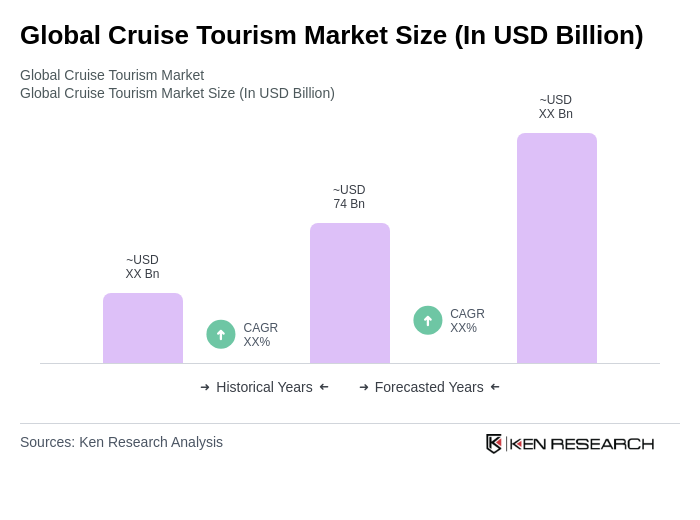
- The Global Cruise Tourism Market is valued at USD 74 billion, based on a five-year historical analysis. This growth is primarily driven by increasing disposable incomes, a rising trend in experiential travel, the expansion of cruise itineraries to new and exotic destinations, and the adoption of advanced technologies such as artificial intelligence for enhanced passenger experience and operational efficiency. The market has seen a robust resurgence post-pandemic, with a marked uptick in bookings and consumer interest in cruise vacations, especially among Gen-X and Millennials. The sector now supports over 1.6 million jobs and delivers significant global economic impact, reflecting its dynamic recovery and sustained momentum .
- Key players in this market include the United States, the Caribbean, and Europe, which dominate due to their well-established cruise infrastructure, diverse offerings, and strong marketing strategies. The United States remains the leading source market for cruise passengers, with North America, the Caribbean, Bahamas, Bermuda, and the Mediterranean as top destination choices. The Caribbean is favored for its picturesque destinations and favorable weather, making it a top choice for cruise itineraries .
- In 2023, the U.S. government implemented new regulations aimed at enhancing safety and environmental standards in the cruise industry. Under the “Cruise Vessel Security and Safety Act (CVSSA), 2023” issued by the U.S. Department of Transportation, cruise lines are required to adopt cleaner technologies and reduce emissions by 30% by 2030, promoting sustainability and ensuring compliance with international maritime laws. These regulations mandate operational upgrades, emission monitoring, and periodic reporting to federal authorities .
Global Cruise Tourism Market Segmentation
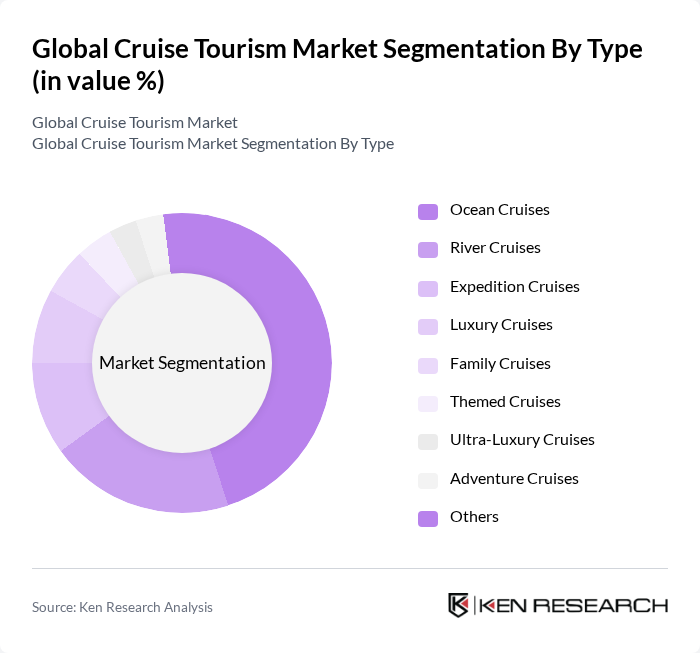
By Type:The cruise tourism market is segmented into various types, including Ocean Cruises, River Cruises, Expedition Cruises, Luxury Cruises, Family Cruises, Themed Cruises, Ultra-Luxury Cruises, Adventure Cruises, and Others. Among these, Ocean Cruises dominate the market due to their extensive itineraries, larger passenger capacities, and broad appeal across demographics. River Cruises are gaining traction for their unique experiences and scenic routes, while Luxury and Ultra-Luxury Cruises cater to affluent travelers seeking exclusive, personalized experiences. Expedition Cruises are increasingly popular for adventure seekers, offering specialized journeys to remote destinations with onboard experts and sustainability-focused amenities .
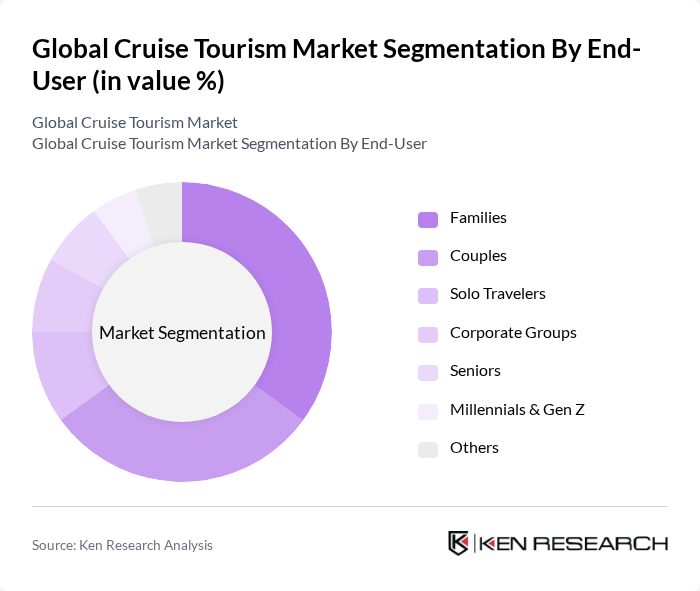
By End-User:The end-user segmentation includes Families, Couples, Solo Travelers, Corporate Groups, Seniors, Millennials & Gen Z, and Others. Families and Couples are the leading segments, driven by the appeal of family-friendly amenities, diverse entertainment options, and romantic getaway packages. Millennials and Gen Z are increasingly participating in cruise tourism, seeking unique experiences, social activities, and technology-driven amenities onboard. Corporate Groups utilize cruises for retreats and team-building events, while Seniors favor cruises for their comfort, safety, and curated itineraries .
Global Cruise Tourism Market Competitive Landscape
The Global Cruise Tourism Market is characterized by a dynamic mix of regional and international players. Leading participants such as Carnival Corporation & plc, Royal Caribbean Group, Norwegian Cruise Line Holdings Ltd., MSC Cruises S.A., Genting Hong Kong Limited, Disney Cruise Line, Holland America Line, Princess Cruises, Celebrity Cruises, AIDA Cruises, Costa Cruises, Viking Cruises, Seabourn Cruise Line, P&O Cruises, Cunard Line contribute to innovation, geographic expansion, and service delivery in this space.
Global Cruise Tourism Market Industry Analysis
Growth Drivers
- Increasing Disposable Income:The global average disposable income is projected to reach $32,000 per capita in future, up from $28,000. This increase allows more consumers to allocate funds for leisure activities, including cruise vacations. Countries like China and India are experiencing rapid economic growth, with GDP growth rates of 4.5% and 6.6%, respectively, further boosting consumer spending on travel. This trend is expected to significantly enhance the cruise tourism market.
- Rising Popularity of Experiential Travel:In future, experiential travel is anticipated to account for approximately $1.5 trillion of the global travel market, reflecting a shift in consumer preferences towards immersive experiences. Cruises offer unique opportunities for cultural engagement and adventure, appealing to millennials and Gen Z travelers. This demographic shift is supported by a 25% increase in bookings for experiential travel packages, indicating a strong demand for cruise experiences that combine leisure with exploration.
- Expansion of Cruise Itineraries and Destinations:The number of cruise itineraries is expected to increase by 20% in future, with new routes introduced in regions like Southeast Asia and the Arctic. This expansion is driven by consumer demand for diverse travel experiences. Additionally, the introduction of 15 new cruise ships, each accommodating over 4,000 passengers, will enhance capacity and attract more travelers. This trend is crucial for sustaining growth in the cruise tourism sector.
Market Challenges
- Environmental Concerns and Regulations:The cruise industry faces increasing scrutiny regarding its environmental impact, with regulations tightening globally. In future, the International Maritime Organization (IMO) aims to reduce greenhouse gas emissions from ships by 40% by 2030. Compliance with these regulations may require significant investments, estimated at $6 billion across the industry, potentially impacting profitability and operational strategies for cruise lines.
- Impact of Global Pandemics on Travel:The COVID-19 pandemic severely disrupted the cruise industry, leading to a 70% decline in passenger numbers in 2020. Although recovery is underway, ongoing health concerns and potential future pandemics pose significant risks. In future, the industry anticipates a cautious recovery, with passenger numbers projected to reach 35 million, still below pre-pandemic levels of 40 million, highlighting the lingering effects of health crises on travel behavior.
Global Cruise Tourism Market Future Outlook
The cruise tourism market is poised for a dynamic evolution, driven by changing consumer preferences and technological advancements. As travelers increasingly seek personalized and immersive experiences, cruise lines are expected to innovate their offerings. Enhanced digital engagement strategies will play a crucial role in attracting younger demographics. Furthermore, sustainability initiatives will likely become a focal point, as companies strive to meet regulatory demands while appealing to environmentally conscious consumers, shaping the future landscape of cruise tourism.
Market Opportunities
- Growth in Emerging Markets:Emerging markets, particularly in Asia and South America, present significant growth opportunities for cruise tourism. With a combined population of over 2.5 billion, these regions are witnessing a rise in middle-class consumers eager to explore cruise options. In future, the number of cruise passengers from Asia is expected to increase by 30%, indicating a robust potential for market expansion.
- Development of Sustainable Cruise Options:The demand for sustainable travel options is on the rise, with 70% of travelers indicating a preference for eco-friendly experiences. Cruise lines are increasingly investing in green technologies, such as LNG-powered ships and waste reduction systems. In future, the market for sustainable cruises is projected to grow by 35%, reflecting a significant opportunity for companies to differentiate themselves and attract environmentally conscious consumers.
Scope of the Report
| Segment | Sub-Segments |
|---|---|
| By Type | Ocean Cruises River Cruises Expedition Cruises Luxury Cruises Family Cruises Themed Cruises Ultra-Luxury Cruises Adventure Cruises Others |
| By End-User | Families Couples Solo Travelers Corporate Groups Seniors Millennials & Gen Z Others |
| By Duration | Short Cruises (1-3 days) Medium Cruises (4-7 days) Long Cruises (8-14 days) Extended Cruises (15+ days) Others |
| By Destination | Caribbean Mediterranean Alaska Asia-Pacific Northern Europe South America Antarctica Others |
| By Booking Channel | Direct Booking Travel Agents Online Travel Agencies Cruise Line Websites Mobile Apps Others |
| By Age Group | Children (0-12 years) Teens (13-19 years) Young Adults (20-35 years) Adults (36-60 years) Seniors (60+ years) Others |
| By Price Range | Budget Cruises Mid-Range Cruises Premium Cruises Luxury Cruises Ultra-Luxury Cruises Others |
Key Target Audience
Investors and Venture Capitalist Firms
Government and Regulatory Bodies (e.g., International Maritime Organization, U.S. Coast Guard)
Cruise Line Operators
Port Authorities
Travel Agencies and Tour Operators
Destination Management Organizations
Environmental and Sustainability Organizations
Insurance Companies
Players Mentioned in the Report:
Carnival Corporation & plc
Royal Caribbean Group
Norwegian Cruise Line Holdings Ltd.
MSC Cruises S.A.
Genting Hong Kong Limited
Disney Cruise Line
Holland America Line
Princess Cruises
Celebrity Cruises
AIDA Cruises
Costa Cruises
Viking Cruises
Seabourn Cruise Line
P&O Cruises
Cunard Line
Table of Contents
Market Assessment Phase
1. Executive Summary and Approach
2. Global Cruise Tourism Market Overview
2.1 Key Insights and Strategic Recommendations
2.2 Global Cruise Tourism Market Overview
2.3 Definition and Scope
2.4 Evolution of Market Ecosystem
2.5 Timeline of Key Regulatory Milestones
2.6 Value Chain & Stakeholder Mapping
2.7 Business Cycle Analysis
2.8 Policy & Incentive Landscape
3. Global Cruise Tourism Market Analysis
3.1 Growth Drivers
3.1.1 Increasing disposable income and consumer spending
3.1.2 Rising popularity of experiential travel
3.1.3 Expansion of cruise itineraries and destinations
3.1.4 Technological advancements in cruise operations
3.2 Market Challenges
3.2.1 Environmental concerns and regulations
3.2.2 Impact of global pandemics on travel
3.2.3 High operational costs for cruise lines
3.2.4 Competition from alternative travel options
3.3 Market Opportunities
3.3.1 Growth in emerging markets
3.3.2 Development of sustainable cruise options
3.3.3 Partnerships with local tourism boards
3.3.4 Innovations in onboard experiences
3.4 Market Trends
3.4.1 Increasing demand for luxury cruises
3.4.2 Focus on wellness and health-oriented cruises
3.4.3 Rise of themed cruises (e.g., music, culinary)
3.4.4 Enhanced digital engagement and marketing
3.5 Government Regulation
3.5.1 Emission control regulations
3.5.2 Safety and health regulations post-pandemic
3.5.3 Port access regulations
3.5.4 Tax incentives for cruise tourism development
4. SWOT Analysis
5. Stakeholder Analysis
6. Porter's Five Forces Analysis
7. Global Cruise Tourism Market Market Size, 2019-2024
7.1 By Value
7.2 By Volume
7.3 By Average Selling Price
8. Global Cruise Tourism Market Segmentation
8.1 By Type
8.1.1 Ocean Cruises
8.1.2 River Cruises
8.1.3 Expedition Cruises
8.1.4 Luxury Cruises
8.1.5 Family Cruises
8.1.6 Themed Cruises
8.1.7 Ultra-Luxury Cruises
8.1.8 Adventure Cruises
8.1.9 Others
8.2 By End-User
8.2.1 Families
8.2.2 Couples
8.2.3 Solo Travelers
8.2.4 Corporate Groups
8.2.5 Seniors
8.2.6 Millennials & Gen Z
8.2.7 Others
8.3 By Duration
8.3.1 Short Cruises (1-3 days)
8.3.2 Medium Cruises (4-7 days)
8.3.3 Long Cruises (8-14 days)
8.3.4 Extended Cruises (15+ days)
8.3.5 Others
8.4 By Destination
8.4.1 Caribbean
8.4.2 Mediterranean
8.4.3 Alaska
8.4.4 Asia-Pacific
8.4.5 Northern Europe
8.4.6 South America
8.4.7 Antarctica
8.4.8 Others
8.5 By Booking Channel
8.5.1 Direct Booking
8.5.2 Travel Agents
8.5.3 Online Travel Agencies
8.5.4 Cruise Line Websites
8.5.5 Mobile Apps
8.5.6 Others
8.6 By Age Group
8.6.1 Children (0-12 years)
8.6.2 Teens (13-19 years)
8.6.3 Young Adults (20-35 years)
8.6.4 Adults (36-60 years)
8.6.5 Seniors (60+ years)
8.6.6 Others
8.7 By Price Range
8.7.1 Budget Cruises
8.7.2 Mid-Range Cruises
8.7.3 Premium Cruises
8.7.4 Luxury Cruises
8.7.5 Ultra-Luxury Cruises
8.7.6 Others
9. Global Cruise Tourism Market Competitive Analysis
9.1 Market Share of Key Players
9.2 Cross Comparison of Key Players
9.2.1 Company Name
9.2.2 Group Size (Large, Medium, or Small as per industry convention)
9.2.3 Total Revenue (USD)
9.2.4 Revenue Growth Rate (%)
9.2.5 Passenger Capacity
9.2.6 Number of Ships
9.2.7 Fleet Utilization Rate (%)
9.2.8 Average Occupancy Rate (%)
9.2.9 Market Penetration Rate (%)
9.2.10 Onboard Revenue per Passenger (USD)
9.2.11 Net Promoter Score (NPS)
9.2.12 Customer Satisfaction Score
9.2.13 Repeat Customer Rate (%)
9.2.14 Average Cruise Length (days)
9.2.15 Pricing Strategy (Budget, Mid-Range, Premium, Luxury)
9.2.16 Sustainability Initiatives (e.g., % of fleet with green technology)
9.3 SWOT Analysis of Top Players
9.4 Pricing Analysis
9.5 Detailed Profile of Major Companies
9.5.1 Carnival Corporation & plc
9.5.2 Royal Caribbean Group
9.5.3 Norwegian Cruise Line Holdings Ltd.
9.5.4 MSC Cruises S.A.
9.5.5 Genting Hong Kong Limited
9.5.6 Disney Cruise Line
9.5.7 Holland America Line
9.5.8 Princess Cruises
9.5.9 Celebrity Cruises
9.5.10 AIDA Cruises
9.5.11 Costa Cruises
9.5.12 Viking Cruises
9.5.13 Seabourn Cruise Line
9.5.14 P&O Cruises
9.5.15 Cunard Line
10. Global Cruise Tourism Market End-User Analysis
10.1 Procurement Behavior of Key Ministries
10.1.1 Government spending on tourism promotion
10.1.2 Collaboration with cruise lines for port development
10.1.3 Investment in infrastructure for cruise tourism
10.1.4 Regulatory support for cruise operations
10.2 Corporate Spend on Infrastructure & Energy
10.2.1 Investment in sustainable energy solutions
10.2.2 Funding for port upgrades and expansions
10.2.3 Expenditure on marketing and promotions
10.2.4 Partnerships with local businesses
10.3 Pain Point Analysis by End-User Category
10.3.1 High costs of cruise vacations
10.3.2 Limited availability of desired itineraries
10.3.3 Concerns over safety and health
10.3.4 Environmental impact of cruises
10.4 User Readiness for Adoption
10.4.1 Awareness of cruise options
10.4.2 Willingness to pay for premium experiences
10.4.3 Interest in sustainable travel options
10.4.4 Familiarity with booking processes
10.5 Post-Deployment ROI and Use Case Expansion
10.5.1 Customer retention strategies
10.5.2 Expansion of cruise offerings based on feedback
10.5.3 Analysis of onboard spending patterns
10.5.4 Long-term partnerships with local destinations
11. Global Cruise Tourism Market Future Size, 2025-2030
11.1 By Value
11.2 By Volume
11.3 By Average Selling Price
Go-To-Market Strategy Phase
1. Whitespace Analysis + Business Model Canvas
1.1 Market gaps and opportunities
1.2 Value proposition development
1.3 Revenue model exploration
1.4 Customer segmentation analysis
1.5 Competitive landscape overview
1.6 Key partnerships identification
1.7 Risk assessment and mitigation strategies
2. Marketing and Positioning Recommendations
2.1 Branding strategies
2.2 Product USPs
2.3 Target audience identification
2.4 Marketing channels selection
2.5 Messaging and communication strategies
2.6 Performance metrics for marketing
3. Distribution Plan
3.1 Urban retail strategies
3.2 Rural NGO tie-ups
3.3 Online distribution channels
3.4 Partnerships with travel agencies
3.5 Direct-to-consumer sales approaches
4. Channel & Pricing Gaps
4.1 Underserved routes
4.2 Pricing bands analysis
4.3 Competitor pricing strategies
4.4 Customer willingness to pay
4.5 Dynamic pricing opportunities
5. Unmet Demand & Latent Needs
5.1 Category gaps identification
5.2 Consumer segments analysis
5.3 Emerging trends in consumer preferences
5.4 Opportunities for product innovation
6. Customer Relationship
6.1 Loyalty programs development
6.2 After-sales service strategies
6.3 Customer feedback mechanisms
6.4 Engagement through social media
7. Value Proposition
7.1 Sustainability initiatives
7.2 Integrated supply chains
7.3 Unique onboard experiences
7.4 Customization options for travelers
8. Key Activities
8.1 Regulatory compliance measures
8.2 Branding strategies implementation
8.3 Distribution setup processes
8.4 Staff training and development
9. Entry Strategy Evaluation
9.1 Domestic Market Entry Strategy
9.1.1 Product mix considerations
9.1.2 Pricing band strategies
9.1.3 Packaging options for consumers
9.2 Export Entry Strategy
9.2.1 Target countries analysis
9.2.2 Compliance roadmap development
10. Entry Mode Assessment
10.1 Joint Ventures
10.2 Greenfield investments
10.3 Mergers & Acquisitions
10.4 Distributor Model evaluation
11. Capital and Timeline Estimation
11.1 Capital requirements analysis
11.2 Timelines for market entry
12. Control vs Risk Trade-Off
12.1 Ownership vs Partnerships considerations
13. Profitability Outlook
13.1 Breakeven analysis
13.2 Long-term sustainability strategies
14. Potential Partner List
14.1 Distributors identification
14.2 Joint Ventures opportunities
14.3 Acquisition targets analysis
15. Execution Roadmap
15.1 Phased Plan for Market Entry
15.1.1 Market Setup
15.1.2 Market Entry
15.1.3 Growth Acceleration
15.1.4 Scale & Stabilize
15.2 Key Activities and Milestones
15.2.1 Milestone planning
15.2.2 Activity tracking
Research Methodology
Phase 1: Approach1
Desk Research
- Analysis of global cruise tourism reports from industry associations and tourism boards
- Review of market trends and forecasts from travel and tourism journals
- Examination of demographic and economic data from government tourism statistics
Primary Research
- Interviews with cruise line executives and marketing managers
- Surveys with travel agents and tour operators specializing in cruise packages
- Focus groups with cruise passengers to gather insights on preferences and experiences
Validation & Triangulation
- Cross-validation of findings through multiple data sources including industry reports and expert opinions
- Triangulation of qualitative insights from interviews with quantitative data from surveys
- Sanity checks through expert panel reviews comprising industry veterans and analysts
Phase 2: Market Size Estimation1
Top-down Assessment
- Estimation of total market size based on global tourism expenditure and cruise industry share
- Segmentation by geographic regions and cruise types (e.g., luxury, family, adventure)
- Incorporation of growth rates from historical data and future tourism trends
Bottom-up Modeling
- Collection of data on passenger capacity and occupancy rates from leading cruise lines
- Analysis of average spending per passenger on board and during excursions
- Calculation of revenue streams from ticket sales, onboard services, and excursions
Forecasting & Scenario Analysis
- Multi-factor regression analysis incorporating economic indicators and travel sentiment
- Scenario modeling based on potential impacts of global events (e.g., pandemics, economic downturns)
- Development of baseline, optimistic, and pessimistic forecasts through 2030
Phase 3: CATI Sample Composition1
| Scope Item/Segment | Sample Size | Target Respondent Profiles |
|---|---|---|
| Luxury Cruise Market | 60 | C-suite Executives, Marketing Directors |
| Family Cruise Packages | 100 | Travel Agents, Family Travelers |
| Adventure and Expedition Cruises | 50 | Outdoor Enthusiasts, Tour Operators |
| Emerging Markets in Cruise Tourism | 40 | Regional Tourism Boards, Market Analysts |
| Onboard Experience and Services | 70 | Cruise Passengers, Hospitality Managers |
Frequently Asked Questions
What is the current value of the Global Cruise Tourism Market?
The Global Cruise Tourism Market is valued at approximately USD 74 billion, reflecting a robust recovery and growth driven by increasing disposable incomes, a trend towards experiential travel, and the expansion of cruise itineraries to new destinations.
What factors are driving the growth of the cruise tourism market?
Which regions dominate the Global Cruise Tourism Market?
What types of cruises are available in the market?
Other Regional/Country Reports
Indonesia Cruise Tourism Market
Malaysia Cruise Tourism Market
APAC Cruise Tourism Market
SEA Cruise Tourism Market
Other Adjacent Reports
Malaysia Travel Agency Market
Vietnam Luxury Travel Market Size, Share & Forecast, By Service Type, Customer Type & Booking Channel, 2025–2032UAE Adventure Tourism Market Size, Share & Forecast, By Activity Type, Traveler Type & Booking Channel, 2026–2032Oman Sustainable Tourism Market
Qatar Maritime Transportation Market
Kuwait Travel Technology Market
Philippines Tour Operator Market
Global Vacation Rental Market Size, Share & Forecast, By Property Type, Booking Mode & Traveler Type, 2025-2032Middle East Event Management Market Size, Share & Forecast, By Event Type, Service Type & Delivery Mode, 2026-2031Why Buy From Us?

What makes us stand out is that our consultants follow Robust, Refine and Result (RRR) methodology. Robust for clear definitions, approaches and sanity checking, Refine for differentiating respondents' facts and opinions, and Result for presenting data with story.

We have set a benchmark in the industry by offering our clients with syndicated and customized market research reports featuring coverage of entire market as well as meticulous research and analyst insights.

While we don't replace traditional research, we flip the method upside down. Our dual approach of Top Bottom & Bottom Top ensures quality deliverable by not just verifying company fundamentals but also looking at the sector and macroeconomic factors.

With one step in the future, our research team constantly tries to show you the bigger picture. We help with some of the tough questions you may encounter along the way: How is the industry positioned? Best marketing channel? KPI's of competitors? By aligning every element, we help maximize success.

Our report gives you instant access to the answers and sources that other companies might choose to hide. We elaborate each steps of research methodology we have used and showcase you the sample size to earn your trust.

If you need any support, we are here! We pride ourselves on universe strength, data quality, and quick, friendly, and professional service.