Global Defibrillator Market

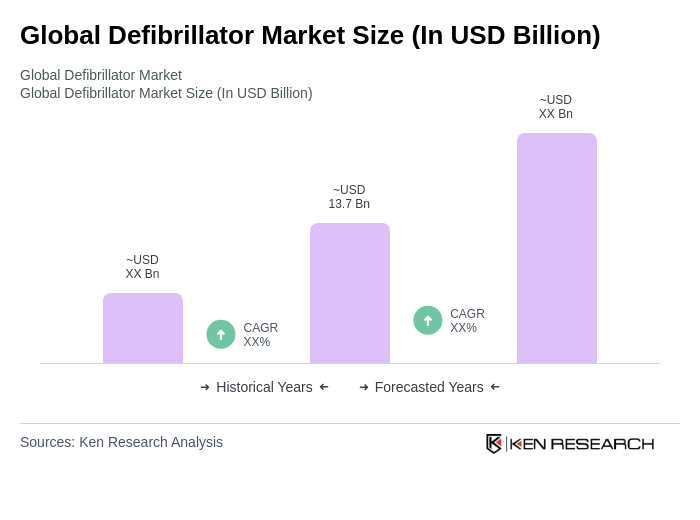
The global defibrillator market, valued at USD 13.7 billion, grows due to increasing CVD prevalence, SCA awareness, and innovations in automated external and implantable devices.

Region:Global

Author(s):Dev

Product Code:KRAA3018

Pages:87

Published On:August 2025
About the Report

Base Year 2024

Global Defibrillator Market Overview

  • The Global Defibrillator Market is valued at USD 13.7 billion, based on a five-year historical analysis. This growth is primarily driven by the increasing prevalence of cardiovascular diseases, rising awareness about sudden cardiac arrest, advancements in defibrillator technology, and the expansion of healthcare infrastructure in developing countries. The market has seen a surge in demand for automated external defibrillators (AEDs) and implantable cardioverter defibrillators (ICDs), which are crucial for emergency medical responses. Additionally, government initiatives to increase public access to defibrillators and training programs are further fueling market expansion .
  • Key players in this market include the United States, Germany, and Japan, which dominate due to their advanced healthcare infrastructure, high investment in medical technology, and strong regulatory frameworks. The U.S. leads in innovation and adoption of new technologies, while Germany and Japan are known for their manufacturing capabilities and high-quality standards in medical devices .
  • In 2023, the United States strengthened requirements for AED accessibility in public spaces through the "Cardiac Arrest Survival Act of 2000" (Public Law 106-505), enforced by the U.S. Department of Health and Human Services. This federal law mandates the availability of AEDs in federal buildings and provides Good Samaritan protections for AED users. Many states have also enacted laws requiring AEDs in schools, airports, and other public venues, with compliance involving regular device maintenance and staff training .
Global Defibrillator Market Size

Global Defibrillator Market Segmentation

By Type:The defibrillator market is segmented into various types, including Automated External Defibrillators (AEDs), Implantable Cardioverter Defibrillators (ICDs), Manual Defibrillators, Wearable Defibrillators, and External Defibrillators (General). Among these, Automated External Defibrillators (AEDs) are the most widely used due to their ease of use and effectiveness in public access locations. The increasing number of public access AEDs is driven by initiatives to improve emergency response capabilities in communities and growing awareness of sudden cardiac arrest survival .
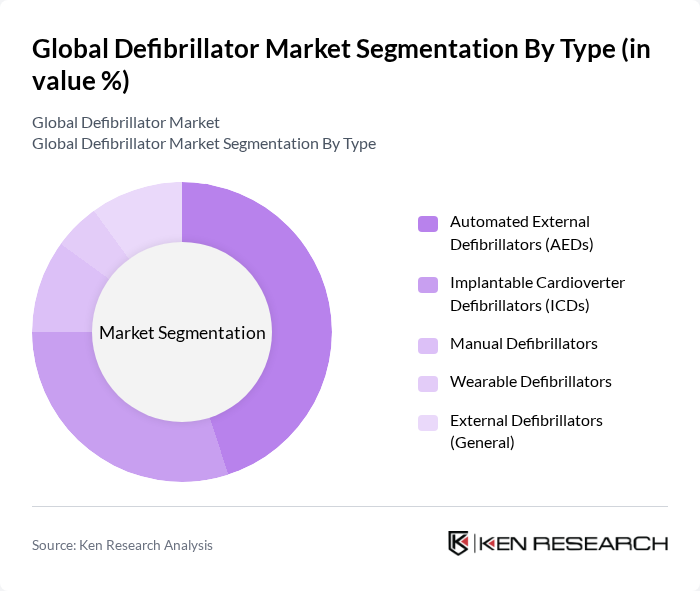
Global Defibrillator Market segmentation by Type.

By End-User:The market is also segmented by end-user, which includes Hospitals, Emergency Medical Services (EMS) / Pre-hospital, Public Access Locations, Home Healthcare / Home Care, and Alternate Care Settings. Hospitals are the largest end-user segment, driven by the need for advanced cardiac care and the increasing number of cardiac procedures performed. The growing trend of integrating defibrillators into emergency medical services is also notable, enhancing pre-hospital care and improving patient outcomes .
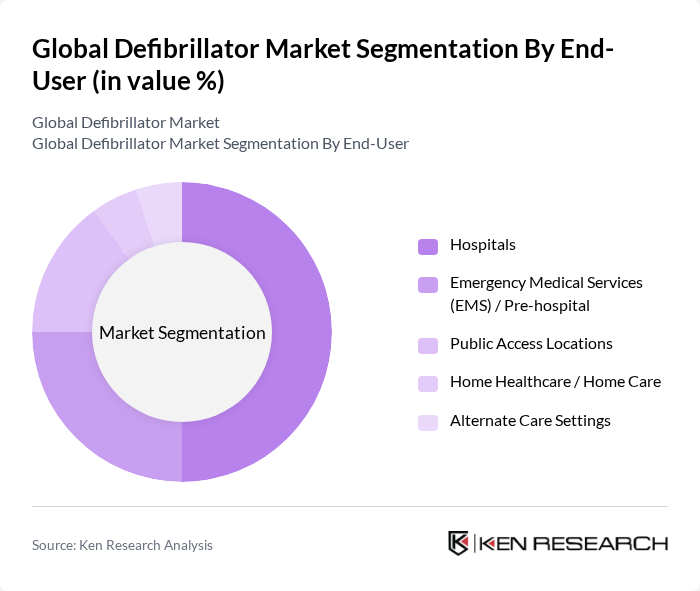
Global Defibrillator Market segmentation by End-User.

Global Defibrillator Market Competitive Landscape

The Global Defibrillator Market is characterized by a dynamic mix of regional and international players. Leading participants such as Philips Healthcare, ZOLL Medical Corporation, Medtronic plc, Cardiac Science Corporation (now part of ZOLL Medical), Physio-Control, Inc. (now part of Stryker Corporation), Stryker Corporation, Abbott Laboratories, Boston Scientific Corporation, Asahi Kasei Corporation (including Nihon Kohden and ZOLL Medical), BIOTRONIK SE & Co. KG, HeartSine Technologies (now part of Stryker Corporation), Defibtech, LLC, Laerdal Medical AS, Nihon Kohden Corporation, MicroPort Scientific Corporation contribute to innovation, geographic expansion, and service delivery in this space .

Philips Healthcare

1891

Amsterdam, Netherlands

ZOLL Medical Corporation

1980

Chelmsford, Massachusetts, USA

Medtronic plc

1949

Dublin, Ireland

Stryker Corporation

1941

Kalamazoo, Michigan, USA

Abbott Laboratories

1888

Abbott Park, Illinois, USA

Company

Establishment Year

Headquarters

Group Size (Large, Medium, or Small as per industry convention)

Global Defibrillator Revenue (USD Million)

Revenue Growth Rate (YoY %)

Market Share (%)

Geographic Presence (Number of Countries/Regions)

Product Portfolio Breadth (Number of Defibrillator SKUs/Models)

Global Defibrillator Market Industry Analysis

Growth Drivers

  • Increasing Prevalence of Cardiovascular Diseases:Cardiovascular diseases (CVDs) are a leading cause of mortality, accounting for approximately 17.9 million deaths annually, as reported by the World Health Organization. In future, the global burden of CVDs is projected to rise, with an estimated 1.6 billion individuals affected. This alarming trend drives the demand for defibrillators, as timely intervention is crucial for survival, thereby propelling market growth in regions with high CVD prevalence, including None.
  • Rising Awareness About Sudden Cardiac Arrest:The awareness surrounding sudden cardiac arrest (SCA) has significantly increased, with campaigns reaching millions. In future, it is estimated that over 356,000 out-of-hospital cardiac arrests occur annually in the U.S. alone, highlighting the urgent need for accessible defibrillation. Educational initiatives and community programs are expected to enhance public knowledge, leading to a higher adoption rate of defibrillators in public spaces and homes, particularly in None.
  • Technological Advancements in Defibrillator Devices:The defibrillator market is witnessing rapid technological advancements, with innovations such as smartphone connectivity and real-time monitoring. In future, the introduction of next-generation automated external defibrillators (AEDs) is anticipated, featuring enhanced user interfaces and improved battery life. These advancements not only increase device efficacy but also encourage broader adoption among healthcare providers and laypersons, particularly in None, where technology integration is becoming essential.

Market Challenges

  • High Cost of Advanced Defibrillator Devices:The high cost associated with advanced defibrillator devices remains a significant barrier to market growth. In future, the average price of high-end AEDs can exceed $2,500, making them less accessible for smaller healthcare facilities and rural areas. This financial constraint limits the widespread deployment of these life-saving devices, particularly in None, where budgetary restrictions are prevalent among healthcare providers.
  • Lack of Trained Personnel for Device Operation:A critical challenge in the defibrillator market is the shortage of trained personnel capable of operating these devices effectively. In future, it is estimated that only 46% of bystanders are trained in CPR and AED usage during emergencies. This lack of training can lead to underutilization of defibrillators, particularly in None, where educational resources and training programs are insufficient, hindering potential life-saving interventions.

Global Defibrillator Market Future Outlook

The future of the defibrillator market appears promising, driven by increasing public health initiatives and technological innovations. As awareness of cardiovascular health continues to grow, more communities are likely to implement public access defibrillation programs. Additionally, the integration of artificial intelligence and telemedicine into defibrillator technology is expected to enhance patient outcomes. These trends will likely foster a more proactive approach to cardiac care, particularly in underserved regions like None, where access to life-saving devices is critical.

Market Opportunities

  • Expansion in Emerging Markets:Emerging markets present significant opportunities for defibrillator manufacturers. With a growing middle class and increasing healthcare investments, regions like None are poised for expansion. In future, healthcare spending in these markets is projected to reach $1.2 trillion, creating a favorable environment for the adoption of defibrillators in hospitals and public spaces.
  • Development of Portable and User-Friendly Devices:The demand for portable and user-friendly defibrillators is on the rise, particularly among non-medical users. In future, the market for compact AEDs is expected to grow, driven by innovations that simplify usage. This trend will enhance accessibility, especially in None, where portable devices can be deployed in schools, workplaces, and public venues, increasing survival rates during cardiac emergencies.

Scope of the Report

SegmentSub-Segments
By Type

Automated External Defibrillators (AEDs)

Implantable Cardioverter Defibrillators (ICDs)

Manual Defibrillators

Wearable Defibrillators

External Defibrillators (General)

By End-User

Hospitals

Emergency Medical Services (EMS) / Pre-hospital

Public Access Locations

Home Healthcare / Home Care

Alternate Care Settings

By Application

Cardiac Arrest Treatment

Emergency Response

Training and Education

Others

By Distribution Channel

Direct Sales

Online Retail

Medical Supply Distributors

Others

By Region

North America (U.S., Canada)

Europe (Germany, U.K., France, Italy, Spain, Rest of Europe)

Asia-Pacific (China, Japan, India, South Korea, Australia, Rest of Asia-Pacific)

Latin America (Brazil, Mexico, Argentina, Rest of Latin America)

Middle East & Africa (Saudi Arabia, UAE, South Africa, Rest of MEA)

By Price Range

Low Price Range

Mid Price Range

High Price Range

By Technology

Biphasic Technology

Monophasic Technology

Others

Key Target Audience

Investors and Venture Capitalist Firms

Government and Regulatory Bodies (e.g., Food and Drug Administration, European Medicines Agency)

Manufacturers and Producers

Distributors and Retailers

Healthcare Providers and Hospitals

Emergency Medical Services (EMS) Organizations

Health Insurance Companies

Medical Device Regulatory Consultants

Players Mentioned in the Report:

Philips Healthcare

ZOLL Medical Corporation

Medtronic plc

Cardiac Science Corporation (now part of ZOLL Medical)

Physio-Control, Inc. (now part of Stryker Corporation)

Stryker Corporation

Abbott Laboratories

Boston Scientific Corporation

Asahi Kasei Corporation (including Nihon Kohden and ZOLL Medical)

BIOTRONIK SE & Co. KG

HeartSine Technologies (now part of Stryker Corporation)

Defibtech, LLC

Laerdal Medical AS

Nihon Kohden Corporation

MicroPort Scientific Corporation

Table of Contents

Market Assessment Phase

1. Executive Summary and Approach


2. Global Defibrillator Market Overview

2.1 Key Insights and Strategic Recommendations

2.2 Global Defibrillator Market Overview

2.3 Definition and Scope

2.4 Evolution of Market Ecosystem

2.5 Timeline of Key Regulatory Milestones

2.6 Value Chain & Stakeholder Mapping

2.7 Business Cycle Analysis

2.8 Policy & Incentive Landscape


3. Global Defibrillator Market Analysis

3.1 Growth Drivers

3.1.1 Increasing prevalence of cardiovascular diseases
3.1.2 Rising awareness about sudden cardiac arrest
3.1.3 Technological advancements in defibrillator devices
3.1.4 Government initiatives promoting public access to defibrillators

3.2 Market Challenges

3.2.1 High cost of advanced defibrillator devices
3.2.2 Lack of trained personnel for device operation
3.2.3 Regulatory hurdles in device approval
3.2.4 Limited awareness in rural areas

3.3 Market Opportunities

3.3.1 Expansion in emerging markets
3.3.2 Development of portable and user-friendly devices
3.3.3 Integration of AI and IoT in defibrillator technology
3.3.4 Partnerships with healthcare providers for training programs

3.4 Market Trends

3.4.1 Increasing adoption of automated external defibrillators (AEDs)
3.4.2 Growth in telemedicine and remote monitoring
3.4.3 Focus on preventive healthcare measures
3.4.4 Rising demand for wearable defibrillator devices

3.5 Government Regulation

3.5.1 Standards for device safety and efficacy
3.5.2 Guidelines for public access defibrillation programs
3.5.3 Certification requirements for manufacturers
3.5.4 Reimbursement policies for defibrillator devices

4. SWOT Analysis


5. Stakeholder Analysis


6. Porter's Five Forces Analysis


7. Global Defibrillator Market Market Size, 2019-2024

7.1 By Value

7.2 By Volume

7.3 By Average Selling Price


8. Global Defibrillator Market Segmentation

8.1 By Type

8.1.1 Automated External Defibrillators (AEDs)
8.1.2 Implantable Cardioverter Defibrillators (ICDs)
8.1.3 Manual Defibrillators
8.1.4 Wearable Defibrillators
8.1.5 External Defibrillators (General)

8.2 By End-User

8.2.1 Hospitals
8.2.2 Emergency Medical Services (EMS) / Pre-hospital
8.2.3 Public Access Locations
8.2.4 Home Healthcare / Home Care
8.2.5 Alternate Care Settings

8.3 By Application

8.3.1 Cardiac Arrest Treatment
8.3.2 Emergency Response
8.3.3 Training and Education
8.3.4 Others

8.4 By Distribution Channel

8.4.1 Direct Sales
8.4.2 Online Retail
8.4.3 Medical Supply Distributors
8.4.4 Others

8.5 By Region

8.5.1 North America (U.S., Canada)
8.5.2 Europe (Germany, U.K., France, Italy, Spain, Rest of Europe)
8.5.3 Asia-Pacific (China, Japan, India, South Korea, Australia, Rest of Asia-Pacific)
8.5.4 Latin America (Brazil, Mexico, Argentina, Rest of Latin America)
8.5.5 Middle East & Africa (Saudi Arabia, UAE, South Africa, Rest of MEA)

8.6 By Price Range

8.6.1 Low Price Range
8.6.2 Mid Price Range
8.6.3 High Price Range

8.7 By Technology

8.7.1 Biphasic Technology
8.7.2 Monophasic Technology
8.7.3 Others

9. Global Defibrillator Market Competitive Analysis

9.1 Market Share of Key Players

9.2 KPIs for Cross Comparison of Key Players

9.2.1 Company Name
9.2.2 Group Size (Large, Medium, or Small as per industry convention)
9.2.3 Global Defibrillator Revenue (USD Million)
9.2.4 Revenue Growth Rate (YoY %)
9.2.5 Market Share (%)
9.2.6 Geographic Presence (Number of Countries/Regions)
9.2.7 Product Portfolio Breadth (Number of Defibrillator SKUs/Models)
9.2.8 R&D Investment (% of Revenue)
9.2.9 Regulatory Approvals (Number of Major Approvals Last 3 Years)
9.2.10 Distribution Network Coverage (Number of Distributors/Partners)
9.2.11 Customer Satisfaction Score (NPS or Equivalent)
9.2.12 Product Recall Incidence (Last 5 Years)

9.3 SWOT Analysis of Top Players

9.4 Pricing Analysis

9.5 Detailed Profile of Major Companies

9.5.1 Philips Healthcare
9.5.2 ZOLL Medical Corporation
9.5.3 Medtronic plc
9.5.4 Cardiac Science Corporation (now part of ZOLL Medical)
9.5.5 Physio-Control, Inc. (now part of Stryker Corporation)
9.5.6 Stryker Corporation
9.5.7 Abbott Laboratories
9.5.8 Boston Scientific Corporation
9.5.9 Asahi Kasei Corporation (including Nihon Kohden and ZOLL Medical)
9.5.10 BIOTRONIK SE & Co. KG
9.5.11 HeartSine Technologies (now part of Stryker Corporation)
9.5.12 Defibtech, LLC
9.5.13 Laerdal Medical AS
9.5.14 Nihon Kohden Corporation
9.5.15 MicroPort Scientific Corporation

10. Global Defibrillator Market End-User Analysis

10.1 Procurement Behavior of Key Ministries

10.1.1 Budget Allocation for Medical Equipment
10.1.2 Decision-Making Process
10.1.3 Evaluation Criteria for Suppliers

10.2 Corporate Spend on Infrastructure & Energy

10.2.1 Investment in Health Infrastructure
10.2.2 Funding for Emergency Services

10.3 Pain Point Analysis by End-User Category

10.3.1 Accessibility Issues
10.3.2 Training Gaps

10.4 User Readiness for Adoption

10.4.1 Awareness Levels
10.4.2 Training Availability

10.5 Post-Deployment ROI and Use Case Expansion

10.5.1 Cost Savings from Reduced Emergency Response Times
10.5.2 Increased Survival Rates

11. Global Defibrillator Market Future Size, 2025-2030

11.1 By Value

11.2 By Volume

11.3 By Average Selling Price


Go-To-Market Strategy Phase

1. Whitespace Analysis + Business Model Canvas

1.1 Market Gaps Identification

1.2 Business Model Development


2. Marketing and Positioning Recommendations

2.1 Branding Strategies

2.2 Product USPs


3. Distribution Plan

3.1 Urban Retail Strategies

3.2 Rural NGO Tie-Ups


4. Channel & Pricing Gaps

4.1 Underserved Routes

4.2 Pricing Bands


5. Unmet Demand & Latent Needs

5.1 Category Gaps

5.2 Consumer Segments


6. Customer Relationship

6.1 Loyalty Programs

6.2 After-Sales Service


7. Value Proposition

7.1 Sustainability

7.2 Integrated Supply Chains


8. Key Activities

8.1 Regulatory Compliance

8.2 Branding

8.3 Distribution Setup


9. Entry Strategy Evaluation

9.1 Domestic Market Entry Strategy

9.1.1 Product Mix
9.1.2 Pricing Band
9.1.3 Packaging

9.2 Export Entry Strategy

9.2.1 Target Countries
9.2.2 Compliance Roadmap

10. Entry Mode Assessment

10.1 Joint Ventures

10.2 Greenfield Investments

10.3 Mergers & Acquisitions

10.4 Distributor Model


11. Capital and Timeline Estimation

11.1 Capital Requirements

11.2 Timelines


12. Control vs Risk Trade-Off

12.1 Ownership vs Partnerships


13. Profitability Outlook

13.1 Breakeven Analysis

13.2 Long-Term Sustainability


14. Potential Partner List

14.1 Distributors

14.2 Joint Ventures

14.3 Acquisition Targets


15. Execution Roadmap

15.1 Phased Plan for Market Entry

15.1.1 Market Setup
15.1.2 Market Entry
15.1.3 Growth Acceleration
15.1.4 Scale & Stabilize

15.2 Key Activities and Milestones

15.2.1 Activity Planning
15.2.2 Milestone Tracking

Research Methodology

ApproachModellingSample

Phase 1: Approach1

Desk Research

  • Analysis of global defibrillator market reports from industry associations and health organizations
  • Review of published articles and white papers on advancements in defibrillator technology
  • Examination of regulatory frameworks and guidelines from health authorities regarding defibrillator usage

Primary Research

  • Interviews with cardiologists and emergency medical professionals to gather insights on defibrillator usage
  • Surveys conducted with hospital procurement managers to understand purchasing trends and preferences
  • Field interviews with paramedics and first responders to assess real-world application and effectiveness

Validation & Triangulation

  • Cross-validation of data through multiple sources including market reports and expert opinions
  • Triangulation of findings from primary interviews with secondary data trends
  • Sanity checks performed through expert panel reviews to ensure data accuracy and relevance

Phase 2: Market Size Estimation1

Top-down Assessment

  • Estimation of market size based on global healthcare expenditure and emergency medical services funding
  • Segmentation of market data by defibrillator type (manual, automated external defibrillators, etc.)
  • Incorporation of demographic data to assess potential market growth in various regions

Bottom-up Modeling

  • Collection of sales data from leading defibrillator manufacturers to establish baseline figures
  • Analysis of unit sales and pricing strategies across different healthcare settings
  • Volume x price calculations to derive revenue estimates for each market segment

Forecasting & Scenario Analysis

  • Multi-factor regression analysis incorporating factors such as population health trends and technological advancements
  • Scenario modeling based on potential changes in healthcare policies and emergency response protocols
  • Development of baseline, optimistic, and pessimistic forecasts through 2030

Phase 3: CATI Sample Composition1

Scope Item/SegmentSample SizeTarget Respondent Profiles
Hospital Procurement Departments120Procurement Managers, Supply Chain Directors
Emergency Medical Services90Paramedics, EMT Supervisors
Cardiology Clinics60Cardiologists, Clinic Administrators
Public Health Organizations50Health Policy Analysts, Program Directors
Defibrillator Manufacturers40Product Managers, Sales Executives

Frequently Asked Questions

What is the current value of the Global Defibrillator Market?

The Global Defibrillator Market is valued at approximately USD 13.7 billion, driven by the rising prevalence of cardiovascular diseases, increased awareness of sudden cardiac arrest, and advancements in defibrillator technology.

What types of defibrillators are available in the market?

Who are the key players in the Global Defibrillator Market?

What are the main drivers of growth in the defibrillator market?

Other Regional/Country Reports

Why Buy From Us?

Refine Robust Result (RRR) Framework

What makes us stand out is that our consultants follow Robust, Refine and Result (RRR) methodology. Robust for clear definitions, approaches and sanity checking, Refine for differentiating respondents' facts and opinions, and Result for presenting data with story.

Our Reach Is Unmatched

We have set a benchmark in the industry by offering our clients with syndicated and customized market research reports featuring coverage of entire market as well as meticulous research and analyst insights.

Shifting the Research Paradigm

While we don't replace traditional research, we flip the method upside down. Our dual approach of Top Bottom & Bottom Top ensures quality deliverable by not just verifying company fundamentals but also looking at the sector and macroeconomic factors.

More Insights-Better Decisions

With one step in the future, our research team constantly tries to show you the bigger picture. We help with some of the tough questions you may encounter along the way: How is the industry positioned? Best marketing channel? KPI's of competitors? By aligning every element, we help maximize success.

Transparency and Trust

Our report gives you instant access to the answers and sources that other companies might choose to hide. We elaborate each steps of research methodology we have used and showcase you the sample size to earn your trust.

Round the Clock Support

If you need any support, we are here! We pride ourselves on universe strength, data quality, and quick, friendly, and professional service.

Why Clients Choose Us?

400000+
Reports in repository
150+
Consulting projects a year
100+
Analysts
8000+
Client Queries in 2022








