About the Report
Base Year 2024Global DIY Home Improvement Market Overview
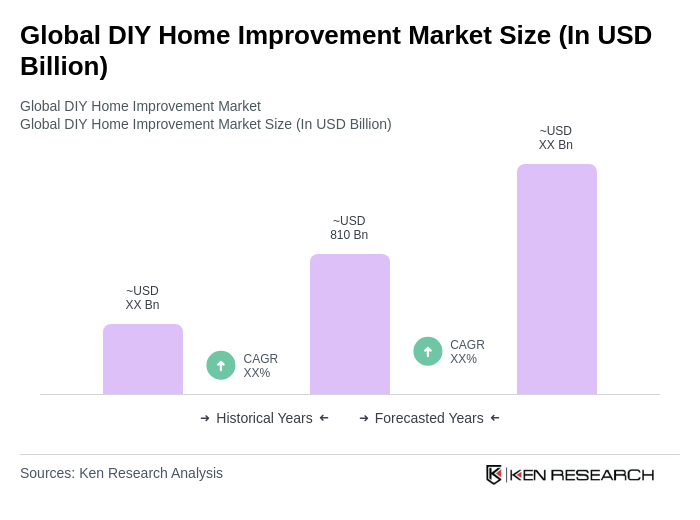
- The Global DIY Home Improvement Market is valued at USD 810 billion, based on a five-year historical analysis. This growth is primarily driven by increasing consumer interest in home renovation projects, the rise of e-commerce platforms, and a growing trend towards sustainable living. Key growth drivers include the surge in homeownership rates among younger generations, heightened demand for personalized living spaces, and the proliferation of online tutorials and communities that support DIY activities. The market has seen a significant uptick in demand for home improvement products as consumers invest in enhancing their living spaces.
- Key players in this market include the United States, Germany, and the United Kingdom. The dominance of these countries can be attributed to their strong retail infrastructure, high disposable incomes, and a culture that encourages home improvement and DIY projects. Additionally, the presence of major retail chains and a robust online shopping environment further solidify their market leadership. North America accounts for over 35% of the global DIY market share, with the United States leading due to high consumer awareness and widespread product availability.
- In 2023, the U.S. government implemented regulations aimed at promoting energy-efficient home improvements. The Inflation Reduction Act of 2022, issued by the U.S. Congress, introduced tax credits for homeowners who invest in energy-efficient appliances and materials, encouraging sustainable practices in the DIY home improvement sector. This regulation requires compliance with specific energy efficiency standards and provides incentives for upgrades such as insulation, windows, and HVAC systems, aiming to reduce energy consumption and promote environmentally friendly home renovations.
Global DIY Home Improvement Market Segmentation
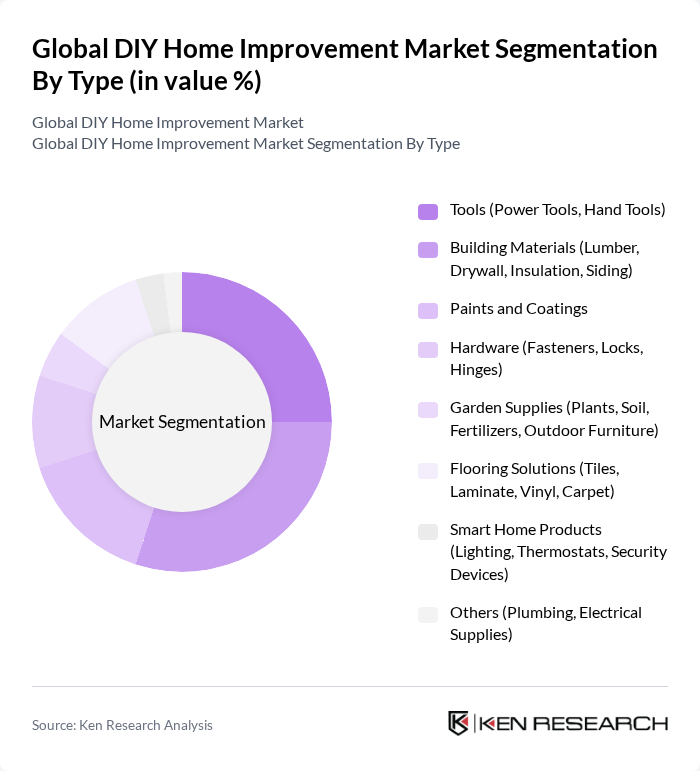
By Type:The market is segmented into various types, including Tools, Building Materials, Paints and Coatings, Hardware, Fixtures and Fittings, Garden Supplies, Flooring Solutions, and Others. Each of these subsegments plays a crucial role in the overall market dynamics, catering to different consumer needs and preferences. Building materials hold the largest share, reflecting their necessity across all project types, while tools and paints/coatings remain essential for both novice and experienced DIY consumers.
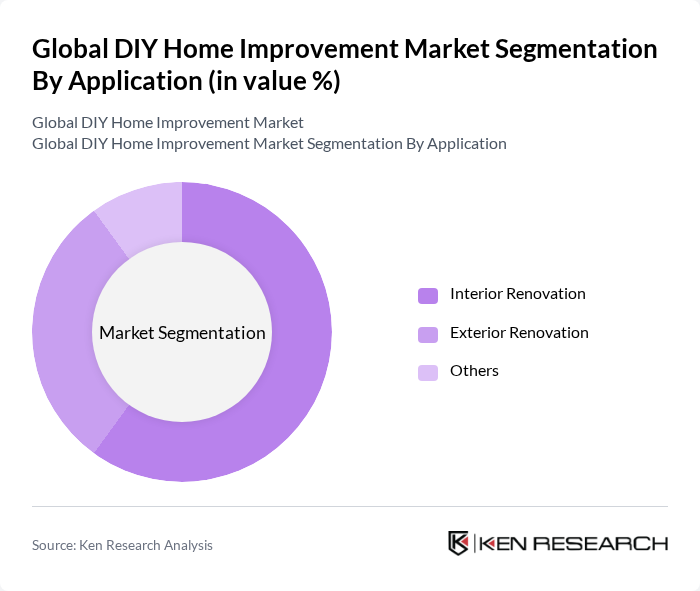
By Application:The applications of DIY home improvement products are categorized into Interior Renovation, Exterior Renovation, and Others. Each application serves distinct consumer needs, with interior renovations often being more popular due to the immediate impact on living spaces. Interior renovation projects, such as painting, furniture assembly, and flooring upgrades, account for the majority of DIY activities, while exterior renovations focus on landscaping, outdoor structures, and facade improvements.
Global DIY Home Improvement Market Competitive Landscape
The Global DIY Home Improvement Market is characterized by a dynamic mix of regional and international players. Leading participants such as The Home Depot, Inc., Lowe's Companies, Inc., Ace Hardware Corporation, Menards, Inc., Kingfisher plc, Travis Perkins plc, B&Q plc, OBI Group Holding SE & Co. KGaA, Sika AG, Saint-Gobain S.A., The Sherwin-Williams Company, RPM International Inc., PPG Industries, Inc., Masco Corporation, Ferguson plc, Groupe Adeo, Wesfarmers Limited (Bunnings Warehouse), HORNBACH Holding AG & Co. KGaA, BAUHAUS AG, Mr. Bricolage Group, Maxeda DIY Group, Intergamma BV, Kesko Corporation, REWE Group, BAUVISTA GmbH & Co. KG, HELLWEG Die Profi-Baumärkte GmbH & Co. KG, hagebau connect GmbH & Co. KG contribute to innovation, geographic expansion, and service delivery in this space.
Global DIY Home Improvement Market Industry Analysis
Growth Drivers
- Increasing Consumer Interest in Home Renovation:The DIY home improvement sector is experiencing a surge, with 60% of homeowners in None indicating plans to undertake renovation projects in future. This trend is driven by a desire for personalized living spaces and increased home value. According to the National Association of Home Builders, the average expenditure on home renovations is projected to reach USD 16,000 per household, reflecting a robust commitment to home improvement activities.
- Rise in Disposable Income:In None, the average disposable income is expected to rise by 4.5% in future, reaching approximately USD 36,000 per capita. This increase allows consumers to allocate more funds toward home improvement projects. As financial stability grows, homeowners are more willing to invest in DIY projects, leading to a projected increase in spending on home improvement supplies and tools, which is anticipated to exceed USD 11 billion in the region.
- Growth of E-commerce Platforms:The e-commerce sector for DIY home improvement products in None is projected to grow by 25% in future, driven by increased online shopping convenience. With over 70% of consumers preferring to shop online for home improvement supplies, platforms like Amazon and local e-commerce sites are expanding their offerings. This shift not only enhances accessibility but also encourages impulse purchases, significantly boosting overall market sales.
Market Challenges
- Supply Chain Disruptions:The DIY home improvement market in None faces significant supply chain challenges, with delays reported in 40% of shipments in future. Factors such as global shipping issues and local logistics inefficiencies have led to increased lead times for essential materials. This disruption can hinder project timelines and increase costs, ultimately affecting consumer satisfaction and market growth.
- Fluctuating Raw Material Prices:The cost of raw materials, such as lumber and steel, has seen volatility, with prices increasing by 16% in future. This fluctuation poses a challenge for DIY enthusiasts and retailers alike, as unpredictable costs can deter consumers from starting projects. Additionally, manufacturers may face squeezed profit margins, leading to potential price increases that could further impact consumer spending in future.
Global DIY Home Improvement Market Future Outlook
The DIY home improvement market in None is poised for significant transformation, driven by evolving consumer preferences and technological advancements. As sustainability becomes a priority, eco-friendly products are expected to gain traction, appealing to environmentally conscious consumers. Furthermore, the integration of smart home technologies will enhance DIY projects, making them more efficient and appealing. These trends indicate a dynamic market landscape, with opportunities for innovation and growth in the coming years.
Market Opportunities
- Expansion into Emerging Markets:Companies can capitalize on the growing middle class in None, where home ownership is increasing. With an estimated 1.6 million new households expected in future, there is a substantial opportunity for DIY retailers to introduce tailored products and services that cater to this expanding demographic, potentially increasing market share significantly.
- Development of Eco-Friendly Products:The demand for sustainable home improvement solutions is rising, with 56% of consumers in None expressing interest in eco-friendly products. By developing and marketing green alternatives, companies can tap into this growing segment, enhancing brand loyalty and attracting environmentally conscious consumers, which could lead to a 21% increase in sales for eco-friendly lines.
Scope of the Report
| Segment | Sub-Segments |
|---|---|
| By Type | Tools Building Materials Paints and Coatings Hardware Fixtures and Fittings Garden Supplies Flooring Solutions Others |
| By Application | Interior Renovation Exterior Renovation Others |
| By End-User | Residential Commercial |
| By Sales Channel | Online Retail Offline Retail Specialty Stores Wholesale Distributors Direct Sales |
| By Product Category | Indoor Improvement Outdoor Improvement Seasonal Products |
| By Price Range | Budget Mid-Range Premium |
| By Geographic Region | North America Europe Asia-Pacific Latin America Middle East & Africa |
Key Target Audience
Investors and Venture Capitalist Firms
Government and Regulatory Bodies (e.g., U.S. Department of Housing and Urban Development, European Commission)
Manufacturers and Producers
Distributors and Retailers
Home Improvement Product Wholesalers
Trade Associations (e.g., National Retail Federation)
Financial Institutions
Real Estate Developers and Contractors
Players Mentioned in the Report:
The Home Depot, Inc.
Lowe's Companies, Inc.
Ace Hardware Corporation
Menards, Inc.
Kingfisher plc
Travis Perkins plc
B&Q plc
OBI Group Holding SE & Co. KGaA
Sika AG
Saint-Gobain S.A.
The Sherwin-Williams Company
RPM International Inc.
PPG Industries, Inc.
Masco Corporation
Ferguson plc
Groupe Adeo
Wesfarmers Limited (Bunnings Warehouse)
HORNBACH Holding AG & Co. KGaA
BAUHAUS AG
Mr. Bricolage Group
Maxeda DIY Group
Intergamma BV
Kesko Corporation
REWE Group
BAUVISTA GmbH & Co. KG
HELLWEG Die Profi-Baumarkte GmbH & Co. KG
hagebau connect GmbH & Co. KG
Table of Contents
Market Assessment Phase
1. Executive Summary and Approach
2. Global DIY Home Improvement Market Overview
2.1 Key Insights and Strategic Recommendations
2.2 Global DIY Home Improvement Market Overview
2.3 Definition and Scope
2.4 Evolution of Market Ecosystem
2.5 Timeline of Key Regulatory Milestones
2.6 Value Chain & Stakeholder Mapping
2.7 Business Cycle Analysis
2.8 Policy & Incentive Landscape
3. Global DIY Home Improvement Market Analysis
3.1 Growth Drivers
3.1.1 Increasing consumer interest in home renovation
3.1.2 Rise in disposable income
3.1.3 Growth of e-commerce platforms
3.1.4 Influence of social media and DIY culture
3.2 Market Challenges
3.2.1 Supply chain disruptions
3.2.2 Fluctuating raw material prices
3.2.3 Competition from professional services
3.2.4 Regulatory compliance issues
3.3 Market Opportunities
3.3.1 Expansion into emerging markets
3.3.2 Development of eco-friendly products
3.3.3 Integration of smart home technologies
3.3.4 Collaboration with influencers and content creators
3.4 Market Trends
3.4.1 Increased focus on sustainability
3.4.2 Growth of online DIY tutorials
3.4.3 Customization and personalization of products
3.4.4 Rise of subscription-based DIY kits
3.5 Government Regulation
3.5.1 Safety standards for home improvement products
3.5.2 Environmental regulations on materials
3.5.3 Tax incentives for home renovations
3.5.4 Building codes and compliance requirements
4. SWOT Analysis
5. Stakeholder Analysis
6. Porter's Five Forces Analysis
7. Global DIY Home Improvement Market Market Size, 2019-2024
7.1 By Value
7.2 By Volume
7.3 By Average Selling Price
8. Global DIY Home Improvement Market Segmentation
8.1 By Type
8.1.1 Tools
8.1.2 Building Materials
8.1.3 Paints and Coatings
8.1.4 Hardware
8.1.5 Fixtures and Fittings
8.1.6 Garden Supplies
8.1.7 Flooring Solutions
8.1.8 Others
8.2 By Application
8.2.1 Interior Renovation
8.2.2 Exterior Renovation
8.2.3 Others
8.3 By End-User
8.3.1 Residential
8.3.2 Commercial
8.4 By Sales Channel
8.4.1 Online Retail
8.4.2 Offline Retail
8.4.3 Specialty Stores
8.4.4 Wholesale Distributors
8.4.5 Direct Sales
8.5 By Product Category
8.5.1 Indoor Improvement
8.5.2 Outdoor Improvement
8.5.3 Seasonal Products
8.6 By Price Range
8.6.1 Budget
8.6.2 Mid-Range
8.6.3 Premium
8.7 By Geographic Region
8.7.1 North America
8.7.2 Europe
8.7.3 Asia-Pacific
8.7.4 Latin America
8.7.5 Middle East & Africa
9. Global DIY Home Improvement Market Competitive Analysis
9.1 Market Share of Key Players
9.2 Cross Comparison of Key Players
9.2.1 Company Name
9.2.2 Group Size (Large, Medium, or Small as per industry convention)
9.2.3 Global Revenue (USD, latest fiscal year)
9.2.4 Revenue Growth Rate (CAGR %)
9.2.5 Market Share (%)
9.2.6 Geographic Presence (Number of countries/regions)
9.2.7 Product Portfolio Breadth (Number of product categories)
9.2.8 Online vs. Offline Sales Mix (%)
9.2.9 Customer Retention Rate (%)
9.2.10 Brand Recognition Score (Survey-based or index)
9.2.11 Customer Satisfaction Index (NPS or equivalent)
9.2.12 Sustainability/ESG Initiatives (qualitative or index)
9.3 SWOT Analysis of Top Players
9.4 Pricing Analysis
9.5 Detailed Profile of Major Companies
9.5.1 The Home Depot, Inc.
9.5.2 Lowe's Companies, Inc.
9.5.3 Ace Hardware Corporation
9.5.4 Menards, Inc.
9.5.5 Kingfisher plc
9.5.6 Travis Perkins plc
9.5.7 B&Q plc
9.5.8 OBI Group Holding SE & Co. KGaA
9.5.9 Sika AG
9.5.10 Saint-Gobain S.A.
9.5.11 The Sherwin-Williams Company
9.5.12 RPM International Inc.
9.5.13 PPG Industries, Inc.
9.5.14 Masco Corporation
9.5.15 Ferguson plc
9.5.16 Groupe Adeo
9.5.17 Wesfarmers Limited (Bunnings Warehouse)
9.5.18 HORNBACH Holding AG & Co. KGaA
9.5.19 BAUHAUS AG
9.5.20 Mr. Bricolage Group
9.5.21 Maxeda DIY Group
9.5.22 Intergamma BV
9.5.23 Kesko Corporation
9.5.24 REWE Group
9.5.25 BAUVISTA GmbH & Co. KG
9.5.26 HELLWEG Die Profi-Baumärkte GmbH & Co. KG
9.5.27 hagebau connect GmbH & Co. KG
10. Global DIY Home Improvement Market End-User Analysis
10.1 Procurement Behavior of Key Ministries
10.1.1 Budget Allocation Trends
10.1.2 Preferred Procurement Channels
10.1.3 Decision-Making Processes
10.2 Corporate Spend on Infrastructure & Energy
10.2.1 Investment Priorities
10.2.2 Spending Patterns
10.2.3 Impact of Economic Conditions
10.3 Pain Point Analysis by End-User Category
10.3.1 Common Challenges Faced
10.3.2 Product Availability Issues
10.3.3 Quality Concerns
10.4 User Readiness for Adoption
10.4.1 Awareness Levels
10.4.2 Training and Support Needs
10.4.3 Technology Adoption Rates
10.5 Post-Deployment ROI and Use Case Expansion
10.5.1 Measurement of Success
10.5.2 Future Investment Plans
10.5.3 Expansion Opportunities
11. Global DIY Home Improvement Market Future Size, 2025-2030
11.1 By Value
11.2 By Volume
11.3 By Average Selling Price
Go-To-Market Strategy Phase
1. Whitespace Analysis + Business Model Canvas
1.1 Market Gaps Identification
1.2 Value Proposition Development
1.3 Revenue Streams Analysis
1.4 Cost Structure Evaluation
1.5 Key Partnerships Exploration
1.6 Customer Segmentation Insights
1.7 Channels and Customer Relationships
2. Marketing and Positioning Recommendations
2.1 Branding Strategies
2.2 Product USPs
2.3 Target Audience Identification
2.4 Communication Strategies
2.5 Digital Marketing Approaches
3. Distribution Plan
3.1 Urban Retail Strategies
3.2 Rural NGO Tie-Ups
3.3 E-commerce Integration
3.4 Logistics and Supply Chain Management
4. Channel & Pricing Gaps
4.1 Underserved Routes
4.2 Pricing Bands Analysis
4.3 Competitor Pricing Strategies
5. Unmet Demand & Latent Needs
5.1 Category Gaps Identification
5.2 Consumer Segments Analysis
5.3 Product Development Opportunities
6. Customer Relationship
6.1 Loyalty Programs
6.2 After-Sales Service Enhancements
6.3 Customer Feedback Mechanisms
7. Value Proposition
7.1 Sustainability Initiatives
7.2 Integrated Supply Chains
7.3 Unique Selling Points
8. Key Activities
8.1 Regulatory Compliance
8.2 Branding Efforts
8.3 Distribution Setup
9. Entry Strategy Evaluation
9.1 Domestic Market Entry Strategy
9.1.1 Product Mix Considerations
9.1.2 Pricing Band Strategies
9.1.3 Packaging Innovations
9.2 Export Entry Strategy
9.2.1 Target Countries Identification
9.2.2 Compliance Roadmap Development
10. Entry Mode Assessment
10.1 Joint Ventures
10.2 Greenfield Investments
10.3 Mergers & Acquisitions
10.4 Distributor Model Evaluation
11. Capital and Timeline Estimation
11.1 Capital Requirements Analysis
11.2 Timelines for Implementation
12. Control vs Risk Trade-Off
12.1 Ownership vs Partnerships
13. Profitability Outlook
13.1 Breakeven Analysis
13.2 Long-Term Sustainability Strategies
14. Potential Partner List
14.1 Distributors
14.2 Joint Ventures
14.3 Acquisition Targets
15. Execution Roadmap
15.1 Phased Plan for Market Entry
15.1.1 Market Setup
15.1.2 Market Entry
15.1.3 Growth Acceleration
15.1.4 Scale & Stabilize
15.2 Key Activities and Milestones
15.2.1 Milestone Planning
15.2.2 Activity Tracking
Research Methodology
Phase 1: Approach1
Desk Research
- Analysis of industry reports from market research firms focusing on DIY home improvement trends
- Review of government publications and housing statistics to understand market dynamics
- Examination of online platforms and forums to gauge consumer preferences and DIY project popularity
Primary Research
- Interviews with industry experts, including product managers from leading DIY brands
- Surveys conducted with home improvement retailers to assess sales trends and customer demographics
- Focus groups with DIY enthusiasts to gather insights on purchasing behavior and product satisfaction
Validation & Triangulation
- Cross-validation of findings through multiple data sources, including sales data and consumer surveys
- Triangulation of qualitative insights from interviews with quantitative data from surveys
- Sanity checks through expert panel reviews to ensure data reliability and accuracy
Phase 2: Market Size Estimation1
Top-down Assessment
- Estimation of market size based on national home improvement spending and growth rates
- Segmentation of the market by product categories such as tools, materials, and home décor
- Incorporation of macroeconomic indicators such as housing starts and renovation trends
Bottom-up Modeling
- Collection of sales data from major DIY retailers to establish baseline revenue figures
- Estimation of average transaction values and frequency of purchases in the DIY sector
- Analysis of regional market variations to refine overall market size estimates
Forecasting & Scenario Analysis
- Utilization of time-series analysis to project future market growth based on historical data
- Scenario modeling based on potential economic shifts and consumer behavior changes
- Development of best-case, worst-case, and most-likely scenarios through 2030
Phase 3: CATI Sample Composition1
| Scope Item/Segment | Sample Size | Target Respondent Profiles |
|---|---|---|
| Home Improvement Retailers | 100 | Store Managers, Category Buyers |
| DIY Product Manufacturers | 80 | Product Development Managers, Marketing Directors |
| Home Renovation Contractors | 60 | General Contractors, Project Managers |
| Consumer DIY Enthusiasts | 90 | Homeowners, Hobbyists |
| Online DIY Platforms | 50 | Community Managers, Content Creators |
Frequently Asked Questions
What is the current value of the Global DIY Home Improvement Market?
The Global DIY Home Improvement Market is valued at approximately USD 810 billion, reflecting significant growth driven by consumer interest in home renovations, e-commerce expansion, and a trend towards sustainable living practices.
What factors are driving growth in the DIY home improvement market?
Which regions dominate the Global DIY Home Improvement Market?
How has government regulation impacted the DIY home improvement market?
Other Regional/Country Reports
Indonesia DIY Home Improvement Market
Malaysia DIY Home Improvement Market
APAC DIY Home Improvement Market
SEA DIY Home Improvement Market
Other Adjacent Reports
Vietnam Gardening Supplies Market
Indonesia Power Tools Market Size, Share & Forecast, By Product Type, Application & Sales Channel, 2025–2032Middle East Building Materials Market Size, Share, Trends & Forecast, By Material Type, Application & Distribution Channel, 2026–2031Belgium Paint and Coatings Market
Japan Hardware Market
Brazil Flooring Solutions Market
Global Lighting Fixtures Market Size, Share, Growth Drivers, Trends, Opportunities & Forecast 2025–2030Global Furniture Market Size, Share & Forecast, By Product Type, Material, End User & Distribution Channel, 2026-2031Indonesia Smart Home Devices Market
Why Buy From Us?

What makes us stand out is that our consultants follow Robust, Refine and Result (RRR) methodology. Robust for clear definitions, approaches and sanity checking, Refine for differentiating respondents' facts and opinions, and Result for presenting data with story.

We have set a benchmark in the industry by offering our clients with syndicated and customized market research reports featuring coverage of entire market as well as meticulous research and analyst insights.

While we don't replace traditional research, we flip the method upside down. Our dual approach of Top Bottom & Bottom Top ensures quality deliverable by not just verifying company fundamentals but also looking at the sector and macroeconomic factors.

With one step in the future, our research team constantly tries to show you the bigger picture. We help with some of the tough questions you may encounter along the way: How is the industry positioned? Best marketing channel? KPI's of competitors? By aligning every element, we help maximize success.

Our report gives you instant access to the answers and sources that other companies might choose to hide. We elaborate each steps of research methodology we have used and showcase you the sample size to earn your trust.

If you need any support, we are here! We pride ourselves on universe strength, data quality, and quick, friendly, and professional service.