Region:Global
Author(s):Dev
Product Code:KRAA8205
Pages:96
Published On:November 2025
 Traction Motor Market.png "Global Electric Vehicle (EV) Traction Motor Market Size")
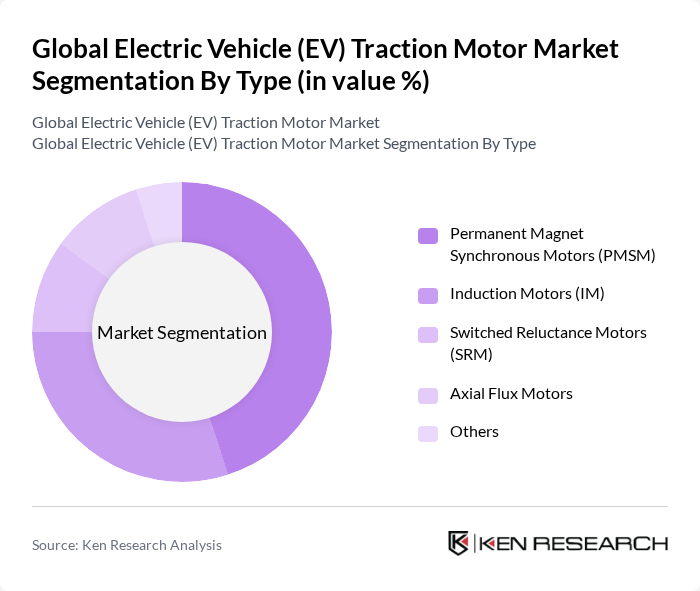
By Type:The traction motor market is segmented into various types, including Permanent Magnet Synchronous Motors (PMSM), Induction Motors (IM), Switched Reluctance Motors (SRM), Axial Flux Motors, and others. Among these, Permanent Magnet Synchronous Motors (PMSM) are leading the market due to their high efficiency, compact size, and superior performance in electric vehicles. The growing demand for high-performance motors in passenger and commercial vehicles is driving the adoption of PMSM, making it the preferred choice for manufacturers.
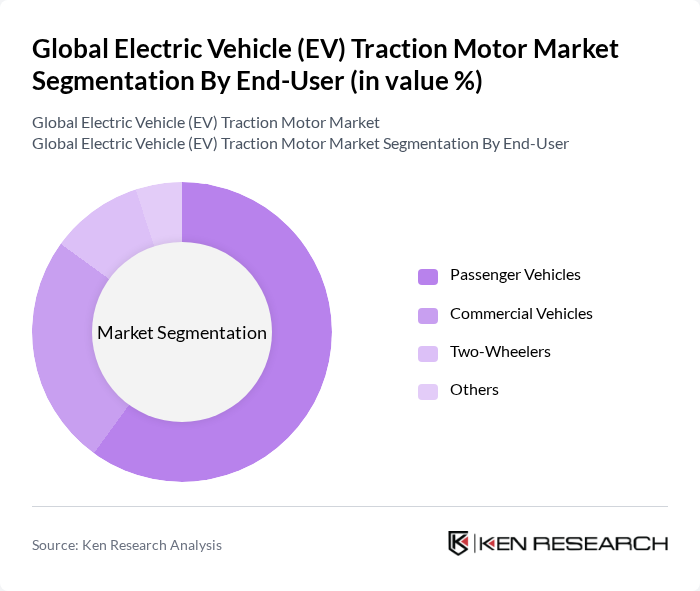
By End-User:The market is segmented by end-user into Passenger Vehicles, Commercial Vehicles, Two-Wheelers, and others. The Passenger Vehicles segment dominates the market, driven by the increasing consumer preference for electric cars and the growing availability of electric models from major automotive manufacturers. The shift towards sustainable transportation and the rising awareness of environmental issues are further propelling the demand for electric passenger vehicles.
The Global Electric Vehicle (EV) Traction Motor Market is characterized by a dynamic mix of regional and international players. Leading participants such as Tesla, Inc., Siemens AG, Nidec Corporation, Bosch Group, Continental AG, ZF Friedrichshafen AG, Mitsubishi Electric Corporation, Hitachi, Ltd., Parker Hannifin Corporation, Yaskawa Electric Corporation, ABB Ltd., Hyundai Mobis, Aisin Seiki Co., Ltd., Valeo SA, BYD Company Limited, Magna International Inc., Dana Incorporated, LG Electronics Inc., Delta Electronics Inc., YASA Limited, Equipmake Ltd., Hitachi Astemo, Ltd., MAHLE GmbH, Schaeffler AG, BorgWarner Inc. contribute to innovation, geographic expansion, and service delivery in this space.
The future of the electric vehicle traction motor market appears promising, driven by ongoing technological advancements and increasing consumer acceptance. As battery technologies improve, the efficiency and performance of electric vehicles will enhance, further stimulating demand for high-quality traction motors. Additionally, the integration of renewable energy sources into the charging infrastructure will support sustainable growth. The collaboration between automotive manufacturers and technology firms is expected to yield innovative solutions, paving the way for a more robust electric vehicle ecosystem in the coming years.
| Segment | Sub-Segments |
|---|---|
| By Type | Permanent Magnet Synchronous Motors (PMSM) Induction Motors (IM) Switched Reluctance Motors (SRM) Axial Flux Motors Others |
| By End-User | Passenger Vehicles Commercial Vehicles Two-Wheelers Others |
| By Region | North America Europe Asia-Pacific Others |
| By Application | Automotive Industrial Marine Others |
| By Motor Configuration | Axial Flux Motors Radial Flux Motors Others |
| By Cooling Method | Air-Cooled Liquid-Cooled Others |
| By Power Rating | Below 50 kW 100 kW Above 100 kW Others |
| Scope Item/Segment | Sample Size | Target Respondent Profiles |
|---|---|---|
| Passenger Electric Vehicles | 100 | Product Managers, R&D Engineers |
| Commercial Electric Vehicles | 60 | Fleet Managers, Procurement Specialists |
| Two-Wheeler Electric Vehicles | 50 | Manufacturing Engineers, Market Analysts |
| Traction Motor Suppliers | 40 | Sales Directors, Technical Experts |
| EV Infrastructure Providers | 40 | Business Development Managers, Policy Advisors |
The Global Electric Vehicle (EV) Traction Motor Market is valued at approximately USD 15.65 billion, reflecting significant growth driven by the increasing adoption of electric vehicles and advancements in motor technology.

What makes us stand out is that our consultants follow Robust, Refine and Result (RRR) methodology. Robust for clear definitions, approaches and sanity checking, Refine for differentiating respondents' facts and opinions, and Result for presenting data with story.

We have set a benchmark in the industry by offering our clients with syndicated and customized market research reports featuring coverage of entire market as well as meticulous research and analyst insights.

While we don't replace traditional research, we flip the method upside down. Our dual approach of Top Bottom & Bottom Top ensures quality deliverable by not just verifying company fundamentals but also looking at the sector and macroeconomic factors.

With one step in the future, our research team constantly tries to show you the bigger picture. We help with some of the tough questions you may encounter along the way: How is the industry positioned? Best marketing channel? KPI's of competitors? By aligning every element, we help maximize success.

Our report gives you instant access to the answers and sources that other companies might choose to hide. We elaborate each steps of research methodology we have used and showcase you the sample size to earn your trust.

If you need any support, we are here! We pride ourselves on universe strength, data quality, and quick, friendly, and professional service.













