Global Fats and Oils Market

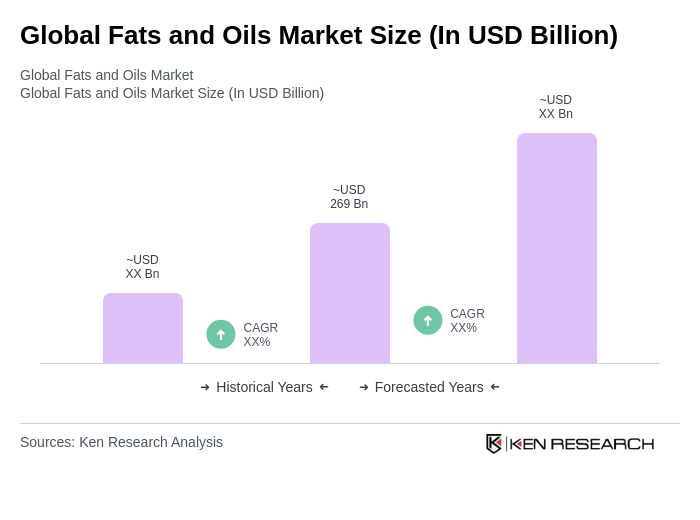
Global Fats and Oils Market, valued at USD 269 billion, grows due to health trends, vegetable oils dominance, and applications in food, biofuels, and cosmetics.

Region:Global

Author(s):Rebecca

Product Code:KRAA2876

Pages:95

Published On:August 2025
About the Report

Base Year 2024

Global Fats and Oils Market Overview

  • The Global Fats and Oils Market is valued at approximately USD 269 billion, based on a five-year analysis. This growth is driven by increasing consumer demand for healthier cooking oils, the expansion of the food processing industry, and the growing popularity of plant-based diets. Additionally, the biofuels sector is contributing to market expansion, as fats and oils are increasingly utilized in biodiesel and renewable energy production. The trend toward minimally processed and functional oils, such as those enriched with omega-3 fatty acids and antioxidants, is also shaping industry growth .
  • Key players in this market include countries such as the United States, Brazil, and Indonesia, which dominate due to large-scale production of vegetable oils, particularly palm and soybean oils. The United States leads in canola and soybean oil production, while Brazil and Indonesia are major palm oil producers, supported by favorable climates and established agricultural practices .
  • The European Union’s Regulation (EU) 2018/848, issued by the European Parliament and Council, sets sustainability criteria for palm oil imports. This regulation requires that all palm oil imported into the EU must meet strict environmental and social sustainability standards, including traceability and certification requirements, to promote the use of certified sustainable palm oil and encourage environmentally responsible production practices .
Global Fats and Oils Market Size

Global Fats and Oils Market Segmentation

By Type:The fats and oils market is segmented into vegetable oils, animal fats, specialty fats, margarine and spreads, shortening, and others. Vegetable oils, especially palm, soybean, sunflower, and canola oils, dominate the market due to their widespread use in cooking and food processing. Rising health consciousness is fueling demand for oils perceived as healthier, such as olive, avocado, and high-oleic sunflower oil, further boosting the vegetable oils segment .
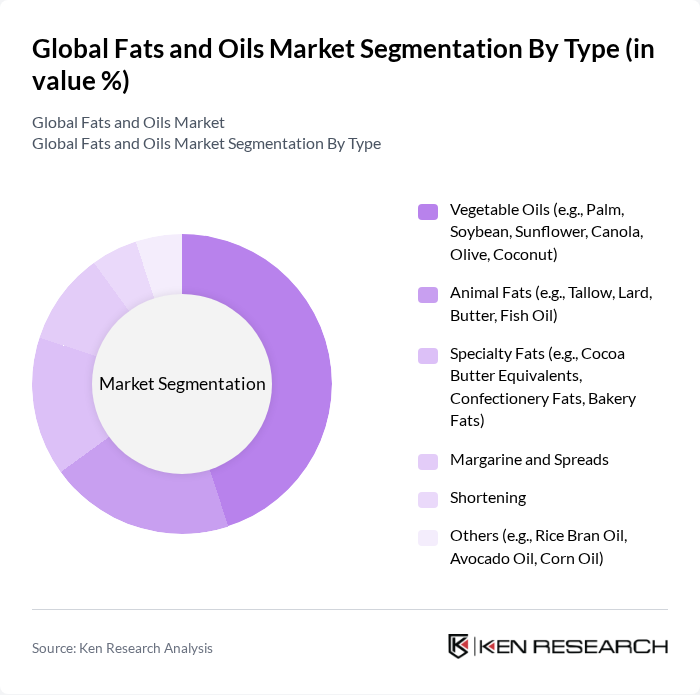
Global Fats and Oils Market segmentation by Type.

By Application:The application segment of the fats and oils market includes food and beverage, personal care and cosmetics, biofuels, pharmaceuticals and nutraceuticals, animal feed, and others. The food and beverage sector holds the largest share, driven by increased consumption of processed foods and the trend toward home cooking. Demand for healthier cooking oils and the use of fats and oils in bakery, confectionery, and ready-to-eat meals are key growth drivers in this segment .
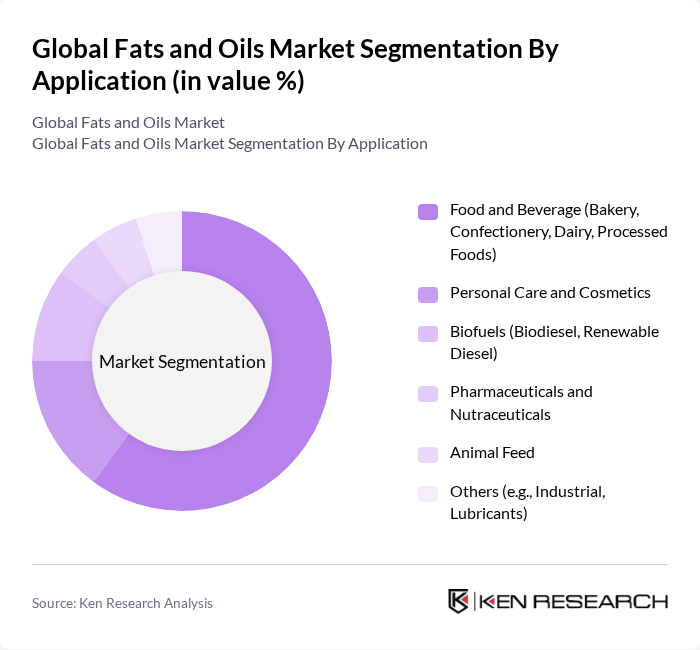
Global Fats and Oils Market segmentation by Application.

Global Fats and Oils Market Competitive Landscape

The Global Fats and Oils Market is characterized by a dynamic mix of regional and international players. Leading participants such as Cargill, Incorporated, Archer Daniels Midland Company (ADM), Bunge Limited, Wilmar International Limited, Unilever PLC, Associated British Foods PLC, Olam International Limited, AAK AB, IOI Corporation Berhad, Musim Mas Holdings, Fuji Oil Holdings Inc., Catania Spagna Corporation, Catania Oils, Kadoya Sesame Mills, Inc., Mewah International Inc., Upfield Holdings B.V., Conagra Brands, Inc., Sime Darby Plantation Berhad, Biorigin (Zilor Group), Richardson International Limited contribute to innovation, geographic expansion, and service delivery in this space.

Cargill, Incorporated

1865

Wayzata, Minnesota, USA

Archer Daniels Midland Company (ADM)

1902

Chicago, Illinois, USA

Bunge Limited

1818

St. Louis, Missouri, USA

Wilmar International Limited

1991

Singapore

Unilever PLC

1929

London, United Kingdom

Company

Establishment Year

Headquarters

Group Size (Large, Medium, or Small as per industry convention)

Total Revenue (USD, Latest Fiscal Year)

Revenue Growth Rate (CAGR %)

Market Share (%)

Geographic Presence (Number of Countries/Regions)

Product Portfolio Breadth (Number of Product Types/Segments)

Global Fats and Oils Market Industry Analysis

Growth Drivers

  • Increasing Health Consciousness:The global shift towards healthier eating habits is driving the demand for fats and oils perceived as healthier options. In future, the health food market is projected to reach $1.1 trillion, with consumers increasingly opting for oils rich in omega-3 fatty acids, such as flaxseed and canola oil. This trend is supported by the World Health Organization's recommendation to reduce saturated fat intake, further propelling the market for healthier oils.
  • Rising Demand for Plant-Based Oils:The plant-based oil segment is experiencing significant growth, with a projected increase in consumption to 200 million metric tons by future. This surge is driven by the growing vegan population, which reached 79 million globally in future, and the increasing use of plant-based oils in food products, cosmetics, and biofuels. The trend aligns with the global push for sustainable and environmentally friendly products, enhancing market prospects.
  • Expansion of Food Processing Industry:The food processing industry is expected to grow to $4.5 trillion by future, significantly boosting the demand for various fats and oils. This growth is attributed to the increasing urbanization and changing lifestyles, leading to higher consumption of processed foods. The industry’s expansion is also supported by technological advancements in food preservation and packaging, which require diverse oil applications, thereby driving market growth.

Market Challenges

  • Fluctuating Raw Material Prices:The volatility in raw material prices poses a significant challenge to the fats and oils market. For instance, palm oil prices fluctuated between $600 and $1,000 per metric ton in future, influenced by climatic conditions and geopolitical factors. This unpredictability affects profit margins for producers and can lead to increased prices for consumers, creating a ripple effect throughout the supply chain.
  • Stringent Regulatory Framework:The fats and oils industry faces stringent regulations regarding food safety and labeling, which can hinder market growth. In future, compliance costs are expected to rise by 15% due to new regulations imposed by the FDA and EFSA. These regulations aim to ensure consumer safety but can create barriers for smaller producers who may struggle to meet the required standards, limiting their market access.

Global Fats and Oils Market Future Outlook

The future of the fats and oils market appears promising, driven by increasing health awareness and the demand for sustainable products. Innovations in extraction technologies are expected to enhance oil quality and yield, while the expansion into emerging markets will provide new growth avenues. Additionally, the rising popularity of organic and functional oils will likely shape consumer preferences, leading to a more diversified product offering in the market.

Market Opportunities

  • Innovations in Oil Extraction Technologies:Advancements in extraction methods, such as cold-pressing and supercritical CO2 extraction, are creating opportunities for higher-quality oils. These technologies can increase yield and preserve nutritional value, appealing to health-conscious consumers. The market for innovative extraction methods is projected to grow significantly, potentially reaching $2 billion by future.
  • Development of Sustainable Products:The increasing consumer demand for sustainable and eco-friendly products presents a significant opportunity. Companies focusing on sustainable sourcing and production methods can capture a growing segment of environmentally conscious consumers. The sustainable fats and oils market is expected to grow to $1.5 billion by future, driven by initiatives aimed at reducing carbon footprints and promoting ethical sourcing.

Scope of the Report

SegmentSub-Segments
By Type

Vegetable Oils (e.g., Palm, Soybean, Sunflower, Canola, Olive, Coconut)

Animal Fats (e.g., Tallow, Lard, Butter, Fish Oil)

Specialty Fats (e.g., Cocoa Butter Equivalents, Confectionery Fats, Bakery Fats)

Margarine and Spreads

Shortening

Others (e.g., Rice Bran Oil, Avocado Oil, Corn Oil)

By Application

Food and Beverage (Bakery, Confectionery, Dairy, Processed Foods)

Personal Care and Cosmetics

Biofuels (Biodiesel, Renewable Diesel)

Pharmaceuticals and Nutraceuticals

Animal Feed

Others (e.g., Industrial, Lubricants)

By End-User

Food Manufacturers

Restaurants and Food Service

Retail Consumers

Industrial Users

Others

By Distribution Channel

Direct Sales

Retail Outlets (Supermarkets, Hypermarkets, Convenience Stores)

E-commerce

Wholesale Distributors

Others

By Region

North America

Europe

Asia-Pacific

Latin America

Middle East and Africa

By Price Range

Economy

Mid-Range

Premium

By Packaging Type

Bottles

Cans

Bulk Packaging (Drums, Totes, Tankers)

Pouches

Others (e.g., Cartons, Sachets)

Key Target Audience

Investors and Venture Capitalist Firms

Government and Regulatory Bodies (e.g., Food and Drug Administration, European Food Safety Authority)

Manufacturers and Producers

Distributors and Retailers

Food and Beverage Companies

Health and Nutrition Organizations

Industry Associations (e.g., American Oil Chemists' Society)

Financial Institutions

Players Mentioned in the Report:

Cargill, Incorporated

Archer Daniels Midland Company (ADM)

Bunge Limited

Wilmar International Limited

Unilever PLC

Associated British Foods PLC

Olam International Limited

AAK AB

IOI Corporation Berhad

Musim Mas Holdings

Fuji Oil Holdings Inc.

Catania Spagna Corporation

Catania Oils

Kadoya Sesame Mills, Inc.

Mewah International Inc.

Upfield Holdings B.V.

Conagra Brands, Inc.

Sime Darby Plantation Berhad

Biorigin (Zilor Group)

Richardson International Limited

Table of Contents

Market Assessment Phase

1. Executive Summary and Approach


2. Global Fats and Oils Market Overview

2.1 Key Insights and Strategic Recommendations

2.2 Global Fats and Oils Market Overview

2.3 Definition and Scope

2.4 Evolution of Market Ecosystem

2.5 Timeline of Key Regulatory Milestones

2.6 Value Chain & Stakeholder Mapping

2.7 Business Cycle Analysis

2.8 Policy & Incentive Landscape


3. Global Fats and Oils Market Analysis

3.1 Growth Drivers

3.1.1 Increasing Health Consciousness
3.1.2 Rising Demand for Plant-Based Oils
3.1.3 Expansion of Food Processing Industry
3.1.4 Growth in Biofuel Production

3.2 Market Challenges

3.2.1 Fluctuating Raw Material Prices
3.2.2 Stringent Regulatory Framework
3.2.3 Competition from Alternative Products
3.2.4 Environmental Concerns

3.3 Market Opportunities

3.3.1 Innovations in Oil Extraction Technologies
3.3.2 Expansion into Emerging Markets
3.3.3 Development of Sustainable Products
3.3.4 Increasing Use in Personal Care Products

3.4 Market Trends

3.4.1 Shift Towards Organic Oils
3.4.2 Growing Popularity of Functional Oils
3.4.3 Rise of E-commerce in Oil Sales
3.4.4 Increased Focus on Traceability and Transparency

3.5 Government Regulation

3.5.1 Labeling Requirements for Fats and Oils
3.5.2 Standards for Food Safety and Quality
3.5.3 Regulations on Trans Fats
3.5.4 Environmental Regulations on Production

4. SWOT Analysis


5. Stakeholder Analysis


6. Porter's Five Forces Analysis


7. Global Fats and Oils Market Market Size, 2019-2024

7.1 By Value

7.2 By Volume

7.3 By Average Selling Price


8. Global Fats and Oils Market Segmentation

8.1 By Type

8.1.1 Vegetable Oils (e.g., Palm, Soybean, Sunflower, Canola, Olive, Coconut)
8.1.2 Animal Fats (e.g., Tallow, Lard, Butter, Fish Oil)
8.1.3 Specialty Fats (e.g., Cocoa Butter Equivalents, Confectionery Fats, Bakery Fats)
8.1.4 Margarine and Spreads
8.1.5 Shortening
8.1.6 Others (e.g., Rice Bran Oil, Avocado Oil, Corn Oil)

8.2 By Application

8.2.1 Food and Beverage (Bakery, Confectionery, Dairy, Processed Foods)
8.2.2 Personal Care and Cosmetics
8.2.3 Biofuels (Biodiesel, Renewable Diesel)
8.2.4 Pharmaceuticals and Nutraceuticals
8.2.5 Animal Feed
8.2.6 Others (e.g., Industrial, Lubricants)

8.3 By End-User

8.3.1 Food Manufacturers
8.3.2 Restaurants and Food Service
8.3.3 Retail Consumers
8.3.4 Industrial Users
8.3.5 Others

8.4 By Distribution Channel

8.4.1 Direct Sales
8.4.2 Retail Outlets (Supermarkets, Hypermarkets, Convenience Stores)
8.4.3 E-commerce
8.4.4 Wholesale Distributors
8.4.5 Others

8.5 By Region

8.5.1 North America
8.5.2 Europe
8.5.3 Asia-Pacific
8.5.4 Latin America
8.5.5 Middle East and Africa

8.6 By Price Range

8.6.1 Economy
8.6.2 Mid-Range
8.6.3 Premium

8.7 By Packaging Type

8.7.1 Bottles
8.7.2 Cans
8.7.3 Bulk Packaging (Drums, Totes, Tankers)
8.7.4 Pouches
8.7.5 Others (e.g., Cartons, Sachets)

9. Global Fats and Oils Market Competitive Analysis

9.1 Market Share of Key Players

9.2 Cross Comparison of Key Players

9.2.1 Company Name
9.2.2 Group Size (Large, Medium, or Small as per industry convention)
9.2.3 Total Revenue (USD, Latest Fiscal Year)
9.2.4 Revenue Growth Rate (CAGR %)
9.2.5 Market Share (%)
9.2.6 Geographic Presence (Number of Countries/Regions)
9.2.7 Product Portfolio Breadth (Number of Product Types/Segments)
9.2.8 R&D Investment as % of Revenue
9.2.9 Sustainability/ESG Score
9.2.10 Supply Chain Integration Level
9.2.11 Capacity Utilization Rate (%)
9.2.12 Key End-Use Segments Served
9.2.13 Innovation Index (Patents, New Product Launches)

9.3 SWOT Analysis of Top Players

9.4 Pricing Analysis

9.5 Detailed Profile of Major Companies

9.5.1 Cargill, Incorporated
9.5.2 Archer Daniels Midland Company (ADM)
9.5.3 Bunge Limited
9.5.4 Wilmar International Limited
9.5.5 Unilever PLC
9.5.6 Associated British Foods PLC
9.5.7 Olam International Limited
9.5.8 AAK AB
9.5.9 IOI Corporation Berhad
9.5.10 Musim Mas Holdings
9.5.11 Fuji Oil Holdings Inc.
9.5.12 Catania Spagna Corporation
9.5.13 Catania Oils
9.5.14 Kadoya Sesame Mills, Inc.
9.5.15 Mewah International Inc.
9.5.16 Upfield Holdings B.V.
9.5.17 Conagra Brands, Inc.
9.5.18 Sime Darby Plantation Berhad
9.5.19 Biorigin (Zilor Group)
9.5.20 Richardson International Limited

10. Global Fats and Oils Market End-User Analysis

10.1 Procurement Behavior of Key Ministries

10.1.1 Government Procurement Policies
10.1.2 Budget Allocations for Fats and Oils
10.1.3 Supplier Selection Criteria
10.1.4 Contract Management Practices

10.2 Corporate Spend on Infrastructure & Energy

10.2.1 Investment Trends in Fats and Oils
10.2.2 Budgeting for Sustainable Practices
10.2.3 Infrastructure Development Needs

10.3 Pain Point Analysis by End-User Category

10.3.1 Quality Assurance Issues
10.3.2 Supply Chain Disruptions
10.3.3 Cost Management Challenges

10.4 User Readiness for Adoption

10.4.1 Awareness of Health Benefits
10.4.2 Readiness for Sustainable Products
10.4.3 Adoption of New Technologies

10.5 Post-Deployment ROI and Use Case Expansion

10.5.1 Measurement of ROI Metrics
10.5.2 Case Studies of Successful Implementations
10.5.3 Future Use Case Opportunities

11. Global Fats and Oils Market Future Size, 2025-2030

11.1 By Value

11.2 By Volume

11.3 By Average Selling Price


Go-To-Market Strategy Phase

1. Whitespace Analysis + Business Model Canvas

1.1 Market Gaps Identification

1.2 Business Model Framework


2. Marketing and Positioning Recommendations

2.1 Branding Strategies

2.2 Product USPs


3. Distribution Plan

3.1 Urban Retail Strategies

3.2 Rural NGO Tie-ups


4. Channel & Pricing Gaps

4.1 Underserved Routes

4.2 Pricing Bands Analysis


5. Unmet Demand & Latent Needs

5.1 Category Gaps

5.2 Consumer Segments


6. Customer Relationship

6.1 Loyalty Programs

6.2 After-sales Service


7. Value Proposition

7.1 Sustainability Initiatives

7.2 Integrated Supply Chains


8. Key Activities

8.1 Regulatory Compliance

8.2 Branding Efforts

8.3 Distribution Setup


9. Entry Strategy Evaluation

9.1 Domestic Market Entry Strategy

9.1.1 Product Mix Considerations
9.1.2 Pricing Band Strategy
9.1.3 Packaging Innovations

9.2 Export Entry Strategy

9.2.1 Target Countries Analysis
9.2.2 Compliance Roadmap

10. Entry Mode Assessment

10.1 Joint Ventures

10.2 Greenfield Investments

10.3 Mergers & Acquisitions

10.4 Distributor Model


11. Capital and Timeline Estimation

11.1 Capital Requirements

11.2 Timelines for Implementation


12. Control vs Risk Trade-Off

12.1 Ownership Considerations

12.2 Partnerships Evaluation


13. Profitability Outlook

13.1 Breakeven Analysis

13.2 Long-term Sustainability Strategies


14. Potential Partner List

14.1 Distributors

14.2 Joint Ventures

14.3 Acquisition Targets


15. Execution Roadmap

15.1 Phased Plan for Market Entry

15.1.1 Market Setup
15.1.2 Market Entry
15.1.3 Growth Acceleration
15.1.4 Scale & Stabilize

15.2 Key Activities and Milestones

15.2.1 Milestone Planning
15.2.2 Activity Tracking

Research Methodology

ApproachModellingSample

Phase 1: Approach1

Desk Research

  • Industry reports from global agricultural and food organizations
  • Market analysis from trade associations and government publications
  • Academic journals focusing on fats and oils market trends and innovations

Primary Research

  • Interviews with key stakeholders in the fats and oils supply chain, including producers and distributors
  • Surveys targeting food manufacturers and their procurement teams
  • Field interviews with R&D managers in food processing companies

Validation & Triangulation

  • Cross-validation of data from multiple industry sources to ensure accuracy
  • Triangulation of findings from primary interviews and secondary data sources
  • Sanity checks through expert panel reviews and feedback loops

Phase 2: Market Size Estimation1

Top-down Assessment

  • Analysis of global consumption patterns and production statistics of fats and oils
  • Segmentation of market size by product type (e.g., vegetable oils, animal fats)
  • Incorporation of macroeconomic indicators and demographic trends influencing demand

Bottom-up Modeling

  • Volume estimates based on production capacities of leading manufacturers
  • Cost analysis derived from pricing data across different regions
  • Aggregation of data from various distribution channels (retail, food service, industrial)

Forecasting & Scenario Analysis

  • Multi-variable regression analysis incorporating economic growth and health trends
  • Scenario modeling based on potential regulatory changes and sustainability initiatives
  • Development of baseline, optimistic, and pessimistic forecasts through 2030

Phase 3: CATI Sample Composition1

Scope Item/SegmentSample SizeTarget Respondent Profiles
Vegetable Oil Producers60Production Managers, Quality Control Officers
Food Manufacturers Using Fats and Oils50Procurement Managers, Product Development Heads
Retail Sector Distributors40Supply Chain Managers, Category Managers
Health and Nutrition Experts40Dietitians, Food Scientists
Regulatory Bodies and Industry Associations40Policy Makers, Industry Analysts

Frequently Asked Questions

What is the current value of the Global Fats and Oils Market?

The Global Fats and Oils Market is valued at approximately USD 269 billion, driven by increasing consumer demand for healthier cooking oils, the expansion of the food processing industry, and the growing popularity of plant-based diets.

What factors are driving the growth of the Fats and Oils Market?

Which countries are the leading producers in the Fats and Oils Market?

What are the main types of fats and oils in the market?

Other Regional/Country Reports

UAE Fats and Oils MarketKSA Fats and Oils Market

Indonesia Fats and Oils Market

Malaysia Fats and Oils Market

APAC Fats and Oils Market

SEA Fats and Oils Market

Why Buy From Us?

Refine Robust Result (RRR) Framework

What makes us stand out is that our consultants follow Robust, Refine and Result (RRR) methodology. Robust for clear definitions, approaches and sanity checking, Refine for differentiating respondents' facts and opinions, and Result for presenting data with story.

Our Reach Is Unmatched

We have set a benchmark in the industry by offering our clients with syndicated and customized market research reports featuring coverage of entire market as well as meticulous research and analyst insights.

Shifting the Research Paradigm

While we don't replace traditional research, we flip the method upside down. Our dual approach of Top Bottom & Bottom Top ensures quality deliverable by not just verifying company fundamentals but also looking at the sector and macroeconomic factors.

More Insights-Better Decisions

With one step in the future, our research team constantly tries to show you the bigger picture. We help with some of the tough questions you may encounter along the way: How is the industry positioned? Best marketing channel? KPI's of competitors? By aligning every element, we help maximize success.

Transparency and Trust

Our report gives you instant access to the answers and sources that other companies might choose to hide. We elaborate each steps of research methodology we have used and showcase you the sample size to earn your trust.

Round the Clock Support

If you need any support, we are here! We pride ourselves on universe strength, data quality, and quick, friendly, and professional service.

Why Clients Choose Us?

400000+
Reports in repository
150+
Consulting projects a year
100+
Analysts
8000+
Client Queries in 2022








