About the Report
Base Year 2024Listen to the audio summary
Global Fertilizer Market Overview
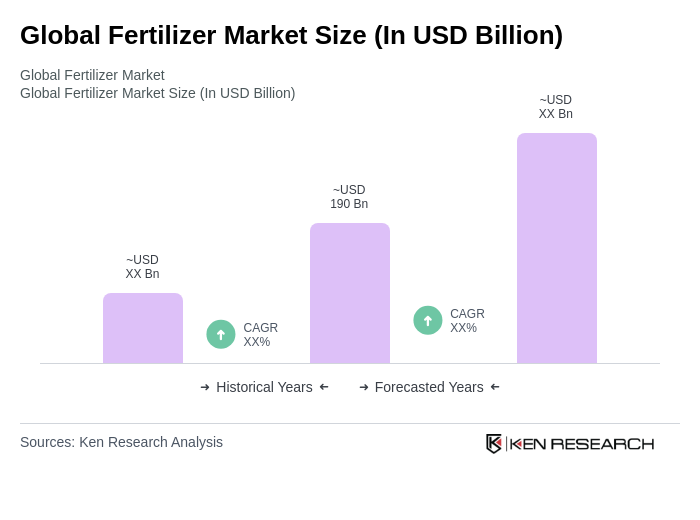
- The Global Fertilizer Market is valued at USD 190 billion, based on a five-year historical analysis. This growth is primarily driven by the increasing global population, which necessitates higher agricultural productivity, and the rising demand for food security. Additionally, advancements in fertilizer technology—including nitrification/urease inhibitors, controlled-release coatings, and emerging green ammonia pathways—and the growing awareness of sustainable agricultural practices and nutrient stewardship (4R practices) have further propelled market expansion .
- Key players in this market include the United States, China, India, and Brazil. These countries dominate due to their large agricultural sectors, high fertilizer consumption, supportive policies and subsidies, and significant investments in agricultural technology and logistics, with Asia-Pacific holding over half of global market share in recent assessments .
- In 2023, the European Union implemented regulations aimed at reducing nitrogen fertilizer usage to mitigate environmental impacts. While there is no single EU-wide mandate requiring a uniform 20% nitrogen application reduction by 2025, the EU adopted the Farm to Fork and Biodiversity strategies targeting a 20% reduction in fertilizer use by 2030, alongside strengthened rules under the Nitrates Directive and CAP eco-schemes that promote organic fertilizers and precision application; member states have also enacted national measures to curb reactive nitrogen losses and ammonia emissions on accelerated timelines .
Global Fertilizer Market Segmentation
By Type:The fertilizer market is segmented into various types, including nitrogen fertilizers, phosphate fertilizers, potash fertilizers, compound/complex fertilizers, organic & biofertilizers, specialty & enhanced-efficiency fertilizers, and others. Among these, nitrogen fertilizers dominate the market due to their essential role in crop growth and high demand from farmers seeking to maximize yields; global market analyses consistently show nitrogen products as the largest segment by value and volume . The increasing focus on sustainable agriculture has also led to a rise in the adoption of organic and biofertilizers and enhanced-efficiency fertilizers to improve nutrient-use efficiency and reduce losses, although they currently hold a smaller market share compared to nitrogen fertilizers .

By Application Method:The application methods for fertilizers include soil application, foliar application, fertigation, and seed treatment/coating. Soil application remains the most widely used method due to its simplicity and effectiveness in delivering nutrients directly to the root zone of crops; precision placement and banding techniques are increasingly used to improve efficiency . However, fertigation is gaining traction as it allows for precise nutrient delivery and water management—especially in high-value horticulture and water-scarce regions—aligning with broader adoption of drip and micro-irrigation systems .

Global Fertilizer Market Competitive Landscape
The Global Fertilizer Market is characterized by a dynamic mix of regional and international players. Leading participants such as Nutrien Ltd., CF Industries Holdings, Inc., Yara International ASA, The Mosaic Company, OCP Group, K+S Aktiengesellschaft, ICL Group Ltd., EuroChem Group AG, Sinofert Holdings Limited, Haifa Group, AGLUKON Spezialdünger GmbH & Co. KG, Sociedad Química y Minera de Chile S.A. (SQM), Uralchem JSC, PhosAgro PJSC, Coromandel International Limited contribute to innovation, geographic expansion, and service delivery in this space .
Global Fertilizer Market Industry Analysis
Growth Drivers
- Increasing Global Food Demand:The global population is projected to reach approximately 9.7 billion by 2050, necessitating a substantial increase in food production by 2025. This surge in demand drives fertilizer consumption, with the Food and Agriculture Organization estimating that around 1.6 billion tons of fertilizers will be required annually to meet this need. Consequently, the fertilizer market is positioned to expand significantly, driven by agricultural intensification and the need for higher crop yields.
- Technological Advancements in Fertilizer Production:Innovations in fertilizer production technologies, such as controlled-release fertilizers and nanotechnology, are enhancing efficiency and effectiveness. For instance, the introduction of slow-release fertilizers can reduce application rates by up to 25%, optimizing nutrient use. The global investment in agricultural technology is expected to exceed $12 billion in future, further propelling the demand for advanced fertilizers that improve crop productivity and sustainability.
- Rising Awareness of Soil Health:There is a growing recognition of the importance of soil health in sustainable agriculture. According to the World Bank, soil degradation affects 30% of the world's land, prompting farmers to adopt practices that enhance soil quality. The global market for soil health products, including fertilizers, is projected to reach $6 billion in future, driven by increased investments in soil restoration and nutrient management practices that promote long-term agricultural sustainability.
Market Challenges
- Environmental Concerns and Regulations:The fertilizer industry faces increasing scrutiny due to its environmental impact, particularly concerning water pollution and greenhouse gas emissions. In future, regulatory bodies are expected to enforce stricter environmental standards, potentially increasing compliance costs for manufacturers. The European Union's Green Deal aims to reduce nutrient losses by 50% in future, which could significantly affect fertilizer usage patterns and market dynamics.
- Fluctuating Raw Material Prices:The fertilizer market is heavily influenced by the prices of raw materials such as natural gas and phosphate rock. In future, natural gas prices are projected to remain volatile, with fluctuations impacting production costs. For example, a 15% increase in natural gas prices could lead to a corresponding rise in nitrogen fertilizer costs, affecting overall market stability and profitability for producers and farmers alike.
Global Fertilizer Market Future Outlook
The future of the fertilizer market is poised for transformation, driven by sustainability and technological integration. As farmers increasingly adopt precision agriculture techniques, the demand for customized fertilizer solutions is expected to rise. Additionally, the shift towards eco-friendly fertilizers will likely gain momentum, supported by government initiatives and consumer preferences for sustainable practices. These trends indicate a dynamic market landscape where innovation and environmental stewardship will play crucial roles in shaping the industry's trajectory.
Market Opportunities
- Expansion into Emerging Markets:Emerging economies, particularly in Asia and Africa, present significant growth opportunities for fertilizer companies. With agricultural sectors in these regions projected to grow by 5% annually, the demand for fertilizers is expected to increase substantially. Companies that strategically enter these markets can capitalize on rising food production needs and improve their global footprint.
- Development of Eco-Friendly Fertilizers:The increasing consumer preference for organic and sustainable farming practices is driving the demand for eco-friendly fertilizers. The global market for organic fertilizers is expected to reach $12 billion in future. Companies investing in the development of bio-based and biodegradable fertilizers can tap into this growing segment, aligning with environmental regulations and consumer trends.
Scope of the Report
| Segment | Sub-Segments |
|---|---|
| By Type | Nitrogen Fertilizers (Urea, Ammonium Nitrate, Ammonium Sulfate, UAN) Phosphate Fertilizers (DAP, MAP, TSP, SSP) Potash Fertilizers (MOP/Potassium Chloride, SOP/Potassium Sulfate, Others) Compound/Complex Fertilizers (NPK, NP, PK) Organic & Biofertilizers (Compost/Manure, Microbial/Biofertilizers, Seaweed/Other Organics) Specialty & Enhanced-Efficiency Fertilizers (CRF/SRF, Water-Soluble, Micronutrients, Inhibitor-treated) Others (Secondary Nutrients—Ca, Mg, S) |
| By Application Method | Soil Application Foliar Application Fertigation Seed Treatment/Coating |
| By Crop | Cereals & Grains (Wheat, Corn, Rice, Others) Oilseeds & Pulses Fruits & Vegetables Turf, Ornamentals & Plantation Crops Others (Forage, Sugar Crops, Fiber Crops) |
| By End-User | Smallholder Farmers Commercial Farms & Agribusinesses Agricultural Cooperatives Landscape & Horticulture Enterprises Distributors & Retail Networks |
| By Distribution Channel | Direct/Industrial Offtake (Large Farms, Blenders) Dealer/Distributor Networks Retail Stores & Ag-Inputs Retailers Online & E-commerce Platforms Government Procurement & Subsidy Channels |
| By Form | Dry/Granular Liquid Water-Soluble Powders |
| By Region | North America Europe Asia-Pacific Latin America Middle East & Africa |
Key Target Audience
Investors and Venture Capitalist Firms
Government and Regulatory Bodies (e.g., Environmental Protection Agency, Food and Agriculture Organization)
Manufacturers and Producers
Distributors and Retailers
Agricultural Cooperatives
Farming Associations
Logistics and Supply Chain Companies
Financial Institutions
Players Mentioned in the Report:
Nutrien Ltd.
CF Industries Holdings, Inc.
Yara International ASA
The Mosaic Company
OCP Group
K+S Aktiengesellschaft
ICL Group Ltd.
EuroChem Group AG
Sinofert Holdings Limited
Haifa Group
AGLUKON Spezialdunger GmbH & Co. KG
Sociedad Quimica y Minera de Chile S.A. (SQM)
Uralchem JSC
PhosAgro PJSC
Coromandel International Limited
Table of Contents
Market Assessment Phase
1. Executive Summary and Approach
2. Global Fertilizer Market Overview
2.1 Key Insights and Strategic Recommendations
2.2 Global Fertilizer Market Overview
2.3 Definition and Scope
2.4 Evolution of Market Ecosystem
2.5 Timeline of Key Regulatory Milestones
2.6 Value Chain & Stakeholder Mapping
2.7 Business Cycle Analysis
2.8 Policy & Incentive Landscape
3. Global Fertilizer Market Analysis
3.1 Growth Drivers
3.1.1 Increasing Global Food Demand
3.1.2 Technological Advancements in Fertilizer Production
3.1.3 Rising Awareness of Soil Health
3.1.4 Government Support and Subsidies
3.2 Market Challenges
3.2.1 Environmental Concerns and Regulations
3.2.2 Fluctuating Raw Material Prices
3.2.3 Supply Chain Disruptions
3.2.4 Competition from Organic Fertilizers
3.3 Market Opportunities
3.3.1 Expansion into Emerging Markets
3.3.2 Development of Eco-Friendly Fertilizers
3.3.3 Precision Agriculture Technologies
3.3.4 Strategic Partnerships and Collaborations
3.4 Market Trends
3.4.1 Shift Towards Sustainable Practices
3.4.2 Increased Use of Digital Farming Solutions
3.4.3 Growth in Biofertilizers
3.4.4 Rising Demand for Customized Fertilizer Solutions
3.5 Government Regulation
3.5.1 Fertilizer Quality Standards
3.5.2 Environmental Protection Regulations
3.5.3 Subsidy Programs for Farmers
3.5.4 Import and Export Regulations
4. SWOT Analysis
5. Stakeholder Analysis
6. Porter's Five Forces Analysis
7. Global Fertilizer Market Market Size, 2019-2024
7.1 By Value
7.2 By Volume
7.3 By Average Selling Price
8. Global Fertilizer Market Segmentation
8.1 By Type
8.1.1 Nitrogen Fertilizers (Urea, Ammonium Nitrate, Ammonium Sulfate, UAN)
8.1.2 Phosphate Fertilizers (DAP, MAP, TSP, SSP)
8.1.3 Potash Fertilizers (MOP/Potassium Chloride, SOP/Potassium Sulfate, Others)
8.1.4 Compound/Complex Fertilizers (NPK, NP, PK)
8.1.5 Organic & Biofertilizers (Compost/Manure, Microbial/Biofertilizers, Seaweed/Other Organics)
8.1.6 Specialty & Enhanced-Efficiency Fertilizers (CRF/SRF, Water-Soluble, Micronutrients, Inhibitor-treated)
8.1.7 Others (Secondary Nutrients—Ca, Mg, S)
8.2 By Application Method
8.2.1 Soil Application
8.2.2 Foliar Application
8.2.3 Fertigation
8.2.4 Seed Treatment/Coating
8.3 By Crop
8.3.1 Cereals & Grains (Wheat, Corn, Rice, Others)
8.3.2 Oilseeds & Pulses
8.3.3 Fruits & Vegetables
8.3.4 Turf, Ornamentals & Plantation Crops
8.3.5 Others (Forage, Sugar Crops, Fiber Crops)
8.4 By End-User
8.4.1 Smallholder Farmers
8.4.2 Commercial Farms & Agribusinesses
8.4.3 Agricultural Cooperatives
8.4.4 Landscape & Horticulture Enterprises
8.4.5 Distributors & Retail Networks
8.5 By Distribution Channel
8.5.1 Direct/Industrial Offtake (Large Farms, Blenders)
8.5.2 Dealer/Distributor Networks
8.5.3 Retail Stores & Ag-Inputs Retailers
8.5.4 Online & E-commerce Platforms
8.5.5 Government Procurement & Subsidy Channels
8.6 By Form
8.6.1 Dry/Granular
8.6.2 Liquid
8.6.3 Water-Soluble Powders
8.7 By Region
8.7.1 North America
8.7.2 Europe
8.7.3 Asia-Pacific
8.7.4 Latin America
8.7.5 Middle East & Africa
9. Global Fertilizer Market Competitive Analysis
9.1 Market Share of Key Players
9.2 Cross Comparison of Key Players
9.2.1 Company Name
9.2.2 Segment Focus (Nitrogen, Phosphate, Potash, NPK, Specialty, Biofertilizers)
9.2.3 Revenue (USD) and Revenue Growth Rate (YoY)
9.2.4 EBITDA Margin
9.2.5 Production Capacity and Capacity Utilization (%)
9.2.6 Geographic Footprint (Production Sites and Sales Regions)
9.2.7 Feedstock Exposure (Natural Gas, Phosphate Rock, Potash) and Hedging Practices
9.2.8 Pricing Strategy (Contract vs Spot Mix, Premiums for Specialty/EEFs)
9.2.9 Distribution Reach (Dealer Count, Direct Offtake, Export Share)
9.2.10 R&D Spend (% of Revenue) and Pipeline (EEFs, Inhibitors, Bio-solutions)
9.2.11 Sustainability KPIs (CO?e per ton nutrient, Water Intensity, Circularity, Certifications)
9.2.12 Safety & Reliability (TRIR, Unplanned Downtime)
9.2.13 Customer Metrics (Retention/Wallet Share with Top 10 Accounts)
9.3 SWOT Analysis of Top Players
9.4 Pricing Analysis
9.5 Detailed Profile of Major Companies
9.5.1 Nutrien Ltd.
9.5.2 CF Industries Holdings, Inc.
9.5.3 Yara International ASA
9.5.4 The Mosaic Company
9.5.5 OCP Group
9.5.6 K+S Aktiengesellschaft
9.5.7 ICL Group Ltd.
9.5.8 EuroChem Group AG
9.5.9 Sinofert Holdings Limited
9.5.10 Haifa Group
9.5.11 AGLUKON Spezialdünger GmbH & Co. KG
9.5.12 Sociedad Química y Minera de Chile S.A. (SQM)
9.5.13 Uralchem JSC
9.5.14 PhosAgro PJSC
9.5.15 Coromandel International Limited
10. Global Fertilizer Market End-User Analysis
10.1 Procurement Behavior of Key Ministries
10.1.1 Government Procurement Policies
10.1.2 Budget Allocations for Fertilizers
10.1.3 Supplier Selection Criteria
10.2 Corporate Spend on Infrastructure & Energy
10.2.1 Investment Trends in Agriculture
10.2.2 Infrastructure Development Initiatives
10.2.3 Energy Consumption Patterns
10.3 Pain Point Analysis by End-User Category
10.3.1 Cost Management Challenges
10.3.2 Quality Assurance Issues
10.3.3 Supply Chain Reliability
10.4 User Readiness for Adoption
10.4.1 Awareness of Fertilizer Benefits
10.4.2 Training and Support Needs
10.4.3 Technology Adoption Rates
10.5 Post-Deployment ROI and Use Case Expansion
10.5.1 Measurement of Fertilizer Effectiveness
10.5.2 Long-term Sustainability Practices
10.5.3 Expansion into New Use Cases
11. Global Fertilizer Market Future Size, 2025-2030
11.1 By Value
11.2 By Volume
11.3 By Average Selling Price
Go-To-Market Strategy Phase
1. Whitespace Analysis + Business Model Canvas
1.1 Market Gaps Identification
1.2 Value Proposition Development
1.3 Revenue Streams Analysis
1.4 Cost Structure Evaluation
1.5 Key Partnerships Exploration
1.6 Customer Segments Definition
1.7 Channels Strategy
2. Marketing and Positioning Recommendations
2.1 Branding Strategies
2.2 Product USPs
2.3 Target Market Identification
2.4 Communication Strategies
2.5 Digital Marketing Approaches
3. Distribution Plan
3.1 Urban Retail Strategies
3.2 Rural NGO Tie-ups
3.3 E-commerce Integration
3.4 Logistics Optimization
4. Channel & Pricing Gaps
4.1 Underserved Routes
4.2 Pricing Bands Analysis
4.3 Competitor Pricing Strategies
5. Unmet Demand & Latent Needs
5.1 Category Gaps Identification
5.2 Consumer Segments Analysis
5.3 Emerging Trends Exploration
6. Customer Relationship
6.1 Loyalty Programs Development
6.2 After-sales Service Strategies
6.3 Customer Feedback Mechanisms
7. Value Proposition
7.1 Sustainability Initiatives
7.2 Integrated Supply Chains
7.3 Competitive Advantages
8. Key Activities
8.1 Regulatory Compliance
8.2 Branding Efforts
8.3 Distribution Setup
9. Entry Strategy Evaluation
9.1 Domestic Market Entry Strategy
9.1.1 Product Mix Considerations
9.1.2 Pricing Band Strategy
9.1.3 Packaging Solutions
9.2 Export Entry Strategy
9.2.1 Target Countries Identification
9.2.2 Compliance Roadmap Development
10. Entry Mode Assessment
10.1 Joint Ventures
10.2 Greenfield Investments
10.3 Mergers & Acquisitions
10.4 Distributor Model Evaluation
11. Capital and Timeline Estimation
11.1 Capital Requirements Analysis
11.2 Timelines for Implementation
12. Control vs Risk Trade-Off
12.1 Ownership Considerations
12.2 Partnerships Evaluation
13. Profitability Outlook
13.1 Breakeven Analysis
13.2 Long-term Sustainability Strategies
14. Potential Partner List
14.1 Distributors Identification
14.2 Joint Ventures Opportunities
14.3 Acquisition Targets
15. Execution Roadmap
15.1 Phased Plan for Market Entry
15.1.1 Market Setup
15.1.2 Market Entry
15.1.3 Growth Acceleration
15.1.4 Scale & Stabilize
15.2 Key Activities and Milestones
15.2.1 Activity Planning
15.2.2 Milestone Tracking
Research Methodology
Phase 1: Approach1
Desk Research
- Analysis of global fertilizer consumption data from FAO and IFA
- Review of market reports and white papers from agricultural research institutions
- Examination of trade statistics and import/export data from national agricultural departments
Primary Research
- Interviews with agronomists and soil scientists to understand fertilizer application trends
- Surveys with farmers and agricultural cooperatives regarding fertilizer usage and preferences
- Discussions with distributors and retailers to gauge market dynamics and pricing strategies
Validation & Triangulation
- Cross-validation of findings with historical market data and growth rates
- Triangulation of insights from primary interviews with secondary data sources
- Sanity checks through expert panels comprising industry veterans and academic researchers
Phase 2: Market Size Estimation1
Top-down Assessment
- Estimation of global fertilizer market size based on agricultural output and crop acreage
- Segmentation by fertilizer type (nitrogen, phosphorus, potassium) and application method
- Incorporation of regional growth trends and government agricultural policies
Bottom-up Modeling
- Collection of sales data from leading fertilizer manufacturers and distributors
- Estimation of average fertilizer application rates per crop type across different regions
- Calculation of market size based on volume sold and average pricing per fertilizer type
Forecasting & Scenario Analysis
- Multi-variable forecasting using factors such as population growth, dietary changes, and climate impact
- Scenario analysis based on potential regulatory changes and sustainability initiatives
- Development of baseline, optimistic, and pessimistic market projections through 2030
Phase 3: CATI Sample Composition1
| Scope Item/Segment | Sample Size | Target Respondent Profiles |
|---|---|---|
| Crop Fertilizer Usage | 150 | Farmers, Agronomists |
| Fertilizer Distribution Channels | 100 | Distributors, Retailers |
| Fertilizer Manufacturing Insights | 80 | Production Managers, Quality Control Officers |
| Regulatory Impact on Fertilizer Use | 70 | Policy Makers, Environmental Consultants |
| Sustainability Practices in Fertilizer Application | 90 | Sustainability Officers, Agricultural Researchers |
Frequently Asked Questions
What is the current value of the Global Fertilizer Market?
The Global Fertilizer Market is valued at approximately USD 190 billion, driven by factors such as increasing global food demand and advancements in fertilizer technology. This valuation is based on a comprehensive five-year historical analysis.
Which countries are the largest consumers of fertilizers?
What are the main types of fertilizers in the market?
How is the Global Fertilizer Market expected to grow in the future?
Why Buy From Us?

What makes us stand out is that our consultants follow Robust, Refine and Result (RRR) methodology. Robust for clear definitions, approaches and sanity checking, Refine for differentiating respondents' facts and opinions, and Result for presenting data with story.

We have set a benchmark in the industry by offering our clients with syndicated and customized market research reports featuring coverage of entire market as well as meticulous research and analyst insights.

While we don't replace traditional research, we flip the method upside down. Our dual approach of Top Bottom & Bottom Top ensures quality deliverable by not just verifying company fundamentals but also looking at the sector and macroeconomic factors.

With one step in the future, our research team constantly tries to show you the bigger picture. We help with some of the tough questions you may encounter along the way: How is the industry positioned? Best marketing channel? KPI's of competitors? By aligning every element, we help maximize success.

Our report gives you instant access to the answers and sources that other companies might choose to hide. We elaborate each steps of research methodology we have used and showcase you the sample size to earn your trust.

If you need any support, we are here! We pride ourselves on universe strength, data quality, and quick, friendly, and professional service.