About the Report
Base Year 2024Global Gesture Recognition Market Overview
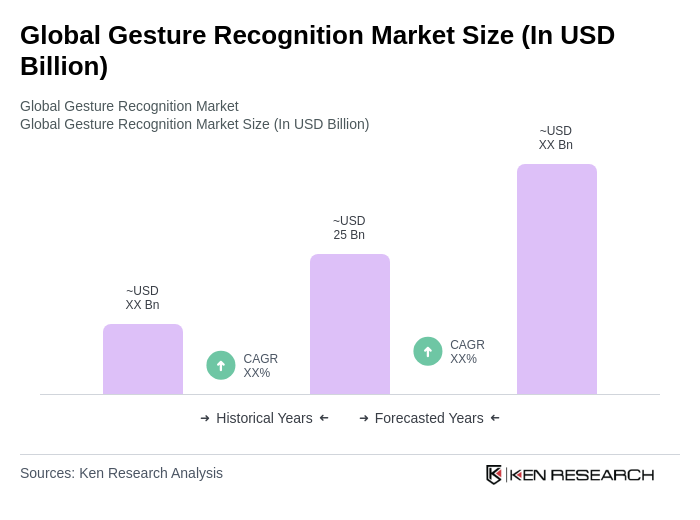
- The Global Gesture Recognition Market is valued at approximatelyUSD 25 billion, based on a five-year historical analysis. This growth is primarily driven by advancements in sensor technology, the increasing demand for touchless interfaces, and the proliferation of smart devices across consumer electronics, automotive, and healthcare sectors. The integration of artificial intelligence and machine learning in gesture recognition systems has further enhanced their accuracy and responsiveness, making them more appealing to both consumers and enterprises. Additional growth drivers include the rising adoption of gesture control in automotive infotainment systems and the expansion of gesture-enabled features in smart home devices .
- Key players in this market are predominantly located inNorth America, Europe, and Asia-Pacific. The United States leads due to its robust technological infrastructure and significant investments in research and development. Countries such as Germany and Japan also play crucial roles, driven by their advanced automotive and consumer electronics industries, which are at the forefront of adopting gesture recognition technologies for enhanced user experiences .
- In 2023, the European Union implemented theArtificial Intelligence Act (Regulation (EU) 2023/1114)issued by the European Parliament and the Council. This regulation establishes mandatory requirements for AI systems, including gesture recognition technologies, to ensure user privacy, data protection, and transparency. All gesture recognition systems deployed within the EU must comply with strict data handling, user consent protocols, and risk management obligations, promoting secure and responsible deployment across industries .
Global Gesture Recognition Market Segmentation
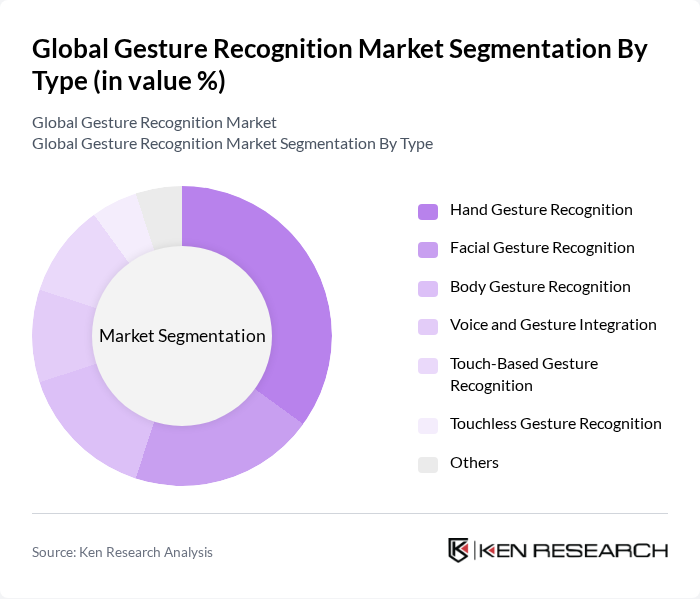
By Type:The gesture recognition market can be segmented into several types, including Hand Gesture Recognition, Facial Gesture Recognition, Body Gesture Recognition, Voice and Gesture Integration, Touch-Based Gesture Recognition, Touchless Gesture Recognition, and Others. Among these,Hand Gesture Recognitionis currently the leading sub-segment, driven by its widespread application in consumer electronics, automotive infotainment, and gaming. The increasing adoption of gesture-enabled smart home devices and the demand for intuitive, contactless user interfaces are accelerating the growth of this segment. Touchless gesture recognition is also gaining momentum, particularly in healthcare and public environments, due to heightened hygiene awareness .
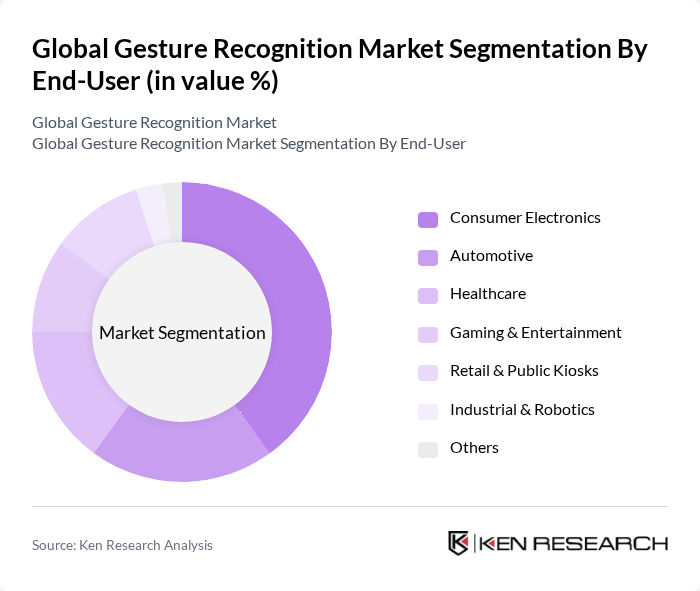
By End-User:The end-user segmentation includes Consumer Electronics, Automotive, Healthcare, Gaming & Entertainment, Retail & Public Kiosks, Industrial & Robotics, and Others. TheConsumer Electronicssegment is the most dominant, driven by the rising demand for smart devices, interactive technologies, and enhanced user experiences. Integration of gesture recognition in smartphones, tablets, smart TVs, and wearables is significantly boosting user engagement. The automotive sector is rapidly expanding its use of gesture control for infotainment and safety features, while healthcare is adopting touchless solutions for improved hygiene and operational efficiency .
Global Gesture Recognition Market Competitive Landscape
The Global Gesture Recognition Market is characterized by a dynamic mix of regional and international players. Leading participants such as Microsoft Corporation, Google LLC, Apple Inc., Intel Corporation, Amazon.com, Inc., GestureTek Inc., Ultraleap Ltd., Leap Motion, Inc. (now part of Ultraleap), Cognitec Systems GmbH, Omek Interactive Ltd., Vicon Motion Systems Ltd., Infineon Technologies AG, eyeSight Technologies Ltd., Omnivision Technologies, Inc., PointGrab Ltd. contribute to innovation, geographic expansion, and service delivery in this space.
Global Gesture Recognition Market Industry Analysis
Growth Drivers
- Increasing Adoption of Smart Devices:The global smart device market is projected to reach 7.1 billion units in future, driven by a surge in consumer demand for connected technologies. This growth is supported by the increasing penetration of smartphones, tablets, and wearables, which are expected to exceed 4.5 billion units alone. As these devices integrate gesture recognition capabilities, the market for gesture-based interactions is anticipated to expand significantly, enhancing user experiences and driving further adoption.
- Advancements in AI and Machine Learning:The AI market is expected to grow to $200 billion in future, with machine learning technologies playing a crucial role in enhancing gesture recognition systems. These advancements enable more accurate and responsive gesture detection, improving user interaction across various applications. The integration of AI-driven algorithms allows for real-time processing of gestures, which is essential for applications in gaming, healthcare, and smart home technologies, thereby propelling market growth.
- Rising Demand for Touchless Interfaces:The global touchless technology market is projected to reach $40 billion in future, driven by increased consumer preference for hygienic solutions, especially post-pandemic. This trend is particularly evident in sectors such as retail and healthcare, where touchless interfaces reduce the risk of contamination. Gesture recognition technology is at the forefront of this shift, providing intuitive and safe interaction methods that align with consumer expectations for cleanliness and convenience.
Market Challenges
- High Development Costs:The development of advanced gesture recognition systems requires significant investment in research and development, often exceeding $1 million for initial prototypes. This high cost can deter smaller companies from entering the market, limiting innovation and competition. Additionally, ongoing maintenance and updates to keep pace with technological advancements further strain financial resources, posing a barrier to widespread adoption of gesture recognition technologies.
- Privacy and Security Concerns:With the increasing integration of gesture recognition in consumer devices, concerns regarding data privacy and security are escalating. In future, it is estimated that data breaches could cost businesses over $5 trillion globally. Consumers are becoming more cautious about how their biometric data is collected and used, which can hinder the acceptance of gesture recognition technologies. Addressing these concerns is crucial for fostering trust and encouraging market growth.
Global Gesture Recognition Market Future Outlook
The future of gesture recognition technology appears promising, driven by continuous advancements in AI and machine learning, which enhance the accuracy and responsiveness of these systems. As industries increasingly adopt touchless interfaces, the demand for gesture recognition is expected to rise significantly. Furthermore, the integration of gesture recognition with IoT devices will create new opportunities for seamless user experiences, while the expansion into sectors like automotive and healthcare will further solidify its relevance in the coming years.
Market Opportunities
- Expansion in Automotive Applications:The automotive sector is projected to invest over $60 billion in advanced driver-assistance systems (ADAS) in future. Gesture recognition can enhance user interaction with in-car systems, providing safer and more intuitive controls. This integration not only improves driver experience but also aligns with the industry's shift towards automation and smart vehicle technologies, presenting a significant growth opportunity.
- Growth in Healthcare Sector:The global healthcare market is expected to reach over $10 trillion in future, with gesture recognition playing a vital role in telemedicine and patient monitoring. By enabling touchless interactions, healthcare providers can enhance patient safety and streamline workflows. This technology can facilitate remote consultations and improve accessibility for patients with mobility challenges, creating a substantial opportunity for market expansion.
Scope of the Report
| Segment | Sub-Segments |
|---|---|
| By Type | Hand Gesture Recognition Facial Gesture Recognition Body Gesture Recognition Voice and Gesture Integration Touch-Based Gesture Recognition Touchless Gesture Recognition Others |
| By End-User | Consumer Electronics Automotive Healthcare Gaming & Entertainment Retail & Public Kiosks Industrial & Robotics Others |
| By Application | Smart Home Devices Automotive Control Systems Healthcare Monitoring Systems Gaming and Entertainment Security & Surveillance Retail Interactive Systems Others |
| By Component | Hardware (Sensors, Cameras, Controllers) Software (AI Algorithms, SDKs) Services (Integration, Support) |
| By Distribution Channel | Online Retail Offline Retail Direct Sales |
| By Region | North America Europe Asia-Pacific Latin America Middle East & Africa |
| By Price Range | Low Price Range Mid Price Range High Price Range |
Key Target Audience
Investors and Venture Capitalist Firms
Government and Regulatory Bodies (e.g., Federal Communications Commission, National Institute of Standards and Technology)
Manufacturers and Producers of Gesture Recognition Devices
Distributors and Retailers of Consumer Electronics
Technology Providers and Software Developers
Industry Associations (e.g., International Association for Gesture Recognition)
Financial Institutions and Investment Banks
Telecommunications Companies
Players Mentioned in the Report:
Microsoft Corporation
Google LLC
Apple Inc.
Intel Corporation
Amazon.com, Inc.
GestureTek Inc.
Ultraleap Ltd.
Leap Motion, Inc. (now part of Ultraleap)
Cognitec Systems GmbH
Omek Interactive Ltd.
Vicon Motion Systems Ltd.
Infineon Technologies AG
eyeSight Technologies Ltd.
Omnivision Technologies, Inc.
PointGrab Ltd.
Table of Contents
Market Assessment Phase
1. Executive Summary and Approach
2. Global Gesture Recognition Market Overview
2.1 Key Insights and Strategic Recommendations
2.2 Global Gesture Recognition Market Overview
2.3 Definition and Scope
2.4 Evolution of Market Ecosystem
2.5 Timeline of Key Regulatory Milestones
2.6 Value Chain & Stakeholder Mapping
2.7 Business Cycle Analysis
2.8 Policy & Incentive Landscape
3. Global Gesture Recognition Market Analysis
3.1 Growth Drivers
3.1.1 Increasing Adoption of Smart Devices
3.1.2 Advancements in AI and Machine Learning
3.1.3 Rising Demand for Touchless Interfaces
3.1.4 Growth in Gaming and Entertainment Sectors
3.2 Market Challenges
3.2.1 High Development Costs
3.2.2 Privacy and Security Concerns
3.2.3 Limited Awareness Among Consumers
3.2.4 Integration Issues with Existing Systems
3.3 Market Opportunities
3.3.1 Expansion in Automotive Applications
3.3.2 Growth in Healthcare Sector
3.3.3 Increasing Use in Smart Home Technologies
3.3.4 Potential in Augmented and Virtual Reality
3.4 Market Trends
3.4.1 Shift Towards Gesture-Based Interfaces
3.4.2 Integration with IoT Devices
3.4.3 Rise of Contactless Payment Solutions
3.4.4 Development of Multi-Modal Interaction Systems
3.5 Government Regulation
3.5.1 Data Protection Regulations
3.5.2 Standards for Device Interoperability
3.5.3 Guidelines for User Privacy
3.5.4 Compliance Requirements for AI Technologies
4. SWOT Analysis
5. Stakeholder Analysis
6. Porter's Five Forces Analysis
7. Global Gesture Recognition Market Market Size, 2019-2024
7.1 By Value
7.2 By Volume
7.3 By Average Selling Price
8. Global Gesture Recognition Market Segmentation
8.1 By Type
8.1.1 Hand Gesture Recognition
8.1.2 Facial Gesture Recognition
8.1.3 Body Gesture Recognition
8.1.4 Voice and Gesture Integration
8.1.5 Touch-Based Gesture Recognition
8.1.6 Touchless Gesture Recognition
8.1.7 Others
8.2 By End-User
8.2.1 Consumer Electronics
8.2.2 Automotive
8.2.3 Healthcare
8.2.4 Gaming & Entertainment
8.2.5 Retail & Public Kiosks
8.2.6 Industrial & Robotics
8.2.7 Others
8.3 By Application
8.3.1 Smart Home Devices
8.3.2 Automotive Control Systems
8.3.3 Healthcare Monitoring Systems
8.3.4 Gaming and Entertainment
8.3.5 Security & Surveillance
8.3.6 Retail Interactive Systems
8.3.7 Others
8.4 By Component
8.4.1 Hardware (Sensors, Cameras, Controllers)
8.4.2 Software (AI Algorithms, SDKs)
8.4.3 Services (Integration, Support)
8.5 By Distribution Channel
8.5.1 Online Retail
8.5.2 Offline Retail
8.5.3 Direct Sales
8.6 By Region
8.6.1 North America
8.6.2 Europe
8.6.3 Asia-Pacific
8.6.4 Latin America
8.6.5 Middle East & Africa
8.7 By Price Range
8.7.1 Low Price Range
8.7.2 Mid Price Range
8.7.3 High Price Range
9. Global Gesture Recognition Market Competitive Analysis
9.1 Market Share of Key Players
9.2 Cross Comparison of Key Players
9.2.1 Company Name
9.2.2 Company Size (Large, Medium, Small)
9.2.3 Revenue Growth Rate (CAGR %)
9.2.4 Market Share (%)
9.2.5 Geographic Presence (Regions/Countries)
9.2.6 Product Portfolio Breadth (Number of Gesture Recognition Solutions)
9.2.7 R&D Investment (% of Revenue)
9.2.8 Patent Portfolio (Number of Relevant Patents)
9.2.9 Strategic Partnerships & Alliances
9.2.10 Customer Base (Key End-User Segments)
9.2.11 Product Innovation Rate (New Launches per Year)
9.2.12 Operational Efficiency (Revenue per Employee)
9.2.13 Brand Recognition (Global/Regional)
9.2.14 Customer Satisfaction Score (NPS or Equivalent)
9.3 SWOT Analysis of Top Players
9.4 Pricing Analysis
9.5 Detailed Profile of Major Companies
9.5.1 Microsoft Corporation
9.5.2 Google LLC
9.5.3 Apple Inc.
9.5.4 Intel Corporation
9.5.5 Amazon.com, Inc.
9.5.6 GestureTek Inc.
9.5.7 Ultraleap Ltd.
9.5.8 Leap Motion, Inc. (now part of Ultraleap)
9.5.9 Cognitec Systems GmbH
9.5.10 Omek Interactive Ltd.
9.5.11 Vicon Motion Systems Ltd.
9.5.12 Infineon Technologies AG
9.5.13 eyeSight Technologies Ltd.
9.5.14 Omnivision Technologies, Inc.
9.5.15 PointGrab Ltd.
10. Global Gesture Recognition Market End-User Analysis
10.1 Procurement Behavior of Key Ministries
10.1.1 Government Technology Adoption Rates
10.1.2 Budget Allocations for Technology Upgrades
10.1.3 Collaboration with Tech Firms
10.2 Corporate Spend on Infrastructure & Energy
10.2.1 Investment in Smart Technologies
10.2.2 Budget for R&D in Gesture Recognition
10.2.3 Spending on User Experience Enhancements
10.3 Pain Point Analysis by End-User Category
10.3.1 Integration with Legacy Systems
10.3.2 User Training and Adaptation Challenges
10.3.3 Cost of Implementation
10.4 User Readiness for Adoption
10.4.1 Awareness of Gesture Recognition Benefits
10.4.2 Training and Support Availability
10.4.3 User Feedback Mechanisms
10.5 Post-Deployment ROI and Use Case Expansion
10.5.1 Measurement of User Engagement
10.5.2 Analysis of Cost Savings
10.5.3 Expansion into New Applications
11. Global Gesture Recognition Market Future Size, 2025-2030
11.1 By Value
11.2 By Volume
11.3 By Average Selling Price
Go-To-Market Strategy Phase
1. Whitespace Analysis + Business Model Canvas
1.1 Market Gaps Identification
1.2 Business Model Development
2. Marketing and Positioning Recommendations
2.1 Branding Strategies
2.2 Product USPs
3. Distribution Plan
3.1 Urban Retail Strategies
3.2 Rural NGO Tie-Ups
4. Channel & Pricing Gaps
4.1 Underserved Routes
4.2 Pricing Bands Analysis
5. Unmet Demand & Latent Needs
5.1 Category Gaps
5.2 Consumer Segments
6. Customer Relationship
6.1 Loyalty Programs
6.2 After-Sales Service
7. Value Proposition
7.1 Sustainability Initiatives
7.2 Integrated Supply Chains
8. Key Activities
8.1 Regulatory Compliance
8.2 Branding Efforts
8.3 Distribution Setup
9. Entry Strategy Evaluation
9.1 Domestic Market Entry Strategy
9.1.1 Product Mix Considerations
9.1.2 Pricing Band Strategy
9.1.3 Packaging Solutions
9.2 Export Entry Strategy
9.2.1 Target Countries Identification
9.2.2 Compliance Roadmap Development
10. Entry Mode Assessment
10.1 Joint Ventures
10.2 Greenfield Investments
10.3 Mergers & Acquisitions
10.4 Distributor Model Evaluation
11. Capital and Timeline Estimation
11.1 Capital Requirements Analysis
11.2 Timelines for Market Entry
12. Control vs Risk Trade-Off
12.1 Ownership vs Partnerships
13. Profitability Outlook
13.1 Breakeven Analysis
13.2 Long-Term Sustainability Strategies
14. Potential Partner List
14.1 Distributors
14.2 Joint Ventures
14.3 Acquisition Targets
15. Execution Roadmap
15.1 Phased Plan for Market Entry
15.1.1 Market Setup
15.1.2 Market Entry
15.1.3 Growth Acceleration
15.1.4 Scale & Stabilize
15.2 Key Activities and Milestones
15.2.1 Milestone Planning
15.2.2 Activity Tracking
Research Methodology
Phase 1: Approach1
Desk Research
- Market reports from industry associations such as the International Gesture Recognition Association
- Academic journals and publications focusing on gesture recognition technologies and applications
- Government publications and white papers on technology adoption in various sectors
Primary Research
- Interviews with technology developers and researchers in gesture recognition
- Surveys targeting end-users in sectors such as gaming, healthcare, and automotive
- Focus groups with consumers to understand user experience and preferences
Validation & Triangulation
- Cross-validation of data from multiple sources including market reports and expert interviews
- Triangulation of findings from primary and secondary research to ensure consistency
- Sanity checks through expert panel reviews to validate assumptions and findings
Phase 2: Market Size Estimation1
Top-down Assessment
- Analysis of global technology spending trends in sectors utilizing gesture recognition
- Segmentation of the market by application areas such as consumer electronics, automotive, and healthcare
- Incorporation of growth rates from related technology markets to estimate potential market size
Bottom-up Modeling
- Estimation of market size based on sales data from leading gesture recognition technology providers
- Volume estimates derived from user adoption rates in various applications
- Cost analysis of gesture recognition systems to determine pricing strategies and revenue potential
Forecasting & Scenario Analysis
- Multi-factor regression analysis incorporating technological advancements and market trends
- Scenario modeling based on varying levels of market adoption and regulatory impacts
- Development of baseline, optimistic, and pessimistic forecasts through 2030
Phase 3: CATI Sample Composition1
| Scope Item/Segment | Sample Size | Target Respondent Profiles |
|---|---|---|
| Consumer Electronics Adoption | 100 | Product Managers, Marketing Directors |
| Healthcare Gesture Recognition Applications | 80 | Healthcare IT Managers, Medical Device Developers |
| Automotive Gesture Control Systems | 60 | Automotive Engineers, UX Designers |
| Gaming Industry Insights | 90 | Game Developers, User Experience Researchers |
| Smart Home Technology Integration | 70 | Home Automation Specialists, Product Development Managers |
Frequently Asked Questions
What is the current value of the Global Gesture Recognition Market?
The Global Gesture Recognition Market is valued at approximately USD 25 billion, driven by advancements in sensor technology, the demand for touchless interfaces, and the integration of AI and machine learning in gesture recognition systems.
What are the main drivers of growth in the Gesture Recognition Market?
Which regions are leading in the Gesture Recognition Market?
What types of gesture recognition are available in the market?
Other Regional/Country Reports
Indonesia Gesture Recognition Market
Malaysia Gesture Recognition Market
Other Adjacent Reports
Vietnam Touchless Technology Market
Qatar Artificial Intelligence Market Size, Share & Forecast, By Solution Type, Deployment Model & End-Use Industry, 2026–2032Global Machine Learning Market Size, Share & Forecast, By Solution Type, Deployment Model & End-Use Industry, 2025-2032Philippines Consumer Electronics Market Size, Share & Forecast, By Product Type, Price Tier & Distribution Channel, 2025–2032Germany Automotive Infotainment Market
Brazil Smart Home Devices Market
Philippines Healthcare Technology Market
UAE Gaming and Entertainment Market
Vietnam Biometric Systems Market
India Internet of Things Market Size, Share & Forecast, By Solution Type, End-Use Industry & Application, 2026-2031Why Buy From Us?

What makes us stand out is that our consultants follow Robust, Refine and Result (RRR) methodology. Robust for clear definitions, approaches and sanity checking, Refine for differentiating respondents' facts and opinions, and Result for presenting data with story.

We have set a benchmark in the industry by offering our clients with syndicated and customized market research reports featuring coverage of entire market as well as meticulous research and analyst insights.

While we don't replace traditional research, we flip the method upside down. Our dual approach of Top Bottom & Bottom Top ensures quality deliverable by not just verifying company fundamentals but also looking at the sector and macroeconomic factors.

With one step in the future, our research team constantly tries to show you the bigger picture. We help with some of the tough questions you may encounter along the way: How is the industry positioned? Best marketing channel? KPI's of competitors? By aligning every element, we help maximize success.

Our report gives you instant access to the answers and sources that other companies might choose to hide. We elaborate each steps of research methodology we have used and showcase you the sample size to earn your trust.

If you need any support, we are here! We pride ourselves on universe strength, data quality, and quick, friendly, and professional service.