About the Report
Base Year 2024Global Honey Wine Market Overview
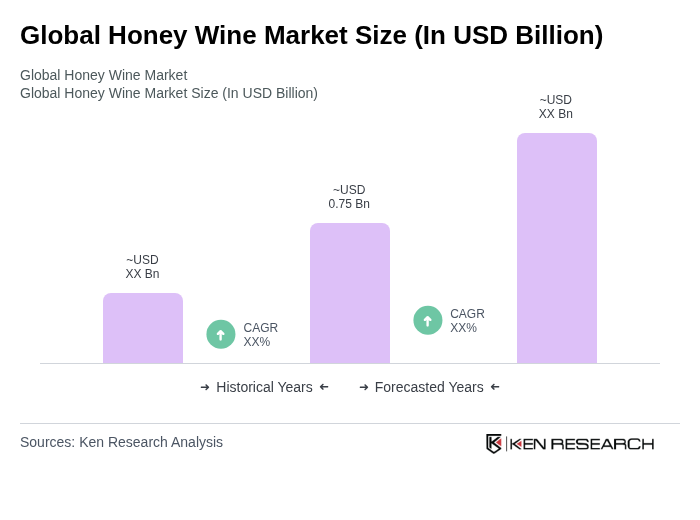
- The Global Honey Wine Market is valued at USD 0.75 billion, based on a five?year historical analysis. This growth is primarily driven by rising consumer preference for natural and organic beverages, the strong momentum of artisanal and craft alcoholic drinks, and increasing interest in premium, small?batch products. The market is further supported by the perceived functional benefits of honey (including antioxidant and anti?inflammatory properties) and the positioning of honey wine as a lower?sulfite, naturally sweet alternative to conventional grape wine among health?conscious consumers.
- Key countries driving this market include the United States, Germany, and the United Kingdom, supported by a broader concentration of meaderies in North America and Europe. The U.S. leads in terms of revenue share within the honey wine category, underpinned by a large craft beverage ecosystem, a high number of licensed meaderies, and strong participation in festivals and tasting rooms that promote mead. Germany and the UK benefit from long?standing cultural familiarity with mead, heritage brands, and a consumer base increasingly interested in distinctive, historically rooted alcoholic beverages.
- Within the European Union, honey wine is covered under the regulatory framework for wine and aromatised wine products, including rules on ingredient use and labelling transparency. In particular, Regulation (EU) 2021/2117 of the European Parliament and of the Council, which amends Regulation (EU) No 1308/2013 establishing a common organisation of the markets in agricultural products, reinforces requirements for detailed ingredient listings, allergen indication, and origin labelling for wine products marketed in the EU, and these provisions apply by extension to honey?based wines placed on the market. Producers of honey wine in the EU therefore must comply with oenological practice standards, compositional limits, and labelling rules designed to support product quality assurance and consumer information.
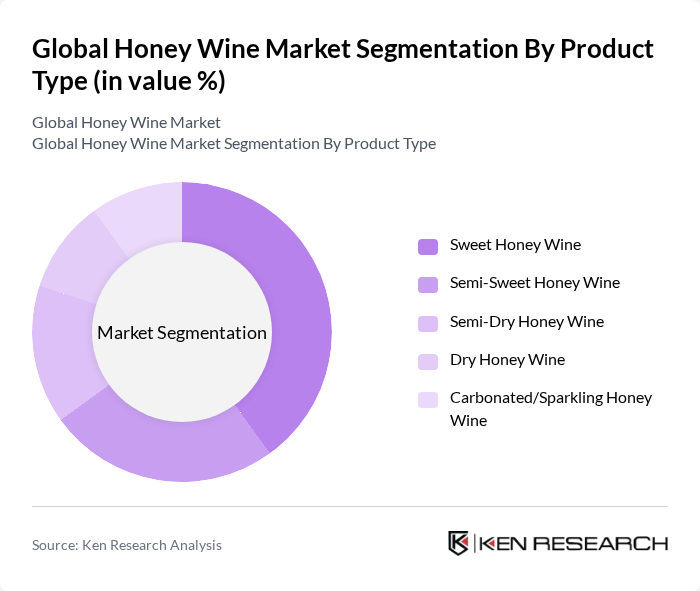
Global Honey Wine Market Segmentation
By Product Type:The product type segmentation includes various styles of honey wine, catering to diverse consumer preferences. The subsegments are Sweet Honey Wine, Semi-Sweet Honey Wine, Semi-Dry Honey Wine, Dry Honey Wine, and Carbonated/Sparkling Honey Wine. Among these, Sweet Honey Wine is currently the most popular choice in volume terms, as many new consumers entering the category prefer approachable, dessert?like profiles before experimenting with drier styles. The trend towards sweeter options is reinforced by younger consumers and flavored?beverage drinkers seeking unique, naturally sweet alternatives to traditional grape wines, ciders, and ready?to?drink cocktails.
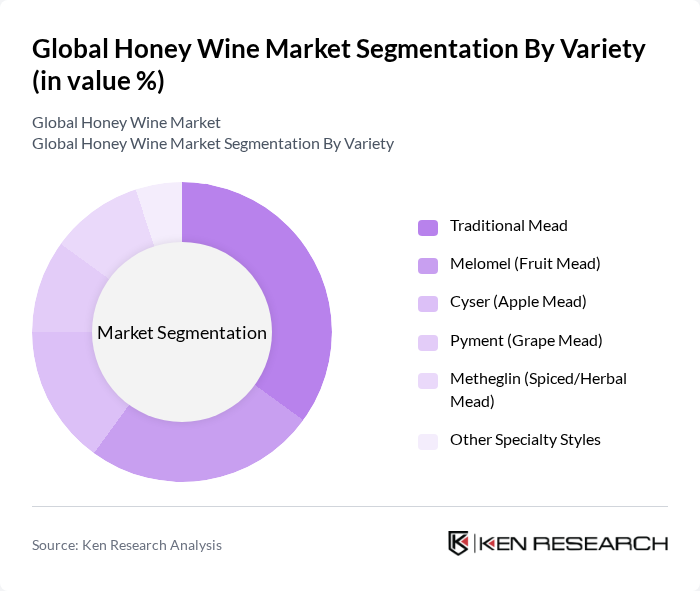
By Variety:This segmentation focuses on the different styles of honey wine, including Traditional Mead, Melomel (Fruit Mead), Cyser (Apple Mead), Pyment (Grape Mead), Metheglin (Spiced/Herbal Mead), and Other Specialty Styles. Traditional Mead remains the leading variety globally, reflecting its role as the core, heritage expression of honey wine and the entry point for many consumers discovering mead for the first time. At the same time, the growing interest in innovative flavors and culinary pairings is driving faster growth for fruit?based and spiced meads such as Melomel and Metheglin, which align with broader trends for flavored craft beverages and experimental releases from small meaderies.
Global Honey Wine Market Competitive Landscape
The Global Honey Wine Market is characterized by a dynamic mix of regional and international players. Leading participants such as Schramm's Mead (USA), B. Nektar Meadery (USA), Redstone Meadery (USA), Moonlight Meadery (USA), Superstition Meadery (USA), Brothers Drake Meadery (USA), Medovina Meadery (USA), Golden Coast Mead (USA), The Honey Wine Company (USA), Martin Brothers Winery & Meadery (USA), Moonshine Meadery (India), Gosnells of London (UK), Dansk Mjød A/S (Denmark), Lindisfarne Mead (UK), and other prominent regional meaderies contribute to innovation, geographic expansion, and service delivery in this space.
Global Honey Wine Market Industry Analysis
Growth Drivers
- Increasing Consumer Interest in Natural Beverages:The global trend towards health and wellness has led to a significant rise in demand for natural and organic beverages. In future, the organic beverage market is projected to reach $200 billion, with honey wine benefiting from this shift. Consumers are increasingly seeking products with fewer additives, and honey wine, made from fermented honey, aligns perfectly with this preference. This growing consumer base is expected to drive honey wine sales significantly in the None region.
- Rising Popularity of Mead in Social Events:Mead, or honey wine, is gaining traction in social and cultural events, with an estimated 15% increase in mead consumption noted in future. Events such as weddings, festivals, and local gatherings are increasingly featuring honey wine, enhancing its visibility and appeal. The rise of mead festivals, which attracted over 100,000 attendees in future, further solidifies its position as a trendy beverage choice, contributing to market growth in the None region.
- Expansion of E-commerce Platforms:The growth of e-commerce has revolutionized beverage sales, with online alcohol sales projected to reach $40 billion by future. This shift allows honey wine producers to reach a broader audience, particularly younger consumers who prefer online shopping. The convenience of purchasing honey wine through various platforms is expected to enhance market penetration in the None region, making it more accessible to consumers who may not find it in local stores.
Market Challenges
- Limited Awareness and Understanding:Despite its growing popularity, honey wine still faces challenges related to consumer awareness. A survey indicated that only 30% of consumers could correctly identify honey wine, limiting its market potential. This lack of understanding can hinder sales, as consumers may opt for more familiar alcoholic beverages. Educational initiatives are crucial to overcoming this barrier and increasing honey wine's market share in the None region.
- Regulatory Hurdles:The honey wine industry faces various regulatory challenges that can impede growth. In future, it is estimated that compliance costs for small producers could reach $10,000 annually due to licensing and labeling requirements. These regulations vary significantly across regions, creating barriers for producers looking to enter new markets. Navigating these complexities is essential for honey wine producers to thrive in the None region.
Global Honey Wine Market Future Outlook
The future of honey wine in the None region appears promising, driven by increasing consumer demand for natural products and the growing popularity of mead in social settings. As e-commerce continues to expand, honey wine producers will have greater opportunities to reach diverse consumer segments. Additionally, innovative marketing strategies and collaborations with local artisans can enhance brand visibility, further solidifying honey wine's position in the beverage market. The focus on sustainability will also play a crucial role in shaping future trends.
Market Opportunities
- Development of Flavored Honey Wines:There is a growing opportunity for producers to create flavored honey wines, appealing to adventurous consumers. The introduction of unique flavors, such as berry-infused or spiced honey wines, can attract a broader audience. This trend aligns with the increasing consumer interest in diverse beverage options, potentially boosting sales and market share in the None region.
- Collaborations with Local Producers:Partnering with local artisans and producers can enhance the authenticity and appeal of honey wine. Such collaborations can lead to unique product offerings that resonate with consumers seeking local and sustainable options. This strategy not only supports local economies but also strengthens brand loyalty, creating a significant opportunity for growth in the None region.
Scope of the Report
| Segment | Sub-Segments |
|---|---|
| By Product Type | Sweet Honey Wine Semi-Sweet Honey Wine Semi-Dry Honey Wine Dry Honey Wine Carbonated/Sparkling Honey Wine |
| By Variety | Traditional Mead Melomel (Fruit Mead) Cyser (Apple Mead) Pyment (Grape Mead) Metheglin (Spiced/Herbal Mead) Other Specialty Styles |
| By Nature | Conventional Organic |
| By End-Use Application | Personal / At-Home Consumption HoReCa (Hotels, Restaurants, Bars) Events, Festivals & Catering Gifting & Occasional Purchases |
| By Packaging Type | Glass Bottles Cans Kegs Bag-in-Box & Others |
| By Distribution Channel | Online Retail & Direct-to-Consumer Supermarkets/Hypermarkets Specialty Liquor & Wine Stores Convenience Stores & Others |
| By Region | North America Europe Asia-Pacific Latin America Middle East & Africa |
| By Alcohol Content | Low Alcohol (up to 5%) Medium Alcohol (5% - 12%) High Alcohol (above 12%) |
| By Price Range | Premium Mid-range Budget |
Key Target Audience
Investors and Venture Capitalist Firms
Government and Regulatory Bodies (e.g., Food and Drug Administration, European Food Safety Authority)
Manufacturers and Producers
Distributors and Retailers
Importers and Exporters
Industry Associations (e.g., National Honey Board)
Financial Institutions
Packaging Suppliers
Players Mentioned in the Report:
Schramm's Mead (USA)
B. Nektar Meadery (USA)
Redstone Meadery (USA)
Moonlight Meadery (USA)
Superstition Meadery (USA)
Brothers Drake Meadery (USA)
Medovina Meadery (USA)
Golden Coast Mead (USA)
The Honey Wine Company (USA)
Martin Brothers Winery & Meadery (USA)
Moonshine Meadery (India)
Gosnells of London (UK)
Dansk Mjd A/S (Denmark)
Lindisfarne Mead (UK)
Other Prominent Regional Meaderies
Table of Contents
Market Assessment Phase
1. Executive Summary and Approach
2. Global Honey Wine Market Overview
2.1 Key Insights and Strategic Recommendations
2.2 Global Honey Wine Market Overview
2.3 Definition and Scope
2.4 Evolution of Market Ecosystem
2.5 Timeline of Key Regulatory Milestones
2.6 Value Chain & Stakeholder Mapping
2.7 Business Cycle Analysis
2.8 Policy & Incentive Landscape
3. Global Honey Wine Market Analysis
3.1 Growth Drivers
3.1.1 Increasing consumer interest in natural and organic beverages
3.1.2 Rising popularity of mead in social and cultural events
3.1.3 Expansion of e-commerce platforms for beverage sales
3.1.4 Growth in the craft beverage industry
3.2 Market Challenges
3.2.1 Limited awareness and understanding of honey wine
3.2.2 Regulatory hurdles in different regions
3.2.3 Competition from established alcoholic beverages
3.2.4 Fluctuating honey prices affecting production costs
3.3 Market Opportunities
3.3.1 Development of flavored honey wines
3.3.2 Collaborations with local producers and artisans
3.3.3 Growth in health-conscious consumer segments
3.3.4 Export opportunities in emerging markets
3.4 Market Trends
3.4.1 Increasing demand for sustainable and eco-friendly products
3.4.2 Rise of mead festivals and tasting events
3.4.3 Innovative packaging solutions for honey wine
3.4.4 Social media influence on beverage choices
3.5 Government Regulation
3.5.1 Labeling requirements for alcoholic beverages
3.5.2 Taxation policies on honey wine production
3.5.3 Licensing regulations for mead producers
3.5.4 Health and safety standards for production facilities
4. SWOT Analysis
5. Stakeholder Analysis
6. Porter's Five Forces Analysis
7. Global Honey Wine Market Market Size, 2019-2024
7.1 By Value
7.2 By Volume
7.3 By Average Selling Price
8. Global Honey Wine Market Segmentation
8.1 By Product Type
8.1.1 Sweet Honey Wine
8.1.2 Semi-Sweet Honey Wine
8.1.3 Semi-Dry Honey Wine
8.1.4 Dry Honey Wine
8.1.5 Carbonated/Sparkling Honey Wine
8.2 By Variety
8.2.1 Traditional Mead
8.2.2 Melomel (Fruit Mead)
8.2.3 Cyser (Apple Mead)
8.2.4 Pyment (Grape Mead)
8.2.5 Metheglin (Spiced/Herbal Mead)
8.2.6 Other Specialty Styles
8.3 By Nature
8.3.1 Conventional
8.3.2 Organic
8.4 By End-Use Application
8.4.1 Personal / At-Home Consumption
8.4.2 HoReCa (Hotels, Restaurants, Bars)
8.4.3 Events, Festivals & Catering
8.4.4 Gifting & Occasional Purchases
8.5 By Packaging Type
8.5.1 Glass Bottles
8.5.2 Cans
8.5.3 Kegs
8.5.4 Bag-in-Box & Others
8.6 By Distribution Channel
8.6.1 Online Retail & Direct-to-Consumer
8.6.2 Supermarkets/Hypermarkets
8.6.3 Specialty Liquor & Wine Stores
8.6.4 Convenience Stores & Others
8.7 By Region
8.7.1 North America
8.7.2 Europe
8.7.3 Asia-Pacific
8.7.4 Latin America
8.7.5 Middle East & Africa
8.8 By Alcohol Content
8.8.1 Low Alcohol (up to 5%)
8.8.2 Medium Alcohol (5% - 12%)
8.8.3 High Alcohol (above 12%)
8.9 By Price Range
8.9.1 Premium
8.9.2 Mid-range
8.9.3 Budget
9. Global Honey Wine Market Competitive Analysis
9.1 Market Share of Key Players
9.2 Cross Comparison of Key Players
9.2.1 Company Name
9.2.2 Scale (Micro, Small, Medium, Large Meadery)
9.2.3 Total Revenue from Honey Wine
9.2.4 Honey Wine Revenue CAGR (3–5 Years)
9.2.5 Production Capacity (Liters per Year)
9.2.6 Average Selling Price per Liter
9.2.7 SKU Count / Product Portfolio Breadth
9.2.8 Share of Export Sales in Total Sales
9.2.9 Geographic Presence (No. of Countries/Regions)
9.2.10 Distribution Channel Mix (D2C vs On-Trade vs Off-Trade)
9.2.11 Marketing & Promotion Intensity (Spend as % of Sales)
9.2.12 Customer Ratings / Review Score (Key Platforms)
9.3 SWOT Analysis of Top Players
9.4 Pricing Analysis
9.5 Detailed Profile of Major Companies
9.5.1 Schramm's Mead (USA)
9.5.2 B. Nektar Meadery (USA)
9.5.3 Redstone Meadery (USA)
9.5.4 Moonlight Meadery (USA)
9.5.5 Superstition Meadery (USA)
9.5.6 Brothers Drake Meadery (USA)
9.5.7 Medovina Meadery (USA)
9.5.8 Golden Coast Mead (USA)
9.5.9 The Honey Wine Company (USA)
9.5.10 Martin Brothers Winery & Meadery (USA)
9.5.11 Moonshine Meadery (India)
9.5.12 Gosnells of London (UK)
9.5.13 Dansk Mjød A/S (Denmark)
9.5.14 Lindisfarne Mead (UK)
9.5.15 Other Prominent Regional Meaderies
10. Global Honey Wine Market End-User Analysis
10.1 Procurement Behavior of Key Ministries
10.1.1 Government procurement policies
10.1.2 Budget allocation for honey wine
10.1.3 Supplier selection criteria
10.1.4 Contract management practices
10.2 Corporate Spend on Infrastructure & Energy
10.2.1 Investment in production facilities
10.2.2 Spending on marketing and branding
10.2.3 Budget for research and development
10.2.4 Others
10.3 Pain Point Analysis by End-User Category
10.3.1 Quality consistency issues
10.3.2 Supply chain disruptions
10.3.3 Pricing volatility
10.3.4 Regulatory compliance challenges
10.4 User Readiness for Adoption
10.4.1 Awareness of honey wine benefits
10.4.2 Availability of products in local markets
10.4.3 Consumer education initiatives
10.4.4 Others
10.5 Post-Deployment ROI and Use Case Expansion
10.5.1 Measurement of sales growth
10.5.2 Customer feedback and satisfaction
10.5.3 Market share analysis
10.5.4 Opportunities for product line expansion
11. Global Honey Wine Market Future Size, 2025-2030
11.1 By Value
11.2 By Volume
11.3 By Average Selling Price
Go-To-Market Strategy Phase
1. Whitespace Analysis + Business Model Canvas
1.1 Market gaps identification
1.2 Value proposition development
1.3 Revenue model exploration
1.4 Customer segmentation analysis
1.5 Competitive landscape overview
1.6 Key partnerships and alliances
1.7 Operational framework design
2. Marketing and Positioning Recommendations
2.1 Branding strategies
2.2 Product USPs
2.3 Target audience identification
2.4 Marketing channels selection
2.5 Promotional tactics
2.6 Customer engagement strategies
2.7 Performance metrics
3. Distribution Plan
3.1 Urban retail vs rural NGO tie-ups
3.2 Distribution channel optimization
3.3 Logistics and supply chain management
3.4 Partnership with distributors
3.5 Inventory management strategies
3.6 Sales force deployment
3.7 Performance tracking
4. Channel & Pricing Gaps
4.1 Underserved routes
4.2 Pricing bands
4.3 Competitor pricing analysis
4.4 Value-based pricing strategies
4.5 Discount and promotion strategies
4.6 Price elasticity assessment
4.7 Customer willingness to pay
5. Unmet Demand & Latent Needs
5.1 Category gaps
5.2 Consumer segments
5.3 Product innovation opportunities
5.4 Market entry barriers
5.5 Customer feedback analysis
5.6 Future trends forecasting
5.7 Strategic recommendations
6. Customer Relationship
7.1 Loyalty programs
7.2 After-sales service
7.3 Customer feedback mechanisms
7.4 Community engagement initiatives
7.5 Customer education programs
7.6 Relationship management tools
7.7 Performance evaluation
7. Value Proposition
8.1 Sustainability
8.2 Integrated supply chains
8.3 Unique selling points
8.4 Customer-centric approach
8.5 Competitive advantages
8.6 Brand loyalty factors
8.7 Market differentiation strategies
8. Key Activities
9.1 Regulatory compliance
9.2 Branding
9.3 Distribution setup
9.4 Marketing execution
9.5 Customer service enhancement
9.6 Performance monitoring
9.7 Continuous improvement initiatives
9. Entry Strategy Evaluation
9.1 Domestic Market Entry Strategy
10.1.1 Product mix
10.1.2 Pricing band
10.1.3 Packaging
9.2 Export Entry Strategy
10.2.1 Target countries
10.2.2 Compliance roadmap
10. Entry Mode Assessment
11.1 JV
11.2 Greenfield
11.3 M&A
11.4 Distributor Model
11. Capital and Timeline Estimation
12.1 Capital requirements
12.2 Timelines
12. Control vs Risk Trade-Off
13.1 Ownership vs Partnerships
13. Profitability Outlook
14.1 Breakeven analysis
14.2 Long-term sustainability
14. Potential Partner List
15.1 Distributors
15.2 JVs
15.3 Acquisition targets
15. Execution Roadmap
15.1 Phased Plan for Market Entry
16.1.1 Market Setup
16.1.2 Market Entry
16.1.3 Growth Acceleration
16.1.4 Scale & Stabilize
15.2 Key Activities and Milestones
16.2.1 Milestone tracking
16.2.2 Activity scheduling
16.2.3 Resource allocation
Research Methodology
Phase 1: Approach1
Desk Research
- Analysis of industry reports from global honey wine associations and market research firms
- Review of academic journals and publications on honey wine production and consumption trends
- Examination of government publications and trade statistics related to honey and wine production
Primary Research
- Interviews with honey wine producers and distributors to gather insights on market dynamics
- Surveys targeting consumers to understand preferences and purchasing behavior regarding honey wine
- Field interviews with sommeliers and beverage industry experts to assess market trends and challenges
Validation & Triangulation
- Cross-validation of findings through multiple data sources, including trade publications and consumer surveys
- Triangulation of qualitative insights from interviews with quantitative data from market reports
- Sanity checks conducted through expert panel reviews to ensure data accuracy and relevance
Phase 2: Market Size Estimation1
Top-down Assessment
- Estimation of the global honey wine market size based on overall wine market growth rates
- Segmentation analysis by region, product type, and distribution channel
- Incorporation of trends in organic and natural beverage consumption influencing honey wine sales
Bottom-up Modeling
- Collection of production data from honey wine manufacturers to establish baseline volumes
- Analysis of sales data from retail and online channels to determine market penetration
- Volume x price modeling to estimate revenue generation across different market segments
Forecasting & Scenario Analysis
- Multi-factor regression analysis incorporating variables such as consumer health trends and premiumization
- Scenario planning based on potential regulatory changes affecting honey production and wine sales
- Development of baseline, optimistic, and pessimistic forecasts through 2030
Phase 3: CATI Sample Composition1
| Scope Item/Segment | Sample Size | Target Respondent Profiles |
|---|---|---|
| Honey Wine Producers | 60 | Owners, Production Managers |
| Retailers of Honey Wine | 50 | Store Managers, Beverage Buyers |
| Consumers of Honey Wine | 120 | Wine Enthusiasts, Health-Conscious Consumers |
| Distributors and Wholesalers | 55 | Sales Representatives, Distribution Managers |
| Industry Experts and Sommeliers | 45 | Wine Critics, Beverage Consultants |
Frequently Asked Questions
What is the current value of the Global Honey Wine Market?
The Global Honey Wine Market is valued at approximately USD 0.75 billion, reflecting a growing consumer preference for natural and organic beverages, alongside the rising popularity of artisanal and craft alcoholic drinks.
Which countries are leading in the honey wine market?
What are the main product types in the honey wine market?
What varieties of honey wine are available?
Other Regional/Country Reports
Indonesia Honey Wine Market
Malaysia Honey Wine Market
KSA Honey Wine Market
APAC Honey Wine Market
SEA Honey Wine Market
Vietnam Honey Wine Market
Other Adjacent Reports
South Korea Honey Production Market
Middle East Organic Beverages Market Size, Share, Growth Drivers, Trends, Opportunities & Forecast 2025–2030UAE Craft Spirits MarketGlobal Functional Beverages Market Size, Share & Forecast, By Product Type, Function & Distribution Channel, 2026-2031Philippines Artisanal Foods Market
Qatar Alcoholic E-commerce Market
India Beverage Packaging Market Size, Share & Forecast, By Material, Packaging Format, Beverage Type & Distribution Channel, 2026-2031Why Buy From Us?

What makes us stand out is that our consultants follow Robust, Refine and Result (RRR) methodology. Robust for clear definitions, approaches and sanity checking, Refine for differentiating respondents' facts and opinions, and Result for presenting data with story.

We have set a benchmark in the industry by offering our clients with syndicated and customized market research reports featuring coverage of entire market as well as meticulous research and analyst insights.

While we don't replace traditional research, we flip the method upside down. Our dual approach of Top Bottom & Bottom Top ensures quality deliverable by not just verifying company fundamentals but also looking at the sector and macroeconomic factors.

With one step in the future, our research team constantly tries to show you the bigger picture. We help with some of the tough questions you may encounter along the way: How is the industry positioned? Best marketing channel? KPI's of competitors? By aligning every element, we help maximize success.

Our report gives you instant access to the answers and sources that other companies might choose to hide. We elaborate each steps of research methodology we have used and showcase you the sample size to earn your trust.

If you need any support, we are here! We pride ourselves on universe strength, data quality, and quick, friendly, and professional service.