About the Report
Base Year 2024Global Luxury Apparel Market Overview
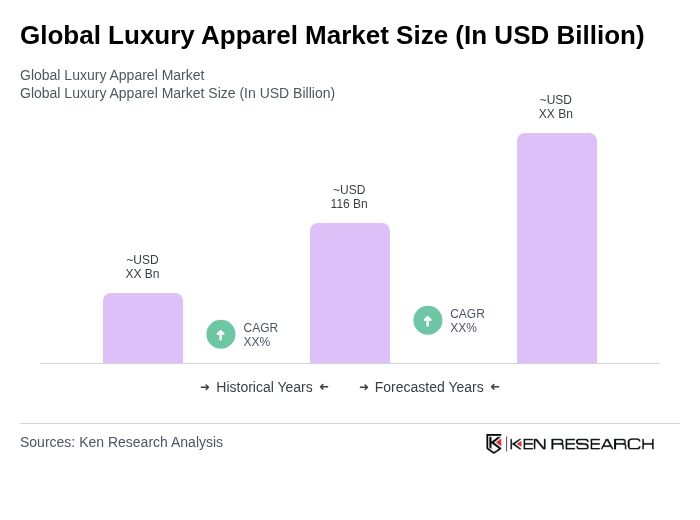
- The Global Luxury Apparel Market is valued at approximately USD 116 billion, based on a five-year historical analysis. This growth is primarily driven by increasing disposable incomes, a rising number of affluent consumers, and a growing preference for high-quality, branded products. The market has seen a significant shift towards online shopping, with luxury brands enhancing their digital presence to cater to tech-savvy consumers, integrating immersive 3-D showroom tools, live-chat styling assistance, and same-day courier deliveries to improve the online experience .
- Key players in this market include countries like the United States, France, Italy, and China. The United States leads due to its strong consumer base and established luxury brands, while France and Italy are renowned for their fashion heritage and luxury craftsmanship. China has emerged as a dominant player due to its expanding middle class and increasing demand for luxury goods, with Asia-Pacific showing the strongest growth outlook in the sector .
- In 2023, the European Union implemented the Sustainable Products Initiative, which includes mandatory reporting on environmental impact and the introduction of eco-labels for sustainable products. These measures require brands to adopt more environmentally friendly practices and ensure greater transparency in their supply chains, aligning with broader regulatory efforts to promote sustainable fashion within the luxury apparel sector .
Global Luxury Apparel Market Segmentation
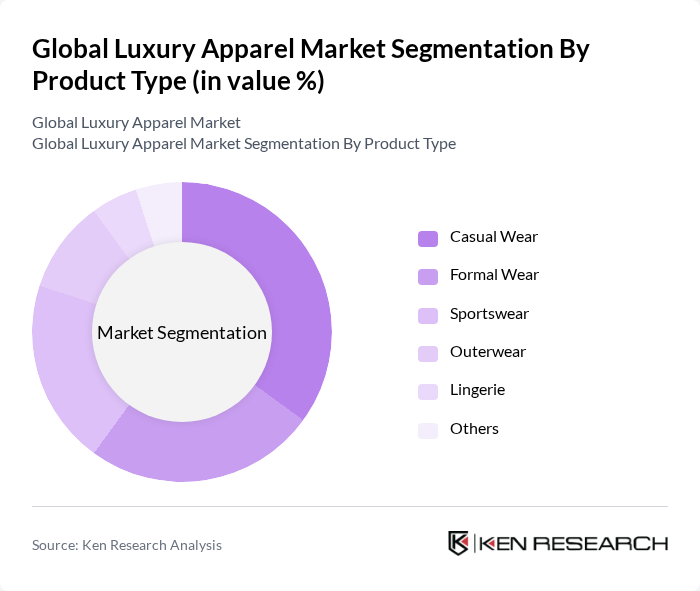
By Product Type:The luxury apparel market is segmented into various product types, including Casual Wear, Formal Wear, Sportswear, Outerwear, Lingerie, and Others. Among these, Casual Wear has gained significant traction due to the increasing trend of athleisure and comfortable clothing, especially post-pandemic. Consumers are increasingly seeking versatile pieces that can be worn for both leisure and formal occasions, driving the demand for high-quality casual apparel. Formal Wear remains a staple for events and business settings, while Sportswear is also on the rise as health and fitness trends continue to influence consumer choices. The dominance of casual and athleisure segments is further reinforced by the growing popularity of elevated everyday wear such as luxury T-shirts and shirts .
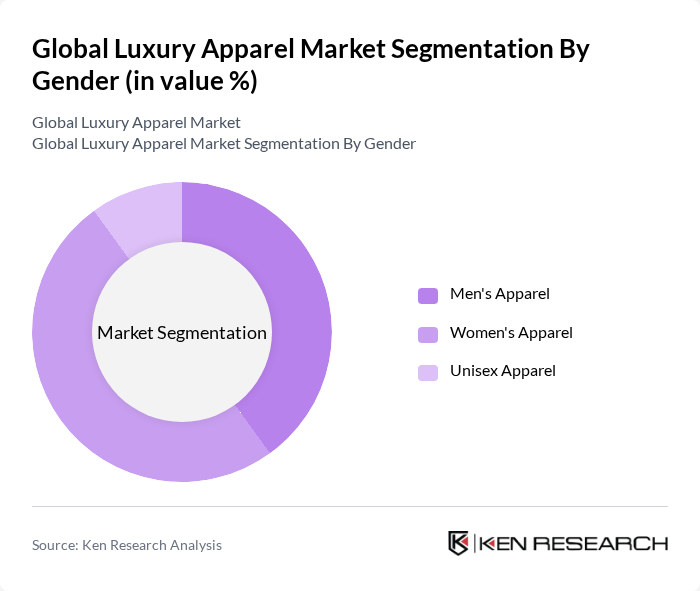
By Gender:The luxury apparel market is also segmented by gender, including Men's Apparel, Women's Apparel, and Unisex Apparel. Women's Apparel dominates the market, driven by a wider variety of styles and the increasing participation of women in the workforce. This segment has seen a surge in demand for both casual and formal wear, as women seek fashionable yet functional clothing. Men's Apparel is also growing, particularly in the casual and athleisure segments, while Unisex Apparel is gaining popularity among younger consumers who prioritize inclusivity and gender-neutral fashion .
Global Luxury Apparel Market Competitive Landscape
The Global Luxury Apparel Market is characterized by a dynamic mix of regional and international players. Leading participants such as LVMH Moët Hennessy Louis Vuitton, Kering, Hermès, Chanel, Prada, Gucci, Burberry, Ralph Lauren Corporation, Versace, Dolce & Gabbana, Valentino, Fendi, Salvatore Ferragamo, Bottega Veneta, Moncler contribute to innovation, geographic expansion, and service delivery in this space.
Global Luxury Apparel Market Industry Analysis
Growth Drivers
- Increasing Disposable Income:The global luxury apparel market is significantly driven by rising disposable incomes, particularly in emerging economies. For instance, the World Bank reported that the global middle class is expected to reach 5.3 billion by 2030, with a substantial increase in spending power. In future, the average disposable income in high-income countries is projected to be around $47,000, fostering greater consumer spending on luxury goods, including apparel, which is anticipated to boost market growth.
- Rising Demand for Sustainable Fashion:The shift towards sustainable fashion is a key growth driver in the luxury apparel sector. According to a McKinsey report, 67% of consumers consider sustainability when making a purchase. In future, the global market for sustainable fashion is expected to reach $9.5 billion, reflecting a growing consumer preference for eco-friendly products. This trend encourages luxury brands to adopt sustainable practices, enhancing their appeal and driving sales in the luxury apparel market.
- Growth of E-commerce Platforms:The expansion of e-commerce platforms is revolutionizing the luxury apparel market. In future, online sales of luxury goods are projected to account for 35% of total luxury sales, up from 20% in 2020, according to Bain & Company. This growth is fueled by increased internet penetration and mobile shopping convenience, allowing luxury brands to reach a broader audience. Enhanced online shopping experiences are expected to further drive consumer engagement and sales in the luxury apparel sector.
Market Challenges
- Intense Competition Among Luxury Brands:The luxury apparel market faces intense competition, with numerous established brands vying for market share. In future, the top 10 luxury brands are expected to account for over 55% of the market, intensifying rivalry. This competition pressures brands to innovate continuously and differentiate their offerings, which can lead to increased marketing costs and reduced profit margins, posing a significant challenge to maintaining market position.
- Economic Fluctuations Affecting Consumer Spending:Economic fluctuations pose a significant challenge to the luxury apparel market. In future, global GDP growth is projected to be around 2.8%, with potential downturns in key markets affecting consumer confidence. Economic uncertainty can lead to reduced discretionary spending, particularly on luxury items. Brands must navigate these fluctuations carefully to sustain sales and profitability in a volatile economic environment.
Global Luxury Apparel Market Future Outlook
The future of the luxury apparel market appears promising, driven by evolving consumer preferences and technological advancements. As sustainability becomes a core value for consumers, brands that prioritize eco-friendly practices are likely to thrive. Additionally, the integration of augmented reality and artificial intelligence in online shopping experiences is expected to enhance customer engagement. These trends indicate a shift towards a more personalized and responsible luxury shopping experience, positioning the market for continued growth in the coming years.
Market Opportunities
- Expansion into Emerging Markets:Emerging markets present significant growth opportunities for luxury apparel brands. With a projected increase in the middle class population, particularly in Asia and Africa, brands can tap into new consumer bases. In future, the luxury market in Asia is expected to grow by $35 billion, driven by rising disposable incomes and changing consumer behaviors, making it a lucrative target for expansion.
- Collaborations with Influencers and Designers:Collaborations with influencers and renowned designers offer luxury brands a unique opportunity to enhance their market presence. In future, influencer marketing in the fashion sector is projected to reach $18 billion, highlighting its effectiveness in reaching younger consumers. Strategic partnerships can amplify brand visibility and attract new customers, driving sales and fostering brand loyalty in a competitive landscape.
Scope of the Report
| Segment | Sub-Segments |
|---|---|
| By Product Type | Casual Wear Formal Wear Sportswear Outerwear Lingerie Others |
| By Gender | Men's Apparel Women's Apparel Unisex Apparel |
| By Distribution Channel | Offline Retail Online Retail Specialty Stores Department Stores Boutiques Others |
| By Price Range | Premium Ultra-Premium Affordable Luxury |
| By Material | Cotton Silk Leather Denim Synthetic Others |
| By Region | North America Europe Asia-Pacific Latin America Middle East & Africa |
Key Target Audience
Investors and Venture Capitalist Firms
Government and Regulatory Bodies (e.g., Federal Trade Commission, Department of Commerce)
Manufacturers and Producers
Distributors and Retailers
Luxury Brand Owners
Fashion Industry Trade Associations
Financial Institutions
Logistics and Supply Chain Companies
Players Mentioned in the Report:
LVMH Moet Hennessy Louis Vuitton
Kering
Hermes
Chanel
Prada
Gucci
Burberry
Ralph Lauren Corporation
Versace
Dolce & Gabbana
Valentino
Fendi
Salvatore Ferragamo
Bottega Veneta
Moncler
Table of Contents
Market Assessment Phase
1. Executive Summary and Approach
2. Global Luxury Apparel Market Overview
2.1 Key Insights and Strategic Recommendations
2.2 Global Luxury Apparel Market Overview
2.3 Definition and Scope
2.4 Evolution of Market Ecosystem
2.5 Timeline of Key Regulatory Milestones
2.6 Value Chain & Stakeholder Mapping
2.7 Business Cycle Analysis
2.8 Policy & Incentive Landscape
3. Global Luxury Apparel Market Analysis
3.1 Growth Drivers
3.1.1 Increasing disposable income
3.1.2 Rising demand for sustainable fashion
3.1.3 Growth of e-commerce platforms
3.1.4 Influence of social media and celebrity endorsements
3.2 Market Challenges
3.2.1 Intense competition among luxury brands
3.2.2 Economic fluctuations affecting consumer spending
3.2.3 Counterfeit products undermining brand value
3.2.4 Supply chain disruptions
3.3 Market Opportunities
3.3.1 Expansion into emerging markets
3.3.2 Collaborations with influencers and designers
3.3.3 Development of personalized shopping experiences
3.3.4 Investment in sustainable practices
3.4 Market Trends
3.4.1 Shift towards online luxury shopping
3.4.2 Increasing focus on ethical sourcing
3.4.3 Rise of rental and resale markets
3.4.4 Integration of technology in retail experiences
3.5 Government Regulation
3.5.1 Regulations on sustainable materials
3.5.2 Import/export tariffs on luxury goods
3.5.3 Consumer protection laws
3.5.4 Intellectual property rights enforcement
4. SWOT Analysis
5. Stakeholder Analysis
6. Porter's Five Forces Analysis
7. Global Luxury Apparel Market Market Size, 2019-2024
7.1 By Value
7.2 By Volume
7.3 By Average Selling Price
8. Global Luxury Apparel Market Segmentation
8.1 By Product Type
8.1.1 Casual Wear
8.1.2 Formal Wear
8.1.3 Sportswear
8.1.4 Outerwear
8.1.5 Lingerie
8.1.6 Others
8.2 By Gender
8.2.1 Men's Apparel
8.2.2 Women's Apparel
8.2.3 Unisex Apparel
8.3 By Distribution Channel
8.3.1 Offline Retail
8.3.2 Online Retail
8.3.3 Specialty Stores
8.3.4 Department Stores
8.3.5 Boutiques
8.3.6 Others
8.4 By Price Range
8.4.1 Premium
8.4.2 Ultra-Premium
8.4.3 Affordable Luxury
8.5 By Material
8.5.1 Cotton
8.5.2 Silk
8.5.3 Leather
8.5.4 Denim
8.5.5 Synthetic
8.5.6 Others
8.6 By Region
8.6.1 North America
8.6.2 Europe
8.6.3 Asia-Pacific
8.6.4 Latin America
8.6.5 Middle East & Africa
9. Global Luxury Apparel Market Competitive Analysis
9.1 Market Share of Key Players
9.2 Cross Comparison of Key Players
9.2.1 Company Name
9.2.2 Group Size (Large, Medium, or Small as per industry convention)
9.2.3 Annual Revenue (USD Billion)
9.2.4 Year-over-Year Revenue Growth Rate (%)
9.2.5 Market Share (%)
9.2.6 Geographic Presence (Number of Countries)
9.2.7 Online Sales Penetration (%)
9.2.8 Brand Equity Score
9.2.9 Customer Satisfaction Score (NPS)
9.2.10 Sustainability Rating (% Sustainable Product Launches)
9.3 SWOT Analysis of Top Players
9.4 Pricing Analysis
9.5 Detailed Profile of Major Companies
9.5.1 LVMH Moët Hennessy Louis Vuitton
9.5.2 Kering
9.5.3 Hermès
9.5.4 Chanel
9.5.5 Prada
9.5.6 Gucci
9.5.7 Burberry
9.5.8 Ralph Lauren Corporation
9.5.9 Versace
9.5.10 Dolce & Gabbana
9.5.11 Valentino
9.5.12 Fendi
9.5.13 Salvatore Ferragamo
9.5.14 Bottega Veneta
9.5.15 Moncler
10. Global Luxury Apparel Market End-User Analysis
10.1 Consumer Demographics and Behavior
10.1.1 High-net-worth individuals (HNWI)
10.1.2 Affluent consumers
10.1.3 Emerging luxury consumers
10.1.4 Digital-first luxury buyers
10.2 Purchase Drivers and Motivations
10.2.1 Brand heritage and prestige
10.2.2 Quality and craftsmanship
10.2.3 Exclusivity and limited editions
10.2.4 Sustainability and ethical production
10.3 Pain Point Analysis by End-User Category
10.3.1 Sizing and fit consistency
10.3.2 Authenticity verification
10.3.3 Price accessibility
10.3.4 Personalization and customization options
10.4 User Readiness for Adoption
10.4.1 Digital shopping adoption rates
10.4.2 Willingness to pay premium prices
10.4.3 Preference for sustainable options
10.4.4 Engagement with luxury brands online
10.5 Post-Purchase Engagement and Loyalty
10.5.1 Repeat purchase rates
10.5.2 Brand loyalty program participation
10.5.3 Customer lifetime value
10.5.4 Referral and advocacy metrics
11. Global Luxury Apparel Market Future Size, 2025-2030
11.1 By Value
11.2 By Volume
11.3 By Average Selling Price
Go-To-Market Strategy Phase
1. Whitespace Analysis + Business Model Canvas
1.1 Market gaps identification
1.2 Value proposition development
1.3 Revenue model exploration
1.4 Customer segmentation analysis
1.5 Competitive landscape overview
1.6 Key partnerships identification
1.7 Operational framework design
2. Marketing and Positioning Recommendations
2.1 Branding strategies
2.2 Product USPs
2.3 Target audience definition
2.4 Communication channels selection
2.5 Campaign planning
3. Distribution Plan
3.1 Omnichannel retail strategy
3.2 E-commerce and digital platforms
3.3 Partnerships with luxury retailers and department stores
3.4 Logistics and supply chain management
4. Channel & Pricing Gaps
4.1 Underserved geographic markets
4.2 Pricing bands and tiers
4.3 Competitor pricing analysis
4.4 Value-based pricing strategies
5. Unmet Demand & Latent Needs
5.1 Category gaps
5.2 Consumer segments
5.3 Product innovation opportunities
5.4 Market entry strategies
6. Customer Relationship
6.1 Loyalty programs
6.2 After-sales service
6.3 Customer engagement strategies
6.4 Feedback and improvement mechanisms
7. Value Proposition
7.1 Sustainability and ethical practices
7.2 Integrated supply chains
7.3 Unique selling points
7.4 Customer-centric approach
8. Key Activities
8.1 Regulatory compliance
8.2 Branding and positioning
8.3 Distribution setup
8.4 Marketing execution
9. Entry Strategy Evaluation
9.1 Domestic Market Entry Strategy
9.1.1 Product mix
9.1.2 Pricing band
9.1.3 Packaging and presentation
9.2 Export Entry Strategy
9.2.1 Target countries and regions
9.2.2 Compliance roadmap
10. Entry Mode Assessment
10.1 Joint Venture
10.2 Greenfield Investment
10.3 Mergers & Acquisitions
10.4 Distributor Model
11. Capital and Timeline Estimation
11.1 Capital requirements
11.2 Timelines
12. Control vs Risk Trade-Off
12.1 Ownership vs Partnerships
13. Profitability Outlook
13.1 Breakeven analysis
13.2 Long-term sustainability
14. Potential Partner List
14.1 Distributors
14.2 Joint Venture Partners
14.3 Acquisition targets
15. Execution Roadmap
15.1 Phased Plan for Market Entry
15.1.1 Market Setup
15.1.2 Market Entry
15.1.3 Growth Acceleration
15.1.4 Scale & Stabilize
Research Methodology
Phase 1: Approach1
Desk Research
- Analysis of industry reports from luxury fashion associations and market research firms
- Review of financial statements and annual reports from leading luxury apparel brands
- Examination of consumer behavior studies and trend reports from fashion forecasting agencies
Primary Research
- In-depth interviews with brand managers and marketing executives in the luxury apparel sector
- Surveys targeting high-income consumers to understand purchasing preferences and trends
- Focus groups with fashion influencers and stylists to gauge market sentiment and brand perception
Validation & Triangulation
- Cross-validation of findings through multiple data sources, including sales data and consumer insights
- Triangulation of qualitative insights from interviews with quantitative data from surveys
- Sanity checks conducted through expert panel reviews comprising industry veterans and analysts
Phase 2: Market Size Estimation1
Top-down Assessment
- Estimation of total luxury apparel market size based on global fashion industry revenue
- Segmentation analysis by product category, including clothing, accessories, and footwear
- Incorporation of regional growth trends and economic indicators affecting luxury spending
Bottom-up Modeling
- Collection of sales data from key luxury retailers and e-commerce platforms
- Estimation of average transaction values and purchase frequencies among affluent consumers
- Analysis of market entry and expansion strategies of emerging luxury brands
Forecasting & Scenario Analysis
- Multi-variable forecasting models incorporating economic growth, consumer confidence, and fashion trends
- Scenario analysis based on potential impacts of global events, such as economic downturns or pandemics
- Development of baseline, optimistic, and pessimistic market projections through 2030
Phase 3: CATI Sample Composition1
| Scope Item/Segment | Sample Size | Target Respondent Profiles |
|---|---|---|
| Luxury Apparel Retailers | 75 | Store Managers, Regional Directors |
| High-Income Consumer Insights | 120 | Affluent Shoppers, Fashion Enthusiasts |
| Brand Marketing Strategies | 65 | Marketing Executives, Brand Strategists |
| Fashion Influencer Perspectives | 45 | Fashion Bloggers, Social Media Influencers |
| Luxury E-commerce Trends | 85 | E-commerce Managers, Digital Marketing Specialists |
Frequently Asked Questions
What is the current value of the Global Luxury Apparel Market?
The Global Luxury Apparel Market is valued at approximately USD 116 billion, driven by increasing disposable incomes and a growing number of affluent consumers seeking high-quality, branded products.
Which regions are leading in the Global Luxury Apparel Market?
What are the main product types in the luxury apparel market?
How is the luxury apparel market responding to sustainability trends?
Other Regional/Country Reports
Indonesia Luxury Apparel Market
Malaysia Luxury Apparel Market
KSA Luxury Apparel Market
APAC Luxury Apparel Market
SEA Luxury Apparel Market
Vietnam Luxury Apparel Market
Other Adjacent Reports
Kuwait Luxury Accessories Market
Malaysia Luxury Jewelry Market Size, Share & Forecast, By Product Category, Price Tier & Distribution Channel, 2025–2032UAE Luxury Handbags Market Size, Share, Growth Drivers, Trends, Opportunities & Forecast 2025–2030UAE Luxury Watches Market Size, Share, Growth Drivers, Trends, Opportunities & Forecast 2025–2030Thailand Sustainable Fashion Market
Vietnam Athleisure Apparel Market
South Africa High-End Cosmetics Market
Singapore Fashion E-Commerce Market
South Africa Premium Leather Goods Market
Why Buy From Us?

What makes us stand out is that our consultants follow Robust, Refine and Result (RRR) methodology. Robust for clear definitions, approaches and sanity checking, Refine for differentiating respondents' facts and opinions, and Result for presenting data with story.

We have set a benchmark in the industry by offering our clients with syndicated and customized market research reports featuring coverage of entire market as well as meticulous research and analyst insights.

While we don't replace traditional research, we flip the method upside down. Our dual approach of Top Bottom & Bottom Top ensures quality deliverable by not just verifying company fundamentals but also looking at the sector and macroeconomic factors.

With one step in the future, our research team constantly tries to show you the bigger picture. We help with some of the tough questions you may encounter along the way: How is the industry positioned? Best marketing channel? KPI's of competitors? By aligning every element, we help maximize success.

Our report gives you instant access to the answers and sources that other companies might choose to hide. We elaborate each steps of research methodology we have used and showcase you the sample size to earn your trust.

If you need any support, we are here! We pride ourselves on universe strength, data quality, and quick, friendly, and professional service.