About the Report
Base Year 2024Listen to the audio summary
Global Moving Services Market Overview
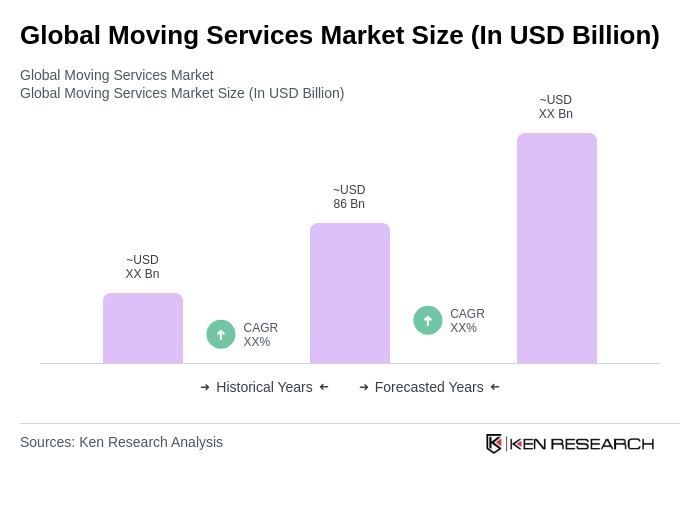
- The Global Moving Services Market is valued at USD 86 billion, based on a five-year historical analysis. This growth is primarily driven by increasing urbanization, rising disposable incomes, and the expansion of corporate sectors requiring employee relocations. The integration of advanced technologies, such as AI-driven route optimization and digital booking platforms, is enhancing operational efficiency and customer satisfaction. The demand for both residential and commercial moving services has significantly increased, as individuals and businesses seek efficient solutions for their moving needs. Companies are also adopting sustainable practices to address environmental concerns and maintain competitiveness .
- Key players in this market include the United States, Canada, and Australia, which dominate due to their robust economies, high mobility rates, and well-established logistics infrastructure. North America continues to lead the market, accounting for over 40% of the global share, supported by a strong demand for both domestic and international moving services, a growing population, and a trend towards urban living .
- In 2023, the U.S. government implemented new regulations aimed at enhancing consumer protection in the moving industry. The “Household Goods Motor Carrier Regulatory Reform Act of 2023” issued by the Federal Motor Carrier Safety Administration (FMCSA) introduced stricter guidelines for pricing transparency, service quality, and dispute resolution. These regulations require moving companies to provide clear written estimates, standardized contracts, and improved complaint handling procedures, ensuring that consumers are well-informed about their rights and the services they are purchasing. The initiative aims to foster trust and accountability within the moving services sector .
Global Moving Services Market Segmentation
By Type:The major subsegments under this category include Residential Moving, Commercial Moving, International Moving, Specialty Moving Services, Storage Services, Packing and Unpacking Services, and Disposal Services. Among these, Residential Moving is currently the leading subsegment, accounting for the largest share, driven by the increasing number of individuals relocating for job opportunities, lifestyle changes, and retirement. The demand for efficient and reliable moving services has surged, particularly in urban areas where population density is high. The adoption of digital booking platforms and eco-friendly moving solutions is further accelerating growth in this segment .

By End-User:The end-user segments include Individuals and Families, Corporations/Businesses, Government Agencies, and Non-Profit Organizations. The Individuals and Families segment is the most significant, as it encompasses a wide range of moving needs, from local relocations to long-distance moves. The increasing trend of urban migration, flexible work arrangements, and the need for housing flexibility have made this segment a key driver of market growth. Corporations and businesses are also driving demand through employee relocations and office expansions, while government and non-profit organizations require specialized logistics support for various missions .

Global Moving Services Market Competitive Landscape
The Global Moving Services Market is characterized by a dynamic mix of regional and international players. Leading participants such as United Van Lines, Mayflower Transit, Atlas Van Lines, North American Van Lines, Allied Van Lines, U-Haul, PODS Enterprises, LLC, Two Men and a Truck, Bekins Van Lines, Wheaton World Wide Moving, Suddath, Crown Relocations, International Van Lines, A-1 Freeman Moving Group, Arpin Van Lines, Armstrong Relocation, Beltmann Relocation Group, Coleman Worldwide Moving, Corrigan Moving Systems, Daryl Flood Relocation & Logistics, New World Van Lines, Planes Moving & Storage, Tri Star Freight System, U-Pack, Crown Worldwide Group contribute to innovation, geographic expansion, and service delivery in this space.
Global Moving Services Market Industry Analysis
Growth Drivers
- Increasing Urbanization:Urbanization is a significant driver of the moving services market, with the United Nations projecting that by future, 56% of the global population will reside in urban areas, up from 55.3% in 2020. This shift leads to increased demand for residential relocations, as urban centers attract individuals seeking employment and better living conditions. In cities like Tokyo and New York, the influx of residents has resulted in a 15% increase in moving service requests, highlighting the correlation between urban growth and moving services demand.
- Rising Global Mobility:The trend of global mobility is accelerating, with the International Organization for Migration reporting that over 281 million people were living outside their country of birth in recent years, a number expected to rise by 5% annually. This increase in international migration drives demand for moving services, as individuals and families require assistance in relocating across borders. In regions like Europe and North America, the demand for cross-border moving services has surged by 20% since 2020, reflecting the growing interconnectedness of global labor markets.
- Demand for Professional Services:The growing complexity of moving logistics has led to an increased demand for professional moving services. According to the American Moving and Storage Association, approximately 27 to 31 million Americans relocate each year, with 80% opting for professional movers due to the convenience and expertise they offer. This trend is supported by a 10% increase in consumer spending on moving services from 2020 to future, indicating a shift towards valuing professional assistance in the moving process, particularly among millennials and urban dwellers.
Market Challenges
- High Competition:The moving services market is characterized by intense competition, with over 7,000 registered moving companies in the United States alone. This saturation leads to price wars, which can erode profit margins. A report from IBISWorld indicates that the average profit margin for moving companies has decreased from 10% in 2018 to 6% in future, as companies struggle to differentiate their services in a crowded marketplace. This challenge necessitates innovation and strategic marketing to maintain profitability.
- Regulatory Compliance Issues:Moving companies face numerous regulatory challenges, including compliance with federal and state transportation regulations. The Federal Motor Carrier Safety Administration (FMCSA) enforces strict guidelines that require moving companies to maintain specific safety standards and obtain necessary licenses. In future, over 1,200 moving companies faced penalties for non-compliance, highlighting the financial and operational risks associated with regulatory adherence. This complexity can deter new entrants and strain existing businesses.
Global Moving Services Market Future Outlook
The future of the moving services market appears promising, driven by ongoing urbanization and the increasing trend of remote work, which is reshaping relocation patterns. As more individuals seek flexible living arrangements, the demand for moving services is expected to rise. Additionally, the integration of technology in logistics, such as AI and real-time tracking, will enhance operational efficiency and customer satisfaction. Companies that adapt to these trends will likely capture a larger market share and improve service delivery in the coming years.
Market Opportunities
- Expansion into Emerging Markets:Emerging markets, particularly in Asia and Africa, present significant growth opportunities for moving services. With urbanization rates exceeding 3% annually in countries like India and Nigeria, the demand for relocation services is set to increase. Companies that establish a presence in these regions can capitalize on the growing middle class and their need for professional moving assistance, potentially increasing their market share by 15% over the next five years.
- Adoption of Eco-Friendly Practices:The rising consumer preference for sustainability offers a unique opportunity for moving companies to differentiate themselves. By adopting eco-friendly practices, such as using biodegradable packing materials and fuel-efficient vehicles, companies can attract environmentally conscious customers. A survey by EcoFocus found that 70% of consumers are willing to pay a premium for sustainable services, indicating that companies embracing green initiatives could enhance their brand loyalty and market competitiveness.
Scope of the Report
| Segment | Sub-Segments |
|---|---|
| By Type | Residential Moving Commercial Moving International Moving Specialty Moving Services Storage Services Packing and Unpacking Services Disposal Services |
| By End-User | Individuals and Families Corporations/Businesses Government Agencies Non-Profit Organizations |
| By Service Model | Full-Service Moving Self-Service/DIY Moving Hybrid Moving Services |
| By Pricing Model | Flat Rate Hourly Rate Variable/Distance-Based Pricing |
| By Geographic Coverage | Local Moves Long-Distance/Interstate Moves International Moves |
| By Customer Segment | First-Time Movers Repeat Movers Corporate Relocations |
| By Value-Added Services | Insurance Services Packing and Unpacking Storage Solutions Cleaning Services Furniture Assembly/Disassembly |
Key Target Audience
Investors and Venture Capitalist Firms
Government and Regulatory Bodies (e.g., Federal Motor Carrier Safety Administration, Department of Transportation)
Logistics and Supply Chain Companies
Real Estate Developers and Agencies
Insurance Providers
International Trade Organizations
Property Management Firms
Transport and Freight Forwarding Companies
Players Mentioned in the Report:
United Van Lines
Mayflower Transit
Atlas Van Lines
North American Van Lines
Allied Van Lines
U-Haul
PODS Enterprises, LLC
Two Men and a Truck
Bekins Van Lines
Wheaton World Wide Moving
Suddath
Crown Relocations
International Van Lines
A-1 Freeman Moving Group
Arpin Van Lines
Armstrong Relocation
Beltmann Relocation Group
Coleman Worldwide Moving
Corrigan Moving Systems
Daryl Flood Relocation & Logistics
New World Van Lines
Planes Moving & Storage
Tri Star Freight System
U-Pack
Crown Worldwide Group
Table of Contents
Market Assessment Phase
1. Executive Summary and Approach
2. Global Moving Services Market Overview
2.1 Key Insights and Strategic Recommendations
2.2 Global Moving Services Market Overview
2.3 Definition and Scope
2.4 Evolution of Market Ecosystem
2.5 Timeline of Key Regulatory Milestones
2.6 Value Chain & Stakeholder Mapping
2.7 Business Cycle Analysis
2.8 Policy & Incentive Landscape
3. Global Moving Services Market Analysis
3.1 Growth Drivers
3.1.1 Increasing Urbanization
3.1.2 Rising Global Mobility
3.1.3 Demand for Professional Services
3.1.4 Technological Advancements in Logistics
3.2 Market Challenges
3.2.1 High Competition
3.2.2 Regulatory Compliance Issues
3.2.3 Fluctuating Fuel Prices
3.2.4 Seasonal Demand Variability
3.3 Market Opportunities
3.3.1 Expansion into Emerging Markets
3.3.2 Adoption of Eco-Friendly Practices
3.3.3 Integration of Technology Solutions
3.3.4 Growth in E-commerce Logistics
3.4 Market Trends
3.4.1 Increased Use of Digital Platforms
3.4.2 Customization of Moving Services
3.4.3 Focus on Customer Experience
3.4.4 Rise of On-Demand Services
3.5 Government Regulation
3.5.1 Transportation Safety Regulations
3.5.2 Environmental Protection Standards
3.5.3 Labor Laws and Employment Standards
3.5.4 Licensing and Permitting Requirements
4. SWOT Analysis
5. Stakeholder Analysis
6. Porter's Five Forces Analysis
7. Global Moving Services Market Market Size, 2019-2024
7.1 By Value
7.2 By Volume
7.3 By Average Selling Price
8. Global Moving Services Market Segmentation
8.1 By Type
8.1.1 Residential Moving
8.1.2 Commercial Moving
8.1.3 International Moving
8.1.4 Specialty Moving Services
8.1.5 Storage Services
8.1.6 Packing and Unpacking Services
8.1.7 Disposal Services
8.2 By End-User
8.2.1 Individuals and Families
8.2.2 Corporations/Businesses
8.2.3 Government Agencies
8.2.4 Non-Profit Organizations
8.3 By Service Model
8.3.1 Full-Service Moving
8.3.2 Self-Service/DIY Moving
8.3.3 Hybrid Moving Services
8.4 By Pricing Model
8.4.1 Flat Rate
8.4.2 Hourly Rate
8.4.3 Variable/Distance-Based Pricing
8.5 By Geographic Coverage
8.5.1 Local Moves
8.5.2 Long-Distance/Interstate Moves
8.5.3 International Moves
8.6 By Customer Segment
8.6.1 First-Time Movers
8.6.2 Repeat Movers
8.6.3 Corporate Relocations
8.7 By Value-Added Services
8.7.1 Insurance Services
8.7.2 Packing and Unpacking
8.7.3 Storage Solutions
8.7.4 Cleaning Services
8.7.5 Furniture Assembly/Disassembly
9. Global Moving Services Market Competitive Analysis
9.1 Market Share of Key Players
9.2 Cross Comparison of Key Players
9.2.1 Company Name
9.2.2 Group Size (Large, Medium, or Small as per industry convention)
9.2.3 Annual Revenue
9.2.4 Revenue Growth Rate (3-year CAGR)
9.2.5 Number of Moves Handled Annually
9.2.6 Customer Satisfaction Score (NPS or equivalent)
9.2.7 Market Penetration Rate (by region or segment)
9.2.8 Average Move Cost
9.2.9 Service Diversification Index (range of services offered)
9.2.10 On-Time Delivery Rate
9.2.11 Claims Ratio (damage/loss incidents per 1,000 moves)
9.2.12 Digital Platform Adoption (online bookings, tracking, etc.)
9.2.13 Employee Retention Rate
9.2.14 Brand Recognition Score
9.3 SWOT Analysis of Top Players
9.4 Pricing Analysis
9.5 Detailed Profile of Major Companies
9.5.1 United Van Lines
9.5.2 Mayflower Transit
9.5.3 Atlas Van Lines
9.5.4 North American Van Lines
9.5.5 Allied Van Lines
9.5.6 U-Haul
9.5.7 PODS Enterprises, LLC
9.5.8 Two Men and a Truck
9.5.9 Bekins Van Lines
9.5.10 Wheaton World Wide Moving
9.5.11 Suddath
9.5.12 Crown Relocations
9.5.13 International Van Lines
9.5.14 A-1 Freeman Moving Group
9.5.15 Arpin Van Lines
9.5.16 Armstrong Relocation
9.5.17 Beltmann Relocation Group
9.5.18 Coleman Worldwide Moving
9.5.19 Corrigan Moving Systems
9.5.20 Daryl Flood Relocation & Logistics
9.5.21 New World Van Lines
9.5.22 Planes Moving & Storage
9.5.23 Tri Star Freight System
9.5.24 U-Pack
9.5.25 Crown Worldwide Group
10. Global Moving Services Market End-User Analysis
10.1 Procurement Behavior of Key Ministries
10.1.1 Budget Allocation Trends
10.1.2 Decision-Making Processes
10.1.3 Preferred Service Providers
10.2 Corporate Spend on Infrastructure & Energy
10.2.1 Investment in Relocation Services
10.2.2 Budgeting for Employee Relocations
10.2.3 Trends in Corporate Mobility
10.3 Pain Point Analysis by End-User Category
10.3.1 Cost Concerns
10.3.2 Service Reliability
10.3.3 Communication Gaps
10.4 User Readiness for Adoption
10.4.1 Awareness of Services
10.4.2 Willingness to Pay
10.4.3 Technology Adoption
10.5 Post-Deployment ROI and Use Case Expansion
10.5.1 Measurement of Success
10.5.2 Opportunities for Upselling
10.5.3 Long-Term Partnerships
11. Global Moving Services Market Future Size, 2025-2030
11.1 By Value
11.2 By Volume
11.3 By Average Selling Price
Go-To-Market Strategy Phase
1. Whitespace Analysis + Business Model Canvas
1.1 Market Gaps Identification
1.2 Value Proposition Development
1.3 Revenue Streams Analysis
1.4 Cost Structure Evaluation
1.5 Key Partnerships Exploration
1.6 Customer Segmentation
1.7 Channels of Distribution
2. Marketing and Positioning Recommendations
2.1 Branding Strategies
2.2 Product USPs
2.3 Target Audience Identification
2.4 Marketing Channels Selection
2.5 Campaign Effectiveness Metrics
3. Distribution Plan
3.1 Urban Retail Strategies
3.2 Rural NGO Tie-Ups
3.3 Logistics Optimization
3.4 Partnership Opportunities
4. Channel & Pricing Gaps
4.1 Underserved Routes
4.2 Pricing Bands Analysis
4.3 Competitor Pricing Comparison
5. Unmet Demand & Latent Needs
5.1 Category Gaps Identification
5.2 Consumer Segments Analysis
5.3 Service Enhancement Opportunities
6. Customer Relationship
6.1 Loyalty Programs
6.2 After-Sales Service Improvement
6.3 Customer Feedback Mechanisms
7. Value Proposition
7.1 Sustainability Initiatives
7.2 Integrated Supply Chains
7.3 Competitive Differentiation
8. Key Activities
8.1 Regulatory Compliance
8.2 Branding Efforts
8.3 Distribution Setup
9. Entry Strategy Evaluation
9.1 Domestic Market Entry Strategy
9.1.1 Product Mix Considerations
9.1.2 Pricing Band Strategy
9.1.3 Packaging Solutions
9.2 Export Entry Strategy
9.2.1 Target Countries Identification
9.2.2 Compliance Roadmap Development
10. Entry Mode Assessment
10.1 Joint Ventures
10.2 Greenfield Investments
10.3 Mergers & Acquisitions
10.4 Distributor Model Evaluation
11. Capital and Timeline Estimation
11.1 Capital Requirements Analysis
11.2 Timelines for Implementation
12. Control vs Risk Trade-Off
12.1 Ownership vs Partnerships
13. Profitability Outlook
13.1 Breakeven Analysis
13.2 Long-Term Sustainability Strategies
14. Potential Partner List
14.1 Distributors
14.2 Joint Ventures
14.3 Acquisition Targets
15. Execution Roadmap
15.1 Phased Plan for Market Entry
15.1.1 Market Setup
15.1.2 Market Entry
15.1.3 Growth Acceleration
15.1.4 Scale & Stabilize
15.2 Key Activities and Milestones
15.2.1 Milestone Planning
15.2.2 Activity Tracking
Research Methodology
Phase 1: Approach1
Desk Research
- Analysis of industry reports from global moving associations and logistics publications
- Review of government publications and trade statistics related to international relocations
- Examination of market trends and consumer behavior studies from academic journals
Primary Research
- Interviews with executives from leading moving service providers
- Surveys targeting customers who have recently utilized moving services
- Focus groups with relocation consultants and real estate professionals
Validation & Triangulation
- Cross-validation of findings through multiple data sources, including trade publications and expert opinions
- Triangulation of qualitative insights from interviews with quantitative data from surveys
- Sanity checks conducted through expert panel reviews to ensure data reliability
Phase 2: Market Size Estimation1
Top-down Assessment
- Estimation of market size based on national and regional moving service expenditure
- Segmentation by residential, commercial, and international moving services
- Incorporation of demographic trends influencing relocation patterns
Bottom-up Modeling
- Collection of data on service pricing from various moving companies
- Estimation of service volumes based on historical data and growth rates
- Calculation of market size using volume x price methodology for different service segments
Forecasting & Scenario Analysis
- Development of forecasts based on economic indicators and housing market trends
- Scenario analysis considering factors such as urbanization rates and migration patterns
- Creation of baseline, optimistic, and pessimistic projections through 2030
Phase 3: CATI Sample Composition1
| Scope Item/Segment | Sample Size | Target Respondent Profiles |
|---|---|---|
| Residential Moving Services | 120 | Homeowners, Renters |
| Commercial Relocation Services | 90 | Office Managers, Facility Coordinators |
| International Moving Services | 60 | Expats, Relocation Specialists |
| Specialized Moving Services (e.g., antiques, pianos) | 50 | Art Curators, Specialty Movers |
| Logistics and Supply Chain Management in Moving | 40 | Logistics Managers, Supply Chain Analysts |
Frequently Asked Questions
What is the current value of the Global Moving Services Market?
The Global Moving Services Market is valued at approximately USD 86 billion, driven by factors such as urbanization, rising disposable incomes, and corporate relocations. This market is expected to continue growing as demand for both residential and commercial moving services increases.
What are the main drivers of growth in the moving services market?
Which regions dominate the Global Moving Services Market?
What types of moving services are available in the market?
Other Regional/Country Reports
Indonesia Moving Services Market
Malaysia Moving Services Market
APAC Moving Services Market
SEA Moving Services Market
Other Adjacent Reports
Vietnam Storage Services Market
Belgium Packing Materials Market
North America Freight Transportation Market Size, Share & Forecast, By Mode of Transport, Shipment Flow & End-Use Industry, 2025–2032UK Real Estate Services Market Size, Share & Forecast, By Service Type, Property Type & Customer Type, 2026-2031Colombia Logistics Software MarketSingapore Relocation Consulting Market
Malaysia International Shipping Market
Indonesia Home Improvement Market Size, Share & Forecast, By Product Category, Project Type & Distribution Channel, 2025-2032South Korea Insurance Services Market
Spain Warehousing Market Outlook to 2031Why Buy From Us?

What makes us stand out is that our consultants follow Robust, Refine and Result (RRR) methodology. Robust for clear definitions, approaches and sanity checking, Refine for differentiating respondents' facts and opinions, and Result for presenting data with story.

We have set a benchmark in the industry by offering our clients with syndicated and customized market research reports featuring coverage of entire market as well as meticulous research and analyst insights.

While we don't replace traditional research, we flip the method upside down. Our dual approach of Top Bottom & Bottom Top ensures quality deliverable by not just verifying company fundamentals but also looking at the sector and macroeconomic factors.

With one step in the future, our research team constantly tries to show you the bigger picture. We help with some of the tough questions you may encounter along the way: How is the industry positioned? Best marketing channel? KPI's of competitors? By aligning every element, we help maximize success.

Our report gives you instant access to the answers and sources that other companies might choose to hide. We elaborate each steps of research methodology we have used and showcase you the sample size to earn your trust.

If you need any support, we are here! We pride ourselves on universe strength, data quality, and quick, friendly, and professional service.