About the Report
Base Year 2024Global Religious Tourism Market Overview
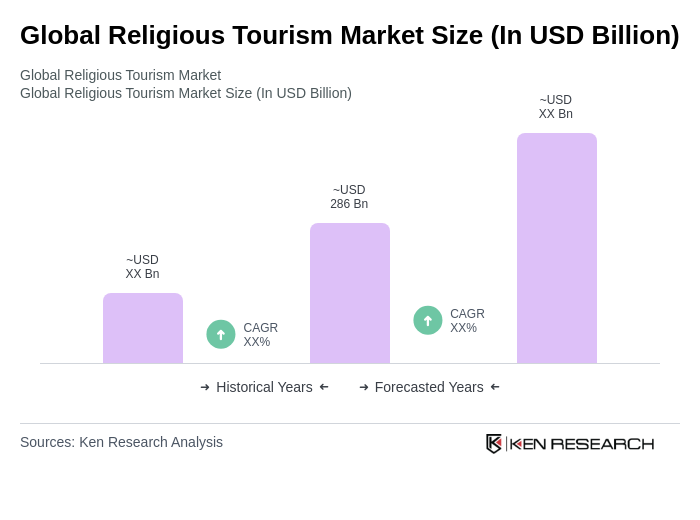
- The Global Religious Tourism Market is valued at USD 286 billion, based on a five-year historical analysis. This growth is primarily driven by the increasing number of religious events, pilgrimages, and the rising interest in spiritual experiences among travelers. The market has seen a surge in demand for faith-based travel packages, spiritual retreats, and heritage-focused journeys, reflecting a broader trend towards wellness, cultural exploration, and personal growth. Key destinations such as Mecca, Vatican City, Jerusalem, and Varanasi continue to witness high tourist inflow each year, supported by rising disposable incomes and improved travel infrastructure .
- Countries such as India, Saudi Arabia, and Italy dominate the Global Religious Tourism Market due to their rich cultural heritage and significant religious sites. India attracts hundreds of millions of ritual visits to its temples and holy cities during major festivals like the Kumbh Mela, while Saudi Arabia is a focal point for Islamic pilgrimages, particularly the Hajj and Umrah, drawing over 18 million pilgrims annually. Italy, with its historical significance in Christianity, draws millions of tourists to its churches, Vatican City, and religious festivals .
- In 2023, the Indian government implemented the "Pilgrimage Rejuvenation and Spiritual, Heritage Augmentation Drive" (PRASHAD) scheme, aimed at enhancing infrastructure and facilities at pilgrimage sites. This initiative includes an investment of INR 1,500 crore to improve accessibility and amenities, thereby promoting religious tourism and ensuring a better experience for pilgrims. The PRASHAD scheme is administered under the Ministry of Tourism, Government of India, and focuses on integrated development of pilgrimage destinations to provide world-class infrastructure and promote sustainable tourism .
Global Religious Tourism Market Segmentation
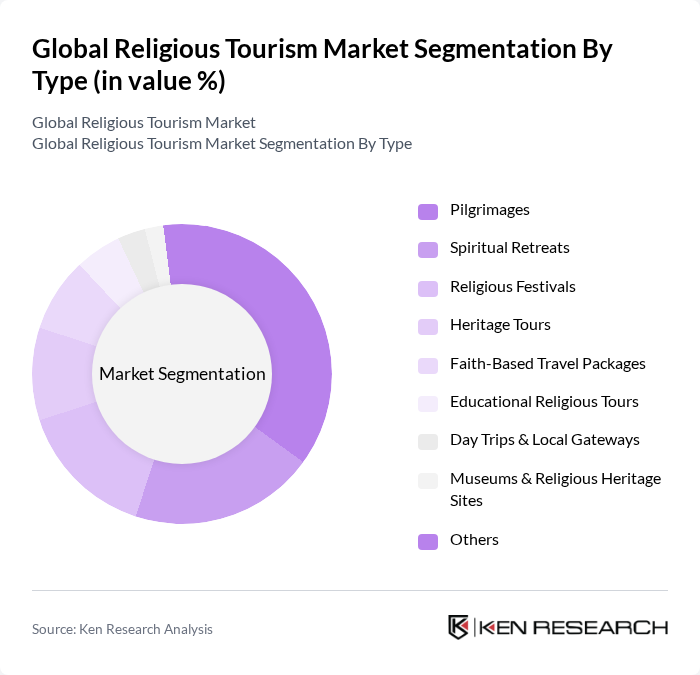
By Type:The market is segmented into various types, including Pilgrimages, Spiritual Retreats, Religious Festivals, Heritage Tours, Faith-Based Travel Packages, Educational Religious Tours, Day Trips & Local Gateways, Museums & Religious Heritage Sites, and Others. Each of these segments caters to different traveler preferences and motivations, contributing to the overall growth of the market. The segmentation reflects the diversification of religious tourism beyond traditional pilgrimages to include wellness-oriented and cultural experiences .
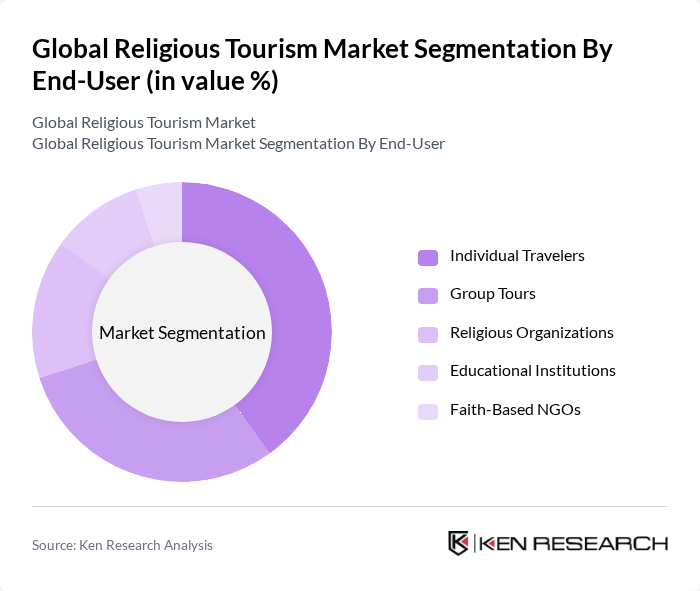
By End-User:The market is further segmented by end-users, including Individual Travelers, Group Tours, Religious Organizations, Educational Institutions, and Faith-Based NGOs. Each segment reflects different travel patterns and preferences, influencing the overall dynamics of the religious tourism market. Individual travelers and group tours together account for the majority of market activity, with religious organizations and educational institutions playing a significant role in organized pilgrimages and educational trips .
Global Religious Tourism Market Competitive Landscape
The Global Religious Tourism Market is characterized by a dynamic mix of regional and international players. Leading participants such as Thomas Cook Group, TUI Group, Expedia Group, Booking Holdings Inc., Travel Leaders Group, CWT (Carlson Wagonlit Travel), American Express Global Business Travel, Flight Centre Travel Group, G Adventures, Intrepid Travel, Abercrombie & Kent, Insight Vacations, Trafalgar, Globus Family of Brands, Religious Travel Association, Select International Tours & Cruises, Israel Ministry of Tourism, Saudi Arabia Ministry of Hajj and Umrah, Vatican Pilgrimage Office (Opera Romana Pellegrinaggi), TCDD Ta??mac?l?k A.?. contribute to innovation, geographic expansion, and service delivery in this space.
Global Religious Tourism Market Industry Analysis
Growth Drivers
- Increasing Global Mobility:The global mobility trend is significantly boosting religious tourism, with international tourist arrivals reaching 1.5 billion in the future, according to the UNWTO. This surge is driven by improved transportation networks and affordable travel options, enabling more individuals to embark on spiritual journeys. Countries like India and Saudi Arabia are witnessing increased footfall, with India alone attracting over 30 million religious tourists annually, highlighting the growing accessibility of sacred sites worldwide.
- Rising Interest in Spiritual Experiences:A notable shift towards seeking spiritual fulfillment is evident, with 60% of travelers expressing interest in spiritual experiences, as reported by the Global Wellness Institute. This trend is particularly strong among millennials, who prioritize meaningful travel. The wellness tourism sector, valued at $639 billion in the future, is increasingly intersecting with religious tourism, as travelers seek retreats that combine spirituality with wellness, further driving market growth.
- Development of Religious Infrastructure:Investment in religious infrastructure is crucial for market expansion, with global spending on tourism infrastructure projected to reach $1.2 trillion in the future. Countries are enhancing facilities at pilgrimage sites, such as the $1 billion expansion of the Hajj terminal in Saudi Arabia. Improved amenities and services not only attract more visitors but also enhance their overall experience, making religious sites more appealing to a broader audience.
Market Challenges
- Political Instability in Key Regions:Political instability poses a significant challenge to religious tourism, particularly in regions like the Middle East and North Africa. For instance, the World Bank reported that tourism in Egypt dropped by 30% in the future due to ongoing unrest. Such instability deters potential travelers, leading to decreased visitor numbers and revenue losses for local economies reliant on religious tourism.
- Cultural Sensitivities and Misunderstandings:Cultural sensitivities can hinder the growth of religious tourism, as misunderstandings may arise between tourists and local communities. Incidents of cultural insensitivity have been reported, leading to backlash against tourists. For example, a survey indicated that 45% of local residents in pilgrimage areas expressed concerns about tourists' behavior, which can negatively impact the reputation of destinations and deter future visitors.
Global Religious Tourism Market Future Outlook
The future of religious tourism is poised for transformation, driven by evolving traveler preferences and technological advancements. As personalization becomes paramount, operators are expected to offer tailored experiences that resonate with individual spiritual needs. Additionally, the integration of technology, such as virtual reality pilgrimages, is likely to enhance accessibility. Sustainable practices will also gain traction, as travelers increasingly seek eco-friendly options, ensuring that religious tourism aligns with broader environmental goals while fostering community engagement.
Market Opportunities
- Growth of Eco-Religious Tourism:Eco-religious tourism is emerging as a significant opportunity, with a projected market value of $300 billion in the future. This trend appeals to environmentally conscious travelers seeking spiritual experiences that also promote sustainability. Destinations that integrate eco-friendly practices into their religious tourism offerings can attract a growing demographic focused on responsible travel.
- Digital Transformation in Booking Processes:The digital transformation of booking processes presents a lucrative opportunity, with online travel bookings expected to reach $1 trillion in the future. Enhanced online platforms can streamline the planning and reservation of religious trips, making it easier for travelers to access information and services. This shift can significantly increase participation in religious tourism, particularly among tech-savvy younger generations.
Scope of the Report
| Segment | Sub-Segments |
|---|---|
| By Type | Pilgrimages Spiritual Retreats Religious Festivals Heritage Tours Faith-Based Travel Packages Educational Religious Tours Day Trips & Local Gateways Museums & Religious Heritage Sites Others |
| By End-User | Individual Travelers Group Tours Religious Organizations Educational Institutions Faith-Based NGOs |
| By Travel Type | Domestic Travel International Travel |
| By Accommodation Type | Hotels Guesthouses Hostels Religious Lodging (Monasteries, Dharamshalas, Pilgrim Houses) |
| By Booking Channel | Online Travel Agencies Direct Bookings Travel Agents In-Person Booking Phone Booking |
| By Duration of Stay | Short-term (1-3 days) Medium-term (4-7 days) Long-term (8+ days) |
| By Purpose of Visit | Pilgrimage Cultural Exploration Educational Purposes Community Service Wellness & Spiritual Renewal |
| By Age Group | Below 20 Years 40 Years 60 Years Years & Above |
| By Religion | Christianity Islam Hinduism Buddhism Judaism Others |
| By Region | North America Europe Asia Pacific Latin America Middle East & Africa |
Key Target Audience
Investors and Venture Capitalist Firms
Government and Regulatory Bodies (e.g., Ministry of Tourism, National Parks Service)
Religious Organizations and Institutions
Travel Agencies and Tour Operators
Hospitality Providers (e.g., Hotels, Lodges)
Local Communities and Cultural Heritage Organizations
Event Organizers and Pilgrimage Coordinators
Transportation Services (e.g., Airlines, Bus Companies)
Players Mentioned in the Report:
Thomas Cook Group
TUI Group
Expedia Group
Booking Holdings Inc.
Travel Leaders Group
CWT (Carlson Wagonlit Travel)
American Express Global Business Travel
Flight Centre Travel Group
G Adventures
Intrepid Travel
Abercrombie & Kent
Insight Vacations
Trafalgar
Globus Family of Brands
Religious Travel Association
Select International Tours & Cruises
Israel Ministry of Tourism
Saudi Arabia Ministry of Hajj and Umrah
Vatican Pilgrimage Office (Opera Romana Pellegrinaggi)
TCDD Tasmaclk A.S.
Table of Contents
Market Assessment Phase
1. Executive Summary and Approach
2. Global Religious Tourism Market Overview
2.1 Key Insights and Strategic Recommendations
2.2 Global Religious Tourism Market Overview
2.3 Definition and Scope
2.4 Evolution of Market Ecosystem
2.5 Timeline of Key Regulatory Milestones
2.6 Value Chain & Stakeholder Mapping
2.7 Business Cycle Analysis
2.8 Policy & Incentive Landscape
3. Global Religious Tourism Market Analysis
3.1 Growth Drivers
3.1.1 Increasing Global Mobility
3.1.2 Rising Interest in Spiritual Experiences
3.1.3 Development of Religious Infrastructure
3.1.4 Government Support for Religious Events
3.2 Market Challenges
3.2.1 Political Instability in Key Regions
3.2.2 Cultural Sensitivities and Misunderstandings
3.2.3 Economic Downturns Affecting Travel Budgets
3.2.4 Competition from Secular Tourism
3.3 Market Opportunities
3.3.1 Growth of Eco-Religious Tourism
3.3.2 Digital Transformation in Booking Processes
3.3.3 Expansion of Pilgrimage Routes
3.3.4 Collaboration with Local Communities
3.4 Market Trends
3.4.1 Personalization of Travel Experiences
3.4.2 Integration of Technology in Pilgrimages
3.4.3 Rise of Wellness and Spiritual Retreats
3.4.4 Increased Focus on Sustainable Practices
3.5 Government Regulation
3.5.1 Visa Facilitation for Religious Travelers
3.5.2 Safety Regulations for Pilgrimage Sites
3.5.3 Tax Incentives for Religious Tourism Operators
3.5.4 Environmental Regulations Impacting Sites
4. SWOT Analysis
5. Stakeholder Analysis
6. Porter's Five Forces Analysis
7. Global Religious Tourism Market Market Size, 2019-2024
7.1 By Value
7.2 By Volume
7.3 By Average Selling Price
8. Global Religious Tourism Market Segmentation
8.1 By Type
8.1.1 Pilgrimages
8.1.2 Spiritual Retreats
8.1.3 Religious Festivals
8.1.4 Heritage Tours
8.1.5 Faith-Based Travel Packages
8.1.6 Educational Religious Tours
8.1.7 Day Trips & Local Gateways
8.1.8 Museums & Religious Heritage Sites
8.1.9 Others
8.2 By End-User
8.2.1 Individual Travelers
8.2.2 Group Tours
8.2.3 Religious Organizations
8.2.4 Educational Institutions
8.2.5 Faith-Based NGOs
8.3 By Travel Type
8.3.1 Domestic Travel
8.3.2 International Travel
8.4 By Accommodation Type
8.4.1 Hotels
8.4.2 Guesthouses
8.4.3 Hostels
8.4.4 Religious Lodging (Monasteries, Dharamshalas, Pilgrim Houses)
8.5 By Booking Channel
8.5.1 Online Travel Agencies
8.5.2 Direct Bookings
8.5.3 Travel Agents
8.5.4 In-Person Booking
8.5.5 Phone Booking
8.6 By Duration of Stay
8.6.1 Short-term (1-3 days)
8.6.2 Medium-term (4-7 days)
8.6.3 Long-term (8+ days)
8.7 By Purpose of Visit
8.7.1 Pilgrimage
8.7.2 Cultural Exploration
8.7.3 Educational Purposes
8.7.4 Community Service
8.7.5 Wellness & Spiritual Renewal
8.8 By Age Group
8.8.1 Below 20 Years
8.8.2 20 - 40 Years
8.8.3 40 - 60 Years
8.8.4 60 Years & Above
8.9 By Religion
8.9.1 Christianity
8.9.2 Islam
8.9.3 Hinduism
8.9.4 Buddhism
8.9.5 Judaism
8.9.6 Others
8.10 By Region
8.10.1 North America
8.10.2 Europe
8.10.3 Asia Pacific
8.10.4 Latin America
8.10.5 Middle East & Africa
9. Global Religious Tourism Market Competitive Analysis
9.1 Market Share of Key Players(Micro, Small, Medium, Large Enterprises)
9.2 Cross Comparison of Key Players
9.2.1 Company Name
9.2.2 Group Size (Large, Medium, or Small as per industry convention)
9.2.3 Revenue (USD, latest fiscal year)
9.2.4 Revenue Growth Rate (YoY %)
9.2.5 Number of Pilgrims/Travelers Served Annually
9.2.6 Market Penetration Rate (by region or segment)
9.2.7 Average Booking Value (USD)
9.2.8 Customer Retention Rate (%)
9.2.9 Customer Satisfaction Score (NPS or equivalent)
9.2.10 Digital Adoption Rate (online bookings as % of total)
9.2.11 Brand Recognition Index
9.2.12 Operational Efficiency Ratio (cost per traveler)
9.2.13 Partnerships with Religious Institutions (number or key alliances)
9.2.14 Sustainability Initiatives (qualitative/quantitative)
9.3 SWOT Analysis of Top Players
9.4 Pricing Analysis(By Class and Payload)
9.5 Detailed Profile of Major Companies
9.5.1 Thomas Cook Group
9.5.2 TUI Group
9.5.3 Expedia Group
9.5.4 Booking Holdings Inc.
9.5.5 Travel Leaders Group
9.5.6 CWT (Carlson Wagonlit Travel)
9.5.7 American Express Global Business Travel
9.5.8 Flight Centre Travel Group
9.5.9 G Adventures
9.5.10 Intrepid Travel
9.5.11 Abercrombie & Kent
9.5.12 Insight Vacations
9.5.13 Trafalgar
9.5.14 Globus Family of Brands
9.5.15 Religious Travel Association
9.5.16 Select International Tours & Cruises
9.5.17 Israel Ministry of Tourism
9.5.18 Saudi Arabia Ministry of Hajj and Umrah
9.5.19 Vatican Pilgrimage Office (Opera Romana Pellegrinaggi)
9.5.20 TCDD Ta??mac?l?k A.?.
10. Global Religious Tourism Market End-User Analysis
10.1 Procurement Behavior of Key Ministries
10.1.1 Engagement with Local Communities
10.1.2 Budget Allocation for Religious Events
10.1.3 Collaboration with Travel Agencies
10.2 Corporate Spend on Infrastructure & Energy
10.2.1 Investment in Pilgrimage Sites
10.2.2 Funding for Religious Events
10.3 Pain Point Analysis by End-User Category
10.3.1 Accessibility Issues
10.3.2 Safety Concerns
10.3.3 Cultural Sensitivity Training
10.4 User Readiness for Adoption
10.4.1 Awareness of Religious Tourism Options
10.4.2 Acceptance of Digital Booking Platforms
10.5 Post-Deployment ROI and Use Case Expansion
10.5.1 Evaluation of Travel Experiences
10.5.2 Feedback Mechanisms for Improvement
11. Global Religious Tourism Market Future Size, 2025-2030
11.1 By Value
11.2 By Volume
11.3 By Average Selling Price
Go-To-Market Strategy Phase
1. Whitespace Analysis + Business Model Canvas
1.1 Market Gaps Identification
1.2 Value Proposition Development
1.3 Revenue Streams Analysis
1.4 Key Partnerships Exploration
1.5 Customer Segmentation
1.6 Cost Structure Assessment
1.7 Channels of Distribution
2. Marketing and Positioning Recommendations
2.1 Branding Strategies
2.2 Product USPs
3. Distribution Plan
3.1 Urban Retail vs Rural NGO Tie-ups
4. Channel & Pricing Gaps
4.1 Underserved Routes
4.2 Pricing Bands
5. Unmet Demand & Latent Needs
5.1 Category Gaps
5.2 Consumer Segments
6. Customer Relationship
6.1 Loyalty Programs
6.2 After-sales Service
7. Value Proposition
7.1 Sustainability
7.2 Integrated Supply Chains
8. Key Activities
8.1 Regulatory Compliance
8.2 Branding
8.3 Distribution Setup
9. Entry Strategy Evaluation
9.1 Domestic Market Entry Strategy
9.1.1 Product Mix
9.1.2 Pricing Band
9.1.3 Packaging
9.2 Export Entry Strategy
9.2.1 Target Countries
9.2.2 Compliance Roadmap
10. Entry Mode Assessment
10.1 JV
10.2 Greenfield
10.3 M&A
10.4 Distributor Model
11. Capital and Timeline Estimation
11.1 Capital Requirements
11.2 Timelines
12. Control vs Risk Trade-Off
12.1 Ownership vs Partnerships
13. Profitability Outlook
13.1 Breakeven Analysis
13.2 Long-term Sustainability
14. Potential Partner List
14.1 Distributors
14.2 JVs
14.3 Acquisition Targets
15. Execution Roadmap
15.1 Phased Plan for Market Entry
15.1.1 Market Setup
15.1.2 Market Entry
15.1.3 Growth Acceleration
15.1.4 Scale & Stabilize
15.2 Key Activities and Milestones
15.2.1 Milestone Planning
15.2.2 Activity Tracking
Research Methodology
Phase 1: Approach1
Desk Research
- Analysis of global religious tourism trends from industry reports and market studies
- Review of government tourism statistics and religious site visitation data
- Examination of academic journals and publications on religious tourism dynamics
Primary Research
- Interviews with tourism board officials from major religious destinations
- Surveys with travel agencies specializing in religious tours
- Field interviews with pilgrims and tourists at key religious sites
Validation & Triangulation
- Cross-validation of findings through multiple data sources, including tourism boards and travel agencies
- Triangulation of qualitative insights from interviews with quantitative data from surveys
- Sanity checks through expert panel reviews comprising industry veterans and academics
Phase 2: Market Size Estimation1
Top-down Assessment
- Estimation of market size based on global tourism expenditure on religious travel
- Segmentation by geographic regions and types of religious tourism (e.g., pilgrimage, spiritual retreats)
- Incorporation of macroeconomic factors influencing travel behavior and religious tourism growth
Bottom-up Modeling
- Data collection from religious tourism operators regarding average spending per pilgrim
- Estimation of visitor numbers to major religious sites and events
- Calculation of revenue generated from ancillary services (e.g., accommodation, food, transportation)
Forecasting & Scenario Analysis
- Multi-factor regression analysis incorporating socio-economic trends and religious participation rates
- Scenario modeling based on potential impacts of global events (e.g., pandemics, geopolitical tensions)
- Development of baseline, optimistic, and pessimistic forecasts through 2030
Phase 3: CATI Sample Composition1
| Scope Item/Segment | Sample Size | Target Respondent Profiles |
|---|---|---|
| Pilgrimage Tourism in India | 120 | Pilgrims, Travel Agents, Tour Operators |
| Religious Festivals and Events | 90 | Event Organizers, Local Authorities, Attendees |
| Spiritual Retreats and Wellness Tourism | 60 | Retreat Leaders, Participants, Wellness Coaches |
| Religious Heritage Sites | 100 | Site Managers, Tour Guides, Visitors |
| International Religious Tourism | 70 | International Tourists, Travel Planners, Cultural Experts |
Frequently Asked Questions
What is the current value of the Global Religious Tourism Market?
The Global Religious Tourism Market is valued at approximately USD 286 billion, reflecting a significant growth trend driven by increased interest in spiritual experiences, pilgrimages, and religious events, alongside improved travel infrastructure and rising disposable incomes.
Which countries are the leading destinations for religious tourism?
What initiatives has the Indian government taken to promote religious tourism?
What types of experiences are included in religious tourism?
Other Regional/Country Reports
Indonesia Religious Tourism Market
Malaysia Religious Tourism Market
KSA Religious Tourism Market
APAC Religious Tourism Market
SEA Religious Tourism Market
Vietnam Religious Tourism Market
Other Adjacent Reports
Singapore Cultural Tourism Market
Global wellness tourism market Size, Share, Growth Drivers, Trends, Opportunities & Forecast 2025–2030Qatar heritage tourism market report size, share, growth drivers, trends, opportunities & forecast 2025–2030Mexico Spiritual Retreat Market
Germany Pilgrimage Services Market
Eco-Tourism MarketBrazil Event Tourism Market
UAE adventure tourism market report Size, Share, Growth Drivers, Trends, Opportunities & Forecast 2025–2030Bahrain Medical Tourism Market Report Size, Share, Growth Drivers, Trends, Opportunities & Forecast 2025–2030Gcc Educational Tourism Market Report Size, Share, Growth Drivers, Trends, Opportunities & Forecast 2025–2030Why Buy From Us?

What makes us stand out is that our consultants follow Robust, Refine and Result (RRR) methodology. Robust for clear definitions, approaches and sanity checking, Refine for differentiating respondents' facts and opinions, and Result for presenting data with story.

We have set a benchmark in the industry by offering our clients with syndicated and customized market research reports featuring coverage of entire market as well as meticulous research and analyst insights.

While we don't replace traditional research, we flip the method upside down. Our dual approach of Top Bottom & Bottom Top ensures quality deliverable by not just verifying company fundamentals but also looking at the sector and macroeconomic factors.

With one step in the future, our research team constantly tries to show you the bigger picture. We help with some of the tough questions you may encounter along the way: How is the industry positioned? Best marketing channel? KPI's of competitors? By aligning every element, we help maximize success.

Our report gives you instant access to the answers and sources that other companies might choose to hide. We elaborate each steps of research methodology we have used and showcase you the sample size to earn your trust.

If you need any support, we are here! We pride ourselves on universe strength, data quality, and quick, friendly, and professional service.