About the Report
Base Year 2024Listen to the audio summary
Global Ride Hailing Market Overview
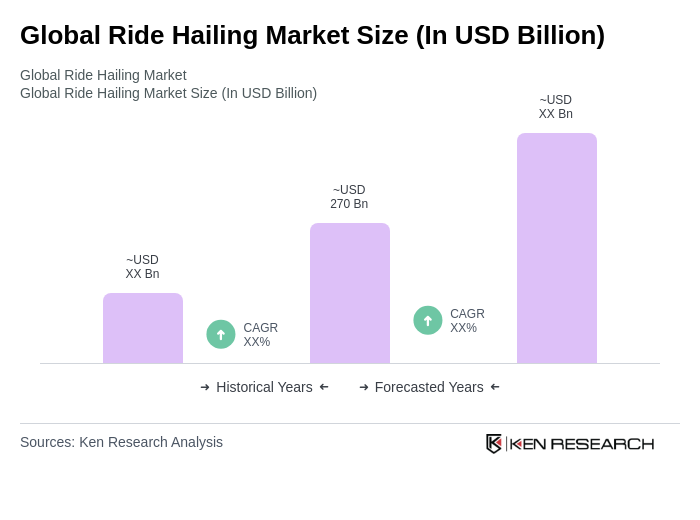
- The Global Ride Hailing Market is valued at USD 270 billion, based on a five-year historical analysis. This growth is primarily driven by the increasing adoption of smartphones, the rise of urbanization, and the growing demand for convenient transportation solutions. The market has seen a significant shift towards app-based services, which have made ride-hailing more accessible and user-friendly for consumers. Artificial intelligence integration, multimodal mobility platforms, and sustainability initiatives are increasingly shaping market dynamics .
- Key players in this market include major cities such as New York, London, and Beijing, which dominate due to their large populations, high urban density, and well-developed infrastructure. These cities have embraced ride-hailing services as a solution to traffic congestion and public transport limitations, making them hotspots for ride-hailing activities .
- In 2023, the European Union implemented regulations aimed at enhancing passenger safety and ensuring fair competition in the ride-hailing sector. This includes mandatory background checks for drivers and the establishment of minimum fare standards, which aim to protect both consumers and drivers while promoting a level playing field among service providers. The “Regulation (EU) 2023/650 of the European Parliament and of the Council on common rules for the operation of ride-hailing services,” issued by the European Parliament, mandates comprehensive driver vetting, minimum fare thresholds, and digital platform compliance requirements across member states.
Global Ride Hailing Market Segmentation
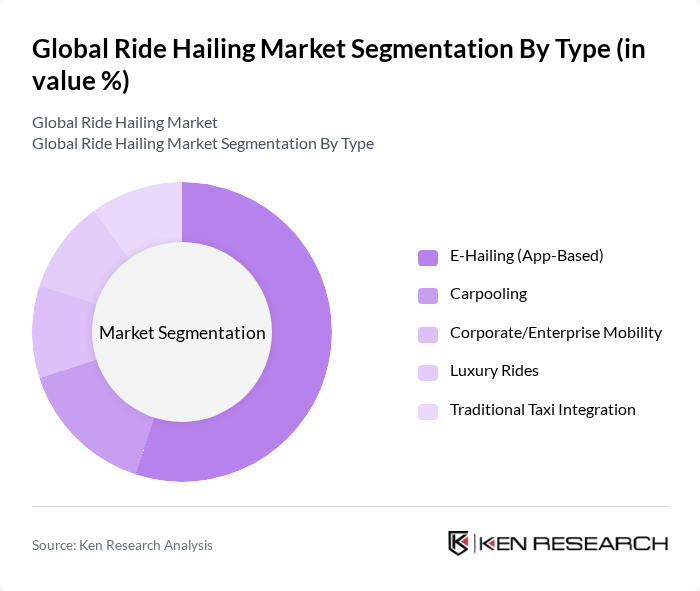
By Type:The ride-hailing market can be segmented into various types, including E-Hailing (App-Based), Carpooling, Corporate/Enterprise Mobility, Luxury Rides, and Traditional Taxi Integration. Among these, E-Hailing (App-Based) is the most dominant segment, driven by the convenience of mobile applications and the growing trend of on-demand services. The increasing smartphone penetration, integration of digital payments, and the preference for cashless transactions have further propelled this segment's growth .
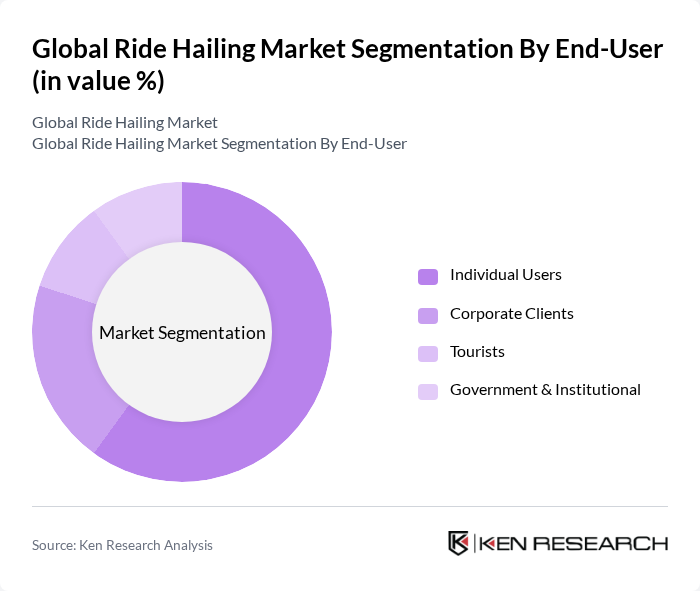
By End-User:The end-user segmentation includes Individual Users, Corporate Clients, Tourists, and Government & Institutional users. Individual Users represent the largest segment, as the convenience and flexibility of ride-hailing services appeal to everyday commuters. The rise in urban populations and the increasing preference for shared mobility solutions, especially among younger demographics and urban professionals, have significantly contributed to the growth of this segment .
Global Ride Hailing Market Competitive Landscape
The Global Ride Hailing Market is characterized by a dynamic mix of regional and international players. Leading participants such as Uber Technologies, Inc., Lyft, Inc., DiDi Chuxing Technology Co., Grab Holdings Inc., Ola Cabs (ANI Technologies Pvt. Ltd.), Bolt Technology OÜ, Careem Networks FZ LLC, Gojek, Yandex.Taxi, Via Transportation, Inc., Gett, Curb Mobility, Z?m, FREE NOW, Cabify, Addison Lee, Kakao Mobility, Maxim, inDriver, Easy Taxi contribute to innovation, geographic expansion, and service delivery in this space.
Global Ride Hailing Market Industry Analysis
Growth Drivers
- Increasing Urbanization:Urbanization is a significant driver of the ride-hailing market, with the United Nations projecting that by future, 56.6% of the global population will reside in urban areas. This shift leads to higher demand for efficient transportation solutions, as urban dwellers often lack access to personal vehicles. In cities like New York, ride-hailing services have seen a 21% increase in usage, reflecting the growing reliance on these services for daily commutes and social activities.
- Rising Smartphone Penetration:The proliferation of smartphones is a crucial factor in the ride-hailing market's growth. As of future, global smartphone penetration is expected to reach 80%, with over 6.5 billion users. This widespread access enables consumers to easily book rides through mobile applications. In regions like Southeast Asia, where smartphone adoption is surging, ride-hailing app downloads have increased by 32%, indicating a strong correlation between smartphone usage and ride-hailing service adoption.
- Demand for Convenient Transportation:The demand for convenient transportation options is driving the ride-hailing market forward. In future, the average urban commuter spends approximately 56 minutes daily on transportation, leading to a growing preference for on-demand services. A study by the International Transport Forum found that 42% of commuters in major cities prefer ride-hailing over traditional taxis due to convenience and ease of use, further solidifying the market's growth trajectory.
Market Challenges
- Regulatory Compliance Issues:Regulatory compliance poses a significant challenge for ride-hailing companies. In future, over 32 countries are expected to implement stricter regulations regarding ride-hailing operations, including licensing and insurance requirements. For instance, in London, the Transport for London (TfL) has mandated that all drivers must undergo enhanced background checks, increasing operational costs for companies. This regulatory landscape can hinder market entry and expansion efforts for new players.
- Safety and Security Concerns:Safety and security concerns remain a critical challenge for the ride-hailing industry. In future, it is estimated that 27% of users express apprehension about personal safety when using ride-hailing services. High-profile incidents have led to increased scrutiny and calls for improved safety measures. Companies are investing heavily in driver training and safety technology, but the ongoing concerns can deter potential users and impact overall market growth.
Global Ride Hailing Market Future Outlook
The future of the ride-hailing market appears promising, driven by technological advancements and evolving consumer preferences. As urban populations continue to grow, the demand for efficient and flexible transportation solutions will likely increase. Additionally, the integration of electric vehicles and autonomous technology is expected to reshape the market landscape, enhancing service efficiency and sustainability. Companies that adapt to these trends will be well-positioned to capture market share and meet the changing needs of consumers in urban environments.
Market Opportunities
- Integration of Electric Vehicles:The shift towards electric vehicles (EVs) presents a significant opportunity for ride-hailing companies. By future, the global EV market is projected to grow to 12 million units sold annually. Companies that incorporate EVs into their fleets can reduce operational costs and appeal to environmentally conscious consumers, potentially increasing market share and enhancing brand loyalty.
- Expansion into Emerging Markets:Emerging markets offer substantial growth potential for ride-hailing services. In future, regions like Africa and Southeast Asia are expected to see a 17% increase in urban population, driving demand for affordable transportation options. Companies that strategically enter these markets can capitalize on the growing need for ride-hailing services, establishing a foothold in regions with limited public transport infrastructure.
Scope of the Report
| Segment | Sub-Segments |
|---|---|
| By Type | E-Hailing (App-Based) Carpooling Corporate/Enterprise Mobility Luxury Rides Traditional Taxi Integration |
| By End-User | Individual Users Corporate Clients Tourists Government & Institutional |
| By Vehicle Type | Sedan SUV Minivan Electric Vehicles (EVs) Hybrid Vehicles Two- and Three-Wheelers |
| By Service Model | On-Demand Services Pre-Booked Services Subscription-Based Services |
| By Payment Model | Pay-Per-Ride Subscription-Based Digital Wallets & Cashless Payments |
| By Geographic Coverage | Urban Areas Suburban Areas Rural Areas |
| By Customer Segment | Students Professionals Families Senior Citizens Others |
Key Target Audience
Investors and Venture Capitalist Firms
Government and Regulatory Bodies (e.g., Federal Transit Administration, National Highway Traffic Safety Administration)
Ride Hailing Service Providers
Automobile Manufacturers
Insurance Companies
Payment Processing Companies
Telecommunications Providers
Urban Planning and Transportation Agencies
Players Mentioned in the Report:
Uber Technologies, Inc.
Lyft, Inc.
DiDi Chuxing Technology Co.
Grab Holdings Inc.
Ola Cabs (ANI Technologies Pvt. Ltd.)
Bolt Technology OU
Careem Networks FZ LLC
Gojek
Yandex.Taxi
Via Transportation, Inc.
Gett
Curb Mobility
Zum
FREE NOW
Cabify
Addison Lee
Kakao Mobility
Maxim
inDriver
Easy Taxi
Table of Contents
Market Assessment Phase
1. Executive Summary and Approach
2. Global Ride Hailing Market Overview
2.1 Key Insights and Strategic Recommendations
2.2 Global Ride Hailing Market Overview
2.3 Definition and Scope
2.4 Evolution of Market Ecosystem
2.5 Timeline of Key Regulatory Milestones
2.6 Value Chain & Stakeholder Mapping
2.7 Business Cycle Analysis
2.8 Policy & Incentive Landscape
3. Global Ride Hailing Market Analysis
3.1 Growth Drivers
3.1.1 Increasing Urbanization
3.1.2 Rising Smartphone Penetration
3.1.3 Demand for Convenient Transportation
3.1.4 Expansion of Internet Connectivity
3.2 Market Challenges
3.2.1 Regulatory Compliance Issues
3.2.2 Intense Competition
3.2.3 Safety and Security Concerns
3.2.4 Fluctuating Fuel Prices
3.3 Market Opportunities
3.3.1 Integration of Electric Vehicles
3.3.2 Expansion into Emerging Markets
3.3.3 Development of Autonomous Vehicles
3.3.4 Partnerships with Public Transport Systems
3.4 Market Trends
3.4.1 Shift Towards Shared Mobility
3.4.2 Adoption of Subscription Models
3.4.3 Increased Focus on Sustainability
3.4.4 Use of AI and Big Data Analytics
3.5 Government Regulation
3.5.1 Licensing Requirements
3.5.2 Safety Standards for Drivers
3.5.3 Taxation Policies
3.5.4 Data Privacy Regulations
4. SWOT Analysis
5. Stakeholder Analysis
6. Porter's Five Forces Analysis
7. Global Ride Hailing Market Market Size, 2019-2024
7.1 By Value
7.2 By Volume
7.3 By Average Selling Price
8. Global Ride Hailing Market Segmentation
8.1 By Type
8.1.1 E-Hailing (App-Based)
8.1.2 Carpooling
8.1.3 Corporate/Enterprise Mobility
8.1.4 Luxury Rides
8.1.5 Traditional Taxi Integration
8.2 By End-User
8.2.1 Individual Users
8.2.2 Corporate Clients
8.2.3 Tourists
8.2.4 Government & Institutional
8.3 By Vehicle Type
8.3.1 Sedan
8.3.2 SUV
8.3.3 Minivan
8.3.4 Electric Vehicles (EVs)
8.3.5 Hybrid Vehicles
8.3.6 Two- and Three-Wheelers
8.4 By Service Model
8.4.1 On-Demand Services
8.4.2 Pre-Booked Services
8.4.3 Subscription-Based Services
8.5 By Payment Model
8.5.1 Pay-Per-Ride
8.5.2 Subscription-Based
8.5.3 Digital Wallets & Cashless Payments
8.6 By Geographic Coverage
8.6.1 Urban Areas
8.6.2 Suburban Areas
8.6.3 Rural Areas
8.7 By Customer Segment
8.7.1 Students
8.7.2 Professionals
8.7.3 Families
8.7.4 Senior Citizens
8.7.5 Others
9. Global Ride Hailing Market Competitive Analysis
9.1 Market Share of Key Players
9.2 Cross Comparison of Key Players
9.2.1 Company Name
9.2.2 Group Size (Large, Medium, or Small as per industry convention)
9.2.3 Annual Revenue
9.2.4 Revenue Growth Rate
9.2.5 Number of Active Users
9.2.6 Number of Registered Drivers
9.2.7 Customer Acquisition Cost
9.2.8 Average Ride Fare
9.2.9 Market Penetration Rate
9.2.10 Customer Retention Rate
9.2.11 Pricing Strategy
9.2.12 Driver Utilization Rate
9.2.13 Average Trip Duration
9.2.14 Geographic Coverage
9.2.15 Fleet Electrification Ratio
9.3 SWOT Analysis of Top Players
9.4 Pricing Analysis
9.5 Detailed Profile of Major Companies
9.5.1 Uber Technologies, Inc.
9.5.2 Lyft, Inc.
9.5.3 DiDi Chuxing Technology Co.
9.5.4 Grab Holdings Inc.
9.5.5 Ola Cabs (ANI Technologies Pvt. Ltd.)
9.5.6 Bolt Technology OÜ
9.5.7 Careem Networks FZ LLC
9.5.8 Gojek
9.5.9 Yandex.Taxi
9.5.10 Via Transportation, Inc.
9.5.11 Gett
9.5.12 Curb Mobility
9.5.13 Z?m
9.5.14 FREE NOW
9.5.15 Cabify
9.5.16 Addison Lee
9.5.17 Kakao Mobility
9.5.18 Maxim
9.5.19 inDriver
9.5.20 Easy Taxi
10. Global Ride Hailing Market End-User Analysis
10.1 Procurement Behavior of Key Ministries
10.1.1 Budget Allocation for Transportation
10.1.2 Preference for Sustainable Options
10.1.3 Evaluation of Service Providers
10.2 Corporate Spend on Infrastructure & Energy
10.2.1 Investment in Ride Hailing Services
10.2.2 Partnerships with Ride Hailing Companies
10.3 Pain Point Analysis by End-User Category
10.3.1 Cost of Services
10.3.2 Availability of Rides
10.3.3 Safety Concerns
10.4 User Readiness for Adoption
10.4.1 Awareness of Ride Hailing Services
10.4.2 Comfort with Technology
10.5 Post-Deployment ROI and Use Case Expansion
10.5.1 Measurement of Cost Savings
10.5.2 User Satisfaction Surveys
11. Global Ride Hailing Market Future Size, 2025-2030
11.1 By Value
11.2 By Volume
11.3 By Average Selling Price
Go-To-Market Strategy Phase
1. Whitespace Analysis + Business Model Canvas
1.1 Market Gaps Identification
1.2 Value Proposition Development
1.3 Revenue Streams Analysis
1.4 Cost Structure Evaluation
1.5 Key Partnerships
1.6 Customer Segments
1.7 Channels
2. Marketing and Positioning Recommendations
2.1 Branding Strategies
2.2 Product USPs
3. Distribution Plan
3.1 Urban Retail vs Rural NGO Tie-Ups
4. Channel & Pricing Gaps
4.1 Underserved Routes
4.2 Pricing Bands
5. Unmet Demand & Latent Needs
5.1 Category Gaps
5.2 Consumer Segments
6. Customer Relationship
6.1 Loyalty Programs
6.2 After-Sales Service
7. Value Proposition
7.1 Sustainability
7.2 Integrated Supply Chains
8. Key Activities
8.1 Regulatory Compliance
8.2 Branding
8.3 Distribution Setup
9. Entry Strategy Evaluation
9.1 Domestic Market Entry Strategy
9.1.1 Product Mix
9.1.2 Pricing Band
9.1.3 Packaging
9.2 Export Entry Strategy
9.2.1 Target Countries
9.2.2 Compliance Roadmap
10. Entry Mode Assessment
10.1 JV
10.2 Greenfield
10.3 M&A
10.4 Distributor Model
11. Capital and Timeline Estimation
11.1 Capital Requirements
11.2 Timelines
12. Control vs Risk Trade-Off
12.1 Ownership vs Partnerships
13. Profitability Outlook
13.1 Breakeven Analysis
13.2 Long-Term Sustainability
14. Potential Partner List
14.1 Distributors
14.2 JVs
14.3 Acquisition Targets
15. Execution Roadmap
15.1 Phased Plan for Market Entry
15.1.1 Market Setup
15.1.2 Market Entry
15.1.3 Growth Acceleration
15.1.4 Scale & Stabilize
15.2 Key Activities and Milestones
15.2.1 Activity Planning
15.2.2 Milestone Tracking
Research Methodology
Phase 1: Approach1
Desk Research
- Analysis of industry reports from global ride-hailing associations and transport authorities
- Review of market trends and forecasts from transportation and mobility research publications
- Examination of regulatory frameworks and policy documents affecting ride-hailing services
Primary Research
- Interviews with executives from leading ride-hailing companies to gather insights on market dynamics
- Surveys with drivers to understand their experiences and challenges within the ride-hailing ecosystem
- Focus groups with consumers to assess preferences and satisfaction levels regarding ride-hailing services
Validation & Triangulation
- Cross-validation of data through multiple sources including government statistics and industry reports
- Triangulation of findings from primary interviews and secondary data to ensure consistency
- Sanity checks through expert panel reviews comprising industry veterans and academic researchers
Phase 2: Market Size Estimation1
Top-down Assessment
- Estimation of total addressable market based on urban population growth and transportation needs
- Segmentation of market size by geographical regions and service types (e.g., ride-sharing, ride-hailing)
- Incorporation of macroeconomic indicators such as GDP growth and urbanization rates
Bottom-up Modeling
- Collection of operational data from ride-hailing platforms to establish average fare rates and ride frequency
- Analysis of driver-partner earnings and their impact on overall market revenue
- Estimation of market size based on the number of rides multiplied by average fare per ride
Forecasting & Scenario Analysis
- Multi-variable forecasting using factors such as technological advancements and regulatory changes
- Scenario analysis based on varying levels of market penetration and consumer adoption rates
- Development of baseline, optimistic, and pessimistic forecasts through 2030
Phase 3: CATI Sample Composition1
| Scope Item/Segment | Sample Size | Target Respondent Profiles |
|---|---|---|
| Urban Ride-Hailing Users | 100 | Frequent Users, Occasional Users |
| Driver-Partners | 80 | Full-time Drivers, Part-time Drivers |
| Regulatory Stakeholders | 40 | Transport Authorities, Policy Makers |
| Industry Experts | 40 | Consultants, Academics in Transportation |
| Corporate Clients Using Ride-Hailing Services | 60 | Travel Managers, HR Representatives |
Frequently Asked Questions
What is the current value of the Global Ride Hailing Market?
The Global Ride Hailing Market is valued at approximately USD 270 billion, reflecting significant growth driven by smartphone adoption, urbanization, and demand for convenient transportation solutions.
What factors are driving the growth of the ride-hailing market?
Which cities are the largest markets for ride-hailing services?
What are the main types of ride-hailing services available?
Other Regional/Country Reports
Malaysia Ride Hailing Market
APAC Ride Hailing Market
Other Adjacent Reports
Bahrain Bike Sharing Market
South Korea Electric Vehicle Charging Market
Kuwait Autonomous Vehicle Technology Market
Global Mobility as a Service Market Size, Share & Forecast, By Service Type, Transport Mode & Revenue Model, 2026-2031UK Fleet Management Software Market Size, Share & Forecast, By Solution Type, Deployment Model & Enterprise Size, 2026-2031Bahrain digital payment solutions market size, share, growth drivers, trends, opportunities & forecast 2025–2030Singapore Navigation App Market
UK Urban Logistics Market Size, Share & Forecast, By Service Type, Mode of Transport & End-Use Industry, 2025–2032Indonesia Insurance Telematics Market
Why Buy From Us?

What makes us stand out is that our consultants follow Robust, Refine and Result (RRR) methodology. Robust for clear definitions, approaches and sanity checking, Refine for differentiating respondents' facts and opinions, and Result for presenting data with story.

We have set a benchmark in the industry by offering our clients with syndicated and customized market research reports featuring coverage of entire market as well as meticulous research and analyst insights.

While we don't replace traditional research, we flip the method upside down. Our dual approach of Top Bottom & Bottom Top ensures quality deliverable by not just verifying company fundamentals but also looking at the sector and macroeconomic factors.

With one step in the future, our research team constantly tries to show you the bigger picture. We help with some of the tough questions you may encounter along the way: How is the industry positioned? Best marketing channel? KPI's of competitors? By aligning every element, we help maximize success.

Our report gives you instant access to the answers and sources that other companies might choose to hide. We elaborate each steps of research methodology we have used and showcase you the sample size to earn your trust.

If you need any support, we are here! We pride ourselves on universe strength, data quality, and quick, friendly, and professional service.