About the Report
Base Year 2024Listen to the audio summary
Global Vertical Farming Market Overview
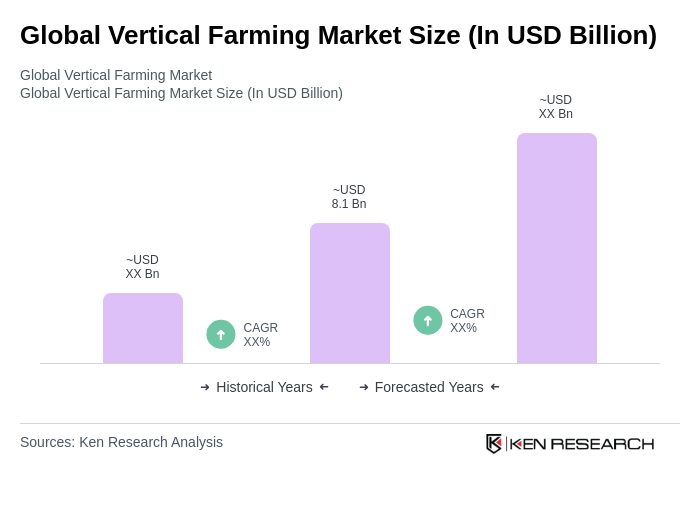
- The Global Vertical Farming Market is valued at USD 8.1 billion, based on a five-year historical analysis. This growth is primarily driven by increasing demand for sustainable agricultural practices, rapid urbanization, and the need for food security in densely populated areas. The rise in consumer awareness regarding the benefits of locally grown produce and the adoption of advanced technologies such as automation and LED lighting have also contributed significantly to market expansion .
- Key players in this market include the United States, Canada, and several countries in Europe such as the Netherlands and Germany. The dominance of these regions is attributed to advanced technological infrastructure, significant investments in research and development, and supportive government policies that promote sustainable farming practices. North America holds the largest share of the market, while Europe is experiencing robust growth due to its focus on food security and sustainability .
- In 2023, the U.S. government expanded support for urban agriculture, including vertical farming, through initiatives such as the Urban Agriculture and Innovative Production grants, which allocate substantial funding to support vertical farming projects. These initiatives aim to enhance food production in urban areas, reduce transportation costs, and promote local food systems, thereby fostering a more sustainable agricultural landscape .
Global Vertical Farming Market Segmentation
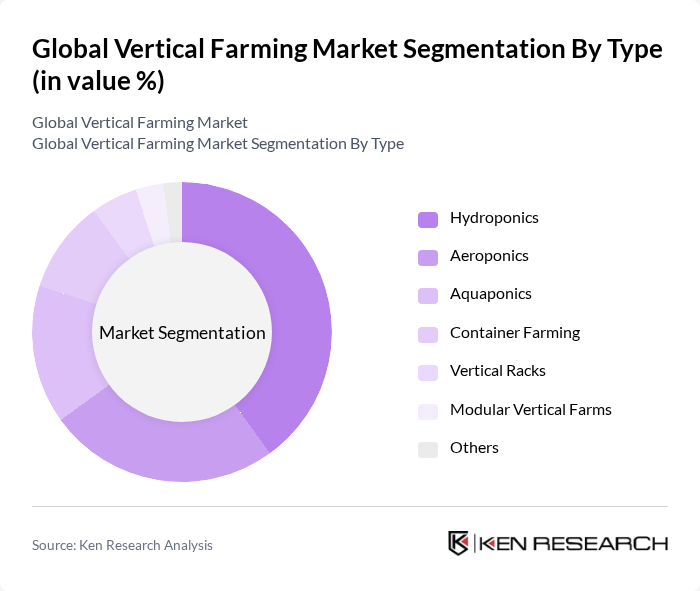
By Type:The vertical farming market is segmented into various types, including Hydroponics, Aeroponics, Aquaponics, Container Farming, Vertical Racks, Modular Vertical Farms, and Others. Among these, Hydroponics is the most dominant segment due to its efficiency in water usage, high yields in limited space, and adaptability for urban environments. The growing trend of urban agriculture, technological advancements in nutrient delivery systems, and the increasing demand for fresh produce in urban areas further bolster the popularity of hydroponic systems .
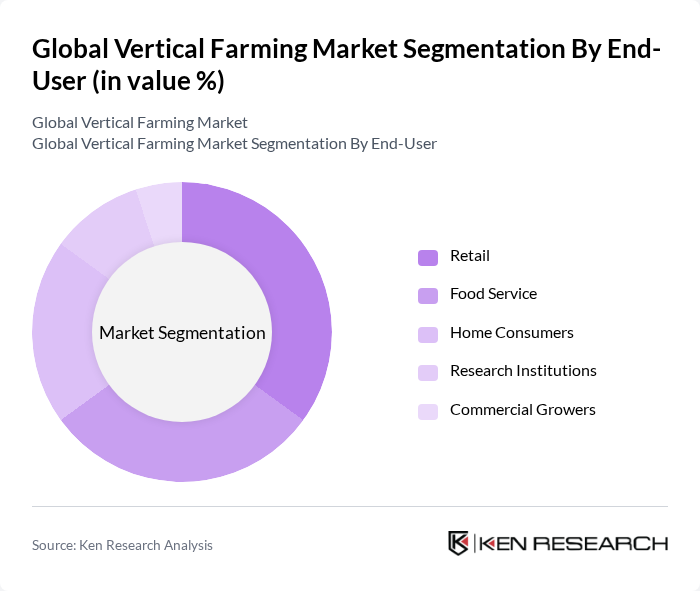
By End-User:The end-user segmentation includes Retail, Food Service, Home Consumers, Research Institutions, and Commercial Growers. The Retail segment is currently leading the market, driven by increasing consumer preference for fresh, organic produce and the expansion of supermarkets and grocery stores that prioritize locally sourced products. This trend is further supported by heightened awareness of health and wellness, as well as the integration of vertical farming outputs into retail supply chains .
Global Vertical Farming Market Competitive Landscape
The Global Vertical Farming Market is characterized by a dynamic mix of regional and international players. Leading participants such as AeroFarms, Plenty, Bowery Farming, Vertical Harvest, Green Spirit Farms, FarmedHere, Infarm, Gotham Greens, Sky Greens, Urban Crop Solutions, GrowUp Farms, Agricool, Plantagon, Oishii, Lettuce Grow, Illumitex, American Hydroponics, Spread Co., Ltd., Mirai Co., Ltd., Crop One Holdings contribute to innovation, geographic expansion, and service delivery in this space.
Global Vertical Farming Market Industry Analysis
Growth Drivers
- Increasing Urbanization:Urbanization is a significant driver of the vertical farming market, with the United Nations projecting that in future, approximately 56% of the global population will reside in urban areas. This shift leads to a higher demand for locally sourced food, reducing transportation costs and carbon footprints. Cities like Tokyo and New York are already investing in vertical farms, with Tokyo's urban agriculture initiatives aiming to produce 1.5 million tons of food annually in future, showcasing the potential for urban farming solutions.
- Demand for Fresh Produce:The global demand for fresh produce is expected to reach 1.5 billion tons in future, driven by health-conscious consumers seeking organic and pesticide-free options. This trend is particularly pronounced in urban areas, where access to fresh food is limited. Vertical farming offers a solution by providing fresh produce year-round, with companies like AeroFarms reporting a 30% increase in sales of leafy greens in urban markets, highlighting the growing consumer preference for fresh, locally grown food.
- Technological Advancements:Technological innovations are revolutionizing vertical farming, with investments in automation and smart farming technologies projected to exceed $10 billion in future. The integration of AI and IoT in farming practices enhances efficiency and yield, with companies like Plenty utilizing advanced sensors to monitor plant health. This technological shift not only reduces labor costs but also increases productivity, making vertical farming a more viable option for urban food production in the coming years.
Market Challenges
- High Initial Investment:The high initial investment required for setting up vertical farms poses a significant challenge, with costs ranging from $500,000 to $2 million for a medium-sized facility. This financial barrier can deter potential investors, especially in regions where traditional farming methods are more established. Additionally, the return on investment can take several years, making it crucial for stakeholders to secure funding and support to navigate these financial hurdles effectively.
- Energy Consumption:Energy consumption remains a critical challenge for vertical farming, with facilities consuming up to 20 times more energy than traditional farms. As energy costs rise, the sustainability of vertical farming practices is questioned. For instance, a study by the International Energy Agency indicates that energy costs could account for up to 40% of operational expenses in future, necessitating the adoption of renewable energy sources to mitigate these costs and enhance sustainability.
Global Vertical Farming Market Future Outlook
The future of vertical farming appears promising, driven by technological advancements and increasing consumer demand for sustainable food sources. As urban populations grow, the need for efficient food production methods will intensify. Innovations in automation and AI will likely enhance productivity, while government support for sustainable practices may further bolster the industry. Additionally, as energy-efficient technologies become more accessible, vertical farming could become a cornerstone of urban agriculture, addressing food security challenges in densely populated areas.
Market Opportunities
- Expansion in Emerging Markets:Emerging markets present significant opportunities for vertical farming, with countries like India and Brazil experiencing rapid urbanization. In future, India's urban population is expected to reach 600 million, creating a substantial demand for local food production. This growth can drive investments in vertical farming technologies, enabling these regions to enhance food security and reduce reliance on imports.
- Partnerships with Retailers:Collaborations between vertical farms and retailers can enhance market reach and consumer access. In future, partnerships with major grocery chains could facilitate the distribution of fresh produce, tapping into the growing consumer preference for local sourcing. Such alliances can also provide vertical farms with valuable insights into consumer trends, enabling them to tailor their offerings effectively and increase market penetration.
Scope of the Report
| Segment | Sub-Segments |
|---|---|
| By Type | Hydroponics Aeroponics Aquaponics Container Farming Vertical Racks Modular Vertical Farms Others |
| By End-User | Retail Food Service Home Consumers Research Institutions Commercial Growers |
| By Region | North America Europe Asia-Pacific Latin America Middle East & Africa |
| By Technology | LED Lighting Climate Control Systems Nutrient Delivery Systems Monitoring & Automation Systems Irrigation Systems |
| By Application | Leafy Greens Herbs Fruits Flowers & Ornamentals Microgreens |
| By Investment Source | Private Equity Venture Capital Government Grants Corporate Investments |
| By Policy Support | Tax Incentives Research Grants Subsidies for Equipment Urban Agriculture Policies |
Key Target Audience
Investors and Venture Capitalist Firms
Government and Regulatory Bodies (e.g., Food and Drug Administration, Environmental Protection Agency)
Agricultural Technology Companies
Urban Development Agencies
Retail Grocery Chains
Food Supply Chain Managers
Real Estate Developers
Non-Governmental Organizations focused on Food Security
Players Mentioned in the Report:
AeroFarms
Plenty
Bowery Farming
Vertical Harvest
Green Spirit Farms
FarmedHere
Infarm
Gotham Greens
Sky Greens
Urban Crop Solutions
GrowUp Farms
Agricool
Plantagon
Oishii
Lettuce Grow
Illumitex
American Hydroponics
Spread Co., Ltd.
Mirai Co., Ltd.
Crop One Holdings
Table of Contents
Market Assessment Phase
1. Executive Summary and Approach
2. Global Vertical Farming Market Overview
2.1 Key Insights and Strategic Recommendations
2.2 Global Vertical Farming Market Overview
2.3 Definition and Scope
2.4 Evolution of Market Ecosystem
2.5 Timeline of Key Regulatory Milestones
2.6 Value Chain & Stakeholder Mapping
2.7 Business Cycle Analysis
2.8 Policy & Incentive Landscape
3. Global Vertical Farming Market Analysis
3.1 Growth Drivers
3.1.1 Increasing Urbanization
3.1.2 Demand for Fresh Produce
3.1.3 Technological Advancements
3.1.4 Sustainability Concerns
3.2 Market Challenges
3.2.1 High Initial Investment
3.2.2 Energy Consumption
3.2.3 Regulatory Hurdles
3.2.4 Market Competition
3.3 Market Opportunities
3.3.1 Expansion in Emerging Markets
3.3.2 Partnerships with Retailers
3.3.3 Innovations in Farming Techniques
3.3.4 Government Support and Funding
3.4 Market Trends
3.4.1 Rise of Automation
3.4.2 Integration of AI and IoT
3.4.3 Shift Towards Organic Produce
3.4.4 Consumer Preference for Local Sourcing
3.5 Government Regulation
3.5.1 Food Safety Standards
3.5.2 Environmental Regulations
3.5.3 Subsidies for Sustainable Practices
3.5.4 Zoning Laws for Urban Farming
4. SWOT Analysis
5. Stakeholder Analysis
6. Porter's Five Forces Analysis
7. Global Vertical Farming Market Market Size, 2019-2024
7.1 By Value
7.2 By Volume
7.3 By Average Selling Price
8. Global Vertical Farming Market Segmentation
8.1 By Type
8.1.1 Hydroponics
8.1.2 Aeroponics
8.1.3 Aquaponics
8.1.4 Container Farming
8.1.5 Vertical Racks
8.1.6 Modular Vertical Farms
8.1.7 Others
8.2 By End-User
8.2.1 Retail
8.2.2 Food Service
8.2.3 Home Consumers
8.2.4 Research Institutions
8.2.5 Commercial Growers
8.3 By Region
8.3.1 North America
8.3.2 Europe
8.3.3 Asia-Pacific
8.3.4 Latin America
8.3.5 Middle East & Africa
8.4 By Technology
8.4.1 LED Lighting
8.4.2 Climate Control Systems
8.4.3 Nutrient Delivery Systems
8.4.4 Monitoring & Automation Systems
8.4.5 Irrigation Systems
8.5 By Application
8.5.1 Leafy Greens
8.5.2 Herbs
8.5.3 Fruits
8.5.4 Flowers & Ornamentals
8.5.5 Microgreens
8.6 By Investment Source
8.6.1 Private Equity
8.6.2 Venture Capital
8.6.3 Government Grants
8.6.4 Corporate Investments
8.7 By Policy Support
8.7.1 Tax Incentives
8.7.2 Research Grants
8.7.3 Subsidies for Equipment
8.7.4 Urban Agriculture Policies
9. Global Vertical Farming Market Competitive Analysis
9.1 Market Share of Key Players
9.2 Cross Comparison of Key Players
9.2.1 Company Name
9.2.2 Number of Farms/Facilities
9.2.3 Annual Revenue
9.2.4 Revenue Growth Rate
9.2.5 Market Penetration (by Region/City)
9.2.6 Yield per Square Meter
9.2.7 Energy Consumption per kg Output
9.2.8 Water Usage Efficiency
9.2.9 Crop Variety Portfolio
9.2.10 Technology Adoption Level (e.g., Automation, AI)
9.2.11 Customer Retention Rate
9.2.12 Distribution Partnerships
9.2.13 R&D Investment as % of Revenue
9.2.14 Certification & Compliance (e.g., Organic, GAP)
9.2.15 Brand Recognition
9.3 SWOT Analysis of Top Players
9.4 Pricing Analysis
9.5 Detailed Profile of Major Companies
9.5.1 AeroFarms
9.5.2 Plenty
9.5.3 Bowery Farming
9.5.4 Vertical Harvest
9.5.5 Green Spirit Farms
9.5.6 FarmedHere
9.5.7 Infarm
9.5.8 Gotham Greens
9.5.9 Sky Greens
9.5.10 Urban Crop Solutions
9.5.11 GrowUp Farms
9.5.12 Agricool
9.5.13 Plantagon
9.5.14 Oishii
9.5.15 Lettuce Grow
9.5.16 Illumitex
9.5.17 American Hydroponics
9.5.18 Spread Co., Ltd.
9.5.19 Mirai Co., Ltd.
9.5.20 Crop One Holdings
10. Global Vertical Farming Market End-User Analysis
10.1 Procurement Behavior of Key Ministries
10.1.1 Government Contracts
10.1.2 Budget Allocations
10.1.3 Sustainability Initiatives
10.2 Corporate Spend on Infrastructure & Energy
10.2.1 Investment in Renewable Energy
10.2.2 Infrastructure Development Costs
10.2.3 Operational Expenditure
10.3 Pain Point Analysis by End-User Category
10.3.1 Supply Chain Disruptions
10.3.2 Quality Control Issues
10.3.3 Cost Management Challenges
10.4 User Readiness for Adoption
10.4.1 Technology Acceptance
10.4.2 Training and Support Needs
10.4.3 Financial Readiness
10.5 Post-Deployment ROI and Use Case Expansion
10.5.1 Performance Metrics
10.5.2 Scalability Potential
10.5.3 Customer Feedback Integration
11. Global Vertical Farming Market Future Size, 2025-2030
11.1 By Value
11.2 By Volume
11.3 By Average Selling Price
Go-To-Market Strategy Phase
1. Whitespace Analysis + Business Model Canvas
1.1 Market Gaps Identification
1.2 Value Proposition Development
1.3 Revenue Streams Analysis
1.4 Cost Structure Evaluation
1.5 Key Partnerships Exploration
1.6 Customer Segmentation
1.7 Competitive Advantage Assessment
2. Marketing and Positioning Recommendations
2.1 Branding Strategies
2.2 Product USPs
3. Distribution Plan
3.1 Urban Retail vs Rural NGO Tie-ups
4. Channel & Pricing Gaps
4.1 Underserved Routes
4.2 Pricing Bands
5. Unmet Demand & Latent Needs
5.1 Category Gaps
5.2 Consumer Segments
6. Customer Relationship
6.1 Loyalty Programs
6.2 After-sales Service
7. Value Proposition
7.1 Sustainability
7.2 Integrated Supply Chains
8. Key Activities
8.1 Regulatory Compliance
8.2 Branding
8.3 Distribution Setup
9. Entry Strategy Evaluation
9.1 Domestic Market Entry Strategy
9.1.1 Product Mix
9.1.2 Pricing Band
9.1.3 Packaging
9.2 Export Entry Strategy
9.2.1 Target Countries
9.2.2 Compliance Roadmap
10. Entry Mode Assessment
10.1 JV
10.2 Greenfield
10.3 M&A
10.4 Distributor Model
11. Capital and Timeline Estimation
11.1 Capital Requirements
11.2 Timelines
12. Control vs Risk Trade-Off
12.1 Ownership vs Partnerships
13. Profitability Outlook
13.1 Breakeven Analysis
13.2 Long-term Sustainability
14. Potential Partner List
14.1 Distributors
14.2 JVs
14.3 Acquisition Targets
15. Execution Roadmap
15.1 Phased Plan for Market Entry
15.1.1 Market Setup
15.1.2 Market Entry
15.1.3 Growth Acceleration
15.1.4 Scale & Stabilize
15.2 Key Activities and Milestones
15.2.1 Activity Planning
15.2.2 Milestone Tracking
Research Methodology
Phase 1: Approach1
Desk Research
- Industry reports from agricultural technology associations and vertical farming publications
- Market analysis from government agricultural departments and international trade organizations
- Academic journals and white papers focusing on innovations in vertical farming technologies
Primary Research
- Interviews with founders and executives of leading vertical farming companies
- Surveys with agricultural scientists and researchers specializing in urban agriculture
- Field visits to operational vertical farms to gather firsthand insights on practices and challenges
Validation & Triangulation
- Cross-validation of data through multiple industry sources and expert opinions
- Triangulation of market trends with sales data and investment patterns in vertical farming
- Sanity checks conducted through expert panel discussions and feedback sessions
Phase 2: Market Size Estimation1
Top-down Assessment
- Analysis of global agricultural market size and growth rates to estimate vertical farming's share
- Segmentation by geographical regions and crop types to identify key growth areas
- Incorporation of urbanization trends and food security initiatives influencing market demand
Bottom-up Modeling
- Data collection from existing vertical farms to establish average yield and operational costs
- Estimation of market potential based on the number of farms and average investment per facility
- Volume and revenue projections based on crop types and sales channels (B2B vs. B2C)
Forecasting & Scenario Analysis
- Multi-variable forecasting using factors such as technological advancements and consumer preferences
- Scenario analysis based on regulatory changes and sustainability trends impacting vertical farming
- Development of baseline, optimistic, and pessimistic growth scenarios through 2030
Phase 3: CATI Sample Composition1
| Scope Item/Segment | Sample Size | Target Respondent Profiles |
|---|---|---|
| Commercial Vertical Farms | 100 | Farm Owners, Operations Managers |
| Research Institutions in Agriculture | 60 | Agricultural Researchers, University Professors |
| Technology Providers for Vertical Farming | 50 | Product Managers, R&D Directors |
| Government Agricultural Departments | 40 | Policy Makers, Agricultural Advisors |
| Investors in AgriTech Startups | 40 | Venture Capitalists, Angel Investors |
Frequently Asked Questions
What is the current value of the Global Vertical Farming Market?
The Global Vertical Farming Market is valued at approximately USD 8.1 billion, reflecting significant growth driven by urbanization, sustainable agricultural practices, and technological advancements in farming methods.
What factors are driving the growth of the vertical farming market?
Which regions are leading in the vertical farming market?
What types of vertical farming systems are most common?
Other Regional/Country Reports
Why Buy From Us?

What makes us stand out is that our consultants follow Robust, Refine and Result (RRR) methodology. Robust for clear definitions, approaches and sanity checking, Refine for differentiating respondents' facts and opinions, and Result for presenting data with story.

We have set a benchmark in the industry by offering our clients with syndicated and customized market research reports featuring coverage of entire market as well as meticulous research and analyst insights.

While we don't replace traditional research, we flip the method upside down. Our dual approach of Top Bottom & Bottom Top ensures quality deliverable by not just verifying company fundamentals but also looking at the sector and macroeconomic factors.

With one step in the future, our research team constantly tries to show you the bigger picture. We help with some of the tough questions you may encounter along the way: How is the industry positioned? Best marketing channel? KPI's of competitors? By aligning every element, we help maximize success.

Our report gives you instant access to the answers and sources that other companies might choose to hide. We elaborate each steps of research methodology we have used and showcase you the sample size to earn your trust.

If you need any support, we are here! We pride ourselves on universe strength, data quality, and quick, friendly, and professional service.