Ken Research Logo

Indonesia Cattle Feed Market Size, Share, Growth Drivers, Trends, Opportunities & Forecast 2025–2030

Indonesia cattle feed market, valued at USD 2.1 billion, grows due to increasing dairy demand, government initiatives, and advancements in feed technology across Java and Sumatra.

Region:Asia

Author(s):Shubham

Product Code:KRAD5352

Pages:99

Published On:December 2025
About the Report

Base Year 2024

Indonesia Cattle Feed Market Overview

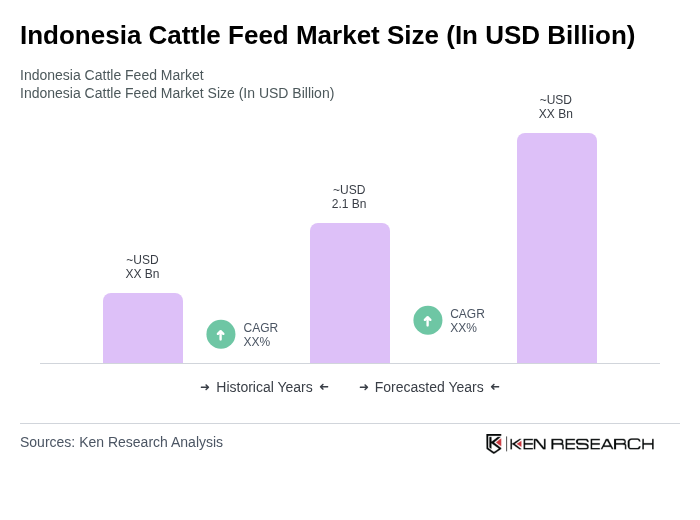
  • The Indonesia Cattle Feed Market is valued at USD 2.1 billion, based on a five-year historical analysis and considering the share of cattle feed within the broader Indonesia animal feed market, which is estimated at around USD 8.7 billion for all species. This growth is primarily driven by the increasing demand for high-quality cattle products, rising livestock population, and the growing awareness of nutritional feed among farmers, supported by the expansion of feed mills and commercial farming. The market is also supported by advancements in feed technology, including improved formulations and feed additives, and the expansion of the livestock sector, which contributes significantly to Indonesia’s agricultural GDP.
  • Key regions dominating the market include Java, Sumatra, and Kalimantan. Java, being the most populous island, has a high concentration of dairy and beef cattle farms and the largest cluster of feed mills and industrial livestock operations, leading to significant demand for cattle feed. Sumatra and Kalimantan also contribute to the market due to their agricultural activities and livestock farming, supported by local government initiatives to enhance livestock productivity and expand commercial-scale farms.
  • In 2023, the Indonesian government strengthened feed quality control through the implementation and enforcement of standards under the Indonesian National Standard (SNI) for animal feed, including SNI 3148 on feed for ruminants, along with the “Peraturan Menteri Pertanian (Regulation of the Minister of Agriculture) No. 22/Permentan/PK.350/5/2017 on the Provision, Circulation, and Supervision of Animal Feed”, which mandates that all commercial feed must meet specified nutritional content, carry proper labelling, and be subject to regular inspection and sampling by authorized officers to ensure safety and efficacy. This regulatory framework is designed to enhance livestock health and productivity, support food safety, and improve the overall performance of the agricultural sector.
Indonesia Cattle Feed Market Size

Indonesia Cattle Feed Market Segmentation

By Feed Type:The feed type segmentation includes various categories such as Compound Feed, Fodder, Forage, Total Mixed Rations (TMR), Mineral & Vitamin Premixes, and Others. Among these, Compound Feed is the leading subsegment due to its balanced nutritional profile, consistent quality, and suitability for intensive and semi-intensive production systems, which are increasingly adopted in Indonesia. The increasing trend of commercial farming, the growth of integrated feed–farm operations, and the need for high-quality formulated rations to improve milk yield and weight gain have further propelled the demand for Compound Feed.
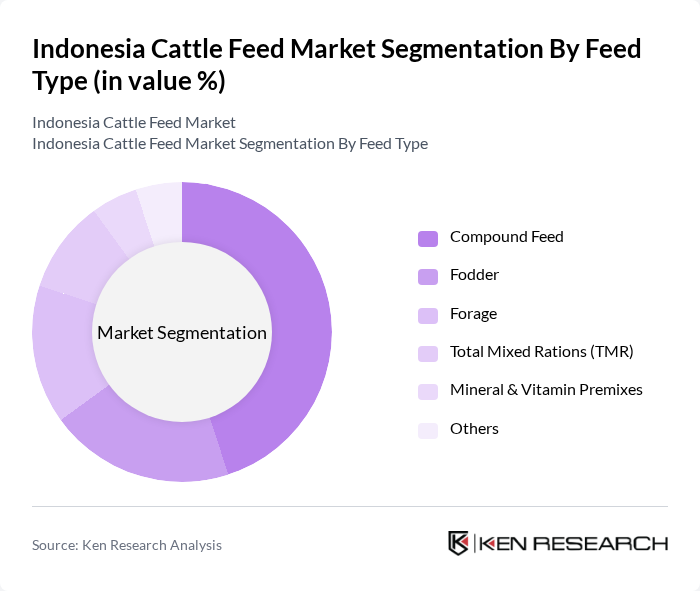
Indonesia Cattle Feed Market segmentation by Feed Type.

By Cattle Category:The cattle category segmentation includes Dairy Cattle, Beef Cattle, Calves, and Others. Dairy Cattle is the dominant subsegment, driven by the increasing demand for milk and dairy products in Indonesia and the policy focus on improving national milk self-sufficiency. The growing consumer preference for dairy consumption, urbanization-driven changes in diets, and the expansion of smallholder and commercial dairy farms have significantly contributed to the rise in demand for specialized feed tailored for dairy cattle, including high-energy concentrates and mineral–vitamin-enriched rations.
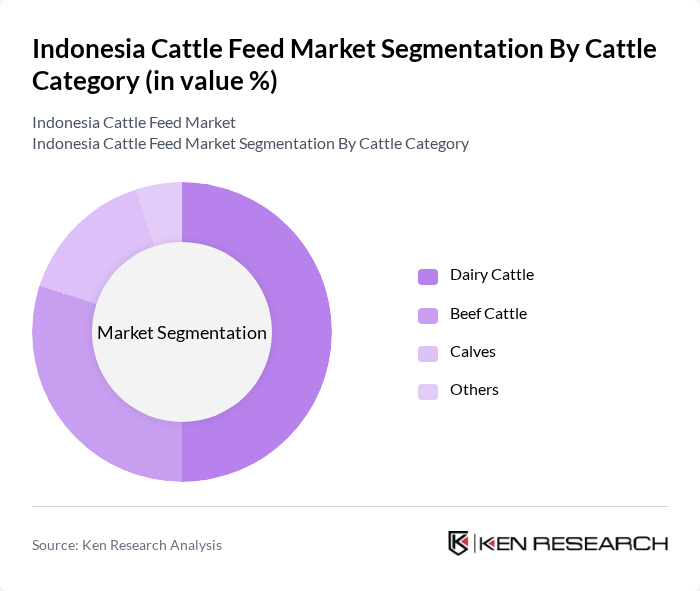
Indonesia Cattle Feed Market segmentation by Cattle Category.

Indonesia Cattle Feed Market Competitive Landscape

The Indonesia Cattle Feed Market is characterized by a dynamic mix of regional and international players. Leading participants such as PT Charoen Pokphand Indonesia Tbk, PT Japfa Comfeed Indonesia Tbk, PT Malindo Feedmill Tbk, PT Sierad Produce Tbk, PT Cargill Indonesia, PT Gold Coin Indonesia, PT Suprama, PT Greenfields Indonesia, PT Sinar Mas Agro Resources and Technology Tbk (SMART Tbk), PT CJ Feed and Care Indonesia, PT De Heus Indonesia, PT FKS Multi Agro Tbk, PT Provimi Indonesia (Cargill Group), PT Wonokoyo Jaya Corporindo, PT Buana Karya Bhakti contribute to innovation, geographic expansion, and service delivery in this space.

PT Charoen Pokphand Indonesia Tbk

1972

Jakarta, Indonesia

PT Japfa Comfeed Indonesia Tbk

1971

Jakarta, Indonesia

PT Malindo Feedmill Tbk

1997

Jakarta, Indonesia

PT Sierad Produce Tbk

1985

South Tangerang, Indonesia

PT Cargill Indonesia

1974

Jakarta, Indonesia

Company

Establishment Year

Headquarters

Cattle Feed Revenue (Indonesia), Last 3 Years

Cattle Feed Sales Volume (Tons per Year)

CAGR in Cattle Feed Segment

Market Share in Indonesia Cattle Feed (%)

Production Capacity Utilization (%)

EBITDA Margin from Cattle Feed Business (%)

Indonesia Cattle Feed Market Industry Analysis

Growth Drivers

  • Increasing Demand for Livestock Products:The demand for livestock products in Indonesia is projected to reach 3.7 million tons of beef and 1.3 million tons of milk in future. This surge is driven by a growing population, expected to hit 277 million, and rising incomes, which increase meat and dairy consumption. The livestock sector's contribution to the national GDP is approximately IDR 210 trillion, highlighting the economic significance of cattle farming and the corresponding need for quality feed.
  • Government Initiatives to Boost Cattle Farming:The Indonesian government has allocated IDR 1.6 trillion for livestock development in future, focusing on enhancing cattle farming practices. Initiatives include subsidies for feed production and training programs for farmers. These efforts aim to increase local beef production by 25% in future, reducing reliance on imports and fostering a more self-sufficient agricultural sector, which directly benefits the cattle feed market.
  • Rising Awareness of Animal Nutrition:With the livestock sector's growth, awareness of animal nutrition has increased significantly. In future, it is estimated that 65% of cattle farmers will adopt specialized feed formulations to enhance livestock health and productivity. This shift is supported by educational campaigns and research initiatives, leading to a projected increase in the demand for high-quality feed products, which is essential for improving meat and milk yields in the cattle industry.

Market Challenges

  • Fluctuating Raw Material Prices:The cattle feed market faces significant challenges due to fluctuating raw material prices, which can vary by up to 35% annually. Factors such as climate change, global supply chain disruptions, and local agricultural output impact the availability and cost of essential ingredients like corn and soybean meal. This volatility can hinder feed production and profitability for local manufacturers, creating uncertainty in the market.
  • Limited Access to Quality Feed:Approximately 45% of Indonesian cattle farmers struggle to access quality feed, particularly in rural areas. This limitation is exacerbated by inadequate distribution networks and a lack of investment in local feed production facilities. As a result, many farmers resort to substandard feed, which negatively impacts livestock health and productivity, ultimately affecting the overall growth of the cattle feed market in Indonesia.

Indonesia Cattle Feed Market Future Outlook

The future of the Indonesia cattle feed market appears promising, driven by increasing investments in livestock farming and a growing emphasis on sustainable practices. In future, the integration of digital technologies in feed management is expected to enhance efficiency and traceability. Additionally, the rise of organic feed products will cater to health-conscious consumers, creating new market segments. These trends indicate a shift towards more innovative and environmentally friendly solutions in the cattle feed industry, positioning it for sustainable growth.

Market Opportunities

  • Growth in Organic and Natural Feed Products:The demand for organic and natural feed products is anticipated to increase significantly, with a projected market value of IDR 600 billion in future. This trend is driven by consumer preferences for healthier livestock products and the growing awareness of sustainable farming practices, presenting a lucrative opportunity for feed manufacturers to innovate and diversify their product offerings.
  • Technological Advancements in Feed Production:Technological advancements in feed production, such as precision nutrition and automated feed systems, are expected to enhance production efficiency. In future, investments in these technologies could reach IDR 1.2 trillion, allowing producers to optimize feed formulations and reduce waste. This opportunity not only improves profitability but also supports the overall sustainability of the cattle feed market in Indonesia.

Scope of the Report

SegmentSub-Segments
By Feed Type

Compound Feed

Fodder

Forage

Total Mixed Rations (TMR)

Mineral & Vitamin Premixes

Others

By Cattle Category

Dairy Cattle

Beef Cattle

Calves

Others

By Distribution Channel

Direct Sales to Large Farms

Dealers and Retail Outlets

Cooperatives

Online Sales

Wholesalers

Others

By Form

Pellets

Mash

Crumbles

Others

By Ingredient

Cereals (Corn, Wheat, etc.)

Oilseed Meal (Soybean Meal, etc.)

By-products (Bran, Molasses, etc.)

Additives (Vitamins, Minerals, Enzymes, etc.)

Others

By Production System

Commercial Feed Mills

Integrated Operations

On-farm Mixing

Others

By Region

Java

Sumatra

Kalimantan

Sulawesi

Bali & Nusa Tenggara

Others

By Price Range

Economy

Mid-range

Premium

Others

Key Target Audience

Investors and Venture Capitalist Firms

Government and Regulatory Bodies (e.g., Ministry of Agriculture, National Food Agency)

Manufacturers and Producers of Cattle Feed

Distributors and Retailers of Livestock Feed

Livestock Farmers and Cooperatives

Feed Ingredient Suppliers

Industry Associations (e.g., Indonesian Cattle Breeders Association)

Financial Institutions and Banks

Players Mentioned in the Report:

PT Charoen Pokphand Indonesia Tbk

PT Japfa Comfeed Indonesia Tbk

PT Malindo Feedmill Tbk

PT Sierad Produce Tbk

PT Cargill Indonesia

PT Gold Coin Indonesia

PT Suprama

PT Greenfields Indonesia

PT Sinar Mas Agro Resources and Technology Tbk (SMART Tbk)

PT CJ Feed and Care Indonesia

PT De Heus Indonesia

PT FKS Multi Agro Tbk

PT Provimi Indonesia (Cargill Group)

PT Wonokoyo Jaya Corporindo

PT Buana Karya Bhakti

Table of Contents

Market Assessment Phase

1. Executive Summary and Approach


2. Indonesia Cattle Feed Market Overview

2.1 Key Insights and Strategic Recommendations

2.2 Indonesia Cattle Feed Market Overview

2.3 Definition and Scope

2.4 Evolution of Market Ecosystem

2.5 Timeline of Key Regulatory Milestones

2.6 Value Chain & Stakeholder Mapping

2.7 Business Cycle Analysis

2.8 Policy & Incentive Landscape


3. Indonesia Cattle Feed Market Analysis

3.1 Growth Drivers

3.1.1 Increasing demand for livestock products
3.1.2 Government initiatives to boost cattle farming
3.1.3 Rising awareness of animal nutrition
3.1.4 Expansion of the dairy and meat processing industries

3.2 Market Challenges

3.2.1 Fluctuating raw material prices
3.2.2 Limited access to quality feed
3.2.3 Regulatory compliance issues
3.2.4 Competition from imported feed products

3.3 Market Opportunities

3.3.1 Growth in organic and natural feed products
3.3.2 Technological advancements in feed production
3.3.3 Increasing investment in livestock farming
3.3.4 Export potential to neighboring countries

3.4 Market Trends

3.4.1 Shift towards sustainable and eco-friendly feed
3.4.2 Rise in customized feed formulations
3.4.3 Integration of digital technologies in feed management
3.4.4 Growing focus on animal health and welfare

3.5 Government Regulation

3.5.1 Feed safety and quality standards
3.5.2 Import regulations for feed ingredients
3.5.3 Subsidies for local feed production
3.5.4 Environmental regulations affecting feed production

4. SWOT Analysis


5. Stakeholder Analysis


6. Porter's Five Forces Analysis


7. Indonesia Cattle Feed Market Market Size, 2019-2024

7.1 By Value

7.2 By Volume

7.3 By Average Selling Price


8. Indonesia Cattle Feed Market Segmentation

8.1 By Feed Type

8.1.1 Compound Feed
8.1.2 Fodder
8.1.3 Forage
8.1.4 Total Mixed Rations (TMR)
8.1.5 Mineral & Vitamin Premixes
8.1.6 Others

8.2 By Cattle Category

8.2.1 Dairy Cattle
8.2.2 Beef Cattle
8.2.3 Calves
8.2.4 Others

8.3 By Distribution Channel

8.3.1 Direct Sales to Large Farms
8.3.2 Dealers and Retail Outlets
8.3.3 Cooperatives
8.3.4 Online Sales
8.3.5 Wholesalers
8.3.6 Others

8.4 By Form

8.4.1 Pellets
8.4.2 Mash
8.4.3 Crumbles
8.4.4 Others

8.5 By Ingredient

8.5.1 Cereals (Corn, Wheat, etc.)
8.5.2 Oilseed Meal (Soybean Meal, etc.)
8.5.3 By-products (Bran, Molasses, etc.)
8.5.4 Additives (Vitamins, Minerals, Enzymes, etc.)
8.5.5 Others

8.6 By Production System

8.6.1 Commercial Feed Mills
8.6.2 Integrated Operations
8.6.3 On-farm Mixing
8.6.4 Others

8.7 By Region

8.7.1 Java
8.7.2 Sumatra
8.7.3 Kalimantan
8.7.4 Sulawesi
8.7.5 Bali & Nusa Tenggara
8.7.6 Others

8.8 By Price Range

8.8.1 Economy
8.8.2 Mid-range
8.8.3 Premium
8.8.4 Others

9. Indonesia Cattle Feed Market Competitive Analysis

9.1 Market Share of Key Players

9.2 Cross Comparison of Key Players

9.2.1 Company Name
9.2.2 Cattle Feed Revenue (Indonesia), Last 3 Years
9.2.3 Cattle Feed Sales Volume (Tons per Year)
9.2.4 CAGR in Cattle Feed Segment
9.2.5 Market Share in Indonesia Cattle Feed (%)
9.2.6 Production Capacity Utilization (%)
9.2.7 EBITDA Margin from Cattle Feed Business (%)
9.2.8 Average Realized Price per Ton (IDR/ton)
9.2.9 Geographic Coverage within Indonesia (Number of Provinces Served)
9.2.10 Product Portfolio Breadth (Number of Cattle Feed SKUs)
9.2.11 R&D/Innovation Spend on Cattle Feed (% of Segment Revenue)
9.2.12 Share of Contracted / Key-Account Farmers (%)

9.3 SWOT Analysis of Top Players

9.4 Pricing Analysis

9.5 Detailed Profile of Major Companies

9.5.1 PT Charoen Pokphand Indonesia Tbk
9.5.2 PT Japfa Comfeed Indonesia Tbk
9.5.3 PT Malindo Feedmill Tbk
9.5.4 PT Sierad Produce Tbk
9.5.5 PT Cargill Indonesia
9.5.6 PT Gold Coin Indonesia
9.5.7 PT Suprama
9.5.8 PT Greenfields Indonesia
9.5.9 PT Sinar Mas Agro Resources and Technology Tbk (SMART Tbk)
9.5.10 PT CJ Feed and Care Indonesia
9.5.11 PT De Heus Indonesia
9.5.12 PT FKS Multi Agro Tbk
9.5.13 PT Provimi Indonesia (Cargill Group)
9.5.14 PT Wonokoyo Jaya Corporindo
9.5.15 PT Buana Karya Bhakti

10. Indonesia Cattle Feed Market End-User Analysis

10.1 Procurement Behavior of Key Ministries

10.1.1 Ministry of Agriculture
10.1.2 Ministry of Trade
10.1.3 Ministry of Industry
10.1.4 Others

10.2 Corporate Spend on Infrastructure & Energy

10.2.1 Livestock Farms
10.2.2 Feed Manufacturers
10.2.3 Distributors
10.2.4 Others

10.3 Pain Point Analysis by End-User Category

10.3.1 Farmers
10.3.2 Feed Retailers
10.3.3 Livestock Processors
10.3.4 Others

10.4 User Readiness for Adoption

10.4.1 Awareness of Feed Quality
10.4.2 Willingness to Invest in Better Feed
10.4.3 Training and Support Needs
10.4.4 Others

10.5 Post-Deployment ROI and Use Case Expansion

10.5.1 Increased Milk Production
10.5.2 Improved Weight Gain in Cattle
10.5.3 Enhanced Feed Efficiency
10.5.4 Others

11. Indonesia Cattle Feed Market Future Size, 2025-2030

11.1 By Value

11.2 By Volume

11.3 By Average Selling Price


Go-To-Market Strategy Phase

1. Whitespace Analysis + Business Model Canvas

1.1 Market Gaps Identification

1.2 Business Model Development


2. Marketing and Positioning Recommendations

2.1 Branding Strategies

2.2 Product USPs


3. Distribution Plan

3.1 Urban Retail vs Rural NGO Tie-ups


4. Channel & Pricing Gaps

4.1 Underserved Routes

4.2 Pricing Bands


5. Unmet Demand & Latent Needs

5.1 Category Gaps

5.2 Consumer Segments


6. Customer Relationship

6.1 Loyalty Programs

6.2 After-sales Service


7. Value Proposition

7.1 Sustainability

7.2 Integrated Supply Chains


8. Key Activities

8.1 Regulatory Compliance

8.2 Branding

8.3 Distribution Setup


9. Entry Strategy Evaluation

9.1 Domestic Market Entry Strategy

9.1.1 Product Mix
9.1.2 Pricing Band
9.1.3 Packaging

9.2 Export Entry Strategy

9.2.1 Target Countries
9.2.2 Compliance Roadmap

10. Entry Mode Assessment

10.1 JV

10.2 Greenfield

10.3 M&A

10.4 Distributor Model


11. Capital and Timeline Estimation

11.1 Capital Requirements

11.2 Timelines


12. Control vs Risk Trade-Off

12.1 Ownership vs Partnerships


13. Profitability Outlook

13.1 Breakeven Analysis

13.2 Long-term Sustainability


14. Potential Partner List

14.1 Distributors

14.2 JVs

14.3 Acquisition Targets


15. Execution Roadmap

15.1 Phased Plan for Market Entry

15.1.1 Market Setup
15.1.2 Market Entry
15.1.3 Growth Acceleration
15.1.4 Scale & Stabilize

15.2 Key Activities and Milestones

15.2.1 Milestone Planning
15.2.2 Activity Tracking

Research Methodology

ApproachModellingSample

Phase 1: Approach1

Desk Research

  • Analysis of government reports and publications from the Indonesian Ministry of Agriculture
  • Review of industry reports from agricultural associations and livestock organizations
  • Examination of academic journals and market studies focusing on cattle feed production and consumption trends

Primary Research

  • Interviews with key stakeholders in the cattle feed supply chain, including manufacturers and distributors
  • Surveys conducted with livestock farmers to understand their feeding practices and preferences
  • Focus group discussions with veterinarians and animal nutritionists to gather insights on feed formulations

Validation & Triangulation

  • Cross-validation of data from multiple sources, including trade statistics and expert opinions
  • Triangulation of findings from primary interviews with secondary data trends
  • Sanity checks through expert panel reviews to ensure data accuracy and reliability

Phase 2: Market Size Estimation1

Top-down Assessment

  • Estimation of total cattle population in Indonesia and average feed consumption per animal
  • Analysis of market share distribution among different types of cattle feed (e.g., concentrates, roughages)
  • Incorporation of government initiatives aimed at increasing livestock productivity and feed efficiency

Bottom-up Modeling

  • Collection of sales data from leading cattle feed manufacturers to establish baseline volumes
  • Estimation of production costs and pricing strategies based on raw material availability
  • Volume x price analysis to project revenue generation across different feed segments

Forecasting & Scenario Analysis

  • Multi-factor regression analysis incorporating economic indicators, feed prices, and livestock growth rates
  • Scenario modeling based on potential changes in consumer preferences and regulatory impacts
  • Development of baseline, optimistic, and pessimistic forecasts through 2030

Phase 3: CATI Sample Composition1

Scope Item/SegmentSample SizeTarget Respondent Profiles
Cattle Feed Manufacturers60Production Managers, Sales Directors
Livestock Farmers120Farm Owners, Herd Managers
Veterinary Professionals80Veterinarians, Animal Nutritionists
Feed Distributors70Logistics Coordinators, Supply Chain Managers
Government Agricultural Officials40Policy Makers, Agricultural Advisors

Frequently Asked Questions

What is the current value of the Indonesia Cattle Feed Market?

The Indonesia Cattle Feed Market is valued at approximately USD 2.1 billion, reflecting its significant share within the broader animal feed market, which totals around USD 8.7 billion for all species in Indonesia.

What factors are driving the growth of the Indonesia Cattle Feed Market?

Which regions are the primary markets for cattle feed in Indonesia?

What are the main types of cattle feed available in Indonesia?

Other Regional/Country Reports

Indonesia Cattle Feed Market Size, Share, Growth Drivers, Trends, Opportunities & Forecast 2025–2030

Malaysia Cattle Feed Market Size, Share, Growth Drivers, Trends, Opportunities & Forecast 2025–2030

KSA Cattle Feed Market Size, Share, Growth Drivers, Trends, Opportunities & Forecast 2025–2030

APAC Cattle Feed Market Size, Share, Growth Drivers, Trends, Opportunities & Forecast 2025–2030

SEA Cattle Feed Market Size, Share, Growth Drivers, Trends, Opportunities & Forecast 2025–2030

Vietnam Cattle Feed Market Size, Share, Growth Drivers, Trends, Opportunities & Forecast 2025–2030

Why Buy From Us?

Refine Robust Result (RRR) Framework

What makes us stand out is that our consultants follow Robust, Refine and Result (RRR) methodology. Robust for clear definitions, approaches and sanity checking, Refine for differentiating respondents' facts and opinions, and Result for presenting data with story.

Our Reach Is Unmatched

We have set a benchmark in the industry by offering our clients with syndicated and customized market research reports featuring coverage of entire market as well as meticulous research and analyst insights.

Shifting the Research Paradigm

While we don't replace traditional research, we flip the method upside down. Our dual approach of Top Bottom & Bottom Top ensures quality deliverable by not just verifying company fundamentals but also looking at the sector and macroeconomic factors.

More Insights-Better Decisions

With one step in the future, our research team constantly tries to show you the bigger picture. We help with some of the tough questions you may encounter along the way: How is the industry positioned? Best marketing channel? KPI's of competitors? By aligning every element, we help maximize success.

Transparency and Trust

Our report gives you instant access to the answers and sources that other companies might choose to hide. We elaborate each steps of research methodology we have used and showcase you the sample size to earn your trust.

Round the Clock Support

If you need any support, we are here! We pride ourselves on universe strength, data quality, and quick, friendly, and professional service.

Why Clients Choose Us?

400000+
Reports in repository
150+
Consulting projects a year
100+
Analysts
8000+
Client Queries in 2022








