About the Report
Base Year 2024Listen to the audio summary
Indonesia Contact Lens Solution Market Overview
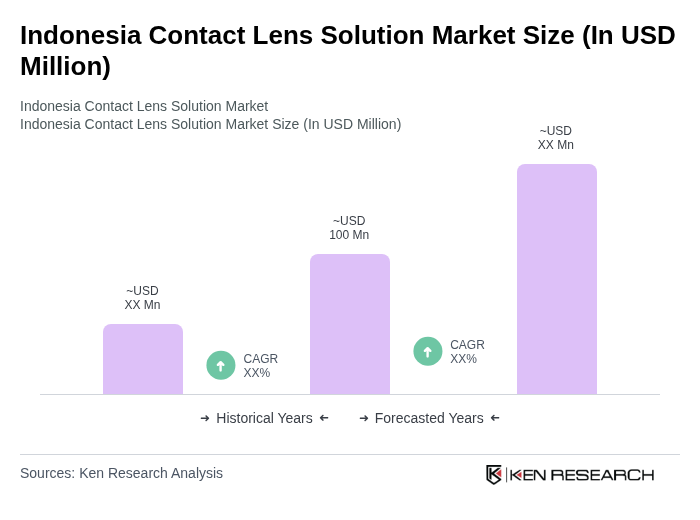
- The Indonesia Contact Lens Solution Market is valued at USD 100 million, based on a five-year historical analysis. This growth is primarily driven by the increasing prevalence of vision disorders such as uncorrected refractive errors affecting around 8.8 million people, rising awareness about eye health, growing preference for convenience among active lifestyles, technological advancements in materials like silicone hydrogel, and the growing trend of cosmetic contact lenses among the youth. The market has seen a significant uptick in demand for various types of contact lens solutions, including daily disposables and specialty lenses.
- Key cities such as Jakarta, Surabaya, and Bandung dominate the market due to their high population density and urbanization. These cities have a well-established healthcare infrastructure and a growing number of eye care professionals, which facilitates easy access to contact lens solutions. Additionally, the increasing disposable income of consumers in these urban areas contributes to the market's growth.
- The Minister of Health Regulation No. 62 of 2017 issued by the Ministry of Health requires contact lens solutions to obtain distribution permits through product registration, ensuring compliance with safety, quality, and labeling standards including biocompatibility testing and microbial limits. Manufacturers must register products via the e-registration system, meet Good Manufacturing Practices, and adhere to thresholds for preservatives and pH levels to obtain marketing authorization for distribution across Indonesia.
Indonesia Contact Lens Solution Market Segmentation
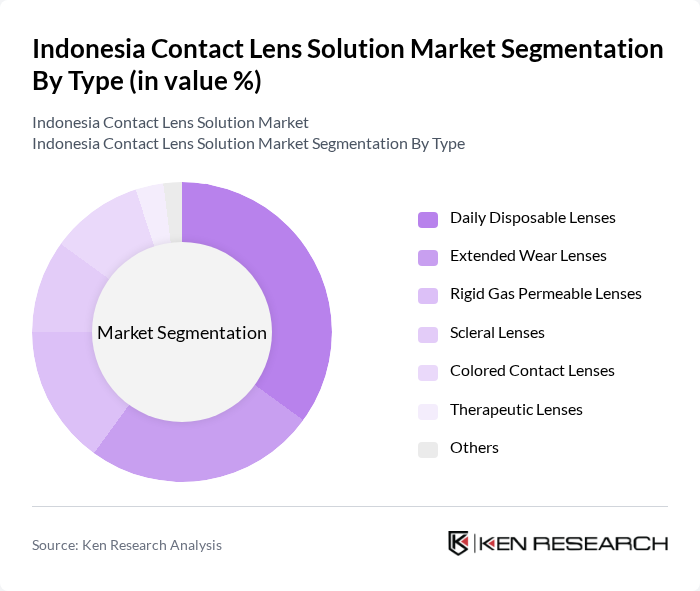
By Type:The market is segmented into various types of contact lenses, including Soft Contact Lenses, Rigid Gas Permeable Lenses, Specialty Lenses, Cosmetic Lenses, and Others. Among these, Soft Contact Lenses dominate the market due to their comfort and ease of use, making them the preferred choice for consumers. The increasing trend of daily disposable lenses is also contributing to the growth of this segment, as they offer convenience and hygiene.
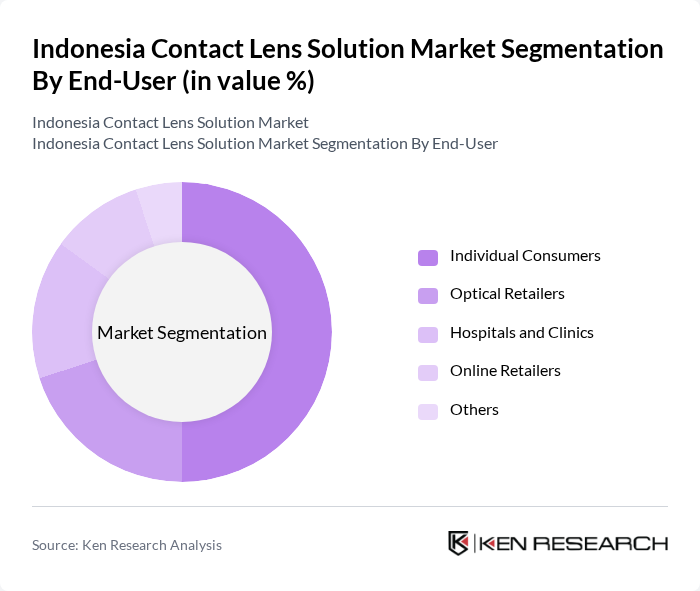
By End-User:The end-user segmentation includes Individual Consumers, Eye Care Professionals, Retail Pharmacies, Online Retailers, and Others. Individual Consumers represent the largest segment, driven by the increasing number of people opting for contact lenses over traditional eyewear. The convenience of online shopping has also led to a rise in sales through online retailers, catering to the tech-savvy population.
Indonesia Contact Lens Solution Market Competitive Landscape
The Indonesia Contact Lens Solution Market is characterized by a dynamic mix of regional and international players. Leading participants such as PT. Johnson & Johnson Indonesia, PT. Bausch + Lomb Indonesia, PT. Alcon Indonesia, PT. CooperVision Indonesia, PT. Menicon Indonesia, PT. Optik Seis, PT. Vision Care Indonesia, PT. Sinar Mas Optik, PT. Citra Lensa Indonesia, PT. Lensa Kesehatan Indonesia, PT. Optik Melawai, PT. Lensa Cinta, PT. Lensa Muda, PT. Lensa Sehat, PT. Lensa Terang contribute to innovation, geographic expansion, and service delivery in this space.
Indonesia Contact Lens Solution Market Industry Analysis
Growth Drivers
- Increasing Prevalence of Vision Disorders:The World Health Organization reported that approximately 30 million Indonesians suffer from vision disorders, with myopia being the most common. This rising prevalence is driving demand for contact lens solutions, as individuals seek effective alternatives to glasses. The increasing number of eye care clinics, which grew by 15% from the previous year to the current year, further supports this trend, providing greater access to vision correction options for the population.
- Rising Awareness About Eye Health:A national health campaign launched recently has significantly increased awareness about eye health, reaching over 50 million people. This initiative has led to a 20% increase in eye check-ups, resulting in more individuals being diagnosed with vision issues and subsequently seeking contact lens solutions. The growing emphasis on preventive healthcare is expected to further enhance the market for contact lens solutions in Indonesia.
- Growth in the Cosmetic Contact Lens Segment:The cosmetic contact lens segment in Indonesia has seen a remarkable growth rate of 25% this year, driven by changing fashion trends and increased social media influence. With over 70% of young adults expressing interest in cosmetic lenses, manufacturers are expanding their product lines to cater to this demand. This trend is expected to continue, bolstering the overall contact lens solution market in the country.
Market Challenges
- High Cost of Advanced Contact Lens Solutions:Advanced contact lens solutions, particularly those with innovative features, can cost up to IDR 500,000 per box, which is prohibitive for many consumers. This high price point limits accessibility, especially in lower-income regions where the average monthly income is around IDR 3 million. Consequently, many potential users may opt for cheaper alternatives, hindering market growth.
- Limited Consumer Education on Proper Usage:A survey conducted recently revealed that nearly 60% of contact lens users in Indonesia lack adequate knowledge about proper lens care and usage. This gap in education can lead to complications such as eye infections, which discourage new users from adopting contact lenses. The need for comprehensive educational initiatives is critical to overcoming this challenge and promoting safe usage.
Indonesia Contact Lens Solution Market Future Outlook
The Indonesia contact lens solution market is poised for significant growth, driven by increasing consumer awareness and the rising prevalence of vision disorders. Innovations in lens technology and materials are expected to enhance product offerings, while the expansion of distribution channels will improve accessibility. Additionally, the growing trend of online sales is likely to reshape purchasing behaviors, making contact lenses more available to a broader audience, particularly in rural areas where traditional retail options are limited.
Market Opportunities
- Introduction of Innovative Products:The market presents opportunities for companies to introduce innovative contact lens solutions, such as smart lenses equipped with health-monitoring features. With the Indonesian tech market projected to grow by 15% in future, integrating technology into contact lenses could attract tech-savvy consumers and enhance user experience.
- Expansion into Rural Markets:Approximately 60% of Indonesia's population resides in rural areas, where access to eye care is limited. Targeting these markets with affordable and accessible contact lens solutions could significantly increase market penetration. Collaborations with local healthcare providers can facilitate outreach and education, driving demand in these underserved regions.
Scope of the Report
| Segment | Sub-Segments |
|---|---|
| By Type | Soft Contact Lenses Rigid Gas Permeable Lenses Specialty Lenses Cosmetic Lenses Others |
| By End-User | Individual Consumers Eye Care Professionals Retail Pharmacies Online Retailers Others |
| By Distribution Channel | Online Sales Offline Retail Hospitals and Clinics Optical Stores Others |
| By Material | Hydrogel Silicone Hydrogel Rigid Gas Permeable Others |
| By Age Group | Children Adults Seniors Others |
| By Usage Frequency | Daily Wear Extended Wear Disposable Others |
| By Price Range | Budget Mid-Range Premium Others |
Key Target Audience
Investors and Venture Capitalist Firms
Government and Regulatory Bodies (e.g., Ministry of Health, National Agency of Drug and Food Control)
Manufacturers and Producers
Distributors and Retailers
Optometry Clinics and Eye Care Professionals
Health Insurance Companies
Industry Associations (e.g., Indonesian Optometry Association)
Pharmaceutical Companies
Players Mentioned in the Report:
PT. Johnson & Johnson Indonesia
PT. Bausch + Lomb Indonesia
PT. Alcon Indonesia
PT. CooperVision Indonesia
PT. Menicon Indonesia
PT. Optik Seis
PT. Vision Care Indonesia
PT. Sinar Mas Optik
PT. Citra Lensa Indonesia
PT. Lensa Kesehatan Indonesia
PT. Optik Melawai
PT. Lensa Cinta
PT. Lensa Muda
PT. Lensa Sehat
PT. Lensa Terang
Table of Contents
Market Assessment Phase
1. Executive Summary and Approach
2. Indonesia Contact Lens Solution Market Overview
2.1 Key Insights and Strategic Recommendations
2.2 Indonesia Contact Lens Solution Market Overview
2.3 Definition and Scope
2.4 Evolution of Market Ecosystem
2.5 Timeline of Key Regulatory Milestones
2.6 Value Chain & Stakeholder Mapping
2.7 Business Cycle Analysis
2.8 Policy & Incentive Landscape
3. Indonesia Contact Lens Solution Market Analysis
3.1 Growth Drivers
3.1.1 Increasing prevalence of vision disorders
3.1.2 Rising awareness about eye health
3.1.3 Growth in the cosmetic contact lens segment
3.1.4 Expansion of distribution channels
3.2 Market Challenges
3.2.1 High cost of advanced contact lens solutions
3.2.2 Limited consumer education on proper usage
3.2.3 Regulatory hurdles in product approvals
3.2.4 Competition from alternative vision correction methods
3.3 Market Opportunities
3.3.1 Introduction of innovative products
3.3.2 Expansion into rural markets
3.3.3 Collaborations with healthcare providers
3.3.4 Growth in online sales channels
3.4 Market Trends
3.4.1 Increasing demand for daily disposable lenses
3.4.2 Rise in eco-friendly contact lens solutions
3.4.3 Technological advancements in lens materials
3.4.4 Growth of subscription-based models
3.5 Government Regulation
3.5.1 Stricter quality control measures
3.5.2 Guidelines for advertising and marketing
3.5.3 Import regulations for foreign products
3.5.4 Health and safety standards for manufacturing
4. SWOT Analysis
5. Stakeholder Analysis
6. Porter's Five Forces Analysis
7. Indonesia Contact Lens Solution Market Market Size, 2019-2024
7.1 By Value
7.2 By Volume
7.3 By Average Selling Price
8. Indonesia Contact Lens Solution Market Segmentation
8.1 By Type
8.1.1 Soft Contact Lenses
8.1.2 Rigid Gas Permeable Lenses
8.1.3 Specialty Lenses
8.1.4 Cosmetic Lenses
8.1.5 Others
8.2 By End-User
8.2.1 Individual Consumers
8.2.2 Eye Care Professionals
8.2.3 Retail Pharmacies
8.2.4 Online Retailers
8.2.5 Others
8.3 By Distribution Channel
8.3.1 Online Sales
8.3.2 Offline Retail
8.3.3 Hospitals and Clinics
8.3.4 Optical Stores
8.3.5 Others
8.4 By Material
8.4.1 Hydrogel
8.4.2 Silicone Hydrogel
8.4.3 Rigid Gas Permeable
8.4.4 Others
8.5 By Age Group
8.5.1 Children
8.5.2 Adults
8.5.3 Seniors
8.5.4 Others
8.6 By Usage Frequency
8.6.1 Daily Wear
8.6.2 Extended Wear
8.6.3 Disposable
8.6.4 Others
8.7 By Price Range
8.7.1 Budget
8.7.2 Mid-Range
8.7.3 Premium
8.7.4 Others
9. Indonesia Contact Lens Solution Market Competitive Analysis
9.1 Market Share of Key Players
9.2 Cross Comparison of Key Players
9.2.1 Company Name
9.2.2 Group Size (Large, Medium, or Small as per industry convention)
9.2.3 Revenue Growth Rate
9.2.4 Market Penetration Rate
9.2.5 Customer Retention Rate
9.2.6 Pricing Strategy
9.2.7 Product Diversification
9.2.8 Distribution Efficiency
9.2.9 Brand Recognition
9.2.10 Customer Satisfaction Score
9.3 SWOT Analysis of Top Players
9.4 Pricing Analysis
9.5 Detailed Profile of Major Companies
9.5.1 PT. Johnson & Johnson Indonesia
9.5.2 PT. Bausch + Lomb Indonesia
9.5.3 PT. Alcon Indonesia
9.5.4 PT. CooperVision Indonesia
9.5.5 PT. Menicon Indonesia
9.5.6 PT. Optik Seis
9.5.7 PT. Vision Care Indonesia
9.5.8 PT. Sinar Mas Optik
9.5.9 PT. Citra Lensa Indonesia
9.5.10 PT. Lensa Kesehatan Indonesia
9.5.11 PT. Optik Melawai
9.5.12 PT. Lensa Cinta
9.5.13 PT. Lensa Muda
9.5.14 PT. Lensa Sehat
9.5.15 PT. Lensa Terang
10. Indonesia Contact Lens Solution Market End-User Analysis
10.1 Procurement Behavior of Key Ministries
10.1.1 Government procurement processes
10.1.2 Budget allocation for eye care
10.1.3 Collaboration with private sectors
10.1.4 Evaluation criteria for suppliers
10.2 Corporate Spend on Infrastructure & Energy
10.2.1 Investment in healthcare infrastructure
10.2.2 Spending on eye care technology
10.2.3 Budget for public health campaigns
10.2.4 Partnerships with NGOs for outreach
10.3 Pain Point Analysis by End-User Category
10.3.1 Accessibility of products
10.3.2 Affordability of solutions
10.3.3 Quality of available products
10.3.4 Awareness of eye health
10.4 User Readiness for Adoption
10.4.1 Familiarity with contact lens solutions
10.4.2 Willingness to switch from glasses
10.4.3 Perceived benefits of contact lenses
10.4.4 Availability of educational resources
10.5 Post-Deployment ROI and Use Case Expansion
10.5.1 Measurement of user satisfaction
10.5.2 Analysis of repeat purchases
10.5.3 Expansion into new user segments
10.5.4 Long-term health outcomes
11. Indonesia Contact Lens Solution Market Future Size, 2025-2030
11.1 By Value
11.2 By Volume
11.3 By Average Selling Price
Go-To-Market Strategy Phase
1. Whitespace Analysis + Business Model Canvas
1.1 Market gaps identification
1.2 Business model development
2. Marketing and Positioning Recommendations
2.1 Branding strategies
2.2 Product USPs
3. Distribution Plan
3.1 Urban retail vs rural NGO tie-ups
4. Channel & Pricing Gaps
4.1 Underserved routes
4.2 Pricing bands
5. Unmet Demand & Latent Needs
5.1 Category gaps
5.2 Consumer segments
6. Customer Relationship
6.1 Loyalty programs
6.2 After-sales service
7. Value Proposition
7.1 Sustainability
7.2 Integrated supply chains
8. Key Activities
8.1 Regulatory compliance
8.2 Branding
8.3 Distribution setup
9. Entry Strategy Evaluation
9.1 Domestic Market Entry Strategy
9.1.1 Product mix
9.1.2 Pricing band
9.1.3 Packaging
9.2 Export Entry Strategy
9.2.1 Target countries
9.2.2 Compliance roadmap
10. Entry Mode Assessment
10.1 JV
10.2 Greenfield
10.3 M&A
10.4 Distributor Model
11. Capital and Timeline Estimation
11.1 Capital requirements
11.2 Timelines
12. Control vs Risk Trade-Off
12.1 Ownership vs Partnerships
13. Profitability Outlook
13.1 Breakeven analysis
13.2 Long-term sustainability
14. Potential Partner List
14.1 Distributors
14.2 JVs
14.3 Acquisition targets
15. Execution Roadmap
15.1 Phased Plan for Market Entry
15.1.1 Market Setup
15.1.2 Market Entry
15.1.3 Growth Acceleration
15.1.4 Scale & Stabilize
15.2 Key Activities and Milestones
15.2.1 Activity timelines
15.2.2 Milestone tracking
Research Methodology
Phase 1: Approach1
Desk Research
- Market reports from industry associations and government publications on contact lens solutions
- Analysis of consumer behavior studies and demographic data from national statistics agencies
- Review of academic journals and articles focusing on ophthalmic products and innovations
Primary Research
- Interviews with ophthalmologists and optometrists to understand prescribing trends
- Surveys with retailers and distributors of contact lens solutions to gauge market dynamics
- Focus groups with end-users to capture preferences and satisfaction levels regarding contact lens solutions
Validation & Triangulation
- Cross-validation of findings through multiple data sources including sales data and consumer feedback
- Triangulation of insights from healthcare professionals, retailers, and market reports
- Sanity checks conducted through expert panel reviews comprising industry veterans
Phase 2: Market Size Estimation1
Top-down Assessment
- Estimation of total market size based on national healthcare expenditure and vision care spending
- Segmentation of the market by product type, including saline solutions, disinfectants, and multipurpose solutions
- Incorporation of growth trends in the contact lens market and related healthcare policies
Bottom-up Modeling
- Volume estimates derived from sales data of leading contact lens solution manufacturers
- Cost analysis based on pricing strategies of various product categories
- Calculation of market size using unit sales multiplied by average selling prices
Forecasting & Scenario Analysis
- Multi-variable forecasting model incorporating factors such as population growth and aging demographics
- Scenario analysis based on potential regulatory changes and advancements in contact lens technology
- Development of baseline, optimistic, and pessimistic market projections through 2030
Phase 3: CATI Sample Composition1
| Scope Item/Segment | Sample Size | Target Respondent Profiles |
|---|---|---|
| Ophthalmologist Insights | 100 | Ophthalmologists, Optometrists |
| Retailer Feedback | 80 | Pharmacy Managers, Optical Store Owners |
| Consumer Preferences | 120 | Contact Lens Users, Potential Users |
| Distributor Perspectives | 70 | Supply Chain Managers, Product Managers |
| Market Trends Analysis | 60 | Healthcare Analysts, Market Researchers |
Frequently Asked Questions
What is the current value of the Indonesia Contact Lens Solution Market?
The Indonesia Contact Lens Solution Market is valued at approximately USD 100 million, reflecting a significant growth driven by increasing vision disorders, awareness of eye health, and a preference for contact lenses over traditional eyewear.
What factors are driving the growth of the contact lens solution market in Indonesia?
Which cities are the primary markets for contact lens solutions in Indonesia?
What types of contact lenses are most popular in Indonesia?
Other Regional/Country Reports
Malaysia Contact Lens Solution Market
KSA Contact Lens Solution Market
APAC Contact Lens Solution Market
SEA Contact Lens Solution Market
Vietnam Contact Lens Solution Market
Thailand Contact Lens Solution Market
Other Adjacent Reports
Germany Vision Care Products Market
Qatar Eye Care Pharmaceuticals Market
Indonesia Optical Retail Market
Bahrain Cosmetic Lens Market
Brazil Optometry Services Market
Kuwait eye health supplements market size, share, growth drivers, trends, opportunities & forecast 2025–2030Vietnam Personal Care Products Market Size, Share & Forecast, By Product Type, Price Tier & Distribution Channel, 2025–2032Indonesia Healthcare Consumables Market
Why Buy From Us?

What makes us stand out is that our consultants follow Robust, Refine and Result (RRR) methodology. Robust for clear definitions, approaches and sanity checking, Refine for differentiating respondents' facts and opinions, and Result for presenting data with story.

We have set a benchmark in the industry by offering our clients with syndicated and customized market research reports featuring coverage of entire market as well as meticulous research and analyst insights.

While we don't replace traditional research, we flip the method upside down. Our dual approach of Top Bottom & Bottom Top ensures quality deliverable by not just verifying company fundamentals but also looking at the sector and macroeconomic factors.

With one step in the future, our research team constantly tries to show you the bigger picture. We help with some of the tough questions you may encounter along the way: How is the industry positioned? Best marketing channel? KPI's of competitors? By aligning every element, we help maximize success.

Our report gives you instant access to the answers and sources that other companies might choose to hide. We elaborate each steps of research methodology we have used and showcase you the sample size to earn your trust.

If you need any support, we are here! We pride ourselves on universe strength, data quality, and quick, friendly, and professional service.