About the Report
Base Year 2024Indonesia Contract Tracing Technologies Market Overview
- The Indonesia Contract Tracing Technologies Market is valued at USD 65 million, based on a five-year historical analysis.This growth is primarily driven by the increasing adoption of digital health solutions, expansion of national health data integration through platforms such as SATUSEHAT, broader uptake of telemedicine and remote monitoring, government initiatives to enhance public health infrastructure, and the rising demand for efficient contact tracing and proximity‑based monitoring methods in response to infectious disease risks.The market has seen significant investments in mobile applications, cloud-based analytics, and IoT‑enabled health monitoring to improve health outcomes and manage disease outbreaks more effectively.
- Key players in this market include Jakarta, Surabaya, and Bandung, which dominate due to their large populations, advanced connectivity and digital infrastructure, higher smartphone and mobile data penetration, and active provincial and municipal government support for e-health and smart city initiatives.These cities have become hubs for digital health and IoT solutions, attracting investments and fostering innovation in app‑based contact tracing, QR‑based check‑in systems, and integrated health data platforms, thereby enhancing their market presence.
- To strengthen digital disease surveillance and response, the Indonesian government has mandated the use of standardized digital tools for reporting and integrating COVID‑19‑related and other priority disease data through the SATUSEHAT platform, including the transition of the PeduliLindungi contact tracing application into SATUSEHAT Mobile.This mandate is implemented under the Regulation of the Minister of Health of the Republic of Indonesia Number 24 of 2022 on Medical Records issued by the Ministry of Health, which requires health facilities to submit electronic medical record data to the national health information system and comply with data standardization, interoperability, and security requirements, thereby streamlining data collection and improving the efficiency of public health responses.

Indonesia Contract Tracing Technologies Market Segmentation
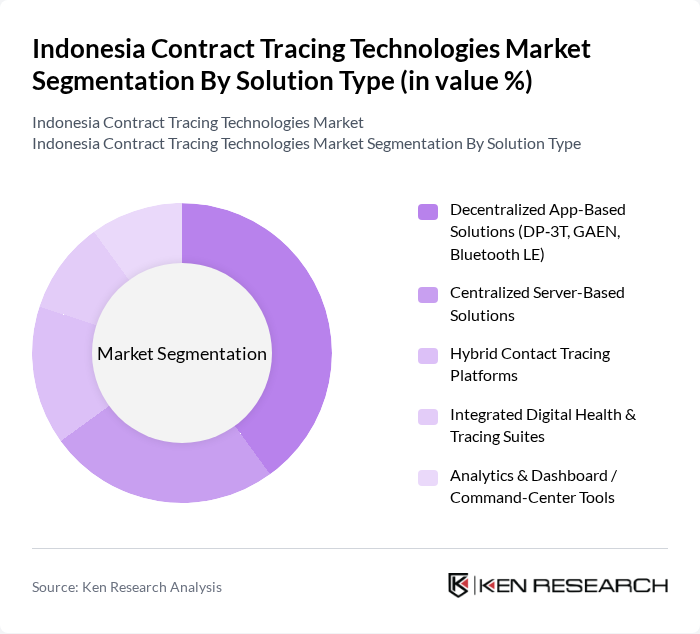
By Solution Type:The solution type segmentation includes various approaches to contact tracing technologies, each catering to different needs and preferences. The subsegments are Decentralized App-Based Solutions (DP‑3T, GAEN, Bluetooth LE), Centralized Server-Based Solutions, Hybrid Contact Tracing Platforms, Integrated Digital Health & Tracing Suites, and Analytics & Dashboard / Command-Center Tools.In the Indonesian context, Bluetooth Low Energy and QR code–based check‑in applications integrated with national platforms such as PeduliLindungi/SATUSEHAT Mobile and other digital health services are prominent, while global decentralized protocols like DP‑3T are used more as reference architectures than as stand‑alone consumer apps.Among these, Decentralized App-Based Solutions and integrated digital health and tracing suites are gaining traction due to their emphasis on user privacy, app‑based convenience, and linkage with vaccination records and test results, appealing to a tech‑savvy population increasingly concerned about personal data protection and seamless digital health journeys.
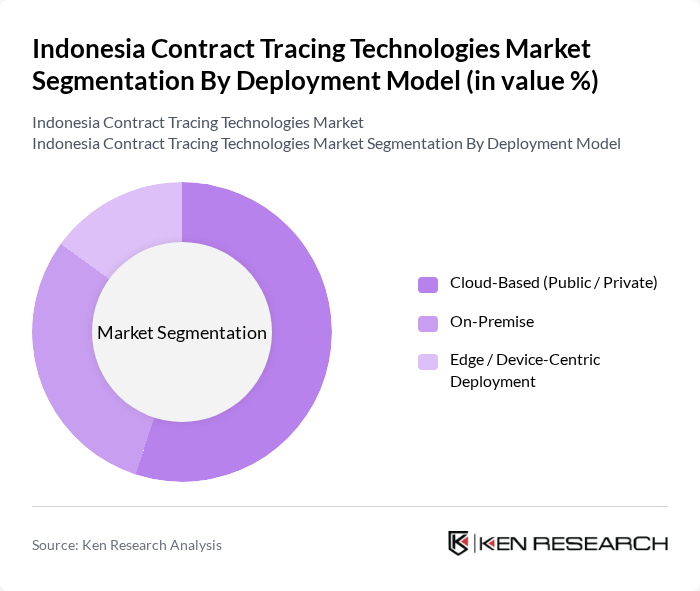
By Deployment Model:The deployment model segmentation encompasses various methods of implementing contact tracing technologies, including Cloud-Based (Public / Private), On-Premise, and Edge / Device-Centric Deployment.Cloud-Based solutions are particularly popular due to their scalability, ease of access, and alignment with broader IoT and digital health trends in Indonesia, allowing organizations and government agencies to deploy contact tracing and exposure notification applications quickly and efficiently without significant upfront investment in infrastructure.Edge and device‑centric deployments, including proximity wearables and on‑device analytics, are also emerging in high‑density workplaces and industrial settings to enable low‑latency risk monitoring while reducing continuous connectivity requirements.
Indonesia Contract Tracing Technologies Market Competitive Landscape
The Indonesia Contract Tracing Technologies Market is characterized by a dynamic mix of regional and international players.Leading participants such as PT GoTo Gojek Tokopedia Tbk (Gojek), PT Telekomunikasi Selular (Telkomsel), Grab Holdings Limited (Grab Indonesia), PT Media Dokter Investama (Halodok), PT Sumo Teknologi Solusi (Alodokter), Kementerian Kesehatan Republik Indonesia – Direktorat Jenderal Pencegahan dan Pengendalian Penyakit, PT Bio Farma (Persero), PT Indosat Tbk (Indosat Ooredoo Hutchison), Medigo Indonesia, PT Qlue Performa Indonesia (Qlue), Badan Penelitian dan Pengembangan Kesehatan (Balitbangkes) / Transformasi ke Badan Kebijakan Pembangunan Kesehatan, Aplikasi PeduliLindungi / SATUSEHAT Mobile (Kementerian Kesehatan RI), Aplikasi Cek COVID-19 (Inisiatif Pemerintah Daerah & Mitra Teknologi), Platform SatuSehat (Platform Integrasi Data Kesehatan Nasional), Smart Health & IoT-Based Contact Tracing Solution Providers (Berbasis Operator & Vendor Teknologi) contribute to innovation, geographic expansion, integration of contact tracing with broader digital health and immunization services, and service delivery in this space.
Indonesia Contract Tracing Technologies Market Industry Analysis
Growth Drivers
- Increased Government Initiatives:The Indonesian government has allocated approximately IDR 2.5 trillion (around USD 160 million) for health technology initiatives in future. This funding aims to enhance contract tracing capabilities, reflecting a commitment to public health. The government's proactive stance includes the development of digital health policies and frameworks, which are expected to improve the efficiency of contact tracing technologies. Such initiatives are crucial in managing health crises and ensuring a robust response to potential outbreaks.
- Rising Health Awareness:Health awareness in Indonesia has surged, with a reported 80% increase in public interest in health technologies since 2020. This trend is driven by the COVID-19 pandemic, which has heightened the population's understanding of disease transmission and prevention. As a result, more individuals are utilizing contract tracing applications, leading to a significant rise in user engagement. This growing awareness is expected to further stimulate demand for innovative health solutions in future.
- Technological Advancements:The Indonesian tech sector is projected to grow by IDR 300 trillion (approximately USD 20.2 billion) in future, driven by advancements in mobile technology and data analytics. These innovations facilitate the development of more effective contract tracing applications, enabling real-time data collection and analysis. Enhanced technologies, such as AI and machine learning, are being integrated into health solutions, improving their accuracy and efficiency. This technological evolution is vital for the future of public health management in Indonesia.
Market Challenges
- Data Privacy Concerns:Data privacy remains a significant challenge in Indonesia, with 60% of citizens expressing concerns over personal data security in health applications. The lack of robust data protection laws has led to hesitance in adopting contract tracing technologies. As the government works to establish clearer regulations, the public's trust in these technologies is crucial for their widespread acceptance and effectiveness in managing health crises.
- Limited Public Trust:Public trust in government-led health initiatives is low, with only 50% of Indonesians believing that contact tracing apps are effective. This skepticism stems from past experiences with data misuse and inadequate transparency. Building trust is essential for the successful implementation of contract tracing technologies, as user participation is critical for their effectiveness in controlling disease spread and ensuring public health safety.
Indonesia Contract Tracing Technologies Market Future Outlook
The future of contract tracing technologies in Indonesia appears promising, driven by ongoing government support and increasing public health awareness. As digital health solutions expand, the integration of advanced technologies like AI will enhance the effectiveness of these applications. Furthermore, collaboration between health authorities and tech companies is expected to foster innovation, leading to more user-friendly solutions. This collaborative approach will likely address existing challenges, paving the way for a more resilient public health infrastructure in Indonesia.
Market Opportunities
- Expansion of Digital Health Solutions:The digital health market in Indonesia is projected to reach IDR 70 trillion (approximately USD 4.7 billion) by future. This growth presents opportunities for contract tracing technologies to integrate with broader health solutions, enhancing their utility and user engagement. By leveraging this expansion, developers can create comprehensive health management systems that include contract tracing as a core feature.
- Partnerships with Tech Companies:Collaborations between health authorities and technology firms are expected to increase, with an estimated 50% rise in joint ventures by future. These partnerships can facilitate the development of innovative contract tracing solutions, combining expertise in health and technology. Such collaborations will enhance the capabilities of tracing applications, making them more effective in real-time data collection and analysis.
Scope of the Report
| Segment | Sub-Segments |
|---|---|
| By Solution Type | Decentralized App-Based Solutions (DP?3T, GAEN, Bluetooth LE) Centralized Server-Based Solutions Hybrid Contact Tracing Platforms Integrated Digital Health & Tracing Suites Analytics & Dashboard / Command-Center Tools |
| By Deployment Model | Cloud-Based (Public / Private) On-Premise Edge / Device-Centric Deployment |
| By Proximity & Data Collection Technology | Bluetooth Low Energy (BLE) GPS / GNSS Location Tracking QR Code / Check-In Based Systems Cellular Network & Wi?Fi Based Location NFC & Other Short-Range Technologies |
| By Application Use Case | Community & Public Health Contact Tracing Workplace & Corporate Exposure Management Travel, Events, and Venue Access Management Digital Health Passes, Screening & Compliance Analytics for Outbreak Detection & Response Planning |
| By End-User | National & Local Government Health Authorities Public and Private Healthcare Providers Large Enterprises & Industrial Facilities Transport, Retail, Hospitality & Tourism Operators Educational Institutions & Public Venues |
| By Revenue Model | Government-Funded / Public Sector Contracts Subscription (SaaS) Licenses Per?Seat / Per?Facility Enterprise Licensing Implementation, Integration & Managed Services Data & Analytics Monetization |
| By Region | Java (Including Jakarta, West Java, Central Java, East Java, Banten, DI Yogyakarta) Sumatra Kalimantan Sulawesi Bali & Nusa Tenggara Maluku & Papua |
Key Target Audience
Investors and Venture Capitalist Firms
Government and Regulatory Bodies (e.g., Ministry of Health, Ministry of Communication and Information Technology)
Healthcare Providers and Institutions
Telecommunication Companies
Technology Providers and Software Developers
Public Health Organizations
Local Government Authorities
Insurance Companies
Players Mentioned in the Report:
PT GoTo Gojek Tokopedia Tbk (Gojek)
PT Telekomunikasi Selular (Telkomsel)
Grab Holdings Limited (Grab Indonesia)
PT Media Dokter Investama (Halodoc)
PT Sumo Teknologi Solusi (Alodokter)
Kementerian Kesehatan Republik Indonesia Direktorat Jenderal Pencegahan dan Pengendalian Penyakit
PT Bio Farma (Persero)
PT Indosat Tbk (Indosat Ooredoo Hutchison)
Medigo Indonesia
PT Qlue Performa Indonesia (Qlue)
Badan Penelitian dan Pengembangan Kesehatan (Balitbangkes) / Transformasi ke Badan Kebijakan Pembangunan Kesehatan
Aplikasi PeduliLindungi / SATUSEHAT Mobile (Kementerian Kesehatan RI)
Aplikasi Cek COVID-19 (Inisiatif Pemerintah Daerah & Mitra Teknologi)
Platform SatuSehat (Platform Integrasi Data Kesehatan Nasional)
Smart Health & IoT-Based Contact Tracing Solution Providers (Berbasis Operator & Vendor Teknologi)
Table of Contents
Market Assessment Phase
1. Executive Summary and Approach
2. Indonesia Contract Tracing Technologies Market Overview
2.1 Key Insights and Strategic Recommendations
2.2 Indonesia Contract Tracing Technologies Market Overview
2.3 Definition and Scope
2.4 Evolution of Market Ecosystem
2.5 Timeline of Key Regulatory Milestones
2.6 Value Chain & Stakeholder Mapping
2.7 Business Cycle Analysis
2.8 Policy & Incentive Landscape
3. Indonesia Contract Tracing Technologies Market Analysis
3.1 Growth Drivers
3.1.1 Increased Government Initiatives
3.1.2 Rising Health Awareness
3.1.3 Technological Advancements
3.1.4 Demand for Real-Time Data
3.2 Market Challenges
3.2.1 Data Privacy Concerns
3.2.2 Limited Public Trust
3.2.3 Infrastructure Limitations
3.2.4 Regulatory Compliance Issues
3.3 Market Opportunities
3.3.1 Expansion of Digital Health Solutions
3.3.2 Partnerships with Tech Companies
3.3.3 Integration with National Health Systems
3.3.4 Development of User-Friendly Applications
3.4 Market Trends
3.4.1 Increased Use of AI and Machine Learning
3.4.2 Growth of Mobile Health Applications
3.4.3 Focus on User-Centric Design
3.4.4 Enhanced Data Analytics Capabilities
3.5 Government Regulation
3.5.1 Data Protection Laws
3.5.2 Health Emergency Regulations
3.5.3 Technology Standards for Health Apps
3.5.4 Public Health Policy Frameworks
4. SWOT Analysis
5. Stakeholder Analysis
6. Porter's Five Forces Analysis
7. Indonesia Contract Tracing Technologies Market Market Size, 2019-2024
7.1 By Value
7.2 By Volume
7.3 By Average Selling Price
8. Indonesia Contract Tracing Technologies Market Segmentation
8.1 By Solution Type
8.1.1 Decentralized App-Based Solutions (DP?3T, GAEN, Bluetooth LE)
8.1.2 Centralized Server-Based Solutions
8.1.3 Hybrid Contact Tracing Platforms
8.1.4 Integrated Digital Health & Tracing Suites
8.1.5 Analytics & Dashboard / Command-Center Tools
8.2 By Deployment Model
8.2.1 Cloud-Based (Public / Private)
8.2.2 On-Premise
8.2.3 Edge / Device-Centric Deployment
8.3 By Proximity & Data Collection Technology
8.3.1 Bluetooth Low Energy (BLE)
8.3.2 GPS / GNSS Location Tracking
8.3.3 QR Code / Check-In Based Systems
8.3.4 Cellular Network & Wi?Fi Based Location
8.3.5 NFC & Other Short-Range Technologies
8.4 By Application Use Case
8.4.1 Community & Public Health Contact Tracing
8.4.2 Workplace & Corporate Exposure Management
8.4.3 Travel, Events, and Venue Access Management
8.4.4 Digital Health Passes, Screening & Compliance
8.4.5 Analytics for Outbreak Detection & Response Planning
8.5 By End-User
8.5.1 National & Local Government Health Authorities
8.5.2 Public and Private Healthcare Providers
8.5.3 Large Enterprises & Industrial Facilities
8.5.4 Transport, Retail, Hospitality & Tourism Operators
8.5.5 Educational Institutions & Public Venues
8.6 By Revenue Model
8.6.1 Government-Funded / Public Sector Contracts
8.6.2 Subscription (SaaS) Licenses
8.6.3 Per?Seat / Per?Facility Enterprise Licensing
8.6.4 Implementation, Integration & Managed Services
8.6.5 Data & Analytics Monetization
8.7 By Region
8.7.1 Java (Including Jakarta, West Java, Central Java, East Java, Banten, DI Yogyakarta)
8.7.2 Sumatra
8.7.3 Kalimantan
8.7.4 Sulawesi
8.7.5 Bali & Nusa Tenggara
8.7.6 Maluku & Papua
9. Indonesia Contract Tracing Technologies Market Competitive Analysis
9.1 Market Share of Key Players
9.2 Cross Comparison of Key Players
9.2.1 Company Name
9.2.2 Group Size (Large, Medium, or Small as per industry convention)
9.2.3 Annual Recurring Revenue (ARR) from Contact Tracing Solutions
9.2.4 Year-on-Year Revenue Growth (%)
9.2.5 Customer Acquisition Cost (CAC) per Active Organization
9.2.6 Customer Lifetime Value (CLV)
9.2.7 Active Monthly Users / Registrations
9.2.8 Daily Active Users (DAU) / Monthly Active Users (MAU) Ratio
9.2.9 Churn Rate (% of Organizations / Users per Year)
9.2.10 Average Revenue per User (ARPU)
9.2.11 Average Contract Tenure (Months)
9.2.12 Gross Margin (%) on Software & Services
9.2.13 R&D Spend as % of Revenue
9.2.14 Implementation Time per Deployment (Days)
9.2.15 Uptime / Service Availability (%)
9.3 SWOT Analysis of Top Players
9.4 Pricing Analysis
9.5 Detailed Profile of Major Companies
9.5.1 PT GoTo Gojek Tokopedia Tbk (Gojek)
9.5.2 PT Telekomunikasi Selular (Telkomsel)
9.5.3 Grab Holdings Limited (Grab Indonesia)
9.5.4 PT Media Dokter Investama (Halodoc)
9.5.5 PT Sumo Teknologi Solusi (Alodokter)
9.5.6 Kementerian Kesehatan Republik Indonesia – Direktorat Jenderal Pencegahan dan Pengendalian Penyakit
9.5.7 PT Bio Farma (Persero)
9.5.8 PT Indosat Tbk (Indosat Ooredoo Hutchison)
9.5.9 Medigo Indonesia
9.5.10 PT Qlue Performa Indonesia (Qlue)
9.5.11 Badan Penelitian dan Pengembangan Kesehatan (Balitbangkes) / Transformasi ke Badan Kebijakan Pembangunan Kesehatan
9.5.12 Aplikasi PeduliLindungi / SATUSEHAT Mobile (Kementerian Kesehatan RI)
9.5.13 Aplikasi Cek COVID-19 (Inisiatif Pemerintah Daerah & Mitra Teknologi)
9.5.14 Platform SatuSehat (Platform Integrasi Data Kesehatan Nasional)
9.5.15 Smart Health & IoT-Based Contact Tracing Solution Providers (Berbasis Operator & Vendor Teknologi)
10. Indonesia Contract Tracing Technologies Market End-User Analysis
10.1 Procurement Behavior of Key Ministries
10.1.1 Ministry of Health
10.1.2 Ministry of Communication and Information
10.1.3 Ministry of Home Affairs
10.1.4 Ministry of Education and Culture
10.2 Corporate Spend on Infrastructure & Energy
10.2.1 Investment in Digital Health Infrastructure
10.2.2 Budget Allocation for Technology Upgrades
10.2.3 Spending on Training and Development
10.2.4 Expenditure on Compliance and Regulation
10.3 Pain Point Analysis by End-User Category
10.3.1 Healthcare Providers
10.3.2 Government Agencies
10.3.3 Corporates
10.3.4 Educational Institutions
10.4 User Readiness for Adoption
10.4.1 Awareness Levels
10.4.2 Training Needs
10.4.3 Technology Accessibility
10.4.4 Support Systems
10.5 Post-Deployment ROI and Use Case Expansion
10.5.1 Measurement of Effectiveness
10.5.2 User Feedback Mechanisms
10.5.3 Scalability of Solutions
10.5.4 Future Use Cases
11. Indonesia Contract Tracing Technologies Market Future Size, 2025-2030
11.1 By Value
11.2 By Volume
11.3 By Average Selling Price
Go-To-Market Strategy Phase
1. Whitespace Analysis + Business Model Canvas
1.1 Market Gaps Identification
1.2 Value Proposition Development
1.3 Revenue Streams
1.4 Cost Structure Analysis
1.5 Key Partnerships
1.6 Customer Segments
1.7 Channels
2. Marketing and Positioning Recommendations
2.1 Branding Strategies
2.2 Product USPs
3. Distribution Plan
3.1 Urban Retail vs Rural NGO Tie-Ups
4. Channel & Pricing Gaps
4.1 Underserved Routes
4.2 Pricing Bands
5. Unmet Demand & Latent Needs
5.1 Category Gaps
5.2 Consumer Segments
6. Customer Relationship
6.1 Loyalty Programs
6.2 After-Sales Service
7. Value Proposition
7.1 Sustainability
7.2 Integrated Supply Chains
8. Key Activities
8.1 Regulatory Compliance
8.2 Branding
8.3 Distribution Setup
9. Entry Strategy Evaluation
9.1 Domestic Market Entry Strategy
9.1.1 Product Mix
9.1.2 Pricing Band
9.1.3 Packaging
9.2 Export Entry Strategy
9.2.1 Target Countries
9.2.2 Compliance Roadmap
10. Entry Mode Assessment
10.1 JV
10.2 Greenfield
10.3 M&A
10.4 Distributor Model
11. Capital and Timeline Estimation
11.1 Capital Requirements
11.2 Timelines
12. Control vs Risk Trade-Off
12.1 Ownership vs Partnerships
13. Profitability Outlook
13.1 Breakeven Analysis
13.2 Long-Term Sustainability
14. Potential Partner List
14.1 Distributors
14.2 JVs
14.3 Acquisition Targets
15. Execution Roadmap
15.1 Phased Plan for Market Entry
15.1.1 Market Setup
15.1.2 Market Entry
15.1.3 Growth Acceleration
15.1.4 Scale & Stabilize
15.2 Key Activities and Milestones
15.2.1 Milestone Planning
15.2.2 Activity Tracking
Research Methodology
Phase 1: Approach1
Desk Research
- Analysis of government publications on health and technology initiatives in Indonesia
- Review of academic journals and white papers on contract tracing technologies
- Examination of industry reports from health organizations and technology firms
Primary Research
- Interviews with public health officials involved in contract tracing implementation
- Surveys with technology providers specializing in health tech solutions
- Focus groups with end-users, including healthcare professionals and citizens
Validation & Triangulation
- Cross-validation of findings through multiple data sources, including government and private sector
- Triangulation of qualitative insights from interviews with quantitative data from surveys
- Sanity checks conducted through expert panel reviews and feedback sessions
Phase 2: Market Size Estimation1
Top-down Assessment
- Estimation of market size based on national health expenditure and technology adoption rates
- Segmentation by technology type, including mobile apps, wearables, and software solutions
- Incorporation of government health initiatives and funding allocations for contract tracing
Bottom-up Modeling
- Data collection from leading technology providers on sales volumes and pricing structures
- Estimation of user adoption rates based on demographic and geographic factors
- Volume x cost analysis for different contract tracing technologies deployed
Forecasting & Scenario Analysis
- Multi-factor regression analysis incorporating COVID-19 trends and public health policies
- Scenario modeling based on varying levels of technology adoption and regulatory support
- Baseline, optimistic, and pessimistic projections through 2028
Phase 3: CATI Sample Composition1
| Scope Item/Segment | Sample Size | Target Respondent Profiles |
|---|---|---|
| Government Health Officials | 60 | Health Policy Makers, Epidemiologists |
| Technology Providers | 50 | Product Managers, Business Development Executives |
| Healthcare Professionals | 80 | Doctors, Nurses, Public Health Workers |
| End-Users of Contract Tracing Apps | 100 | General Public, Tech-Savvy Users |
| Academic Researchers | 40 | Health Technology Researchers, Data Analysts |
Frequently Asked Questions
What is the current value of the Indonesia Contract Tracing Technologies Market?
The Indonesia Contract Tracing Technologies Market is valued at approximately USD 65 million, driven by the increasing adoption of digital health solutions and government initiatives aimed at enhancing public health infrastructure and disease monitoring capabilities.
What are the key drivers of growth in the Indonesia Contract Tracing Technologies Market?
Which cities are leading in the adoption of contact tracing technologies in Indonesia?
What types of solutions are available in the Indonesia Contract Tracing Technologies Market?
Other Regional/Country Reports
Other Adjacent Reports
Qatar Digital Health Solutions Market
Global Telemedicine Market Report Size, Share, Growth Drivers, Trends, Opportunities & Forecast 2025–2030Kuwait Remote Monitoring Market
Brazil IoT Health Monitoring Market
Japan Mobile Health Applications Market
Thailand Cloud-Based Analytics Market
South Africa Proximity-Based Monitoring Market
Germany Public Health Infrastructure Market
UAE Data Integration Platforms Market
Qatar Wearable Technology Market Report Size Share Growth Drivers Trends Opportunities & Forecast 2025–2030Why Buy From Us?

What makes us stand out is that our consultants follow Robust, Refine and Result (RRR) methodology. Robust for clear definitions, approaches and sanity checking, Refine for differentiating respondents' facts and opinions, and Result for presenting data with story.

We have set a benchmark in the industry by offering our clients with syndicated and customized market research reports featuring coverage of entire market as well as meticulous research and analyst insights.

While we don't replace traditional research, we flip the method upside down. Our dual approach of Top Bottom & Bottom Top ensures quality deliverable by not just verifying company fundamentals but also looking at the sector and macroeconomic factors.

With one step in the future, our research team constantly tries to show you the bigger picture. We help with some of the tough questions you may encounter along the way: How is the industry positioned? Best marketing channel? KPI's of competitors? By aligning every element, we help maximize success.

Our report gives you instant access to the answers and sources that other companies might choose to hide. We elaborate each steps of research methodology we have used and showcase you the sample size to earn your trust.

If you need any support, we are here! We pride ourselves on universe strength, data quality, and quick, friendly, and professional service.