About the Report
Base Year 2024Bahrain Contract Tracing Technologies Market Overview
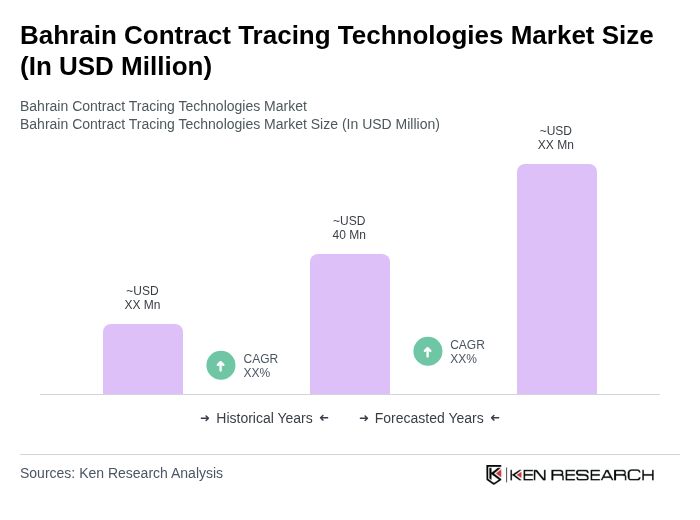
- The Bahrain Contract Tracing Technologies Market is valued at USD 40 million, based on a five-year historical analysis. This value is consistent with Bahrain’s broader ICT and digital health investments, where the national ICT market exceeds USD 3.5 billion and is supported by extensive 5G, cloud, and data infrastructure roll-outs that underpin digital public health and contact tracing solutions.This growth is primarily driven by the increasing need for effective public health measures, especially in response to the COVID-19 pandemic, which has heightened awareness of the importance of contact tracing technologies in managing outbreaks and ensuring public safety.
- Key demand centers for contact tracing and related digital health technologies include Manama, the capital city, which has been at the forefront of implementing e‑government and digital health solutions, alongside other major population centers such as Muharraq and Riffa. The dominance of these areas is attributed to their high population density, high mobile penetration, and the concentration of healthcare and government facilities, making them critical hubs for deploying effective contact tracing technologies and integrated digital public services.
- The regulatory environment for digital contact tracing in Bahrain is framed by national data protection and health regulations. The Personal Data Protection Law (Law No. 30 of 2018) issued by the Kingdom of Bahrain establishes requirements for lawful processing of personal data, consent, purpose limitation, and data security, which apply to digital contact tracing applications handling health and location data.In addition, the Ministry of Health’s COVID‑19 response measures, including the nationally deployed BeAware Bahrain app, have set operational requirements for digital contact tracing and quarantine monitoring in coordination with health authorities.
Bahrain Contract Tracing Technologies Market Segmentation
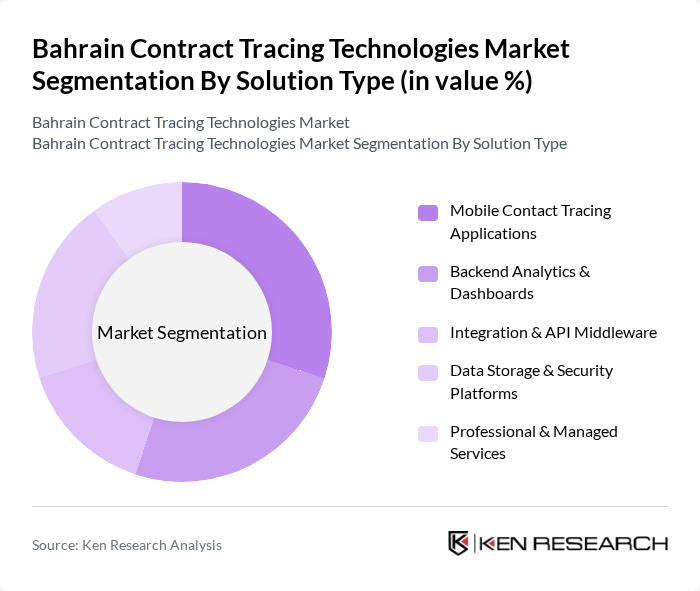
By Solution Type:The market is segmented into various solution types, including mobile contact tracing applications, backend analytics & dashboards, integration & API middleware, data storage & security platforms, and professional & managed services. Each of these segments plays a crucial role in the overall functionality and effectiveness of contact tracing technologies, with strong reliance on Bahrain’s advanced telecom, cloud, and managed security capabilities to support secure data exchange, analytics, and scalable deployments.
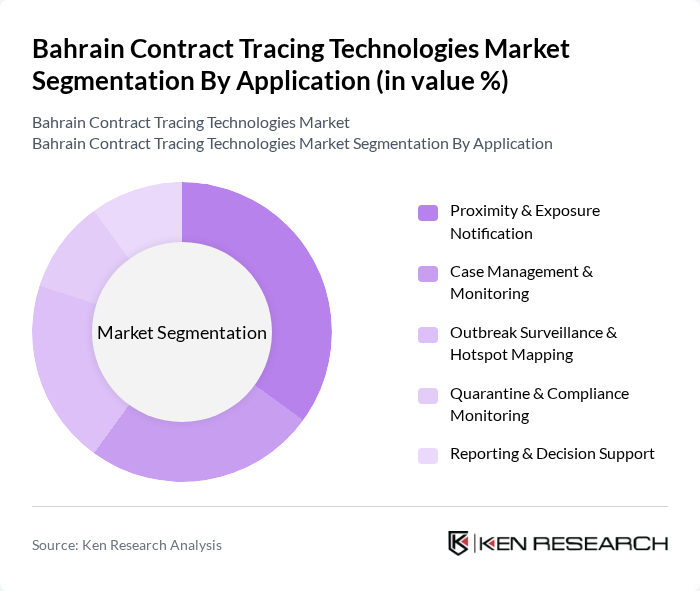
By Application:The applications of contact tracing technologies include proximity & exposure notification, case management & monitoring, outbreak surveillance & hotspot mapping, quarantine & compliance monitoring, and reporting & decision support. These applications are essential for ensuring effective tracking and management of health-related data, leveraging high mobile connection penetration, cloud-based analytics, and integrated ICT infrastructure to support real-time monitoring, early outbreak detection, and informed policy decision-making.
Bahrain Contract Tracing Technologies Market Competitive Landscape
The Bahrain Contract Tracing Technologies Market is characterized by a dynamic mix of regional and international players. Leading participants such as BeAware Bahrain (National Contact Tracing Platform), stc Bahrain, Bahrain Telecommunications Company (Batelco), Zain Bahrain, BNET (Bahrain Network), Gulf Business Machines (GBM), Microsoft, Oracle, Huawei Technologies, Cisco Systems, IBM, SAP, Amazon Web Services (AWS), Google Cloud, Local Health-Tech and System Integrator Partners contribute to innovation, geographic expansion, and service delivery in this space, supported by Bahrain’s strong telecom backbone and rapidly growing ICT market.
Bahrain Contract Tracing Technologies Market Industry Analysis
Growth Drivers
- Increased Demand for Public Health Safety:The COVID-19 pandemic has heightened the focus on public health safety, leading to a surge in demand for contract tracing technologies. In Bahrain, the health expenditure reached approximately BHD 1.4 billion in future, reflecting a 16.67% increase from the previous year. This investment underscores the government's commitment to enhancing public health infrastructure, driving the adoption of digital solutions that ensure safety and mitigate health risks effectively.
- Government Initiatives for Digital Health Solutions:The Bahraini government has launched several initiatives to promote digital health solutions, allocating BHD 600 million for health technology advancements in future. These initiatives aim to integrate contract tracing technologies into the national health strategy, enhancing the efficiency of health services. Such government backing not only fosters innovation but also encourages private sector participation, creating a robust ecosystem for health tech development.
- Rising Smartphone Penetration:With smartphone penetration in Bahrain reaching 98% in future, the accessibility of mobile applications for contract tracing has significantly improved. This high penetration rate facilitates the widespread adoption of digital health solutions, as more citizens can utilize these technologies. The increasing reliance on smartphones for daily activities further supports the growth of contract tracing technologies, making them an integral part of public health strategies.
Market Challenges
- Privacy Concerns Among Users:Privacy issues remain a significant challenge in the adoption of contract tracing technologies. A survey conducted in future indicated that 62% of Bahraini citizens expressed concerns about data privacy and security. These apprehensions can hinder user engagement and trust in digital health solutions, ultimately affecting the effectiveness of contract tracing efforts. Addressing these concerns is crucial for fostering public confidence and ensuring widespread adoption.
- Integration with Existing Health Systems:The integration of contract tracing technologies with existing health systems poses a considerable challenge. In Bahrain, the healthcare sector comprises over 220 facilities, many of which operate on legacy systems. The lack of interoperability can lead to inefficiencies and data silos, complicating the implementation of new technologies. Overcoming these integration hurdles is essential for maximizing the potential of contract tracing solutions in public health management.
Bahrain Contract Tracing Technologies Market Future Outlook
The future of contract tracing technologies in Bahrain appears promising, driven by ongoing government support and technological advancements. As the healthcare sector increasingly embraces digital transformation, innovations such as AI and blockchain are expected to enhance data security and user experience. Furthermore, the growing emphasis on decentralized data management will likely reshape how health data is collected and utilized, fostering a more resilient public health infrastructure that can respond effectively to future health crises.
Market Opportunities
- Expansion into Regional Markets:Bahrain's strategic location offers opportunities for contract tracing technology providers to expand into neighboring Gulf Cooperation Council (GCC) markets. With a combined population of over 55 million, these markets present significant growth potential, especially as regional governments prioritize digital health solutions to enhance public safety and health management.
- Partnerships with Healthcare Providers:Collaborating with local healthcare providers can create synergies that enhance the effectiveness of contract tracing technologies. By leveraging existing networks and expertise, technology firms can develop tailored solutions that address specific health challenges in Bahrain, ultimately improving public health outcomes and driving adoption rates.
Scope of the Report
| Segment | Sub-Segments |
|---|---|
| By Solution Type | Mobile Contact Tracing Applications Backend Analytics & Dashboards Integration & API Middleware Data Storage & Security Platforms Professional & Managed Services |
| By Application | Proximity & Exposure Notification Case Management & Monitoring Outbreak Surveillance & Hotspot Mapping Quarantine & Compliance Monitoring Reporting & Decision Support |
| By Deployment Model | On-Premise Public Cloud Private Cloud Hybrid |
| By Technology | Bluetooth Low Energy (BLE) Based GPS / Location-Based QR Code / Check-in Based Network-Based (Cell-ID, Wi-Fi) Others |
| By End-User | Public Health Authorities & Government Agencies Hospitals & Healthcare Providers Enterprises & Workplaces Educational Institutions Transportation & Public Venues |
| By Enterprise Size | Large Enterprises Small & Medium Enterprises (SMEs) |
| By Deployment Environment | Public Sector Programs Private Sector Implementations Public–Private Partnership (PPP) Initiatives |
Key Target Audience
Investors and Venture Capitalist Firms
Government and Regulatory Bodies (e.g., Ministry of Health, Telecommunications Regulatory Authority)
Healthcare Providers and Institutions
Technology Providers and Software Developers
Telecommunications Companies
Public Health Organizations
Data Privacy and Cybersecurity Firms
Local Municipalities and Government Agencies
Players Mentioned in the Report:
BeAware Bahrain (National Contact Tracing Platform)
stc Bahrain
Bahrain Telecommunications Company (Batelco)
Zain Bahrain
BNET (Bahrain Network)
Gulf Business Machines (GBM)
Microsoft
Oracle
Huawei Technologies
Cisco Systems
IBM
SAP
Amazon Web Services (AWS)
Google Cloud
Local Health-Tech and System Integrator Partners
Table of Contents
Market Assessment Phase
1. Executive Summary and Approach
2. Bahrain Contract Tracing Technologies Market Overview
2.1 Key Insights and Strategic Recommendations
2.2 Bahrain Contract Tracing Technologies Market Overview
2.3 Definition and Scope
2.4 Evolution of Market Ecosystem
2.5 Timeline of Key Regulatory Milestones
2.6 Value Chain & Stakeholder Mapping
2.7 Business Cycle Analysis
2.8 Policy & Incentive Landscape
3. Bahrain Contract Tracing Technologies Market Analysis
3.1 Growth Drivers
3.1.1 Increased demand for public health safety
3.1.2 Government initiatives for digital health solutions
3.1.3 Rising smartphone penetration
3.1.4 Enhanced data analytics capabilities
3.2 Market Challenges
3.2.1 Privacy concerns among users
3.2.2 Integration with existing health systems
3.2.3 Limited public awareness and adoption
3.2.4 Regulatory compliance issues
3.3 Market Opportunities
3.3.1 Expansion into regional markets
3.3.2 Partnerships with healthcare providers
3.3.3 Development of advanced features (e.g., AI)
3.3.4 Government funding for health tech innovations
3.4 Market Trends
3.4.1 Shift towards decentralized data management
3.4.2 Increased focus on user-friendly interfaces
3.4.3 Adoption of blockchain for data security
3.4.4 Growth in telehealth and remote monitoring
3.5 Government Regulation
3.5.1 Data protection laws
3.5.2 Health technology assessment guidelines
3.5.3 Mandatory reporting of COVID-19 cases
3.5.4 Standards for interoperability
4. SWOT Analysis
5. Stakeholder Analysis
6. Porter's Five Forces Analysis
7. Bahrain Contract Tracing Technologies Market Market Size, 2019-2024
7.1 By Value
7.2 By Volume
7.3 By Average Selling Price
8. Bahrain Contract Tracing Technologies Market Segmentation
8.1 By Solution Type
8.1.1 Mobile Contact Tracing Applications
8.1.2 Backend Analytics & Dashboards
8.1.3 Integration & API Middleware
8.1.4 Data Storage & Security Platforms
8.1.5 Professional & Managed Services
8.2 By Application
8.2.1 Proximity & Exposure Notification
8.2.2 Case Management & Monitoring
8.2.3 Outbreak Surveillance & Hotspot Mapping
8.2.4 Quarantine & Compliance Monitoring
8.2.5 Reporting & Decision Support
8.3 By Deployment Model
8.3.1 On-Premise
8.3.2 Public Cloud
8.3.3 Private Cloud
8.3.4 Hybrid
8.4 By Technology
8.4.1 Bluetooth Low Energy (BLE) Based
8.4.2 GPS / Location-Based
8.4.3 QR Code / Check-in Based
8.4.4 Network-Based (Cell-ID, Wi-Fi)
8.4.5 Others
8.5 By End-User
8.5.1 Public Health Authorities & Government Agencies
8.5.2 Hospitals & Healthcare Providers
8.5.3 Enterprises & Workplaces
8.5.4 Educational Institutions
8.5.5 Transportation & Public Venues
8.6 By Enterprise Size
8.6.1 Large Enterprises
8.6.2 Small & Medium Enterprises (SMEs)
8.7 By Deployment Environment
8.7.1 Public Sector Programs
8.7.2 Private Sector Implementations
8.7.3 Public–Private Partnership (PPP) Initiatives
9. Bahrain Contract Tracing Technologies Market Competitive Analysis
9.1 Market Share of Key Players
9.2 Cross Comparison of Key Players
9.2.1 Company Name
9.2.2 Organization Size (Large, Medium, Small)
9.2.3 Annual Recurring Revenue from Contact Tracing (USD)
9.2.4 Active Users / Deployments (Number)
9.2.5 Customer Acquisition Cost (CAC)
9.2.6 Customer Retention / Renewal Rate (%)
9.2.7 Average Revenue Per User / Deployment (ARPU)
9.2.8 Market Share in Bahrain Contact Tracing Segment (%)
9.2.9 Year-on-Year Revenue Growth Rate (%)
9.2.10 EBITDA Margin (%)
9.2.11 Payback Period on Key Projects (Months)
9.2.12 R&D and Product Enhancement Spend (% of Revenue)
9.3 SWOT Analysis of Top Players
9.4 Pricing Analysis
9.5 Detailed Profile of Major Companies
9.5.1 BeAware Bahrain (National Contact Tracing Platform)
9.5.2 stc Bahrain
9.5.3 Bahrain Telecommunications Company (Batelco)
9.5.4 Zain Bahrain
9.5.5 BNET (Bahrain Network)
9.5.6 Gulf Business Machines (GBM)
9.5.7 Microsoft
9.5.8 Oracle
9.5.9 Huawei Technologies
9.5.10 Cisco Systems
9.5.11 IBM
9.5.12 SAP
9.5.13 Amazon Web Services (AWS)
9.5.14 Google Cloud
9.5.15 Local Health-Tech and System Integrator Partners
10. Bahrain Contract Tracing Technologies Market End-User Analysis
10.1 Procurement Behavior of Key Ministries
10.1.1 Ministry of Health
10.1.2 Ministry of Interior
10.1.3 Ministry of Education
10.1.4 Ministry of Information
10.2 Corporate Spend on Infrastructure & Energy
10.2.1 Healthcare Sector Investments
10.2.2 Technology Upgrades
10.2.3 Training and Development
10.2.4 Others
10.3 Pain Point Analysis by End-User Category
10.3.1 Healthcare Providers
10.3.2 Corporates
10.3.3 Educational Institutions
10.3.4 Government Agencies
10.4 User Readiness for Adoption
10.4.1 Awareness Levels
10.4.2 Training Needs
10.4.3 Technology Accessibility
10.4.4 Others
10.5 Post-Deployment ROI and Use Case Expansion
10.5.1 Performance Metrics
10.5.2 User Feedback
10.5.3 Scalability Potential
10.5.4 Others
11. Bahrain Contract Tracing Technologies Market Future Size, 2025-2030
11.1 By Value
11.2 By Volume
11.3 By Average Selling Price
Go-To-Market Strategy Phase
1. Whitespace Analysis + Business Model Canvas
1.1 Market Gaps Identification
1.2 Value Proposition Development
1.3 Revenue Streams
1.4 Cost Structure
1.5 Key Partnerships
1.6 Customer Segments
1.7 Channels
2. Marketing and Positioning Recommendations
2.1 Branding Strategies
2.2 Product USPs
3. Distribution Plan
3.1 Urban Retail vs Rural NGO Tie-ups
4. Channel & Pricing Gaps
4.1 Underserved Routes
4.2 Pricing Bands
5. Unmet Demand & Latent Needs
5.1 Category Gaps
5.2 Consumer Segments
6. Customer Relationship
6.1 Loyalty Programs
6.2 After-sales Service
7. Value Proposition
7.1 Sustainability
7.2 Integrated Supply Chains
8. Key Activities
8.1 Regulatory Compliance
8.2 Branding
8.3 Distribution Setup
9. Entry Strategy Evaluation
9.1 Domestic Market Entry Strategy
9.1.1 Product Mix
9.1.2 Pricing Band
9.1.3 Packaging
9.2 Export Entry Strategy
9.2.1 Target Countries
9.2.2 Compliance Roadmap
10. Entry Mode Assessment
10.1 JV
10.2 Greenfield
10.3 M&A
10.4 Distributor Model
11. Capital and Timeline Estimation
11.1 Capital Requirements
11.2 Timelines
12. Control vs Risk Trade-Off
12.1 Ownership vs Partnerships
13. Profitability Outlook
13.1 Breakeven Analysis
13.2 Long-term Sustainability
14. Potential Partner List
14.1 Distributors
14.2 JVs
14.3 Acquisition Targets
15. Execution Roadmap
15.1 Phased Plan for Market Entry
15.1.1 Market Setup
15.1.2 Market Entry
15.1.3 Growth Acceleration
15.1.4 Scale & Stabilize
15.2 Key Activities and Milestones
15.2.1 Milestone Planning
15.2.2 Activity Tracking
Research Methodology
Phase 1: Approach1
Desk Research
- Analysis of government publications and health ministry reports on contact tracing technologies
- Review of academic journals and white papers on the effectiveness of contact tracing applications
- Examination of market reports and industry analyses from local and regional technology firms
Primary Research
- Interviews with health officials and policymakers involved in the implementation of contact tracing
- Surveys with technology providers specializing in health tech solutions
- Focus groups with end-users to gather insights on user experience and technology adoption
Validation & Triangulation
- Cross-validation of findings through multiple data sources, including government and private sector reports
- Triangulation of qualitative insights from interviews with quantitative data from surveys
- Sanity checks through expert panel reviews comprising health tech specialists and market analysts
Phase 2: Market Size Estimation1
Top-down Assessment
- Estimation of market size based on national health expenditure and technology adoption rates
- Segmentation by user demographics, including age, location, and technology access
- Incorporation of government initiatives and funding for digital health solutions
Bottom-up Modeling
- Data collection from local technology firms on sales volumes and pricing strategies
- Estimation of user engagement metrics and app download statistics
- Volume x cost analysis based on projected user base growth and service fees
Forecasting & Scenario Analysis
- Multi-factor regression analysis incorporating COVID-19 trends and public health policies
- Scenario modeling based on varying levels of technology adoption and regulatory changes
- Baseline, optimistic, and pessimistic forecasts through 2025
Phase 3: CATI Sample Composition1
| Scope Item/Segment | Sample Size | Target Respondent Profiles |
|---|---|---|
| Government Health Officials | 60 | Health Policy Makers, Epidemiologists |
| Technology Providers | 50 | Product Managers, Software Developers |
| Healthcare Professionals | 50 | Doctors, Nurses, Public Health Workers |
| End-Users of Contact Tracing Apps | 70 | General Public, Tech-Savvy Users |
| Data Privacy Experts | 40 | Legal Advisors, Data Protection Officers |
Frequently Asked Questions
What is the current value of the Bahrain Contract Tracing Technologies Market?
The Bahrain Contract Tracing Technologies Market is valued at approximately USD 40 million, reflecting the country's significant investments in ICT and digital health, particularly in response to the COVID-19 pandemic and the need for effective public health measures.
What are the key demand centers for contact tracing technologies in Bahrain?
How does the regulatory environment affect contact tracing technologies in Bahrain?
What are the main solution types in the Bahrain Contract Tracing Technologies Market?
Other Regional/Country Reports
Other Adjacent Reports
Vietnam Mobile Health Market
Bahrain Public Health Surveillance Market
Qatar AI in Healthcare MarketJapan Blockchain in Healthcare Market
Brazil Telecommunications Market
Why Buy From Us?

What makes us stand out is that our consultants follow Robust, Refine and Result (RRR) methodology. Robust for clear definitions, approaches and sanity checking, Refine for differentiating respondents' facts and opinions, and Result for presenting data with story.

We have set a benchmark in the industry by offering our clients with syndicated and customized market research reports featuring coverage of entire market as well as meticulous research and analyst insights.

While we don't replace traditional research, we flip the method upside down. Our dual approach of Top Bottom & Bottom Top ensures quality deliverable by not just verifying company fundamentals but also looking at the sector and macroeconomic factors.

With one step in the future, our research team constantly tries to show you the bigger picture. We help with some of the tough questions you may encounter along the way: How is the industry positioned? Best marketing channel? KPI's of competitors? By aligning every element, we help maximize success.

Our report gives you instant access to the answers and sources that other companies might choose to hide. We elaborate each steps of research methodology we have used and showcase you the sample size to earn your trust.

If you need any support, we are here! We pride ourselves on universe strength, data quality, and quick, friendly, and professional service.