About the Report
Base Year 2024Philippines Contract Tracing Technologies Market Overview
- The Philippines Contract Tracing Technologies Market is valued at USD 25 million, based on a five-year historical analysis.This growth is primarily driven by the increasing need for effective public health measures in response to the COVID-19 pandemic, alongside the rising adoption of digital health solutions and connected healthcare platforms across various sectors.The market has seen a surge in demand for technologies that facilitate efficient contact tracing, real-time case reporting, digital check-in, and integrated outbreak management as part of broader digital health and connected care initiatives.
- Metro Manila, Cebu, and Davao are the dominant regions in the Philippines Contract Tracing Technologies Market.Metro Manila leads due to its high population density, urbanization, concentration of tertiary hospitals, and extensive commercial establishments, which necessitate advanced health monitoring and digital check-in solutions.Cebu and Davao follow closely, benefiting from their growing healthcare infrastructure, active local government units (LGUs), and government initiatives aimed at enhancing public health response capabilities, including the deployment of QR-based systems and LGU-managed platforms for case reporting and contact tracing.
- In response to the pandemic, the Philippine government rolled out multiple policy and operational measures mandating or strongly requiring establishments to implement contact tracing and digital log systems, anchored on statutory and administrative instruments such as Republic Act No. 11332 (Mandatory Reporting of Notifiable Diseases and Health Events of Public Health Concern Act, Department of Health, 2019) and subsequent Department of Health and Inter-Agency Task Force (IATF) issuances operationalizing digital contact tracing, data reporting, and standardized case notification protocols.These instruments require timely reporting of notifiable diseases, empower authorities to prescribe electronic information systems, and guide establishments and local governments in adopting interoperable digital platforms for case logging, QR-based entry systems, and integration with national surveillance tools such as COVID KAYA and StaySafe.

Philippines Contract Tracing Technologies Market Segmentation
By Solution Type:The solution type segmentation includes various technologies utilized for contact tracing. The subsegments are Mobile Contact Tracing Applications, QR Code / Venue Check-in Systems, Wearable / Token-Based Tracing Devices, Integrated Outbreak Management Platforms & Dashboards, SMS / USSD and IVR-Based Tracing Solutions, and Others.Among these, Mobile Contact Tracing Applications have emerged as the leading subsegment due to their accessibility and user-friendliness, allowing individuals to easily report and receive notifications about potential exposures through smartphones and app-based alerting.The widespread use of smartphones, growing familiarity with digital health apps, and integration of mobile tracing tools with QR venue check-in, vaccination records, and case reporting workflows have further propelled this segment, making it a preferred choice for both users and government agencies.

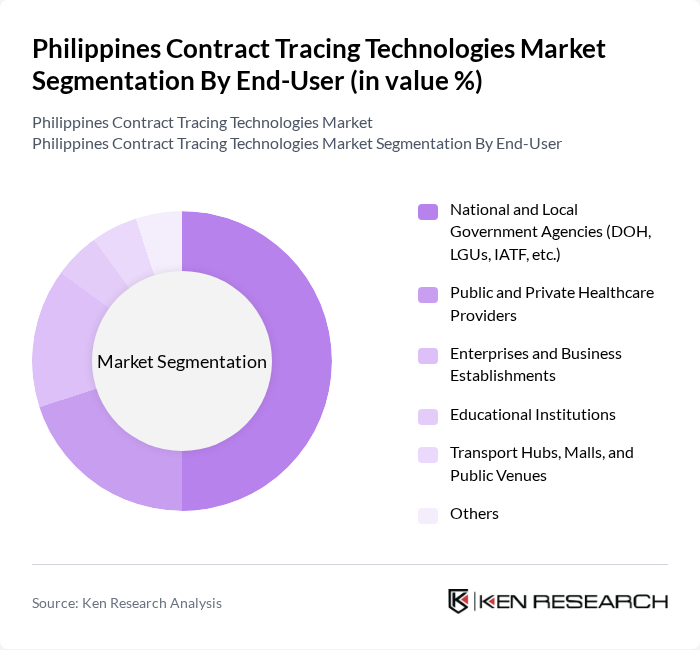
By End-User:The end-user segmentation encompasses various entities utilizing contact tracing technologies, including National and Local Government Agencies, Public and Private Healthcare Providers, Enterprises and Business Establishments, Educational Institutions, Transport Hubs, Malls, and Public Venues, and Others.National and Local Government Agencies are the dominant end-users, as they are responsible for implementing public health policies, managing surveillance systems, and coordinating outbreak response, including case investigation and contact tracing.Their need for comprehensive epidemiological data, integration with national reporting platforms (such as COVID KAYA and LGU dashboards), and effective communication tools to reach citizens and facilities drives the demand for advanced contact tracing and digital public health solutions.
Philippines Contract Tracing Technologies Market Competitive Landscape
The Philippines Contract Tracing Technologies Market is characterized by a dynamic mix of regional and international players.Leading participants such as StaySafe PH (StaySafe.ph), COVID KAYA (Department of Health – DOH), Traze Contact Tracing (Philippine Ports Authority & Partner Consortium), SafePass / SafePass PH (Amihan Global Strategies & Partners), Google Apple Exposure Notification (GAEN)-Based Solutions, Local Government Unit (LGU) Contact Tracing Platforms (e.g., PasigPass, Antipolo Bantay COVID-19), Integrated Hospital & Health Information System Providers (Philippine Market), Telecom-Led Contact Tracing and Mobility Analytics Solutions, QR-Based Venue and Establishment Check-in Solution Providers, Regional HealthTech and Digital Health Platform Providers Active in the Philippines, System Integrators Offering End-to-End Contact Tracing Implementations, Cybersecurity and Data Privacy Solution Providers Supporting Contact Tracing Platforms, Analytics and AI Vendors for Outbreak Prediction and Contact Network Analysis, Cloud and Infrastructure Service Providers Powering Contact Tracing Solutions, Emerging Startups and Local IT Firms in Digital Public Health & Contact Tracing contribute to innovation, geographic expansion, and service delivery in this space.
Philippines Contract Tracing Technologies Market Industry Analysis
Growth Drivers
- Increased Government Initiatives:The Philippine government allocated approximately PHP 2.5 billion (around USD 45 million) in future for the development and implementation of contact tracing technologies. This funding aims to enhance public health infrastructure and improve response times during health emergencies. With a focus on digital solutions, the government is actively promoting the adoption of technology to streamline contact tracing processes, thereby increasing efficiency and effectiveness in managing public health crises.
- Rising Public Health Awareness:Public health awareness in the Philippines has surged, with a reported 80% of the population now recognizing the importance of contact tracing in disease prevention. This heightened awareness is driven by ongoing health campaigns and educational programs, leading to increased public participation in contact tracing initiatives. As a result, the demand for effective contact tracing technologies is expected to rise, encouraging further investment in innovative solutions that cater to the needs of the population.
- Technological Advancements:The Philippines is witnessing rapid technological advancements, particularly in mobile application development and data analytics. In future, the mobile penetration rate is projected to reach 90%, facilitating the widespread adoption of contact tracing apps. Additionally, the integration of AI and machine learning technologies is enhancing the accuracy and efficiency of contact tracing efforts, allowing for real-time data analysis and improved response strategies in managing public health threats.
Market Challenges
- Data Privacy Concerns:Data privacy remains a significant challenge in the Philippines, with 75% of citizens expressing concerns over the security of personal information collected through contact tracing technologies. The implementation of stringent data protection laws is essential to address these concerns. Without robust privacy measures, public trust in contact tracing initiatives may decline, hindering the effectiveness of these technologies in managing health crises.
- Limited Public Trust:A survey conducted in early future indicated that only 50% of Filipinos trust government-led contact tracing initiatives. This lack of trust stems from previous data breaches and ineffective communication regarding the use of personal data. Building public confidence is crucial for the success of contact tracing technologies, as skepticism can lead to lower participation rates and ultimately compromise public health efforts.
Philippines Contract Tracing Technologies Market Future Outlook
The future of contact tracing technologies in the Philippines appears promising, driven by ongoing government support and technological innovations. As public health awareness continues to grow, the integration of contact tracing solutions with existing health systems will enhance their effectiveness. Furthermore, the expansion of these technologies into rural areas will ensure broader accessibility, ultimately improving the overall public health response. The focus on user-friendly applications will also play a critical role in increasing adoption rates among the population.
Market Opportunities
- Integration with Health Systems:There is a significant opportunity for contact tracing technologies to integrate seamlessly with existing health systems. This integration can enhance data sharing and improve response times during health emergencies, ultimately leading to better health outcomes. By collaborating with healthcare providers, technology developers can create solutions that are more effective and user-friendly.
- Expansion into Rural Areas:Expanding contact tracing technologies into rural areas presents a vital opportunity for improving public health. With approximately 40% of the population residing in these regions, tailored solutions can address unique challenges faced by rural communities. This expansion can enhance accessibility and ensure that all citizens benefit from effective contact tracing measures.
Scope of the Report
| Segment | Sub-Segments |
|---|---|
| By Solution Type | Mobile Contact Tracing Applications QR Code / Venue Check-in Systems Wearable / Token-Based Tracing Devices Integrated Outbreak Management Platforms & Dashboards SMS / USSD and IVR-Based Tracing Solutions Others |
| By End-User | National and Local Government Agencies (DOH, LGUs, IATF, etc.) Public and Private Healthcare Providers Enterprises and Business Establishments Educational Institutions Transport Hubs, Malls, and Public Venues Others |
| By Deployment Model | Cloud / SaaS Deployment On-Premises Deployment Hybrid Deployment Others |
| By Underlying Technology | Bluetooth Low Energy (BLE) Proximity Tracing GPS / Location-Based Tracing QR Code and Barcode-Based Check-In Cell-Tower and Network-Based Tracing Others |
| By Application | Individual Exposure Notification Case Investigation and Contact Follow-Up Workplace and Community Outbreak Management Border, Travel, and Event Screening Analytics, Reporting, and Policy Planning Others |
| By Region (Philippines) | Luzon Visayas Mindanao Others (Special Economic Zones / Highly Urbanized Cities) |
| By Data Governance & Privacy Model | Centralized Data Architecture Decentralized / Privacy-Preserving Architecture Hybrid Models Others |
Key Target Audience
Investors and Venture Capitalist Firms
Government and Regulatory Bodies (e.g., Department of Health, Department of Information and Communications Technology)
Healthcare Providers and Institutions
Telecommunications Companies
Technology Providers and Software Developers
Local Government Units (LGUs)
Public Health Organizations
Insurance Companies
Players Mentioned in the Report:
StaySafe PH (StaySafe.ph)
COVID KAYA (Department of Health DOH)
Traze Contact Tracing (Philippine Ports Authority & Partner Consortium)
SafePass / SafePass PH (Amihan Global Strategies & Partners)
Google Apple Exposure Notification (GAEN)-Based Solutions
Local Government Unit (LGU) Contact Tracing Platforms (e.g., PasigPass, Antipolo Bantay COVID-19)
Integrated Hospital & Health Information System Providers (Philippine Market)
Telecom-Led Contact Tracing and Mobility Analytics Solutions
QR-Based Venue and Establishment Check-in Solution Providers
Regional HealthTech and Digital Health Platform Providers Active in the Philippines
System Integrators Offering End-to-End Contact Tracing Implementations
Cybersecurity and Data Privacy Solution Providers Supporting Contact Tracing Platforms
Analytics and AI Vendors for Outbreak Prediction and Contact Network Analysis
Cloud and Infrastructure Service Providers Powering Contact Tracing Solutions
Emerging Startups and Local IT Firms in Digital Public Health & Contact Tracing
Table of Contents
Market Assessment Phase
1. Executive Summary and Approach
2. Philippines Contract Tracing Technologies Market Overview
2.1 Key Insights and Strategic Recommendations
2.2 Philippines Contract Tracing Technologies Market Overview
2.3 Definition and Scope
2.4 Evolution of Market Ecosystem
2.5 Timeline of Key Regulatory Milestones
2.6 Value Chain & Stakeholder Mapping
2.7 Business Cycle Analysis
2.8 Policy & Incentive Landscape
3. Philippines Contract Tracing Technologies Market Analysis
3.1 Growth Drivers
3.1.1 Increased Government Initiatives
3.1.2 Rising Public Health Awareness
3.1.3 Technological Advancements
3.1.4 Demand for Efficient Contact Tracing Solutions
3.2 Market Challenges
3.2.1 Data Privacy Concerns
3.2.2 Limited Public Trust
3.2.3 High Implementation Costs
3.2.4 Fragmented Market Players
3.3 Market Opportunities
3.3.1 Integration with Health Systems
3.3.2 Expansion into Rural Areas
3.3.3 Partnerships with Tech Companies
3.3.4 Development of User-Friendly Applications
3.4 Market Trends
3.4.1 Increased Use of Mobile Applications
3.4.2 Adoption of AI and Machine Learning
3.4.3 Focus on Interoperability
3.4.4 Shift Towards Decentralized Solutions
3.5 Government Regulation
3.5.1 Data Protection Laws
3.5.2 Health Emergency Declarations
3.5.3 Guidelines for Technology Providers
3.5.4 Funding for Digital Health Initiatives
4. SWOT Analysis
5. Stakeholder Analysis
6. Porter's Five Forces Analysis
7. Philippines Contract Tracing Technologies Market Size, 2019-2024
7.1 By Value
7.2 By Volume
7.3 By Average Selling Price
8. Philippines Contract Tracing Technologies Market Segmentation
8.1 By Solution Type
8.1.1 Mobile Contact Tracing Applications
8.1.2 QR Code / Venue Check-in Systems
8.1.3 Wearable / Token-Based Tracing Devices
8.1.4 Integrated Outbreak Management Platforms & Dashboards
8.1.5 SMS / USSD and IVR-Based Tracing Solutions
8.1.6 Others
8.2 By End-User
8.2.1 National and Local Government Agencies (DOH, LGUs, IATF, etc.)
8.2.2 Public and Private Healthcare Providers
8.2.3 Enterprises and Business Establishments
8.2.4 Educational Institutions
8.2.5 Transport Hubs, Malls, and Public Venues
8.2.6 Others
8.3 By Deployment Model
8.3.1 Cloud / SaaS Deployment
8.3.2 On-Premises Deployment
8.3.3 Hybrid Deployment
8.3.4 Others
8.4 By Underlying Technology
8.4.1 Bluetooth Low Energy (BLE) Proximity Tracing
8.4.2 GPS / Location-Based Tracing
8.4.3 QR Code and Barcode-Based Check-In
8.4.4 Cell-Tower and Network-Based Tracing
8.4.5 Others
8.5 By Application
8.5.1 Individual Exposure Notification
8.5.2 Case Investigation and Contact Follow-Up
8.5.3 Workplace and Community Outbreak Management
8.5.4 Border, Travel, and Event Screening
8.5.5 Analytics, Reporting, and Policy Planning
8.5.6 Others
8.6 By Region (Philippines)
8.6.1 Luzon
8.6.2 Visayas
8.6.3 Mindanao
8.6.4 Others (Special Economic Zones / Highly Urbanized Cities)
8.7 By Data Governance & Privacy Model
8.7.1 Centralized Data Architecture
8.7.2 Decentralized / Privacy-Preserving Architecture
8.7.3 Hybrid Models
8.7.4 Others
9. Philippines Contract Tracing Technologies Market Competitive Analysis
9.1 Market Share of Key Players
9.2 Cross Comparison of Key Players
9.2.1 Company Name
9.2.2 Group Size (Large, Medium, or Small as per industry convention)
9.2.3 Annual Recurring Revenue (ARR) from Contact Tracing Solutions
9.2.4 Number of Active Institutional Clients (Government, Hospitals, Enterprises)
9.2.5 Number of Registered / Active Users
9.2.6 Customer Acquisition Cost (CAC)
9.2.7 Customer Lifetime Value (CLV)
9.2.8 Gross Margin (%) on Contact Tracing Offerings
9.2.9 Average Revenue Per User (ARPU)
9.2.10 Contract Win Rate in Competitive Bids / Tenders
9.2.11 Churn Rate (Logo and Revenue Churn)
9.2.12 Average Contract Tenure / Renewal Rate
9.2.13 R&D Spend as % of Revenue
9.2.14 Time-to-Deploy / Implementation Lead Time
9.3 SWOT Analysis of Top Players
9.4 Pricing Analysis
9.5 Detailed Profile of Major Companies
9.5.1 StaySafe PH (StaySafe.ph)
9.5.2 COVID KAYA (Department of Health – DOH)
9.5.3 Traze Contact Tracing (Philippine Ports Authority & Partner Consortium)
9.5.4 SafePass / SafePass PH (Amihan Global Strategies & Partners)
9.5.5 Google Apple Exposure Notification (GAEN)-Based Solutions
9.5.6 Local Government Unit (LGU) Contact Tracing Platforms (e.g., PasigPass, Antipolo Bantay COVID-19)
9.5.7 Integrated Hospital & Health Information System Providers (Philippine Market)
9.5.8 Telecom-Led Contact Tracing and Mobility Analytics Solutions
9.5.9 QR-Based Venue and Establishment Check-in Solution Providers
9.5.10 Regional HealthTech and Digital Health Platform Providers Active in the Philippines
9.5.11 System Integrators Offering End-to-End Contact Tracing Implementations
9.5.12 Cybersecurity and Data Privacy Solution Providers Supporting Contact Tracing Platforms
9.5.13 Analytics and AI Vendors for Outbreak Prediction and Contact Network Analysis
9.5.14 Cloud and Infrastructure Service Providers Powering Contact Tracing Solutions
9.5.15 Emerging Startups and Local IT Firms in Digital Public Health & Contact Tracing
10. Philippines Contract Tracing Technologies Market End-User Analysis
10.1 Procurement Behavior of Key Ministries
10.1.1 Budget Allocation Trends
10.1.2 Decision-Making Processes
10.1.3 Preferred Technology Providers
10.1.4 Contracting Procedures
10.2 Corporate Spend on Infrastructure & Energy
10.2.1 Investment Priorities
10.2.2 Spending Patterns
10.2.3 Budget Constraints
10.2.4 Future Projections
10.3 Pain Point Analysis by End-User Category
10.3.1 Common Challenges Faced
10.3.2 Technology Gaps
10.3.3 User Experience Issues
10.3.4 Support and Maintenance Needs
10.4 User Readiness for Adoption
10.4.1 Awareness Levels
10.4.2 Training Requirements
10.4.3 Infrastructure Readiness
10.4.4 Adoption Barriers
10.5 Post-Deployment ROI and Use Case Expansion
10.5.1 Measurement of Success
10.5.2 Expansion Opportunities
10.5.3 User Feedback Mechanisms
10.5.4 Long-Term Sustainability
11. Philippines Contract Tracing Technologies Market Future Size, 2025-2030
11.1 By Value
11.2 By Volume
11.3 By Average Selling Price
Go-To-Market Strategy Phase
1. Whitespace Analysis + Business Model Canvas
1.1 Market Gaps Identification
1.2 Value Proposition Development
1.3 Revenue Streams
1.4 Cost Structure Analysis
1.5 Key Partnerships
1.6 Customer Segments
1.7 Channels
2. Marketing and Positioning Recommendations
2.1 Branding Strategies
2.2 Product USPs
2.3 Target Audience Identification
2.4 Communication Strategies
2.5 Digital Marketing Approaches
2.6 Offline Marketing Strategies
2.7 Performance Metrics
3. Distribution Plan
3.1 Urban Retail Strategies
3.2 Rural NGO Tie-Ups
3.3 Online Distribution Channels
3.4 Partnerships with Local Businesses
3.5 Logistics and Supply Chain Management
3.6 Distribution Cost Analysis
3.7 Performance Evaluation
4. Channel & Pricing Gaps
4.1 Underserved Routes
4.2 Pricing Bands
4.3 Competitor Pricing Analysis
4.4 Customer Willingness to Pay
4.5 Pricing Strategy Recommendations
4.6 Price Sensitivity Analysis
4.7 Channel Optimization
5. Unmet Demand & Latent Needs
5.1 Category Gaps
5.2 Consumer Segments
5.3 Emerging Trends
5.4 Future Demand Projections
5.5 Customer Feedback Analysis
5.6 Market Research Insights
5.7 Strategic Recommendations
6. Customer Relationship
6.1 Loyalty Programs
6.2 After-Sales Service
6.3 Customer Engagement Strategies
6.4 Feedback Mechanisms
6.5 Relationship Management Tools
6.6 Performance Metrics
6.7 Long-Term Relationship Strategies
7. Value Proposition
7.1 Sustainability Initiatives
7.2 Integrated Supply Chains
7.3 Unique Selling Points
7.4 Customer-Centric Approaches
7.5 Competitive Advantages
7.6 Value Delivery Mechanisms
7.7 Performance Metrics
8. Key Activities
8.1 Regulatory Compliance
8.2 Branding Initiatives
8.3 Distribution Setup
8.4 Technology Development
8.5 Marketing Campaigns
8.6 Performance Monitoring
8.7 Continuous Improvement Strategies
9. Entry Strategy Evaluation
9.1 Domestic Market Entry Strategy
9.1.1 Product Mix
9.1.2 Pricing Band
9.1.3 Packaging
9.2 Export Entry Strategy
9.2.1 Target Countries
9.2.2 Compliance Roadmap
10. Entry Mode Assessment
10.1 Joint Ventures
10.2 Greenfield Investments
10.3 Mergers & Acquisitions
10.4 Distributor Model
10.5 Risk Assessment
10.6 Strategic Fit Analysis
10.7 Performance Metrics
11. Capital and Timeline Estimation
11.1 Capital Requirements
11.2 Timelines
11.3 Funding Sources
11.4 Financial Projections
11.5 Risk Management Strategies
11.6 Performance Metrics
12. Control vs Risk Trade-Off
12.1 Ownership vs Partnerships
12.2 Risk Mitigation Strategies
12.3 Control Mechanisms
12.4 Performance Metrics
13. Profitability Outlook
13.1 Breakeven Analysis
13.2 Long-Term Sustainability
13.3 Financial Health Indicators
13.4 Performance Metrics
14. Potential Partner List
14.1 Distributors
14.2 Joint Ventures
14.3 Acquisition Targets
14.4 Strategic Alliances
14.5 Performance Metrics
15. Execution Roadmap
15.1 Phased Plan for Market Entry
15.1.1 Market Setup
15.1.2 Market Entry
15.1.3 Growth Acceleration
15.1.4 Scale & Stabilize
15.2 Key Activities and Milestones
15.2.1 Activity Planning
15.2.2 Milestone Tracking
15.2.3 Performance Metrics
Research Methodology
Phase 1: Approach1
Desk Research
- Analysis of government publications on COVID-19 response and contact tracing initiatives
- Review of academic papers and case studies on the effectiveness of contact tracing technologies
- Examination of reports from health organizations and NGOs regarding technology adoption in the Philippines
Primary Research
- Interviews with public health officials involved in the implementation of contact tracing technologies
- Surveys with technology providers specializing in health tech solutions
- Focus group discussions with end-users, including local government units and healthcare workers
Validation & Triangulation
- Cross-validation of findings through multiple data sources, including government and private sector reports
- Triangulation of qualitative insights from interviews with quantitative data from surveys
- Sanity checks through expert reviews from public health and technology sectors
Phase 2: Market Size Estimation1
Top-down Assessment
- Estimation of market size based on national health expenditure and technology investment trends
- Segmentation by technology type, including mobile applications, wearables, and software solutions
- Incorporation of government funding and international aid for health technology initiatives
Bottom-up Modeling
- Data collection from leading technology firms on sales volumes and pricing strategies
- Estimation of user adoption rates based on demographic and geographic factors
- Volume x pricing analysis to derive revenue projections for each technology segment
Forecasting & Scenario Analysis
- Multi-factor regression analysis incorporating variables such as pandemic trends and technology acceptance
- Scenario modeling based on potential future health crises and government policy changes
- Baseline, optimistic, and pessimistic forecasts through 2025, considering market dynamics
Phase 3: CATI Sample Composition1
| Scope Item/Segment | Sample Size | Target Respondent Profiles |
|---|---|---|
| Government Health Officials | 60 | Health Department Executives, Local Government Health Officers |
| Technology Providers | 50 | Product Managers, Business Development Executives |
| Healthcare Workers | 80 | Nurses, Community Health Workers, Epidemiologists |
| End-Users of Contact Tracing Apps | 100 | General Public, App Users, Community Leaders |
| Public Health Researchers | 40 | Academics, Research Analysts, Policy Advisors |
Frequently Asked Questions
What is the current value of the Philippines Contract Tracing Technologies Market?
The Philippines Contract Tracing Technologies Market is valued at approximately USD 25 million, reflecting a significant increase driven by the need for effective public health measures in response to the COVID-19 pandemic and the growing adoption of digital health solutions.
Which regions dominate the Philippines Contract Tracing Technologies Market?
What are the main types of solutions in the Philippines Contract Tracing Technologies Market?
Who are the primary end-users of contact tracing technologies in the Philippines?
Other Regional/Country Reports
Other Adjacent Reports
Thailand Connected Healthcare Market
Malaysia Mobile Health Applications Market
Germany Wearable Health Devices Market
Brazil Health Information Systems Market
Bahrain Public Health Surveillance Market
Japan Outbreak Management Platforms Market
GCC Healthcare Cybersecurity Market Size, Share, Growth Drivers, Trends, Opportunities & Forecast 2025–2030Saudi Arabia Pacific Healthcare Analytics Market Report Size Share Growth Drivers Trends Opportunities & Forecast 2025–2030Global Telemedicine Market Report Size, Share, Growth Drivers, Trends, Opportunities & Forecast 2025–2030Why Buy From Us?

What makes us stand out is that our consultants follow Robust, Refine and Result (RRR) methodology. Robust for clear definitions, approaches and sanity checking, Refine for differentiating respondents' facts and opinions, and Result for presenting data with story.

We have set a benchmark in the industry by offering our clients with syndicated and customized market research reports featuring coverage of entire market as well as meticulous research and analyst insights.

While we don't replace traditional research, we flip the method upside down. Our dual approach of Top Bottom & Bottom Top ensures quality deliverable by not just verifying company fundamentals but also looking at the sector and macroeconomic factors.

With one step in the future, our research team constantly tries to show you the bigger picture. We help with some of the tough questions you may encounter along the way: How is the industry positioned? Best marketing channel? KPI's of competitors? By aligning every element, we help maximize success.

Our report gives you instant access to the answers and sources that other companies might choose to hide. We elaborate each steps of research methodology we have used and showcase you the sample size to earn your trust.

If you need any support, we are here! We pride ourselves on universe strength, data quality, and quick, friendly, and professional service.