About the Report
Base Year 2024Australia Contract Tracing Technologies Market Overview
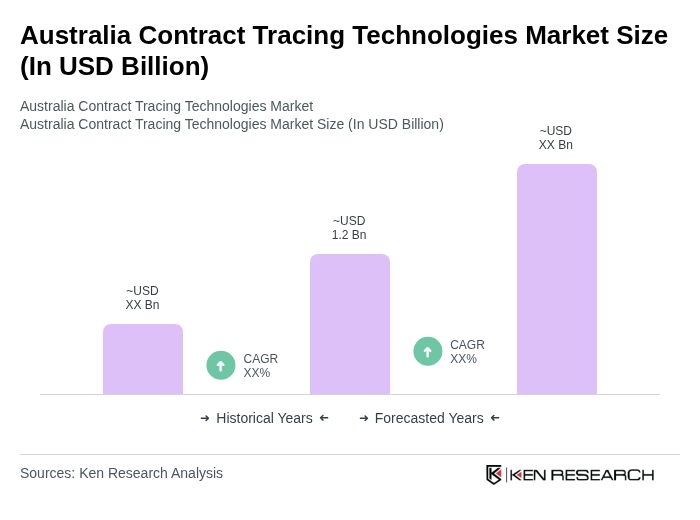
- The Australia Contract Tracing Technologies Market is valued at USD 1.2 billion, based on a five-year historical analysis, supported by increased demand for digital contact tracing driven by the COVID-19 pandemic, broader digitalization of healthcare, advancements in Bluetooth and GPS-based tracking, and wider adoption across healthcare, public transport, and other public settings.
- Key cities such as Sydney, Melbourne, and Brisbane dominate the market due to their high population density, concentration of healthcare facilities, and advanced digital infrastructure, which have positioned them at the forefront of deploying mobile apps, QR-based check-in systems, and integrated digital health platforms for contact tracing and broader outbreak management.
- The My Health Record Act 2012, issued by the Australian Government, establishes a national digital health record system that governs secure integration and sharing of health data, including information relevant to contact tracing, by setting interoperability requirements, privacy safeguards under the Office of the Australian Information Commissioner, and compliance obligations for healthcare providers and government agencies to support coordinated digital public health responses.
Australia Contract Tracing Technologies Market Segmentation
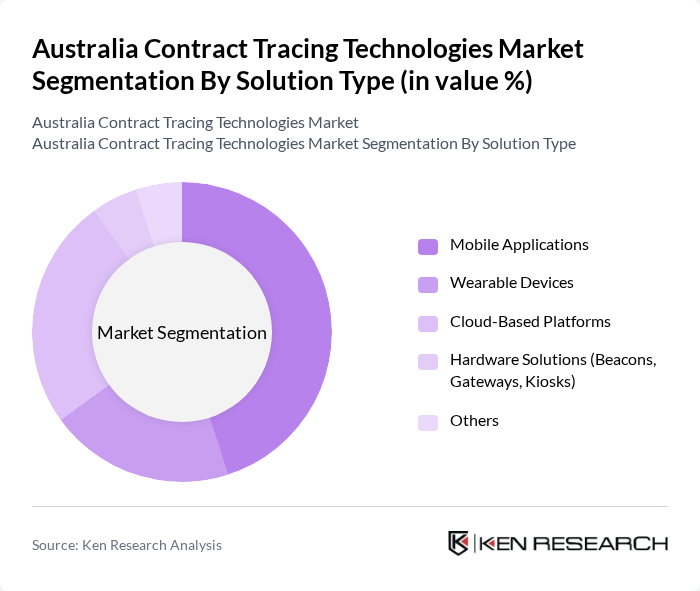
By Solution Type:The solution type segmentation includes various technologies that facilitate contact tracing. The dominant sub-segment is mobile applications, which have gained widespread adoption due to high smartphone penetration, ease of deployment, and support from government-backed apps like COVIDSafe and state check-in applications.Wearable devices and cloud-based platforms are also significant, as they support workplace safety programs, healthcare environments, and centralized analytics for exposure event management.Hardware solutions, such as beacons and kiosks, are emerging but currently hold a smaller market share, primarily used in controlled environments like offices, campuses, and transport hubs for automated check-ins and density monitoring.The increasing reliance on smartphones, integration of digital health records, and continued investments in healthcare IT are key factors driving the growth of mobile applications in this market.
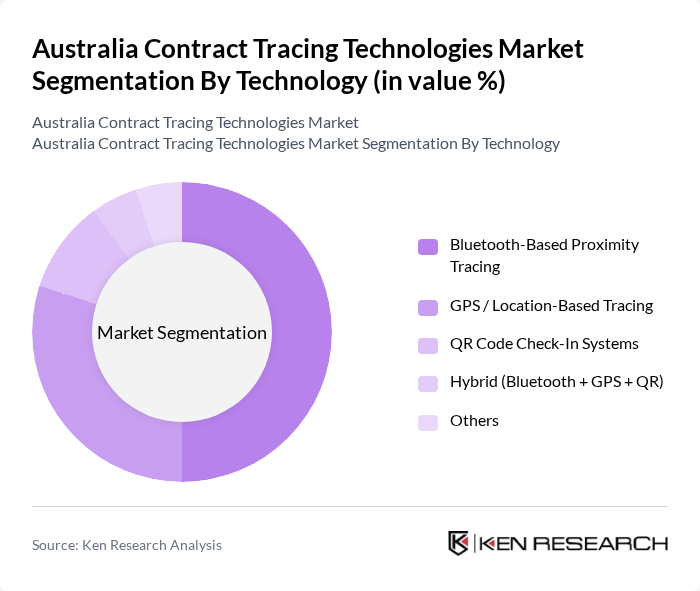
By Technology:The technology segmentation encompasses various methods used for contact tracing. Bluetooth-based proximity tracing is the leading technology due to its suitability for privacy-preserving proximity detection, alignment with major mobile operating system exposure-notification frameworks, and extensive use in COVID-19-era applications.GPS/location-based tracing follows, particularly in outdoor and enterprise settings where location history supports outbreak investigation and movement analytics.QR code check-in systems are widely used by businesses and public venues for visitor registration and time-stamped attendance records, enabling rapid identification of potential exposure sites.Hybrid systems that combine Bluetooth, GPS, and QR codes are also emerging to improve coverage, accuracy, and flexibility, especially in large organizations and multi-site operations, while “other” technologies such as Wi-Fi, NFC, RFID, and sensor networks complement these approaches in specific use cases.
Australia Contract Tracing Technologies Market Competitive Landscape
The Australia Contract Tracing Technologies Market is characterized by a dynamic mix of regional and international players. Leading participants such as COVIDSafe (Australian Government), Australian Government Health App, SafeWA, Service NSW COVID-19 Check-in (NSW Health COVID-19 App), Victorian Government COVID-19 App / QR Check-in, MyTrace, HealthEngine, Apple Inc., Google LLC, Telstra Corporation Limited, IBM Australia, Microsoft Australia, Atlassian Corporation Plc, SAP Australia, Accenture Australia, Deloitte Australia contribute to innovation, geographic expansion, and service delivery in this space.
Australia Contract Tracing Technologies Market Industry Analysis
Growth Drivers
- Increased Demand for Public Health Safety:The COVID-19 pandemic has heightened the focus on public health safety, leading to a surge in demand for contact tracing technologies. In future, the Australian government allocated AUD 250 million towards enhancing public health infrastructure, which includes contact tracing initiatives. This funding is expected to facilitate the development and deployment of advanced tracing applications, ensuring better management of health crises and improving overall community safety.
- Government Initiatives and Funding:The Australian government has been proactive in supporting contact tracing technologies through various initiatives. In future, the government plans to invest AUD 200 million in technology grants aimed at local developers. This funding is designed to foster innovation in contact tracing solutions, ensuring that they are effective, user-friendly, and widely adopted, thereby enhancing the overall public health response to potential outbreaks.
- Technological Advancements in Mobile Applications:The rapid evolution of mobile technology has significantly improved the capabilities of contact tracing applications. In future, it is estimated that over 95% of Australians will own smartphones, providing a robust platform for these applications. Enhanced features such as real-time notifications and geolocation tracking are being integrated, making contact tracing more efficient and effective in curbing the spread of infectious diseases.
Market Challenges
- Privacy Concerns Among Users:Privacy remains a significant challenge for the adoption of contact tracing technologies. In future, surveys indicate that approximately 65% of Australians express concerns about data security and misuse of personal information. This apprehension can hinder user engagement and limit the effectiveness of contact tracing efforts, as individuals may be reluctant to share their data with health authorities.
- Integration with Existing Health Systems:The integration of new contact tracing technologies with existing health systems poses a considerable challenge. In future, it is projected that only 45% of health facilities in Australia will have the necessary infrastructure to support seamless integration. This lack of compatibility can lead to inefficiencies and delays in data sharing, ultimately undermining the effectiveness of contact tracing initiatives.
Australia Contract Tracing Technologies Market Future Outlook
The future of contact tracing technologies in Australia appears promising, driven by ongoing technological advancements and increased government support. As public health priorities evolve, the integration of artificial intelligence and machine learning into contact tracing applications is expected to enhance their effectiveness. Furthermore, the collaboration between tech companies and health authorities will likely lead to innovative solutions that address privacy concerns while improving user engagement and data accuracy, ultimately strengthening public health responses.
Market Opportunities
- Expansion into Rural and Underserved Areas:There is a significant opportunity to expand contact tracing technologies into rural and underserved regions of Australia. In future, approximately 30% of the population in these areas lacks access to effective health services. By targeting these regions, technology providers can enhance public health outcomes and ensure equitable access to contact tracing solutions.
- Partnerships with Healthcare Providers:Collaborating with healthcare providers presents a valuable opportunity for technology developers. In future, it is estimated that partnerships could increase the adoption rate of contact tracing applications by up to 35%. By leveraging the trust and reach of healthcare providers, technology firms can enhance user engagement and improve the overall effectiveness of contact tracing efforts.
Scope of the Report
| Segment | Sub-Segments |
|---|---|
| By Solution Type | Mobile Applications Wearable Devices Cloud-Based Platforms Hardware Solutions (Beacons, Gateways, Kiosks) Others |
| By Technology | Bluetooth-Based Proximity Tracing GPS / Location-Based Tracing QR Code Check-In Systems Hybrid (Bluetooth + GPS + QR) Others |
| By End-User | Healthcare Providers & Hospitals Government & Public Health Agencies Educational Institutions Corporates & Workplaces Transport & Mobility Providers Others |
| By Deployment Model | Cloud-Based On-Premises Hybrid Others |
| By Region | New South Wales Victoria Queensland Western Australia Others |
| By Data Management Architecture | Centralized Systems Decentralized Systems Hybrid Systems Others |
| By Compliance & Security | Compliance with Australian Privacy Principles (APPs) My Health Record & Digital Health Regulations Alignment Sector-Specific Data Protection Standards Others |
Key Target Audience
Investors and Venture Capitalist Firms
Government and Regulatory Bodies (e.g., Australian Department of Health, Australian Digital Health Agency)
Healthcare Providers and Hospitals
Telecommunications Companies
Software Development Firms
Public Health Organizations
Local Government Authorities
Technology Integration Companies
Players Mentioned in the Report:
COVIDSafe (Australian Government)
Australian Government Health App
SafeWA
Service NSW COVID-19 Check-in (NSW Health COVID-19 App)
Victorian Government COVID-19 App / QR Check-in
MyTrace
HealthEngine
Apple Inc.
Google LLC
Telstra Corporation Limited
IBM Australia
Microsoft Australia
Atlassian Corporation Plc
SAP Australia
Accenture Australia
Deloitte Australia
Table of Contents
Market Assessment Phase
1. Executive Summary and Approach
2. Australia Contract Tracing Technologies Market Overview
2.1 Key Insights and Strategic Recommendations
2.2 Australia Contract Tracing Technologies Market Overview
2.3 Definition and Scope
2.4 Evolution of Market Ecosystem
2.5 Timeline of Key Regulatory Milestones
2.6 Value Chain & Stakeholder Mapping
2.7 Business Cycle Analysis
2.8 Policy & Incentive Landscape
3. Australia Contract Tracing Technologies Market Analysis
3.1 Growth Drivers
3.1.1 Increased demand for public health safety
3.1.2 Government initiatives and funding
3.1.3 Technological advancements in mobile applications
3.1.4 Rising awareness of contact tracing effectiveness
3.2 Market Challenges
3.2.1 Privacy concerns among users
3.2.2 Integration with existing health systems
3.2.3 Variability in user adoption rates
3.2.4 Regulatory compliance complexities
3.3 Market Opportunities
3.3.1 Expansion into rural and underserved areas
3.3.2 Partnerships with healthcare providers
3.3.3 Development of advanced analytics features
3.3.4 Integration with vaccination tracking systems
3.4 Market Trends
3.4.1 Increased use of AI in contact tracing
3.4.2 Shift towards decentralized data storage
3.4.3 Growing emphasis on user-friendly interfaces
3.4.4 Enhanced collaboration between tech companies and governments
3.5 Government Regulation
3.5.1 Data protection laws and compliance
3.5.2 Guidelines for app development and deployment
3.5.3 Funding and support for technology adoption
3.5.4 Public health emergency protocols
4. SWOT Analysis
5. Stakeholder Analysis
6. Porter's Five Forces Analysis
7. Australia Contract Tracing Technologies Market Market Size, 2019-2024
7.1 By Value
7.2 By Volume
7.3 By Average Selling Price
8. Australia Contract Tracing Technologies Market Segmentation
8.1 By Solution Type
8.1.1 Mobile Applications
8.1.2 Wearable Devices
8.1.3 Cloud-Based Platforms
8.1.4 Hardware Solutions (Beacons, Gateways, Kiosks)
8.1.5 Others
8.2 By Technology
8.2.1 Bluetooth-Based Proximity Tracing
8.2.2 GPS / Location-Based Tracing
8.2.3 QR Code Check-In Systems
8.2.4 Hybrid (Bluetooth + GPS + QR)
8.2.5 Others
8.3 By End-User
8.3.1 Healthcare Providers & Hospitals
8.3.2 Government & Public Health Agencies
8.3.3 Educational Institutions
8.3.4 Corporates & Workplaces
8.3.5 Transport & Mobility Providers
8.3.6 Others
8.4 By Deployment Model
8.4.1 Cloud-Based
8.4.2 On-Premises
8.4.3 Hybrid
8.4.4 Others
8.5 By Region
8.5.1 New South Wales
8.5.2 Victoria
8.5.3 Queensland
8.5.4 Western Australia
8.5.5 Others
8.6 By Data Management Architecture
8.6.1 Centralized Systems
8.6.2 Decentralized Systems
8.6.3 Hybrid Systems
8.6.4 Others
8.7 By Compliance & Security
8.7.1 Compliance with Australian Privacy Principles (APPs)
8.7.2 My Health Record & Digital Health Regulations Alignment
8.7.3 Sector-Specific Data Protection Standards
8.7.4 Others
9. Australia Contract Tracing Technologies Market Competitive Analysis
9.1 Market Share of Key Players
9.2 Cross Comparison of Key Players
9.2.1 Company Name
9.2.2 Group Size (Large, Medium, or Small as per industry convention)
9.2.3 Annual Revenue (Australia, USD Million)
9.2.4 3-Year Revenue CAGR (Australia, %)
9.2.5 R&D Intensity (% of Revenue)
9.2.6 EBITDA Margin (%)
9.2.7 Customer Acquisition Cost (CAC, USD per Customer)
9.2.8 Lifetime Value to CAC Ratio (LTV/CAC)
9.2.9 Active Users / Install Base (’000)
9.2.10 Market Penetration in Target End-Users (% of Addressable Accounts)
9.2.11 Churn / Customer Retention Rate (%)
9.2.12 Average Contract Value (ACV, USD)
9.2.13 Average Sales Cycle Length (Days)
9.2.14 Uptime / Service Availability (%)
9.3 SWOT Analysis of Top Players
9.4 Pricing Analysis
9.5 Detailed Profile of Major Companies
9.5.1 COVIDSafe (Australian Government)
9.5.2 Australian Government Health App
9.5.3 SafeWA
9.5.4 Service NSW COVID-19 Check-in (NSW Health COVID-19 App)
9.5.5 Victorian Government COVID-19 App / QR Check-in
9.5.6 MyTrace
9.5.7 HealthEngine
9.5.8 Apple Inc.
9.5.9 Google LLC
9.5.10 Telstra Corporation Limited
9.5.11 IBM Australia
9.5.12 Microsoft Australia
9.5.13 Atlassian Corporation Plc
9.5.14 SAP Australia
9.5.15 Accenture Australia
9.5.16 Deloitte Australia
10. Australia Contract Tracing Technologies Market End-User Analysis
10.1 Procurement Behavior of Key Ministries
10.1.1 Health Ministry
10.1.2 Education Ministry
10.1.3 Defense Ministry
10.1.4 Others
10.2 Corporate Spend on Infrastructure & Energy
10.2.1 Budget Allocations
10.2.2 Investment Trends
10.2.3 Spending Priorities
10.2.4 Others
10.3 Pain Point Analysis by End-User Category
10.3.1 Healthcare Providers
10.3.2 Educational Institutions
10.3.3 Corporates
10.3.4 Government Agencies
10.3.5 Others
10.4 User Readiness for Adoption
10.4.1 Awareness Levels
10.4.2 Training Needs
10.4.3 Technology Familiarity
10.4.4 Others
10.5 Post-Deployment ROI and Use Case Expansion
10.5.1 Performance Metrics
10.5.2 User Feedback
10.5.3 Scalability Potential
10.5.4 Others
11. Australia Contract Tracing Technologies Market Future Size, 2025-2030
11.1 By Value
11.2 By Volume
11.3 By Average Selling Price
Go-To-Market Strategy Phase
1. Whitespace Analysis + Business Model Canvas
1.1 Market Gaps Identification
1.2 Value Proposition Development
1.3 Revenue Streams Analysis
1.4 Cost Structure Evaluation
1.5 Key Partnerships Exploration
1.6 Customer Segmentation
1.7 Channels and Customer Relationships
2. Marketing and Positioning Recommendations
2.1 Branding Strategies
2.2 Product USPs
3. Distribution Plan
3.1 Urban Retail vs Rural NGO Tie-ups
4. Channel & Pricing Gaps
4.1 Underserved Routes
4.2 Pricing Bands
5. Unmet Demand & Latent Needs
5.1 Category Gaps
5.2 Consumer Segments
6. Customer Relationship
6.1 Loyalty Programs
6.2 After-Sales Service
7. Value Proposition
7.1 Sustainability
7.2 Integrated Supply Chains
8. Key Activities
8.1 Regulatory Compliance
8.2 Branding
8.3 Distribution Setup
9. Entry Strategy Evaluation
9.1 Domestic Market Entry Strategy
9.1.1 Product Mix
9.1.2 Pricing Band
9.1.3 Packaging
9.2 Export Entry Strategy
9.2.1 Target Countries
9.2.2 Compliance Roadmap
10. Entry Mode Assessment
10.1 JV
10.2 Greenfield
10.3 M&A
10.4 Distributor Model
11. Capital and Timeline Estimation
11.1 Capital Requirements
11.2 Timelines
12. Control vs Risk Trade-Off
12.1 Ownership vs Partnerships
13. Profitability Outlook
13.1 Breakeven Analysis
13.2 Long-Term Sustainability
14. Potential Partner List
14.1 Distributors
14.2 JVs
14.3 Acquisition Targets
15. Execution Roadmap
15.1 Phased Plan for Market Entry
15.1.1 Market Setup
15.1.2 Market Entry
15.1.3 Growth Acceleration
15.1.4 Scale & Stabilize
15.2 Key Activities and Milestones
15.2.1 Milestone Planning
15.2.2 Activity Tracking
Research Methodology
Phase 1: Approach1
Desk Research
- Analysis of government publications and health department reports on contact tracing technologies
- Review of academic journals and white papers focusing on the efficacy of digital contact tracing
- Examination of market reports and industry analyses from technology and healthcare sectors
Primary Research
- Interviews with public health officials and policymakers involved in contact tracing initiatives
- Surveys with technology providers specializing in health informatics and contact tracing solutions
- Focus groups with end-users, including healthcare professionals and citizens using tracing apps
Validation & Triangulation
- Cross-validation of findings through multiple data sources, including government and private sector reports
- Triangulation of qualitative insights from interviews with quantitative data from surveys
- Sanity checks conducted through expert panel reviews comprising epidemiologists and tech experts
Phase 2: Market Size Estimation1
Top-down Assessment
- Estimation of market size based on national healthcare expenditure and technology adoption rates
- Segmentation by application areas such as public health, private sector, and emergency response
- Incorporation of government funding and initiatives aimed at enhancing digital health solutions
Bottom-up Modeling
- Data collection from leading technology firms on sales volumes and pricing strategies for contact tracing solutions
- Estimation of user adoption rates based on demographic studies and smartphone penetration statistics
- Volume x cost analysis for various contact tracing technologies deployed across sectors
Forecasting & Scenario Analysis
- Multi-factor regression analysis incorporating variables such as pandemic trends and technological advancements
- Scenario modeling based on potential future public health crises and government responses
- Baseline, optimistic, and pessimistic projections through 2030, considering market dynamics
Phase 3: CATI Sample Composition1
| Scope Item/Segment | Sample Size | Target Respondent Profiles |
|---|---|---|
| Public Health Officials | 60 | Health Department Directors, Epidemiologists |
| Technology Providers | 60 | Product Managers, Software Developers |
| Healthcare Professionals | 60 | Doctors, Nurses, Public Health Workers |
| End-Users of Contact Tracing Apps | 60 | General Public, Tech-Savvy Users |
| Policy Makers | 40 | Government Advisors, Health Policy Analysts |
Frequently Asked Questions
What is the current value of the Australia Contract Tracing Technologies Market?
The Australia Contract Tracing Technologies Market is valued at approximately USD 1.2 billion, driven by the increased demand for digital contact tracing solutions, particularly during the COVID-19 pandemic, and the broader digitalization of healthcare services.
Which cities are leading in the Australia Contract Tracing Technologies Market?
What are the main types of solutions in the Australia Contract Tracing Technologies Market?
What technologies are used for contact tracing in Australia?
Other Regional/Country Reports
Other Adjacent Reports
Qatar Location-Based Services Market
Japan Public Safety Technology Market
GCC Health Data Analytics Market Size, Share, Growth Drivers, Trends, Opportunities & Forecast 2025–2030Mexico Cybersecurity Solutions Market
Why Buy From Us?

What makes us stand out is that our consultants follow Robust, Refine and Result (RRR) methodology. Robust for clear definitions, approaches and sanity checking, Refine for differentiating respondents' facts and opinions, and Result for presenting data with story.

We have set a benchmark in the industry by offering our clients with syndicated and customized market research reports featuring coverage of entire market as well as meticulous research and analyst insights.

While we don't replace traditional research, we flip the method upside down. Our dual approach of Top Bottom & Bottom Top ensures quality deliverable by not just verifying company fundamentals but also looking at the sector and macroeconomic factors.

With one step in the future, our research team constantly tries to show you the bigger picture. We help with some of the tough questions you may encounter along the way: How is the industry positioned? Best marketing channel? KPI's of competitors? By aligning every element, we help maximize success.

Our report gives you instant access to the answers and sources that other companies might choose to hide. We elaborate each steps of research methodology we have used and showcase you the sample size to earn your trust.

If you need any support, we are here! We pride ourselves on universe strength, data quality, and quick, friendly, and professional service.