About the Report
Base Year 2024Indonesia Enteral Feeding Formulas Market Overview
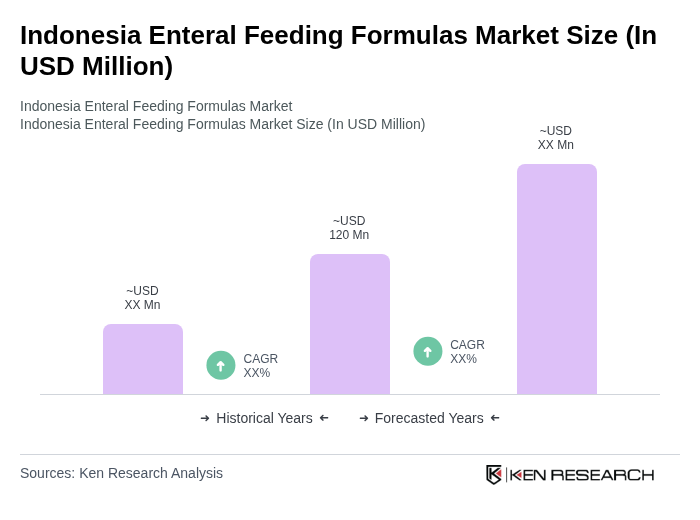
- The Indonesia Enteral Feeding Formulas Market is valued at USD 120 million, based on a five-year historical analysis. This growth is primarily driven by the increasing prevalence of chronic diseases, a rapidly aging population, and heightened awareness of clinical nutrition among healthcare providers and patients. Additional growth drivers include the expansion of home healthcare services, rising healthcare expenditure, and the introduction of advanced, disease-specific, and peptide-based formulas tailored to local patient needs. The market is further supported by technological advancements in enteral feeding equipment and a shift toward personalized nutrition solutions for chronic and critical care patients .
- Key cities such as Jakarta, Surabaya, and Bandung dominate the market due to their high population density, advanced healthcare infrastructure, and the presence of major hospitals and specialized care facilities. These urban centers are also experiencing increased healthcare spending and a higher incidence of chronic conditions, which further propels the demand for enteral feeding formulas .
- In 2023, the Indonesian government implemented regulations to enhance the quality and safety of enteral feeding products. This includes mandatory compliance with the "Regulation of the Minister of Health of the Republic of Indonesia Number 28 of 2019 concerning the Provision of Special Nutrition in Hospitals," which sets standards for nutritional content, labeling, and safety of enteral formulas. All products must meet these requirements to ensure patient safety and product efficacy, with regular audits and certification required for manufacturers and importers .
Indonesia Enteral Feeding Formulas Market Segmentation
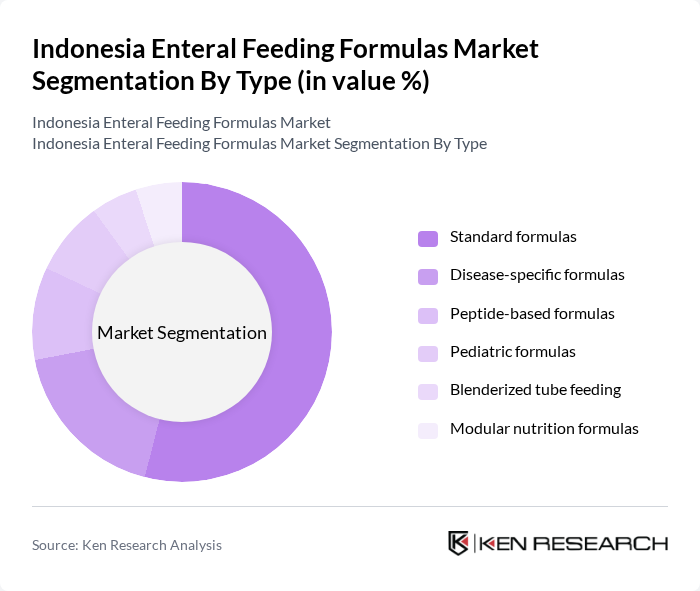
By Type:The market is segmented into various types of enteral feeding formulas, including standard formulas, disease-specific formulas, peptide-based formulas, pediatric formulas, blenderized tube feeding, and modular nutrition formulas. Each type addresses distinct patient needs and dietary requirements, shaping consumer preferences and influencing market dynamics. Standard formulas are widely used for general nutritional support, while disease-specific and peptide-based formulas are increasingly adopted for complex medical conditions. Pediatric and modular formulas cater to specialized populations, and blenderized tube feeding is gaining traction among patients seeking more natural or customized nutrition solutions .
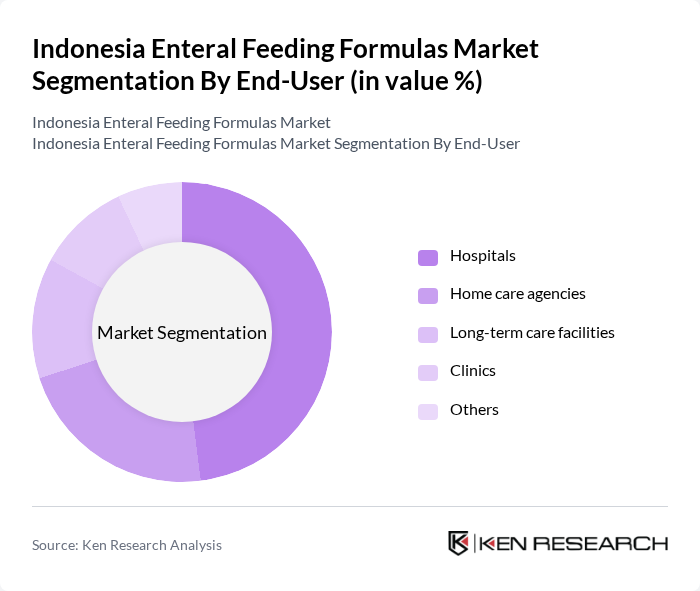
By End-User:The end-user segmentation includes hospitals, home care agencies, long-term care facilities, clinics, and others. Hospitals remain the largest consumers of enteral feeding formulas due to the high volume of acute and critical care patients. Home care agencies are experiencing rapid growth as more patients receive long-term nutritional support outside hospital settings. Long-term care facilities and clinics also represent significant demand segments, driven by the management of chronic illnesses and rehabilitation needs .
Indonesia Enteral Feeding Formulas Market Competitive Landscape
The Indonesia Enteral Feeding Formulas Market is characterized by a dynamic mix of regional and international players. Leading participants such as Nutricia Indonesia (Danone Specialized Nutrition Indonesia), Abbott Laboratories Indonesia, Fresenius Kabi Indonesia, Nestlé Health Science Indonesia, Meiji Holdings Co., Ltd., B. Braun Melsungen AG, Otsuka Nutraceutical Indonesia, Ajinomoto Co., Inc., Kalbe Farma Tbk, PT Sanghiang Perkasa (KALBE Nutritionals), Mead Johnson Nutrition (Reckitt Benckiser Group plc), GlaxoSmithKline Indonesia, PT Nutrifood Indonesia, PT Sarihusada Generasi Mahardhika, PT Tempo Scan Pacific Tbk contribute to innovation, geographic expansion, and service delivery in this space.
Indonesia Enteral Feeding Formulas Market Industry Analysis
Growth Drivers
- Increasing Prevalence of Chronic Diseases:The rise in chronic diseases such as diabetes and cancer in Indonesia is significant, with approximately 10 million diabetes cases reported in future. This growing health crisis necessitates enteral feeding solutions, as many patients require specialized nutritional support. The World Health Organization indicates that chronic diseases account for 71% of all deaths globally, emphasizing the urgent need for effective nutritional interventions in healthcare settings.
- Rising Geriatric Population:Indonesia's geriatric population is projected to reach 28 million in future, representing a substantial demographic shift. This age group often faces multiple health challenges, increasing the demand for enteral feeding formulas tailored to their nutritional needs. The government’s focus on elderly care, including healthcare services and nutritional support, further drives the market, as older adults frequently require enteral nutrition due to conditions like dysphagia and malnutrition.
- Growing Awareness of Nutritional Needs:There is a notable increase in awareness regarding the importance of nutrition in health management among Indonesian consumers. Educational campaigns and healthcare initiatives have led to a 30% rise in consultations with nutritionists in future. This heightened awareness is driving demand for enteral feeding products, as healthcare providers and patients recognize the critical role of proper nutrition in recovery and overall health maintenance.
Market Challenges
- High Cost of Enteral Feeding Products:The cost of enteral feeding products remains a significant barrier to market growth, with prices ranging from IDR 150,000 to IDR 500,000 per unit. Many healthcare facilities, especially in rural areas, struggle to afford these products, limiting access for patients who need them. The economic disparity in Indonesia exacerbates this issue, as lower-income families may prioritize basic needs over specialized nutritional products.
- Limited Access in Rural Areas:Approximately 60% of Indonesia's population resides in rural areas, where healthcare infrastructure is often inadequate. Many rural healthcare facilities lack the resources to provide enteral feeding solutions, leading to a significant gap in access. The Indonesian Ministry of Health reports that only 40% of rural health centers are equipped to handle enteral nutrition, highlighting the urgent need for improved distribution and accessibility of these essential products.
Indonesia Enteral Feeding Formulas Market Future Outlook
The future of the enteral feeding formulas market in Indonesia appears promising, driven by increasing healthcare investments and a growing focus on personalized nutrition. As the government enhances healthcare infrastructure, particularly in rural areas, access to enteral feeding products is expected to improve. Additionally, the integration of technology in product development will likely lead to innovative solutions that cater to diverse nutritional needs, further expanding market potential and enhancing patient outcomes in the coming years.
Market Opportunities
- Development of Innovative Products:There is a significant opportunity for companies to invest in research and development of innovative enteral feeding formulas. By creating products that cater to specific dietary needs, such as gluten-free or low-sugar options, manufacturers can tap into niche markets and meet the diverse requirements of patients, enhancing their competitive edge in the industry.
- Partnerships with Healthcare Providers:Collaborating with hospitals and clinics presents a valuable opportunity for enteral feeding formula manufacturers. By establishing partnerships, companies can ensure their products are included in treatment protocols, increasing visibility and usage. Such collaborations can also facilitate educational initiatives, promoting awareness of the benefits of enteral nutrition among healthcare professionals and patients alike.
Scope of the Report
| Segment | Sub-Segments |
|---|---|
| By Type | Standard formulas Disease-specific formulas Peptide-based formulas Pediatric formulas Blenderized tube feeding Modular nutrition formulas |
| By End-User | Hospitals Home care agencies Long-term care facilities Clinics Others |
| By Distribution Channel | Direct sales Online retail Pharmacies Medical supply stores Others |
| By Formulation Type | Liquid formulas Powdered formulas Ready-to-use formulas Others |
| By Nutritional Content | High-protein formulas Fiber-enriched formulas Low-sugar formulas Diabetic formulas Renal formulas Oncology formulas Others |
| By Packaging Type | Bottles Tetra packs Cans Sachets Others |
| By Region | Java Sumatra Bali Kalimantan Sulawesi Others |
Key Target Audience
Investors and Venture Capitalist Firms
Government and Regulatory Bodies (e.g., Ministry of Health, National Agency of Drug and Food Control)
Manufacturers and Producers
Distributors and Retailers
Healthcare Providers and Hospitals
Pharmaceutical Companies
Health Insurance Companies
Industry Associations and Advocacy Groups
Players Mentioned in the Report:
Nutricia Indonesia (Danone Specialized Nutrition Indonesia)
Abbott Laboratories Indonesia
Fresenius Kabi Indonesia
Nestle Health Science Indonesia
Meiji Holdings Co., Ltd.
B. Braun Melsungen AG
Otsuka Nutraceutical Indonesia
Ajinomoto Co., Inc.
Kalbe Farma Tbk
PT Sanghiang Perkasa (KALBE Nutritionals)
Mead Johnson Nutrition (Reckitt Benckiser Group plc)
GlaxoSmithKline Indonesia
PT Nutrifood Indonesia
PT Sarihusada Generasi Mahardhika
PT Tempo Scan Pacific Tbk
Table of Contents
Market Assessment Phase
1. Executive Summary and Approach
2. Indonesia Enteral Feeding Formulas Market Overview
2.1 Key Insights and Strategic Recommendations
2.2 Indonesia Enteral Feeding Formulas Market Overview
2.3 Definition and Scope
2.4 Evolution of Market Ecosystem
2.5 Timeline of Key Regulatory Milestones
2.6 Value Chain & Stakeholder Mapping
2.7 Business Cycle Analysis
2.8 Policy & Incentive Landscape
3. Indonesia Enteral Feeding Formulas Market Analysis
3.1 Growth Drivers
3.1.1 Increasing prevalence of chronic diseases
3.1.2 Rising geriatric population
3.1.3 Growing awareness of nutritional needs
3.1.4 Expansion of healthcare infrastructure
3.2 Market Challenges
3.2.1 High cost of enteral feeding products
3.2.2 Limited access in rural areas
3.2.3 Regulatory hurdles
3.2.4 Competition from alternative nutrition sources
3.3 Market Opportunities
3.3.1 Development of innovative products
3.3.2 Partnerships with healthcare providers
3.3.3 Expansion into untapped markets
3.3.4 Increasing demand for home healthcare solutions
3.4 Market Trends
3.4.1 Shift towards personalized nutrition
3.4.2 Growth of online distribution channels
3.4.3 Emphasis on sustainability in packaging
3.4.4 Integration of technology in product development
3.5 Government Regulation
3.5.1 Standards for nutritional labeling
3.5.2 Import regulations for enteral products
3.5.3 Guidelines for healthcare provider partnerships
3.5.4 Policies promoting local manufacturing
4. SWOT Analysis
5. Stakeholder Analysis
6. Porter's Five Forces Analysis
7. Indonesia Enteral Feeding Formulas Market Market Size, 2019-2024
7.1 By Value
7.2 By Volume
7.3 By Average Selling Price
8. Indonesia Enteral Feeding Formulas Market Segmentation
8.1 By Type
8.1.1 Standard formulas
8.1.2 Disease-specific formulas
8.1.3 Peptide-based formulas
8.1.4 Pediatric formulas
8.1.5 Blenderized tube feeding
8.1.6 Modular nutrition formulas
8.2 By End-User
8.2.1 Hospitals
8.2.2 Home care agencies
8.2.3 Long-term care facilities
8.2.4 Clinics
8.2.5 Others
8.3 By Distribution Channel
8.3.1 Direct sales
8.3.2 Online retail
8.3.3 Pharmacies
8.3.4 Medical supply stores
8.3.5 Others
8.4 By Formulation Type
8.4.1 Liquid formulas
8.4.2 Powdered formulas
8.4.3 Ready-to-use formulas
8.4.4 Others
8.5 By Nutritional Content
8.5.1 High-protein formulas
8.5.2 Fiber-enriched formulas
8.5.3 Low-sugar formulas
8.5.4 Diabetic formulas
8.5.5 Renal formulas
8.5.6 Oncology formulas
8.5.7 Others
8.6 By Packaging Type
8.6.1 Bottles
8.6.2 Tetra packs
8.6.3 Cans
8.6.4 Sachets
8.6.5 Others
8.7 By Region
8.7.1 Java
8.7.2 Sumatra
8.7.3 Bali
8.7.4 Kalimantan
8.7.5 Sulawesi
8.7.6 Others
9. Indonesia Enteral Feeding Formulas Market Competitive Analysis
9.1 Market Share of Key Players
9.2 Cross Comparison of Key Players
9.2.1 Company Name
9.2.2 Group Size (Large, Medium, or Small as per industry convention)
9.2.3 Revenue (Indonesia market, USD million)
9.2.4 Revenue Growth Rate (YoY %)
9.2.5 Market Share (%)
9.2.6 Product Portfolio Breadth (number of SKUs or formula types)
9.2.7 Distribution Network Coverage (number of provinces/cities served)
9.2.8 Penetration in Key End-User Segments (hospitals, home care, etc.)
9.2.9 Regulatory Compliance Score (BPOM/Ministry of Health approvals)
9.2.10 Pricing Strategy (premium, mid, value)
9.2.11 Brand Recognition Score (survey-based or proxy)
9.2.12 Customer Satisfaction Index (survey-based or proxy)
9.2.13 Innovation Index (new launches, R&D spend, etc.)
9.3 SWOT Analysis of Top Players
9.4 Pricing Analysis
9.5 Detailed Profile of Major Companies
9.5.1 Nutricia Indonesia (Danone Specialized Nutrition Indonesia)
9.5.2 Abbott Laboratories Indonesia
9.5.3 Fresenius Kabi Indonesia
9.5.4 Nestlé Health Science Indonesia
9.5.5 Meiji Holdings Co., Ltd.
9.5.6 B. Braun Melsungen AG
9.5.7 Otsuka Nutraceutical Indonesia
9.5.8 Ajinomoto Co., Inc.
9.5.9 Kalbe Farma Tbk
9.5.10 PT Sanghiang Perkasa (KALBE Nutritionals)
9.5.11 Mead Johnson Nutrition (Reckitt Benckiser Group plc)
9.5.12 GlaxoSmithKline Indonesia
9.5.13 PT Nutrifood Indonesia
9.5.14 PT Sarihusada Generasi Mahardhika
9.5.15 PT Tempo Scan Pacific Tbk
10. Indonesia Enteral Feeding Formulas Market End-User Analysis
10.1 Procurement Behavior of Key Ministries
10.1.1 Budget allocation for healthcare
10.1.2 Procurement processes and timelines
10.1.3 Preferred suppliers and products
10.1.4 Compliance requirements
10.2 Corporate Spend on Infrastructure & Energy
10.2.1 Investment in healthcare facilities
10.2.2 Funding for nutritional programs
10.2.3 Partnerships with NGOs
10.2.4 Others
10.3 Pain Point Analysis by End-User Category
10.3.1 Challenges faced by hospitals
10.3.2 Issues in home care settings
10.3.3 Needs of long-term care facilities
10.3.4 Others
10.4 User Readiness for Adoption
10.4.1 Awareness of enteral feeding benefits
10.4.2 Training and support requirements
10.4.3 Accessibility of products
10.4.4 Others
10.5 Post-Deployment ROI and Use Case Expansion
10.5.1 Measurement of health outcomes
10.5.2 Cost savings analysis
10.5.3 Expansion into new use cases
10.5.4 Others
11. Indonesia Enteral Feeding Formulas Market Future Size, 2025-2030
11.1 By Value
11.2 By Volume
11.3 By Average Selling Price
Go-To-Market Strategy Phase
1. Whitespace Analysis + Business Model Canvas
1.1 Market gaps identification
1.2 Business model development
1.3 Value proposition analysis
1.4 Competitive landscape overview
1.5 Customer segmentation
1.6 Revenue stream identification
1.7 Cost structure analysis
2. Marketing and Positioning Recommendations
2.1 Branding strategies
2.2 Product USPs
2.3 Target audience identification
2.4 Communication strategies
2.5 Digital marketing initiatives
2.6 Partnership opportunities
2.7 Market positioning tactics
3. Distribution Plan
3.1 Urban retail strategies
3.2 Rural NGO tie-ups
3.3 E-commerce strategies
3.4 Logistics and supply chain management
3.5 Distribution channel optimization
3.6 Partnership with healthcare providers
3.7 Inventory management strategies
4. Channel & Pricing Gaps
4.1 Underserved routes
4.2 Pricing bands analysis
4.3 Competitor pricing strategies
4.4 Customer willingness to pay
4.5 Price sensitivity analysis
4.6 Discounting strategies
4.7 Value-based pricing models
5. Unmet Demand & Latent Needs
5.1 Category gaps identification
5.2 Consumer segments analysis
5.3 Product development opportunities
5.4 Market entry strategies
5.5 Customer feedback mechanisms
5.6 Innovation opportunities
5.7 Future trends analysis
6. Customer Relationship
6.1 Loyalty programs
6.2 After-sales service
6.3 Customer engagement strategies
6.4 Feedback and improvement processes
6.5 Community building initiatives
6.6 Customer education programs
6.7 Relationship management tools
7. Value Proposition
7.1 Sustainability initiatives
7.2 Integrated supply chains
7.3 Unique selling propositions
7.4 Customer-centric approaches
7.5 Competitive advantages
7.6 Value delivery mechanisms
7.7 Brand loyalty factors
8. Key Activities
8.1 Regulatory compliance
8.2 Branding strategies
8.3 Distribution setup
8.4 Marketing initiatives
8.5 Product development
8.6 Customer support
8.7 Performance monitoring
9. Entry Strategy Evaluation
9.1 Domestic Market Entry Strategy
9.1.1 Product mix considerations
9.1.2 Pricing band analysis
9.1.3 Packaging strategies
9.2 Export Entry Strategy
9.2.1 Target countries identification
9.2.2 Compliance roadmap development
10. Entry Mode Assessment
10.1 Joint Ventures
10.2 Greenfield investments
10.3 Mergers & Acquisitions
10.4 Distributor Model
10.5 Risk assessment
10.6 Strategic partnerships
10.7 Market entry barriers
11. Capital and Timeline Estimation
11.1 Capital requirements
11.2 Timelines for market entry
11.3 Funding sources
11.4 Financial projections
11.5 Investment strategies
11.6 Cost management
11.7 Return on Investment (ROI) analysis
12. Control vs Risk Trade-Off
12.1 Ownership considerations
12.2 Partnership dynamics
12.3 Risk management strategies
12.4 Control mechanisms
12.5 Decision-making processes
12.6 Exit strategies
12.7 Long-term sustainability
13. Profitability Outlook
13.1 Breakeven analysis
13.2 Long-term sustainability
13.3 Profit margin analysis
13.4 Revenue growth projections
13.5 Cost structure evaluation
13.6 Financial health indicators
13.7 Market share growth
14. Potential Partner List
14.1 Distributors
14.2 Joint Ventures
14.3 Acquisition targets
14.4 Strategic alliances
14.5 Local partnerships
14.6 International collaborations
14.7 Industry associations
15. Execution Roadmap
15.1 Phased Plan for Market Entry
15.1.1 Market Setup
15.
Research Methodology
Phase 1: Approach1
Desk Research
- Analysis of industry reports from health organizations and nutritional associations in Indonesia
- Review of government publications on healthcare policies and enteral nutrition guidelines
- Examination of market trends through academic journals and publications related to enteral feeding
Primary Research
- Interviews with healthcare professionals, including dietitians and nutritionists specializing in enteral feeding
- Surveys conducted with hospital procurement managers to understand purchasing behaviors
- Field interviews with caregivers and patients using enteral feeding formulas to gather firsthand insights
Validation & Triangulation
- Cross-validation of data through multiple sources, including sales data and healthcare expenditure reports
- Triangulation of findings from primary interviews and secondary research to ensure consistency
- Sanity checks through expert panel reviews comprising industry veterans and academic researchers
Phase 2: Market Size Estimation1
Top-down Assessment
- Estimation of the total addressable market based on national healthcare spending and enteral nutrition segments
- Segmentation of the market by product type, including standard and specialized enteral formulas
- Incorporation of demographic data to assess the prevalence of conditions requiring enteral feeding
Bottom-up Modeling
- Collection of sales data from leading manufacturers of enteral feeding formulas in Indonesia
- Estimation of market share based on distribution channels, including hospitals and home care settings
- Volume and pricing analysis to derive revenue estimates for each segment of the market
Forecasting & Scenario Analysis
- Utilization of time-series analysis to project market growth based on historical data trends
- Scenario modeling based on potential changes in healthcare policies and consumer behavior
- Development of baseline, optimistic, and pessimistic forecasts through 2030
Phase 3: CATI Sample Composition1
| Scope Item/Segment | Sample Size | Target Respondent Profiles |
|---|---|---|
| Hospital Procurement Departments | 60 | Procurement Managers, Supply Chain Coordinators |
| Healthcare Professionals | 50 | Dietitians, Nutritionists, Medical Doctors |
| Home Care Providers | 40 | Caregivers, Home Health Aides |
| Patients Using Enteral Feeding | 45 | Patients, Family Members, Caregivers |
| Pharmaceutical Distributors | 40 | Sales Representatives, Distribution Managers |
Frequently Asked Questions
What is the current value of the Indonesia Enteral Feeding Formulas Market?
The Indonesia Enteral Feeding Formulas Market is valued at approximately USD 120 million, reflecting growth driven by chronic diseases, an aging population, and increased awareness of clinical nutrition among healthcare providers and patients.
What factors are driving the growth of the enteral feeding formulas market in Indonesia?
Which cities are the primary markets for enteral feeding formulas in Indonesia?
What regulations govern the enteral feeding products in Indonesia?
Other Regional/Country Reports
Malaysia Enteral Feeding Formulas Market
KSA Enteral Feeding Formulas Market
APAC Enteral Feeding Formulas Market
SEA Enteral Feeding Formulas Market
Other Adjacent Reports
Japan Geriatric Care Market
South Africa Diabetes Management Market
Egypt Oncology Nutrition Market
Middle East Medical Foods Market Report Size Share Growth Drivers Trends Opportunities & Forecast 2025–2030Why Buy From Us?

What makes us stand out is that our consultants follow Robust, Refine and Result (RRR) methodology. Robust for clear definitions, approaches and sanity checking, Refine for differentiating respondents' facts and opinions, and Result for presenting data with story.

We have set a benchmark in the industry by offering our clients with syndicated and customized market research reports featuring coverage of entire market as well as meticulous research and analyst insights.

While we don't replace traditional research, we flip the method upside down. Our dual approach of Top Bottom & Bottom Top ensures quality deliverable by not just verifying company fundamentals but also looking at the sector and macroeconomic factors.

With one step in the future, our research team constantly tries to show you the bigger picture. We help with some of the tough questions you may encounter along the way: How is the industry positioned? Best marketing channel? KPI's of competitors? By aligning every element, we help maximize success.

Our report gives you instant access to the answers and sources that other companies might choose to hide. We elaborate each steps of research methodology we have used and showcase you the sample size to earn your trust.

If you need any support, we are here! We pride ourselves on universe strength, data quality, and quick, friendly, and professional service.