About the Report
Base Year 2024Listen to the audio summary
Indonesia Fucoidan Market Overview
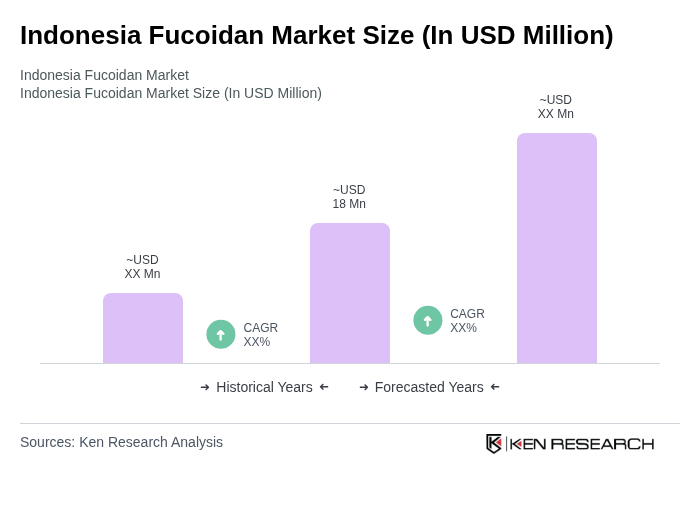
- The Indonesia Fucoidan Market is valued at approximately USD 18 million, based on a five-year historical analysis. This growth is primarily driven by the increasing awareness of health benefits associated with fucoidan, particularly in the healthcare and nutraceutical sectors. The rising demand for natural and organic products has further propelled the market, as consumers seek alternatives to synthetic ingredients. Indonesia's position within the Asia-Pacific region, which commands 43.3% of the global fucoidan market, underscores the country's significance in the broader regional landscape.
- Key regions dominating the market include Java and Bali, where the concentration of health-conscious consumers and wellness trends are more pronounced. The urban population in these areas is more inclined towards dietary supplements and functional foods, contributing significantly to the market's growth. Additionally, the presence of established distribution networks enhances accessibility to fucoidan products. Indonesia's abundant brown seaweed resources and established seaweed harvesting industry position it as a key production hub within Asia-Pacific.
- Indonesia operates under the Food Law No. 18 of 2012 issued by the Ministry of Health, which establishes comprehensive guidelines for the sourcing, processing, and quality standards of natural ingredients including seaweed-based products used in food and health applications. This regulatory framework ensures compliance with safety and sustainability requirements, thereby boosting consumer confidence and supporting market growth through standardized operational protocols for fucoidan extraction and product manufacturing.
Indonesia Fucoidan Market Segmentation
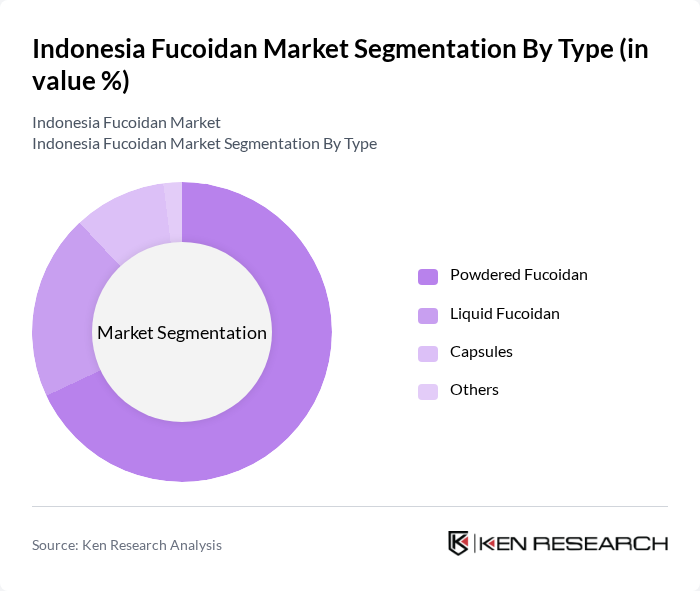
By Type:The market is segmented into various types, including Liquid Fucoidan, Powdered Fucoidan, Capsules, and Others. Powdered Fucoidan currently dominates the global market with a 68.2% share, driven by easy integration and storage capabilities. Consumers prefer powdered forms for their versatility and shelf stability, particularly in dietary supplements and functional food applications. Liquid Fucoidan also holds a significant share, appealing to those seeking rapid absorption and convenience. Capsules are popular for their portability and precise dosing, while the 'Others' category includes various innovative formats that are emerging in the market.
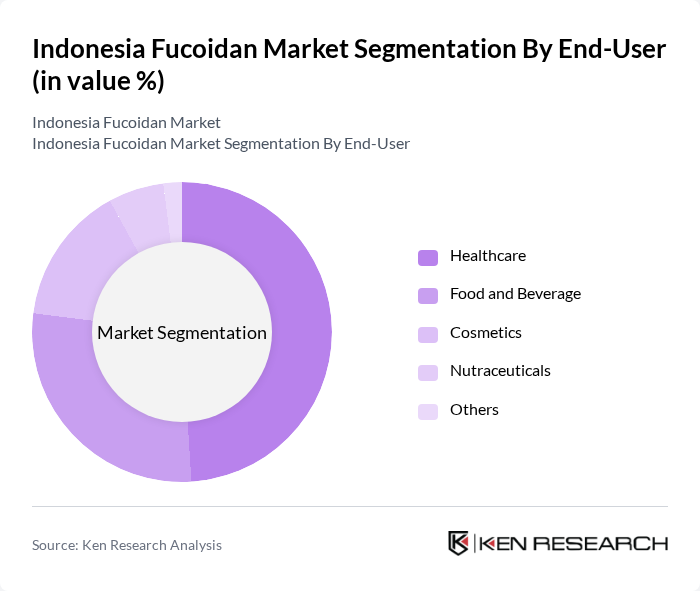
By End-User:The end-user segmentation includes Healthcare, Food and Beverage, Cosmetics, Nutraceuticals, and Others. The Healthcare sector dominates the market with a 49.4% share, driven by the increasing use of fucoidan in dietary supplements and functional foods aimed at enhancing health and wellness. The Food and Beverage industry is also growing, as consumers seek natural ingredients for health benefits. Cosmetics and Nutraceuticals are emerging segments, with rising interest in natural beauty products and health supplements. The 'Others' category includes various niche applications that are gaining traction.
Indonesia Fucoidan Market Competitive Landscape
The Indonesia Fucoidan Market is characterized by a dynamic mix of regional and international players. Leading participants such as PT. Fucoidan Indonesia, PT. Algaecare, PT. Seaweed Solutions, PT. BioMarine, PT. Green Sea, PT. Ocean Harvest, PT. Marine Bio, PT. Sea Health, PT. Algaeforce, PT. Seaweed Innovations, PT. Bioactive Seaweed, PT. Nutraceuticals Indonesia, PT. Marine Nutrients, PT. Sea Essence, PT. EcoSea contribute to innovation, geographic expansion, and service delivery in this space.
Indonesia Fucoidan Market Industry Analysis
Growth Drivers
- Increasing Health Awareness:The Indonesian population is becoming increasingly health-conscious, with a reported 65% of adults actively seeking healthier lifestyle choices. This trend is supported by the World Health Organization's findings that indicate a rise in non-communicable diseases, prompting consumers to turn to natural supplements like fucoidan. The health supplement market in Indonesia is projected to reach IDR 35 trillion (approximately USD 2.3 billion) in future, reflecting a growing demand for health-enhancing products.
- Rising Demand for Natural Supplements:The global shift towards natural and organic products is mirrored in Indonesia, where the natural supplement market is expected to grow significantly. In future, the market for natural supplements is anticipated to reach IDR 18 trillion (around USD 1.2 billion). This growth is driven by increasing consumer preference for products perceived as safe and effective, with fucoidan being recognized for its health benefits, including immune support and anti-inflammatory properties.
- Expanding Applications in Cosmetics:The cosmetics industry in Indonesia is experiencing a surge in demand for natural ingredients, with the market projected to reach IDR 55 trillion (approximately USD 3.7 billion) in future. Fucoidan's properties, such as skin hydration and anti-aging effects, are increasingly being utilized in cosmetic formulations. This trend is supported by a growing consumer base that prioritizes products with natural and sustainable ingredients, further driving the fucoidan market's growth.
Market Challenges
- Limited Awareness Among Consumers:Despite the health benefits of fucoidan, consumer awareness remains low, with only 30% of the population familiar with its uses. This lack of knowledge hinders market growth, as many potential customers are unaware of the advantages of incorporating fucoidan into their diets. Educational initiatives and marketing strategies are essential to bridge this gap and increase consumer interest in fucoidan products.
- High Production Costs:The production of fucoidan is often associated with high costs due to the extraction processes and sourcing of raw materials. In Indonesia, the average production cost is estimated at IDR 1.8 billion (approximately USD 120,000) per ton. These elevated costs can limit the competitiveness of fucoidan products in the market, making it challenging for manufacturers to offer affordable pricing while maintaining quality.
Indonesia Fucoidan Market Future Outlook
The future of the fucoidan market in Indonesia appears promising, driven by increasing health awareness and a growing preference for natural products. As consumers continue to prioritize health and wellness, the demand for fucoidan is expected to rise. Additionally, innovations in product development and strategic partnerships with research institutions will likely enhance the market's growth. E-commerce platforms will play a crucial role in expanding market reach, making fucoidan products more accessible to a broader audience.
Market Opportunities
- Export Potential to Southeast Asia:Indonesia's fucoidan market has significant export potential, particularly to neighboring Southeast Asian countries. With a combined population of over 700 million, these markets present lucrative opportunities for Indonesian manufacturers to expand their reach and increase revenue through international sales.
- Development of Innovative Products:There is a growing opportunity for the development of innovative fucoidan-based products tailored to specific consumer needs, such as functional foods and dietary supplements. By leveraging research and development, companies can create unique offerings that cater to health-conscious consumers, enhancing market competitiveness and driving growth.
Scope of the Report
| Segment | Sub-Segments |
|---|---|
| By Type | Liquid Fucoidan Powdered Fucoidan Capsules Others |
| By End-User | Healthcare Food and Beverage Cosmetics Nutraceuticals Others |
| By Source | Brown Seaweed Red Seaweed Green Seaweed Others |
| By Distribution Channel | Online Retail Offline Retail Direct Sales Others |
| By Application | Dietary Supplements Functional Foods Personal Care Products Others |
| By Region | Java Sumatra Bali Kalimantan Others |
| By Consumer Demographics | Age Group Gender Income Level Others |
Key Target Audience
Investors and Venture Capitalist Firms
Government and Regulatory Bodies (e.g., Badan Pengawas Obat dan Makanan - BPOM)
Manufacturers and Producers of Fucoidan
Distributors and Retailers of Nutraceuticals
Pharmaceutical Companies
Health and Wellness Product Companies
Industry Associations (e.g., Indonesian Seaweed Association)
Financial Institutions and Banks
Players Mentioned in the Report:
PT. Fucoidan Indonesia
PT. Algaecare
PT. Seaweed Solutions
PT. BioMarine
PT. Green Sea
PT. Ocean Harvest
PT. Marine Bio
PT. Sea Health
PT. Algaeforce
PT. Seaweed Innovations
PT. Bioactive Seaweed
PT. Nutraceuticals Indonesia
PT. Marine Nutrients
PT. Sea Essence
PT. EcoSea
Table of Contents
Market Assessment Phase
1. Executive Summary and Approach
2. Indonesia Fucoidan Market Overview
2.1 Key Insights and Strategic Recommendations
2.2 Indonesia Fucoidan Market Overview
2.3 Definition and Scope
2.4 Evolution of Market Ecosystem
2.5 Timeline of Key Regulatory Milestones
2.6 Value Chain & Stakeholder Mapping
2.7 Business Cycle Analysis
2.8 Policy & Incentive Landscape
3. Indonesia Fucoidan Market Analysis
3.1 Growth Drivers
3.1.1 Increasing Health Awareness
3.1.2 Rising Demand for Natural Supplements
3.1.3 Expanding Applications in Cosmetics
3.1.4 Government Support for Marine Biotechnology
3.2 Market Challenges
3.2.1 Limited Awareness Among Consumers
3.2.2 High Production Costs
3.2.3 Regulatory Hurdles
3.2.4 Competition from Synthetic Alternatives
3.3 Market Opportunities
3.3.1 Export Potential to Southeast Asia
3.3.2 Development of Innovative Products
3.3.3 Collaborations with Research Institutions
3.3.4 Growth in E-commerce Platforms
3.4 Market Trends
3.4.1 Shift Towards Organic Products
3.4.2 Increasing Use in Functional Foods
3.4.3 Focus on Sustainable Sourcing
3.4.4 Rise of Personalized Nutrition
3.5 Government Regulation
3.5.1 Food Safety Standards
3.5.2 Labeling Requirements
3.5.3 Import Regulations
3.5.4 Support for Research and Development
4. SWOT Analysis
5. Stakeholder Analysis
6. Porter's Five Forces Analysis
7. Indonesia Fucoidan Market Market Size, 2019-2024
7.1 By Value
7.2 By Volume
7.3 By Average Selling Price
8. Indonesia Fucoidan Market Segmentation
8.1 By Type
8.1.1 Liquid Fucoidan
8.1.2 Powdered Fucoidan
8.1.3 Capsules
8.1.4 Others
8.2 By End-User
8.2.1 Healthcare
8.2.2 Food and Beverage
8.2.3 Cosmetics
8.2.4 Nutraceuticals
8.2.5 Others
8.3 By Source
8.3.1 Brown Seaweed
8.3.2 Red Seaweed
8.3.3 Green Seaweed
8.3.4 Others
8.4 By Distribution Channel
8.4.1 Online Retail
8.4.2 Offline Retail
8.4.3 Direct Sales
8.4.4 Others
8.5 By Application
8.5.1 Dietary Supplements
8.5.2 Functional Foods
8.5.3 Personal Care Products
8.5.4 Others
8.6 By Region
8.6.1 Java
8.6.2 Sumatra
8.6.3 Bali
8.6.4 Kalimantan
8.6.5 Others
8.7 By Consumer Demographics
8.7.1 Age Group
8.7.2 Gender
8.7.3 Income Level
8.7.4 Others
9. Indonesia Fucoidan Market Competitive Analysis
9.1 Market Share of Key Players
9.2 Cross Comparison of Key Players
9.2.1 Company Name
9.2.2 Group Size (Large, Medium, or Small as per industry convention)
9.2.3 Revenue Growth Rate
9.2.4 Market Penetration Rate
9.2.5 Customer Retention Rate
9.2.6 Pricing Strategy
9.2.7 Product Diversification Index
9.2.8 Brand Recognition Score
9.2.9 Distribution Efficiency
9.2.10 Innovation Rate
9.3 SWOT Analysis of Top Players
9.4 Pricing Analysis
9.5 Detailed Profile of Major Companies
9.5.1 PT. Fucoidan Indonesia
9.5.2 PT. Algaecare
9.5.3 PT. Seaweed Solutions
9.5.4 PT. BioMarine
9.5.5 PT. Green Sea
9.5.6 PT. Ocean Harvest
9.5.7 PT. Marine Bio
9.5.8 PT. Sea Health
9.5.9 PT. Algaeforce
9.5.10 PT. Seaweed Innovations
9.5.11 PT. Bioactive Seaweed
9.5.12 PT. Nutraceuticals Indonesia
9.5.13 PT. Marine Nutrients
9.5.14 PT. Sea Essence
9.5.15 PT. EcoSea
10. Indonesia Fucoidan Market End-User Analysis
10.1 Procurement Behavior of Key Ministries
10.1.1 Ministry of Health
10.1.2 Ministry of Agriculture
10.1.3 Ministry of Trade
10.1.4 Others
10.2 Corporate Spend on Infrastructure & Energy
10.2.1 Investment Trends
10.2.2 Budget Allocations
10.2.3 Project Priorities
10.2.4 Others
10.3 Pain Point Analysis by End-User Category
10.3.1 Healthcare Providers
10.3.2 Food Manufacturers
10.3.3 Cosmetic Brands
10.3.4 Others
10.4 User Readiness for Adoption
10.4.1 Awareness Levels
10.4.2 Training Needs
10.4.3 Infrastructure Readiness
10.4.4 Others
10.5 Post-Deployment ROI and Use Case Expansion
10.5.1 ROI Metrics
10.5.2 Use Case Scenarios
10.5.3 Feedback Mechanisms
10.5.4 Others
11. Indonesia Fucoidan Market Future Size, 2025-2030
11.1 By Value
11.2 By Volume
11.3 By Average Selling Price
Go-To-Market Strategy Phase
1. Whitespace Analysis + Business Model Canvas
1.1 Market Gaps Identification
1.2 Business Model Framework
2. Marketing and Positioning Recommendations
2.1 Branding Strategies
2.2 Product USPs
3. Distribution Plan
3.1 Urban Retail Strategies
3.2 Rural NGO Tie-ups
4. Channel & Pricing Gaps
4.1 Underserved Routes
4.2 Pricing Bands
5. Unmet Demand & Latent Needs
5.1 Category Gaps
5.2 Consumer Segments
6. Customer Relationship
6.1 Loyalty Programs
6.2 After-sales Service
7. Value Proposition
7.1 Sustainability
7.2 Integrated Supply Chains
8. Key Activities
8.1 Regulatory Compliance
8.2 Branding
8.3 Distribution Setup
9. Entry Strategy Evaluation
9.1 Domestic Market Entry Strategy
9.1.1 Product Mix
9.1.2 Pricing Band
9.1.3 Packaging
9.2 Export Entry Strategy
9.2.1 Target Countries
9.2.2 Compliance Roadmap
10. Entry Mode Assessment
10.1 JV
10.2 Greenfield
10.3 M&A
10.4 Distributor Model
11. Capital and Timeline Estimation
11.1 Capital Requirements
11.2 Timelines
12. Control vs Risk Trade-Off
12.1 Ownership vs Partnerships
13. Profitability Outlook
13.1 Breakeven Analysis
13.2 Long-term Sustainability
14. Potential Partner List
14.1 Distributors
14.2 JVs
14.3 Acquisition Targets
15. Execution Roadmap
15.1 Phased Plan for Market Entry
15.1.1 Market Setup
15.1.2 Market Entry
15.1.3 Growth Acceleration
15.1.4 Scale & Stabilize
15.2 Key Activities and Milestones
15.2.1 Milestone Planning
15.2.2 Activity Tracking
Research Methodology
Phase 1: Approach1
Desk Research
- Analysis of industry reports from Indonesian government agencies and trade associations
- Review of academic publications and journals focusing on fucoidan and its applications
- Examination of market trends and consumer behavior studies related to health supplements in Indonesia
Primary Research
- Interviews with key opinion leaders in the health and wellness sector
- Surveys targeting manufacturers and distributors of fucoidan products
- Field visits to health food stores and pharmacies to gather insights on product availability and consumer preferences
Validation & Triangulation
- Cross-validation of findings through multiple data sources including sales data and market reports
- Triangulation of qualitative insights from interviews with quantitative data from surveys
- Sanity checks conducted through expert panel discussions to ensure data reliability
Phase 2: Market Size Estimation1
Top-down Assessment
- Estimation of the overall health supplement market size in Indonesia as a baseline
- Segmentation of the fucoidan market by application areas such as dietary supplements and cosmetics
- Incorporation of growth rates from related sectors to project fucoidan market potential
Bottom-up Modeling
- Collection of sales data from leading fucoidan product manufacturers
- Estimation of average selling prices and volume sold across different distribution channels
- Analysis of consumer purchasing patterns and frequency of fucoidan product purchases
Forecasting & Scenario Analysis
- Development of market forecasts based on historical growth trends and emerging health trends
- Scenario analysis considering factors such as regulatory changes and shifts in consumer preferences
- Creation of multiple growth scenarios (baseline, optimistic, and pessimistic) through 2030
Phase 3: CATI Sample Composition1
| Scope Item/Segment | Sample Size | Target Respondent Profiles |
|---|---|---|
| Health Supplement Retailers | 100 | Store Managers, Product Buyers |
| Fucoidan Product Manufacturers | 45 | Production Managers, Quality Control Officers |
| Health and Wellness Practitioners | 50 | Nutritionists, Herbalists |
| Consumers of Health Supplements | 100 | Health-Conscious Individuals, Fitness Enthusiasts |
| Distributors and Wholesalers | 60 | Sales Managers, Logistics Coordinators |
Frequently Asked Questions
What is the current value of the Indonesia Fucoidan Market?
The Indonesia Fucoidan Market is valued at approximately USD 18 million, reflecting a growing interest in health benefits associated with fucoidan, particularly in healthcare and nutraceutical sectors.
Which regions in Indonesia dominate the Fucoidan Market?
What are the main types of Fucoidan products available in Indonesia?
What are the primary end-user segments for Fucoidan in Indonesia?
Other Regional/Country Reports
Other Adjacent Reports
Philippines Seaweed Market
Singapore Nutraceutical Market Size, Share & Forecast, By Product Type, Application & Distribution Channel, 2026-2031Malaysia Dietary Supplement Market
Global Functional Food Market Size, Share & Forecast, By Product Type, Ingredient, Health Benefit & Distribution Channel, 2026-2031Oman Cosmetic Ingredient Market
Vietnam Health Supplement Market Outlook to 2030New Zealand Marine Biotechnology Market Report Size, Share, Growth Drivers, Trends, Opportunities & Forecast 2025–2030Kuwait Natural Extract Market
Philippines Wellness Product Market
UAE Bioactive Compound Market
Why Buy From Us?

What makes us stand out is that our consultants follow Robust, Refine and Result (RRR) methodology. Robust for clear definitions, approaches and sanity checking, Refine for differentiating respondents' facts and opinions, and Result for presenting data with story.

We have set a benchmark in the industry by offering our clients with syndicated and customized market research reports featuring coverage of entire market as well as meticulous research and analyst insights.

While we don't replace traditional research, we flip the method upside down. Our dual approach of Top Bottom & Bottom Top ensures quality deliverable by not just verifying company fundamentals but also looking at the sector and macroeconomic factors.

With one step in the future, our research team constantly tries to show you the bigger picture. We help with some of the tough questions you may encounter along the way: How is the industry positioned? Best marketing channel? KPI's of competitors? By aligning every element, we help maximize success.

Our report gives you instant access to the answers and sources that other companies might choose to hide. We elaborate each steps of research methodology we have used and showcase you the sample size to earn your trust.

If you need any support, we are here! We pride ourselves on universe strength, data quality, and quick, friendly, and professional service.