About the Report
Base Year 2024Indonesia Geosynthetics Market Overview
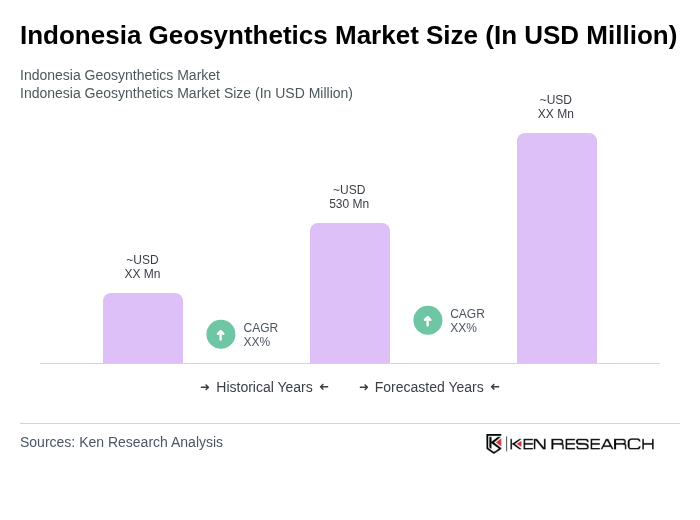
- The Indonesia Geosynthetics Market is valued at USD 530 million, based on a five-year historical analysis. This growth is primarily driven by the increasing demand for sustainable construction materials, rapid urbanization, and significant investments in infrastructure projects across the country, including roadways, railways, drainage, and the new capital city Nusantara. The rising focus on erosion control, soil stabilization, and the need for effective waste and water management solutions further contributes to the market's expansion, supported by broader regional demand for geotextiles and related products in construction and environmental applications.
- Key regions dominating the market include Java, Sumatra, and Kalimantan. Java, being the most populous island and the country’s economic center, has a high concentration of construction, industrial, and infrastructure projects, including toll roads, bridges, and urban development. Sumatra and Kalimantan are rich in natural resources and host extensive mining, plantation, and energy activities, leading to increased demand for geosynthetics for soil reinforcement, haul roads, tailings storage, and environmental containment. The strategic location, natural resource base, and ongoing infrastructure expansion in these regions significantly influence market dynamics and geosynthetics consumption.
- Regulatory support for geosynthetics use is strengthened through environmental and construction-related requirements embedded in infrastructure and waste management regulation. For example, the Government Regulation of the Republic of Indonesia Number 22 of 2021 on the Implementation of Environmental Protection and Management, issued by the Government of Indonesia, requires engineered landfill and hazardous waste facilities to implement impermeable liners and leachate control systems, which in practice are commonly designed with geomembranes and geosynthetic clay liners to prevent groundwater contamination and ensure environmental compliance. Additionally, infrastructure budget allocations for roads, tollways, and the new capital city create a regulatory and investment environment that promotes the adoption of durable, sustainable geosynthetic solutions in major projects.
Indonesia Geosynthetics Market Segmentation
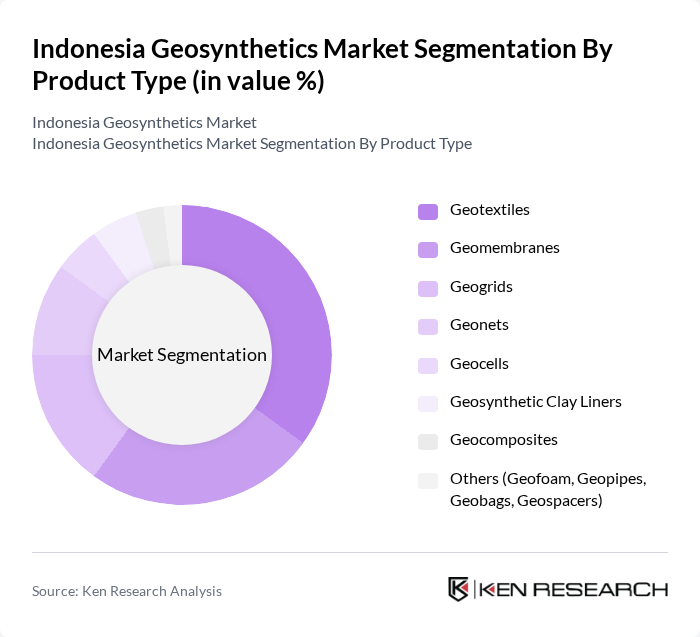
By Product Type:The product type segmentation includes various geosynthetic materials that serve different functions in construction and environmental applications. The primary subsegments are Geotextiles, Geomembranes, Geogrids, Geonets, Geocells, Geosynthetic Clay Liners, Geocomposites, and Others (Geofoam, Geopipes, Geobags, Geospacers). Geotextiles represent the leading segment in Indonesia in value terms, supported by their extensive use in road and railway construction, separation, filtration, and soil stabilization, as also reflected in regional and Indonesia-specific analyses that identify geotextiles as the dominant and fastest-growing product category. Geomembranes and geosynthetic clay liners are increasingly adopted for landfills, mining, and water containment, while geogrids and geocells are gaining traction in embankment reinforcement, slopes, and retaining structures, in line with the broader shift toward reinforced soil technologies in infrastructure works.
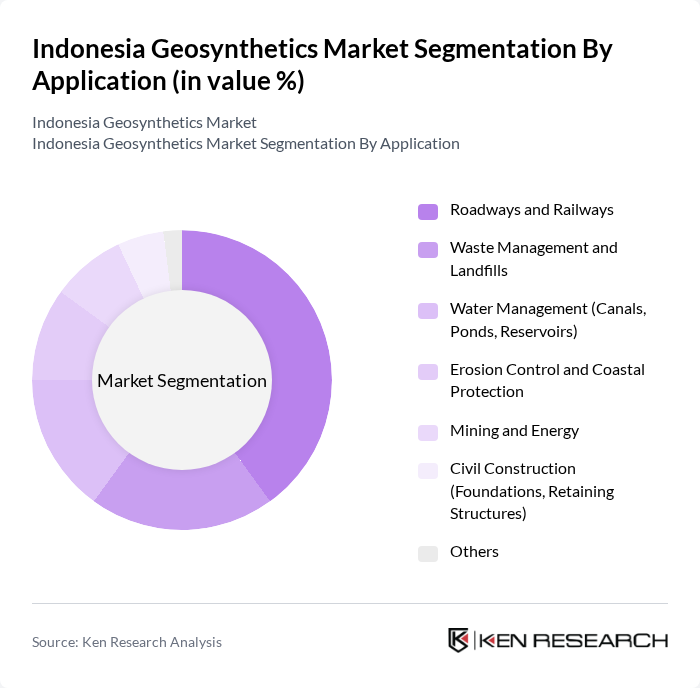
By Application:The application segmentation encompasses various sectors where geosynthetics are utilized, including Roadways and Railways, Waste Management and Landfills, Water Management (Canals, Ponds, Reservoirs), Erosion Control and Coastal Protection, Mining and Energy, Civil Construction (Foundations, Retaining Structures), and Others. Roadways and railways constitute the most significant application segment in Indonesia, underpinned by large-scale national road programs, toll road expansion, and transport corridors linked to the development of Nusantara and other strategic infrastructure. Waste management and landfills, along with water management projects (irrigation canals, reservoirs, ponds), are also key growth areas as geosynthetics are specified for lining, drainage, and protection functions to meet environmental and performance requirements.
Indonesia Geosynthetics Market Competitive Landscape
The Indonesia Geosynthetics Market is characterized by a dynamic mix of regional and international players. Leading participants such as PT Geosynthetics Indonesia, TenCate Geosynthetics, GSE Environmental, Solmax International, HUESKER Synthetic GmbH, NAUE GmbH & Co. KG, Maccaferri Indonesia, Agru America, Inc., Fibertex Nonwovens, Geofabrics Australasia, Propex Global, Sika AG, AECOM, TERRAM (a Berry Global company), and other notable local and regional players contribute to innovation, geographic expansion, and service delivery in this space.
Indonesia Geosynthetics Market Industry Analysis
Growth Drivers
- Increasing Infrastructure Development:Indonesia's infrastructure investment is projected to reach IDR 500 trillion (approximately USD 34 billion) in future, driven by the government's commitment to enhance connectivity and urban development. This surge in infrastructure projects, including roads, bridges, and dams, significantly boosts the demand for geosynthetics, which are essential for soil stabilization and erosion control. The focus on improving infrastructure is expected to create a robust market for geosynthetic materials, supporting sustainable construction practices.
- Rising Environmental Concerns:With Indonesia facing severe environmental challenges, including flooding and land degradation, the demand for eco-friendly construction solutions is increasing. The government reported that over 60% of urban areas are prone to flooding, necessitating the use of geosynthetics for effective drainage and soil reinforcement. This heightened awareness of environmental issues is driving the adoption of geosynthetics, which offer sustainable alternatives to traditional materials, thereby enhancing market growth.
- Government Initiatives for Sustainable Practices:The Indonesian government has implemented various initiatives to promote sustainable construction practices, including the National Medium-Term Development Plan (RPJMN), which allocates IDR 1,200 trillion (approximately USD 83 billion) for sustainable infrastructure. These initiatives encourage the use of geosynthetics in construction projects, as they contribute to environmental protection and resource efficiency. The government's focus on sustainability is expected to significantly drive the geosynthetics market forward.
Market Challenges
- High Initial Investment Costs:The adoption of geosynthetics often faces resistance due to high initial investment costs, which can be up to 30% more than traditional materials. This financial barrier is particularly challenging for small and medium-sized enterprises (SMEs) in Indonesia, where budget constraints limit their ability to invest in advanced materials. Consequently, this challenge hampers the widespread adoption of geosynthetics in various construction projects across the country.
- Lack of Awareness Among End-Users:A significant challenge in the Indonesian geosynthetics market is the lack of awareness among end-users regarding the benefits and applications of these materials. Many construction professionals still prefer traditional materials due to familiarity, leading to a slower adoption rate. According to industry reports, approximately 40% of construction firms in Indonesia are unaware of the advantages of geosynthetics, which limits market growth and innovation in the sector.
Indonesia Geosynthetics Market Future Outlook
The future of the geosynthetics market in Indonesia appears promising, driven by increasing infrastructure investments and a growing emphasis on sustainable practices. As the government continues to prioritize eco-friendly construction, the integration of innovative geosynthetic solutions is expected to rise. Additionally, advancements in technology, such as smart geosynthetics and IoT integration, will likely enhance product performance and durability, further propelling market growth. The focus on sustainability will shape the industry's trajectory in the coming years.
Market Opportunities
- Expansion in Emerging Markets:The growing urbanization in Indonesia presents significant opportunities for geosynthetics. With urban areas projected to grow by 3.5% annually, there is an increasing need for effective soil management and erosion control solutions. This trend opens avenues for geosynthetic manufacturers to expand their reach and cater to the rising demand in emerging urban markets.
- Development of Innovative Products:The demand for innovative geosynthetic products, such as biodegradable options, is on the rise. As environmental regulations tighten, manufacturers are encouraged to invest in research and development to create sustainable alternatives. This focus on innovation not only meets regulatory requirements but also positions companies to capture a larger market share in the eco-conscious construction sector.
Scope of the Report
| Segment | Sub-Segments |
|---|---|
| By Product Type | Geotextiles Geomembranes Geogrids Geonets Geocells Geosynthetic Clay Liners Geocomposites Others (Geofoam, Geopipes, Geobags, Geospacers) |
| By Application | Roadways and Railways Waste Management and Landfills Water Management (Canals, Ponds, Reservoirs) Erosion Control and Coastal Protection Mining and Energy Civil Construction (Foundations, Retaining Structures) Others |
| By Material | Polypropylene (PP) Polyethylene (PE) Polyester (PET) Polyvinyl Chloride (PVC) Natural Fibers Others (Rubber, Bitumen, Fiberglass, Polystyrene) |
| By Primary Function | Stabilization Reinforcement Drainage Filtration Separation Barrier & Protection |
| By End-Use Sector | Infrastructure and Construction Environmental Engineering Mining and Energy Agriculture Others |
| By Region | Java Sumatra Kalimantan Sulawesi Others |
Key Target Audience
Investors and Venture Capitalist Firms
Government and Regulatory Bodies (e.g., Ministry of Public Works and Housing, Ministry of Environment and Forestry)
Manufacturers and Producers
Distributors and Retailers
Construction and Engineering Firms
Infrastructure Development Agencies
Environmental Consultants
Financial Institutions
Players Mentioned in the Report:
PT Geosynthetics Indonesia
TenCate Geosynthetics
GSE Environmental
Solmax International
HUESKER Synthetic GmbH
NAUE GmbH & Co. KG
Maccaferri Indonesia
Agru America, Inc.
Fibertex Nonwovens
Geofabrics Australasia
Propex Global
Sika AG
AECOM
TERRAM (a Berry Global company)
Other Notable Local and Regional Players
Table of Contents
Market Assessment Phase
1. Executive Summary and Approach
2. Indonesia Geosynthetics Market Overview
2.1 Key Insights and Strategic Recommendations
2.2 Indonesia Geosynthetics Market Overview
2.3 Definition and Scope
2.4 Evolution of Market Ecosystem
2.5 Timeline of Key Regulatory Milestones
2.6 Value Chain & Stakeholder Mapping
2.7 Business Cycle Analysis
2.8 Policy & Incentive Landscape
3. Indonesia Geosynthetics Market Analysis
3.1 Growth Drivers
3.1.1 Increasing Infrastructure Development
3.1.2 Rising Environmental Concerns
3.1.3 Government Initiatives for Sustainable Practices
3.1.4 Technological Advancements in Geosynthetics
3.2 Market Challenges
3.2.1 High Initial Investment Costs
3.2.2 Lack of Awareness Among End-Users
3.2.3 Regulatory Compliance Issues
3.2.4 Competition from Traditional Materials
3.3 Market Opportunities
3.3.1 Expansion in Emerging Markets
3.3.2 Development of Innovative Products
3.3.3 Collaborations with Government Projects
3.3.4 Increasing Demand for Eco-Friendly Solutions
3.4 Market Trends
3.4.1 Growing Adoption of Smart Geosynthetics
3.4.2 Integration of IoT in Geosynthetics
3.4.3 Shift Towards Circular Economy Practices
3.4.4 Enhanced Focus on Durability and Performance
3.5 Government Regulation
3.5.1 Standards for Geosynthetic Materials
3.5.2 Environmental Protection Regulations
3.5.3 Incentives for Sustainable Construction
3.5.4 Compliance with International Standards
4. SWOT Analysis
5. Stakeholder Analysis
6. Porter's Five Forces Analysis
7. Indonesia Geosynthetics Market Market Size, 2019-2024
7.1 By Value
7.2 By Volume
7.3 By Average Selling Price
8. Indonesia Geosynthetics Market Segmentation
8.1 By Product Type
8.1.1 Geotextiles
8.1.2 Geomembranes
8.1.3 Geogrids
8.1.4 Geonets
8.1.5 Geocells
8.1.6 Geosynthetic Clay Liners
8.1.7 Geocomposites
8.1.8 Others (Geofoam, Geopipes, Geobags, Geospacers)
8.2 By Application
8.2.1 Roadways and Railways
8.2.2 Waste Management and Landfills
8.2.3 Water Management (Canals, Ponds, Reservoirs)
8.2.4 Erosion Control and Coastal Protection
8.2.5 Mining and Energy
8.2.6 Civil Construction (Foundations, Retaining Structures)
8.2.7 Others
8.3 By Material
8.3.1 Polypropylene (PP)
8.3.2 Polyethylene (PE)
8.3.3 Polyester (PET)
8.3.4 Polyvinyl Chloride (PVC)
8.3.5 Natural Fibers
8.3.6 Others (Rubber, Bitumen, Fiberglass, Polystyrene)
8.4 By Primary Function
8.4.1 Stabilization
8.4.2 Reinforcement
8.4.3 Drainage
8.4.4 Filtration
8.4.5 Separation
8.4.6 Barrier & Protection
8.5 By End-Use Sector
8.5.1 Infrastructure and Construction
8.5.2 Environmental Engineering
8.5.3 Mining and Energy
8.5.4 Agriculture
8.5.5 Others
8.6 By Region
8.6.1 Java
8.6.2 Sumatra
8.6.3 Kalimantan
8.6.4 Sulawesi
8.6.5 Others
9. Indonesia Geosynthetics Market Competitive Analysis
9.1 Market Share of Key Players
9.2 Cross Comparison of Key Players
9.2.1 Company Name
9.2.2 Indonesia Geosynthetics Revenue (USD million)
9.2.3 3-Year Revenue CAGR in Indonesia (%)
9.2.4 Indonesia Market Share (%)
9.2.5 EBITDA Margin (%) – Indonesia Operations
9.2.6 Order Backlog / Book-to-Bill Ratio
9.2.7 Share of Infrastructure & Environmental Projects in Revenue (%)
9.2.8 Average Project Size (USD million)
9.2.9 Contract Win Rate (%) in Public Tenders
9.2.10 Capex Intensity (% of Revenue)
9.2.11 R&D Spend (% of Revenue)
9.2.12 New Product / Solution Launches in Last 3 Years (Number)
9.2.13 Geographic Coverage Within Indonesia (Number of Provinces Served)
9.2.14 Key Local Partnerships / JV Count
9.3 SWOT Analysis of Top Players
9.4 Pricing Analysis
9.5 Detailed Profile of Major Companies
9.5.1 PT Geosynthetics Indonesia
9.5.2 TenCate Geosynthetics
9.5.3 GSE Environmental
9.5.4 Solmax International
9.5.5 HUESKER Synthetic GmbH
9.5.6 NAUE GmbH & Co. KG
9.5.7 Maccaferri Indonesia
9.5.8 Agru America, Inc.
9.5.9 Fibertex Nonwovens
9.5.10 Geofabrics Australasia
9.5.11 Propex Global
9.5.12 Sika AG
9.5.13 AECOM
9.5.14 TERRAM (a Berry Global company)
9.5.15 Other Notable Local and Regional Players
10. Indonesia Geosynthetics Market End-User Analysis
10.1 Procurement Behavior of Key Ministries
10.1.1 Ministry of Public Works
10.1.2 Ministry of Environment
10.1.3 Ministry of Agriculture
10.1.4 Others
10.2 Corporate Spend on Infrastructure & Energy
10.2.1 Infrastructure Projects
10.2.2 Energy Sector Investments
10.2.3 Environmental Initiatives
10.2.4 Others
10.3 Pain Point Analysis by End-User Category
10.3.1 Construction Sector
10.3.2 Environmental Agencies
10.3.3 Agricultural Sector
10.3.4 Others
10.4 User Readiness for Adoption
10.4.1 Awareness Levels
10.4.2 Training and Support Needs
10.4.3 Financial Readiness
10.4.4 Others
10.5 Post-Deployment ROI and Use Case Expansion
10.5.1 Performance Metrics
10.5.2 Case Studies
10.5.3 Future Expansion Plans
10.5.4 Others
11. Indonesia Geosynthetics Market Future Size, 2025-2030
11.1 By Value
11.2 By Volume
11.3 By Average Selling Price
Go-To-Market Strategy Phase
1. Whitespace Analysis + Business Model Canvas
1.1 Market Gaps Identification
1.2 Business Model Development
2. Marketing and Positioning Recommendations
2.1 Branding Strategies
2.2 Product USPs
3. Distribution Plan
3.1 Urban Retail Strategies
3.2 Rural NGO Tie-Ups
4. Channel & Pricing Gaps
4.1 Underserved Routes
4.2 Pricing Bands
5. Unmet Demand & Latent Needs
5.1 Category Gaps
5.2 Consumer Segments
6. Customer Relationship
6.1 Loyalty Programs
6.2 After-Sales Service
7. Value Proposition
7.1 Sustainability Initiatives
7.2 Integrated Supply Chains
8. Key Activities
8.1 Regulatory Compliance
8.2 Branding Efforts
8.3 Distribution Setup
9. Entry Strategy Evaluation
9.1 Domestic Market Entry Strategy
9.1.1 Product Mix
9.1.2 Pricing Band
9.1.3 Packaging
9.2 Export Entry Strategy
9.2.1 Target Countries
9.2.2 Compliance Roadmap
10. Entry Mode Assessment
10.1 Joint Ventures
10.2 Greenfield Investments
10.3 Mergers & Acquisitions
10.4 Distributor Model
11. Capital and Timeline Estimation
11.1 Capital Requirements
11.2 Timelines
12. Control vs Risk Trade-Off
12.1 Ownership vs Partnerships
13. Profitability Outlook
13.1 Breakeven Analysis
13.2 Long-Term Sustainability
14. Potential Partner List
14.1 Distributors
14.2 Joint Ventures
14.3 Acquisition Targets
15. Execution Roadmap
15.1 Phased Plan for Market Entry
15.1.1 Market Setup
15.1.2 Market Entry
15.1.3 Growth Acceleration
15.1.4 Scale & Stabilize
15.2 Key Activities and Milestones
15.2.1 Milestone Planning
15.2.2 Activity Tracking
Research Methodology
Phase 1: Approach1
Desk Research
- Analysis of industry reports from Indonesian government agencies and trade associations
- Review of academic publications and market studies focusing on geosynthetics applications in Indonesia
- Examination of import/export data and market trends from customs and trade databases
Primary Research
- Interviews with key stakeholders in the geosynthetics supply chain, including manufacturers and distributors
- Surveys targeting civil engineers and construction project managers involved in infrastructure projects
- Field visits to construction sites utilizing geosynthetics to gather firsthand insights
Validation & Triangulation
- Cross-validation of findings through multiple data sources, including government reports and industry publications
- Triangulation of market data with insights from expert interviews and field observations
- Sanity checks through feedback from industry experts and academic professionals
Phase 2: Market Size Estimation1
Top-down Assessment
- Estimation of the geosynthetics market size based on national infrastructure spending and development plans
- Segmentation of the market by application areas such as road construction, landfill, and erosion control
- Incorporation of government initiatives promoting sustainable construction practices
Bottom-up Modeling
- Collection of sales data from leading geosynthetics manufacturers operating in Indonesia
- Estimation of market share based on production capacity and sales volume of key players
- Analysis of pricing strategies and cost structures to derive revenue estimates
Forecasting & Scenario Analysis
- Utilization of historical growth rates and market trends to project future demand for geosynthetics
- Scenario analysis based on potential changes in regulatory frameworks and environmental policies
- Development of baseline, optimistic, and pessimistic forecasts through 2030
Phase 3: CATI Sample Composition1
| Scope Item/Segment | Sample Size | Target Respondent Profiles |
|---|---|---|
| Infrastructure Development Projects | 120 | Project Managers, Civil Engineers |
| Geosynthetics Manufacturing Sector | 90 | Production Managers, Quality Control Officers |
| Environmental Protection Initiatives | 60 | Environmental Engineers, Sustainability Consultants |
| Construction Material Suppliers | 80 | Sales Managers, Procurement Officers |
| Research and Development in Geosynthetics | 50 | R&D Managers, Technical Directors |
Frequently Asked Questions
What is the current value of the Indonesia Geosynthetics Market?
The Indonesia Geosynthetics Market is valued at approximately USD 530 million, driven by increasing demand for sustainable construction materials and significant investments in infrastructure projects across the country.
What factors are driving the growth of the geosynthetics market in Indonesia?
Which regions in Indonesia dominate the geosynthetics market?
What are the main applications of geosynthetics in Indonesia?
Other Regional/Country Reports
Malaysia Geosynthetics Market
APAC Geosynthetics Market
SEA Geosynthetics Market
Other Adjacent Reports
Germany Infrastructure Development Market
Middle East Civil Engineering Market Size, Share, Growth Drivers, Trends, Opportunities & Forecast 2025–2030Brazil Erosion Control Market
India Waste Management Market (2022-2030)Indonesia Water Management Market
Malaysia Mining Materials Market
Global Soil Stabilization Market Report Size, Share, Growth Drivers, Trends, Opportunities & Forecast 2025–2030Saudi Arabia geotechnical engineering market report size, share, growth drivers, trends, opportunities & forecast 2025–2030Mexico Sustainable Building Materials Market
Why Buy From Us?

What makes us stand out is that our consultants follow Robust, Refine and Result (RRR) methodology. Robust for clear definitions, approaches and sanity checking, Refine for differentiating respondents' facts and opinions, and Result for presenting data with story.

We have set a benchmark in the industry by offering our clients with syndicated and customized market research reports featuring coverage of entire market as well as meticulous research and analyst insights.

While we don't replace traditional research, we flip the method upside down. Our dual approach of Top Bottom & Bottom Top ensures quality deliverable by not just verifying company fundamentals but also looking at the sector and macroeconomic factors.

With one step in the future, our research team constantly tries to show you the bigger picture. We help with some of the tough questions you may encounter along the way: How is the industry positioned? Best marketing channel? KPI's of competitors? By aligning every element, we help maximize success.

Our report gives you instant access to the answers and sources that other companies might choose to hide. We elaborate each steps of research methodology we have used and showcase you the sample size to earn your trust.

If you need any support, we are here! We pride ourselves on universe strength, data quality, and quick, friendly, and professional service.