About the Report
Base Year 2024Listen to the audio summary
Indonesia Medical Device Testing Services Market Overview
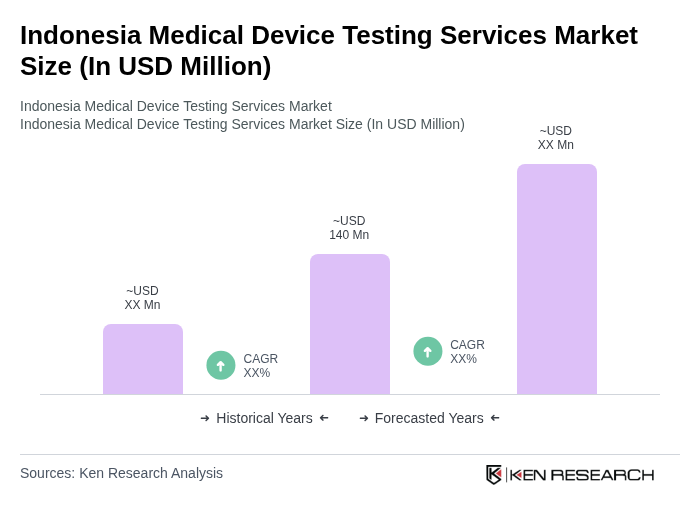
- The Indonesia Medical Device Testing Services Market is valued at USD 140 million, based on a five-year historical analysis. This growth is primarily driven by the increasing demand for high-quality medical devices, stringent regulatory requirements from the Ministry of Health and related agencies, and the rising focus on patient safety. The market is further supported by advancements in technology such as digital imaging, connected monitoring, and in?vitro diagnostics, and by the growing healthcare sector under the BPJS national health insurance scheme, which necessitates comprehensive testing services to ensure compliance with international and Indonesian National Standards (SNI).
- Key cities such as Jakarta, Surabaya, and Bandung dominate the market due to their robust healthcare infrastructure, concentration of tertiary referral hospitals, and presence of major medical device importers, distributors, and manufacturers. Jakarta, being the capital, serves as a hub for the Ministry of Health, BPOM, Badan Standardisasi Nasional (BSN), and many international testing, inspection, and certification companies, while Surabaya and Bandung contribute significantly through local manufacturing clusters, university hospitals, and innovation in diagnostic and therapeutic medical technologies.
- In 2021, the Indonesian government issued Ministry of Health Regulation No. 62 of 2017 on Medical Device and Household Health Supplies Distribution Permits as updated and operationalized through subsequent implementing rules including Regulation of the Minister of Health No. 14 of 2021 on Standards for Business Activities and Products in the Health Sector, which together mandate that medical devices be classified, conform to applicable SNI/ISO standards, and undergo conformity assessment, performance and safety testing, and certification prior to market entry. These instruments aim to enhance the safety and efficacy of medical devices by requiring pre? and post?market evaluation, local or recognized foreign test reports, and registration in the national online system (Sistem Registrasi Alat Kesehatan), thereby fostering consumer trust and improving public health outcomes.
Indonesia Medical Device Testing Services Market Segmentation
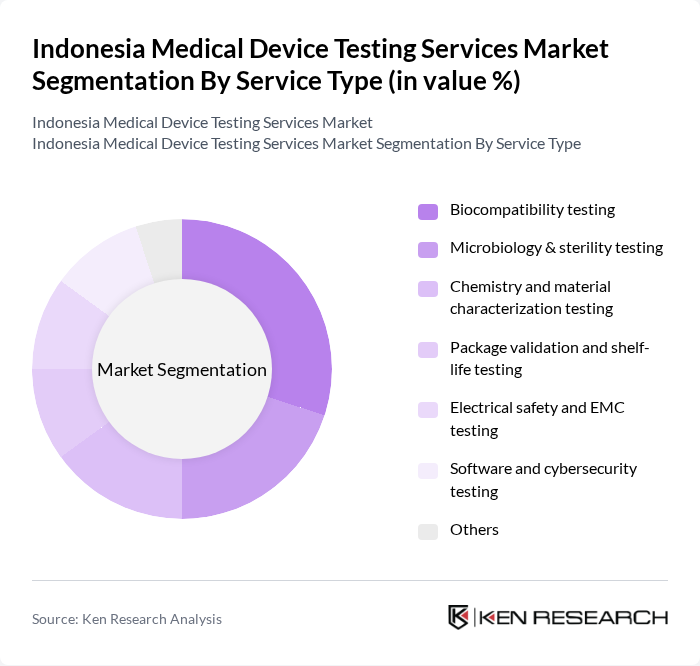
By Service Type:The service type segmentation includes various testing services essential for ensuring the safety and efficacy of medical devices. The subsegments include biocompatibility testing, microbiology & sterility testing, chemistry and material characterization testing, package validation and shelf-life testing, electrical safety and EMC testing, software and cybersecurity testing, and others. Among these, biocompatibility testing is currently the leading subsegment, in line with industry data that identifies biocompatibility tests as the largest revenue?generating service, driven by the increasing emphasis on patient safety, ISO 10993 compliance, and regulatory requirements for materials in contact with the body.
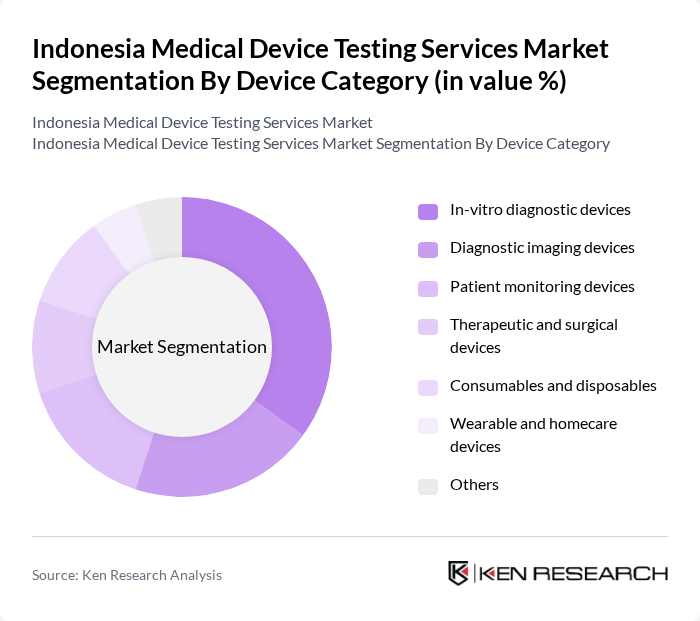
By Device Category:The device category segmentation encompasses various types of medical devices that require testing services. This includes in-vitro diagnostic devices, diagnostic imaging devices, patient monitoring devices, therapeutic and surgical devices, consumables and disposables, wearable and homecare devices, and others. The in-vitro diagnostic devices segment is currently the most significant, reflecting Indonesia’s high utilization of laboratory and rapid tests under BPJS coverage and the rising prevalence of chronic and infectious diseases that require reliable and rapid diagnostic solutions.
Indonesia Medical Device Testing Services Market Competitive Landscape
The Indonesia Medical Device Testing Services Market is characterized by a dynamic mix of regional and international players. Leading participants such as PT TÜV Rheinland Indonesia, PT SGS Indonesia, PT Intertek Utama Services, PT Sucofindo (Persero), PT Surveyor Indonesia, PT Qualis Indonesia (Qualis Indonesia Laboratory), PT Saraswanti Indo Genetech, PT Prodia Widyahusada Tbk (Prodia Diagnostic Laboratory), PT Bio Farma (Persero) – Biomedical & device testing facilities, Balai Besar Pengujian Alat Kesehatan (BBPOM / National Medical Device Testing Center), Badan Standardisasi Nasional (BSN) – SNI and conformity assessment bodies, PT Medivest Indonesia, PT Kalgen Innolab (Kalgen Laboratory), PT Kimia Farma Diagnostika, PT ITS Testing Services Indonesia contribute to innovation, geographic expansion, and service delivery in this space.
Indonesia Medical Device Testing Services Market Industry Analysis
Growth Drivers
- Increasing Healthcare Expenditure:Indonesia's healthcare expenditure is projected to reach IDR 1,200 trillion (approximately USD 78 billion) in future, reflecting a significant increase from IDR 1,000 trillion. This growth is driven by the government's commitment to improving healthcare access and quality, which directly impacts the demand for medical device testing services. As healthcare spending rises, manufacturers are increasingly seeking testing services to ensure compliance and enhance product quality, thereby driving market growth.
- Rising Demand for Quality Assurance:The Indonesian medical device market is experiencing a surge in demand for quality assurance, with an estimated 30% increase in the number of devices requiring testing in future. This demand is fueled by heightened consumer awareness and the need for reliable medical devices. As healthcare providers prioritize patient safety, manufacturers are compelled to invest in testing services to meet quality standards, thus propelling the growth of the medical device testing services market.
- Expansion of the Medical Device Market:The Indonesian medical device market is expected to grow to IDR 50 trillion (approximately USD 3.2 billion) in future, up from IDR 40 trillion. This expansion is driven by increasing healthcare needs, technological advancements, and a growing aging population. As the market expands, the demand for comprehensive testing services will rise, providing opportunities for testing service providers to cater to a broader range of medical devices and technologies.
Market Challenges
- High Costs of Testing Services:The costs associated with medical device testing services in Indonesia can be prohibitive, with average testing fees ranging from IDR 100 million to IDR 500 million (USD 6,500 to USD 32,500) per device. This financial burden can deter smaller manufacturers from seeking necessary testing, potentially compromising product quality and safety. As a result, the high costs present a significant challenge to the growth of the medical device testing services market.
- Limited Awareness Among Manufacturers:Many Indonesian manufacturers lack awareness of the importance of medical device testing, with approximately 40% of local companies not utilizing testing services. This gap in understanding can lead to subpar product quality and increased regulatory scrutiny. As manufacturers face challenges in navigating compliance requirements, the lack of awareness poses a significant barrier to the growth of the medical device testing services market in Indonesia.
Indonesia Medical Device Testing Services Market Future Outlook
The future of the Indonesia medical device testing services market appears promising, driven by technological advancements and increasing regulatory scrutiny. As manufacturers adopt automation and AI in testing processes, efficiency and accuracy will improve, enhancing service delivery. Additionally, the focus on sustainability will encourage the development of eco-friendly testing methodologies. These trends, combined with a growing emphasis on personalized medicine, will shape the market landscape, fostering innovation and expanding opportunities for service providers in the coming years.
Market Opportunities
- Growth in Telemedicine and Digital Health:The rise of telemedicine and digital health solutions presents a significant opportunity for medical device testing services. With an estimated 25% increase in telehealth usage in future, there is a growing need for testing services to ensure the reliability and safety of connected medical devices, thus creating a lucrative market segment for testing providers.
- Increasing Partnerships with Local Manufacturers:Collaborations between testing service providers and local manufacturers are on the rise, with a projected 15% increase in partnerships in future. These partnerships can enhance the capabilities of local manufacturers, ensuring compliance with international standards and improving product quality, thereby expanding the market for testing services in Indonesia.
Scope of the Report
| Segment | Sub-Segments |
|---|---|
| By Service Type | Biocompatibility testing Microbiology & sterility testing Chemistry and material characterization testing Package validation and shelf-life testing Electrical safety and EMC testing Software and cybersecurity testing Others |
| By Device Category | In-vitro diagnostic devices Diagnostic imaging devices Patient monitoring devices Therapeutic and surgical devices Consumables and disposables Wearable and homecare devices Others |
| By End-User | Medical device manufacturers Contract research organizations (CROs) Hospitals and diagnostic laboratories Academic and research institutes Others |
| By Regulatory Compliance Support | Indonesia local certification (MoH/BPOM, SNI) CE Marking (EU MDR/IVDR) U.S. FDA submissions Other international certifications |
| By Testing Phase | Preclinical testing Clinical performance and validation studies Post-market surveillance and vigilance testing Others |
| By Service Delivery Model | Outsourced / third-party testing services In-house testing services Hybrid / collaborative model Others |
| By Client Size | Multinational medical device companies Large domestic manufacturers Small & medium enterprises (SMEs) / start-ups Others |
Key Target Audience
Investors and Venture Capitalist Firms
Government and Regulatory Bodies (e.g., National Agency of Drug and Food Control, Ministry of Health)
Medical Device Manufacturers
Quality Assurance and Compliance Officers
Healthcare Providers and Hospitals
Medical Device Distributors
Industry Associations (e.g., Indonesian Medical Device Industry Association)
Insurance Companies and Payers
Players Mentioned in the Report:
PT TUV Rheinland Indonesia
PT SGS Indonesia
PT Intertek Utama Services
PT Sucofindo (Persero)
PT Surveyor Indonesia
PT Qualis Indonesia (Qualis Indonesia Laboratory)
PT Saraswanti Indo Genetech
PT Prodia Widyahusada Tbk (Prodia Diagnostic Laboratory)
PT Bio Farma (Persero) Biomedical & device testing facilities
Balai Besar Pengujian Alat Kesehatan (BBPOM / National Medical Device Testing Center)
Badan Standardisasi Nasional (BSN) SNI and conformity assessment bodies
PT Medivest Indonesia
PT Kalgen Innolab (Kalgen Laboratory)
PT Kimia Farma Diagnostika
PT ITS Testing Services Indonesia
Table of Contents
Market Assessment Phase
1. Executive Summary and Approach
2. Indonesia Medical Device Testing Services Market Overview
2.1 Key Insights and Strategic Recommendations
2.2 Indonesia Medical Device Testing Services Market Overview
2.3 Definition and Scope
2.4 Evolution of Market Ecosystem
2.5 Timeline of Key Regulatory Milestones
2.6 Value Chain & Stakeholder Mapping
2.7 Business Cycle Analysis
2.8 Policy & Incentive Landscape
3. Indonesia Medical Device Testing Services Market Analysis
3.1 Growth Drivers
3.1.1 Increasing healthcare expenditure
3.1.2 Rising demand for quality assurance
3.1.3 Expansion of the medical device market
3.1.4 Stringent regulatory requirements
3.2 Market Challenges
3.2.1 High costs of testing services
3.2.2 Limited awareness among manufacturers
3.2.3 Regulatory compliance complexities
3.2.4 Competition from international players
3.3 Market Opportunities
3.3.1 Growth in telemedicine and digital health
3.3.2 Increasing partnerships with local manufacturers
3.3.3 Development of innovative testing technologies
3.3.4 Expansion into underserved regions
3.4 Market Trends
3.4.1 Adoption of automation in testing processes
3.4.2 Focus on sustainability in testing services
3.4.3 Integration of AI in testing methodologies
3.4.4 Shift towards personalized medicine
3.5 Government Regulation
3.5.1 Implementation of ISO standards
3.5.2 Compliance with BPOM regulations
3.5.3 Introduction of local testing requirements
3.5.4 Support for R&D initiatives in medical devices
4. SWOT Analysis
5. Stakeholder Analysis
6. Porter's Five Forces Analysis
7. Indonesia Medical Device Testing Services Market Market Size, 2019-2024
7.1 By Value
7.2 By Volume
7.3 By Average Selling Price
8. Indonesia Medical Device Testing Services Market Segmentation
8.1 By Service Type
8.1.1 Biocompatibility testing
8.1.2 Microbiology & sterility testing
8.1.3 Chemistry and material characterization testing
8.1.4 Package validation and shelf-life testing
8.1.5 Electrical safety and EMC testing
8.1.6 Software and cybersecurity testing
8.1.7 Others
8.2 By Device Category
8.2.1 In-vitro diagnostic devices
8.2.2 Diagnostic imaging devices
8.2.3 Patient monitoring devices
8.2.4 Therapeutic and surgical devices
8.2.5 Consumables and disposables
8.2.6 Wearable and homecare devices
8.2.7 Others
8.3 By End-User
8.3.1 Medical device manufacturers
8.3.2 Contract research organizations (CROs)
8.3.3 Hospitals and diagnostic laboratories
8.3.4 Academic and research institutes
8.3.5 Others
8.4 By Regulatory Compliance Support
8.4.1 Indonesia local certification (MoH/BPOM, SNI)
8.4.2 CE Marking (EU MDR/IVDR)
8.4.3 U.S. FDA submissions
8.4.4 Other international certifications
8.5 By Testing Phase
8.5.1 Preclinical testing
8.5.2 Clinical performance and validation studies
8.5.3 Post-market surveillance and vigilance testing
8.5.4 Others
8.6 By Service Delivery Model
8.6.1 Outsourced / third-party testing services
8.6.2 In-house testing services
8.6.3 Hybrid / collaborative model
8.6.4 Others
8.7 By Client Size
8.7.1 Multinational medical device companies
8.7.2 Large domestic manufacturers
8.7.3 Small & medium enterprises (SMEs) / start-ups
8.7.4 Others
9. Indonesia Medical Device Testing Services Market Competitive Analysis
9.1 Market Share of Key Players
9.2 Cross Comparison of Key Players
9.2.1 Company name
9.2.2 Ownership and group type (global TIC, regional, local independent)
9.2.3 Estimated Indonesia medical device testing revenue
9.2.4 Revenue growth rate in medical device testing services
9.2.5 Number of accredited laboratories in Indonesia
9.2.6 Scope of accreditation (ISO/IEC 17025, ISO 15189, GLP, others)
9.2.7 Service mix (biocompatibility, microbiology, chemistry, electrical, software, etc.)
9.2.8 Average service turnaround time (days)
9.2.9 On-time delivery rate
9.2.10 Compliance rate with Indonesian and international regulatory standards
9.2.11 Share of revenue from export-oriented testing (for CE/FDA submissions)
9.2.12 Average pricing level vs market (premium, mid, value)
9.2.13 Key industry vertical focus (IVD, imaging, implants, disposables, etc.)
9.2.14 R&D and method development intensity (number of new methods/validations per year)
9.2.15 Strategic partnerships and key client relationships
9.3 SWOT Analysis of Top Players
9.4 Pricing Analysis
9.5 Detailed Profile of Major Companies
9.5.1 PT TÜV Rheinland Indonesia
9.5.2 PT SGS Indonesia
9.5.3 PT Intertek Utama Services
9.5.4 PT Sucofindo (Persero)
9.5.5 PT Surveyor Indonesia
9.5.6 PT Qualis Indonesia (Qualis Indonesia Laboratory)
9.5.7 PT Saraswanti Indo Genetech
9.5.8 PT Prodia Widyahusada Tbk (Prodia Diagnostic Laboratory)
9.5.9 PT Bio Farma (Persero) – Biomedical & device testing facilities
9.5.10 Balai Besar Pengujian Alat Kesehatan (BBPOM / National Medical Device Testing Center)
9.5.11 Badan Standardisasi Nasional (BSN) – SNI and conformity assessment bodies
9.5.12 PT Medivest Indonesia
9.5.13 PT Kalgen Innolab (Kalgen Laboratory)
9.5.14 PT Kimia Farma Diagnostika
9.5.15 PT ITS Testing Services Indonesia
10. Indonesia Medical Device Testing Services Market End-User Analysis
10.1 Procurement Behavior of Key Ministries
10.1.1 Ministry of Health
10.1.2 Ministry of Industry
10.1.3 Ministry of Research and Technology
10.1.4 Others
10.2 Corporate Spend on Infrastructure & Energy
10.2.1 Investment in medical infrastructure
10.2.2 Budget allocation for testing services
10.2.3 Funding for R&D initiatives
10.2.4 Others
10.3 Pain Point Analysis by End-User Category
10.3.1 Hospitals
10.3.2 Clinics
10.3.3 Manufacturers
10.3.4 Others
10.4 User Readiness for Adoption
10.4.1 Awareness of testing standards
10.4.2 Training and education needs
10.4.3 Infrastructure readiness
10.4.4 Others
10.5 Post-Deployment ROI and Use Case Expansion
10.5.1 Measurement of testing effectiveness
10.5.2 Expansion into new device categories
10.5.3 Long-term partnerships with manufacturers
10.5.4 Others
11. Indonesia Medical Device Testing Services Market Future Size, 2025-2030
11.1 By Value
11.2 By Volume
11.3 By Average Selling Price
Go-To-Market Strategy Phase
1. Whitespace Analysis + Business Model Canvas
1.1 Market Gaps Identification
1.2 Business Model Development
2. Marketing and Positioning Recommendations
2.1 Branding Strategies
2.2 Product USPs
3. Distribution Plan
3.1 Urban Retail vs Rural NGO Tie-ups
4. Channel & Pricing Gaps
4.1 Underserved Routes
4.2 Pricing Bands
5. Unmet Demand & Latent Needs
5.1 Category Gaps
5.2 Consumer Segments
6. Customer Relationship
6.1 Loyalty Programs
6.2 After-sales Service
7. Value Proposition
7.1 Sustainability
7.2 Integrated Supply Chains
8. Key Activities
8.1 Regulatory Compliance
8.2 Branding
8.3 Distribution Setup
9. Entry Strategy Evaluation
9.1 Domestic Market Entry Strategy
9.1.1 Product Mix
9.1.2 Pricing Band
9.1.3 Packaging
9.2 Export Entry Strategy
9.2.1 Target Countries
9.2.2 Compliance Roadmap
10. Entry Mode Assessment
10.1 JV
10.2 Greenfield
10.3 M&A
10.4 Distributor Model
11. Capital and Timeline Estimation
11.1 Capital Requirements
11.2 Timelines
12. Control vs Risk Trade-Off
12.1 Ownership vs Partnerships
13. Profitability Outlook
13.1 Breakeven Analysis
13.2 Long-term Sustainability
14. Potential Partner List
14.1 Distributors
14.2 JVs
14.3 Acquisition Targets
15. Execution Roadmap
15.1 Phased Plan for Market Entry
15.1.1 Market Setup
15.1.2 Market Entry
15.1.3 Growth Acceleration
15.1.4 Scale & Stabilize
15.2 Key Activities and Milestones
15.2.1 Milestone Planning
15.2.2 Activity Tracking
Research Methodology
Phase 1: Approach1
Desk Research
- Analysis of industry reports from the Indonesian Ministry of Health and related regulatory bodies
- Review of market studies and publications from medical device associations in Indonesia
- Examination of trade journals and articles focusing on medical device testing and compliance standards
Primary Research
- Interviews with key stakeholders in medical device manufacturing and testing services
- Surveys conducted with regulatory experts and compliance officers in the healthcare sector
- Field interviews with laboratory managers and technicians involved in medical device testing
Validation & Triangulation
- Cross-validation of findings through multiple data sources, including government and industry reports
- Triangulation of insights from primary interviews with secondary data trends
- Sanity checks performed through expert panel discussions and feedback sessions
Phase 2: Market Size Estimation1
Top-down Assessment
- Estimation of the overall healthcare expenditure in Indonesia as a basis for market size
- Segmentation of the market by device categories and testing service types
- Incorporation of growth rates from historical data and projected healthcare trends
Bottom-up Modeling
- Collection of data on the number of medical devices tested annually by leading laboratories
- Estimation of service pricing based on competitive analysis of testing service providers
- Calculation of market size based on volume of tests conducted and average pricing
Forecasting & Scenario Analysis
- Development of forecasting models based on healthcare policy changes and technological advancements
- Scenario analysis considering potential impacts of regulatory changes on testing services
- Projections of market growth under various economic conditions through 2030
Phase 3: CATI Sample Composition1
| Scope Item/Segment | Sample Size | Target Respondent Profiles |
|---|---|---|
| Medical Device Manufacturers | 90 | Quality Assurance Managers, Regulatory Affairs Specialists |
| Testing Laboratories | 70 | Laboratory Directors, Compliance Officers |
| Healthcare Providers | 60 | Clinical Engineers, Procurement Managers |
| Regulatory Bodies | 40 | Policy Makers, Health Inspectors |
| Industry Associations | 50 | Executive Directors, Research Analysts |
Frequently Asked Questions
What is the current value of the Indonesia Medical Device Testing Services Market?
The Indonesia Medical Device Testing Services Market is valued at approximately USD 140 million, reflecting a significant growth driven by increasing demand for high-quality medical devices and stringent regulatory requirements from the Ministry of Health and related agencies.
What factors are driving the growth of the medical device testing services market in Indonesia?
Which cities are the primary hubs for medical device testing services in Indonesia?
What are the main types of testing services offered in the Indonesia Medical Device Testing Services Market?
Other Regional/Country Reports
Malaysia Medical Device Testing Services Market
APAC Medical Device Testing Services Market
SEA Medical Device Testing Services Market
Vietnam Medical Device Testing Services Market
Other Adjacent Reports
South Korea Medical Device Manufacturing Market
Saudi Arabia In-Vitro Diagnostics Market Outlook to 2030Mexico Diagnostic Imaging Market
APAC patient monitoring devices market Size, Share, Growth Drivers, Trends, Opportunities & Forecast 2025–2030Thailand Therapeutic Devices Market
Bahrain Healthcare Regulatory Services Market
Singapore Biocompatibility Testing Market
UAE Microbiology Testing MarketJapan Electrical Safety Testing Market
Egypt Software Testing Services Market
Why Buy From Us?

What makes us stand out is that our consultants follow Robust, Refine and Result (RRR) methodology. Robust for clear definitions, approaches and sanity checking, Refine for differentiating respondents' facts and opinions, and Result for presenting data with story.

We have set a benchmark in the industry by offering our clients with syndicated and customized market research reports featuring coverage of entire market as well as meticulous research and analyst insights.

While we don't replace traditional research, we flip the method upside down. Our dual approach of Top Bottom & Bottom Top ensures quality deliverable by not just verifying company fundamentals but also looking at the sector and macroeconomic factors.

With one step in the future, our research team constantly tries to show you the bigger picture. We help with some of the tough questions you may encounter along the way: How is the industry positioned? Best marketing channel? KPI's of competitors? By aligning every element, we help maximize success.

Our report gives you instant access to the answers and sources that other companies might choose to hide. We elaborate each steps of research methodology we have used and showcase you the sample size to earn your trust.

If you need any support, we are here! We pride ourselves on universe strength, data quality, and quick, friendly, and professional service.