Indonesia Motion Sensors Market Size Share Growth Drivers Trends Opportunities & Forecast 2025–2030

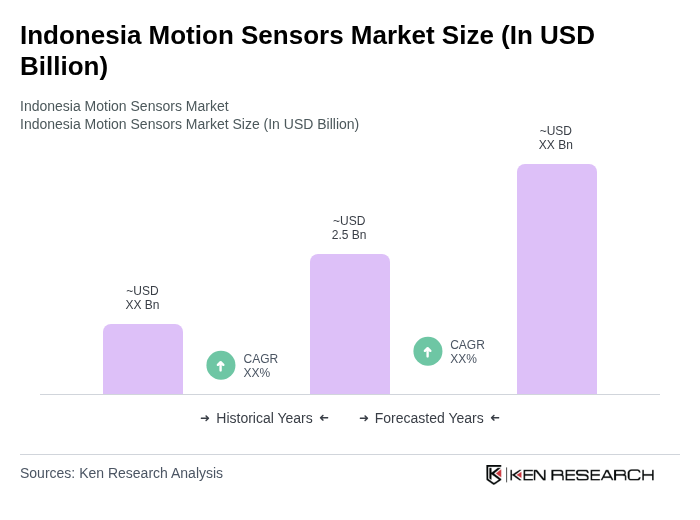
Indonesia motion sensors market grows with IoT and smart infrastructure, valued at $2.5Bn.

Region:Asia

Author(s):Rebecca

Product Code:KRAB0832

Pages:91

Published On:December 2025
About the Report

Base Year 2024

Indonesia Motion Sensors Market Overview

  • The Indonesia Motion Sensors Market is part of the broader Indonesia Sensors and Smart Sensors Market, with motion and related sensing components in Indonesia estimated at approximately USD 2.5 billion based on a synthesis of recent global motion sensor and regional smart sensor assessments. This growth is primarily driven by increasing digitization across manufacturing and construction sectors, expanding demand for automation in logistics and smart systems, and the rapid adoption of smart devices. The trend toward integrating motion detection within IoT-enabled equipment, building automation, and smart infrastructure also fuels demand for these sensor technologies.
  • Key players in this market include Mitsubishi Electric, Honeywell, Sony Semiconductor Solutions, Bosch Sensortec, and TSMC, which are all active global suppliers of motion and MEMS-based sensors used in consumer electronics, industrial automation, and automotive systems. These companies play a significant role in driving growth and maintaining high standards in sensor technology across Asia-Pacific, supported by rising urbanization and industrial modernization in Indonesia, with domestic integration of sensor technologies into automotive assembly, consumer electronics, energy management, and smart city projects.
  • The Indonesian government’s "Making Indonesia 4.0" initiative, launched by the Ministry of Industry through the Making Indonesia 4.0 Roadmap issued in 2018, prioritizes digitalization of key sectors including automotive, electronics, chemicals, food and beverage, and textiles, and encourages deployment of advanced sensors, robotics, and IoT to raise productivity and competitiveness. This broader manufacturing and digital transformation agenda, supported by national programs for smart industry and infrastructure, positions motion sensors within a supportive regulatory and industry development ecosystem, particularly for factory automation, smart buildings, and smart city applications.
Indonesia Motion Sensors Market Size

Indonesia Motion Sensors Market Segmentation

By Sensor Type:The motion sensors market is segmented into various sensor types, including MEMS accelerometers, MEMS gyroscopes, MEMS magnetometers, sensor combos, and others, which is consistent with the typical structure of the global motion sensor market. Among these, MEMS accelerometers are widely used in smartphones, wearables, automotive safety systems, and industrial monitoring, while multi?axis sensor combos (combining accelerometers, gyroscopes, and sometimes magnetometers) are increasingly adopted in consumer electronics, gaming, AR/VR, and robotics for higher precision motion tracking. MEMS gyroscopes and magnetometers contribute to orientation and navigation functions, particularly in automotive and IoT devices, and other motion-sensing technologies such as radar and ultrasonic modules complement MEMS sensors in security and industrial automation applications.
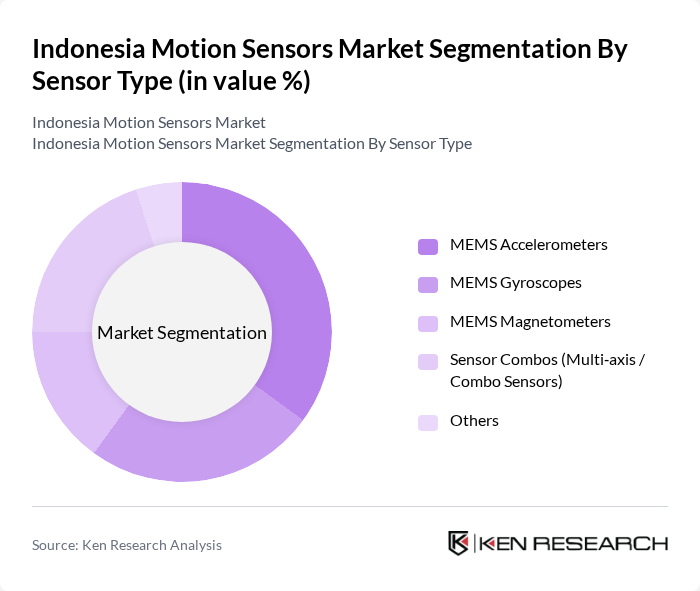
Indonesia Motion Sensors Market segmentation by Sensor Type.

By Motion Technology:The market is also segmented by motion technology into active and passive technologies, reflecting common categorization in global motion sensing applications. Active motion sensors, such as ultrasonic and microwave sensors, are gaining traction in industrial automation, transport, and perimeter security due to their ability to detect motion over longer distances and in various environmental conditions. However, passive infrared (PIR) sensors remain widely deployed in lighting control, building automation, and residential and commercial security because of their cost-effectiveness, low power consumption, and ease of integration into smart lighting and HVAC control systems.
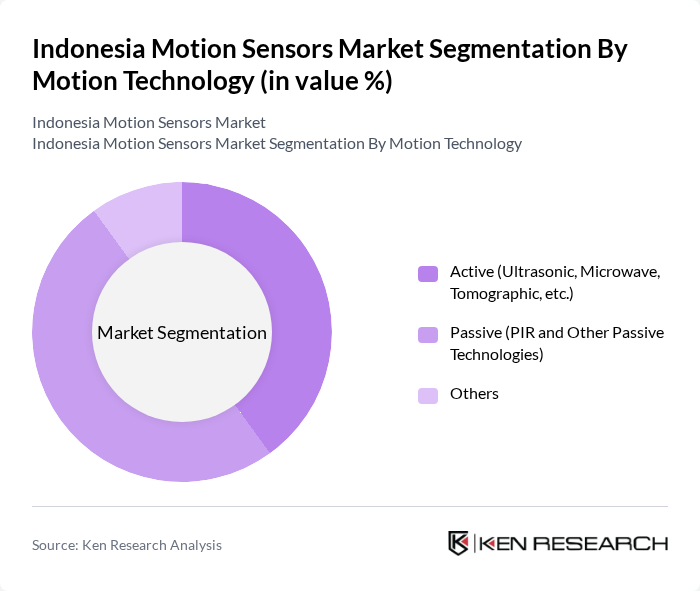
Indonesia Motion Sensors Market segmentation by Motion Technology.

Indonesia Motion Sensors Market Competitive Landscape

The Indonesia Motion Sensors Market is characterized by a dynamic mix of regional and international players. Leading participants such as PT Schneider Electric Indonesia, PT Honeywell Indonesia, PT Siemens Indonesia, PT Bosch Rexroth Indonesia, PT Panasonic Gobel Indonesia, PT Samsung Electronics Indonesia, PT Hikvision Indonesia, PT Dahua Technology Indonesia, PT ZKTeco Indonesia, PT Axis Communications Indonesia, PT D-Link Indonesia, PT Johnson Controls Indonesia, PT Honeywell Security Indonesia, PT FLIR Systems Indonesia, and other regional and local motion sensor suppliers contribute to innovation, geographic expansion, and service delivery in this space, leveraging global portfolios in motion sensing, security, building automation, and industrial control tailored for Indonesian infrastructure and manufacturing projects.

PT Schneider Electric Indonesia

1996

Jakarta, Indonesia

PT Honeywell Indonesia

1992

Jakarta, Indonesia

PT Siemens Indonesia

1989

Jakarta, Indonesia

PT Bosch Rexroth Indonesia

2003

Jakarta, Indonesia

PT Panasonic Gobel Indonesia

1970

Jakarta, Indonesia

Company

Establishment Year

Headquarters

Group Size (Large, Medium, or Small as per industry convention)

Indonesia Motion Sensor Revenue (USD Mn)

Indonesia Motion Sensor Revenue CAGR (Historical & Forecast)

Market Share in Indonesia Motion Sensors (%)

Installed Base / Shipments in Indonesia (Units)

R&D Intensity (% of Revenue Spent on R&D)

Indonesia Motion Sensors Market Industry Analysis

Growth Drivers

  • GDP Growth and Investment Momentum:Indonesia's GDP is projected to grow at an average of 5.2 percent annually in the future, with inflation expected around 3.2 percent. This stable economic environment encourages capital investment, which is crucial for the adoption of advanced technologies, including motion sensors. The benchmark interest rate is set at 6.5 percent, facilitating borrowing for businesses looking to invest in automation and smart technologies.
  • Expanding Digital Infrastructure:Since 2015, nearly US $30 billion has been invested in Indonesia's mobile network infrastructure, with an additional US $17 billion projected in the future. This investment supports the rollout of 5G technology, which is expected to contribute up to US $42 billion to GDP in the future. Enhanced connectivity is essential for the proliferation of IoT applications, including motion sensors, across various sectors.
  • Surging Internet Penetration and Digital Adoption:As of early 2024, Indonesia boasts 222 million internet users, translating to an internet penetration rate of 80 percent. The rapid growth in digital payment systems, with nearly 62 million QRIS users, indicates a strong consumer readiness for connected devices. This trend is likely to drive demand for motion sensors in smart homes, retail environments, and urban applications, enhancing overall market growth.

Market Challenges

  • Digital Infrastructure and Connectivity Gaps:Approximately 58 million Indonesians, or nearly 19 percent of the population, still lack reliable internet access. This significant connectivity gap, particularly in rural areas, poses a challenge for the widespread adoption of IoT devices, including motion sensors. Limited access to digital infrastructure restricts market reach and hinders the potential for growth in these regions.
  • Regulatory and Governance Weaknesses in Data Protection:The enforcement of the Personal Data Protection (PDP) Law remains weak, with insufficient institutional coordination. This lack of clarity in data privacy regulations can deter businesses from adopting motion sensors, as compliance becomes complicated. The uncertainty surrounding data governance frameworks may hinder the growth of sensor technologies in consumer and industrial applications.

Indonesia Motion Sensors Market Future Outlook

The future of the motion sensors market in Indonesia appears promising, driven by advancements in AI and digital infrastructure. Strategic initiatives, including a national AI roadmap and significant investments in data centers, are expected to enhance the deployment of sensor technologies in future. Additionally, the integration of motion sensors into smart city frameworks and healthcare applications will likely accelerate, supported by government policies aimed at digital transformation and sustainability.

Market Opportunities

  • Smart City and Public Services:The government's Digital Public Infrastructure (DPI) strategy opens avenues for deploying motion sensors in traffic management and public facility monitoring. This integration aligns with the "Digital Nusantara" initiative, which aims to enhance urban efficiency and service delivery through advanced technologies.
  • Healthcare and AI-Enabled Monitoring:The focus on AI in healthcare, supported by the sovereign wealth fund INA, presents opportunities for sensor-enabled health monitoring tools. Motion sensors integrated with AI can facilitate patient tracking and automate healthcare facilities, enhancing service delivery and operational efficiency.

Scope of the Report

SegmentSub-Segments
By Sensor Type

MEMS Accelerometers

MEMS Gyroscopes

MEMS Magnetometers

Sensor Combos (Multi?axis / Combo Sensors)

Others

By Motion Technology

Active (Ultrasonic, Microwave, Tomographic, etc.)

Passive (PIR and Other Passive Technologies)

Others

By Function

Fully Automatic

Semi-Automatic

Others

By Application

Consumer Electronics

Automotive

Industrial & Manufacturing

Healthcare & Medical Devices

Building Automation & Security (Residential & Commercial)

Aerospace & Defense

Others

By End-User

Residential

Commercial

Industrial

Government & Utilities

Others

By Region

Java

Sumatra

Bali & Nusa Tenggara

Kalimantan

Sulawesi, Maluku & Papua

By Sales Channel

OEM (Integrated into Devices & Systems)

Aftermarket / Replacement

Distributors & System Integrators

Online & Retail Channels

Key Target Audience

Investors and Venture Capitalist Firms

Government and Regulatory Bodies (e.g., Badan Standardisasi Nasional, Kementerian Perindustrian)

Manufacturers and Producers

Distributors and Retailers

Technology Providers

Industry Associations (e.g., Asosiasi IoT Indonesia)

Financial Institutions

Smart Home and Building Automation Companies

Players Mentioned in the Report:

PT Schneider Electric Indonesia

PT Honeywell Indonesia

PT Siemens Indonesia

PT Bosch Rexroth Indonesia

PT Panasonic Gobel Indonesia

PT Samsung Electronics Indonesia

PT Hikvision Indonesia

PT Dahua Technology Indonesia

PT ZKTeco Indonesia

PT Axis Communications Indonesia

PT D-Link Indonesia

PT Johnson Controls Indonesia

PT Honeywell Security Indonesia

PT FLIR Systems Indonesia

Other Regional and Local Motion Sensor Suppliers

Table of Contents

Market Assessment Phase

1. Executive Summary and Approach


2. Indonesia Motion Sensors Market Overview

2.1 Key Insights and Strategic Recommendations

2.2 Indonesia Motion Sensors Market Overview

2.3 Definition and Scope

2.4 Evolution of Market Ecosystem

2.5 Timeline of Key Regulatory Milestones

2.6 Value Chain & Stakeholder Mapping

2.7 Business Cycle Analysis

2.8 Policy & Incentive Landscape


3. Indonesia Motion Sensors Market Analysis

3.1 Growth Drivers

3.1.1 Increasing demand for smart home technology
3.1.2 Rising security concerns in urban areas
3.1.3 Government initiatives promoting automation
3.1.4 Growth in the automotive sector

3.2 Market Challenges

3.2.1 High initial investment costs
3.2.2 Limited awareness among consumers
3.2.3 Regulatory hurdles
3.2.4 Competition from alternative technologies

3.3 Market Opportunities

3.3.1 Expansion in the industrial automation sector
3.3.2 Development of IoT-integrated solutions
3.3.3 Increasing adoption in healthcare applications
3.3.4 Potential in energy management systems

3.4 Market Trends

3.4.1 Shift towards wireless motion sensors
3.4.2 Integration with AI and machine learning
3.4.3 Growing focus on energy efficiency
3.4.4 Rise of multi-functional sensors

3.5 Government Regulation

3.5.1 Standards for safety and performance
3.5.2 Incentives for green technology adoption
3.5.3 Data privacy regulations impacting sensor use
3.5.4 Import tariffs on electronic components

4. SWOT Analysis


5. Stakeholder Analysis


6. Porter's Five Forces Analysis


7. Indonesia Motion Sensors Market Market Size, 2019-2024

7.1 By Value

7.2 By Volume

7.3 By Average Selling Price


8. Indonesia Motion Sensors Market Segmentation

8.1 By Sensor Type

8.1.1 MEMS Accelerometers
8.1.2 MEMS Gyroscopes
8.1.3 MEMS Magnetometers
8.1.4 Sensor Combos (Multi?axis / Combo Sensors)
8.1.5 Others

8.2 By Motion Technology

8.2.1 Active (Ultrasonic, Microwave, Tomographic, etc.)
8.2.2 Passive (PIR and Other Passive Technologies)
8.2.3 Others

8.3 By Function

8.3.1 Fully Automatic
8.3.2 Semi-Automatic
8.3.3 Others

8.4 By Application

8.4.1 Consumer Electronics
8.4.2 Automotive
8.4.3 Industrial & Manufacturing
8.4.4 Healthcare & Medical Devices
8.4.5 Building Automation & Security (Residential & Commercial)
8.4.6 Aerospace & Defense
8.4.7 Others

8.5 By End-User

8.5.1 Residential
8.5.2 Commercial
8.5.3 Industrial
8.5.4 Government & Utilities
8.5.5 Others

8.6 By Region

8.6.1 Java
8.6.2 Sumatra
8.6.3 Bali & Nusa Tenggara
8.6.4 Kalimantan
8.6.5 Sulawesi, Maluku & Papua

8.7 By Sales Channel

8.7.1 OEM (Integrated into Devices & Systems)
8.7.2 Aftermarket / Replacement
8.7.3 Distributors & System Integrators
8.7.4 Online & Retail Channels

9. Indonesia Motion Sensors Market Competitive Analysis

9.1 Market Share of Key Players

9.2 Cross Comparison of Key Players

9.2.1 Company Name
9.2.2 Group Size (Large, Medium, or Small as per industry convention)
9.2.3 Indonesia Motion Sensor Revenue (USD Mn)
9.2.4 Indonesia Motion Sensor Revenue CAGR (Historical & Forecast)
9.2.5 Market Share in Indonesia Motion Sensors (%)
9.2.6 Installed Base / Shipments in Indonesia (Units)
9.2.7 R&D Intensity (% of Revenue Spent on R&D)
9.2.8 Product Portfolio Breadth (Number of Motion Sensor SKUs / Families)
9.2.9 Average Selling Price Positioning (Premium / Mid / Value)
9.2.10 Channel Mix (% Revenue by OEM, Distribution, Online, Direct)
9.2.11 Key Customer / Project Concentration (% Top 5 Customers)
9.2.12 EBITDA Margin (%) – Indonesia Operations
9.2.13 Return on Invested Capital (ROIC) – Indonesia Motion Sensor Business
9.2.14 New Product Launches in Last 3 Years (Count)
9.2.15 Patent / IP Portfolio Related to Motion Sensing (Count, Indonesia-Relevant)

9.3 SWOT Analysis of Top Players

9.4 Pricing Analysis

9.5 Detailed Profile of Major Companies

9.5.1 PT Schneider Electric Indonesia
9.5.2 PT Honeywell Indonesia
9.5.3 PT Siemens Indonesia
9.5.4 PT Bosch Rexroth Indonesia
9.5.5 PT Panasonic Gobel Indonesia
9.5.6 PT Samsung Electronics Indonesia
9.5.7 PT Hikvision Indonesia
9.5.8 PT Dahua Technology Indonesia
9.5.9 PT ZKTeco Indonesia
9.5.10 PT Axis Communications Indonesia
9.5.11 PT D-Link Indonesia
9.5.12 PT Johnson Controls Indonesia
9.5.13 PT Honeywell Security Indonesia
9.5.14 PT FLIR Systems Indonesia
9.5.15 Other Regional and Local Motion Sensor Suppliers

10. Indonesia Motion Sensors Market End-User Analysis

10.1 Procurement Behavior of Key Ministries

10.1.1 Budget Allocation Trends
10.1.2 Decision-Making Processes
10.1.3 Preferred Suppliers
10.1.4 Procurement Cycles

10.2 Corporate Spend on Infrastructure & Energy

10.2.1 Investment Trends
10.2.2 Key Projects
10.2.3 Budget Priorities
10.2.4 Spending Forecasts

10.3 Pain Point Analysis by End-User Category

10.3.1 Security Concerns
10.3.2 Integration Challenges
10.3.3 Cost Management Issues
10.3.4 Technology Adoption Barriers

10.4 User Readiness for Adoption

10.4.1 Awareness Levels
10.4.2 Training Needs
10.4.3 Infrastructure Readiness
10.4.4 Support Requirements

10.5 Post-Deployment ROI and Use Case Expansion

10.5.1 Performance Metrics
10.5.2 User Feedback
10.5.3 Case Studies
10.5.4 Future Expansion Plans

11. Indonesia Motion Sensors Market Future Size, 2025-2030

11.1 By Value

11.2 By Volume

11.3 By Average Selling Price


Go-To-Market Strategy Phase

1. Whitespace Analysis + Business Model Canvas

1.1 Market Gaps Identification

1.2 Value Proposition Development

1.3 Revenue Streams

1.4 Key Partnerships

1.5 Cost Structure Analysis


2. Marketing and Positioning Recommendations

2.1 Branding Strategies

2.2 Product USPs


3. Distribution Plan

3.1 Urban Retail vs Rural NGO Tie-ups


4. Channel & Pricing Gaps

4.1 Underserved Routes

4.2 Pricing Bands


5. Unmet Demand & Latent Needs

5.1 Category Gaps

5.2 Consumer Segments


6. Customer Relationship

6.1 Loyalty Programs

6.2 After-sales Service


7. Value Proposition

7.1 Sustainability

7.2 Integrated Supply Chains


8. Key Activities

8.1 Regulatory Compliance

8.2 Branding

8.3 Distribution Setup


9. Entry Strategy Evaluation

9.1 Domestic Market Entry Strategy

9.1.1 Product Mix
9.1.2 Pricing Band
9.1.3 Packaging

9.2 Export Entry Strategy

9.2.1 Target Countries
9.2.2 Compliance Roadmap

10. Entry Mode Assessment

10.1 JV

10.2 Greenfield

10.3 M&A

10.4 Distributor Model


11. Capital and Timeline Estimation

11.1 Capital Requirements

11.2 Timelines


12. Control vs Risk Trade-Off

12.1 Ownership vs Partnerships


13. Profitability Outlook

13.1 Breakeven Analysis

13.2 Long-term Sustainability


14. Potential Partner List

14.1 Distributors

14.2 JVs

14.3 Acquisition Targets


15. Execution Roadmap

15.1 Phased Plan for Market Entry

15.1.1 Market Setup
15.1.2 Market Entry
15.1.3 Growth Acceleration
15.1.4 Scale & Stabilize

15.2 Key Activities and Milestones

15.2.1 Milestone Planning
15.2.2 Activity Tracking

Research Methodology

ApproachModellingSample

Phase 1: Approach1

Desk Research

  • Industry reports from government agencies and market research firms focusing on motion sensor technology in Indonesia
  • Analysis of trade publications and journals detailing advancements in motion sensor applications across various sectors
  • Review of academic papers and white papers discussing the technological evolution and market trends of motion sensors

Primary Research

  • Interviews with industry experts, including engineers and product managers from leading motion sensor manufacturers
  • Surveys conducted with end-users in sectors such as automotive, consumer electronics, and smart home technology
  • Field visits to manufacturing facilities to gather insights on production processes and technology adoption

Validation & Triangulation

  • Cross-validation of findings through multiple data sources, including sales data and market forecasts
  • Triangulation of insights from primary interviews with secondary data trends to ensure consistency
  • Sanity checks through expert panel reviews to validate assumptions and projections

Phase 2: Market Size Estimation1

Top-down Assessment

  • Estimation of the overall market size based on national electronics and sensor market growth rates
  • Segmentation of the market by application areas such as automotive, industrial, and consumer electronics
  • Incorporation of government initiatives promoting smart technology adoption in urban planning

Bottom-up Modeling

  • Collection of sales data from key manufacturers and distributors of motion sensors in Indonesia
  • Estimation of market size based on unit sales and average selling prices across different sensor types
  • Analysis of growth rates in specific sectors to project future demand for motion sensors

Forecasting & Scenario Analysis

  • Development of forecasting models using historical data and market trends to project future growth
  • Scenario analysis based on varying levels of technology adoption and regulatory impacts on the motion sensor market
  • Creation of baseline, optimistic, and pessimistic scenarios to assess potential market fluctuations through 2030

Phase 3: CATI Sample Composition1

Scope Item/SegmentSample SizeTarget Respondent Profiles
Automotive Motion Sensors100Product Engineers, R&D Managers
Consumer Electronics Applications80Product Managers, Marketing Directors
Industrial Automation Sensors70Operations Managers, Automation Specialists
Smart Home Technology90Home Automation Experts, Sales Managers
Healthcare Motion Sensors60Healthcare Technology Managers, Biomedical Engineers

Frequently Asked Questions

What is the current size of the Indonesia Motion Sensors Market?

The Indonesia Motion Sensors Market is estimated to be approximately USD 2.5 billion, driven by increasing digitization in manufacturing, construction, and the rapid adoption of smart devices across various sectors.

What are the key drivers of growth in the Indonesia Motion Sensors Market?

Who are the major players in the Indonesia Motion Sensors Market?

What types of motion sensors are prevalent in Indonesia?

Other Regional/Country Reports

Malaysia Motion Sensors Market

KSA Motion Sensors Market

APAC Motion Sensors Market

SEA Motion Sensors Market

Vietnam Motion Sensors Market

Thailand Motion Sensors Market

Why Buy From Us?

Refine Robust Result (RRR) Framework

What makes us stand out is that our consultants follow Robust, Refine and Result (RRR) methodology. Robust for clear definitions, approaches and sanity checking, Refine for differentiating respondents' facts and opinions, and Result for presenting data with story.

Our Reach Is Unmatched

We have set a benchmark in the industry by offering our clients with syndicated and customized market research reports featuring coverage of entire market as well as meticulous research and analyst insights.

Shifting the Research Paradigm

While we don't replace traditional research, we flip the method upside down. Our dual approach of Top Bottom & Bottom Top ensures quality deliverable by not just verifying company fundamentals but also looking at the sector and macroeconomic factors.

More Insights-Better Decisions

With one step in the future, our research team constantly tries to show you the bigger picture. We help with some of the tough questions you may encounter along the way: How is the industry positioned? Best marketing channel? KPI's of competitors? By aligning every element, we help maximize success.

Transparency and Trust

Our report gives you instant access to the answers and sources that other companies might choose to hide. We elaborate each steps of research methodology we have used and showcase you the sample size to earn your trust.

Round the Clock Support

If you need any support, we are here! We pride ourselves on universe strength, data quality, and quick, friendly, and professional service.

Why Clients Choose Us?

400000+
Reports in repository
150+
Consulting projects a year
100+
Analysts
8000+
Client Queries in 2022








