Region:Africa
Author(s):Geetanshi
Product Code:KRAE1770
Pages:113
Published On:December 2025

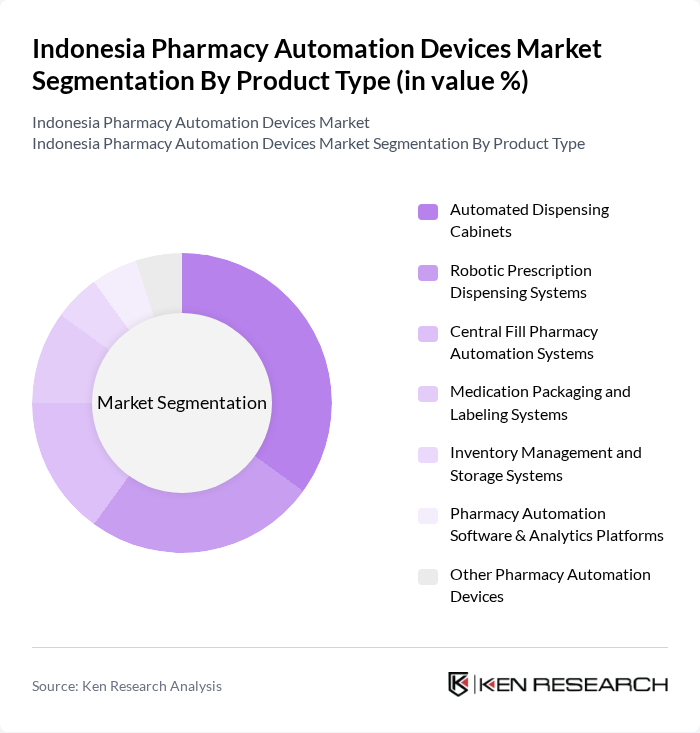
By Product Type:The product type segmentation includes various automation devices that enhance pharmacy operations. The leading sub-segment is Automated Dispensing Cabinets, which are widely adopted for their efficiency in managing medication dispensing, improving access control, and supporting unit-dose management in hospital wards and central pharmacies. Robotic Prescription Dispensing Systems are also gaining traction, particularly in high-volume hospital and chain pharmacy environments, due to their ability to minimize human error, improve workflow, and handle complex prescription mixes. Other notable segments include Central Fill Pharmacy Automation Systems and Medication Packaging and Labeling Systems, which cater to the growing demand for centralized prescription filling, compliance packaging (such as unit-dose and multi-dose blister packs), and streamlined pharmacy operations in large hospital networks and retail chains.
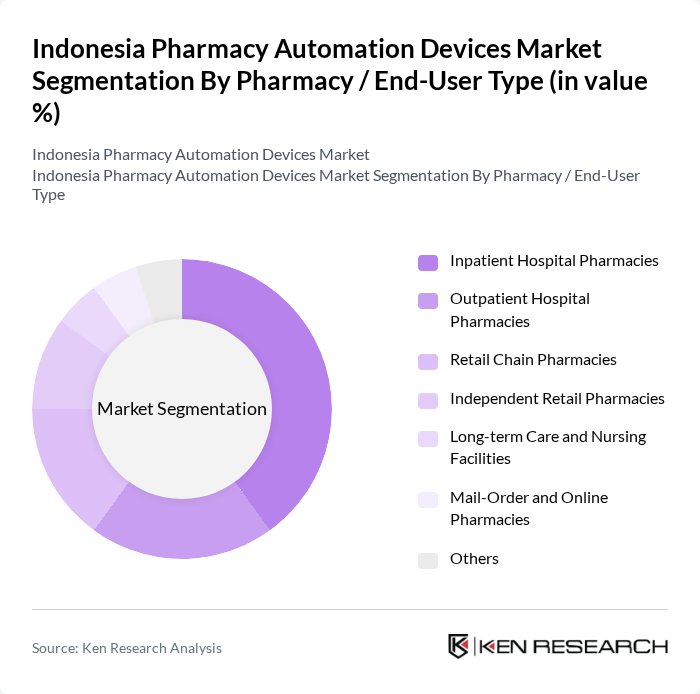
By Pharmacy / End-User Type:The end-user segmentation highlights the various types of pharmacies utilizing automation devices. Inpatient Hospital Pharmacies lead the market due to their high volume of medication dispensing, more stringent patient safety and documentation requirements, and the need for efficient inventory management supported by automated dispensing cabinets and central pharmacy systems. Outpatient Hospital Pharmacies and Retail Chain Pharmacies are also significant contributors, driven by the increasing demand for quick and accurate medication delivery, integration with hospital information systems, and the expansion of branded retail networks across major Indonesian cities. Independent Retail Pharmacies and Long-term Care Facilities are gradually adopting automation, particularly software, inventory management tools, and smaller-scale dispensing and packaging solutions, to enhance service quality, reduce stock-outs, and improve operational efficiency.
The Indonesia Pharmacy Automation Devices Market is characterized by a dynamic mix of regional and international players. Leading participants such as PT Kimia Farma Tbk (Kimia Farma Apotek & Hospital Pharmacy Network), PT Kalbe Farma Tbk (Including Mitra Keluarga & Associated Hospital Networks), PT Pharos Indonesia (Century Healthcare & Viva Health Pharmacy Chains), PT Soho Global Health Tbk (SOHO Group Pharmacy and Distribution Network), PT Guardian Pharmatama (Guardian Indonesia Retail Pharmacy Chain), PT Apotek K-24 Indonesia (Apotek K-24 24-Hour Pharmacy Chain), PT Enseval Putera Megatrading Tbk (Hospital & Pharmacy Distribution – Automation Integrator), PT Anugrah Argon Medica (AAM) – Dexa Group (Healthcare Distribution & Automation Solutions), PT Mitra Keluarga Karyasehat Tbk (Hospital Pharmacy Automation Adopter), PT Siloam International Hospitals Tbk (Siloam Hospitals Pharmacy Automation Adopter), PT Omron Healthcare Indonesia (Medication Management and Monitoring Devices), BD (Becton, Dickinson and Company) – Indonesia Operations, Omnicell, Inc. – Indonesia Channel Partners, BD Rowa™ – Automated Storage and Dispensing Systems in Indonesia, Swisslog Healthcare – Pharmacy Automation Projects in Indonesia contribute to innovation, geographic expansion, and service delivery in this space.
The future of the pharmacy automation market in Indonesia appears promising, driven by ongoing technological advancements and increasing healthcare demands. As the government continues to invest in healthcare infrastructure, pharmacies are likely to adopt more automated solutions to enhance efficiency and patient safety. Additionally, the integration of AI and machine learning technologies is expected to revolutionize pharmacy operations, making them more responsive to patient needs and improving overall service delivery in future.
| Segment | Sub-Segments |
|---|---|
| By Product Type | Automated Dispensing Cabinets Robotic Prescription Dispensing Systems Central Fill Pharmacy Automation Systems Medication Packaging and Labeling Systems Inventory Management and Storage Systems Pharmacy Automation Software & Analytics Platforms Other Pharmacy Automation Devices |
| By Pharmacy / End-User Type | Inpatient Hospital Pharmacies Outpatient Hospital Pharmacies Retail Chain Pharmacies Independent Retail Pharmacies Long-term Care and Nursing Facilities Mail-Order and Online Pharmacies Others |
| By Region | Java Sumatra Bali and Nusa Tenggara Kalimantan Sulawesi Maluku and Papua |
| By Technology | Barcode Medication Administration and Verification RFID-Enabled Tracking and Identification Cloud-Based and Web-Hosted Solutions On-Premise Integrated Automation Platforms Others |
| By Application | Drug Dispensing and Packaging Inventory and Stock Management Drug Storage and Retrieval Medication Compounding and Preparation Patient Safety, Compliance, and Error Reduction Workflow and Process Optimization Others |
| By Investment Source | Private Healthcare Provider Investments Public Hospital and Government Funding International Development and Donor Funding Vendor Financing and Leasing Models Others |
| By Policy / Reimbursement Environment | National Health Insurance (JKN-BPJS) Linked Investments Tax Incentives and Depreciation Benefits for Automation Grants and Pilot Programs for Digital Health and Automation Public–Private Partnership (PPP) Supported Projects Others |
| Scope Item/Segment | Sample Size | Target Respondent Profiles |
|---|---|---|
| Community Pharmacies | 120 | Pharmacy Owners, Store Managers |
| Hospital Pharmacies | 100 | Pharmacists, Pharmacy Directors |
| Pharmacy Automation Suppliers | 80 | Sales Managers, Product Development Leads |
| Healthcare Technology Consultants | 60 | Consultants, Industry Analysts |
| Regulatory Bodies | 40 | Regulatory Affairs Specialists, Compliance Officers |
The Indonesia Pharmacy Automation Devices Market is valued at approximately USD 35 million, reflecting a significant growth driven by the increasing demand for efficient medication management and improved patient safety in healthcare settings.

What makes us stand out is that our consultants follow Robust, Refine and Result (RRR) methodology. Robust for clear definitions, approaches and sanity checking, Refine for differentiating respondents' facts and opinions, and Result for presenting data with story.

We have set a benchmark in the industry by offering our clients with syndicated and customized market research reports featuring coverage of entire market as well as meticulous research and analyst insights.

While we don't replace traditional research, we flip the method upside down. Our dual approach of Top Bottom & Bottom Top ensures quality deliverable by not just verifying company fundamentals but also looking at the sector and macroeconomic factors.

With one step in the future, our research team constantly tries to show you the bigger picture. We help with some of the tough questions you may encounter along the way: How is the industry positioned? Best marketing channel? KPI's of competitors? By aligning every element, we help maximize success.

Our report gives you instant access to the answers and sources that other companies might choose to hide. We elaborate each steps of research methodology we have used and showcase you the sample size to earn your trust.

If you need any support, we are here! We pride ourselves on universe strength, data quality, and quick, friendly, and professional service.













